

4 Takeaways From the Supreme Court's 2025–2026 Term
From executive power to civil liberties, what to make of a momentous year at SCOTUS?
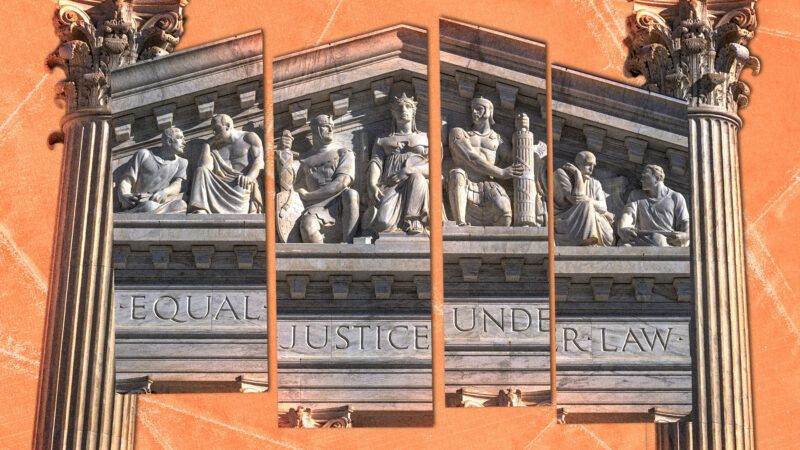
The U.S. Supreme Court's recently concluded 2025–2026 term will go down in the books as a banner one for executive power. Not only did the Court abolish a New Deal-era precedent that blocked the president from firing "independent" federal agency heads at will, but the Court also recognized broad executive discretion over immigration policy and border control. At the same time, however, President Donald Trump lost big in the two blockbuster cases that clearly meant the most to him: tariffs and birthright citizenship.
What should we make of this momentous SCOTUS term? And what should we expect going forward? Here are four key takeaways.
You’re reading Injustice System from Damon Root and Reason. Get more of Damon’s commentary on constitutional law and American history.
1. Executive Power Will Grow
The Supreme Court's decision to let Trump fire Rebecca Slaughter from her position as a commissioner of the Federal Trade Commission for purely political reasons is an immediate win for Trump and an even bigger long-term victory for the executive branch. That's because every president who follows will now do what Trump has just been permitted to do under Trump v. Slaughter: namely, remove the current heads of "independent" federal agencies at will and replace them with his own preferred picks.
We had a preview of this dynamic back in 2021. One of the first things that President Joe Biden did after assuming office was to oust the Trump-appointed head of the Consumer Financial Protection Bureau (CFPB). Biden was able to do this because of the Supreme Court's 2020 decision in Seila Law v. Consumer Financial Protection Bureau, which said that it was unconstitutional to stop the president from firing the CFPB director at will. Seila Law was widely described as a conservative legal victory when it was decided during Trump's first term. But even with the case's conservative pedigree, Biden still had no hesitation about reaping its benefits to advance his own presidential agenda.
Expect to see much more of that in the years ahead as presidents from both parties take advantage of the Slaughter ruling to remake the federal bureaucracy in their own respective images.
2. A Conservative Court but Not a MAGA Court
The current Supreme Court majority is undoubtedly a very conservative one. This is a Court that just narrowed the reach of the Voting Rights Act in Louisiana v. Callais; further expanded the scope of the Second Amendment's right to keep and bear arms in Wolford v. Lopez; affirmed sweeping immigration crackdowns by the executive branch in Mullin v. Doe and Mullin v. Al Otro Lado; and upheld state bans on transgender athletes competing in girls' and women's sports in West Virginia v. B.P.J.—all decisions that have been widely celebrated by the broader conservative movement.
But Trump and his hardcore MAGA supporters have been somewhat less than pleased, to say the least, because the two signature policies of Trump's second term went down to resounding legal defeat at the hands of SCOTUS. On tariffs, Trump lost 6–3 in Learning Resources v. Trump, with two of the president's own judicial appointees ruling against him. Then, on birthright citizenship, Trump lost again, even after he took the unprecedented step of attending the Trump v. Barbara oral arguments in person as a sitting president. In fact, Trump is apparently so upset about losing Barbara that he is now calling for a do-over, which is something that the Supreme Court almost never agrees to do. The political sparring over birthright citizenship will likely continue, but the constitutional battle is now over for Trump.
Liberal and progressive critics of the current Supreme Court sometimes call it the "Trump Court." But if this really was the Trump Court, rather than the Court led (mostly) by Chief Justice John Roberts, why didn't Trump win the two cases that he clearly wanted most desperately to win?
Likewise, if it were the Trump Court, why did the Republican-led challenge to mail-in voting, another Trump priority, fail to succeed? In Watson v. Republican National Committee, Justice Amy Coney Barrett, a Trump appointee, led the Supreme Court in upholding a state voting system that allows the counting of mail-in ballots that were mailed by election day but not received until after election day. A Trump Court would surely have ruled differently on that one.
The same holds for Trump v. Cook, the case arising from the president's efforts to remove Lisa Cook from her position as a member of the Federal Reserve's Board of Governors. While the Court recognized broad presidential control over all other "independent" federal agencies in Slaughter, the Court in Cook took the opposite line and ruled against Trump's attempted firing of the Federal Reserve official. "We cannot accept the Government's contentions in this case," wrote Roberts. "To do so would allow the President to remove a member of the Federal Reserve at any time, for any reason, without any notice before, and without any judicial check after. That would turn for-cause protection into little more than at-will employment."
The fact that Trump lost these important cases is a reminder that Trumpism and legal conservatism need not be synonymous.
3. Thomas, Alito, and Kavanaugh Flunked the Test
Speaking of Trump losing on his signature issue of tariffs, that brings us to the actions of Justices Clarence Thomas, Samuel Alito, and Brett Kavanaugh. One of the big questions going into the tariffs case was whether the Court's conservative majority would let Trump get away with the kind of executive overreach that it previously stopped Biden from getting away with. In other words, it was a consistency test for the Court's conservatives. Thomas, Alito, and Kavanaugh flunked that test.
In Biden v. Nebraska (2023), Thomas, Alito, and Kavanaugh joined the chief justice in finding Biden guilty of wielding legislative power that Congress never properly delegated to him. Yet when Roberts likewise found Trump guilty of wielding tariff-making power that Congress never properly delegated to him, Thomas, Alito, and Kavanaugh all dissented, leading Justice Neil Gorsuch to blast them for their inconsistency in the spirited solo concurrence that he wrote.
All told, it was a rather poor showing from Thomas, Alito, and Kavanaugh.
4. A Mixed Bag for Civil Liberties
The Supreme Court has a long record of sending libertarians into apoplectic fits. This term offered a few more amenable results. One of them was Chatrie v. United States, in which the Court held that a "geofence warrant," a tool that allows law enforcement to access the location data of millions of cell phone users, counts as a search for the purposes of the Fourth Amendment and its famous warrant requirement and prohibition on unreasonable searches and seizures.
Then there was United States v. Hemani, which found the federal prosecution of a marijuana user for possessing a gun to be in violation of that man's Second Amendment rights. This case hit a sort of libertarian trifecta: It was pro-pot, pro-gun, and a big fat loss for the government.
At the same time, however, there were more discouraging results in another key case. That was Landor v. Louisiana Department of Corrections, in which the Court drastically limited the ability of prisoners to sue prison officials for religious liberty violations. Landor also stands as the latest example of the Supreme Court's regrettable trend of providing nearly impenetrable legal shields for rights-violating state and federal officers.
What's Next?
Executive power was the overriding theme of the Supreme Court's recently wrapped term. It is also at the center of the biggest questions going forward.
Thanks to Trump v. Slaughter, the so-called "administrative state" is now—with the notable exception of the Federal Reserve—effectively under direct presidential control. That's a lot of power for a single elected official to possess. Furthermore, it's worth remembering that these federal agencies do not just exercise traditional executive authority (such as enforcing the law); they also exercise significant lawmaking authority that has been delegated to them over the years by Congress. This means that the president now holds that lawmaking power in his hands too.
Does that raise any new constitutional problems? At least one member of the Supreme Court clearly thinks it does. In Slaughter, Gorsuch wrote separately to voice his concerns about the vast powers that he had just joined the Court in handing off to the president. "Would Congress have delegated so much power, including legislative and judicial power, to independent agencies had it known that the President would come to control them?" Gorsuch asked. "How will Congress respond now—if realistically it can? And what, if anything, will this Court do about it?"
It's possible that Congress will now seek to claw back some of the powers that it delegated away to the Federal Trade Commission and various other agencies. However, any new federal law that revokes or limits an agency's authority must be signed into law by the president. And just how many presidents will be willing to voluntarily surrender such authority just because Congress has now decided that it wants it back?
And what about the courts? What role will the judicial branch play in resolving these new constitutional problems? Gorsuch obviously wants the Supreme Court to play a more aggressive role in shrinking the administrative state within its new presidential home. But how many of his conservative colleagues will be willing to join him?
The answers to such questions, if or when we finally get them, may further reshape our constitutional order in the years to come.




