

'Government Totally Annihilated': How Americans Governed Themselves as British Rule Crumbled
America in the mid-1770s was a jumble of spontaneous formations amid the ruins of an empire.
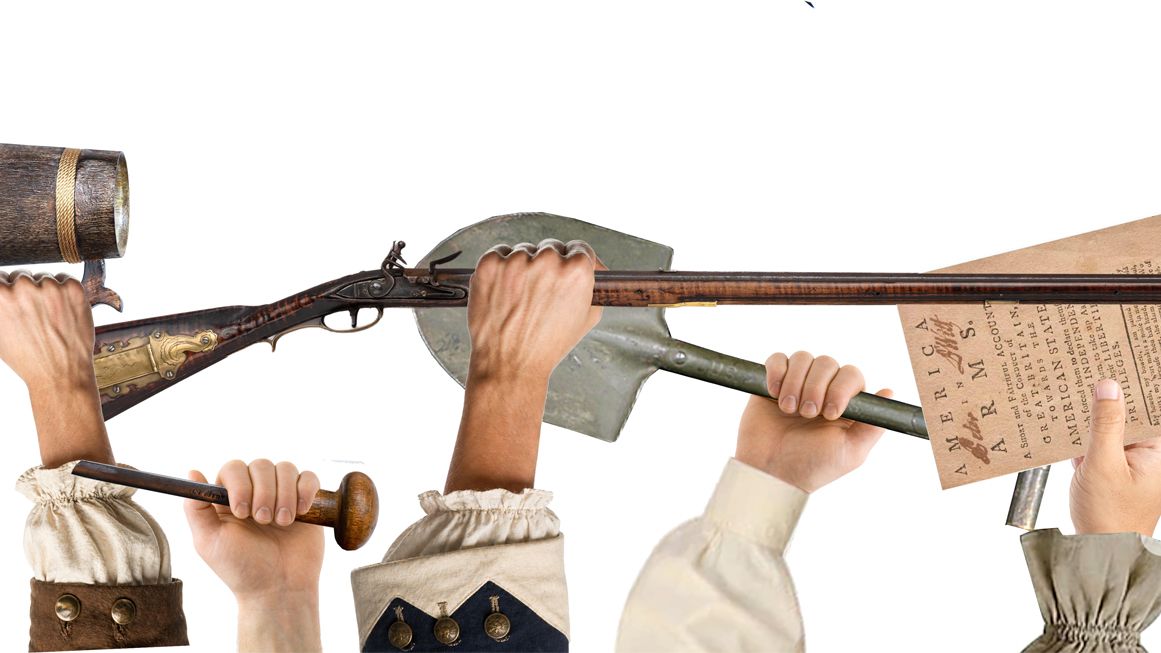
In a special America 250 issue, Reason takes a look back at our country's founding people and ideas. Read more here.

"For upwards of two years from the commencement of the American War, and to a longer period in several of the American States, there were no established forms of government," Tom Paine declared in The Rights of Man. "The old governments had been abolished, and the country was too much occupied in defence to employ its attention in establishing new governments; yet during this interval order and harmony were preserved as inviolate as in any country in Europe."
Well, sort of. It wasn't a period of no governing structures so much as a time when different structures competed for Americans' loyalty. From 1774 through 1776, the old colonial regimes shriveled away. What replaced them was not, to yank a phrase from its original context, what the conservative historian Forrest McDonald sardonically called "the taxless, shiftless Utopia which most Americans cherished as a secret dream, and for which 'republicanism' and 'unalienable rights' were merely euphemisms." Nor were new states formed instantly. Instead, vigorously active associations emerged from below.
Pieces of the previous governments held on, surviving by shifting their loyalty to the new order. (In Georgia in 1775, rebels surrounded a fort and compelled the king's rangers to surrender—but soon asked them to assume their posts again, working now for the revolutionary Council of Safety.) The rest of the old authorities found themselves facing a population that was increasingly unwilling to obey them, taking their cues instead from institutions jerry-rigged by improvising insurgents.
Georgia's royal governor summed up the results in a letter sent in September 1775. "Government totally Annihilated," he reported. In its place, "Congresses, Councils and Committees" were assuming the old Leviathan's functions.
Those grassroots groups stood somewhere on the spectrum between a state and something less rigid and more voluntary. First they coexisted with the prior regimes, and then they displaced them. Gene Sharp, one of the great theorists of civic resistance, described such situations as moments of "dual sovereignty and parallel government." While these alternative institutions might sometimes act violently, he argued in The Politics of Nonviolent Action, their success "depends almost entirely on the voluntary withdrawal of authority, support and obedience from the old regime and their award to the new body."
Consider the Continental Association, a charter adopted at the First Continental Congress to enact a boycott of British goods. (It also featured several other measures meant to foster unity during the crisis, including an effort to discourage plays, cockfights, "the giving of scarves at funerals," and any other "species of extravagance and dissipation.") The Continental Congress would eventually evolve into a government, but when it first met in 1774 it saw itself as a group of English subjects protesting policies they disliked. Its purpose was to overturn laws imposed from London, not to create a legal apparatus of its own. It certainly didn't have the standard tools of a government at its disposal.
"The Continental Association lacked the machinery of a state and therefore the capacity to enforce laws as a state does, by jail, fines, and the like," the sociologist Ronald McCarthy reported in Before Lexington, a book he edited with Sharp and two other scholars. But even without that machinery, the Association's advocates could pressure people into compliance. They could boycott, denounce, ostracize, and, if the locals were rowdy and the circumstances seemed right, assemble an intimidating crowd, perhaps with a tar pot and some feathers.
They organized this activity from the ground up. The First Continental Congress asked Americans to form groups to enact its agenda, but it did not establish or direct those groups itself. It didn't even offer a blueprint for how to constitute them, suggesting merely that "those who are qualified to vote for representatives in the legislature" select the bodies. Hundreds of councils promptly appeared, taking different shapes in different places, and they quickly started burrowing into Britain's edifice of authority.
The Loyalists recoiled. "A Committee has been chosen in every County," fretted Virginia's final royal governor—John Murray, Fourth Earl of Dunmore—in a letter to London. Each committee, he complained, "assumes an authority to inspect the books, invoices, and all other secrets of the trade and correspondence of Merchants; to watch the conduct of every inhabitant, without distinction, and to send for all such as come under their suspicion into their presence; to interrogate them respecting all matters which, at their pleasure, they think fit objects of their inquiry; and to stigmatize, as they term it, such as they find transgressing what they are now hardy enough to call the Laws of the Congress."
In each county, Dunmore added, the rebels were "now arming a Company of men, whom they call an Independent Company, for the avowed purpose of protecting their Committees, and to be employed against Government, if occasion require. The Committee of one County has proceeded so far as to swear the men of their Independent Company, to execute all orders which shall be given them from the Committee of their County." These rebellious companies and committees "have set themselves up superiour to all other authority, under the auspices of their Congress, the Laws of which they talk of in a style of respect, and treat with marks of reverence, which they never bestowed on their legal Government."
Over the course of 1775, those dissident Virginia formations attracted enough support that Dunmore fled the capital and tried running his rump regime from a British warship. By July 1776, a full-fledged revolutionary government was in place, with Patrick Henry as governor, and Dunmore was on his way back to England's imperial bosom.
The process was even more pronounced in New England, where Americans were already accustomed to governing themselves in town meetings. Indeed, one of the blows that prompted the Revolution was the Massachusetts Government Act of 1774, which basically stripped away the colonists' right to self-government. The law gave the royal governor vast new powers, including the right to prevent towns from meeting and the right to appoint judges and other officials who had previously been elected.
Or that's what the law was supposed to do. Out in the countryside, the freeholders of Massachusetts simply refused to recognize the revamped government. "Starting in August 1774," the historian Ray Raphael wrote in The First American Revolution, "each time a court was slated to meet under British authority in some Massachusetts town, great numbers of angry citizens made sure it did not." By October, "all Crown-appointed officials had been forced to disavow British authority or flee to Boston, which was still under military protection."
The leaders of the colony's rural militias resigned their official posts with the colonial government, but they and the militias kept training. Towns kept holding meetings, assembling to govern themselves without permission from the governor. A new Massachusetts Provincial Congress persuaded many towns to send it the taxes that were supposed to be directed to the Brits. "The provincial congress, of course, had no power to enforce this command," McCarthy noted, "and its validity depended completely upon the recognition by the towns of its legitimacy." (Some towns opted just to keep their taxes for themselves.)
Parallel events played out across the colonies. "In the fall and winter of 1774–75," McCarthy wrote, "these bodies quickly adopted more and more of the functions previously performed by the legislatures, executive officials, magistrates, and courts of the crown regime." They settled disputes, enforced rules, and became forums for debate.
Institutions emerged in the social spaces between the colonies as well as within them. The revolutionaries built underground alternatives to the authorities' postal service, for example, allowing insurrectionists to correspond without officials intercepting their letters. The United States Post Office itself was not a government agency when the Continental Congress established it in 1775; it was an independent alternative for surveillance-conscious subversives. When Congress became the ruling body of a new national government, the post office became a socialized delivery service. But in the beginning, it was something else.
These new bodies sprouting across the colonies were more open to popular participation than their predecessors. "Thousands of Americans who had never before held office—indeed, who never even imagined that it was their right to do so—flooded into positions of leadership," wrote the historian T.H. Breen in American Insurgents, American Patriots. Some committees were more open than others, and plenty of old social hierarchies survived. But the aristocracy was cracking, and a more fluid political order was appearing in its place.
By their nature, these grassroots projects relied heavily on voluntary cooperation. But not always. As the rebellion rolled on and the councils turned from enacting the decisions of the Continental Association to running the war effort, they became engines of a crackdown on those deemed British sympathizers, a group that included not just actual Tories but neutralists, pacifists, and the occasional unpopular neighbor. Revolutionaries opened mail, issued fines, confiscated property, burned Loyalist literature, demanded loyalty oaths, and alternated between banishing alleged Tories and restricting their movement. The new state governments backed and often commanded these activities, but the extralegal councils and committees did the bulk of the work. They became more violent, more intrusive, more censorial, more willing to use the jailhouses of the old regime.
Even the most enthusiastic fans of the revolutionary councils usually shake their heads at this repression. The libertarian theorist Murray Rothbard was effusive about the other activities of the Continental Association's enforcers, hailing how they had depended mostly on social pressure and voluntary action. "Never before in history," he argued in Conceived in Liberty, "had so much reliance been placed on such nonviolent methods of mass struggle as the boycott, and on such libertarian and nonviolent means of enforcing the boycott as secondary boycotts, social ostracism, blacklists, and public obloquy." But when it came to persecuting Tories, he wrote regretfully, the committees' zeal took them "beyond the bounds of libertarian principle."
Yet even here, adopting practices that were far too repressive by the standards of any sensible civil libertarian, the committees were much milder than the roughly comparable councils found elsewhere. In North Carolina, for example, the revolutionary congress explicitly instructed the local committees not to inflict physical punishments, a reaction against the stocks and whipping posts of the old government. Thousands of Tories fled the colonies, but barely a handful were killed. "Instead of executing enemies wholesale," Breen writes, "the committees tried to shame them into giving public confessions. These proceedings took on a ritual quality in which terror and humiliation were aimed at converting dissenters. The bark was generally worse than the bite."
Across the ocean, not that many years later, thousands of Frenchmen would literally lose their heads for ideological transgressions. In America, they were more likely just to be canceled. By revolutionary standards, that might almost qualify as tolerant and voluntarist.
After two years, as Paine said, new governments had taken control in most of the colonies, and the Second Continental Congress was evolving into a national authority. Congress was raising an army and issuing paper money to pay for it; the states were experimenting with price controls, conscription, and other intrusive powers. But as long as the war was underway, the committees and councils stuck around, with greater or lesser degrees of autonomy depending on where they were.
So there was truth to Paine's portrait, but he painted it with broad strokes. America in the mid-1770s was a jumble of spontaneous formations amid the ruins of an empire, a mix of anarchistic autonomous local groups, fledgling shoots of a new regime, and old British structures that would soon either crumble or persist with a paint job. From this patchwork emerged the United States we know today. But that took a while, and things could be lively in the meantime.
This article originally appeared in print under the headline "'Government Totally Annihilated'."




