
Maine Lobsterman Asks the Supreme Court To Strike Down a Rule Allowing the Government To Track His Boat 24/7
The case could give the Court a chance to clarify what a "closely regulated" business is and what constitutional protections it enjoys.
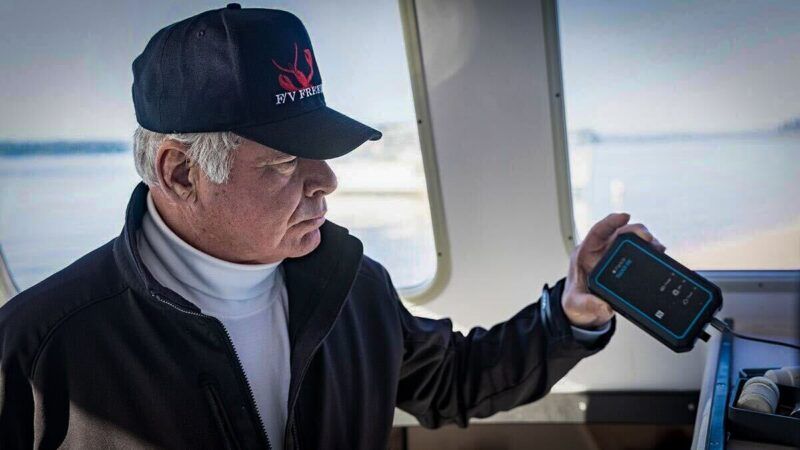
In March 2022, a rule was finalized requiring all federally permitted lobster vessels in 10 East Coast states to install GPS tracking. Now one lobsterman is asking the Supreme Court to overturn the regulation.
Last week, Frank Thompson, a fifth-generation Maine lobsterman, filed a petition to the Supreme Court challenging a rule set by the Atlantic States Marine Fisheries Commission (ASMFC). This rule required lobstermen to install a GPS device on their boats, which tracks and sends locations on a minute-by-minute basis to government agencies—even when the boat is being used recreationally. The systems—which are Bluetooth compatible and can collect audio—also record and update the boat's location every six hours when it is docked or moored. Failing to comply with the rule could lead to fines, forfeiture of fishing licenses, jail time, and even a federal moratorium on lobstering in noncompliant states.
The rule was pitched as a way to save lobstermen time. Rather than using written logs, the GPS device would automatically track their day. It was also proposed to better track and reduce the environmental impact of the industry. However, these fishermen are already ecologically conscious because their livelihood depends on it. The industry has received praise from the state's fishing commissioner for being a "model of conservation."
Whatever the motivation, fishermen say the rule violates their constitutional rights. In 2024, Thompson challenged the regulation in federal court, arguing that it violated his Fourth Amendment right to protection against unreasonable search and seizure. Both the district court and appeals court sided with the government, saying that since lobstering was considered a "closely regulated" industry, it did not enjoy the same constitutional protections from warrantless searches that less-regulated businesses enjoy.
But "digital surveillance without a warrant is unconstitutional—regardless of industry," says the Pacific Legal Foundation (PLF), a public-interest law firm that is representing Thompson. "The government cannot exclude licensed professions from the Fourth Amendment's protections and compel lobstermen to submit to government trespass and around-the-clock" federal surveillance.
Beyond the privacy violations, these trackers also raise serious concerns for Thompson's business. Success in lobstering is contingent on knowing the best harvesting locations, which Thompson has learned over the 60 years he's spent on the water. Having to share this information could hurt his competitive advantage. "It is essential that his trip information remain confidential so that he can retain an important business advantage," Thompson's lawyers write in their petition for certiorari to the Court.
And as the rule makes it harder for lobstermen to succeed in business, these same people could soon be paying for the GPS trackers. When Maine's Department of Marine Resources mandated GPS trackers in 2023 to comply with the ASMFC rule, it provided these devices and three years' worth of cellular data at no cost to lobstermen. With the congressional appropriations that paid for trackers running out, lobstermen fear that they will soon have to fund the monitoring program themselves.
While Thompson's legal battle began when Maine implemented the ASMFC's rule, the constitutional creep from regulators has been going on for years. As the PLF notes, federal courts over time have changed the parameters of a closely regulated business. Instead of pertaining to industries that carry "risk to life and limb," like mines and gun shops, they now include pharmacies, day care centers, commercial fisheries, and even jewelers. "By allowing the closely regulated industry exception to apply to an ever-increasing number of businesses, lower courts ignore the narrowness of this exception," the lawyers write. "The result of these lower courts drifting further away from the original meaning of the Fourth Amendment is that business owners' rights against intrusive governmental searches are dependent on where they operate."
Having the lobstering industry deemed "closely regulated" has effectively meant that these fishermen have "less Fourth Amendment protections than criminally-accused defendants do," writes the PLF.
Thompson's case could give the Court a chance to clarify what a closely regulated business is and what Fourth Amendment rights these businesses should have. Still, the likelihood of the Supreme Court hearing this case is small; the Court usually hears less than 2 percent of the cases that are petitioned.
