The Volokh Conspiracy

Mostly law professors | Sometimes contrarian | Often libertarian | Always independent | Est. 2002

The Volokh Conspiracy

Affirmative Action

Rights and Wrongs of Replacing Traditional Affirmative Action with Preferences for Descendants of Slaves

This approach would avoid many of the flaws of traditional racial preferences. But it has some downsides of its own.

|

The Supreme Court recently decided to hear two cases challenging racial preferences in college admissions. While we cannot know for sure, it seems highly likely that the conservative majority on the Supreme Court will take this opportunity to either strike down or severely curtail the dubious "diversity" rationale that it previously used to justify such preferences.

This possibility has stimulated renewed interest in possible alternatives to the use of racial preferences. One possible option is to replace them with preferences for descendants of American slaves. After I published an article in the Boston Globe criticizing the diversity rationale, a reporter for a Boston NPR station contacted me to ask about this alternative. Co-blogger David Bernstein also highlighted this option in a recent blog post, and in his excellent new book Classified: The Untold Story of Racial Classification in America. Georgetown University has already adopted a small-scale version of this policy, by granting admissions preferences to the descendants of slaves owned and sold by the school in the 19th century. This post expands on the answer I gave the reporter.

In my view, replacing race-based affirmative action with preferences for American descendants of slaves ("ADOS," as David Bernstein refers to them) would be a significant improvement over status quo policies. But this approach would also have crucial downsides.

Depending on how it is structured, this policy might well avoid many of the flaws of traditional race-based affirmative action. Most obviously, it would not require the use of racial classifications. This avoids the well-known moral pitfalls of race discrimination.

It would also  likely avoid the legal problems, as well. Unlike race discrimination, preferences based on ADOS status are not presumptively unconstitutional. They probably would only be subject to minimal "rational basis" scrutiny under current Supreme Court precedent, which they would likely easily pass. Preferences for descendants of slaves also would not violate Title VI of the Civil Rights Act of 1964, which bars discrimination "on the ground of race, color, or national origin" in any program receiving federal funds.

In addition, limiting admissions preferences to descendants of slaves would refocus affirmative action on its original purpose of compensating groups that have been victims of massive historic injustices, a much more compelling justification than the badly flawed "diversity" theory. While slavery and the segregation that followed it are far from the only racial injustices in American history, they are by far the biggest. And similar preferences could potentially be extended to descendants of victims of other massive historical wrongs, such as the forcible displacement of many Native Americans from their lands.

But, despite its attractions, giving preferences to descendants of slaves raises several difficult problems of its own.

First, how would we verify whether a given applicant qualifies as a member of the relevant group? If we rely on self-identification, there will be obvious incentives for fraud or deception. But having university officials investigate applicants' ancestry or demand verification thereof also creates problems. In many cases, there might not be reliable records available, going all the way back to the days of slavery. Conducting investigations into the ancestry of applicants is also likely to be costly and intrusive.

Second, there is the closely related issue of how to classify the large number of people of mixed ancestry. Millions of Americans who look "white" and are perceived as such by society have slaves or former slaves in their family trees. If everyone with such ancestry is allowed to qualify for ADOS preferences, it would mean extending it to a large number of applicants whose claim to be victims of racial injustice is, at best, highly tenuous.

On the other hand, if only sufficiently "black" descendants of slaves qualify as true descendants, then we are right back to using racial classifications. Doing so would bring back the very problem the ADOS strategy is intended to solve. In addition, any attempt to determine who is "black enough" to qualify as a "real" descendant of slaves is all too likely to degenerate into subjectivity and bias. The history of such attempts at racial classification is, to put it mildly, not an encouraging one.

Finally, there are also difficult moral and philosophical issues with assuming that anyone who is a descendant of slaves (even if they are "authentically" black) is automatically a victim of injustice himself or herself. Consider an example from my own family history. I am a Russian Jew and descendant of people who suffered from pogroms, the Holocaust, and a variety of other czarist, Nazi, and Soviet injustices. Does that make me a victim of anti-Semitism myself, thereby worthy of compensation of some kind (perhaps from the Russian or German governments)? Maybe. But the issue is highly contestable.

If not for the many injustices perpetrated by various Russian and German regimes, I almost certainly would not have even been born. My grandmother lost nearly all of her family, including her first husband, in World War II; many of them perished in the brutal 900 day siege of Leningrad. If not for these horrific events - the responsibility of Hitler's regime, with an assist from Joseph Stalin and the Nazi-Soviet Pact - she likely would never have married my grandfather (whom she met after the war), nor given birth to my father. Indeed, even a slightly different chain of events from that which actually happened would have prevented me from ever existing. In a perverse, but real, sense I am at least as much a beneficiary of Hitler and Stalin's injustices as I am a victim.

What is true for me is also true for nearly everyone alive today. If not for our horrible history of injustice, hardly any of us would be here - whether we are descendants of slaves, descendants of slaveowners, or descendants of neither.

This consideration is irrelevant to policies that seek to compensate people who are direct victims of unjust policies, as opposed to descendants of such victims. For example, it does not weaken the rationale for compensation payments to actual Holocaust survivors, or the belated and inadequate compensation paid to Japanese-Americans forcibly detained in camps during World War II. But it is a serious issue when we are considering compensation for the descendants of victims of historic wrongs, on the ground that they have been negatively impacted by the long-term effects of those injustices.

Even aside from the possibility that, but for the history of injustice, they wouldn't exist in the first place, it is often difficult to determine where a given individual would be if not for the wrongs suffered by their ancestors. Some descendants of slaves - like some descendants of Holocaust survivors, Japanese-American internees, and other victims of great historic wrongs - are nonetheless affluent and otherwise well-off today. I myself am a relatively wealthy law professor.

Perhaps all these people would be richer and happier still, if not for the awful history endured by their ancestors. But it's very difficult to tell one way or the other.

This last problem could perhaps be addressed by limiting compensatory preferences to relatively poor and disadvantaged members of the relevant group. But it will not be easy to figure out where to draw the line, and not clear that any institution can be trusted to do so objectively.

In sum, replacing traditional affirmative action with preferences limited to descendants of slaves has some important advantages. But any such program would also have to grapple with grave difficulties of its own.

Despite these reservations, I would not legally forbid private universities from trying this. Public ones are, I think, a closer call, though unlike racial preferences, these programs would not be presumptively unconstitutional. Government institutions, I believe, have stronger nondiscrimination obligations than private ones, and thus should have stronger presumptions against any kind of discrimination based on ancestry, which too often cause grave harm, even if not based on race. Indeed, in most situations, discrimination based on parentage and place of birth is unjust for many of the same reasons as racial discrimination is. And even if such policies are legal and not inherently unjust, they should only be enacted if we can come up with at least reasonably good solutions for the problems described above.

It is perhaps worth noting that my concerns about preferences based on ancestry also apply to the "legacy preferences" still used by many selective universities. Unlike ADOS preferences, they cannot even be defended on the grounds that they help remedy historic wrongs. Schools should, therefore, abolish them, as my own undergraduate alma mater, Amherst College recently did.

Defamation

SSRN Removes Academic Paper Due to Defamation Claim

A paper by Professor Ann Lipton has been deplatformed because Philip R. Shawe does not like how it portrays his actions in a business dispute, and now a law review may refuse to publish the piece.

|

[Note: Here is an update on this story.]

Professor Ann Lipton, a noted corporate law scholar at Tulane, has a new paper, "Capital Discrimination," discussing gender discrimination in business disputes. When she completed her draft she posted the article on SSRN and submitted it law reviews, as one does, and received an offer of publication from the Houston Law Review. Then the paper attracted some unfavorable attention.

In December, attorneys for Philip R. Shawe sent a cease-and-desist letter to SSRN, demanding that the paper be removed, alleging that the paper's characterization of and commentary on Shawe's conduct in a nasty business dispute were defamatory. SSRN responded by pulling the paper and, as Professor Lipton recounts, the Houston Law Review informed her that it could not assure her that it would publish the article.

Tulane University is supporting Professor Lipton, and its lawyers have sent their own letter to SSRN seeking that the paper be reposted. As the letter notes, sources for all of the relevant factual claims are cited, largely to the relevant legal proceedings, and Professor Lipton's opinions about those facts and their significance constitute constitutionally protected expressions of opinion.

SSRN has not yet responded to this request. Professor Lipton's article, however, is available here, and now includes a brief comment on the above events. Here is hoping the article attracts even wider readership than it would have before.

When Philosophers Go Bad

|

I've probably paid less attention than I should have to the matter of Matthew Harris, the apparently schizophrenic former UCLA philosophy lecturer whose threats shut down the school for a day a couple of weeks ago. Still, I just came across the FBI agent's affidavit accompanying the criminal complaint against him, and there is quite some stuff there; one of Harris's emails in particular struck me:

u stupid caucasoids n kikes teach ACTUAL NAZIS LIKE HEIDEGGER AND KANT
AND CARNAP (FUCK UCLA)
ALL OF THOSE FUCKING PIECES OF SHIT WHEN THIS NIGGER SAYS HIS OWN PHILOSOPHY
FUCKING GET SHOT THE FUCK UP U CAUCASOID-KIKE FAGGOTS …

Yow.

Guest Post by Adam Schulman on KBJ's Opinion in Ross v. Lockheed Martin

"Ketanji Brown Jackson — protecting the rights of class members; U.W. Clemon — protecting the pocketbook of his plaintiffs’-side law firm"

|

NBC News published a letter that U.W. Clemon, a former federal judge, wrote to President Biden. Clemon urged Biden not to nominate Ketanji Brown Jackson to the Supreme Court in light of her decision in Ross v. Lockheed Martin Corp. In this case, Judge Jackson rejected a proposed class action settlement.

I am happy to share a guest post from Adam Schulman at the Hamilton Lincoln Law Institute, an expert in class-action cases. (For purposes of full disclosure, I have many connections with HLLI, and its predecessor organization, the Center for Class Action Fairness, which represented me).

Ketanji Brown Jackson — protecting the rights of class members; U.W. Clemon — protecting the pocketbook of his plaintiffs'-side law firm

District court judges face hydraulic pressure to clear their dockets by facilitating and approving the settlement of cases. But when they are presented with settlements that propose to settle the claims of thousands or millions of unconsenting class members, district court judges are supposed to shepherd the best interests of those class members. They are supposed to act, in the legal vernacular, as a "fiduciary" for those class members who are not at the bargaining table. They are not supposed to be a rubber stamp of the desires of the plaintiffs' attorneys and the defendants.

As reported by NBC, however, however, last week retired Alabama federal judge U.W. Clemon sent a letter to President Biden urging him not to nominate Judge Ketanji Brown Jackson to the Supreme Court vacancy left in the wake of Justice Breyer's retirement. In his letter Clemon effectively faults Jackson for taking her duty to absent class members too seriously when she rejected the proposed settlement in Ross v. Lockheed Martin Corp., 267 F. Supp. 3d 174 (2017). Clemon is wrong; the proposed settlement in Ross was not "designed to benefit" the employees in the case. To her credit, Jackson discharged her duty to protect class members exactly as the law requires.

Let me explain the various defects of the proposed settlement in Ross that Jackson correctly identified in her opinion denying settlement approval.

  • The proposed notice to class members did not provide any "sense of how giving particular answers on the claim form [would] likely influence the amount of a class member's recovery."
  • If class members did not complete the "extensive" claim form, they would lose their right to sue yet "would become ineligible to recover any compensation from the settlement fund."
  • There was a "gross imbalance" between the claims actually at issue in the case and the claims released under the proposed settlement. In other words, the settlement asked the employees to give up more than the law permitted.
  • Lockheed Martin would have been legally immunized from misconduct that occurred after the class members were given a chance to exit the settlement.
  • The proposed class was not cohesive because the discrimination, if any, against the employees was individualized and differed person to person.
  • The settling parties had not fully evaluated the class members' claims; indeed, they wanted to settle within a few months of filing suit.

Each of these legal conclusions is nigh indisputable under the operative law. Of course, Ross is just a sample size of one case and one settlement, but it portends well for Judge Jackson's view of the rule of law. For it is far too common for district court judges to succumb to the wishes of the settling parties against the best interests of class members whose claims are actually at stake. My organization, the Hamilton Lincoln Law Institute and its Center for Class Action Fairness, have been fighting similar abuses for years.

Conversely, retired Judge Clemon's letter makes one wonder whether class members whose claims were discharged in his court received the due consideration that they were owed. However cynical, it is more likely Clemon's objection is simply sour grapes, because he himself is counsel at the plaintiff-side firm who was lead counsel in Ross and negotiated the very settlement was denied approval by Judge Jackson. He joined there six months before Judge Jackson rejected their flawed settlement.  Clemon's letter to Biden neglects to mention that small detail—the decision Clemon bemoans just so happened to cost his firm more than $6 million.

I find it very problematic that Clemon did not disclose that his firm was on the losing end of Jackson's ruling. There is a blatant conflict of interest here. But this episode does show that the knives are out for Jackson, the presumptive front-runner. The next few weeks will get ugly.

Funny Oral Argument Moments

|

In my Persuasion class, we started with clips from oral arguments, and one was the famous "orthogonal" exchange, at 21:54 in Briscoe v. Virginia (2010)—instructive, but also a bit amusing.

A student asked if I could recommend some other funny exchanges, or perhaps exchanges that the participants thought were funning, whether from the Supreme Court or any other court. None came to my mind, but I thought I'd ask you folks, especially since I expect others would like to see some such examples. Please post suggestions in the comments, and please, if possible, include links to oral argument audio or video, if that's available.

Religion and the Law

Mormon Missionary Training, Insufficiently Feminine Haircuts, and the First Amendment

|

From Markowski v. BYU, decided yesterday by Judge Jill Parrish (D. Utah):

The Church of Jesus Christ of Latter-day Saints ("the Church") is a religious organization with its headquarters in Utah. One of the Church's "most recognized characteristics" is its missionary program. Church members, typically under the age of twenty-five, can serve a mission for eighteen to twenty-four months, during which they share the teachings of Jesus Christ and the Church. Prior to beginning their mission, future missionaries spend a short period of time at a Missionary Training Center to learn how to effectively teach Church doctrine.

BYU is a university "founded, supported, and guided by The Church of Jesus Christ of Latter-day Saints." BYU's mission includes "making its resources available to the Church when called upon to do so." As part of this mission, BYU operates a Missionary Training Center ("MTC") in Provo, Utah. The MTC employs many BYU students who assist in preparing missionaries for their missions.

On November 6, 2017, BYU hired Plaintiff Ashtin Markowski ("Markowski") as a trainer at the MTC's Online Teaching Center. Markowski trained full-time missionaries in how to respond to online inquiries about the Church and how to use their social media to have discussions with people interested in learning more about the Church. Markowski also piloted new online engagement projects.

All MTC employees, including Markowski, must comply with the Church's Missionary Dress and Grooming Standards. On April 3, 2020, Markowski cut her hair short. Six weeks later, Markowski's supervisors informed her that they considered her haircut to be extreme and distracting. Her supervisors informed her that her haircut was "not feminine enough" and "was too masculine." They also complained that her eyebrows were "too firm." Markowski indicated that she did not want her haircut to jeopardize her ability to work at the MTC and agreed to grow her hair out. The next day, Markowski's supervisors fired her….

Read More

Free Speech

Injunctions Against Allegedly Libelous Commercial Advertising Under Texas Law

|

From Judge George Hanks Jr.'s decision two weeks ago in Easyknock, Inc. v. Feldman & Feldman, P.C. (S.D. Tex.):

Easy Knock operates an alleged "sale-leaseback" business whereby Texas homeowners deed their homesteads over to Easy Knock in exchange for payment of a percentage of the appraised value of their home, the entry of an agreement to lease back the homestead property, and an option to buy back the entire deed to their homes. Defendant Feldman & Feldman P.C., a law firm, posted eight statements on its website discussing Easy Knock's business practices of alleged predatory pricing. Easy Knock has now sued Defendants Feldman & Feldman P.C. and certain of its attorneys (collectively "Feldman & Feldman") under Texas law for defamation and tortious interference…. Prior to an adjudication that the statements are in fact defamatory or otherwise unlawful, Easy Knock has applied to the Court for injunctive relief in the form of a temporary restraining order against Feldman & Feldman….

A judicial order forbidding future statements before they occur constitutes a prior restraint on speech and Texas courts have long held that such orders are presumed to violate the Texas Constitution. Likewise, prior to an adjudication that the statements are defamatory or otherwise unlawful, a judicial order requiring the retraction or removal of the statements from a website is also presumed to violate the Texas Constitution.

{In comparison, after an adjudication that the statements are defamatory such injunctive relief is available and does not violate the Texas Constitution. This is true because at this stage of the litigation the speech is no longer protected. As Texas courts have explained: "If a plaintiff prevails in a defamation claim based on statements the defendant posted on the internet, the court can order the defendant to delete the defamatory matter and ask third-party republishers to do the same. This remedy is available because it constitutes the erasure of past speech that has already been found to be unprotected in the context in which it was made."}

Read More

Qualified Immunity

Assessing the State of the Struggle to Reform Qualified Immunity

The Institute for Justice offers a generally pessimistic appraisal of the situation under state law, but some optimism about prospects in the Supreme Court.

|

In the aftermath of the killing of George Floyd by Minnesota police officer and resulting nationwide protests in 2020, many hoped that these tragic events would generate political momentum for abolishing or at least severely curtailing qualified immunity, the judicially created legal doctrine that shields law enforcement officers and other government officials from most liability for violating constitutional rights. Sadly, after some initial success, reform efforts seem to have largely stalled at the state level, and the Supreme Court has recently signaled it may be unwilling to pursue more than a very modest revamping of the doctrine.

Qualified immunity exempts government officials from most civil liability for violations of constitutional rights unless there is "clearly established" precedent  indicating that what they did was illegal. All too often, courts interpret "clearly established" so narrowly that officers routinely get away with horrendous abuses merely because no federal court in their area has previously decided a case with essentially identical facts. The doctrine has been severely criticized by leading legal scholars, such as Joanna Schwartz, and co-blogger Will Baude.

The Institute for Justice (IJ), a public interest law firm that has helped lead the fight to abolish QI, recently put out two notable publications assessing the state of QI reform. Both are must-reads for those who follow this issue. The first, 50 Shades of Government Immunity, by Kendall Morton and Megan Cairns, provides an overview of the state of official liability for rights violations in all 50 states, as well as the District of Columbia and various US territories. The second, an article by IJ attorneys Patrick Jaicomo and Anya Bidwell, is an analysis of recent Supreme Court precedents relevant to QI and what they portend for the future. Jaicomo and Bidwell are much more optimistic about the Supreme Court than Morton and Cairns are about the states.

50 Shades of Government makes for grim reading. Of the 56 jurisdictions rated (50 states, DC, Puerto Rico, and several territories), only three (New Mexico, California, and New Jersey) have grades in the A or B range on the authors' A to F scale. New Mexico's "A-" is the only grade in the A range; California and New Jersey each get a B-. By contrast, there are numerous Ds and Fs.

Even Colorado and Connecticut, states which enacted important reform laws in the wake of George Floyd protests, get mediocre grades (C+ for Colorado, and C for Connecticut).  The low scores are in part due to the fact that Morton and Cairns are tough graders. For example, Colorado gets only  a C+ in large part because its otherwise strong reform law only applies to law enforcement officers, not other state officials.

Despite being a state employee myself (a state university professor), I agree with the authors that QI and similar state-level doctrines should be abolished for all government officials; yes, including me! But law enforcement officers are particularly important, because few other officials literally wield the power of life and death over citizens, or have the ability to arrest and detain them.

The authors may also dock Colorado and some other states more than they should for allowing lawsuits only under state civil rights statutes, rather than directly under the state constitution. If a victim of official abuse can get the compensation she deserves, I'm not sure it matters greatly whether it is under a statute or through the state constitution directly. That's especially true in the many states where the distinction between constitutional and statutory law is much weaker than at the federal level, because their constitutions are relatively easy to amend. Thus, I think Colorado probably deserves a higher grade. The same can be said for a few other states.

Despite such caveats, Morton and Cairns are right to emphasize the severe flaws in the status quo in most jurisdictions. Much work remains to be done. In a previous post, I offered some reasons why reforms have stalled, and made tentative suggestions on how to regain momentum.

Jaicomo and Bidwell's analysis of the Supreme Court is much more optimistic. They go over several Supreme Court rulings in late 2020 and early 2021 that indicate the Justices are willing to curb QI. My own view is that these rulings are more ambiguous than Jiacomo and Bidwell suggest, and may be compatible with a scenario where a majority of the justices merely want to curb the more extreme abuses of QI, rather than end the doctrine altogether, or even severely restrict it. But Jiacomo and Bidwell make a strong case for their more positive assessment.

If their article has a weakness, it is the seeming dismissal of two recent Supreme Court decisions that appear to put the brakes on QI reform. These rulings have led other commentators, including myself, to become more pessimistic (see also analyses by Billy Binion and Mark Joseph Stern). Jiacomo and Bidwell contend too much has been made of these cases, because they represent "an unexceptional continuation of the Supreme Court's general deference toward government defendants in its application of the clearly established test, especially in cases involving excessive force claims against law enforcement officers." 

It could be that the Court still wants to curb QI in other settings. But "general deference toward government defendants in [the] application of the clearly established test" is the single biggest flaw in QI doctrine. If the Court is unwilling to seriously cut back on that, it's a sign the justices aren't willing to do much about QI more generally, other than curb some of the more extreme abuses. Even if judicial deference is going to be limited to excessive force claims against law enforcement officers, that category is itself an important issue, as it includes many of the most egregious cases.

That said, I think the jury is still out on the Court's ultimate intentions here. Even the justices themselves may not be certain about what they intend to do (or at least not the swing voters on this issue). As I have noted before, the unusual alliance of Clarence Thomas on the right and Sonia Sotomayor on the left does want to severely constrain QI. perhaps they will yet win over enough of their colleagues to make it happen. The imminent replacement of Justice Stephen Breyer (a relatively pro-law enforcement liberal) with a new justice who might have other views, could also help.

Overall, I take a slightly more optimistic view of state-level trends than Morton and Cairns, and a considerably more pessimistic view of the Supreme Court than Jiacomo and Bidwell. But there is a lot of uncertainty here, especially with regards to the Court. I could be wrong about the justices, and I hope that I am. In the meantime, both these works are valuable contributions to the public debate over qualified immunity reform.

NOTE: I have worked with IJ on a variety of issues over the years, but have not been involved in its QI reform and litigation efforts.


Crime

Maryland Rifle Ban in the Supreme Court

Professors' and think tanks' amicus brief urges Court to grant certiorari

|

Today I filed an amicus brief in support of a cert. petition challenging Maryland's ban on various semiautomatic rifles. The case is Bianchi v. Frosh, and was brought by the Firearms Policy Coalition, the Second Amendment Foundation, and individual plaintiffs. Petitioners are represented by the D.C. powerhouse litigation boutique Cooper & Kirk. (Docket page here, Petition here.)

Maryland Attorney General Frosh initially waived his right to file a response to the petition, but on January 14 the Supreme Court called for a response. The Court granted Frosh (and consequently his amici) an extension of time for the response, which is due March 14.

My brief, co-written with several other lawyers, including University of Wyoming law professor George Mocsary, is on behalf of a dozen professors of Second Amendment law, including the VC's Randy Barnett. It is also on behalf of the Independence Institute (the Denver think tank where I work), the John Locke Foundation (a North Carolina think tank), the Cato Institute, and the Center to Keep and Bear Arms (a project of the Mountain States Legal Foundation).

Led by Arizona and West Virginia, twenty-five state Attorneys General have filed an amicus brief in support of the petition. They argue that cert. should be granted because:

  1. Many lower courts have narrowed Heller from below.

  2. Failure to grant review would tempt Congress to enact a national ban, over-riding the policy choices of 43 states.

  3. The Fourth Circuit's novel rule that governments can ban all firearms that are supposedly "like" military arms is based on an egregious misreading of one phrase from Heller. The Fourth Circuit rule would uphold a ban on many common firearms, such as the ubiquitous Colt 1911 .45 caliber pistol, and every semiautomatic pistol that is essentially similar to the Colt, which is to say all of them.

  4. The Maryland ban harms public safety because the rifles that it singles out for prohibition are easier to fire accurately, easier to store safely, and often superior for lawful self-defense. To say that improved firearms can be banned because criminals might take advantage of the improvements would be to say that firearms can never be improved.

Any other amicus briefs in support of the cert. petition will be due on Monday, Feb. 14. There is sometimes a lag between when a brief is filed and when it appears on the Court's docket page.

Here is the Summary of Argument from my brief:

Circuit court decisions upholding rifle bans like those in this case rely on untenable reasoning. The Fourth Circuit's rule, at issue here, would authorize prohibiting the most common arms of the colonial and Founding periods: the all-in-one American long gun that was made for hunting, personal defense, and militia use.

The Seventh Circuit purported to favor arms like those of the Founding Era. Yet the court upheld a ban on self-loading firearms, a type that preceded the Second Amendment by a century-and-a-half.

The Second Circuit employed an especially unfavorable version of intermediate scrutiny that considers only the government's evidence, and that does not consider less restrictive alternatives. The First Circuit second-guessed law-abiding citizens' personal choices of common defensive arms.

All four of this Court's Second Amendment precedents on arms bans—Heller, McDonald, Caetano, and Miller—eschewed means-ends balancing. This Court's approach has always been categorial.

The rifles at issue here are "in common use," as lower courts have acknowledged. "Common use" is not determined by how often a gun is fired in self-defense. "Common use" encompasses all lawful uses, including hunting and self-defense. Arms bans do not become constitutional if they slice protected classes of arms into smaller subclasses. Dick Heller's 9-shot .22 caliber revolver was not particularly common, but handguns are very common.


Short Circuit: A Roundup of Recent Federal Court Decisions

Spoiled food, thugs with badges, and strip searches in school.

|

Please enjoy the latest edition of Short Circuit, a weekly feature from the Institute for Justice.

New on the Short Circuit podcast: With neither Congress nor the Supreme Court moving the needle on qualified immunity reform, these days all the action is in state legislatures. Special guest Alex Reinert of Cardozo Law joins the show to talk about civil rights enforcement under state law.

  • An alleged sensitivity to radio waves can give (some of) these plaintiffs standing to challenge an FCC regulation governing placement of radio antennas, says the D.C. Circuit, which means we have jurisdiction to say their arguments are bad and wrong and lose.
  • In January, a district court in Texas issued a nationwide preliminary injunction against Executive Order No. 14043, which directs federal agencies to require their employees to be immunized against COVID-19. The government moved for a stay pending appeal. Fifth Circuit (motions panel): We'll just let the merits panel decide whether they want to act on that. Dissent: We should stay the entire injunction; at an absolute minimum, we should stay it as to people who aren't plaintiffs or members of plaintiff organizations.
  • "Fuck the Police," "fucking thugs with badges," "six bitch ass fucking pigs." Indelicate phrasing? Quite possibly. But constitutionally protected speech? Very clearly. So no qualified immunity for the cops who arrested a potty-mouthed Ohio fairgoer, holds the Sixth Circuit. The case goes to trial. [Ed.: We would've hyphenated "bitch ass," but reasonable minds can differ.]
  • Kentucky man kidnaps his two-year-old daughter from custodial grandparents. When confronted by police did he fight back with "super-human" strength and charge one of the officers, leading police to shoot and kill him? Or did police brutally beat him before shooting him unnecessarily? Sixth Circuit: Most of the witnesses say the former, but there's one who says the latter, and that's enough to take this to a jury.
  • Ben Kramer almost certainly had a more adventurous 1980s than you did. That decade saw him become: a national champion in offshore powerboat racing; a drug kingpin who imported some 500k pounds of marijuana via barges, freighters, and container ships; a murderer of his former idol (the millionaire inventor of the Cigarette speedboat and pal of GHW Bush); and an inmate serving a life sentence made famous by his failed helicopter-escape attempt. (If you had a wilder decade, pray tell.) As part of his convictions, the courts ordered him to forfeit $110 mil and then work to satisfy the judgments. Kramer: You took too much, give it back. Seventh Circuit: No.
  • Sufficiency-of-the-evidence challenges to a criminal conviction are notoriously hard to win. But not impossible, as shown by a California man who persuaded a unanimous Ninth Circuit panel to vacate his convictions for drug-dealing-related crimes. The evidence certainly showed that the man was addicted to methamphetamine, the panel concludes, but not that he had anything to do with selling it.
  • SCOTUS-watchers of 2020 may recall United States v. Sineneng-Smith—where the Supreme Court (sua sponte) admonished the Ninth Circuit for sua sponte holding overbroad the federal statute that makes it a crime to encourage aliens to stay in the U.S. illegally for purposes of financial gain. Ninth Circuit (2022): Now that we have a case where the issue is fairly presented, we again hold that the statute is overbroad.
  • Lawsuit alleges that the Department of Education unlawfully delayed making decisions on student loans during Betsy DeVos's tenure as Secretary of Education. Can the plaintiffs compel DeVos to sit for a deposition? Ninth Circuit: The plaintiffs have shown that the department acted in bad faith, but they also needed to show that they can't get the information they want any other way. So no deposition. Dissent: No reason not to require a former cabinet official to testify. It's not like she's busy.
  • California gov't officials challenge law that prohibits public employers from deterring or discouraging public employees from becoming or remaining members of an employee organization. A First Amendment violation? Ninth Circuit: No need to decide that, because the officials don't have standing. The restriction doesn't apply to anyone in their individual capacity; it restricts speech only to the extent it is attributable to the government employer.
  • The city of Boulder, Colo., as well as the counties of Boulder and San Miguel, sue energy companies for damages caused by climate change. The energy companies would sure love to have the case heard in federal court but, alas, the Tenth Circuit holds that none of the six arguments they advance are enough to support removal.
  • Oklahoma inmate sues prison for violating the Eighth Amendment by allegedly providing inadequate nutrition (telling the inmate they did "not have the budget to fix" the spoiled food, cockroach infestations, and rationed portions) and unhygienic facilities (11 showers for 132 inmates, one toilet for 32 inmates). The district court dismisses the case for failing to allege constitutional violations. Tenth Circuit (2019): Undismissed. District court: Okay, but now he loses for failing to exhaust. Tenth Circuit (2022): Once again, the man's case can continue.
  • In its 2020 decision Tanzin v. Tanvir, the Supreme Court unanimously held that the Religious Freedom Restoration Act (RFRA) allows individuals to sue federal officials who substantially burden religious exercise. Notably, the Court rejected the gov't's request for a policy-based exception to liability under RFRA, explaining that such policymaking would invade the role of Congress. Tenth Circuit: Yeah, but the official can still invoke qualified immunity—a judicially created, policy-based exception to liability.
  • Georgia is a stand-your-ground state in a right-to-bear-arms country. So, when your wife spots a prowler outside your home at midnight, it's well within your rights to take a pistol and investigate. But if the prowler turns out to be a police officer crouching in the darkness, who then shoots you dead in your driveway without ever announcing himself, he's going to get qualified immunity. At least in the Eleventh Circuit.
  • Allegation: Suspecting a Lamar County, Ala. student has marijuana—quelle horreur—two female school staffers strip search her, twice, while she's on her period, once in front of an open window to a school hallway. Eleventh Circuit: That's going to a jury. If true, no qualified immunity.

If you want to teach piano lessons in your living room in Jacksonville, Florida, there are 19 steps—like obtaining a conditional use permit—the city requires you to take first. Plus, it'll cost you over $1,500. In the 20 large and medium-sized cities that are the focus of a new IJ study, Barriers to Business: How Cities Can Pave a Cheaper, Faster, and Simpler Path to Entrepreneurship, you'll have to pay an average of 13 different fees for permits and licenses totaling more than $5,300 if you want to open a restaurant. Around the country, small businesses must contend with complex bureaucratic approval processes, high fees, and unnecessary delays that do nothing to protect public health and safety. But friends, there's a better way, and the study makes lots of city-specific recommendations for reform that local leaders can and should adopt right away.

What Kind of Justice Should President Biden Pick? A Breyer? A Sotomayor? A Kagan? Or A Scalia?

It isn't obvious which way the President should go here.

|

Yesterday, President Biden offered some insight into the type of Justice he is looking for:

"I'm not looking to make an ideological choice here. I'm looking for someone to replace Judge Breyer with the same kind of capacity Judge Breyer had, with an open mind, who understands the Constitution, interprets it in a way that is consistent with the mainstream interpretation of the Constitution."

Like Clarence Thomas three decades ago, I have no idea what Biden is talking about.

What exactly is the "mainstream interpretation of the Constitution"? But more importantly, what would it mean to appoint someone in the mold of Justice Breyer? I adore Justice Breyer, but his jurisprudence is incoherent. His opinions, laden with indeterminate balancing tests, are very difficult to teach. And, his flexible frameworks, which are designed for the case at hand, are difficult to extend to different fact patterns. Does Justice Breyer even favor a "mainstream interpretation of the Constitution," whatever that is? Given all these indeterminacies, should President Biden want to appoint another Justice Breyer? In this moment, is that the right nominee? Or should President Biden look to a different model?

Maybe President Biden should look to someone like Justice Sotomayor, who can serve as a progressive rock star? Justice Sotomayor does not favor a "mainstream" reading of the Constitution, but instead pushes for a progressive reading of the Constitution. And she speaks for a generation of people who do not find their voice on the current conservative majority. Why shouldn't Biden shoot for the stars here, and appoint another liberal lion?

Or maybe President Biden should consider someone like Justice Kagan. Justice Kagan is not a progressive rock star. Most law students probably couldn't pick her out of a lineup. But her greatest asset--at least in the past--was her ability to forge compromises with the Court's conservatives. Kagan has been successful at preventing the Court's rightward lurch. She doesn't get much credit, but Kagan has averted many catastrophes for the left. Why shouldn't Biden favor another Kagan to help bridge compromises--what I called a "Roberts whisperer"--especially now that Justice Breyer is gone?

Or maybe President Biden should appoint someone in the mold of Justice Scalia? Aziz Huq makes this argument at Politico:

Justices don't just exercise influence by wheeling and dealing behind the scenes. Even a jurist without the votes to win can make a mark and move the nation. The proof of this — and a model for a powerful Biden pick — is that least liberal of judicial icons, Antonin Scalia.

Over a career that lasted more than three decades, the Reagan appointee demonstrated that a jurist does not need to command a majority of the court to exercise a wide and deep influence on American law. What's needed is a refusal to compromise or hide one's principles — a crucial lesson for Biden and progressives if they hope to change the direction of the court over the long term.

Maybe President Biden should favor someone who will buck the current orthodoxies, and write for a future generation? Remember, when Justice Scalia came on the bench, originalism and FedSoc were nascent. Scalia then rode the wave for thirty years, which largely brought us to the current moment. (For these reasons, it is unfair to compare any of the current conservative Justices to Scalia). Perhaps the Biden nom can start a new movement, which will bear fruits in a few decades?

The type of Justice that Biden should pick is not obvious.

Free Speech

N.Y. Appellate Court Stays, Pending Appeal, Injunction Against N.Y. Times in Project Veritas Case

|

From yesterday's order in Project Veritas v. N.Y. Times Co.:

ORDERED that the branch of the appellant's [New York Times'] motion which is to stay enforcement of the order pending hearing and determination of the appeal is granted, and enforcement of the order is stayed pending hearing and determination of the appeal on condition that the appeal is perfected on or before March 11, 2022; and it is further, …

ORDERED that the branch of the appellant's motion which is to vacate the order is denied ….

(Thanks to the Media Law Resource Center MediaLawDaily for the pointer.) Here's my Dec. 27 post discussing the underlying order itself:

Read More

Free Speech

OK for Judge to Appear in Ad Saying He "Got Into Law in Part to Advocate for Marginalized Communities"

The ad was an ad for a college that he had attended.

|

From today's unanimous Washington Supreme Court opinion (written by Justice Sheryl Gordon McCloud) in In the Matter of Keenan, reversing a decision I discussed last month:

The Commission on Judicial Conduct (Commission) ruled that Judge David S. Keenan, a King County Superior Court judge, violated the Code of Judicial Conduct (CJC or Code) when he approved a bus advertisement for North Seattle College. The ad pictured him and stated, in part, "A Superior Court Judge, David Keenan got into law in part to advocate for marginalized communities." North Seattle College is a nonprofit community college where Judge Keenan received both his high school and his associate's degrees. The ad ran for three weeks as part of North Seattle College's fall enrollment campaign.

Judge Keenan's conduct … did not violate his duty to be, and to appear, impartial, and he did not abuse the prestige of his office. We therefore reverse the Commission's decision and dismiss the charges….

The Commission ruled that Judge Keenan's decision to approve the bus ad violated Rule 1.2 because it showed that he was partial to "marginalized communities" and, hence, the ad undermined public confidence in the judiciary.

Read More

Free Speech

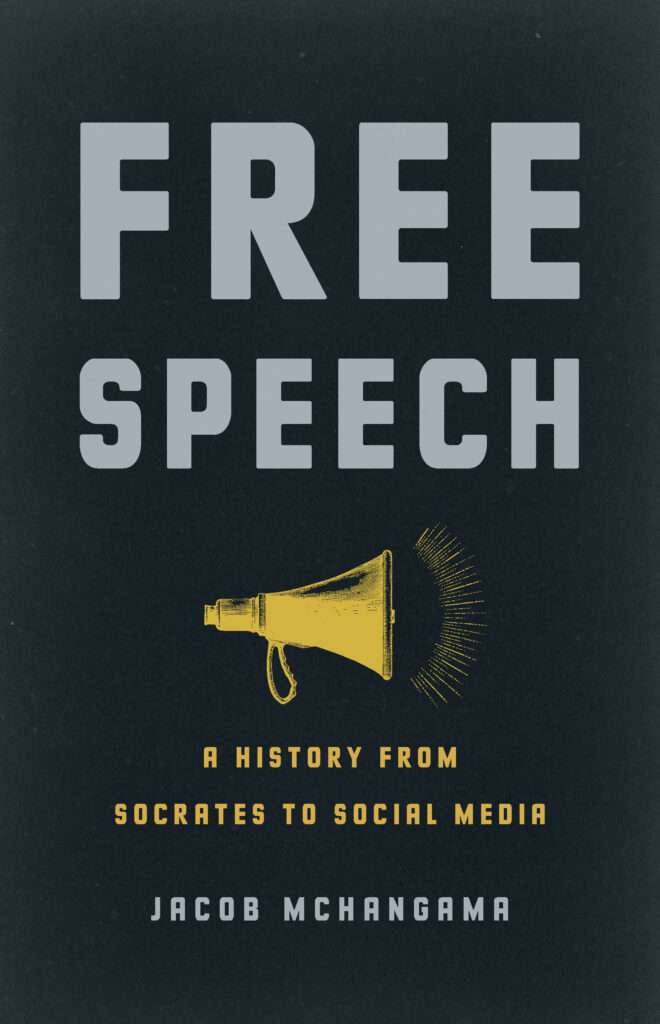
Jacob Mchangama, "Free Speech: A History from Socrates to Social Media," and Milton's Curse

|

I much enjoyed Jacob Mchangama's podcast on the history of free speech (Clear and Present Danger), so I'm particularly pleased to see his book is now out:

I asked him if he could pass along a guest post related to the book, and he graciously agreed:

According to Columbia University president and free speech scholar Lee Bollinger, the United States has become "the most speech protective of any nation on Earth, now or throughout history." Key to this development has been the Supreme Court´s gradual elevation of free speech to "a bedrock principle," barring the government from "prohibit[ing] the expression of an idea simply because society finds the idea offensive or disagreeable."

Most Americans seemingly approve of US free speech exceptionalism. According to a 2022 Knight Institute poll 63% of Americans find free speech "Extremely Important" while 28% find it "Very Important." But when the abstract ideal of free speech is put to the test against concrete and (supposedly) conflicting values, partisan cracks appear in the façade of American tolerance. 73% of Democrats find that kneeling or turning away during the national anthem is a legitimate expression of First Amendment rights, compared to a mere 35% of Republicans. Conversely, 57% of Republicans consider disseminating online misinformation about the 2020 Presidential election as consistent with the First Amendment, whereas Democrats´ tolerance drops to 20%. There are also significant partisan gaps when it comes to tolerance of Covid misinformation and protests against racial injustice. This selective and unprincipled defense of free speech—which I term "Milton´s Curse"—is nothing new, but has in fact been a recurrent theme throughout the history of free speech.

Read More

Pretty Demanding Standards at the D.C. Police Department

|

Perhaps too demanding, though who knows (and it may well be that the punishment was suitably modest). From 2021 D.C. Office of Police Complaints 21-0072, 2021 WL 6804783 (decided Dec. 10 but just posted on Westlaw) (I'm focusing here on only one of the two complaints, against SUBJECT OFFICER #2):

On the evening of the 2020 presidential election, November 3, 2020, COMPLAINANT #1 and his wife, COMPLAINANT #2, and children attended an event at NW, WASHINGTON, DC, in downtown DC. One of their children was to perform at the event featuring Go-Go music. The Go-Go band was playing on the bed of a truck at the location. There were also protests happening at this time and location….

[At some point in the] evening, COMPLAINANT was arrested by MPD. COMPLAINANT was put in the police vehicle wagon and awaited transportation off the scene. SUBJECT OFFICER #2 approached indicating that he was responsible for transporting COMPLAINANT.

SUBJECT OFFICER #2 approached the wagon and asked WITNESS OFFICER #9 and WITNESS OFFICER #10 if COMPLAINANT was wearing handcuffs or zip ties. They indicated that they did not know. An officer standing there told SUBJECT OFFICER #2 that COMPLAINANT would be aggressive. SUBJECT OFFICER #2 shined his flashlight into the transport vehicle. He said, "You got handcuffs on, dude? Or wire cuffs?" COMPLAINANT did not respond. SUBJECT OFFICER #2 repeated, "You got handcuffs on?" COMPLAINANT did not respond.

Read More

More