The Volokh Conspiracy

Mostly law professors | Sometimes contrarian | Often libertarian | Always independent | Est. 2002

The Volokh Conspiracy

A digital curtain descends across Europe

Episode 397 of the Cyberlaw Podcast

|

Much of this episode is devoted to the new digital curtain falling across Europe. With usual host Stewart Baker away from the microphone, Gus Horwitz and Mark-MacCarthy review the tech boycott that has seen companies like Apple, Samsung, Microsoft and Adobe pull their service from Russia. Nick Weaver describes how Russia has cracked down on independent Russian media outlets and blocked access to the websites of foreign media including the BBC and Facebook.  Gus reports on an apparent Russian decision to require all servers and domains to transfer Russian zone, thereby disconnecting itself from the global internet.

Mark describes decisions by private companies in the U.S. to exclude Russian media from their systems, including how DirecTV's decision to drop RT America led the Russian 24-hour news channel to shutter its operations. In contrast, the EU officially shut down all RT and Sputnik operations, including their apps and websites. Nick wonders if the enforcement mechanism is up to the task of taking down the websites. Gus, Dave and Mark discuss the mythmaking in social media about the Ukrainian war such as the Ghost of Kyiv, and wonder if fiction might do some good to keep up the morale of the besieged country.

Dave Aitel reminds us that despite the apparent lack of cyberattacks in the war, more might be going on under the surface. He also he gives us details about the internal attack that affected the Conti Ransomware gang when they voiced support for Russia. Nick opines that cryptocurrencies do not have the volume to serve as an effective way around the financial sanctions against Russia. Sultan Meghji agrees that the financial sanctions will accelerate the move away from the dollar as the world's reserve currency and is skeptical that a principles-based constraint will do much good to halt that trend.

A few things happened other than the war in Ukraine, including President Biden's first state of the union address. Gus notices that much of the speech was devoted to tech. He notes that the presence in the audience of Frances Haugen, the Facebook whistleblower, highlighted Biden's embrace of stronger online children's privacy laws and that the presence of Intel CEO Patrick Gelsinger gave the President the opportunity to pitch his plan to support domestic chip production.

Sultan and Dave discuss the cybersecurity bill that passed out of the Senate unanimously. It would require companies in critical sectors to report cyberattacks and ransomware to the Department of Homeland Security's Cybersecurity and Infrastructure Security Agency (CISA). They also analyze the concerns that companies have about providing information to the FBI. Dave thinks the bills that were discussed in this week's House Commerce hearing to hold Big Tech accountable, respond to widespread public concerns about tech's surveillance business model, but still he thinks they are unlikely to  become law.

Gus says that Amazon's certification that it has responded to the Federal Trade Commission's inquiries about its proposed $6.5 billion MGM merger triggers a statutory deadline for the agency to act. It is not the company's fault, he says, that the agency has a 2-2 between Democrats and Republicans that will likely prevent them opposing the merger in time. Mark takes the opportunity to note that the Senate Commerce committee sent the nominations of Alvaro Bedoya for the Federal Trade Commission and Gigi Sohn for the Federal Communications Commission to the Senate floor, but that it will likely be several months before the full Senate would act on the nominations.

Finally, Nick argues that certain measures in the European Commission's proposed digital identity framework, aiming to improve authentication on the web, would in practice have the opposite effect -- potentially dramatically weakening web security.

Finally, two or three announcements about the podcast.  We have decided to celebrate episode 400 by inviting our listeners to watch in real time.  We'll be doing the podcast at noon Eastern on March 28, with the exact mechanism for listener viewing and participation still to be determined.  More on that to come, but this is the time to mark your calendars.

We're still thinking about doing an episode in person as well, but lingering covid restrictions mean that we've postponed that event for a month or two.

And, finally, with the upcoming departure of our sound and substance guru, Jacob Nelson, we're in the market for a replacement.  The job is part-time, and it will pay, though maybe not a lot. If you'd like a chance to meet the cast of the episode, think deep thoughts about cyberlaw, and master podcasting. this could be the job for you.  Send your CV to cyberlawpodcast@steptoe.com. We'll be making our decision by early summer.

Download the 397th Episode (mp3)

You can subscribe to The Cyberlaw Podcast using iTunes, Google Play, Spotify, Pocket Casts, or our RSS feed. As always, The Cyberlaw Podcast is open to feedback. Be sure to engage with @stewartbaker on Twitter. Send your questions, comments, and suggestions for topics or interviewees to CyberlawPodcast@steptoe.com. Remember: If your suggested guest appears on the show, we will send you a highly coveted Cyberlaw Podcast mug!

The views expressed in this podcast are those of the speakers and do not reflect the opinions of their institutions, clients, friends, families, or pets.

UT Austin Hiring Full-Time Clinical Professor for Law and Religion Clinic

|

I am happy to pass along this hiring notice from the University of Texas at Austin's Law & Religion Clinic:

Description

UT School of Law seeks to hire a full-time clinical professor to teach in its Law and Religion Clinic. The Clinic's principal focus is working on a variety of pro bono law and religion matters under the state or federal constitutions, claims under state or federal religious-liberty legislation, and free-speech claims involving religious speech. The Clinic engages in exciting and cutting-edge work across the United States, including in the United States Supreme Court. The Clinic educates students by involving them in direct client representation or mediation services in law-related disputes and projects arising from a wide range of religious beliefs, practices, and circumstances. The Clinic is a project of the Bech-Loughlin First Amendment Center at the Law School.

The ideal candidate will be available to begin in the summer of 2022. The position is a nine-month, full-time clinical faculty appointment, with an option of an additional three months of paid full- or part-time work during the summers as demanded by the Clinic's cases and projects. The position is non-tenure track, with an initial appointment followed by three-year rolling, presumptively renewable appointments. The new professor will join a close community of over 25 faculty members who teach in our clinical program, and will also have the opportunity to participate in scholarly workshops and the work of the Bech-Loughlin First Amendment Center, if interested. The Clinic is offered in the fall and spring semesters with at least six students enrolled each semester, as is the case with our other clinics.

The professor will largely be independent but will partner with the Clinic director (Professor Steven Collis) in all aspects of the Clinic's work, including:

  • Help teach a weekly classroom component of the Clinic,
  • Meet regularly with students and supervise their work,
  • Participate in selecting and conducting litigation and other advocacy efforts,
  • Meet with clients, opposing counsel, and other third parties as required by the Clinic's cases,
  • Travel as necessary for cases and projects,
  • Mentor and advise students, and
  • Participate in activities of the clinical program,

Qualifications

  • Member of Texas Bar or ability to become licensed in Texas quickly,
  • Five or more years of experience in relevant legal work, including first chairing various aspects of pre-trial litigation and advising clients directly,
  • Experience with claims involving religion or religious institutions (preferred), and
  • Experience supervising law students and/or junior attorneys.

Academic Freedom

Academic Freedom Alliance Letter on a Disinvitation at University of Dayton

The AFA calls on the University of Dayton to allow its faculty to hear from the speakers they want

|

The Academic Freedom Alliance released a public letter to the University of Dayton calling on the university to reaffirm its own commitments to freedom of thought after an unfortunate administrative intervention into a scholarly conference organized by members of its faculty and held on the university campus.

The Human Rights Center at the University of Dayton organized a conference that was held on campus in December. Tlaleng Mofokeng was invited to be a keynote speaker to discuss the public health issues relating to the pandemic. Mofokeng is a Special Rapporteur with the United Nations. She is also a medical doctor in South Africa and has apparently performed abortions. The university leadership disinvited Mofokeng, stating that the Mofokeng's actions relating to abortion were contrary to the Catholic mission of the university and that her presence threatened to cause "negative reactions" that would "disrupt" the conference.

Although a religious institution, Dayton has in place a fairly robust academic freedom policy that simply replicates the standard American Association of University Professors principles. Given that commitment to faculty, the university's actions in intervening in an academic program and disinviting a speaker is a significant intrusion into academic freedom principles and undercuts the university's stated commitments.

The University of Dayton sent the Academic Freedom Alliance a letter similar in substance to the one posted at the Foundation for Individual Rights in Education, which contended that the university remained committed to robust debate on campus but that Mofokeng's actions as a doctor made her unwelcome on a Catholic campus. Unfortunately, the university's response suggests that the administration feels free to intervene to overrule faculty decisions on how to construct academic events if such events are "highly visible" and "widely promoted." This is deeply at odds with how universities that commit themselves to traditional principles of academic freedom should behave.

If the University of Dayton prefers to maintain such an administrative veto over scholarly programming organized by its faculty, then it should say so plainly and revise its faculty handbook to clarify that its faculty will not, in fact, be entitled to the same robust form of academic freedom that professors might enjoy at other American universities.

Free Speech

"Watch Tower's Misuse of Copyright to Suppress Criticism"

|

A very interesting post by Paul Alan Levy (Public Citizen); here's the opening paragraph:

This is a sad tale of hypocrisy on the part of a group whose litigation over the past eighty-five years has set many of our most important First Amendment precedents. But over the past four to five years, the Watch Tower Bible and Tract Society, popularly known as the Jehovah's Witnesses, has been abusing judicial process to suppress criticism by obtaining subpoenas under the Digital Millennium Copyright Act to out its critics by invoking claims of questionable merit. These are typical SLAPP suits, but under the copyright laws. In almost all of these cases, the victims could not find counsel to fight back, and had to censor themselves.

Read the whole post for more. I'd love to post a response from Watch Tower, if one is available; I tried to reach out to them myself through one of their lawyers, but haven't heard back yet.

Goodbye Roberts Brief. Hello Barrett Brief.

Critics of the Independent State Legislature doctrine may as well put Justice Barrett's face on the cover of their briefs.

|

For what felt like an eternity, advocates (present company included) would write briefs directed at Justice Kennedy, the swing vote. Erwin Chemerinsky would joke that he would put Kennedy's phot on the cover the brief, if he could. The so-called Kennedy briefs would discuss concepts such as federalism, dignity, and other related balancing tests.

After Justice Kennedy's retirement, we said goodbye to the Kennedy briefs, and advocates pivoted to the Roberts Briefs. Those filings would focus on the Court's institutional role, and preserving some semblance of the separation of powers. Alas, the Roberts Briefs had a brief shelf life. With Justice Ginsburg's passing, the Chief was no longer the fifth vote. Instead, briefs would target the other two getable votes: Justices Kavanaugh and Barrett.

At present, the most obvious Barrett briefs focus on the independent state legislature (ISL) doctrine. Consider Rick Hasen's posting on tonight's ruling from North Carolina:

If J. Kavanaugh ultimately goes along with the Alito reasoning, it will take only one more Justice to agree in order to overturn over two centuries of practice involving interpretation of state election law by state courts. Chief Justice Roberts' dissent in the Arizona redistricting case from 2015 put him very much in sympathy with Alito's position on the merits; he might demur for prudential reasons, but who knows? And Justice Amy Coney Barrett is a complete mystery, as she has not weighed in on this. I expect the major action is going to be building a strong record, based upon originalist style scholarship, that the independent state legislature theory, as currently understood, is contrary to the original understanding of the Constitution. There's a strong case to be made, and it will be one of the first tests to see how serious Justice Barrett takes such historical arguments.

You get that? ACB can only agree with Justice Alito, and rule in favor of the ISL, if she ignores the Constitution's original meaning. Under the Constitution's original meaning, the maps drawn by the NC Supreme Court should stand. And advocates can put Barrett's face on the cover.

Free Speech

Can Cardi B Get an Injunction Stopping Tasha K from Repeating Libelous Statements?

Yevhen V says likely yes.

|

Singer Cardi B sued vlogger Tasha K for libel, and the jury came back with a verdict in Cardi B's favor (and a total damages award of over $4 million); the libelous statements included claims that Cardi B had herpes, had used cocaine, and had engaged in prostitution. Now Cardi B is seeking an injunction that would require Tasha K to remove all statements that the jury had found to be libelous, and to bar Tasha K from repeating those statements. (You can also read Tasha K's opposition.) Would such an injunction be constitutional?

Probably yes. In the 1800s and early 1900s, many courts had said that any injunction against libel is an unconstitutional "prior restraint"; civil liability and even criminal punishment for libel is allowed, but not an injunction.

But in recent decades, most states and most federal circuit courts have switched to allowing such narrowly targeted injunctions, if they are issued after a final determination (especially one at a jury trial) that the statements are indeed false and libelous. In particular, federal district courts in the Eleventh Circuit (where this case is being litigated) have taken the view that such injunctions don't violate the First Amendment; and Georgia courts have likewise held that the injunctions don't violate Georgia law. (To be valid, the injunction has to be consistent both with state law and with the federal First Amendment.) I discuss this in more detail in my Anti-Libel Injunctions article.

The Eleventh Circuit appellate court has not passed judgment on this, and Tasha K has said she would appeal. It's possible that the court will go along the view, accepted by a minority of state and federal courts, that such injunctions indeed violate the First Amendment. But the recent trend has been in favor of upholding the injunctions, again if they follow a judgment on the merits that the speech is libelous, and if they are limited to speech that had been found to be libelous.

Of course, the court might conclude that an injunction would be constitutionally permissible, but wouldn't make sense on the facts of the case. But my sense is that courts are generally open to such injunctions when the injunctions are constitutionally permitted, and when there seems to be a real likelihood that the defendant won't remove the libelous speech (or will repeat it) in the absence of the injunction.

Free Speech

"Of Course Journalists Should Interview Autocrats"

|

An article in The Atlantic by Graeme Wood, about his profile of Saudi crown prince Mohammed Bin Salman; here are the closing paragraphs:

Various journalists complained that I described MBS as personally "charming" and "intelligent." To this my reply is twofold. First, MBS was indeed charming and intelligent, and if you want me to say otherwise, then you want to be lied to. Second, if you think charm and intelligence are incompatible with being a sociopath, then your years in Washington, D.C., have taught you less than nothing.

Any publication bragging that it is too sanctimonious to accept an invitation to interview the crown prince of Saudi Arabia is admitting it cannot cover Saudi Arabia. The Atlantic is not in the business of sanctimony, and it expects its readers to understand, without being told, that someone who dwells on his own indignities as the result of a murder, rather than on the suffering of the victim, might not be the perfect steward of absolute power.

All journalism is an attempt to bring readers things they do not know, and all interviews with heads of state involve getting them to say things they wish they had not said. To elicit these utterances, one must approach the subject sideways—and, most of all, keep him talking, and reveal more than he intends to say.

"Giving a platform"—to use the cliché that imprisons the minds of those who don't know how journalism is done, or what its purpose is—is not a favor bestowed on important people. It is an invitation to walk the boards and fall through trap doors. And that is exactly what Saudi officials themselves, whose past two days have been spent desperately fluffing pillows for a soft landing below, seem to think their ruler did.

Free Speech

Prof. Jonathan Turley on Blacklisting Artists for Their Political Positions

|

A very good post, I think, here; a brief excerpt:

"It is a great artistic loss for the Met and for opera." Those words from the Metropolitan Opera Manager Peter Gelb makes it sound like soprano Anna Netrebko has died or lost her voice in some accident. In reality, Netrebko was cancelled for failing to denounce Vladimir Putin. As with the criminalization of support for Putin in some countries, the termination of Netrebko is an attack on free speech. It is perfectly bizarre for the Met to stand against tyranny by attacking free speech, the very right that combats tyranny in all forms.

The Dynamic Effects of the Russia Sanctions, Public and Private

Say you lead a foreign country who you expect might encounter harsh condemnation from the West at some point; how would you harden your economic system to protect against such sanctions?

|

I generally appreciate the West's sanctions on Russia for what strikes me as Putin's utterly unjustified invasion of Ukraine. That includes both the official government-imposed sanctions, and similar sanctions imposed by large private organizations, such as Visa, Mastercard, American Express, and PayPal. (My guess is that the line between the public and private here is not entirely crisp, since I suspect that a reasonable organization like that, especially a heavily regulated financial intermediary, would consult with important governments before taking action; and I also suspect that such an organization would be quite open to "suggestions" from such important governments, even if those suggestions aren't actual commands.)

At the same time, surely thoughtful foreign leaders are looking at this, and wondering: Might this happen to my country at some point, if it does something that sufficiently alienates the West?

Read More

Libel

Absolute Immunity from Libel Lawsuits for Witnesses Testifying in Private Universities' Title IX Proceedings?

|

Witnesses testifying in court have such "judicial immunity"; this is a longstanding principle, animated by a worry that otherwise angry litigants would otherwise routinely sue witnesses who testified against them, and that the threat of such lawsuits would deter witnesses from coming forward. (Prosecutors can of course still prosecute witnesses who they think were lying, but that requires an independent and generally disinterested judgment by the prosecutor; whether to file a civil lawsuit would be at the discretion of the litigant.) But does this apply to noncourtroom hearings, including ones in private organizations?

Friday's Second Circuit decision in Khan v. Yale Univ., written by Judge Reena Raggi and joined by Chief Judge Debra Ann Livingston and Amalya Kearse, has just certified that question to the Connecticut Supreme Court:

In 2015, while both were students at Yale University, defendant "Jane Doe" accused plaintiff Saifullah Khan of sexual assault. As a consequence, Yale initiated university disciplinary proceedings against Khan, and the State of Connecticut criminally charged him with sexual assault. Khan and Doe each testified at both proceedings—in each other's presence, under oath, and subject to cross examination at trial, but with none of those procedures at the university hearing. Holding the prosecution to a proof-beyond-a-reasonable-doubt standard at trial, a jury acquitted Khan of all criminal charges. Applying a lesser, preponderance standard of proof to its disciplinary proceeding, Yale found Khan to have violated its Sexual Misconduct Policy and expelled him.

Khan seeks to litigate Doe's sexual assault accusations for a third time, suing Doe in the United States District Court for the District of Connecticut … for defamation and tortious interference with contract, claims on which he would bear a preponderance burden at any trial. {In the same complaint, Khan also sued Yale and various of its employees for violating Title IX of the Education Amendments of 1972, as well as for state law breaches of privacy, contract, and the implied warranty of fair dealing, and for negligent and intentional infliction of emotional distress.}

Read More

Free Speech

Justice Thomas Argues Again for Reading § 230 Immunity More Narrowly

|

From Justice Thomas's statement respecting denial of certiorari today in Doe v. Facebook, Inc. [UPDATE: just saw that Jonathan beat me to it, but I thought I'd keep this up; the main extra matters in this post are the excerpts from the Texas Supreme Court opinion, which may help explain the background of the litigation]:

In 2012, an adult, male sexual predator used Facebook to lure 15-year-old Jane Doe to a meeting, shortly after which she was repeatedly raped, beaten, and trafficked for sex. Doe eventually escaped and sued Facebook in Texas state court, alleging that Facebook had violated Texas' anti-sex-trafficking statute and committed various common-law offenses. Facebook petitioned the Texas Supreme Court for a writ of mandamus dismissing Doe's suit. The court held that a provision of the Communications Decency Act known as § 230 bars Doe's common-law claims, but not her statutory sex-trafficking claim.

Section 230(c)(1) states that "[n]o provider or user of an interactive computer service shall be treated as the publisher or speaker of any information provided by another information content provider." The Texas Supreme Court emphasized that courts have uniformly treated internet platforms as "publisher[s]" under § 230(c)(1), and thus immune, whenever a plaintiff 's claim "'stem[s] from [the platform's] publication of information created by third parties.'"

As relevant here, this expansive understanding of publisher immunity requires dismissal of claims against internet companies for failing to warn consumers of product defects or failing to take reasonable steps "to protect their users from the malicious or objectionable activity of other users." The Texas Supreme Court acknowledged that it is "plausible" to read § 230(c)(1) more narrowly to immunize internet platforms when plaintiffs seek to hold them "strictly liable" for transmitting third-party content, but the court ultimately felt compelled to adopt the consensus approach.

Read More

Section 230

Justice Thomas (Again) Urges Reconsideration of the Scope of Section 230

In a statement respecting the denial of certiorari, Justice Thomas suggested some courts are adopting an overly expansive interpretation of the immunity conferred by Section 230.

|

Today the Supreme Court denied certiorari in Doe v. Facebook, Inc. Justice Thomas issued an opinion respecting the denial of certiorari, repeating his suggestion that the Supreme Court should consider the scope of immunity offered to Facebook and other website publishers under Section 230 of the Communications Decency Act in an appropriate case.

His brief opinion reads:

In 2012, an adult, male sexual predator used Facebook to lure 15-year-old Jane Doe to a meeting, shortly after which she was repeatedly raped, beaten, and trafficked for sex. Doe eventually escaped and sued Facebook in Texas state court, alleging that Facebook had violated Texas' anti-sex trafficking statute and committed various common-law offenses. Facebook petitioned the Texas Supreme Court for a writ of mandamus dismissing Doe's suit. The court held that a provision of the Communications Decency Act known as §230 bars Doe's common-law claims, but not her statutory sex-trafficking claim.

Section 230(c)(1) states that "[n]o provider or user of an interactive computer service shall be treated as the publisher or speaker of any information provided by another information content provider." 47 U. S. C. §230(c)(1). The Texas Supreme Court emphasized that courts have uniformly treated internet platforms as "publisher[s]" under §230(c)(1), and thus immune, whenever a plaintiff 's claim "'stem[s] from [the platform's] publication of information created by third parties.'" In re Facebook, Inc., 625 S. W. 3d 80, 90 (Tex. 2021) (quoting Doe v. MySpace, Inc., 528 F. 3d 413, 418 (CA5 2008)). As relevant here, this expansive understanding of publisher immunity requires dismissal of claims against internet companies for failing to warn consumers of product defects or failing to take reasonable steps "to protect their users from the malicious or objectionable activity of other users." 625 S. W. 3d, at 83. The Texas Supreme Court acknowledged that it is "plausible" to read §230(c)(1) more narrowly to immunize internet platforms when plaintiffs seek to hold them "strictly liable" for transmitting third-party content, id., at 90–91, but the court ultimately felt compelled to adopt the consensus approach, id., at 91.

This decision exemplifies how courts have interpreted §230 "to confer sweeping immunity on some of the largest companies in the world," Malwarebytes, Inc. v. Enigma Software Group USA, LLC, 592 U. S. ___, ___ (2020) (slip op., at 1) (statement of THOMAS, J., respecting denial of certiorari), particularly by employing a "capacious conception of what it means to treat a website operator as [a] publisher or speaker," id., at ___ (slip op., at 8) (internal quotation marks omitted). Here, the Texas Supreme Court afforded publisher immunity even though Facebook allegedly "knows its system facilitates human traffickers in identifying and cultivating victims," but has nonetheless "failed to take any reasonable steps to mitigate the use of Facebook by human traffickers" because doing so would cost the company users—and the advertising revenue those users generate. Fourth Amended Pet. in No. 2018–69816 (Dist. Ct., Harris Cty., Tex., Feb. 10, 2020), pp. 20, 22, 23; see also Reply Brief 3, n. 1, 4, n. 2 (listing recent disclosures and investigations supporting these allegations). It is hard to see why the protection §230(c)(1) grants publishers against being held strictly liable for third parties' content should protect Facebook from liability for its own "acts and omissions." Fourth Amended Pet., at 21.

At the very least, before we close the door on such serious charges, "we should be certain that is what the law demands." Malwarebytes, 592 U. S., at ___ (slip op., at 10). As I have explained, the arguments in favor of broad immunity under §230 rest largely on "policy and purpose," not on the statute's plain text. Id., at ___ (slip op., at 4). Here, the Texas Supreme Court recognized that "[t]he United States Supreme Court—or better yet, Congress—may soon resolve the burgeoning debate about whether the federal courts have thus far correctly interpreted section 230." 625 S. W. 3d, at 84. Assuming Congress does not step in to clarify §230's scope, we should do so in an appropriate case.

Unfortunately, this is not such a case. We have jurisdiction to review only "[f]inal judgments or decrees" of state courts. 28 U. S. C. §1257(a). And finality typically requires "an effective determination of the litigation and not of merely interlocutory or intermediate steps therein." Market Street R. Co. v. Railroad Comm'n of Cal., 324 U. S. 548, 551 (1945). Because the Texas Supreme Court allowed Doe's statutory claim to proceed, the litigation is not "final." Conceding as much, Doe relies on a narrow exception to the finality rule involving cases where "the federal issue, finally decided by the highest court in the State, will survive and require decision regardless of the outcome of future state court proceedings." Cox Broadcasting Corp. v. Cohn, 420 U. S. 469, 480 (1975). But that exception cannot apply here because the Texas courts have not yet conclusively adjudicated a personal-jurisdiction defense that, if successful, would "effectively moot the federal-law question raised here." Jefferson v. City of Tarrant, 522 U. S. 75, 82 (1997).

I, therefore, concur in the Court's denial of certiorari. We should, however, address the proper scope of immunity under §230 in an appropriate case.

Supreme Court

Justices Spar Over How to Interpret the Armed Career Criminal Act

In Wooden v. United States, the justices were unanimous in the judgment, but expressed disagreement over the role of statutory history and the rule of lenity.

|

Today the Supreme Court decided Wooden v. United States, which concerned whether multiple criminal offenses committed in succession as part of a single crime spree occurred on different "occasions" for purposes of sentence enhancements under the Armed Career Criminal Act (ACCA). The Court was unanimous in concluding that a single crime spree is a single "occasion," even if it resulted in multiple convictions, but disagreed about how to get there.

Justice Kagan wrote for the Court, joined in full by the Chief Justice and Justices Breyer, Sotomayor, and Kavanaugh. Justices Thomas, Alito, and Barrett joined all but one section of Justice Kagan's opinion (Part II-B) which concerned statutory purpose and history. Justices Kavanaugh and Sotomayor each wrote separate concurring opinions. Justice Barrett wrote an opinion concurring in part and concurring in the judgment, joined by Justice Thomas. And Justice Gorsuch filed an opinion concurring in the judgment, joined in part by Justice Sotomayor.

Justice Kagan briefly summarized the question presented to the Court, and its conclusion:

In the course of one evening, William Dale Wooden burglarized ten units in a single storage facility. He later pleaded guilty, for that night's work, to ten counts of burglar —one for each storage unit he had entered. Some two decades later, the courts below concluded that those convictions were enough to subject Wooden to enhanced criminal penalties under the Armed Career Criminal Act (ACCA). That statute mandates a 15 year minimum sentence for unlawful gun possession when the offender has three or more prior convictions for violent felonies like burglary "committed on occasions different from one another." 18 U. S. C. §924(e)(1). The question presented is whether Wooden's prior convictions were for offenses occurring on different occasions, as the lower courts held, because the burglary of each unit happened at a distinct point in time, rather than simultaneously. The answer is no. Convictions arising from a single criminal episode, in the way Wooden's did, can count only once under ACCA.

Justice Kagan justified this result on textual grounds, but also explained why statutory history and purpose reinforced this result. It was this latter part of the opinion that prompted disagreement from some of her colleagues.

Justice Barrett, joined by Justice Thomas, explained why she refused to join Justice Kagan's discussion of statutory purpose and history:

I join all but Part II–B of the Court's opinion. I agree with the Court's analysis of the ordinary meaning of the word "occasion" and its conclusion that Wooden's burglaries count only once under the Armed Career Criminal Act. But I do not share the Court's view that Congress ratified the Solicitor General's brief confessing error in United States v. Petty, 798 F. 2d 1157 (CA8 1986), when it amended the Act to add the occasions clause. This argument depends on two flawed inferences: first, that Congress specifically intended to reject the Eighth Circuit's initial decision in Petty, and second, that it embraced the former Solicitor General's reasoning for why that decision was wrong. The latter error, in particular, is likely to work mischief down the line.

And she concluded:

The Court glosses this statute by leaning on weak evidence of Congress' impetus for amending the statute, followed by still weaker evidence that Congress embraced the reasoning of a brief filed by the Solicitor General. I would impute to Congress only what can fairly be imputed to it: the words of the statute. Crimes within a spree like Wooden's do not count as separate ACCA predicates because of the statutory language, not because those who drafted the amendment had either Petty's case or the Solicitor General's prose in mind.

Justice Gorsuch also wrote a separate opinion (joined by Justice Sotomayor for all but one part, as also occurred last week) concurring in the judgment. According to Justice Gorsuch, the Court should have rested its conclusion on the rule of lenity.  His opinion concludes

The rule of lenity has a critical role to play in cases under the Occasions Clause. The statute contains little guidance, and reasonable doubts about its application will arise often. When they do, they should be resolved in favor of liberty. Today, the Court does not consult lenity's rule, but neither does it forbid lower courts from doing so in doubtful cases. That course is the sound course. Under our rule of law, punishments should never be products of judicial conjecture about this factor or that one. They should come only with the assent of the people's elected representatives and in laws clear enough to supply "fair warning . . . to the world." McBoyle, 283 U. S., at 27.

Justice Sotomayor wrote her own concurring opinion endorsing both Justice Kagan's opinion for the Court, and Justice Gorsuch's argument that applying the rule of lenity requires the same result.

Justice Kavanaugh, on the other hand, wrote a concurrence responding to Justice Gorsuch, arguing against application of the rule of lenity in cases like this. From his opinion:

In light of JUSTICE GORSUCH's thoughtful concurrence in the judgment, I write separately to briefly explain why the rule of lenity has appropriately played only a very limited role in this Court's criminal case law. And I further explain how another principle—the presumption of mens rea—can address JUSTICE GORSUCH's important concern, which I share, about fair notice in federal criminal law. . . .

. . . because a court must exhaust all the tools of statutory interpretation before resorting to the rule of lenity, and because a court that does so often determines the best reading of the statute, the rule of lenity rarely if ever comes into play. In other words, "if lenity invariably comes in 'last,' it should essentially come in never." D. Kahan, Lenity and Federal Common Law Crimes, 1994 S. Ct. Rev. 345, 386. As I see it, that explains why this Court rarely relies on the rule of lenity, at least as a decisive factor.

I would not upset our rule of lenity case law by making the ambiguity trigger any easier to satisfy. For example, I would not say that any front-end ambiguity in the statute justifies resort to the rule of lenity even before exhausting the tools of statutory interpretation. One major problem with that kind of ambiguity trigger is that ambiguity is in the eye of the beholder and cannot be readily determined on an objective basis. Applying a looser front-end ambiguity trigger would just exacerbate that problem, leading to significant inconsistency, unpredictability, and unfairness in application. See B. Kavanaugh, Fixing Statutory Interpretation, 129 Harv. L. Rev. 2118, 2136–2139 (2016). . . .

In sum, I would not invite the inconsistency, unpredictability, and unfairness that would result from expanding the rule of lenity beyond its very limited place in the Court's case law. I would, however, continue to vigorously apply (and where appropriate, extend) mens rea requirements, which as Justice Robert Jackson remarked, are "as universal and persistent in mature systems of law as belief in freedom of the human will and a consequent ability and duty of the normal individual to choose between good and evil.". . .

Ukraine

Upcoming George Mason University Event on "Justice, International Law, and the War in Ukraine"

It will take place on Thursday, March 10, at 5 PM and is open to the public. I will speak, along with my colleague Prof. Jeremy Rabkin.

|

On Thursday, March 10, at 5-6:15 PM I will take part in a George Mason University panel on "Justice, International Law, and the War in Ukraine." The panel will be held in Room 121 at the Antonin Scalia Law School, George Mason University, 3301 Fairfax Drive, Arlington, Virginia, and is sponsored by the George Mason student chapter of the Federalist Society. The other speaker (in addition to myself) will be my law school colleague Prof. Jeremy Rabkin, a prominent international law scholar.

Prof. Rabkin will speak about the international law issues raised by Russia's war on Ukraine. I will cover moral issues, and also those related to refugee and migration rights. The event is free and open to the public, and there will also be free Ukrainian food available. We are working on ways to enable people who come to contribute to humanitarian causes assisting refugees and other victims of the war (though such contributions are not required as a condition of attendance).

As of March 4, George Mason University no longer requires masks at this type of event. We are in the process of creating a Zoom link for the event, so that people can also watch remotely. I will post the link here when able to do so. If you want to get it sooner than that, please contact me.

Because we put this event together so quickly, there has not yet been much opportunity to promote it through normal channels yet. So I am doing so here. I look forward to seeing interested VC readers who decide to attend, virtually or in person.


Russia

How to Fight Putin by Offering Russians "a Million Little Carrots"

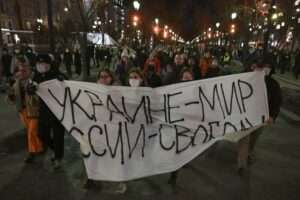
Defeating Putin is better accomplished by measures that divide him from the Russian people.

|

Russian protest against Putin's war on Ukraine. Moscow, February 24, 2022. The sign says "Peace for Ukraine, Freedom for Russia." (AP).


A few days ago, I put up a post expanding on economist Timur Kuran's idea of combating the Russian invasion of Ukraine by granting asylum to Russian troops who surrender, thereby increasing incentives to desert. Canadian political commentator Scott Gilmore offers a much broader version of the same idea, one that isn't limited to soldiers. He suggests Western nations take a wide range of steps to encourage  Russians to join with us in opposing Putin:

The western alliance has moved quicker and implemented more sanctions than anyone would have predicted just a week ago…

And, unfortunately, this historically harsh set of sanctions has failed to move Putin….

Perhaps, then, the west should consider an alliance wide-strategy of offering a million little carrots aimed not at Russia, but at Russians.

For example, the Ukrainian government is now promising Russian deserters 5 million rubles (approximately US $47,000), which is 450 times more than what the Kremlin pays the families of soldiers killed in action. NATO and the EU could match that and add an offer of asylum for them and their families….

Even if each deserting Russian soldier was offered a huge bounty, say $100,000, it would still be incredibly cost effective when you weigh it against the price of supporting a protracted war, or the cost in men and material to remove that soldier from the battlefield in the traditional fashion.

This strategy could be applied more widely. For example, some of these million little carrots could be offered to Russian diplomats. We have already seen at least one resign in protest, but there could be hundreds more if the western alliance also dangled in front of them a path to citizenship and a stipend to cover living costs. This may seem unfair, but the world needs to be pragmatic about this and realize that bigger fish will require larger bait.

For senior military staff or Kremlin officials in Moscow, maybe even notable journalists or celebrities, we could also offer a path to citizenship and an even larger stipend….

But for them and all the rest, there would be one very important catch. All of these little carrots would require a recorded video statement explaining their opposition to the war and urging others to join them.

If thousands of these testimonials were shared in the media and online, coming from powerful Russians and lowly conscripts both, it would be almost impossible for the Kremlin to control the narrative domestically. It would be a body blow to morale, and it would handicap further attempts at disinformation and propaganda.

But, most importantly, a million little carrots strategy would remove Russian boots on the ground. If you consider the slow progress of the Russian military after (according to Pentagon estimates) 90 per cent of the troops assigned to this invasion have already been deployed, it is clear that even a small number of deserters will have a disproportionately large impact on Moscow's ability to fight this war….

I agree with most of Gilmore's points. But I would make the video optional rather than mandatory. Some potential deserters or defectors might fear to make the video, because possible retaliation against their families back home. In addition, the video would be less credible if Russian viewers find out (as they likely would) that it was a mandatory condition of getting asylum in the West.

The strategy of incentivizing Russians to come over to our side can be broadened still further, by offering an open door to Russian migrants, including those who are not high government officials, oligarchs or celebrities. Ordinary people, particularly those with useful scientific technical skills, are still of value to the Putin regime. Better to have them on our side instead. I will have have more to say about this point in an op ed in the New York Times, which is expected to be out on Tuesday. Among other things, it will address a number of potential objections.

This approach should be supplemented by doing everything reasonably possible to avoid sanctions and "cancellations" aimed at ordinary Russians, especially those who oppose Putin's regime. There is good reason to take steps that deny resources to the government (such as freezing Russia's central bank assets abroad) and penalize its high officials and collaborators. But, for both moral and strategic reasons, we should minimize collateral damage to innocent civilians. Political scientist Yascha Mounk makes some good points on this in a recent Washington Post article:

Although we are waging a righteous battle against Vladimir Putin, we are not at war with the Russian people. Acting as if we are is as immoral as it is counterproductive….

Putin undoubtedly enjoys widespread support. But over the past week, many Russians have found the courage to criticize his assault on Ukraine, often incurring tremendous risk in the process.

Thousands have already been arrested for protesting the war. About 7,000 Russian scientists and academics have signed an open letter demanding "an immediate halt to all military operations directed against Ukraine." Similar petitions are circulating among teachers, doctors and many other groups. What appears to be the biggest one, on Change.org, has attracted over a million signatories.

Even more Russians share these sentiments but lack the bravery or the opportunity to speak out….

All of this drives home the importance of continuing to draw the vital distinction between the Russian government and the Russian people — something that many pundits, politicians and institutional leaders are, sadly, failing to do….

Heavy sanctions will unavoidably impose significant costs on ordinary Russians. But since they are necessary to assist Ukraine and weaken Putin, they are morally defensible. It is right to stop doing business with Russian companies, to seize the property of oligarchs who got rich thanks to their connections to the Kremlin, and to ban sports teams from competing in international competitions under the Russian flag….

But none of this is a reason to punish individuals for the accident of their birth or to cast Russia's rich culture under a general pall of suspicion. Dictators do not speak for everybody who shares their nationality. And so we must avoid punishing ordinary Russians who neither have close links to the Kremlin nor represent their country in an official capacity. It would be a serious injustice to stop Russian academics from giving talks in the West, to subject every Russian living outside the country to an ideological litmus test or to cancel performances by Russian artists based purely on their nationality.

As Gilmore and Mounk explain, differentiating between Russia's government and its people is not only morally right, but also a good way to counter Putin's propaganda and weaken his regime's position.

Like the Cold War against the Soviet Union, the conflict with Putin is not just a military confrontation decided by material factors, but also a war of ideas and ideologies. The ideology of liberal democracy ultimately triumphed over communism. It can also prevail over Putin's brutal authoritarian nationalism. Indeed, Putinism probably has a much weaker appeal than communism did, at the height of the latter's influence. Putin's "Russian world" is far less enticing than the utopia of freedom and limitless abundance once promised by Lenin and Stalin. But we are far less likely to win if we alienate large numbers of potentially sympathetic Russians by unnecessarily lumping them in with the enemy.

The "million carrots" strategy is not a complete substitute for sanctions against the Russian state and providing military aid to Ukraine. But it can help increase the effectiveness of these other measures, and at little cost. Indeed, Russian defectors, immigrants, and military deserters, can make valuable contributions to Western economies and societies, as have previous generations of Russian immigrants during the Soviet era, and before. This is another point I will cover in greater detail in my forthcoming New York Times article.

UPDATE: The New York Times article is now out, and available here.

More