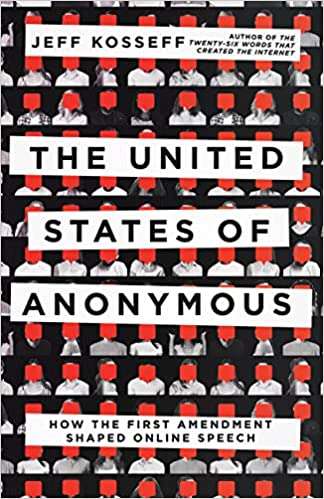
My book explains the strong, but not absolute, protections that U.S. courts provide to anonymous speech. Those safeguards originated from a dispute over civil rights activist Manuel Talley's March 22, 1958, distribution of handbills outside the A&D Market in Los Angeles. The handbills called for a boycott of the store, alleging that the retailer sold products from manufacturers that did not employ racial minorities.
The handbills were signed only with the name of Talley's group, National Consumers Mobilization, in violation of a Los Angeles ordinance that required handbills to include the author's real name. Talley was arrested and charged. At trial, Talley argued that the market also distributed leaflets that did not include the author's name. This argument did not persuade the judge, who convicted Talley of a misdemeanor and fined him. The California Court of Appeal affirmed the conviction, but two judges struggled to reconcile the fine with a recent U.S. Supreme Court ruling that blocked Alabama state officials' efforts to force the NAACP to disclose its membership lists.
The southern California chapter of the American Civil Liberties Union took on Talley's case and convinced the US Supreme Court to grant certiorari. In its brief, the ACLU traced the history of anonymity back to the Renaissance and Reformation, when writers faced "severe penalties," through the anonymous works of the eighteenth century to modern periodicals, such as Foreign Affairs, which routinely used pseudonyms. The right to anonymous speech, the lawyers wrote, is particularly important for social reformers. "People usually resent change, and greet it only with hostile reluctance," they wrote. "For this reason, ideas which tamper with deep-rooted prejudices may expect to encounter serious—and even violent—opposition. The simplest way to discourage such opinions, therefore, is to expose their proponents to a resentful community."
The case is O'Neil v. Neronha, decided today by Judge William E. Smith (D.R.I.); Judge Smith expresses his disapproval of D.C. v. Heller (pp. 9-10 n.7), but applies it to hold that the stun gun ban is unconstitutional. Congratulations to lawyers Alan Beck, Stephen Stamboulieh, and Frank Saccoccio on the victory.
This is the fourth post in series on the Tibetan Uprising. This one is about 1958, when the Chinese communists attempted to reconquer the vast areas that the Tibetans had liberated in 1956-57. In June, the unified national Tibetan resistance was proclaimed: the Chushi Gangdruk.
Post 1 covered Tibet before the 1949 Chinese invasion, including the Tibetan government's refusal to heed the 1932 warning of the Dalai Lama to strengthen national defense against the "'Red' ideology". Post 2 was the Chinese conquest, followed by armed uprising of the people, precipitated by gun registration. Post 3 described how the Tibet Uprising drove the Chinese communist invaders out of most of Eastern Tibet in 1956-57.
These posts are excerpted from my coauthored law school textbook and treatise Firearms Law and the Second Amendment: Regulation, Rights, and Policy (3d ed. 2021, Aspen Publishers). Eight of the book's 23 chapters are available for free on the worldwide web, including Chapter 19, Comparative Law, where Tibet is pages 1885-1916. In this post, I provide citations for direct quotes. Other citations are available in the online book chapter.
Property confiscation
The Chinese Communist Party (CCP) had ordered Tibetan gun registration in 1955, and gun confiscation in 1956. The confiscation demand was repeated in April 1958.
In the summer of 1958, all agriculture and pasturage in Tibet's two eastern provinces, Kham and Amdo, were fully communized. All land and livestock was confiscated by the communists; the people were forced to work in slave labor gangs.
Most of the food produced by the peasants in Tibet and China was taken by Mao's regime for export. He used the food for Chinese urban workers (his political base), to buy arms from the Soviet Union, and to export food to Eastern European communist nations to build up his image there. He sent so much food to communist Albania that food rationing was not needed there--quite a rarity in the communist world.
Meanwhile in China and Tibet, government commandeering of so much food caused famines. Carefully rationing food, the communists gave survival level rations to people who could toil the fields relentlessly, and starved the others.
Death by hunger was part of Chinese Communist Party Chairman Mao's "Great Leap Forward." It was imposed throughout the "People's Republic of China" from 1958 onward. But not in the places of Eastern Tibet where the invaders had been expelled. Nor in Central Tibet; the uprisings in Eastern Tibet were preventing the CCP from supplying a large enough army in Central Tibet to impose what Mao considered to be full communism.
The Foundation for Individual Rights in Education just notedthis as its "Speech Code of the Month." To be sure, a public college can impose some limits on what student groups post on campus, because walls, bulletin boards, and the like are generally seen as "limited public fora," in which reasonable, viewpoint-neutral restrictions are permitted. But restrictions on posting "hate speech" in such a limited public forum (or even on displaying it in a nonpublic forum) are viewpoint-based, and thus unconstitutional (see, e.g., Matal v. Tam (2017) and Iancu v. Brunetti (2019)).
T. Markus Funk (a partner at Perkins Coie and a scholar of, among other things, self-defense law) and I published an article on this subject at Bloomberg Law last week; I thought I'd reprint it, with Bloomberg's permission. The material on English and German law is Markus's contribution, and the material on U.S. law is a joint effort. I think Markus and I disagree in some measure on how self-defense 2ought to be defined, but here we just want to lay out the law as it is. (Thanks also to Perkins Coie's Sean Solis for his help.)
[* * *]
"U.S. Self-Defense Law—'Harsh' By International Standards?"
Last November was marked by wall-to-wall media coverage of Kyle Rittenhouse's trial in Wisconsin for murder after he shot three men, two of whom died. Law professors, criminal lawyers, and laypersons alike filled the airwaves with varied legal and moral assessments of Rittenhouse's self-defense claims.
An evergreen aspect of the Rittenhouse coverage were declarations of U.S. self-defense law's purported laxness, particularly by international comparison.
"Sir," the letter began. "The submission of a free people to the executive authority of government is no more than a compliance with laws which they themselves have enacted. While the national honour is firmly maintained abroad, and while justice is impartially administered at home, the obedience of the subject will be voluntary, cheerful, and, I might almost say, unlimited."
By contemporary standards, such a letter would be unobjectionable, and likely unnoticed. A paean to self-governance. But this letter was published on January 21, 1769, in London's Public Advertiser newspaper. At the time, King George III was facing resistance in the colonies, and such a letter reminded the British people of their civil liberties and right to self determination. The author signed the letter only as "Junius."
Junius's letters are among the most prominent examples of pseudonymous and anonymous speech that proliferated in England and the American colonies throughout the eighteenth century.
Between 1769 and 1772, Public Advertiser publisher Henry Sampson Woodfall would print more than sixty letters from and to Junius in either the newspaper or a book. Woodfall published these letters with care to not reveal the identity of Junius. In a private letter to Woodfall, Junius wrote that he suspected that Woodfall may need to communicate with him. "If that be the case, I beg that you will be particular; and also that you will tell me candidly whether you know or suspect who I am."
"The Institute will make a place for about 15 Fellows who are law students, clerks, or lawyers and legal academics no more than 8 years since graduated from law school."
Professor Hadley Arkes, joined by other distinguished scholars, will offer an in-person seminar over six days in Historic Old Town Alexandria, VA, on Natural Law and its bearing on our jurisprudence. The course will focus on discussing the central points of a jurisprudence of Natural Law, such as the classic connection between the "logic of morals" and the "logic of law," the properties of moral truths and the principles of judgment, and how we would see certain landmark cases differently if they were viewed through the lens of Natural Law. Our main objective is to restore a moral coherence to our jurisprudence.
Topics discussed in past seminars have included, "The Natural Law, the Positive Law, and the American Regime"; "The Natural Law and Ordinary Language: Recovering the Philosophic ground for the Restriction of Assaulting Speech Acts"; "Abortion, Privacy, and the Law: Who is the Bearer of Natural Rights?'"; and "Religion and the Law." To read the biographies of our 2021 faculty, please visit here.
The Institute will make a place for about 15 Fellows who are law students, clerks, or lawyers and legal academics no more than 8 years since graduated from law school. Each Fellow will receive a $500 stipend and funds partially to defray travel expenses. Accommodations, most meals, and entertainment will be provided.
Application
Please submit the following package of materials to be considered for the James Wilson Fellowship. An electronic package of materials in a single PDF file is preferred, though not required:
Personal Information: Full name, DOB, mailing address, preferred telephone number, and email.
Resume/CV: Undergraduate and graduate education with degrees expected, professional experience, fellowships, internships, awards, and publications.
Personal Statement: In 500 words or less please explain what draws you to the Fellowship for the James Wilson Institute and this project on the recovery of Natural Law: why are you interested in spending a week with peers studying Natural Law and its connection to our jurisprudence? Have you done any reading on the subject, or are you interested in acquiring a firmer hold on it? For example, have you read any of Professor Arkes's writings, with his own perspective on Natural Law?
Legal Writing: A journal article, legal brief, course paper, or other relevant piece up to 15 pages.
Contact Information: Two References Academic or Professional.
Official Academic Transcripts: All undergraduate and graduate work; may be submitted separately from the application package.
All electronic application materials may be emailed to: Fellowships at JamesWilsonInstitute.org
All physical application materials may be sent to:
James Wilson Fellowship
Attn: Garrett Snedeker
124 S West St, Suite 200
Alexandria, VA 22314
A complete application package is due no later than 11:59 pm on April 20. Candidates will be notified no later than April 29.
Please email any questions to staff at jwinst.org.
For the third week in a row, we lead with the cyber impact of Russia's invasion of Ukraine. Paul Rosenzweig comments on the most surprising thing about social media's decoupling from Russia – how enthusiastically industry is pursuing the separation. Facebook is allowing Ukrainians to threaten violence against Russian leadership and removing or factchecking Russian government and media posts. Not satisfied with this, the EU wants Google to remove Russia Today and Sputnik from search results. I ask why the U.S. can't take over Facebook and Twitter infrastructure to deliver the Voice of America to Facebook and Twitter users in Russia who've been cut off by the social giants' departure. Nobody likes that idea but me. Meanwhile, Paul notes that The Great Cyberwar that Wasn't may yet make an appearance, citing Ciaran Martin's sober Lawfare piece.
David Kris tells us that Congress has, after a few false starts, finally passed a cyber incident reporting bill, notwithstanding the Justice Department's over-the-top tantrum in opposition. I wonder if the bill, passed in haste due to the Ukraine conflict, should have had another round of edits, since it seems to lock in a leisurely 3 1/2 year reg-writing process that the Cybersecurity and Infrastructure Security Agency (CISA) can't easily cut short.
Jane and I draw lessons from WIRED's "expose" on three wrongful arrests based on face recognition software --but not the lesson WIRED wanted us to draw. The arrests do reflect less than perfect policing, and they are a wrenching view of what it's like for an innocent man to face charges. But WIRED is unpersuasive when it blames face recognition for police mistakes that could have been avoided with a little more care on the part of the cops.
David and I highly recommend Brian Krebs's great series on what we can learn from leaked chat logs stolen from the Conti ransomware gang. My favorite insight was the Conti member who said, apparently when a company didn't want to pay to keep its files from being published, "There is a journalist who will help intimidate them for 5 percent of the payout." I suggest that our listeners could feasibly crowdsource an effort to find journalists who might fit this description. After all, how many journalists these days are breaking stories that dive deep into doxxed databases?
Paul and I spend a little more time than it deserves on a proposal for the Internet community about ways to block Russia from the network. But I am inspired to suggest that the country code .su — presumably all that's left of the Soviet Union – be permanently retired. I mean, really, does anyone respectable want it back?
What about Scarlett Johansson? We save her for last, as I discover that none of the other panelists thinks it surprising that 15% of people have already had sex with a robot but every one of them finds the idea of falling in love with a robot preposterous.
A special reminder that we will be doing episode 400 live on video and with audience participation on March 28, 2022 at noon Eastern daylight time. So mark your calendar and when the time comes, use this link to join the audience:
See you there! You can subscribe to The Cyberlaw Podcast using iTunes, Google Play, Spotify, Pocket Casts, or our RSS feed. As always, The Cyberlaw Podcast is open to feedback. Be sure to engage with @stewartbaker on Twitter. Send your questions, comments, and suggestions for topics or interviewees to CyberlawPodcast@steptoe.com. Remember: If your suggested guest appears on the show, we will send you a highly coveted Cyberlaw Podcast mug!
The views expressed in this podcast are those of the speakers and do not reflect the opinions of their institutions, clients, friends, families, or pets.
Another poem from 2014 by Ukrainian Anastasia Dmitruk, who also wrote "We Will Never Be Brothers" the same year; the performance is by a Georgian, Zaza Zaalishvili (echoing the Lithuanian musicians' performance of We Will Never Be Brothers). I think it's a good bookend to that poem, because it captures the potential closeness that was lost, in large measure in 2014 and now, I think, entirely, and for a long time to come.
Here, with the usual apologies, is an imprecise and highly imperfect translation (e.g., "guys" is the best translation I could find of "ребята," but it doesn't have quite the same tone):
Return to us our skies,
Return to us our peace!
Why did you come, neighbors?
Why did you come with war?
Together we christened our children
And drank to our friendship…
Why did you put chains around us
With the columns of your soldiers?
Much pain to us has been given—
The funerals of our sons.
We saw much sorrow,
We became even stronger.
Why did you come here, guys?
Why did you decide on war?
We'll stand against you as brothers
We too were taught to shoot.
We stand—we have Freedom,
Machineguns won't carry her off.
We won't surrender without fighting,
Let all the churches ring the alarm.
We saw death, guys,
We looked her bravely in the eyes
No need for war, no need…
After, you can't go back.
This is the third post in series on the Tibetan Uprising. This one is about 1956-57, when Tibetans liberated almost all of Eastern Tibet, and preparations for a unified national resistance began. Impressed by the Tibetans' success, the U.S. C.I.A. began to provide arms and training.
Post 1 covered Tibet before the 1949 Chinese invasion, including the Tibetan government's refusal to heed the 1932 warning of the Dalai Lama to strengthen national defense against the "'Red' ideology". Post 2 was the Chinese conquest, followed by armed uprising of the people, precipitated by gun registration.
These posts are excerpted from my coauthored law school textbook and treatise Firearms Law and the Second Amendment: Regulation, Rights, and Policy (3d ed. 2021, Aspen Publishers). Eight of the book's 23 chapters are available for free on the worldwide web, including Chapter 19, Comparative Law, where Tibet is pages 1885-1916. In this post, I provide citations for direct quotes. Other citations are available in the online book chapter.
1956—Kham Explodes
In the early 1950s, the Chinese Communist Party (CCP) annexed Tibet's two eastern provinces--Amdo and Kham--into adjacent Chinese province. Pursuant to the Seventeen Point Agreement, which Tibet was forced to sign in 1951, U-Tsang province (Central Tibet, including Lhasa, the national capital) was supposed to retain internal autonomy.
But in 1956, the Chinese transferred almost all political power Central Tibet to a new entity they controlled, the Preparatory Committee for the Autonomous Region of Tibet. The Central Tibetan national assembly and cabinet (Kashag) became nearly powerless. Gompo Tashi Andrugtsang, Four Rivers Six Ranges: Reminisces of the Resistance Movement in Tibet 39 (1973). In Eastern Tibet--Amdo and Kham provinces--the pace for imposing communism was accelerated.
Thanks to Eugene for inviting me to guest-blog about my new book, The United States of Anonymous: How the First Amendment Shaped Online Speech.
For more than a half century, U.S. courts have held that the First Amendment provides a right to speak and associate anonymously. Courts have applied this right to the Internet and found a robust—though not absolute—ability for people to control the identifying information they reveal online.
Anonymity is deeply rooted in the constitutional values and social norms of the United States. Anonymity has allowed speakers to communicate unpopular political viewpoints, whistleblowers to expose their employers' illegal schemes or ineptitude, and citizen journalists to document corruption and fraud. Anonymity is also employed for nefarious uses, such as defamation, persistent harassment, and online crimes.
The longstanding U.S. tradition of anonymous speech has enabled Americans to often separate their identities from the words that they communicate. In my book, I examine how the First Amendment protections, combined with technology that prevents identities from being associated with online activities, have created a culture of anonymity empowerment.
This post on the Tibetan Uprising is the second in a series. It describes the Chinese invasion of 1949-50, including the Tibetan government's failure to fight when it could have won. Later, when the communists announced gun registration, the Tibetans knew that confiscation and subjugation were next. So they revolted.
Previous Post 1 covers Tibet before the 1949 Chinese invasion, including the Tibetan government's refusal to heed the 1932 warning of the Dalai Lama to strengthen national defense against the "'Red' ideology".
These posts are excerpted from my coauthored law school textbook and treatise Firearms Law and the Second Amendment: Regulation, Rights, and Policy (3d ed. 2021, Aspen Publishers). Eight of the book's 23 chapters are available for free on the worldwide web, including Chapter 19, Comparative Law, where Tibet is pages 1885-1916. In this post, I provide citations for direct quotes. Other citations are available in the online book chapter.
The Communist Occupation of Eastern Tibet
In February 1949, when the communists were well on their way to winning the Chinese civil war, Mao explained his Tibet policy to a leading Soviet Union official. Tibet, said Mao, would be easy to solve, but could not be rushed. "First transportation is poor in the region, making it difficult to move in large numbers of troops and keep them supplied. Second, it takes longer to solve the ethnic questions in regions where religion holds sway. . . ." Jianglin Li, Tibet in Agony: Lhasa 1959 at 23 (2016).
One reason Tibet did not have much of a road network was that the government opposed the use of motor vehicles, which were seen "as modern and anti-Tibetan." Kenneth Knaus, Orphans of the Cold War: America and the Tibetan Struggle for Survival 10 (1999). The traditional lack of good roads ultimately helped the resistance. If Tibetans had grown accustomed to motor transport, they would have been reliant on imported fuel, and the Chinese could easily have cut off resistance access to fueling stations. Because the Tibetan resistance used horses rather than motor vehicles, their transport has ready access to local fuel derived from solar power—namely grass.
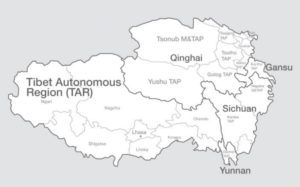
The Tibetan province of Amdo has been incorporated into China's Qinghai and Gansu provinces. Tibet's Kham province has been annexed by Sichuan and Yunnan. The "Tibet Autonomous Region" (hah!) is Tibet's U-Tsang province. (Free Tibet)
In the summer of 1949, the communist army advanced into northeastern Tibet (Amdo province). "Tibetan resistance was immediately aroused." Warren W. Smith, "The Nationalities Policy of the Chinese Communist Party and the Socialist Transformation of Tibet," in Resistance and Reform in Tibet 63 (Robert Barnett & Shirin Akiner eds. 1994).
Likewise in Tibet's far southeast—the town of Gyalthang in Kham province—the people initially drove back the communist army.
Opponents of this dangerous law have a variety of options left to pursue in state and federal courts, despite their recent defeat in the Texas Supreme Court.
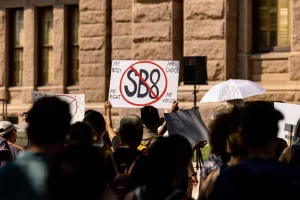
On Friday, the Texas Supreme Court ruled that state medical licensing authorities have no authority to enforce Texas SB 8 - the controversial state law banning nearly all abortions six weeks or more after conception. Some defenders of SB 8, such as co-blogger Josh Blackman, claim this will put an end to lawsuits challenging the constitutionality of the law. But such triumphalism is premature.
The key issue at stake in the SB 8 litigation is whether Texas can evade judicial review by limiting enforcement authority exclusively to private parties (see here and here for more detailed explanation). SB 8 seemingly bars enforcement by state officials, and instead delegates it to private litigants, who each stand to gain $10,000 or more in damages every time they prevail in a lawsuit against anyone who violates the law's provisions.
If the SB 8 ploy succeeds, it would provide a roadmap for undermining other constitutional rights by delegating enforcement to private parties. Preenforcement lawsuits against laws attacking such rights would be barred. And the possibility of enormous civil liability would chill the exercise of the rights in question, even if there were some chance of ultimate vindication through defensive litigation.
In Whole Woman's Health v. Jackson, decided in December, the Supreme Court ruled that abortion providers challenging SB 8 are not allowed to sue the Attorney General of Texas, state judges, state court clerks, and the one private individual who was a defendant in the case. But eight of nine justices agreed the plaintiffs could potentially sue state medical licensing officials, because the latter had the authority to enforce SB 8 by denying licenses to practitioners who "violate the terms of Texas's Health and Safety Code, including S. B. 8." But, as Justice Neil Gorsuch noted in his opinion for the Court, the issue of whether the licensing officials had such power is ultimately a matter of Texas state law.
On remand the US Court of Appeals for the Fifth Circuit certified that state law question to the Texas Supreme Court, which has now concluded the licensing officials have no authority to enforce SB 8 either "directly or indirectly." It does not follow, however, that there are no other state officials that plaintiffs can sue. As I have previously pointed out, Gorsuch's reasoning may well permit lawsuits against state officials tasked with enforcing state court judgments, such as sheriffs. Such people are not judges, and therefore not subject to the Supreme Court's precedents limiting injunctions against state court proceedings. There may be other nonjudicial state officials involved in the enforcement of judgments, as well.
Opponents of SB 8 would do well to search out all such potential defendants, and file cases against all of them. At least two of the justices who joined Gorsuch's opinion expressed grave concerns, in oral argument, about the threat SB 8 poses to constitutional rights (Kavanaugh and Barrett). Only one of the "Gorsuch four" needs to switch in order to defeat the SB 8 ploy in a future case. The three liberal justices and Chief Justice John Roberts have already indicated (in their opinions in the December ruling) that they are open to allowing lawsuits against state court clerks.
For reasons I highlighted here and here, rights valued by conservatives are threatened along with those valued by liberals. California's plan to target gun rights reinforces that point. Future litigation on SB 8 - and perhaps other state laws inspired by it - will reveal whether the Supreme Court (and lower federal courts) are willing to address the threat.
In the meantime, we should not forget that a Texas state court ruled in December that SB 8's delegation of enforcement to private parties violates the Texas Constitution. That ruling is now on appeal, and the trial court did not issue a injunction against enforcement of SB 8 while litigation continues. Nonetheless, it is entirely possible that SB 8's private enforcement ploy will ultimately be defeated in state court.
A state-constitutional ruling against SB 8 cannot prevent other states from imitating the statute. Those states' constitutions may not constrain enforcement delegation in the same way. But a Texas state ruling against SB 8 might at least have some persuasive value for other state courts. At the very least, state constitutional challenges are an additional tool in the armory of those who seek to counter this pernicious strategy for undermining constitutional rights.
As I have emphasized before, the fight over SB 8 is not primarily about abortion. Even if you believe the Supreme Court should overrule or limit Roe v. Wade and other precedents protecting abortion rights (which it may soon do in the Dobbs case), you have reason to be concerned about this menace to our other constitutional rights.
In sum, the legal battle over SB 8 and its would-be imitations elsewhere is far from over. Opponents should not give up too easily.
I came across this poem yesterday; it was written in 2014 by Ukrainian Anastasia Dmitruk, reacting to the Russian invasion of Crimea. As I understand it, it prompted many pro-Russian poems in response; regardless of what you think of their ideological merits, it seems to me a sign of a lively poetic culture.
But whatever arguments there might have been with it at the time, its prophecy has now been entirely fulfilled. An invasion aimed, at least ostensibly, at the union of closely related peoples has, I expect, deeply estranged them, at least for my lifetime and probably longer. The recently created video, which I include above, captures the message well.
Here's one twist I wanted to add (see this post for a bit more on a related matter): The poem denouncing and renouncing Russia is written in Russian. To be sure, part of this might well have been to get the message across to the Russians, who are after all formally the narrator's addressees. But I expect that part of it is also that Russian the language, unlike Russia the country, remains in the author's heart. (See, e.g., her "the masks are torn off," which is also in Russian though it appears to be addressed at least largely to her fellow Ukrainians.) [UPDATE: Commenter Voize of Reazon pointed me to this interview with Dmitruk, in which Dmitruk reports that she was primarily a Russian speaker when the poem was written, though she has shifted to Ukrainian since then.]
Perhaps relatedly, the audio recording in the video above is by Lithuanian musicians (Virgis Pupšys, Gintautas Litinskas, Jeronimas Milius, Kęstutis Nevulis, Vladimiras Konstantinovas). It of course makes perfect sense that Lithuanians would unite with Ukrainians in their desire to be separate from the Russians. But the language of this opposition to Russian empire has itself been Russian, even in places where language is a major part of ethnic definition and division.
That reality, that common link of language and history and culture, has been a key facet of the Eastern Europe that Russia has built. It was an opportunity, I think, for genuine closeness among those countries, including Russia—economic and cultural and perhaps even one day political. And that opportunity Putin has now destroyed.
I hesitate to offer much of a translation; except in the hands of a truly gifted translator of poetry (such as James Falen's Eugene Onegin), a translation can't capture the aptness of the words, which often stems from their meter and rhyme as much as their meaning. But, loosely (and perhaps incorrectly in places; please correct me if I'm wrong), it goes roughly like this: