From the prominent Russian band Leningrad; it now has over 1.25M views, though it was just posted Thursday. The band members, as I've mentioned before, aren't themselves particularly pro-Ukraine (see here and here)—they are more cynical and realist than ideological, it seems to me (see this song, which I blogged a month ago). But here, unless I'm completely missing things, the message is entirely against the Russian government.
Here is my translation, though of course much is doubtless lost in the translation (thanks to my mother Anne for help with some of the words); for the Russian lyrics, see here:
We are more spiritual than everyone in the world,
We are deeper than any seas,
Children, fuck yeah, are our priority
That's why we are kinder than everyone else.
We are the best and the most beautiful of all,
Smarter than everyone, jollier than everyone.
We will fuck up everyone else
And success awaits us everywhere.
In short, we are alone here against the darkness,
Let's save the whole world from digital prison.
Don't even doubt it
Or you will right away become a foreign agent.
Don't even doubt it
Or you will right away become a foreign agent.
Why May Day should be a day to honor victims of an ideology that took tens of millions of lives. But we should also be open to alternative dates if they can attract broader support.
Today is May Day. Since 2007, I have advocated using this date as an international Victims of Communism Day. I outlined the rationale for this proposal (which was not my original idea) in my very first post on the subject:
May Day began as a holiday for socialists and labor union activists, not just communists. But over time, the date was taken over by the Soviet Union and other communist regimes and used as a propaganda tool to prop up their [authority]. I suggest that we instead use it as a day to commemorate those regimes' millions of victims. The authoritative Black Book of Communism estimates the total at 80 to 100 million dead, greater than that caused by all other twentieth century tyrannies combined. We appropriately have a Holocaust Memorial Day. It is equally appropriate to commemorate the victims of the twentieth century's other great totalitarian tyranny. And May Day is the most fitting day to do so….
Our comparative neglect of communist crimes has serious costs. Victims of Communism Day can serve the dual purpose of appropriately commemorating the millions of victims, and diminishing the likelihood that such atrocities will recur. Just as Holocaust Memorial Day and other similar events promote awareness of the dangers of racism, anti-Semitism, and radical nationalism, so Victims of Communism Day can increase awareness of the dangers of left-wing forms of totalitarianism, and government domination of the economy and civil society.
While communism is most closely associated with Russia, where the first communist regime was established, it had comparably horrendous effects in other nations around the world. The highest death toll for a communist regime was not in Russia, but in China. Mao Zedong's Great Leap Forward was likely the biggest episode of mass murder in the entire history of the world.
November 7, 2017 was the 100th anniversary of the Bolshevik seizure of power in Russia, which led to the establishment of the first-ever communist regime. On that day, I put up a post outlining some of the lessons to be learned from a century of experience with communism. The post explains why the lion's share of the horrors perpetrated by communist regimes were intrinsic elements of the system. For the most part, they cannot be ascribed to circumstantial factors, such as flawed individual leaders, peculiarities of Russian and Chinese culture, or the absence of democracy. The latter probably did make the situation worse than it might have been otherwise. But, for reasons I explained in the same post, some form of dictatorship or oligarchy is probably inevitable in a socialist economic system in which the government controls all or nearly all of the economy.
While the influence of communist ideology has declined since its mid-twentieth century peak, it is far from dead. Largely unreformed communist regimes remain in power in Cuba and North Korea. In Venezuela, the Marxist government's socialist policies have resulted in political repression, the starvation of children, and a massive refugee crisis - the biggest in the history of the Western hemisphere. The regime continues to hold on to power by means of repression, despite growing international and domestic opposition.
In Russia, the authoritarian regime of former KGB Colonel Vladimir Putin has embarked on a wholesale whitewashing of communism's historical record. Putin's brutal and indefensible invasion of Ukraine probably owes more to Russian nationalist ideology than communism. But it is nonetheless fed in part by his desire to recapture the supposed power and glory of the Soviet Union, and his long-held belief that the collapse of the USSR was "the greatest geopolitical catastrophe of the century."
In China, the Communist Party remains in power (albeit after having abandoned many of its previous socialist economic policies), and has recently become less tolerant of criticism of the mass murders of the Mao era (part of a more general turn towards greater repression).
Perhaps worst of all its recent atrocities, China's horrific repression of the Uighur minority is reminiscent of similar policies under Mao and Stalin, though it has not - yet? - reached the level of actual mass murder. But imprisoning over 1 million people in horrific concentration camps is more than bad enough.
In a 2012 post, I explained why May 1 is a better date for Victims of Communism Day than the available alternatives, such as November 7 (the anniversary of the Bolshevik seizure of power in Russia) and August 23 (the anniversary of the Nazi-Soviet Pact). I also addressed various possible objections to using May Day, including claims that the date should be reserved for the celebration of labor unions.
But, as explained in my 2013 Victims of Communism Day post, I would be happy to support a different date if it turns out to be easier to build a consensus around it. If another date is chosen, I would prefer November 7; not out of any desire to diminish the significance of communist atrocities in other nations, but because it marks the establishment of the very first communist regime. November 7 has in fact been declared Victims of Communism Memorial Day by three state legislatures. Then-president Trump issued similar declarations in 2017 and 2018 (though he did not have the authority to make it a permanent national holiday through executive action alone).
If this approach continues to spread, I would be happy to switch to November 7, even though May 1 would be still more appropriate. For that reason, I have adopted the practice of also commemorating the victims of communism on November 7.
I am also more than willing to endorse almost any other date that could command broad support. Unless and until that happens, however, May 1 will continue to be Victims of Communism Day at the Volokh Conspiracy.
Here's the latest from Zoya, a singer with the prominent Russian band Leningrad (Russian lyrics here). It has over 350K page views, though it was just posted today (or yesterday Russian time)—I try to focus the posts in this thread on relatively prominent works, since my goal is in part to offer a sense of how some people over there are perceiving things.
The meaning is not completely clear on the face of the song, and as best I can tell, the band members aren't themselves particularly pro-Ukrainian—they are more cynical and realist than ideological, it seems to me (see this song, which I blogged a month ago). But "orc" appears to be a common reference to Russian soldiers by Ukrainians and other critics of Russia, though some say it also has other deeper meanings.
The orcs marched out of Mordor
In the last dawn
They were singing songs together
The fighting orcs.
About fate and about the foreign land
And about their mothers at home
And about the orc's cudgel
With which to kill the elves.
Let the whole world be in ruins—and fuck everything else
Let the whole world be, yes, in ruins—and fuck everything else.
During Steele's appearance on former NFL quarterback Jay Cutler's podcast, which aired Sept. 29, 2021, Cutler asked why she had a Band-Aid on her arm. She explained that she had just gotten her COVID-19 vaccine in compliance with Disney's corporate mandate, even though she personally felt the company's requirement to do so was out of line.
"I respect everyone's decision. I really do. But to mandate it is sick, and it's scary to me in many ways," Steele said on the podcast. "But I have a job, a job that I love and, frankly, a job that I need."
On the topic of race, Steele explained she was proud to come from a family that is both Black and white, the court filing said. As the conversation continued, Steele recalled her 2014 appearance on The View, where she was asked why she didn't simply identify herself as a Black, similar to Obama. She said she was fascinated that the former president had identified solely as Black despite having been raised by his white mother and grandmother."
Steele claims that she was "suspended from on-air appearances," though ESPN denies there was a suspension; she also claims that she was "punish[ed]" by being "remov[ed] from prime assignments, including coverage of the New York City Marathon, the Rose Parade, and the 12th Annual ESPNW Summit, which Steele had hosted and emceed since its inception in 2010," as well as being "forced to issue a humiliating public apology … and [being] subjected to bullying and harassment by colleagues while ESPN and Disney did nothing to stop it." She also alleges that she "appeared on the podcast as a private citizen on her day off, and made it clear during the interview that she was speaking on her own behalf, not on behalf of ESPN or Disney."
My useful correspondent Sammy Straightman asks:
[1.] How come this Sage Steele is suing ESPN for violating her First Amendment rights? I'm well acquainted with the state action doctrine, under which the Bill of Rights only applies to the government (federal, state, or local), not private companies!
From Judge Wendy Beetlestone (E.D. Pa.)'s opinion in Houser v. Feldman & Temple Univ., decided Thursday, here are the plaintiff's allegations (note, as usual, that they are just the allegations, since this is an opinion on defendant's motion to dismiss):
Houser and his laboratory staff ("lab") developed a pig model ("Pig Model") by inducing heart attacks in pigs and opening their arteries after ninety minutes. He and his lab then took tissue samples from these models ("Pig Samples"), conducted tests of therapies for the treatment of heart failure, and collected data pertaining to heart function ("Pig Data"). Houser alleges that, together, the Pig Model, Pig Samples and Pig Data ("Pig Materials") constitute his trade secrets. He further alleges that the Pig Materials are valuable because they have "broad clinical significance" as tests on such models are necessary precursors to the development of potential treatments and therapies for humans.
Defendant Feldman, like Houser, was studying heart failure. Specifically, he was studying the relationship between heart failure and levels of a molecule known as "BAG3" on a mouse model. Feldman did not have a large animal model like Houser's Pig Model, and his mouse model did not hold the same degree of relevancy or significance to the development of human therapies and treatments.
For whatever reason, sometime in 2014 or 2015, Feldman told one of the graduate students working in Houser's lab, Thomas Sharp, that Houser had authorized Feldman to use the Pig Data and Pig Samples for his BAG3 research and that Houser would be a collaborator on forthcoming papers. In reality, Houser had not provided any such authorization, and Feldman had managed to lure Sharp into providing him with Houser's trade secrets ("Stolen Pig Materials"). In 2015, Feldman and Sharp co-authored and published a paper that included the Stolen Pig Data and additional data derived from the Pig Samples. In 2017, Houser learned of this and reported Feldman to the Senior Associate Dean of Faculty Affairs at Temple's School of Medicine, who in turn, forwarded Houser's report to Temple's Integrity Officer and Vice President of Research, Michele Masucci.
This is the second in a series of recommended audio books. This one focuses on continental European history.
Recommended for everyone
The WEIRDest People in the World: How the West Became Psychologically Peculiar and Particularly Prosperous. By Joseph Henrich. Narrated by Korey Jackson. While this book is global in scope, much of the action takes place in Europe. "WEIRD" means "Western, Educated, Industrialized, Rich, and Democratic." If you are reading this post, you are likely WEIRD, and therefore compared to most humans past and present, you are weird.
As the author explains, the social sciences long labored under the misapprehension that almost all of human psychology can be generalized. So studies of the most available subjects of for psychology experiments—namely American undergraduates, a very WEIRD group—we believed to be informative about human psychology in general. To the contrary, modern Westerners are quite different psychologically from most humans throughout history. They are far more individualistic, open to novel experiences, and willing to trust strangers. Whereas most of the world operates on a shame culture (your acts dishonor your clan), the West operates on guilt (an internal sense of wrong-doing). So an average person in Pakistan would feel no shame about privately eating a tub of ice cream, whereas the same act creates intense guilt among some Westerners. Is accidentally taking a stranger's briefcase on a train morally different from intentionally taking someone else's briefcase? Westerners think the answer is absolutely yes, but most other humans, past and present, do not.
Tracing the odd development of the West through centuries of history and a mountain of social science research, Henrich finds the origins of WEIRD psychology in the Catholic Church's ban on cousin intermarriage. We now know that cousin prohibition is not based on science, in the sense of reducing birth defects. But the Church's ban on marriage even among very distant cousins forced people to marry outside the extended clan, and therefore to begin building trusted social networks with strangers. That set the ground for many other psychological changes.
In the audiobook, you can't see the author's many charts and tables, but I was OK with just the narrative descriptions of them. This book made me think a lot about Jonah Goldberg's The Suicide of the West, which examines the decline of civilizational values and the regression to tribalism in contemporary Western politics, especially the United States.
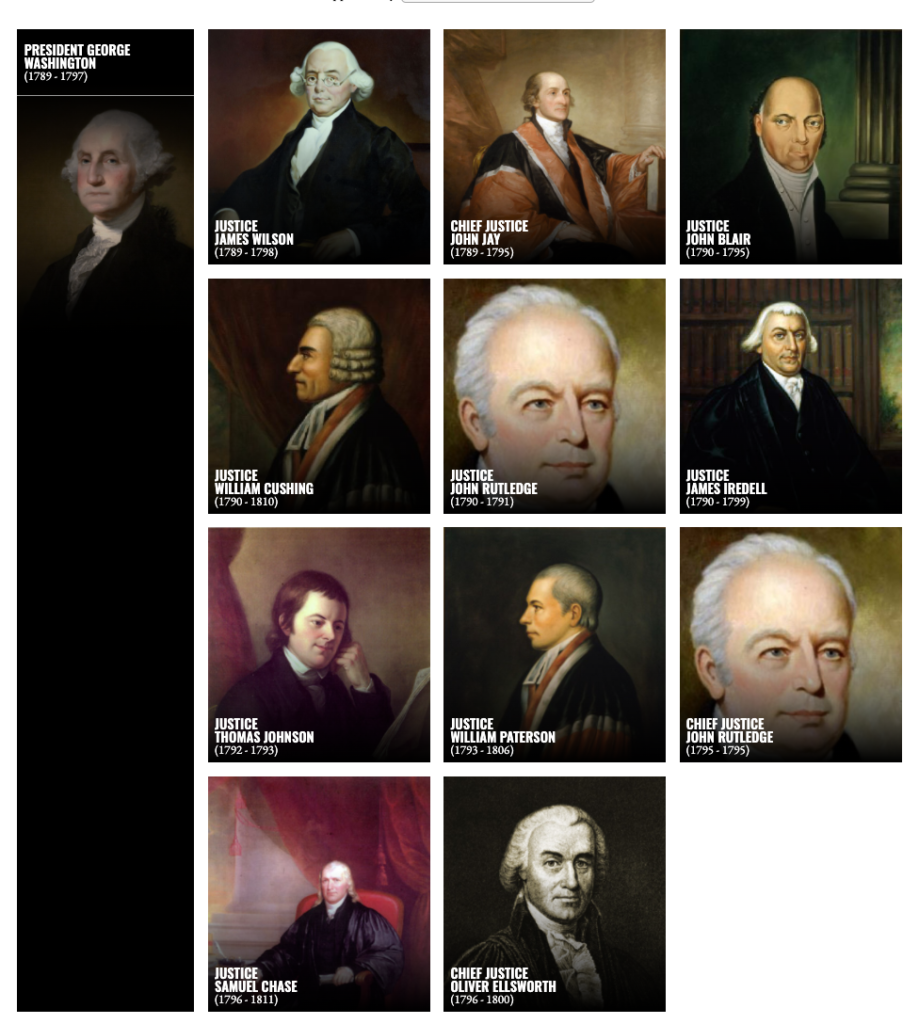
4/30/1789: President Washington's inauguration. He would appoint eleven members to the Supreme Court: Chief Justices Jay, Rutledge, and Ellsworth, and Justices Wilson, Blair, Cushing, Rutledge, Iredell, Johnson, Paterson, and Chase.
Libertarians have historically had an ambivalent and occasionally even antagonistic attitude towards higher education, in part because academics and administrators are overwhelmingly left-wing, including many who have a deep antipathy to libertarianism. That hostility, of course, is sometimes reciprocated.
Some libertarian criticisms of universities are well-founded. But it's also important for libertarians (and others) to recognize that the net effect of higher education is to make people more libertarian! A large-scale new study of British college graduates by political scientist Ralph Scott confirms and extends previous findings from the United States. Here is his summary of the results:
An individual's level of education is increasingly significant in explaining their political attitudes and behaviour, with higher education proposed as a new political cleavage. However, there is limited evidence on the causal effect of university on political attitudes, due to self-selection into educational pathways. Addressing this gap, this article estimates the change in political values that occurs within individuals who graduate from university by applying longitudinal modelling techniques to data from the 1970 British Cohort Study, overcoming the selection problem by accounting for time-invariant confounding. It provides the first causal estimate of higher education specifically, finding that achieving a degree reduces authoritarianism and racial prejudice and increases economic right-wing attitudes. This has important implications for the study of politics: as populations become more highly educated on average, we should expect continuing aggregate value change towards lower levels of authoritarianism and racial prejudice, with significant consequences for political behaviour.
By "economic right-wing attitudes" Scott essentially means support for free markets and limitations on government spending and regulation. By "authoritarianism," he means not support for dictatorship, but "support for social order over individual liberty," including on such things as weakening protections for criminal defendants, and the censorship of media to uphold traditional moral standards. This use of the term "authoritarian" is common in academic social science, though it is can be confusing for nonexperts. "Racial prejudice" means roughly the same thing as in ordinary usage. Among the questions Scott uses to measure it is opposition to interracial marriage and to people of a different race moving into your neighborhood.
On all three dimensions Scott finds that higher education moves people towards more libertarian positions, even if he doesn't use that term. For obvious reasons, libertarians oppose most government intervention in the economy and on "social" issues. Libertarianism is also deeply at odds with racial bigotry, which is both intrinsically inimical to an ideology that emphasizes individual rights over ethnic group loyalty (Ayn Rand rightly called racism "the lowest, most crudely primitive form of collectivism"), and a major source of oppressive government policies.
In each case, the impact of higher education holds true, even after controlling for other variables, including the student's family background and pre-college attitudes.
As Scott notes, these findings are consistent with those of previous research on the impact of higher education in the United States. Much of the latter research is summarized by libertarian economist Bryan Caplan in his important 2018 book, The Case Against Education (which I reviewed here). As the title indicates, Caplan is far from uncritical of higher education. But he does acknowledge its libertarianizing impact.
Scott discusses some possible reasons why higher education leads to more libertarian attitudes. With respect to racism and "authoritarianism," one obvious reason is that these ideas are decried by most academics and university administrators. In addition, going to college can expose students to people from different racial and ethnic backgrounds with whom they share common interests. They may take classes together, participate in extracurricular activities, and so on. This may lead them to realize they have more in common than previously thought, thereby breaking down some of the natural human tendency towards suspicion of members of "out" groups.
Perhaps the most surprising finding of this and previous studies is that college education increases pro-free market economic beliefs. Obviously, that is not the view of the vast majority of faculty and administrators, and probably not the effect that most want to have on students.
The causes of this tendency are far from fully understood. But one factor may be courses in economics and finance, which many students take. Data indicates that studying economics increases pro-free market attitudes among students, even though the vast majority of economics professors are far from libertarian. Even left-liberal economics professors usually cover a variety of free market ideas in their courses. Many of these are counter-intuitive, and cut against the tendency to believe that the economic world is a zero-sum game in which government intervention is routinely needed to protect some groups against others.
Obviously the vast majority of UK and US college graduates are not libertarian. Studies like Scott's do not show that higher education makes people full-blown libertarians; it has that effect only on a small minority. Rather, the point is that it tends to make people more libertarian than they would be otherwise.
For libertarians, the implication of this research is not only that we should have a more favorable view of higher education, but that the university world is potentially fertile ground for recruiting new supporters. A group (students) that is already moving in an incrementally libertarian direction on many issues can more easily be influenced to go further than most other segments of society. This factor works in tandem with the reality that younger people are, on average, less set in their views than older ones, and thus easier to persuade to consider new ideas. Libertarians would do well to increase investment in groups like Students for Liberty and the Institute for Humane Studies, which focus on outreach to students and younger academics.
Another useful lesson for libertarians here is that, at least among the young, support for economic liberty tends to rise in tandem with racial and ethnic tolerance and with support for social freedom. Around the world, ethno-nationalist and socially conservative political movements tend to view economic liberty with suspicion, when they are not outright hostile to it. They fear (often rightly) that economic freedom will undercut some traditional values, and also break down the ethnic and cultural barriers nationalists value. Thus, it is no surprise that the US Republican Party has become more hostile to free markets and property rights as it has become more nationalistic. Right-wing nationalist movements in Europe, such as Viktor Orban's movement in Hungary, and Marine Le Pen's National Rally in France (formerly called the National Front) are also economically statist.
The link between conservative nationalism and statism was long ago noted by the great libertarian economist F.A. Hayek:
Connected with the conservative distrust if the new and the strange is its hostility to internationalism and its proneness to a strident nationalism…. It is no real argument to say that an idea is un-American, or un-German, nor is a mistaken or vicious ideal better for having been conceived by one of our compatriots.
A great deal more might be said about the close connection between conservatism and nationalism . . . I will merely add that it is this nationalistic bias which frequently provides the bridge from conservatism to collectivism: to think in terms of "our" industry or resource is only a short step away from demanding that these national assets be directed in the national interest [by the government].
This does not prove there can never be any useful cooperation between libertarians and conservatives. Still less does it prove that the former will always see eye to eye with the political left. But it does suggest that cosmopolitan liberals have more affinity for free markets than nationalistic conservatives.
None of the above should cause libertarians to ignore the many flaws of the higher education system. It remains true that there is lots of wasteful spending in academia, that many faculty and administrators behave badly in various ways, and that too many are intolerant of opposing views (including, in some cases, libertarian ones).
These findings do not even prove that libertarians (or anyone else) should necessarily want to increase the percentage of high school graduates who go on to get college degrees. For many people, the benefits of higher education are likely to be outweighed by costs. There is a lot of truth to Bryan Caplan's critique of the education system along those lines.
But libertarians should be aware of the ideological impact of higher education and the ways in which it helps our cause. And we should adjust our political strategy accordingly.
While Scott's and other scholars' findings on the effects of higher education should cheer libertarians (who haven't had much else to cheer about in recent years!), they are bad news for right-wing nationalists. The latter's growing hostility towards the university world is somewhat understandable. Not only is academia filled with people who oppose their values. It also tends to influence students against them.
For left-wingers, the findings are equivocal. They should be happy to see that going to college moves people what they see as the right direction on "authoritarianism" and rejection of racism. But, obviously, they are likely to decry the impact on students' economic policy views.
If you enjoy audio books and you're interested in history, here is the first in a series of recommended books, based on what I have listened to in the past several years. All of these books are, in my opinion, well-narrated and informative. All are available from Audible.com.
Favorites
Bonnie Prince Charlie. By Carolly Erickson. Narrated by Steven Crossley. In the United Kingdom's Glorious Revolution of 1688, the despotic Catholic King James II was forced to flee to France. From the continent, he and his descendants schemed about how to reclaim their throne. Eventually, James's son, who styled himself James III, ended up living in Italy and married to a Polish princess. Their son, "Bonnie Prince Charlie," snuck away from home to launch an audacious invasion of Scotland in 1745. Although much of the invasion fleet sank, the dashing and vigorous young prince rallied the Scottish Highlanders to his cause. Soon, he had conquered most of Scotland, and was within 100 miles of London. Although he was eventually defeated (a happy result, in my view), his biography is a wonderful tale of bravery and daring.
Empire: How Britain Made the Modern World. By Niall Ferguson. Narrated by Jonathan Keeble. The British Empire started out as an effort to molest Spanish holdings in the New World. After the British lost their empire in America, they built a new one based in India. Ferguson describes the complete story, both the bad and the good. On the whole, the British Empire treated its subjects better than did the competing empires. Often but not always, it brought many improvements, including in human freedom, to the places it ruled. Read More
A reminder from Judge Paul Byron (M.D. Fla.) in Edgar County Watchdogs, Inc. v. Kurowski. My sense is that a judge's willingness to expressly say this in an order shows that he's more than a little annoyed with the offending behavior.
Please enjoy the latest edition of Short Circuit, a weekly feature from the Institute for Justice.
Is there such a thing as the "Will of the People"? Over at Liberal Currents, Anthony Sanders, the director of IJ's Center for Judicial Engagement, humbly submits that if there is one it's an indeterminate mist—and, moreover, that judges do a lot of harm by attempting to divine the People's Will instead of dispassionately interpreting the law.
First Circuit: We're going to reinstate this First Amendment lawsuit by Courthouse News Service, seeking faster access to newly filed complaints in state court. (But we'll also note in passing that when the Seventh Circuit considered the same issue, it abstained.)
After being struck in the head with a metal handlebar, called the n-word, and having his life threatened by four white men in Lewiston, Me., Black man retrieves a gun from his home nearby, returns to the scene, and fires a shot into a dirt pile. For this, he is convicted and sentenced to three years in prison. First Circuit: It's concerning that, among other things, the only Black potential juror in the 32-person venire was struck for a seemingly trivial reason, only having an 11th grade education. But habeas denied.
If you saw two guys named Sex Offender and Political Speaker, which one would you think got meaningful, evidence-focused judicial review of their right to engage in anonymous online speech? We'd say Political Speaker, wouldn't you? Second Circuit: You'd be wrong, though. It's Sex Offender.
After the plaintiff prevails at summary judgment in his due-process challenge to North Carolina's sex-offender registry, the state legislature changes the law to fix the due-process problems. That means the judgment, which was still on appeal, is vacated as moot. State officials: And that means the plaintiff doesn't get attorney's fees because he isn't a "prevailing party" anymore. Fourth Circuit: Did you guys miss the part where he prevailed? It's right there in the first sentence.
Allegation: After reporting sexual harassment by a supervisor, federal public defender in North Carolina is, among other things, retaliated against and effectively forced to resign. Fourth Circuit (sans any Fourth Circuit judges): Some of her constitutional claims should not have been dismissed.
LEGAL ALERT! Are you a West Virginia lawyer who does plaintiffs-side drug and device product liability lawsuits? Do you like to run advertisements featuring the logos of gov't agencies like the FDA? Have you been ordered to STOP using the word "recall" in reference to things that have not been recalled? If so, contact your local federal appellate court to find out if your First Amendment rights have been violated. (Fourth Circuit: They have not.)
Allegation: Without warning, Baytown, Tex. police violently yank woman, who is perhaps drunk but in no way threatening, to ground. Excessive force? District court: Could be! Fifth Circuit: Reversed. She was awfully mouthy and the police only hurt her a little, so the force wasn't excessive. Besides, qualified immunity means we don't judge officers' actions with the benefit of hindsight. [Ed.: Nuh-uh.]
During plea bargaining, prosecutors will often offer criminal defendants an escape from unconscionably long mandatory minimum sentences if they waive their right to appeal their conviction or challenge it on collateral review. It's a system that's ripe for abuse and coercion. But, per the Sixth Circuit, that's no reason for a district judge to have a blanket rule against approving plea deals that contain these waivers. Mandamus-ed!
To pay for the cost of their incarceration, Minnesota officials deduct up to 50 percent of sexually dangerous civil detainees' $10/hour wages (for labor including cooking, cleaning, woodworking, and sign manufacturing). A minimum-wage violation? Eighth Circuit: They aren't employees, so no.
District court: California prison officials must adopt a statewide policy mandating COVID-19 vaccinations for all staff (with medical and religious exemptions). Ninth Circuit: Vacated. The current policy (in which unvaccinated staff are regularly tested and all prisoners can get vaccinated) may not be the most medically efficacious, but that does not mean it violates the Eighth Amendment.
Man uses Yahoo and Facebook to organize trips to the Philippines for underage encounters and to receive underage porn. Both services find evidence of this and kind of on their own initiative, but kind of because of federal laws, pass it on to the FBI. Fourth Amendment violation? Ninth Circuit: No state action so it's fine. Dissent: That's true for Facebook, but not for Yahoo. Orin Kerr: "Holy crap," this case just made some crazy-wild law on digital seizures and terms of service without the judges even realizing it.
Woman purchases home in Los Angeles next-door to a detective and her family—whom she soon discovers to be neighbors from hell. They park on her driveway, hose their dog's droppings onto her property, and call police on her on multiple occasions. In one incident, they alleged that she tried to run over the detective's daughter; she's arrested but later declared factually innocent thanks to a surveillance video. In another, they alleged that she stabbed the detective's husband. (He was not stabbed.) Did the detective violate the Fourth Amendment by procuring a false arrest? Jury: Sure did, have $3 mil for the trouble. Huzzah! Can she take their home to collect on the judgment? Ninth Circuit: Sure can.
From 2017 to 2020, Espanola, N.M. officials repeatedly refuse to turn on water unless new homeowners pay off the previous owner's water bill. And, says the city, that means they can't sue in 2020 because the statute of limitations started running in 2017. Tenth Circuit: But the "repeated violation" doctrine (which is different, of course, from the "continuing violation" doctrine) salvages at least some of the homeowners' claims.
Man charged with particularly heinous crimes is allegedly advised by counsel not to accept plea deals for 15-, 10-, and 8-year sentences because the gov't doesn't have the evidence convict. It does, and he gets a 30-year sentence. Tenth Circuit: Could be the man's Sixth Amendment rights were violated.
And in en banc news, the Fifth Circuit will not reconsider its ruling that an internet troll cannot sue the HuffPost in Texas for libel (for calling him a Holocaust denier) as HuffPost is based in New York and incorporated in Delaware. Dissental: But it has Texas readership and Texas-specific advertising, and, as a Texas resident, he was largely injured in Texas.
And in more en banc news, the Sixth Circuit will not reconsider its ruling forgiving the feds' failure to timely argue that a vehicle passenger lacked Fourth Amendment standing to challenge a search of the car.
And in amicus appearance news, next week IJ will argue to the Fourth Circuit that the feds can't forfeit $69k cash because they didn't prove—or even specify—the crime they believe the property owner committed. (He did drunkenly crash his car into a concrete pillar, but that's not something that gives rise to a federal forfeiture.) Under the Civil Asset Forfeiture Reform Act of 2000, the burden is on the gov't to affirmatively prove forfeitability, and the district court erred by instead putting the burden on the owner to defend against the gov't's speculation and conjecture.
Victory! In 2015, officials in Zion, Ill., passed an ordinance requiring that renters (of whom the mayor said there were too many) submit to warrantless interior home inspections on pain of $750-per-day fines against their landlords, who could also lose their right to rent the property. (One landlord was fined the astronomical sum of $114k!) But last week—following a federal judge's refusal to dismiss a challenge to the ordinance last year—the city amended its ordinance. Now inspectors will need either a warrant or consent to enter a home. The suit will proceed, however, on the question of whether IJ's clients are entitled to declaratory relief and damages for past Fourth Amendment injuries. Click here to learn more.
A statement from FIRE, which I think is generally quite right:
Today, FIRE wrote New York University School of Law urging it to end an investigation into complaints of harassment based on a statement by Law Students for Justice in Palestine criticizing Zionists. Although some were offended by LSJP's statement — which made several allegations including that the "Zionist grip on media is omnipresent" and that "people living under occupation have a right to resist their violent occupation" — it remains core political expression protected by NYU's clear commitments to students' expressive rights.
The statement from NYU's LSJP chapter came two hours after an April 7 email from NYU's Law Students for Israel, which stated, in part, "Few countries have faced as much violence, hatred, and delegitimization as the State of Israel." The statement also said: "The Middle East is big enough for all its indigenous peoples to enjoy self-determination, security, and prosperity. Do not give credence to those, including in our Law School, who say otherwise."
LSJP's response said Law Students for Israel "flips the realities of aggressor and victim on its head," and criticized Israel as an "apartheid regime."
LSJP went on to say the media "craft a narrative of necessary 'self defense' and 'security'" and Zionists suppress "evidence of their own violence, occupation, and dehumanization." The statement also said, "Zionists falsely equate Palestinian resistance and Israeli oppression as a 'conflict' with two sides."
The Washington Free Beacon reported that 11 student groups subsequently expressed support for LSJP's statement. However, in the latest example of students turning to administrators to try to silence differing opinions on the Israeli-Palestinian conflict, some students submitted complaints to NYU administrators alleging that LSJP's statement and support of it amounted to harassment. The university then said it would investigate, "as required by [its] policies."
Earlier this month I noted Judge Bill Pryor's recent Federalist Society lecture, "Against Living Common Goodism," criticizing Harvard law professor Adrian Vermeule's Common Good Constitutionalism. Professor Vermeule and Conor Casey of the University of Liverpool School of Law & Social Justice have now replied in an essay forthcoming in the Harvard Journal of Law & Public Policy Per Curiam. Here is the abstract from SSRN:
This short essay responds to several lectures and talks given by Chief Judge William Pryor Jr. of the United States Court of Appeals for the 11th Circuit critiquing common good constitutionalism. We demonstrate that the arguments advanced by Chief Judge Pryor in favor of originalism badly misfire, permit the very things Judge Pryor wants to rule out, and beg the critical questions about the classical tradition. In the end, they amount to little more than argument by slogan.
Meanwhile, Liberty Fund's Law & Liberty site has posted "A Return to Classical Law?", a symposium on Vermeule's book, with contributions from several noted scholars. These contributions are as follows:
The Georgetown Journal of Law & Public Policy has published the new article I co-authored with Seth Barrett Tillman: "The Unresolved Threshold Issues in the Emoluments Clauses Litigation: The President Has Three Bodies and There Is No Cause of Action for Ultra Vires Conduct."
The federal courts never fully settled the nature of suits brought against the President based on the Foreign Emoluments Clause. Moreover, the federal courts still have not fully settled whether a cause of action exists to challenge ultra vires conduct--and no, it is not enough to just say "equity!" Our piece should have relevance for future litigation against presidents.
Here is the abstract:
Shortly after President Trump's January 2017 inauguration, he was sued for violating the Foreign and Domestic Emoluments Clauses. The plaintiffs alleged that Trump's acceptance of profits from foreign and U.S. state governments violated these once-obscure provisions of the Constitution. We filed amicus briefs in these cases, and made two arguments that had implications for separation of powers jurisprudence.
First, the Plaintiffs erred by suing President Trump in his "official capacity." Under settled case law, a government officer violates the Constitution in his official capacity if—and only if—a government policy or custom must have played a part in the violation of federal law. Still, the Plaintiffs never alleged that President Trump acted pursuant to any government policy or custom. Nor did the Plaintiffs allege that Trump acted "under the color of law"—a precondition for pleading an individual-capacity claim. Rather, the case concerned alleged conduct that President Trump took personally. With respect to the Emoluments Clauses, the President has three bodies and can be sued in three distinct fashions: [1] an official-capacity claim involves a government policy or custom; [2] an individual-capacity claim involves action taken by a government officer under the color or law; and [3] a personal claim involves private conduct, absent state action.
We identified a second jurisdictional problem. The Plaintiffs argued that the federal courts had equitable jurisdiction to halt ultra vires action by a government officer. To support this argument, the Plaintiffs contended that federal district courts could issue an injunction—an equitable remedy—against the President. This argument conflated equitable jurisdiction and equitable relief. A plaintiff cannot establish equitable jurisdiction merely by seeking equitable relief. Rather, the plaintiffs must invoke a traditional equitable cause of action that was judicially recognized by 1789, or a cause of action that was created by Congress or the courts. The Supreme Court has not recognized a free-floating equitable cause of action to challenge ultra vires conduct by government officers.
Ultimately, the Supreme Court did not settle these issues, or any others presented by the Emoluments Clauses litigation. After President Biden's inauguration, the Supreme Court vacated the lower-court judgments that ran against the President, and ordered the courts of appeals to dismiss the cases as moot.
As the Emoluments Clauses litigation fades in the rear-view mirror, this Article offers a retrospective of these two unresolved threshold issues. Our article also provides some guidance on how to litigate future allegations that the President personally violated the Constitution.
I've been blogging this week about church autonomy. So far my posts have been based on my new paper on "The Limits of Church Autonomy." In this post I'm going to leave the subject of the paper to talk about another issue in the church autonomy caselaw, one that's a bit in the weeds of civil procedure but really matters. (This post is based on a recent symposium presentation I gave at Loyola Chicago; I'm currently writing up a longer version of this for the symposium issue of the Loyola Chicago Law Journal.)
Courts are divided about whether church autonomy is jurisdictional in a more technical and procedural sense. For a while, the federal courts were split as to whether church autonomy should be raised as a jurisdictional challenge under Rule 12(b)(1) or as an affirmative defense under Rule 12(b)(6). Alongside the courts that agreed that church autonomy was jurisdictional were others that denied church autonomy fit the description of jurisdictional.
Why it matters
In many cases it doesn't really matter whether church autonomy is jurisdictional or an affirmative defense. But it does matter in answering the following questions:
Must church autonomy be resolved at the earliest possible opportunity?
Can a denial of church autonomy be subject to an interlocutory appeal?
Can church autonomy be raised at any time in the proceedings?
[I blogged an early draft of this essay three months ago, but I've revised it extensively since then. I'd love to hear any suggestions people might have; I still have a few weeks to edit it before it's put to bed. You can also read the whole thing in a 16-page PDF.]
An entity—a landlord, a manufacturer, a phone company, a credit card company, an Internet platform, a self-driving car manufacturer—is making money off its customers' activities. Some of those customers are using the entity's services in ways that are criminal or tortious. Should the entity be held responsible, legally or morally, for its role (however unintentional) in facilitating its customers' activities? This question has famously been at the center of the debates about platform content moderation,[1] but it can come up in other contexts as well.[2]
This is a broad question, and there might be no general answer. (Perhaps it is two broad questions—one about legal responsibility and one about moral responsibility—but I think the two are connected enough to be worth discussing together.) In this essay, though, I'd like to focus on one downside of answering it "yes": What I call the Reverse Spider-Man Principle—with great responsibility comes great power.[3] Whenever we are contemplating holding entities responsible for their customers' behavior, we should think whether we want to empower such entities to surveil, investigate, and police their customers, both as to that behavior and as to other behavior.[4]
Of course, some of the entities with whom we have relationships do have power over us. Employers are a classic example: In part precisely because they are responsible for our actions (through principles such as respondeat superior or negligent hiring/supervision liability), they have great power to control what we do, both on the job and in some measure off the job.[5] Doctors have the power to decide what prescription drugs we can buy, and psychiatrists have the responsibility (and the power) to report when their patients make credible threats against third parties.[6] And of course we are all within the power of police officers, who have the professional though not the legal responsibility to prevent and investigate crime.
On the other hand, we generally don't expect to be in such subordinate relationships to phone companies, or to manufacturers selling us products. We generally don't expect them to monitor how we use their products or services (except in rare situations where our use of a service interferes with the operation of the service itself), or to monitor our politics to see if we are the sorts of people who might use the products or services badly. At most, we expect some establishments to perform some narrow checks at the time of a sale, often defined specifically and clearly by statute, for instance by laws that require bars not to serve people who are drunk or that require gun dealers to perform background checks on buyers.[7]
Many of us value the fact that, in service-oriented economies, companies try hard to do what it takes to keep customers (consider the mentality that "the customer is always right"), rather than expecting customers to comply with the companies' demands. But as we demand more "responsibility" from such providers, we push them to exercise more power over us, and thus fundamentally change the nature of their relationships with us. If companies are required to police the use or users of their products and services—what scholars have called "third-party policing"[8]—then people's relationship with them may become more and more like people's relationship with the police.