

The Volokh Conspiracy

Mostly law professors | Sometimes contrarian | Often libertarian | Always independent | Est. 2002

The Volokh Conspiracy

Are Chinese gamers leaking China's military secrets?

Episode 410 of the Cyberlaw Podcast

|

If you've been worrying about how a leaky U.S. government can possibly compete with China's combination of economic might and autocratic government, this episode of the Cyberlaw Podcast has a few scraps of good news. The funniest, supplied by Dave Aitel, is the tale of the Chinese gamer who was so upset at the online performance of China's tanks that he demanded an upgrade. When it didn't happen, he bolstered his argument by leaking apparently classified details of Chinese tank performance. The story inspires me to suggest that U.S. intelligence should be subtly degrading the online game performance of other Chinese weapons systems that we need more information about.

There may be similar comfort in the story of Gitee, a well-regarded Chinese competitor to Github that ran into a widespread freeze on open source projects. Jane Bambauer and I speculate that the source of the freeze was a government objection to the code or the comments in several projects. And in the long run, guessing at what it takes to avoid future government freezes will handicap China's software industry and make Western companies more competitive.

In other news, Dave unpacks the widely reported and largely overhyped story of Cyber Command conducting "hunt forward" operations in support of Ukraine.

Mark MacCarthy digs into Justice Samuel A. Alito Jr.'s opinion explaining why he would not have reinstated the district court injunction against Texas's social media regulation. Jane and I weigh in. The short version is that the Alito opinion offers a plausible justification for upholding the law. It is not be the law now, but it could be the law if Justice Alito can find two more votes. And getting those votes may not be all that hard -- at least for an opinion upholding more transparency requirements for social media companies.

Mark and Jane also dig deep into the substance and politics of national privacy legislation. Short version: House Democrats have made substantial concessions in the hopes of getting a privacy bill enacted before they must face what's expected to be a hostile electorate. But Senate Democrats may not be willing to swallow those concessions, and Republican members may think they will do better if they wait until after November. Impressed by the concessions, Jane and Mark hold out hope for a deal this year. I don't.

Meanwhile, Jane notes, California is driving forward with regulations under its privacy law. perhaps helping to persuade Republicans that preemption has lots of value for business.

Finally, revisiting two stories from earlier weeks, Dave notes

Download the 410th Episode (mp3)

You can subscribe to The Cyberlaw Podcast using iTunes, Google Play, Spotify, Pocket Casts, or our RSS feed. As always, The Cyberlaw Podcast is open to feedback. Be sure to engage with @stewartbaker on Twitter. Send your questions, comments, and suggestions for topics or interviewees to CyberlawPodcast@steptoe.com. Remember: If your suggested guest appears on the show, we will send you a highly coveted Cyberlaw Podcast mug!

The views expressed in this podcast are those of the speakers and do not reflect the opinions of their institutions, clients, friends, families, or pets.

Free Speech

New N.Y. Law Aimed at Getting Social Media Platforms to Restrict "Hateful" Speech

Its operative provisions just require social media platforms to create a mechanism for taking complaints about such "hateful" speech; but the title is "hateful conduct prohibited," and it's clear the legislature is trying to get social media platforms to restrict such speech more.

|

N.Y. General Business Law § 394-ccc, just signed by the Governor yesterday (AB A7865A / SB S4511A) and scheduled to go into effect in six months, provides:

Social media networks; hateful conduct prohibited.

  1. As used in this section, the following terms shall have the following meanings:
    1. "hateful conduct" means the use of a social media network to vilify, humiliate, or incite violence against a group or a class of persons on the basis of race, color, religion, ethnicity, national origin, disability, sex, sexual orientation, gender identity or gender expression.
    2. "social media network" means service providers, which, for profit-making purposes, operate Internet platforms that are designed to enable users to share any content with other users or to make such content available to the public.
  2. A social media network that conducts business in the state, shall provide and maintain a clear and easily accessible mechanism for individual users to report incidents of hateful conduct. Such mechanism shall be clearly accessible to users of such network and easily accessed from both a social media networks' application and website, and shall allow the social media network to provide a direct response to any individual reporting hateful conduct informing them of how the matter is being handled.
  3. Each social media network shall have a clear and concise policy readily available and accessible on their website and application which includes how such social media network will respond and address the reports of incidents of hateful conduct on their platform.

Read More

Supreme Court

"The Possibility of Prosecuting Federal Court Leakers—Update & Rejoinder"

Former prosecutors Markus Funk and Andrew S. Boutros, and Judge Virginia Kendall, delve further into this fascinating question.

|

I much appreciate their writing this, and am delighted to pass it along:

We are grateful to Professor Volokh for featuring our June 1 Wall Street Journal op-ed (and, previously, our Bloomberg Law article) questioning common claims that there is no federal law criminalizing the leaking of court-sensitive information, such as a draft Supreme Court opinion. In his parting comments on the WSJ piece, Eugene observes that he is "not sure how viable these arguments are," and then observes two discrete issues. True to form, Eugene has kindly afforded us an opportunity to respond.

Let us kick things off by some early, but necessary, scene (re-)setting. The goals of our articles were modest. We read the near-unanimous claims, advanced in outlets ranging from the Washington Post, Reuters, and Wired to USA Today, PolitiFact, Fox, and Bloomberg, that "leaking [court-sensitive information]" is not—and, indeed, could likely never be—a crime. Could this steady drumbeat of headlines possibly be accurate? And is there really a need for the proposed "Leaker Accountability Act of 2022" designed to, per The Hill, "criminalize Supreme Court leaks"?

We conducted some research into whether federal law clerks (and, for that matter, other chambers staff) at the Supreme Court or in the lower courts could share court-sensitive information with the outside world without fear of prosecution. We then decided to put "pen to paper" regarding our findings (subject, of course, to unyielding word-count maximums).

Our conclusion was that, with the exception of Andrew McCarthy and a few others, most in the legal commentariat jumped the gun. Depending on how the all-important facts turn out, we believe the following statutes could all be in play when a member of a federal judge's staff, including a law clerk, leaks court-sensitive information: 18 U.S.C. §§ 371 (conspiracy), 641 (theft of government property/information), 1001 (false statement), 1512 (corruptly influencing an official proceeding), and 1905 (disclosure of confidential information). (For present purposes we assumed that a Justice did not leak the draft Supreme Court opinion. As such, we did not address what, if any, consequences such a Justice could face, especially given the Constitutional dimensions of the question.)

Read More

Free Speech

What are Georgetown Professors Forbidden to Say?

Under the reasoning of the Georgetown University Office of Institutional Diversity, Equity & Affirmative Action (IDEAA) report in the Ilya Shapiro matter, a wide range of public speech criticizing religions, political parties, veterans, etc. could be "prohibit[ed] harassment."

|

Ilya Shapiro, as many of you know, was suspended and investigated by the Georgetown law school—where he had been about to start a job as a lecturer and as executive director of the Georgetown Center for the Constitution—for tweeting the following about the Ketanji Brown Jackson nomination:

Objectively best pick for Biden is Sri Srinivasan, who is solid prog & v smart. Even has identity politics benefit of being first Asian (Indian) American. But alas doesn't fit into the latest intersectionality hierarchy so we'll get lesser black woman. Thank heaven for small favors?

Because Biden said he's only consider[ing] black women for SCOTUS, his nominee will always have an asterisk attached. Fitting that the Court takes up affirmative action next term.

Last week, the Georgetown dean announced that Shapiro wouldn't be disciplined for this Tweet, on the grounds that "As Mr. Shapiro posted the tweets on January 26, 2022, but his employment did not start until February 1, 2022, IDEAA and HR concluded that Mr. Shapiro was not a Georgetown employee at the time of his tweets." Shapiro then quit, saying he didn't want to work in such an environment.

But whatever you might think about what happened to Shapiro, this incident also produced a report from the IDEAA office that deals with all of Georgetown, not just the law school. (I've received a copy, on condition that I can quote it but can't post it.) And this tells us about much more than just the Shapiro incident: It gives us a good sense about what all Georgetown professors are, at least ostensibly, forbidden from saying. I'd like to use this post to explore that.

Read More

Slippery Slope Arguments

Slippery Slope Arguments in History: 1823

|

From Harrington v. Commissioners of Roads of Newberry District. (S.C. Const. Ct. App. 1823), an opinion dealing with whether a court clerk should be seen as explicitly exempted from the then-existing common duty of working on road construction:

If once the door be opened, by construction, for any officer to escape from the duties of the citizen, the lock is not opened, but the key is useless, and the bolt broken; and however narrow the first opening, there will never be wanting hands to push it wide, and those will be the hands of the strong, the sagacious, and the interested.

If the clerk were to be the only officer thus privileged, I should not greatly regard it, but the peculiar reason given for this exemption will not be regarded. The principle received, will, and must be, that an officer understood to be occupied in his official duties becomes exempt, whether it appeared by statute or common law….

[S]omething peculiar may be found in every case, and future judges will look to the principle alone, and lay aside the guards and qualifications. The people will not comprehend such subtleties. The practice of the country will be upon the general principle. Other officers will be excused and considered exempt. Some circuit decisions will be predicated upon the habit of expectations of the country.

Finally, another qualified decision will creep in, and the two will be enough to beget a race of exempts that may put at defiance the principle to which we are allowing only one harmless exemption. But these little exemptions in favor of individual privileges are as contagious as the leprosy….

A principle once surrendered in a particular case is no longer firm, but trembles at every new attack. As then, in treating of great principles, we would willingly say, "esto perpetua [let it be perpetual -EV]:"  So in resisting the first encroachments, our rule should be "obsta principiis [resist at the beginning -EV]."

"Stop innovation in its early stage,
For when the upstart thing grows strong from age,
No time, nor strength of tenets stop its rage."

Free Speech

Court Rejects RICO and Fraud Claims Against Reputation Management Company

|

From Murrey v. Minc, decided Friday by Judge Analisa Torres (S.D.N.Y.):

Plaintiff pro se, Stewart Murrey, brings claims against Defendants Aaron Minc, Minc Law, Domingo J. Rivera, Rivera Law Group, PLC, PRVT L.L.C., Elizabeth Jordan, Internet Reputation Control, Anthony Will, Digital Revolution LLC, Brandyourself.com, Inc., Tom Vitolo, Christian Tyron, and John Does 1–10 for violations of the Racketeer Influenced and Corrupt Organizations Act ("RICO"); California's unfair competition law (the "UCL"); and California's statutory and common law right of publicity; and claims for common law fraud and civil conspiracy….

{The following facts are taken from the [Complaint], which the Court accepts as true for purposes of this motion.}

Beginning in late 2016, a series of allegedly defamatory comments about Plaintiff were posted on the website www.cheaterreport.com …, along with photographs taken from Plaintiff's personal website, dating profiles, and social media platforms. These posts "consumed" all other search engine results for Plaintiff's name, which "severely harm[ed] his reputation and end[ed] his ability to earn money."  The comments on the Website ultimately led to Plaintiff's being arrested twice, once in 2017 and once in 2018, and Plaintiff's filing of two false arrest lawsuits, which were subsequently settled.

From 2017 to 2019, Defendants and others "solicited and received" thousands of dollars from Plaintiff to "remove online libel and rehabilitate [his] online reputation." Plaintiff alleges that although Defendants and others represented to him that they had no connection to the Website, they were actually in cahoots with the Website, "work[ing] illegally with other individuals and business entities operating and maintaining [the Website]" and giving "kickbacks to the Website's operators….

No dice on the RICO claim, the court held:

Read More

Slippery Slope Arguments

Slippery Slope June: Legal-Cost-Lowering Slippery Slopes

|

[This month, I'm serializing my 2003 Harvard Law Review article, The Mechanisms of the Slippery Slope; in last week's posts, I laid out some examples, definitions, and general observations, and turned to a specific kind of slippery slope mechanism—cost-lowering slippery slopes. This week, I'll elaborate on that, and shift to some other mechanisms.]

Let us briefly revisit the argument that gun registration may increase the chances of gun confiscation. Today, gun confiscation would be hard to enforce, partly because of the Fourth Amendment. Searching all homes for some or all kinds of guns would be unconstitutional, a classic impermissible general search. This, in a sense, is a cost of confiscation—not a financial cost, but a legal cost that keeps confiscation from being performed efficiently.

{The legislature might still enact a gun ban, hoping that nearly all owners will voluntarily comply, planning to rely on informers, or recognizing that the ban would only be enforced gradually, as the gun owners somehow reveal themselves—for instance, by using a gun, either defensively or offensively. But such a legislative decision will be made less likely by the difficulty of enforcement, the public distaste for reliance on informers, and the possible public hostility to punishing even illegal gun owners when their gun ownership is revealed as a result of a legitimate defensive use.}

If, however, guns are first successfully registered, and are later banned, a house-to-house search of the homes of registered owners who haven't turned in their guns may well become constitutional. Your registration as the owner of a weapon may be seen as probable cause to believe that you have it; and one place you're likely to be keeping it is your home. This isn't a certainty—maybe the gun was stolen or lost, and you didn't report this to the police, or maybe you're keeping the gun in some other location—but a magistrate may find that it suffices for probable cause and issue a search warrant that would let the police search your home for the gun.

So gun registration (legislative decision A) would likely lead to some degree of public compliance with the registration requirement. This compliance has the legally significant effect of creating probable cause to search all registrants' homes, once guns are banned. This legally significant effect makes it easier to enforce the gun ban—thus making it more likely that such a ban will be enacted (legislative decision B).

Read More

Is This Legal Doctrine a Garlic Press?

|

Have you ever heard a legal scholar criticize a doctrine because it does several different things, but it isn't really good at any one of those things? That kind of criticism of a doctrine is much less common from a judge. Why is that? If you want the answer to these questions, there's a Green Bag article I wrote a few years ago called On Doctrines That Do Many Things. It starts this way:

Every kitchen has two kinds of tools. Some of these tools do many things well, like a chef's knife. Other tools do only one thing, but they are meant to do that one thing exceedingly well, like a garlic press. The same distinction appears in legal doctrines. Some doctrines do one thing and are meant to do it very well. Others do many different things. They serve multiple functions, though perhaps all imperfectly.

Free Speech

New Haven's Removal of Columbus Statue from Public Park Isn't a First Amendment Violation

|

From Friday's decision by Judge Janet C. Hall (D. Conn.) in American Italian Women for Greater New Haven v. City of New Haven:

[T]he Columbus statue is government speech and, as such, AIW has no cognizable free speech interest in it. Indeed, the Supreme Court has directly foreclosed such a claim. In Pleasant Grove City, Utah v. Summum (2009), the Court "held that the messages of permanent monuments in a public park constituted government speech, even when the monuments were privately funded and donated." Where a city is "communicat[ing] governmental messages," as is the case here, it is "free to choose the [monument it displays] without the constraints of the First Amendment's Free Speech Clause." This is in contrast to when a city opens up a space "for citizens to express their own views," thereby creating a public forum and subjecting that forum to First Amendment constraints.

Here, the City has reserved the statue for its own expression and has not opened up Wooster Square for citizens to display statues of their own choosing there. Thus, the decision to display (or remove) the statue is government speech not subject to "the constraints of the First Amendment's Free Speech clause."

Clearly correct, I think. The government can choose which statues to put up and which not to put up, and does so all the time; it can likewise choose which ones to take down.

Free Speech

Targeting Employee for Op-Ed Criticizing "Anti-Racism" Because She's White May Be Race Discrimination

but because here the employer's (and union's) actions were basically just an incident of public criticism, they didn't qualify as hostile environment harassment (and the employee wasn't fired or demoted).

|

From the decision Thursday by Judge Katherine Polk Failla (S.D.N.Y.) in Maron v. Legal Aid Society:

On July 23, 2020, Plaintiff Maud Maron, a career public defender at Defendant The Legal Aid Society ("LAS"), penned an op-ed in the New York Post entitled "Racial Obsessions Make it Impossible for NYC Schools to Treat Parents, Kids As People" (the "Op-Ed"). Speaking simultaneously in her capacities as a mother, public defender, elected public school council member, and then-candidate for New York City Council, Plaintiff recounted in the Op-Ed her experience at an anti-bias training run by the New York City Department of Education ("DOE").

She decried what she perceived as DOE's endorsement of the "chilling doctrine called anti-racism," which she asserted "insists on defining everyone by race, invites discrimination[,] and divides all thought and behavior along a racial axis." Responding to the Op-Ed, the Black Attorneys of Legal Aid ("BALA"), a caucus of Defendant Association of Legal Aid Attorneys ("ALAA," or the "Union," and together with LAS, "Defendants"), issued a public statement denouncing Plaintiff's "racist" views and characterizing her "as a classic example of what 21st century racism looks like." LAS followed with its own statement, which similarly rebuked Plaintiff's "racist perspective" and questioned the ability of any public defender to "effectively and fully" engage in public interest work if they do not embrace an anti-racist mandate….

The court considered Plaintiff's Title VII claim "that the public statements issued by LAS and BALA criticized Plaintiff and her ability to work as a public defender because of her race":

[T]he LAS Statement … expressly [ties] white attorneys'—specifically Plaintiff's—ability to do the work of a public defender to whether they accept the anti-racist credo and assume the attendant responsibilities. Poignantly, the LAS Statement imposes additional obligations on white public defenders "merely because" they are white:

Read More

Guns

Pennsylvania Supreme Court Agrees to Hear Home Shooting Range Case

|

[Photo by Oleg Volk.]

From today's order granting review in Barris v. Stroud Township:

The issue, as rephrased, is:

Whether an ordinance that limits target shooting to two non-residential zoning districts, and thus does not provide for shooting ranges at all private residences, is facially unconstitutional under the Second Amendment to the United States Constitution?

In addressing this issue, the parties are directed to discuss in their briefs the following subsidiary matters: (1) whether this Court should adopt the two-step framework for addressing Second Amendment challenges utilized by the lower court; (2) whether the core Second Amendment right to possess firearms for self-defense recognized in District of Columbia v. Heller, 554 U.S. 570 (2008), also implies a corresponding right to acquire and maintain proficiency in their use; (3) whether such a corresponding right, if it exists, must extend to one's own home; and (4) the level of scrutiny courts should apply when reviewing enactments that burden individuals' ability to maintain firearms proficiency.

The lower court had allowed plaintiff's Second Amendment challenge to go forward; note that plaintiff wants to set up a range on his "4.66-acre tract of land," not (say) in a studio apartment:

Read More

Torts

Lawsuit Against Kevin Spacey for Allegedly Touching Minor's "Intimate Parts" Can Proceed

Under N.Y. law, the court holds, a jury could find that the alleged touching could qualify as touching of "intimate parts," based on its context.

|

From today's opinion by Judge Lewis Kaplan (S.D.N.Y.) in Rapp v. Fowler:

Plaintiff Anthony Rapp brings this action pursuant to New York's Child Victims Act against Kevin Spacey Fowler, better known as Kevin Spacey, for sexual assault allegedly committed in Manhattan in 1986 when Mr. Rapp was 14 years of age….

Very briefly stated, Mr. Rapp claims that Mr. Fowler lifted him up, that Mr. Fowler's hand his "grazed" Mr. Rapp's clothed buttock for seconds as he did so, that Mr. Fowler placed Mr. Rapp back­ down on a bed, and Mr. Fowler then briefly placed his own clothed body partially beside and partially across Mr. Rapp's. Mr. Rapp "wriggled out," got up, and left the premises. Mr. Rapp testified at his deposition that there was no kissing, no undressing, no reaching under clothes, and no sexualized statements or innuendo. He acknowledges that the entire incident took no more than two minutes.

The complaint alleges that Mr. Fowler's actions constituted assault, battery and intentional infliction of emotional distress. Mr. Rapp seeks compensatory and punitive damages….

Under the usually applicable New York statutes of limitations, these claims all would be time barred. In 2019, however, the Legislature enacted the Child Victims Act, which [revives otherwise time-barred claims based on] "injury … suffered as a result of conduct which would constitute a sexual offense … against a child less than eighteen years of age …." …

Read More

Immigration

The Somin Family's D-Day

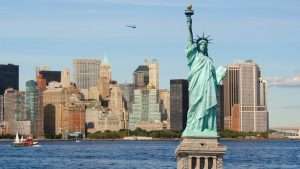
June 6 is not only the anniversary of D-Day, but also of the Somin family's arrival in America, back in 1979. This post reprints my reflections on that milestone, which I hope remain relevant today.

|

The Statue of Liberty. (NA)


Today is the anniversary of D-Day, and also of the Somin family's arrival in the United States, way back in 1979. I posted some reflections on that event on the occasion of its fortieth anniversary in 2019. I repost that short piece  below, as I think the points made remain relevant, especially in an age of ill-advised pandemic-era migration restrictions, some of which have yet to be lifted:

In addition to being the 75th anniversary of D-Day, today is the 40th anniversary of the Somin family's arrival in America! I wrote about our experience of immigration from the Soviet Union to the United States in this 2010 memoir, written for the Hebrew Immigrant Aid Society (HIAS), which helped us gain admission to the US, and continues to assist refugees from many parts of the world, to this day.

Reflecting on this experience, I am profoundly grateful to my parents for making the decision to come to the US, and also to those who fought at D-Day, Gettysburg, and elsewhere to establish, expand, and protect the freedoms that make America a haven for immigrants seeking liberty and opportunity from around the world.

Reflection also inspires humility. I am vastly better off than my peers who remained in Russia. But virtually all of that difference is the result of the difference between American  institutions and Russian ones, not any merit of mine. We should strive to ensure that more people are able to enjoy liberty and opportunity unconstrained by arbitrary circumstances of ancestry and place of birth.

At its worst, America is susceptible to the same types of ethnic, religious, racial, and nationalistic prejudices as all too many other nations. But at its best, it is the nation where freedom and opportunity can be yours regardless of who your parents were, or where you were born; the nation where immigrants are accepted more fully than in almost any other.

In our time, it is fashionable to assume that only people who are themselves members of a particular identity group can truly understand its experience. If so, perhaps only immigrants can fully grasp the value of immigration. Thus, some readers may assume that my work on the importance of  "voting with your feet" and migration rights is an outgrowth of my personal experience.

But, in truth, it began with my engagement with the political economy literature on federalism (which helped me grasp the importance of domestic foot voting). Later, the writings of scholars such as Bryan Caplan, Michael Clemens, and Joseph Carens, helped me see that international migration is an even more significant pathway to expanding human freedom and opportunity; not just one liberty among many, but one of the great issues of our time. To my knowledge, all of them are themselves native-born citizens of western liberal democracies. Yet it was they who enlightened me about the broader significance of migration rights, rather than vice versa.

It is a small, but perhaps telling example of how understanding often comes through logic and evidence, not just personal experience accessible only to members of a particular group. It also offers a measure of hope that we can expand liberty for both immigrants and natives with the help of many who never personally experienced the injustices they seek to end.

Free Speech

Ilya Shapiro Reinstated at Georgetown Law, then Resigns

The law school reinstated him on a technicality, but made it clear that they weren't going to uphold the university's free speech policy.

|

It took Georgetown University Law Center four months, longer than most Supreme Court nominations take to get to the finish line, to investigate a single tweet from Ilya Shapiro. Everyone understands what was going on: the tweet was clearly protected by Georgetown's free expression policy and Georgetown could not in good faith punish Shapiro, but the law school wanted to wait until students were off-campus to avoid protest.*

Yet instead of robustly (or even meekly) defending its own policies, Georgetown found in Shapiro's favor on the technicality that his purportedly harassing tweet was tweeted before he was employed by Georgetown. Finding that he did not yet have employee status also provides a convenient way for Georgetown to deny him access to its grievance procedures.

In any event, Georgetown's report suggesting that he would be under intense and continuing scrutiny, and that if Georgetown constituents were offended by additional "similar" speech of his, he would be subject to termination.

Today, Shapiro announced the Wall Street Journal that he has resigned: "Fundamentally, what Mr. Treanor has done—what he's allowed IDEAA to do—is repeal the Speech and Expression Policy that he claims to hold dear. The freedom to speak is no freedom at all if it makes an exception for speech someone finds offensive or counter to some nebulous conception of equity."

After noting that Georgetown law faculty have not been punished for some rather egregious opinions, Shapiro continues:

It's all well and good to adopt strong free-speech policies, but it's not enough if university administrators aren't willing to stand up to those who demand censorship. And the problem isn't limited to cowardly administrators. Proliferating IDEAA-style offices enforce an orthodoxy that stifles intellectual diversity, undermines equal opportunity, and excludes dissenting voices. Even the dean of an elite law school bucks these bureaucrats at his peril.

What Georgetown subjected me to, what it would be subjecting me to if I stayed, is a heckler's veto that leads to a Star Chamber. "Live not by lies," warned Aleksander Solzhenitsyn. "Let the lie come into the world, let it even triumph. But not through me."

I won't live this way.

UPDATE: And here is Shapiro's resignation letter.

*(As readers may remember, in an awkwardly phrased tweet, Shapiro suggested that DC Circuit judge Siri Srinivasan should have been nominated to the Supreme Court, but because President Biden had pledged to appoint a black woman (which Srinivasan is not), a "lesser" black woman would be appointed instead. Despite an apology and explanation from Shapiro, who asserted quite reasonably that his tweet meant to suggest that Srinivasan was the "best" candidate but would not get the job due to Biden's promise, critics insisted that he was asserting that no black woman would be competent to be on the Supreme Court. To say that this is an uncharitable reading of the tweet and his subsequent explanation is an understatement. My own view on such matters is that everyone should be given a fair opportunity to apologize for and explain a badly phrased message; only people who double down deserve a worse fate. If Shapiro, in response to the controversy, had said that he indeed meant that no black woman could ever be qualified for the Court, that might still be speech protected by Georgetown's policies, but he would deserve the criticism he has received for not saying that.)

Free Speech

FIRE Branches Out into Free Speech Beyond Universities, Planning $75M Litigation and Public Education Campaign

The Foundation for Individual Rights in Education is becoming the Foundation for Individual Rights and Expression.

|

From Josh Gerstein (Politico):

"To say the least, we have not solved the campus free-speech problem, but we started to realize if we wanted to save free speech on campus we have to start earlier and we have to do things not on campus," the group's president, Greg Lukianoff, said.

Lukianoff said FIRE has raised $28.5 million for a planned three-year, $75 million litigation, opinion research and public education campaign aimed at boosting and solidifying support for free-speech values.

"There's a very strong belief in not just the First Amendment, but a culture of freedom of speech that — black or white, liberal or conservative — that most Americans think you should be entitled to your own opinion and not have to lose your job over that," Lukianoff said. "The voices that think of free speech as a dirty word on campus or on Twitter are actually a pretty small minority." …

The new initiative includes $10 million in planned national cable and billboard advertising featuring activists on both ends of the political spectrum extolling the virtues of free speech, officials said.

One TV spot includes a former Emerson College student, K.J. Lynum, whose conservative group was suspended by the school's president for circulating "China kinda sus" stickers promoting the theory that a Chinese government lab caused the oubreak of Covid-19. "Freedom of speech is our right as Americans and we must do everything we can to protect it," Lynum says over images of Martin Luther King Jr. and a young anti-abortion activist.

Another ad features a Montana State University student, Stefan Klaer, who was ordered to take down a Black Lives Matter banner from his dorm room window. "If you silence people, you never get to hear the other side," Klaer says….

[Former ACLU executive director Ira] Glasser, who serves on a FIRE advisory board, said in an interview that he "strongly encouraged" FIRE to broaden its free-speech work in part because the ACLU seems to be abdicating that role….

Read More

Slippery Slope Arguments

Slippery Slope Counterarguments in History: Justice Holmes

|

From Justice Holmes' dissent in Panhandle Oil Co. v. Knox (1928), an argument that the Court shouldn't worry too much about slippery slope concerns:

[C]ertain dicta of Chief Justice Marshall [about prohibitions on certain forms of taxation] … were founded upon his often quoted proposition that the power to tax is the power to destroy. In those days it was not recognized as it is today that most of the distinctions of the law are distinctions of degree. If the States had any power it was assumed that they had all power, and that the necessary alternative was to deny it altogether.

But this Court which so often has defeated the attempt to tax in certain ways can defeat an attempt to discriminate or otherwise go too far without wholly abolishing the power to tax. The power to tax is not the power to destroy while this Court sits. The power to fix rates is the power to destroy if unlimited, but this Court while it endeavors to prevent confiscation does not prevent the fixing of rates. A tax is not an unconstitutional regulation in every case where an absolute prohibition of sales would be one.

Free Speech

Can't Seal Case to Prevent Damage to Business Reputation, Even If Case Settled Quickly

|

From FTL Displays, LLC v. Blackout Inc., decided May 27 by the Nevada Court of Appeals (Chief Judge Michael Gibbons, joined by Judges Jerome Tao and Judge Bonnie Bulla):

… Blackout Inc. filed a complaint against FTL, alleging breach of contract. The parties quickly settled the matter and Blackout filed a voluntary dismissal with prejudice.

FTL then filed a motion to seal, seeking to seal the case, prohibiting public access to the documents filed in the case and the names of the parties. In its motion, FTL asserted that sealing the entire case was warranted pursuant to the Rules Governing Sealing and Redacting Court Records (SRCR) 3(4)(h) because the parties quickly resolved the case; FTL's reputation could be damaged if potential clients discovered the case, despite the fact that it was a mere misunderstanding between the parties; FTL was involved in other litigation and believed the opposing parties in that case may attempt to contact Blackout to "harass and/or coerce them;" and because FTL had partnerships with politically driven companies and wanted to prevent any inquiries into this matter….

Read More

More



