The Volokh Conspiracy

Mostly law professors | Sometimes contrarian | Often libertarian | Always independent | Est. 2002

The Volokh Conspiracy

The Kavanaugh Concurrence Is The New Kennedy Concurrence

"I write separately to emphasize the narrowness of the issue before us." Who said it? Kennedy or Kavanaugh?

|

For a generation, Justice Kennedy was the swing vote on the Supreme Court. In almost every major case, you could expect a concurrence by Justice Kennedy to moderate the holding. And they would always include the same message: I agree with the Court, but let me announce some limits that no one else agreed to. And invariably, the lower courts would treat those limitations as if they were controlling. Forget the Marks rule. Everyone follow the Kennedy rule.

Here are a smattering of those concurrences in cases large and small:

  • Trump v. Hawaii (2018): "I join the Court's opinion in full. . . . In all events, it is appropriate to make this further observation."
  • Pereira v. Sessions (2018): "I agree with the Court's opinion and join it in full. This separate writing is to note my concern with the way in which the Court's opinion in Chevron U.S.A. Inc. v. Natural Resources Defense Council, Inc. (1984), has come to be understood and applied."
  • Burwell v. Hobby Lobby Stores (2014): "It seems to me appropriate, in joining the Court's opinion, to add these few remarks."
  • Arizona v. Inter Tribal Council of Arizona (2013): "The opinion for the Court insists on stating a proposition that, in my respectful view, is unnecessary for the proper disposition of the case and is incorrect in any event."
  • Kiobel v. Royal Dutch Petroleum (2013): "The opinion for the Court is careful to leave open a number of significant questions regarding the reach and interpretation of the Alien Tort Statute. In my view that is a proper disposition."
  • Christian Legal Society v. Martinez (2010): "These observations are offered to support the analysis set forth in the opinion of the Court, which I join."
  • U.S. v. Comstock (2010): "The Court is correct, in my view, to hold that the challenged portions of 18 U.S.C. § 4248 are necessary and proper exercises of congressional authority. . . . This separate writing serves two purposes."
  • Summers v. Earth Island Institute (2009): "I join in full the opinion of the Court. . .  . This case would present different considerations if Congress had sought to provide redress for a concrete injury 'giv[ing] rise to a case or controversy where none existed before.'"
  • Parents Involved in Community Schools v. Seattle School Dist. No. 1 (2007): "I agree with THE CHIEF JUSTICE that we have jurisdiction to decide the cases before us and join Parts I and II of the Court's opinion. I also join Parts III–A and III–C for reasons provided below. My views do not allow me to join the balance of the opinion by THE CHIEF JUSTICE, which seems to me to be inconsistent in both its approach and its implications with the history, meaning, and reach of the Equal Protection Clause."
  • Hein v. Freedom from Religion Foundation (2007): "In my view the result reached in Flast is correct and should not be called into question. For the reasons set forth by Justice ALITO, however, Flast should not be extended to permit taxpayer standing in the instant matter. And I join his opinion in full."
  • Randall v. Sorrell (2006): "Viewed within the legal universe we have ratified and helped create, the result the plurality reaches is correct; given my own skepticism regarding that system and its operation, however, it seems to me appropriate to concur only in the judgment."
  • Rapanos v. U.S. (2006): "Although both the plurality opinion and the dissent by Justice STEVENS (hereinafter the dissent) discuss the background of these cases in some detail, a further discussion of the relevant statutes, regulations, and facts may clarify the analysis suggested here."
  • Hudson v. Michigan (2006): "Two points should be underscored with respect to today's decision. "
  • Kelo v. City of New London (2005): "I join the opinion for the Court and add these further observations."
  • Lingle v. Chevron (2005): "This separate writing is to note that today's decision does not foreclose the possibility that a regulation might be so arbitrary or irrational as to violate due process."
  • Rumsfeld v. Padilla (2004): "Though I join the opinion of the Court, this separate opinion is added to state my understanding of how the statute should be interpreted in light of the Court's holding."
  • Rasul v. Bush (2004): "The Court is correct, in my view, to conclude that federal courts have jurisdiction to consider challenges to the legality of the detention of foreign nationals held at the Guantanamo Bay Naval Base in Cuba. While I reach the same conclusion, my analysis follows a different course. "
  • Vieth v. Jubelirer (2004): "The Court is correct to refrain from directing this substantial intrusion into the Nation's political life. While agreeing with the plurality that the complaint the appellants filed in the District Court must be dismissed, and while understanding that great caution is necessary when approaching this subject, I would not foreclose all possibility of judicial relief if some limited and precise rationale were found to correct an established violation of the Constitution in some redistricting cases."
  • Georgia v. Ashcroft (2003): "With these observations, I join the opinion of the Court."
  • Republican Part of Minnesota v. White (2002): "So I join its opinion. I adhere to my view, however, that content-based speech restrictions that do not fall within any traditional exception should be invalidated without inquiry into narrow tailoring or compelling government interests."
  • Clinton v. City of New York (1998): "With these observations, I join the opinion of the Court."
  • U.S. Term Limits v. Thornton (1995): "I join the opinion of the Court.
    The majority and dissenting opinions demonstrate the intricacy of the question whether or not the Qualifications Clauses are exclusive. In my view, however, it is well settled that the whole people of the United States asserted their political identity and unity of purpose when they created the federal system. "
  • U.S. v. Lopez (1995): "That history gives me some pause about today's decision, but I join the Court's opinion with these observations on what I conceive to be its necessary though limited holding."

In 2018, Justice Kennedy was replaced by Justice Kavanuagh. And, in the process, the Kennedy Concurrence has been replaced by the Kavanuagh Concurrence. During Kavanaugh's brief tenure, he has written many solo concurrences that purport to find limits on the majority opinion. By my count, Justice Kavanaugh often uses the same limiting language: underscore, emphasize, explain, add, and note.

  • Nielsen v. Preap (2019): "I write separately to emphasize the narrowness of the issue before us and, in particular, to emphasize what this case is not about."
  • Bucklew v. Precythe (2019): "Under those precedents, I agree with the Court's holding and join the Court's opinion. I write to underscore the Court's additional holding that the alternative method of execution need not be authorized under current state law—a legal issue that had been uncertain before today's decision."
  • American Legion v. American Humanist Association (2019): "I join the Court's eloquent and persuasive opinion in full. I write separately to emphasize two points."
  • County of Maui, Hawaii v. Hawaii Wildlife Fund (2020): "I join the Court's opinion in full. I write separately to emphasize three points."
  • New York State Rifle & Pistol Association v. City of New York (2020): "I agree with the per curiam opinion's resolution of the procedural issues before us—namely, that petitioners' claim for injunctive relief against New York City's old rule is moot and that petitioners' new claims should be addressed as appropriate in the first instance by the Court of Appeals and the District Court on remand.
    I also agree with Justice ALITO's general analysis of Heller and McDonald."
  • Uzuegbunam v. Preczewski (2021): "I agree with the Court that, as a matter of history and precedent, a plaintiff's request for nominal damages can satisfy the redressability requirement for Article III standing and can keep an otherwise moot case alive. I write separately simply to note that I agree with THE CHIEF JUSTICE and the Solicitor General that a defendant should be able to accept the entry of a judgment for nominal damages against it and thereby end the litigation without a resolution of the merits."
  • CIC Services, LLC v. Internal Revenue Service (2021): "I join the Court's opinion in full. I write separately to underscore what remains (and does not remain) of Alexander v. Americans United Inc. (1974), and Bob Jones Univ. v. Simon (1974), in the wake of the Court's decision today."
  • Caniglia v. Strom (2021): "I join the Court's opinion in full. I write separately to underscore and elaborate on THE CHIEF JUSTICE's point that the Court's decision does not prevent police officers from taking reasonable steps to assist those who are inside a home and in need of aid."
  • Cedar Point Nursery v. Hassid (2021): "I join the Court's opinion, which carefully adheres to constitutional text, history, and precedent. I write separately to explain that, in my view, the Court's precedent in NLRB v. Babcock & Wilcox (1956), also strongly supports today's decision."
  • Ramirez v. Collier (2022): "I join the Court's opinion in full, and I write separately to add three points: one about the recent history of litigation involving religious advisors in execution rooms; a second about the difficulty of applying RLUIPA's compelling interest and least restrictive means standards; and a third about state execution procedures going forward."
  • New York State Rifle & Pistol Association, Inc. v. Bruen (2022): "I join the Court's opinion, and I write separately to underscore two important points about the limits of the Court's decision."
  • Dobbs v. Jackson Women's Health Organization (2022): "I write separately to explain my additional views about why Roe was wrongly decided, why Roe should be overruled at this time, and the future implications of today's decision."

In time, lower courts will seize upon the Kavanaugh opinions as the actual opinions of the Court. I will write about the final two concurrences in Bruen and Dobbs in another post.
Privacy

Substantive Due Process Right to Privacy in Medical Information

|

The Supreme Court hasn't made clear whether such a constitutional right to be free from government disclosure of private information (as opposed to the indubitably existing right to be free from unreasonable searches), even setting aside the Dobbs debate; see NASA v. Nelson (2011). But some lower courts have recognized it, see, e.g., Marsh v. County of San Diego (9th Cir. 2012), and this morning's decision by Judge Matthew Kennelly (N.D. Ind.) in Logan v. City of Evanston follows Seventh Circuit precedent on this point:

… Evanston Police Chief Demitrous Cook … published onto his personal Snapchat story several photos of individuals who were of interest in Evanston police investigations. Cook also published these individuals' dates of birth and last known addresses. Some of the individual photos had comments like "in custody" or "DOA" (dead on arrival) handwritten next to the image. The word "pending" appeared next to Logan's identifying information, and "HIV" was handwritten next to his image…. Social media users who saw Cook's story subsequently shared the photos and personal information on Facebook and through text messages. Days later on February 22, Logan took an HIV test, which was negative, to rebut the perceived public belief that he might have HIV.

On February 21, 2020, after Cook was informed that the pictures had been shared by members of the public, he removed them from his Snapchat story and issued a public statement regarding the incident. He stated that the individuals whose information he shared were subjects previously identified in Evanston Police Department investigations and that the photos were taken to assist him with an investigation. He further stated that he did not realize that photos taken with the Snapchat app could be made public with a single click. The Evanston city manager suspended Cook for three days because of the incident….

The court allowed Logan to proceed on his substantive due process right to privacy claim:

The Seventh Circuit has "recognize[d] a constitutional right to the privacy of medical, sexual, financial, and perhaps other categories of highly personal information" under the Fourteenth Amendment. Wolfe v. Schaefer (7th Cir. 2010). This protection extends to medical "information that most people are reluctant to disclose to strangers." Accordingly, Logan's claim is based on Cook's public disclosure of his supposed HIV status on Snapchat without his permission….

Read More

Criminal Law

"SCOTUS Rejects Negligence Standard in 'Pill Mill' Cases"

|

From T. Markus Funk (a legal scholar, former prosecutor, and my erstwhile coauthor) at Sean Solis, both at Perkins Coie, in Bloomberg Law:

The US Supreme Court issued a significant decision in its Controlled Substances Act (CSA) jurisprudence as applied to the nation's opioid epidemic. At issue in Ruan v. United States was the requisite intent the government must prove to convict a physician under the CSA for the unlawful distribution of controlled substances.

In a significant win for the defense, specifically, and those concerned about imposing criminal liability based on mere negligence, more generally, the Supreme Court held that "[a]fter a [physician] produces evidence that he or she was authorized to dispense controlled substances" (a given in almost every case), "the Government must prove beyond a reasonable doubt that the defendant knew that he or she was acting in an unauthorized manner, or intended to do so."

In reaching this holding, the high court unanimously rejected the government's position. In its briefing, the government argued that it should be allowed to convict a physician merely by showing that he or she acted "objectively unreasonably" in misprescribing opioids. In other words, under the government's requested standard, federal prosecutors would de facto only have to show that a prescribing physician acted with negligence. (Notably, this scienter requirement would be lower than the standard necessary to convict a drug trafficker for distributing heroin or cocaine—namely, "knowingly or intentionally.") …

Guns

Are You Applying for a Concealed Carry License Post-Bruen, in …

California, Hawaii, Maryland, Massachusetts, New Jersey, New York, or D.C.?

|

These were the "may-issue" jurisdictions in which such licenses were generally unavailable; if you're applying there (and outside the counties which were apparently de facto shall-issue, such as Sacramento, San Bernardino, and Riverside Counties in California, as well as some rural counties), let me know what you're seeing of the process. Are you seeing general compliance by the licensing authorities? Obstructionism? Manageable but annoying red tape? Likewise, if you apply a few weeks from now, please e-mail me at volokh at law.ucla.edu to let me know.

I'm inclined to apply for a concealed carry permit in L.A. County, but that would require buying a specific concealed carry gun (I'm not sure I'd want to use my current handgun, which is pretty heavy) before even starting the process, since the particular carry weapons' descriptions and serial numbers have to be listed on the application. Given the press of other business, it will probably take a bit of time for me to figure out what I want and buy it; I'll get going on the application after that.

Reminder: "New York Supreme Court" = N.Y. Trial Court; "New York Court of Appeals" = N.Y. High Court

|

I've been seeing some headlines referring to decisions of the New York Supreme Court (see, e.g., Fox and CNN), but that's likely to be confusing to most readers: In New York,

  • "Supreme Court" refers to the trial court, though in most other states it's the name of the state highest court, and
  • "Court of Appeals" refers to the highest court, though in most other states it's the name of the state intermediate court.

So when you hear that "the New York Supreme Court has struck down a law …," that just means that one trial court judge has made that decision, which would often get appealed (and perhaps reversed) within the state court system. I therefore try to use "New York trial court" or "New York high court" instead, as the case might be. (Technically, New York has some other trial courts as well, but I think "trial court" for "Supreme Court" is likely to be the least confusing option.)

Of course, you might be curious what the New York state intermediate court is called: That would be "the Appellate Division," short for "the Appellate Division of the Supreme Court."

UPDATE: Commenter captcrisis writes:

(I practice in the Appellate Division.) I get Supreme Court decisions reversed all the time. How many lawyers here can say that?

Chief Justice Roberts Lost His "Long Game"

The road from Citizens United to Dobbs was paved with saving constructions.

|

At some point Chief Justice Roberts may have had a "long game." But along the way, he he lost that game.

In Citizens United v. FEC (2010), the Chief Justice wrote a concurrence that seemed to lay the predicates for overruling Roe. Consider this observation:

[I]f adherence to a precedent actually impedes the stable and orderly adjudication of future cases, its stare decisis effect is also diminished. This can happen in a number of circumstances, such as when the precedent's validity is so hotly contested that it cannot reliably function as a basis for decision in future cases, when its rationale threatens to upend our settled jurisprudence in related areas of law, and when the precedent's underlying reasoning has become so discredited that the Court cannot keep the precedent alive without jury-rigging new and different justifications to shore up the original mistake.

This passage could have come from the Dobbs majority opinion. But when the time came to overrule Roe in Dobbs, Roberts blinked. He wrote a concurrence in judgment that no one else joined. Indeed, Roberts committed the same three cardinal sins that the Casey plurality committed. First, both opinions overruled landmark precedents, in part: Casey overruled the trimester framework from Roe; Roberts in Dobbs excised the viability line from Casey. Second, both opinions substituted one arbitrary line for another: Casey replaced the trimester framework with the viability line; Roberts in Dobbs replaced the viability line with a standard based on when a woman knows she is pregnant. Third, both opinions took account of public opinion, and avoided a ruling that would harm the Court's legitimacy (in the eyes of liberal elites).

In Dobbs, Justice Alito's majority opinion cited Roberts's Citizens United concurrence, as if to say, "you changed, bro!"

The concurrence's most fundamental defect is its failure to offer any principled basis for its approach. The concurrence would "discar[d]" "the rule from Roe and Casey that a woman's right to terminate her pregnancy extends up to the point that the fetus is regarded as 'viable' outside the womb." But this rule was a critical component of the holdings in Roe and Casey, and stare decisis is "a doctrine of preservation, not transformation," Citizens United v. Federal Election Comm'n (2010) (Roberts, C. J., concurring). Therefore, a new rule that discards the viability rule cannot be defended on stare decisis grounds. . . .

While the concurrence is moved by a desire for judicial minimalism, "we cannot embrace a narrow ground of decision simply because it is narrow; it must also be right." Citizens United (Roberts, C. J., concurring). For the reasons that we have explained, the concurrence's approach is not.

What happened between Citizens United and Dobbs? NFIB. The decision to adopt the saving construction, and save the ACA, changed the man. Once he signaled that he would choose narrowness as an end unto itself, the template was set. Roberts would do it over and over again. He would make the saving construction an art form, as he balanced the center of the Court. But when he was no longer the Court's fulcrum, all he could muster was lonely, failed saving construction of Roe.

Perhaps the most significant aspect of Dobbs is that progressives no longer have a monopoly on defining the Court's "legitimacy." This rubicon cannot be uncrossed. Come what may, the Court will do its job, Justice Alito explained:

As Chief Justice Rehnquist explained, "The Judicial Branch derives its legitimacy, not from following public opinion, but from deciding by its best lights whether legislative enactments of the popular branches of Government comport with the Constitution. The doctrine of stare decisis is an adjunct of this duty, and should be no more subject to the vagaries of public opinion than is the basic judicial task." Casey. In suggesting otherwise, the Casey plurality went beyond this Court's role in our constitutional system. . . .

We do not pretend to know how our political system or society will respond to today's decision overruling Roe and Casey. And even if we could foresee what will happen, we would have no authority to let that knowledge influence our decision. We can only do our job, which is to interpret the law, apply longstanding principles of stare decisis, and decide this case accordingly.

I made this point in my Deseret News op-ed:

Today, Roe was overruled in the Dobbs v. Jackson Women's Health Organization decision. And in doing so, the majority demonstrated real courage "under fire." Five justices were willing to take this bold and correct legal step in the face of never-ending personal attacks, efforts to pack the court, fallout from the leaked draft opinion, protests outside their homes and even an assassination attempt.

Dobbs, which is a triumph for originalism and sound constitutional law, also signals that the court is infused with judicial fortitude. This virtue, more than any particular method of deciding cases, guarantees that the court will steadfastly safeguard the rule of law.

There is still hope for the Chief Justice to find his lost moorings. Or, he can continue in free-fall.

Politics

Michigan Employees May Not Advertise Availability by Mentioning Religion, Race, Sex, etc., or …

by expressing preference for an employer's characteristics.

|

Here's an unusual Michigan statute that applies to employees as well as employers, and that I just stumbled across; it was enacted in 1976:

An individual seeking employment shall not publish or cause to be published a notice or advertisement that specifies or indicates the individual's religion, race, color, national origin, age, sex, height, weight, or marital status, or expresses a preference, specification, limitation, or discrimination as to the religion, race, color, national origin, age, height, weight, sex, or marital status of a prospective employer.

One exception to the law that I found might cover, for instance, people advertising as to their "bona fide occupational qualifications," such as for actors, but it would require a special application to the Michigan civil rights commission:

A person subject to this article may apply to the commission for an exemption on the basis that religion, national origin, age, height, weight, or sex is a bona fide occupational qualification reasonably necessary to the normal operation of the business or enterprise. Upon sufficient showing, the commission may grant an exemption to the appropriate section of this article.

Another exception seems to exempt "adopt[ing] and carry[ing] out a plan to eliminate present effects of past discriminatory practices or assure equal opportunity with respect to religion, race, color, national origin, or sex if the plan is filed with the commission under rules of the commission and the commission approves the plan." An employee who wants to promote himself on such a basis would presumably have to file a "plan" with the commission as part of his self-promotional efforts—but it's hard to see what exactly that would look like for an individual employee. (This exemption appears to be targeted to employer plans, but I suppose an employee might file such a plan as well.)

Free Speech

Ex-Police-Officer Allowed to Proceed Pseudonymously with Due Process and Libel Claim Against City

I lost my motion opposing pseudonymity in the District of New Hampshire, though I'm appealing to the First Circuit.

|

From Doe v. Town of Lisbon, decided Thursday by Judge Joseph Laplante (D.N.H.):

Through this lawsuit, the plaintiff—a former police officer for the Town of Lisbon—seeks removal from New Hampshire's "Exculpatory Evidence Schedule." Broadly speaking, the EES is "a list of police officers who have engaged in misconduct reflecting negatively on their credibility or trustworthiness." The New Hampshire Department of Justice maintains the EES and, subject to the provisions of a recently enacted New Hampshire statute … the EES "shall be a public record" under New Hampshire's right-to-know laws. The NHDOJ publishes the EES on its website.

If an officer files a timely challenge to his or her placement on the EES, however, the officer's name and corresponding information will be non-public and not subject to disclosure under the right-to-know law until the challenge is complete and all appeals are exhausted. If the officer's challenge is successful, his or her name and corresponding information will remain non-public. See generally RSA 105:13-d. As a result, on the current EES, officers with pending challenges have their names and corresponding information (such as the reporting police department, date of incident, date of notification, and category of infraction), as well as their case information, redacted. If the officer loses his challenge to placement on the EES, his name and corresponding information are made public. It is unclear from the statute, the parties' submissions, and other publicly available information whether the NHDOJ maintains an unredacted version of the EES (including the names and information of officers with pending challenges) and if so, who has access to it within the agency.

The plaintiff initially sued the Town in New Hampshire Superior Court, but after the Town timely and properly removed the case to this court, the plaintiff amended his complaint to add the NHDOJ as a defendant. The plaintiff contends that the Town lacked a factual basis to place him on the EES, violated his procedural and substantive due process rights when investigating the underlying conduct that led to his placement on the EES, and, even if the factual findings that led to his placement on the EES were sustained, his alleged behavior was not potentially exculpatory and did not justify placement on the EES.

Following the NHDOJ's motion to dismiss, the plaintiff's motion for voluntary dismissal, a potential consolidation order, and oral argument on these preliminary motions and issues, the parties filed a stipulation addressing how they wished to proceed. The court approved the stipulation, effectuating remand of all claims against the NHDOJ and certain claims for injunctive relief against the Town, as well as consolidation with the plaintiff's related case.

After remand, the following claims for damages against the Town remain before this court: (1) violation of the plaintiff's procedural due process rights under the United States Constitution and New Hampshire Constitution; (2) violation of his substantive due process rights under both constitutions; and (3) "libel, slander, and damage to reputation" and an award of attorneys' fees. {The aspects of the procedural and substantive due process claims seeking injunctive relief against the Town and NHDOJ have been remanded to state court by agreement of the parties.}

The parties agreed to allow the plaintiff to proceed pseudonymously, both in state court and in this court. While Grafton County Superior Court Judge MacLeod granted the plaintiff's motion to seal the docket and all pleadings in the state court matter, the state court record is not sealed on this court's docket. Nor is this court's docket or any of the operative pleadings sealed. The only document that is currently sealed is a prior version of a complaint that inadvertently included the plaintiff's last name on one page….

Because, as noted above, the sealed records in this case are limited to one document, the heart of Professor Volokh's request is his opposition to pseudonymity. Professor Volokh opposes continued pseudonymous litigation based on the presumption of open court records and his common law and First Amendment rights of access to court records.

Read More

Politics

I Anticipated Chief Justice Roberts's Lonely, Failed Saving Construction of Roe

I held the essay in reserve, waiting to see what would happen in oral arguments, but decided not to use it.

|

On April 27, 2022, the Wall Street Journal editorial page worried that Chief Justice Roberts was "trying to turn another Justice." At the time, I speculated on the blog that the WSJ received a leak from the Court, and was trying to affect internal deliberations. But internally, I had an inkling what could be going on. No, I did not have a leak. Rather, I know Chief Justice Roberts--and his attempts to save things--extremely well.

Back in October 2021, I wrote a draft blog post about what the Chief's preferred middle ground in Dobbs could look like. I understood that this approach would be pure sophistry, but I take that premise as a given for the Chief. Here is an excerpt from the draft post, which should look familiar. I only made slight alterations for readability:

With rational basis review the relevant line would not be based on the viability of the fetus or some arbitrary trimester framework. Rather the line will be drawn based on whether the woman knows or reasonably should have known she was pregnant. At that point, she would have had a meaningful opportunity to terminate the pregnancy. But that notice doesn't need to be the full nine months of the pregnancy. According to a 2017 study, "gestational age at time of pregnancy awareness was 5.5 weeks (standard error = 0.04) and the prevalence of late pregnancy awareness was 23% (standard error = 1 %)." And the "average gestational age at time of pregnancy awareness has not changed over the last two decades." Given these numbers, under S.B. 8 women may have an exceedingly short period of time to actually obtain the abortion. Moreover, cardiac activity may be detected before six-week mark. Or a woman may learn about her pregnancy after the six-week mark. The Texas six-week limit would not be sufficient because many women do not even know they're pregnant at that point. But the 15-week Mississippi ban would afford women the opportunity to learn of their pregnancy.

Here is what Roberts wrote in Dobbs:

I agree with the Court that the viability line established by Roe and Casey should be discarded under a straightforward stare decisis analysis. That line never made any sense. Our abortion precedents describe the right at issue as a woman's right to choose to terminate her pregnancy. That right should therefore extend far enough to ensure a reasonable opportunity to choose, but need not extend any further—certainly not all the way to viability. Mississippi's law allows a woman three months to obtain an abortion, well beyond the point at which it is considered "late" to discover a pregnancy. See A. Ayoola, Late Recognition of Unintended Pregnancies, 32 Pub. Health Nursing 462 (2015) (pregnancy is discoverable and ordinarily discovered by six weeks of gestation). I see no sound basis for questioning the adequacy of that opportunity.

Yes, I anticipated--almost to a tee--what the Chief was cooking up. You're welcome. So whenever I wrote about the "blue-plate special" over the past few months, this was precisely what I had in mind. No party advanced this argument, but I deduced it based on every Roberts opinion I've ever read. I knew Roberts would have to use some line other than viability. The only somewhat objective rule would be when women learn of their pregnancies. This tweet comes to mind:

The Chief's moves are entirely predictable.

Consider this passage:

To be sure, in reaffirming the right to an abortion, Casey termed the viability rule Roe's "central holding." Other cases of ours have repeated that language. But simply declaring it does not make it so.

It doesn't matter if Congress labelled Section 5000A as a penalty. "Simply declaring it does not make it so." Ditto in NFIB:

No one would doubt that this law imposed a tax, and was within Congress's power to tax. That conclusion should not change simply because Congress used the word "penalty" to describe the payment.

Indeed, Roberts actually "excised" the viability line from Roe and Casey:

Applying principles of stare decisis, I would excise that additional rule—and only that rule—from our jurisprudence.

Just like he eliminated the requirement to purchase insurance from Section 5000A, and made the Medicaid expansion optional. Same script, different cast. But unlike with NFIB, the Chief garnered zero other votes. In Dobbs, we were left with the lonely, failed saving construction of Roe.

If you doubt me, I shared this proposal with several people who can attest that it is authentic. I held the essay in reserve, waiting to see what would happen in oral arguments, but I decided not to use it. On some level, I was afraid to write it, lest it become true. I didn't want to jinx it. Thankfully, no other Justice took the bait.

I'll discuss the Roberts concurrence further in another post.

Slippery Slope Arguments

Small Change Tolerance Slippery Slopes and the Desire to Avoid Seeming Extremist or Petty

|

[This month, I'm serializing my 2003 Harvard Law Review article, The Mechanisms of the Slippery Slope.]

Say you care little about the .50-caliber rifle ban, but your neighbor strongly supports or opposes it. His vote in the election, he says, will be influenced by the candidates' views on the ban, and he has donated time and money to pro- or anti-ban groups.

If you don't think the law will tend to lead to broader laws, you might think this fellow is a bit extremist. Some people might enjoy being perceived as rigid on such matters: "Extremism in the defense of liberty," they might say, echoing Barry Goldwater, "is no vice." But people who like to see themselves and to be seen by others as "moderate" might not want such a reputation, and might therefore adopt a small change tolerance heuristic. And this may apply to legislators as well as voters—though some legislators cultivate a reputation for never budging on some issues, others might want to avoid looking like "rigid ideologues" to their constituents, or alienating colleagues with whom they'll have to work again.

Small change tolerance slippery slopes can therefore happen when a law's opponents don't want to seem extremist but the law's supporters don't mind appearing this way, either because they're extremist by temperament or because the status quo looks so bad to them that they feel a strong "don't just stand there, do something" effect. Supporters will push for small changes, and opponents won't push back much. {Of course, if a law's supporters don't want to insistently press their case, but the law's opponents don't mind seeming insistent, the law will more easily be blocked, and the slippery slope likely won't happen. The small change tolerance slippery slope, like the other slippery slopes, happens under particular political circumstances; it is a plausible phenomenon, but far from a certain one.}

Read More

One Small Door, Too Many Fat Men: Congress's Tech Agenda

Episode 414 of the Cyberlaw Podcast

|

It's that time again on the Congressional calendar. All the big, bipartisan tech initiatives that looked so good a few months ago are beginning to compete for time on the floor like fat men desperate to get through a small door. And tech lobbyists are doing their best to handicap the bills they hate while advancing those they like.

We open the Cyberlaw Podcast by reviewing a few of the top contenders. Justin (Gus) Hurwitz tells us that the big bipartisan compromise on privacy is probably dead for this Congress, killed by Senator Maria Cantwell (D-WA) and the new politics of abortion. The big subsidy for domestic chip fabs is still alive, Jamil Jaffer reports, but beset by House and Senate differences, plus a proposal to regulate outward investment in China and Russia by U.S. firms. And Senator Amy Klobuchar's (D-MN) platform anti-self-preferencing bill is being picked to pieces by lobbyists trying to cleave away GOP votes over content moderation and national security. All in all, it's hard times for fat men.

Next, David Kris unpacks the First Circuit decision on telephone pole cameras and the fourth amendment. Technology and Fourth Amendment law is increasingly agoraphobic, I argue, as the Carpenter decision has left aging boomer judges on a vast featureless constitutional plain, lacking principles to guide them and forced to fall back on their sense of what was creepy in their day.

Speaking of creepy, the Australian Strategic Policy Institute (ASPI) has a detailed report oncontent moderation and privacy protections  at TikTok and WeChat. Jamil gives the highlights.

Not that Silicon Valley has anything to brag about when it comes to creepy. I sum up This Week in Big Tech Censorship with two newly emerging rules for conservatives using social media platforms: First, obeying Big Tech's rules is no defense; it just takes a little longer before your business revenue is cut off. Second, having science on your side is no defense. As a Brown University doctor discovered, citing a study that undermines  coronavirus orthodoxy will get you suspended. Who knew we were supposed to follow the science with enough needle and thread to sew its mouth shut?

If Sen. Klobuchar's bill fails, all eyes will turn to Lina Khan's Federal Trade Commission, Gus tells us, and its defense of the "right to repair" may give a clue to how it will regulate.

David flags a Google study of zero-days sold to governments in 2021. He finds it a little depressing, but I note that at least some of the zero-days probably require court orders to implement.

Jamil also reviews a corporate report on security, Microsoft's analysis of how Microsoft saved the world from Russian cyber espionage – or would have if you ignoramuses had just bought more cloud services. OK, it's not quite that bad, but the marketing motivations behind the report show a little too often in what is otherwise a useful review of Russian tactics.

In quick hits:

Download the 414th Episode (mp3)

You can subscribe to The Cyberlaw Podcast using iTunes, Google Play, Spotify, Pocket Casts, or our RSS feed. As always, The Cyberlaw Podcast is open to feedback. Be sure to engage with @stewartbaker on Twitter. Send your questions, comments, and suggestions for topics or interviewees to CyberlawPodcast@steptoe.com. Remember: If your suggested guest appears on the show, we will send you a highly coveted Cyberlaw Podcast mug!

The views expressed in this podcast are those of the speakers and do not reflect the opinions of their institutions, clients, friends, families, or pets.

Justice Thomas and Loving v. Virginia

He already addressed the ruling at length in his Obergefell dissent.

|

Justice Thomas is married to a white woman. And the couple lives in Virginia. Prior to the Supreme Court's decision in Loving v. Virginia, the law of the Commonwealth criminalized interracial marriage. In the wake of Dobbs, critics have tried to hoist Justice Thomas on his own petard: Oh yeah, you would overrule Obergefell, but what about Loving? Indeed, Justice McDonald of the Connecticut Supreme Court, who is in a same-sex marriage, got in on the fun with some wordplay:

"Mr. Justice Thomas had much to say today about my loving marriage. Oddly he didn't have much to say about his 'Loving' marriage."

This argument was predictable, and flawed.

First, Justice Thomas already addressed the status of Loving in his Obergefell dissent. And he expressly distinguished Loving from Obergefell.

Petitioners' misconception of liberty carries over into their discussion of our precedents identifying a right to marry, not one of which has expanded the concept of "liberty" beyond the concept of negative liberty. Those precedents all involved absolute prohibitions on private actions associated with marriage. Loving v. Virginia, 388 U. S. 1 (1967), for example, involved a couple who was criminally prosecutedfor marrying in the District of Columbia and cohabiting in Virginia, id., at 2–3. [FN5] They were each sentenced to a year of imprisonment, suspended for a term of 25 years on the condition that they not reenter the Commonwealth together during that time. Id., at 3. [FN6]

[FN5] The suggestion of petitioners and their amici that antimiscegenation laws are akin to laws defining marriage as between one man and one woman is both offensive and inaccurate. "America's earliest laws against interracial sex and marriage were spawned by slavery." P. Pascoe, What Comes Naturally: Miscegenation Law and the Making of Race in America 19 (2009). For instance, Maryland's 1664 law prohibiting marriages between " 'freeborne English women' " and " 'Negro Sla[v]es' " was passed as part of the very act that authorized lifelong slavery in the colony. Id., at 19–20. Virginia's antimiscegenation laws likewise were passed in a 1691 resolution entitled "An act for suppressing outlying Slaves." Act of Apr. 1691, Ch. XVI, 3 Va. Stat. 86 (W. Hening ed. 1823) (reprint 1969) (italics deleted). "It was not until the Civil War threw the future of slavery into doubt that lawyers, legislators, and judges began to develop the elaborate justifications that signified the emergence of miscegenation law and made restrictions on interracial marriage the foundation of post-Civil War white supremacy." Pascoe, supra, at 27–28. Laws defining marriage as between one man and one woman do not share this sordid history. The traditional definition of marriage has prevailed in every society that has recognized marriage throughout history. Brief for Scholars of History and Related Disciplines as Amici Curiae 1. It arose not out of a desire to shore up an invidious institution like slavery, but out of a desire "to increase the likelihood that children will be born and raised in stable and enduring family units by both the mothers and the fathers who brought them into this world." Id., at 8. And it has existed in civilizations containing all manner of views on homosexuality. See Brief for Ryan T. Anderson as Amicus Curiae 11–12 (explaining that several famous ancient Greeks wrote approvingly of the traditional definition of marriage, though same-sex sexual relations were common in Greece at the time).

[FN6] The prohibition extended so far as to forbid even religious ceremonies, thus raising a serious question under the First Amendment's Free Exercise Clause, as at least one amicus brief at the time pointed out. Brief for John J. Russell et al. as Amici Curiae in Loving v. Virginia, O.T. 1966, No. 395, pp. 12–16.

I hope that distinction will suffice. And I trust Justice McDonald can read the Obergefell dissent to learn Justice Thomas's views on Loving.

Second, Loving was premised on both the Equal Protection Clause and the Due Process Clause. Even if you reject substantive due process, you could still find that Loving reached the correct result on the basis of the Equal Protection Clause. After all, the law literally treats people differently on the basis of their race. Two white people can get married, but a white person and a black person cannot. Even the most conservative jurists would deem such a law unconstitutional.

Third, there is an insinuation lurking in the background of the claim: Justice Thomas did not talk about Loving because doing so would undermine his own marriage. Or, stated differently, Justice Thomas cannot be neutral on the topic of interracial marriage, so he simply ignored the case; thus he is a hypocrite. This charge is perhaps the most pernicious. And it is not new. During the Prop 8 litigation, there was an effort to disqualify Judge Vaughn Walker because he was a gay man who was in a long-term relationship with another man. The defenders of Prop 8 claimed that Judge Walker could not possibly handle the case objectively because he stood to benefit personally from a ruling that Prop 8 was unconstitutional. Ultimately, Walker did not recuse. And he based his decision on a long line of cases involving black judges, who likewise refused to recuse in racial discrimination cases. I like to think that Judge Walker, like Justice Thomas, could objectively assess cases that could affect their personal relationships.

Free Speech

When Is Government Official's Blocking Commenter from Social Media Page "State Action"?

The Sixth Circuit disagrees with the Second Circuit in the @RealDonaldTrump case (but maybe not by much).

|

From Judge Amul Thapar's Sixth Circuit opinion in Lindke v. Freed today, joined  by Judges Ralph Guy and Chad Readler:

Like many Americans, James Freed joined Facebook to connect with friends and family. He created a Facebook profile—a private account limited to his "friends"—and used it for years. But eventually, he grew too popular for Facebook's 5,000-friend limit on profiles. So Freed converted his profile to a "page," which has unlimited "followers" instead of friends. His page was public, and anyone could "follow" it; for the page category, Freed chose "public figure."

In 2014, Freed was appointed city manager for Port Huron, Michigan. So he updated his Facebook page to reflect his new title. In the "About" section, he most recently described himself as "Daddy to Lucy, Husband to Jessie and City Manager, Chief Administrative Officer for the citizens of Port Huron, MI." Freed listed the Port Huron website as his page's website, the City's general email for "City Administration and Staff" (CommunityComments@PortHuron.org) as his page's contact information, and the City Hall address as his page's address.

Freed was an active Facebook user whose page featured a medley of posts. He shared photos of his daughter's birthday, his visits to local community events, and his family's weekend picnics. He also posted about some of the administrative directives he issued as city manager. And when the Covid-19 pandemic hit in spring 2020, he posted about that too, sharing the policies he initiated for Port Huron and news articles on public-health measures and statistics.

Freed's Covid-19 posts caught the attention of one disconcerted citizen, Kevin Lindke. Lindke didn't approve of how Freed was handling the pandemic. He saw Freed's posts about new policies and responded with criticism in the comments section. Freed didn't appreciate the comments, so he deleted them. And Freed eventually "blocked" Lindke from the page, which kept Lindke from commenting on Freed's page and its posts.

Lindke sued, claiming this blocking violated Lindke's First Amendment rights, but the Sixth Circuit said no:

Read More

The "Judges of Wisdom" and the "Mystical Aphorisms of the Fortune Cookie"

The Dobbs dissenters should have quoted that other passage from Justice Scalia about Justice Kennedy.

|

The Dobbs dissent made little effort to defend the handicraft of Justice Blackmun in Roe. And the dissenters didn't bother to endorse the "mystery of human life" pablum from Casey. But Justices Breyer, Sotomayor, and Kagan did heap praise on the stare decisis discussion from Casey--in particular, the focus on the Court's "legitimacy."

The joint dissenters wrote that overruling Roe would extract a "terrible price."

Casey itself made the last point in explaining why it would not overrule Roe—though some members of its majority might not have joined Roe in the first instance. . . . And to overrule for that reason? Quoting Justice Stewart, Casey explained that to do so—to reverse prior law "upon a ground no firmer than a change in [the Court's] membership"—would invite the view that "this institution is little different from the two political branches of the Government." No view, Casey thought, could do "more lasting injury to this Court and to the system of law which it is our abiding mission to serve." For overruling Roe, Casey concluded, the Court would pay a "terrible price."

Next, the joint dissenters wrote an encomium for Justices O'Connor, Kennedy, and Souter.

The Justices who wrote those words—O'Connor, Kennedy, and Souter—they were judges of wisdom.

We learn that Justices O'Connor, Kennedy, and Souter are "judges of wisdom." For evidence of this wisdom, let me quote from Casey.

At the heart of liberty is the right to define one's own concept of existence, of meaning, of the universe, and of the mystery of human life. Beliefs about these matters could not define the attributes of personhood were they formed under compulsion of the State.

I know that the joint dissenters are fond of quoting from Justice Scalia. His rebuke from Obergefell is apt:

If, even as the price to be paid for a fifth vote, I ever joined an opinion for the Court that began: "The Constitution promises liberty to all within its reach, a liberty that includes certain specific rights that allow persons, within a lawful realm, to define and express their identity," I would hide my head in a bag. The Supreme Court of the United States has descended from the disciplined legal reasoning of John Marshall and Joseph Story to the mystical aphorisms of the fortune cookie.

Casey did not exude "wisdom." Nor did it demonstrate judging for that matter. Casey demonstrated a political calculation of the worst sort--engage in blatant misreading of precedent, carve a new rule out of whole cloth, and hope things work out. Not much wisdom here. Perhaps, to borrow from Fifth Circuit lingo, they exhibited minor wisdom.

The joint dissenters continue:

[Justice O'Connor, Kennedy, and Souter] would not have won any contests for the kind of ideological purity some court watchers want Justices to deliver. But if there were awards for Justices who left this Court better than they found it? And who for that reason left this country better? And the rule of law stronger? Sign those Justices up.

There is a lot to unpack here. First, the joint dissenters have launched an attack on their recently-nominated colleagues who apparently passed an "ideological purity" and "deliver" the expected results to appease "some court watchers" (me!). (FYI, none of them pass my ideological purity test.) This statement is as much a rebuke of Justice Gorsuch, Kavanaugh, and Barrett--the young and the restless--than it is a praise of O'Connor, Kennedy, and Souter. Then again, we got the latter three because of the decisions of the former three. No more Souters!

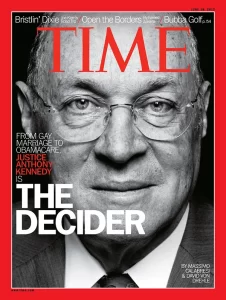
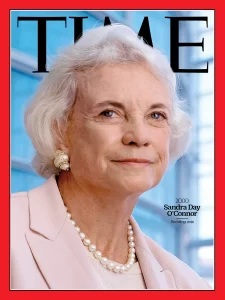
Second, the joint dissenters charge that O'Connor, Kennedy, and Souter would not win any awards or prizes. Oh come on. In light of Casey and related cases, these judges were praised at every opportunity. There is actually a Wikipedia page that lists all the prizes and honorary degrees that Sandra Day O'Connor received. They are not lacking for honors. Liberals love conservatives who vote with liberals.  You don't make it to the cover of Time Magazine by standing for conservative judicial principles.

Third, what the joint dissenters meant is that O'Connor and Kennedy would not receive praise from conservatives. Fair point. But when you are accepted at every level of elite society, who needs to hobnob at the Mayflower with other FedSoc grunts?

In my view, one of the most significant aspects of Dobbs is that we can move past the entire "stare decisis" and "legitimacy" debate. The Court did the deed. Roe is gone. The chips will fall where they may. The political process will work itself through. But the Justices themselves will no longer feel constrained by the Casey fiction that decisions must be made with regard to popular opinion. Courage "under fire" means ruling without regard to those public currents.

Abortion

Abortion and "the People and Their Elected Representatives": Abortion-Related Initiatives and Referenda

|

In Dobbs, the Court concluded that the Constitution doesn't speak on whether abortion should or shouldn't be legal, and that therefore the question should be returned "to the people and their elected representatives." But if we look at national surveys, it appears that the people sharply support abortion rights in the first three months of pregnancy (60%-29% according to one recent poll) and oppose "midterm abortions" (by 56%-30%) as well as "late-term abortions" (67%-19%). That suggests a result quite different from Roe (which basically drew the line at six months) and even Casey (which drew the line at viability, likely around five to five-and-half months). Yet it also suggests a result vastly different from total prohibition on abortion (even with exceptions for the life of the mother and possibly health of the mother, rape, incest, and the like), which are being implemented in some states and likely to be implemented in some more.

One explanation for this, of course, is interstate variation in public attitudes (see, e.g., this post by Louis Jacobson [Sabato's Crystal Ball]). But in some of states, part of it may be the difference between the views of "the people" and "their elected representatives."

Such differences are familiar, and need not be malign:

  1. In some fields, the elected representatives may just be more knowledgeable than individual voters, since we hire them (and their staffs) to look closely at issues that individual voters would rarely be expert on.
  2. But even in fields where the key questions are moral rather than empirical, well-organized, committed political minority groups can often overcome less organized, less devoted political majority opposition. That's the reason, I think, for why many gun control proposals that seem to enjoy majority support are blocked in the legislative process, and also, on the other side, why many race-based affirmative action programs that seem to be opposed by the majority of voters can succeed in the legislative process. (This phenomenon is related to, though likely not entirely exhausted by, Mancur Olson's The Logic of Collective Action, and it goes beyond just concentrated economic interests.) Again, that isn't necessarily bad; but it's there.
  3. And in some contexts, a past legislative (or popular) majority might have enacted a law, which remains on the books, and that enjoys the support of legislative inertia: Even if there might be majority public support for repealing it or changing it, it often takes supermajority support for the legislature to act—given various requirements such as having the law be passed by both houses of the legislature and signed by the governor, state-level filibusters in some states, or other such features. The legislature might thus do nothing, even if a slight majority of voters wants it to act.
  4. Geographical concentration of particular voters (whether filtered through an alleged gerrymander or through non-gerrymandered districting) may also make the results on some issues differ from the statewide view. To take a stylized example, in a state with 100 districts, if 60 districts are 55%-45% for a particular abortion restriction, and 40 districts are 65%-35% against the restriction, the result would be 60 legislative votes for the restriction, even though the public as a whole is 53%-47% against it.

Direct democracy is a standard means of getting around this phenomenon. In many American states, for instance, voters can propose initiatives—either statutes or constitutional amendments—which can then be enacted by direct popular vote. And in many states, voters can call for referenda, in which newly enacted legislation can be blocked by direct popular vote. (In many states, the legislature can also place measures on the ballot for public vote, but that of course involves some degree of concurrence between the legislature and the public, rather than the public's ability to trump legislative action or inaction.) I expect this to happen quite a bit with regard to abortion, at least in many states.

I hope to blog more about such matters in the future, but for now I'm delighted to report that Ryan Byrne of Ballotpedia has very kindly come up with some excellent and specific materials on this very question, which I'm very glad to be able to pass along:

What initiatives have been proposed for the ballot in 2022?

There are two active initiative campaigns—one in Michigan, and one in Arizona—to provide that "Every individual has a fundamental right to reproductive freedom …" Both initiatives would define the term reproductive freedom to include abortion, as well as "decisions about all matters relating to pregnancy." There is also an active campaign, in Colorado, to prohibit abortion except in cases to save the mother's life, when the fetus is no longer alive, and for ectopic pregnancies.

Read More

Scalia's "Prophecy" in Lawrence And The Joint Dissent in Dobbs

That awkward moment when Justice Breyer joins an opinion that criticizes his join in Lawrence.

|

Lawrence v. Texas was decided in 2003. Only two members remain from that Court--Justices Thomas and Breyer. Well, at least Breyer is on the Court for a few more days. Justice Kennedy wrote the majority opinion in Lawrence. At the end of the decision, Justice Kennedy assured everyone that striking down the ban on sodomy would not lead to striking down traditional marriage laws.

It does not involve whether the government must give formal recognition to any relationship that homosexual persons seek to enter.

In dissent, Justice Scalia called bullshit.

At the end of its opinion--after having laid waste the foundations of our rational-basis jurisprudence--the Court says that the present case "does not involve whether the government must give formal recognition to any relationship that homosexual persons seek to enter." Do not believe it.

We all knew the logical end-point of Lawrence. Really, that train started with Romer. Justice Kennedy's assurance was not worth the paper it was printed on. And who joined Lawrence? Justice Breyer.

Fast-forward a decade to Windsor. Once again, Justice Kennedy assured everyone that striking down DOMA would not put in jeopardy traditional marriage laws. The penultimate sentence of the opinion reads:

This opinion and its holding are confined to those lawful marriages.

Once again, Justice Scalia called bullshit. Don't believe it.

The penultimate sentence of the majority's opinion is a naked declaration that "[t]his opinion and its holding are confined" to those couples "joined in same-sex marriages made lawful by the State." Ante, at 26, 25. I have heard such "bald, unreasoned disclaimer[s]" before. Lawrence, 539 U. S., at 604. When the Court declared a constitutional right to homosexual sodomy, we were assured that the case had nothing, nothing at all to do with "whether the government must give formal recognition to any relationship that homosexual persons seek to enter." Id., at 578. Now we are told that DOMA is invalid because it "demeans the couple, whose moral and sexual choices the Constitution protects," ante, at 23—with an accompanying citation of Lawrence. It takes real cheek for today's majority to assure us, as it is going out the door, that a constitutional requirement to give formal recognition to same-sex marriage is not at issue here—when what has preceded that assurance is a lecture on how superior the majority's moral judgment in favor of same-sex marriage is to the Congress's hateful moral judgment against it. I promise you this: The only thing that will "confine" the Court's holding is its sense of what it can get away with.

And who joined Windsor? Justice Breyer, as well as newbies Justice Sotomayor and Kagan. Of course, two years later, Obergefell v. Hodges declared unconstitutional traditional marriage laws that predate the Age of Antiquity (the Age of Antiquity!). Why not? They had the votes and could get away with it.

Now, fast-forward to Dobbs. Here, the dissenters argued that Justice Alito and his ilk cannot be trusted on Lawrence and Obergefell. Their repeated promises that those precedents are safe are illusory. And how do we know the conservatives can't be trusted? Part I of the joint dissent--which I think was written by Justice Kagan--highlights Justice Scalia's Lawrence dissent:

Nor does it even help just to take the majority at its word. Assume the majority is sincere in saying, for whatever reason, that it will go so far and no further. Scout's honor. Still, the future significance of today's opinion will be decided in the future. And law often has a way of evolving without regard to original intentions—a way of actually following where logic leads, rather than tolerating hard-to- explain lines. Rights can expand in that way. Dissenting in Lawrence, Justice Scalia explained why he took no comfort in the Court's statement that a decision recognizing the right to same-sex intimacy did "not involve" same-sex marriage. That could be true, he wrote, "only if one entertains the belief that principle and logic have nothing to do with the decisions of this Court." Score one for the dissent, as a matter of prophecy. And logic and principle are not one-way ratchets. Rights can contract in the same way and for the same reason—because whatever today's majority might say, one thing really does lead to another. We fervently hope that does not happen because of today's decision. We hope that we will not join Justice Scalia in the book of prophets. But we cannot understand how anyone can be confident that today's opinion will be the last of its kind. . . . Even before we get to stare decisis, we dissent.

We should all learn from the prophecy of St. Nino. (This past week revealed at least three judicial miracles for legal canonization--overruling Roe in Dobbs, overruling Lemon in Kennedy, and expanding 2nd Amendment in Bruen!) But there is a special awkwardness for Justice Breyer. He joined the Lawrence dissent which promised, Scout's honor, that marriage laws were not at issue. And there is similar awkwardness for Justices Sotomayor and Kagan, who pinky-sweared that Windsor would not lead to the nullification of marriage laws. None of us believed them. Not for a second.

But I do believe Justice Alito, et al. The outrage about Griswold and Lawrence are mostly messaging. The joint dissent had virtually nothing to say about Roe and Casey being correct decisions. Rather, they had to spend nearly eighty pages talking about related decisions that face no realistic prospect of being overruled. There is no march on Washington to ban birth control. Indeed, even as Griswold was being decided, the Connecticut legislature was in the process of repealing the law. A step that Justice Douglas made unnecessary. And with regard to Lawrence, the Harris County District Attorney ignored everyone's advice to prosecute the case. There was simply no interest in Texas, or anywhere else, to prosecute someone for engaging in a consensual sex act. Finally, in the wake of Obergefell, societal acceptance of gay marriage has steadily increased. Even most social conservatives have given up on the issue. Take a look at who is the Chairman of the National Organization for Marriage!

There were barely five votes to overrule Roe. I don't think there is more than one vote to even grant cert to reconsider these other cases. Let's move on.

The Assignments and Timing in Dobbs

Who assigned the majority opinion to Justice Alito?

|

Now that the votes in Dobbs are finalized, we can look back at the case with the benefit of hindsight. At conference, it now seems clear that Justice Alito's position had five solid votes. Chief Justice Roberts was intent to write a concurrence in judgment based on "reasonable notice." He signaled this position during oral argument. (I will write about that concurrence in another post). I think it reasonable to infer that Justice Thomas assigned the majority opinion to Justice Alito. I suppose it is possible that the Chief Justice was cagey, and assigned the opinion to Alito, knowing that he could break away later. But I think it would be tougher for Roberts to commit to agreeing with Alito, at least in principle, only to later change his mind. NFIB already played that script.

Another related factor: the S.B. 8 case. Whole Woman's Health v. Jackson was argued on November 1, 2021. Dobbs was argued one month later on December 1, 2021. And Jackson was decided on December 10, 2021. By the time Jackson was decided, the majority to overrule Roe was established. I think that outcome may have made it easier for the Court to allow the enforcement of the fetal heartbeat law. Texas cannot "nullify" a constitutional right that the Supreme Court was prepared to overrule. Indeed, the joint dissent in Dobbs referenced the relationship between S.B. 8 and the Mississippi case:

Earlier this Term, this Court signaled that Mississippi's stratagem would succeed. Texas was one of the fistful of States to have recently banned abortions after six weeks of pregnancy. It added to that "flagrantly unconstitutional" restriction an unprecedented scheme to "evade judicial scrutiny." Whole Woman's Health v. Jackson (2021) (Sotomayor, J., dissenting). And five Justices acceded to that cynical maneuver. They let Texas defy this Court's constitutional rulings, nullifying Roe and Casey ahead of schedule in the Nation's second largest State.

Justices Breyer, Sotomayor, and Kagan jointly authored the dissent in Dobbs. Like with the joint dissent in NFIB, I think it is possible to guess which Justice wrote which component.

I thought the most effective part of the joint dissent came at the outset, before roman numeral I. It effectively summarized the entire opinion. Really, if you read those six pages, you get the gist of the entire dissent. If I had to be especially parsimonious for the casebook, I might just include his portion and skip the other sixty pages. This portion felt like a melange--a medley of all three writers, but it worked.

The joint dissent had three parts.

Part I reads like Kagan. You can tell by the liberal use of em-dashes and parentheticals. Plus, it is snappy, witty, and to the point. Here are a few choice excerpts:

So we do not (as the majority insists today) place everything within "the reach of majorities and [government] officials." West Virginia Bd. of Ed. v. Barnette (1943).

We believe in a Constitution that puts some issues off limits to majority rule. Even in the face of public opposition, we uphold the right of individuals—yes, including women—to make their own choices and chart their own futures. Or at least, we did once.

On the one side of 1868, it goes back as far as the 13th (the 13th!) century. But that turns out to be wheel-spinning.

The majority's failure to understand this fairly obvious point stems from its rejection of the idea of balancing interests in this (or maybe in any) constitutional context.

When the majority says that we must read our foundational charter as viewed at the time of ratification (except that we may also check it against the Dark Ages), it consigns women to second-class citizenship.

The first problem with the majority's account comes from Justice Thomas's concurrence—which makes clear he is not with the program.

Part II reads like Breyer. It focuses on "experts" and statistics and so on. I found it the easiest to excerpt.

Part III reads like Sotomayor. Here, the joint dissent echoes Sotomayor's recent claim that the Court is "restless" to overrule precedents.

Now a new and bare majority of this Court—acting at practically the first moment possible—overrules Roe and Casey. It converts a series of dissenting opinions expressing antipathy toward Roe and Casey into a decision greenlighting even total abortion bans.

And Part III faults Mississippi for passing a law that conflicts with Casey, with full knowledge that a more-conservative Court may uphold it.

The year after enacting the law under review, the State passed a 6-week restriction. A state senator who championed both Mississippi laws said the obvious out loud. "[A] lot of people thought," he explained, that "finally, we have" a conservative Court "and so now would be a good time to start testing the limits of Roe." In its petition for certiorari, the State had exercised a smidgen of restraint. It had urged the Court merely to roll back Roe and Casey, specifically assuring the Court that "the questions presented in this petition do not require the Court to overturn" those precedents. But as Mississippi grew ever more confident in its prospects, it resolved to go all in. It urged the Court to overrule Roe and Casey. Nothing but everything would be enough.

This sort of realpolitik point is squarely in Sotomayor's wheelhouse.

One last note on the joint dissent. At times, the opinion got really, really repetitive. Over and over and over again, we heard about Griswold, Lawrence, and Obergefell. How many ways can you make the same exact point? It was obvious to me that the opinion was cobbled together from three separate writers. The joint dissent could have benefited from some better editing to avoid the repetitiveness. Then again, the liberal Justices are badly overworked. They have fewer majority opinions to join, and more separate writings. Get ready for the slog, Justice Jackson.

More