

7/12/1909: 16th Amendment is submitted to the states.
The Volokh Conspiracy
Mostly law professors | Sometimes contrarian | Often libertarian | Always independent | Est. 2002
Hawaii AG Instructs Chiefs of Police to Broadly Grant Concealed Carry Licenses, but not Open Carry
From an opinion issued Thursday:
Following Bruen, the language in Hawaiʻi Revised Statutes ("HRS") § 134-9 requiring that an applicant "[i]n an exceptional case … show[] reason to fear injury to the applicantʻs person or property" in order to obtain a concealed carry license should no longer be enforced…. Assuming this approach to concealed carry licenses, Bruen does not require any change to the requirements established under HRS § 134-9 to obtain an unconcealed carry license….
For example, the chiefs of police can and should still require that applicants for a concealed carry license "[b]e qualified to use the firearm in a safe manner," "[n]ot be prohibited under section 134-7 from the ownership or possession of a firearm," and "[n]ot have been adjudged insane or not appear to be mentally deranged." The chiefs of police should also still require that applicants for a concealed carry license "[a]ppear to be a suitable person to be so licensed." See Bruen (discussing a "suitable person" requirement which "precludes permits only to those 'individuals whose conduct has shown them to be lacking the essential character o[r] temperament necessary to be entrusted with a weapon'" … [and] recognizing that states may impose requirements "designed to ensure only that those bearing arms in the jurisdiction are … 'law-abiding, responsible citizens'").
Being "a suitable person" means that the applicant does not exhibit specific and articulable indicia that the applicant poses a heightened risk to public safety. The chiefs of police may consider the following factors when determining whether an applicant displays specific and articulable indicia that the applicant poses a heightened risk to public safety, such that the applicant is not "a suitable person to be so licensed":
"The first thing we do, let's hack all the lawyers"
Episode 416 of the Cyberlaw Podcast
In this episode, Dave Aitel introduces us to a deliciously shocking story about lawyers as victims -- and maybe co-conspirators -- in the hacking of law firms to win legal disputes. The trick, it turns out, is figuring out how to benefit from hacked documents without actually dirtying one's hands with the hacking. And here too, a Shakespearean Henry (II this time) has the answer: hire a private investigator and ask "Will no one rid me of this meddlesome litigant?" Before you know it, there's a doxing site full of useful evidence on the internet.
But first Dave digs into an intriguing but flawed story of how and why the White House ended up bigfooting a possible acquisition of NSO by L3Harris. Dave spots what looks like a simple fact error, and we are both convinced that the New York Times got only half the story. I suspect the White House was surprised by the leak, popped off about how bad an idea the deal was, and then was surprised to discover that its intelligence community had signaled support.
That leads us to the reason why NSO has continuing value – its ability to break Apple's phone security. Apple is now trying a new way to reinforce security: its new, more secure and less convenient lockdown mode. Dave gives it high marks, and he challenges Google to match Apple's move.
Next, we dive into the US effort to keep Dutch firm ASML from selling chip-making machines to China. Dmitri Alperovich makes a special appearance to urge more effective use of export controls; he cautions, however, that the US must impose the same burdens on its own firms as on its allies'.
Jane Bambauer introduces the latest government proposal to take a bite out of crime by taking a bite out of end-to-end (e2e) encryption. The U.K. has introduced an amendment to its pending online safety bill that would require regulated user-to-user services to identify and swiftly take down terrorism and child sex abuse material. Identifying such material isn't easy in an e2e environment, Jane notes, so this bill could force adoption of the now-abandoned Apple proposal to do local scanning on your phone. I'm usually a cheap date for crypto-skeptical laws, but I can't help noticing that this proposal will stir up 90% as much opposition as requiring companies to intercept communications when they get a court order while addressing only 10% of the crimes that occur on e2e networks.
Jane and I take turns pouring cold water on journalists, NGOs, and even Congress for their feverish effort to turn the Supreme Court's abortion ruling into a privacy issue. Dumbest of all, in my view, is the claim that location services will be used to gather evidence and prosecute women who visit out of state abortion clinics. As I point out, such prosecutions couldn't even muster five votes on this Court.
Dave spots another doubtful story about Russian government misuse of a red team hacking tool. He thinks it's actually a case of a red team hacking tool being used by … a red team.
Jane notes that Department of Homeland Security's (DHS) Cybersecurity and Infrastructure Security Agency (CISA) has announced a surprisingly anodyne (and arguably unnecessary) post-quantum cryptography initiative. I'm a little less hard on DHS, but only a little.
Finally, in updates and quick hits:
- I point out that the U.S. - EU transatlantic data deal is looking a lot like vaporware. That's a worry now that Ireland is on the verge of ordering Facebook to stop moving data across the Atlantic.
- Jane and I take a whack at predicting Elon Musk's Twitter bid. I argue that Musk may escape with less than $1 billion in penalties but for years he will be to mergers what Google is to new digital products.
- And, finally, some modest good news on Silicon Valley's campaign to suppress politically incorrect speech. Last year, Twitter suspended former NYT reporter Alex Berenson for saying several true but inconvenient things about the covid vaccine (it doesn't stop infection or transmission, and it has side effects, all of which raise real doubts about the wisdom of mandating vaccinations for everyone). Berenson sued, and Twitter has now settled, unsuspending his account. The lawsuit had narrowed down the point where Twitter probably felt it could settle without creating a precedent, but any chink in Big Social's self-righteous armor is worth celebrating.
Download the 416th Episode (mp3)
You can subscribe to The Cyberlaw Podcast using iTunes, Google Play, Spotify, Pocket Casts, or our RSS feed. As always, The Cyberlaw Podcast is open to feedback. Be sure to engage with @stewartbaker on Twitter. Send your questions, comments, and suggestions for topics or interviewees to CyberlawPodcast@steptoe.com. Remember: If your suggested guest appears on the show, we will send you a highly coveted Cyberlaw Podcast mug!
The views expressed in this podcast are those of the speakers and do not reflect the opinions of their institutions, clients, friends, families, or pets.
Monday Morning Media: TV Series
Any recommendations for TV series? Please post them here. There'll be later posts asking for suggestions about stand-alone movies, books, and the like, so please focus here just on TV series.
My wife and I just finished the first season of Slow Horses, which we thought was fun but not great. But we very much liked the Russian-language Better Than Us, a show about a near future with humanoid robots; yes, I know that's a common premise, but it's all in the execution. And my old favorite from several years ago is iZombie. (If you go back further, Jonathan Strange & Mr. Norrell was also very good.) What would you folks recommend?
Court Rejects Lawsuit Against China over the COVID Pandemic
From Missouri ex rel. Schmitt v. People's Republic of China, decided Friday by Judge Stephen N. Limbaugh, Jr. (E.D. Mo.) (fun fact: he's the late Rush Limbaugh's cousin):
Amidst the wreckage of the COVID-19 pandemic, plaintiffs across the United States have filed civil suits seeking damages against the People's Republic of China and related entities for their role in the pandemic. This is one such suit. Plaintiff, the State of Missouri ex rel. Missouri Attorney General Eric Schmitt ("Plaintiff"), sues nine Chinese defendants for injuries suffered within the State of Missouri because of the pandemic…. [T]he Court determines that it has no power under the [Foreign Sovereign Immunities Act] to decide the merits of the case and dismisses the complaint for lack of subject matter jurisdiction….
The complaint names as defendants (1) the People's Republic of China (PRC), (2) the Communist Party of China (CCP), (3) PRC's National Health Commission, (4) PRC's Ministry of Emergency Management, (5) PRC's Ministry of Civil Affairs, (6) People's Government of Hubei Province, (7) the People's Government of Wuhan City, (8) the Wuhan Institute of Virology (WIV), and (9) the Chinese Academy of Sciences (CAS).
The following is a broad-brush summary of the complaint's allegations, with details added later in the opinion as needed to address the legal issues.
Lawyer Wins Libel Case Against Husband's Ex-Lover -- But Verdict Is $5K
From Judge John Cronan's decision today in Graterol-Garrido v. Vega (S.D.N.Y.); it's interesting and detailed (32 pages), but here's the Introduction:
Plaintiff Maria Herminia Graterol-Garrido brought this against Defendant Patricia Maria Vega, alleging that Vega made several defamatory statements about her on May 16, 2020. In 2010, Vega had a sexual encounter with Graterol-Garrido's husband, which resulted in the birth of a child early the next year. The allegedly defamatory statements included social media postings that accused Graterol-Garrido of misconduct related to the resulting family court proceedings, Graterol-Garrido's financial dealings, and other matters. Vega also sent messages over Facebook to Graterol-Garrido's prospective business affiliate in Australia, conveying similar allegations.
A two-day bench trial occurred on November 9 and 10, 2021. For reasons that follow, the Court finds in favor of Graterol-Garrido as to all causes of action, concluding that Vega defamed Graterol-Garrido through various statements made on May 16, 2020, and awards judgment in the amount of $5,000….
Graterol-Garrido studied law in Venezuela before obtaining graduate degrees from Harvard University and Columbia Law School. She has specialized in women's rights advocacy since 1995, has done extensive work with the United Nations including as a consultant, and has served on boards of directors for various nonprofit institutions.
And, as to damages:
Right to Videorecord Police Clearly Established, Violated by Blocking Camera and Shining Light Into It
From today's decision in Irizarry v. Yehia, decided by Judge Scott Matheson, joined by Judges Paul Kelly and Carolyn McHugh:
Early in the morning on May 26, 2019, Abade Irizarry, a YouTube journalist and blogger, was filming a DUI traffic stop in Lakewood, Colorado. Officer Ahmed Yehia arrived on the scene and stood in front of Mr. Irizarry, obstructing his filming of the stop. When Mr. Irizarry and a fellow journalist objected, Officer Yehia shined a flashlight into Mr. Irizarry's camera and then drove his police cruiser at the two journalists.
The court held that, if the facts were as alleged, then this behavior was unconstitutional, and clearly established to be so (and thus not protected by qualified immunity):
Analyzing the three elements of a [First Amendment] retaliation claim … under the facts alleged in the complaint, we conclude as follows:
First, as to constitutionally protected activity, … a First Amendment right to film the police performing their duties in public … exists and was clearly established when the incident occurred. {[V]ideorecording is "unambiguously" speech-creation, not mere conduct. "If the creation of speech did not warrant protection under the First Amendment, the government could bypass the Constitution by simply proceeding upstream and damming the source of speech."} Because Mr. Irizarry has alleged facts showing he was exercising his First Amendment right to film the police, he has met the first element of his retaliation claim under clearly established law.
"Alice In Wonderland" In SCOTUS
In two dissents this past term, Justices invoked Alice in Wonderland.
Chief Justice Roberts had this gem in FEC v. Cruz. A paragraph on page 7 begins:
These arguments have an Alice in Wonderland air about them, with the Government arguing that appellees would not violate the statute by repaying Cruz, and the appellees arguing that they would. But this case has unfolded in an unusual way.
Three paragraphs later, on the bottom of page 8, Roberts pays off the Alice reference:
But we need not go further down this rabbit hole.
And Justice Thomas's dissent in U.S. v. Taylor included this reference:
Yet, the Court holds that Taylor did not actually commit a "crime of violence" because a hypothetical defendant—the Court calls him "Adam"—could have been convicted of attempting to commit Hobbs Act robbery without using, attempting to use, or threatening to use physical force. Ante, at 5; see §924(c)(3)(A). This holding exemplifies just how this Court's "categorical approach" has led the Federal Judiciary on a "journey Through the Looking Glass," during which we have found many "strange things." L. Carroll, Alice in Wonderland and Through the Looking Glass 227 (J. Messner ed. 1982).
And Thomas closed the connection in the final paragraph:
Even Alice, having slaked her curiosity, eventually re- turned from the land beyond the looking glass.
I appreciate Thomas's reference, but Roberts's was so much more effective.
Don't forget Justice Scalia's barb from his dissent in Los Angeles v. Patel:
The Court suggests that police could obtain an administrative subpoena to search a guest register and, if a motel moves to quash, the police could "guar[d] the registry pending a hearing" on the motion. Ante, at 2456. This proposal is equal parts 1984 and Alice in Wonderland.
Why make one literary reference in a sentence when you can make two?
"Your Money Or Your Life"
A famous line from NFIB v. Sebelius shows up in U.S. v. Taylor
As I catch up with opinions from the end of the term, I finally came to U.S. v. Taylor. This case considers whether attempted Hobbs Act robbery qualifies as a "crime of violence." Justice Gorsuch's majority opinion offered this colorful hypothetical:
A hypothetical helps illustrate the point. Suppose Adam tells a friend that he is planning to rob a particular store on a particular date. He then sets about researching the business's security measures, layout, and the time of day when its cash registers are at their fullest. He buys a ski mask, plots his escape route, and recruits his brother to drive the getaway car. Finally, he drafts a note—"Your money or your life"—that he plans to pass to the cashier. The note is a bluff, but Adam hopes its implication that he is armed and dangerous will elicit a compliant response. When the day finally comes and Adam crosses the threshold into the store, the police immediately arrest him. It turns out Adam's friend tipped them off.
Gorsuch returns to the hypothetical later in the opinion:
Of course, threats can be communicated verbally or nonverbally—pointing a gun at a cashier conveys a threat no less effectively than passing a note reading "your money or your life." But one way or another, some form of communication is usually required.
"Your money or your life!" This line should sound familiar. It featured prominently in NFIB v. Sebelius. I described the oral argument in Unprecedented:
To illustrate that the Medicaid grant was coercive, Justice Scalia harkened back to "the old Jack Benny thing, 'your money or your life.'" The "your money or your life" bit came from a classic episode of The Jack Benny Show, first aired on March 28, 1948—exactly sixty-four years to the day of the Medicaid oral arguments. (I'll assume that Scalia the Originalist knew this.) During the sketch, Jack Benny is approached by a mugger who demands, "Don't make a move, this is a stickup. Now, come on. Your money or your life?" With a gun pointed at him, Benny pauses for several seconds. The studio audience erupts in laughter. The mugger, growing impatient, demands, "Look, bud! I said, your money or your life!" Benny, with his legendary timing, responds, "I'm thinking it over!"
Scalia mused that even though the mugger provided Benny with a choice, there really was no choice. Of course he would hand over the money. Similarly, Scalia reasoned, although the ACA ostensibly gave states the choice of whether to accept the new money, the failure to accept that funding would result in the death of their preexisting Medicaid programs. To Scalia, the states bringing suit after being mugged by the federal leviathan was no different than Jack Benny being robbed by a common criminal. The states could either take the money or give up their lives—that is, their sovereignty as states. The federal government was not a cooperative partner, but a despotic outlaw.
Continuing his own stand-up routine, Justice Scalia added, "You can't refuse your money or your life. But your life or your wife's, I could refuse that one."
Chief Justice Roberts, who did not look amused, said, "Let's leave the wife out of this." Justice Sotomayor attempted to join in on the fun. Referring to Clement's wife, she warned that "Mr. Clement, he's not going home tonight." Sotomayor's joke fell flat. (After the silent Justice Thomas, Sotomayor usually garners the fewest laugh lines at the Supreme Court.) Clement began saying something about "Ms. Clement," but was interrupted again by Justice Scalia. The chief justice, who at this point was visibly displeased, cut things short. A dour-looking Roberts exclaimed, "That's enough frivolity for a while."
The reference continued during Solicitor General Verrilli's argument:
Roberts, even more engaged, continued. Evoking the image of Clint Eastwood as Dirty Harry, Roberts declared, "Of course no state is going to say, 'Okay, go ahead, make my day, take it away.'" An uncomfortable laughter trickled out. Roberts pursued the point further. The states, he said, are "going to give in." Then Justice Breyer joined the pile-on, sharply asking, "Has the secretary gone around threatening people that we will cut off totally unrelated funds. What is the situation?" Again, the solicitor general refused to answer that question. "I don't think it would be responsible of me to commit that the secretary would exercise the discretion uniformly in one way or another."
Before he could even finish his sentence, Chief Justice Roberts interrupted him. Sticking with the Wild West imagery, Roberts said that Verrilli's response to the "your money or your life" analogy was, "There's no evidence that anyone has ever been shot." The chief justice continued: "Well, it's because you have to give up your wallet. You don't have a choice."
Ultimately, Chief Justice Roberts used the line in Part IV.A of his opinion, which was joined by Justices Breyer and Kagan. Footnote 12 provides:
Justice GINSBURG observes that state Medicaid spending will increase by only 0.8 percent after the expansion. Post, at 2632. That not only ignores increased state administrative expenses, but also assumes that the Federal Government will continue to fund the expansion at the current statutorily specified levels. It is not unheard of, however, for the Federal Government to increase requirements in such a manner as to impose unfunded mandates on the States. More importantly, the size of the new financial burden imposed on a State is irrelevant in analyzing whether the State has been coerced into accepting that burden. "Your money or your life" is a coercive proposition, whether you have a single dollar in your pocket or $500.
All things considered, Gorsuch's hypothetical has some similarities to the attempted assassination of Justice Kavanaugh. Did the defendant commit the necessary "substantial step"? Gorsuch explained:
There is little question the government could win a lawful conviction against Adam for attempted Hobbs Act robbery. After all, he intended to take property against the cashier's will by threat of force, and his actions constituted a substantial step toward that goal. At the same time, this example helps show why attempted Hobbs Act robbery does not qualify as a crime of violence under the elements clause.Adam did not "use" physical force. He did not "attempt" to use such force—his note was a bluff and never delivered. And he never even got to the point of threatening the use of force against anyone or anything. He may have intended and attempted to do just that, but he failed. Simply put, no element of attempted Hobbs Act robbery requires proof that the defendant used, attempted to use, or threatened to use force.
Later, Gorsuch writes:
Individuals like our foiled robber who are arrested before they can threaten anyone may be convicted too.
Eugene wrote about the criminal law issues with the abandonment doctrine here.
Dungeons & Defamation: Role-Playing Game Convention Libel Case Can Go Forward
Good thing Zak Smith had lawyer characters with 18 Tort Law Acumen.
In Smith v. Gen Con LLC, the court allowed plaintiff's defamation claim to go forward:
Zak Smith is an artist who began developing tabletop role-playing games ("RPGs") in 2010. Smith was successful in the RPG world, winning prestigious awards, successfully developing and selling his own games, and consulting on prominent RPGs such as Dungeons & Dragons. Smith generated a substantial portion of his income from RPG development and consulting.
Gen Con is "the largest and longest-running tabletop gaming convention in North America," annually hosting about "70,000 RPG developers, producers, manufacturers, consultants, and fans [who] unveil their new releases, gain recognition and publicity in the RPG industry, and engage in activities to promote themselves, their games, and their businesses." "For consultants, developers, and producers of [RPGs] to succeed in that industry, they must attend Gen Con." Peter Adkison is the co-owner and board chairman of Gen Con. Smith attended Gen Con for many years and "generated a significant amount of his professional and business relations, consulting jobs, sales, and other business interest in the RPG industry from the event."
In February 2019, Smith's estranged wife published a Facebook post accusing Smith of sexual assault during their marriage. Smith alleges, and we must assume for purposes of this appeal, that these accusations are false.
Shortly after Smith's wife made the Facebook post, Adkison published a statement on Gen Con's website:
At Gen Con we have a policy of not disclosing the names of individuals who have been sanctioned or banned from our events. However, our statements regarding a recent ban have caused confusion and more importantly, made people feel that Gen Con doesn't care about attendee safety. To clarify, I want to state that Zak S has been banned from Gen Con and that we flat-out don't tolerate harassers or abusers in our community or at our convention.
Adkison published a post linking to the statement on his personal Facebook page, saying, "In response to the recent outcry against Zak Smith, I've posted an open letter on the Gen Con website uninviting him to Gen Con." In response to a comment on that post characterizing Gen Con's statement as lacking due process, Adkison stated: "There was due process, that's why it took us so long to come around. There were many people abused by Zak, the evidence was overwhelming. I don't need a court process to uninvite [an] abuser to my party." Gen Con also linked to the statement on its Twitter account in a tweet saying, "Last week, we made a statement regarding our stance on abuse & harassment in gaming. {This is apparently in reference to an earlier statement that Gen Con made in response to the accusations against Smith, which did not name Smith or specify that he was banned.} Many of you told us it wasn't clear enough & we need to take a firmer stand. We heard you & want to be clear: Zak S is banned from attending."
In the wake of these statements, the news that Smith was banned was reported in a major gaming news outlet, Smith lost his main game publisher, a game he was working on was suspended, vendors and most relevant game forums banned Smith, and Smith's Wikipedia page was edited to reflect the news. Smith lost substantial income, suffered damage to his reputation, and suffered emotional distress….
What Does Connecticut "Racial Ridicule" Law Mean?, Federal Court Asks Conn. S. Ct.
Connecticut General Statutes § 53-37 provides:
- "Any person who, by his advertisement,
- "ridicules or holds up to contempt any person or class of persons,
- "on account of the creed, religion, color, denomination, nationality or race of such person or class of persons,
- "shall be fined not more than fifty dollars or imprisoned not more than thirty days or both."
Yet despite its text, Connecticut prosecutors haven't been enforcing the law as limited to "advertisement[s]." The two most-publicized recent incidents (see the UConn case and the Fairfield Warde High School case), for instance, involve nothing that could be labeled an advertisement. And in some earlier incidents—about a dozen that I've seen, going back about 20 years—prosecutors seemed to be mostly enforcing the statute to punish people for race- or religion-based "fighting words": generally speaking, face-to-face personal insults that include racial slurs or, in one case I found, religious slurs. Such fighting words might be punishable through specialized statutes that cover racist fighting words alongside other fighting words. But by its text, the "racial ridicule" statute doesn't extend to them, and the prosecutions I describe (some of which led to convictions) strike me as entirely legally unjustified.
A Term Of DIGs And Almost-DIGs
This past term, the Court only issued 58 signed opinions. As low as that number is, it was made even lower by DIGs. The Supreme Court dismissed as improvidently granted two cases:
- United States v. Texas was DIG'd. Justice Sotomayor dissented from the DIG.
- Arizona v. San Francisco was DIG'd. Chief Justice Roberts wrote a concurrence to the DIG, joined by Justices Thomas and Alito.
In four other cases, dissenters would have DIG'd the petition:
- Hemphill v. New York: Justice Thomas would have DIG'd.
- Unicolors v. H&M Henens & Mauritz: Justice Thomas would have DIG'd.
- Kemp v. United States: Justice Gorsuch would have DIG'd.
- Shoop v. Twyford: Justice Gorsuch would have DIG'd the petition.
By contrast, during the OT 2020 Term, there was only one DIG, Henry Schein v. Archer. And Justice Alito would have DIG'd Minerva Surgical v. Hologic.
Utah Online Marriages "Upend" Israeli Marriage Debates
[UPDATE: Though this is a practically important matter, it also just cries out "joke fodder" to me. I have no idea how it would go ("a rabbi, a Mormon, and a bride walk into a bar …"?), but I can just feel there's something there! Please post your candidates in the comments.]
From Times of Israel (Jeremy Sharon):
In a decision published on Friday, Judge Efrat Fink [of the Lod District Court in Israel] ruled that the Population and Immigration Authority of the Interior Ministry is obligated to register as married couples who wed through an online civil marriage service carried out under the auspices of the US state of Utah.
The decision means that Israeli couples can now get married in civil ceremonies without leaving the country, granting a de facto victory to advocates in the decades-long struggle for civil marriage in Israel.
Mobility as the Key to Immigrant Success
An important new study finds that immigrants and their children succeed in large part by being more willing to move to opportunity than the native-born.
Economists Ran Abramitzky (Stanford) and Leah Boustan (Princeton) recently published Streets of Gold: America's Untold Story of Immigrant Success, an important new analysis of the economic impact of immigration to the United States over the last century or more. Some of the conclusions they reach based on extensive new data, are similar to those of previous research, such as that recent immigrants are just as upwardly mobile and assimilate just as quickly as those of the "Ellis Island" era of the early twentieth century. Consistent with much earlier scholarship, they also find large economic benefits of migration to both immigrants themselves and the destination country, though they explore some novel pathways for the latter.
One interesting finding that I have not seen developed in the same way before is their analysis of why children of immigrants are, on average, more economically successful than otherwise comparable children of natives. It is not because immigrants are smarter or more hard-working than natives, or have better parenting skills. A recent Washington Post profile of their work summarizes:
Because their data follows immigrants across generations, the researchers were able to write the surprising sequel to immigrants' early struggles: Their children thrived in America, rising up the economic ladder faster than their native-born peers. And the same is true of immigrants today.
"Children of immigrants from Mexico and the Dominican Republic today are just as likely to move up from their parents' circumstances as were children of poor Swedes and Finns a hundred years ago," the economists write in their new book, "Streets of Gold."
According to Boustan and Abramitzky, the secret weapon deployed by immigrant parents wasn't education. It wasn't a demanding parenting style like the one described in Amy Chua's "Battle Hymn of the Tiger Mother," either.
It was geographic mobility.
Immigrant kids tended to outperform their peers from similar economic backgrounds because, unencumbered by deep hometown roots, their parents were willing to move to where the jobs were. If you compare immigrants to similar native kids born in the same place, they succeed at similar rates. It's just that immigrant kids are much more likely to have grown up in one of those high-opportunity places.
"Immigrants are living in locations that provide upward mobility for everyone," Boustan said.
My own immigration experience illustrates the point that Abramitzky and Boustan make: During the first five years after we arrived in the US from the Soviet Union, my parents moved twice - once for better job opportunities, the second time to put me in a better school system. The latter move almost certainly had a significant impact on such later success as I was able to achieve.
Why are immigrant parents more willing to "move to opportunity" than natives? The Post article highlights what we might call lower moving costs. People who don't have deep roots in a given community (because they have lived there only a short time), on average have less to lose by leaving than those who have lived in the same place their whole lives (or at least for many years), and therefore have more accumulated family ties and other social connections there.
This is surely an important factor. But I would also point to dispositional differences. Almost by definition, immigrants are people willing to radically alter their lives in order to seek out greater freedom or opportunity - often to the point of moving to a place with a very different language and culture from the one where they grew up. In the process, they also often leave behind family members, friends, and other contacts. People willing to do that are also likely to have a greater-than-average willingness to make additional moves within the destination country, if opportunity beckons. Indeed, the latter move may well seem simple and easy compared to international migration! After the experience of moving from the Soviet Union to the US, my parents' later moves from one place in the US to another seemed almost trivial by comparison.
Immigrants, of course, are far from the only people who stand to benefit from "moving to opportunity." The same is often true of natives, as well. We probably cannot do much to change the dispositional differences between immigrants and natives, nor eliminate the special moving costs faced by people who have deep roots in a community they are reluctant to give up. But there are major barriers to interjurisdictional mobility within the United States that can be greatly lowered simply cutting back on dysfunctional government policies, most notably exclusionary zoning and protectionist occupational licensing. We can also do more to facilitate "foot voting" in the private sector, which often enables people to seek out opportunity without changing their place of residence.
By taking these steps, we can increase opportunities for immigrants and native-born citizens alike - and also greatly increase economic productivity and innovation. Even deeply rooted homeowners who never move themselves are likely to benefit.
New SG Filing on "Universal Relief" Under the Administrative Procedure Act
The Solicitor General has filed an application for a stay with the U.S. Supreme Court. The requested stay would be of a judgment entered by the U.S. District Court for the Southern District of Texas, but the real showdown here is between the Fifth Circuit and the Sixth Circuit. Last week they issued directly contrary decisions in cases about the Department of Homeland Security's September 2021 guidance about the enforcement of immigration laws. The issues include state standing, the agency's process for generating the enforcement guidance, the Section 1252(f)(1) jurisdiction-stripping provision, and universal relief (whether via a national injunction or the so-called remedy of "vacatur"). You can read the Fifth Circuit decision here, the Sixth Circuit decision here, and my recent Volokh Conspiracy post on the Sixth Circuit decision here.
This could be the big one--it could set up a Supreme Court decision about universal relief (i.e., relief that goes beyond the parties to the case, not just incidentally, but because the court is purporting to control the actions of the defendant vis-a-vis the world). Now there are various off-ramps that could mean the Court doesn't actually address whether district courts can give national injunctions or a remedy of "setting aside" agency action. For example, the agency could win on the merits, making the remedy question pointless. Or the Court could decide that the Southern District of Texas lacked jurisdiction under Section 1252(f)(1). (This kind of thing has happened several times before when the Court has granted certiorari on questions about "nationwide" relief, including Summers v. Earth Island Institute, where the cert petition was by S.G. Clement.) But if the case runs the procedural gauntlet and gets to the remedy, it would tee up the universal relief question for the Court.
General Prelogar's application for a stay is excellent. I want to add three comments:
- Massachusetts v. Mellon (with its companion case Frothingham v. Mellon) is cited twice in the application, and it shows just how deep the constitutional principles involved are. These are principles about separation of powers and federalism—that is, principles about the federal judicial role, including the interaction of constitutional and equitable limits and how a court interacts with a promulgated legal norm and with its enforcer; and principles about how under our Constitution the national government relates to individual citizens (i.e., directly, and not just through the states). A failure to heed these lessons has landed us in the position we're in where national injunctions have become pervasive (though only in the last eight years).
- The application successfully distinguishes Massachusetts v. EPA. But we shouldn't let that case off the hook. I don't think it's an accident that the meteoric rise of the national injunction happened only after the loose talk about standing in the majority opinion in Massachusetts v. EPA. It would be good for the Court to correct that mistake, or at least to make clear that the case is an outlier, just an eddy and not the river.
- John Harrison has an amazing new paper called Remand Without Vacatur and the Ab Initio Invalidity of Unlawful Regulations in Administrative Law, forthcoming in BYU L. Rev. If you're following this case, you'll want to read it.
Journal of Free Speech Law Now on Lexis as Well as Westlaw; Submit Your Articles to It Now
If you have something you've been working on that relates to free speech, free press, petitioning, right of access to court records, or related topics, submit it to us first. We require exclusive submission, but we will respond within 14 days (a promise we have so far kept for every submission)—and if you want to publish quickly, we could publish it within weeks, which is to say nine months to a year (or more) before most journals would publish it.
We're open to a wide range of articles:
- long or short;
- theoretical, doctrinal, or empirical;
- pure law or interdisciplinary;
- U.S.-focused or comparative;
- focusing on constitutional rules, statutes, or common law; and more.
So far, we've published articles by (among others) Jack Balkin (Yale), Mark Lemley (Stanford), Christopher Yoo (Penn), and more; we are expecting to publish articles shortly from faculty at other top schools, such as Chicago, NYU, and Virginia—though we've also published articles by people who aren't even professors (e.g., are recent law graduates who don't have permanent academic positions or are scholars at think tanks). Our board of peer reviewers includes, among many others, Profs. Amy Adler, Vince Blasi, Erwin Chemerinsky, Jamal Greene, Michael McConnell, Robert Post, Fred Schauer, Geoffrey Stone, and Rebecca Tushnet, as well as Judges Stephanos Bibas, Jose Cabranes, Douglas Ginsburg, Raymond Randolph, Neomi Rao, Robert Sack, David Stras, Jeffrey Sutton, and Diane Wood.
For more on the journal, see here; to submit, go to our ScholasticaHQ page.
Harvard / Harris Poll on Abortion
Interesting results about public attitudes, including the complicated gender gap.
From a survey taken June 28-29 by the Center for American Political Studies at Harvard University and The Harris Poll:
[1.] Abortion rights are listed as the greatest concern by 14% of the respondents and as the second greatest by 11%, far behind inflation (total 62%) but at roughly the same level as energy prices, as crime, and as immigration.
[2.] Dobbs appears to have no visible net effect on the midterms, with 36% saying it makes them more likely to vote Democrat and 36% more likely to vote Republican.
[3.] Dobbs is opposed by a slim majority, 55%-45%; the question wording is, "Do you support or oppose the Supreme Court's decision to overturn Roe vs Wade, which allows each state to decide its own standards for abortion instead of a set right?" At the same time, when asked, "Do you think it is better for abortion standards to be set by judges of the supreme court, by a vote of congress or by the legislatures of each individual state?," only 25% go say "the supreme court," 31% say "Congress," and 44% say "state legislatures."
[4.] The results as to "Do you think your state should allow abortion…?" were
How Many Opinions Did Each Justice Write During OT 2021?
During the October 2021 Term, each Justices authored between five and eight majority opinions. The Chief assigned himself the most majority opinions (8) and Justice Kavanaugh had the fewest (5).
Justice Kavanaugh wrote the most concurring opinions with 8. Indeed, Kavanaugh beat Thomas and Alito, who each had 7. Five of the Kavanaugh concurrences were solo (Wooden, Ramirez, Shurtleff, Dobbs, and Biden v. Texas). The other three were joined by Barrett (Zubaydah), Gorsuch (Cummings), and Roberts (Bruen). We are well familiar by now with the Kavanaugh concurrence, which stakes out some middle ground to moderate a majority opinion.
Gorsuch wrote five concurrences. Unlike the Kavanaugh concurrences, many of the Gorsuch concurrences would push even further than did the majority. Some concurrences push the Court to the right (NFIB v. OSHA, Shurtleff, Egbert, West Virginia v. EPA). Other concurrences push the Court to the left (Wooden, Vaello Madero).
Justice Barrett wrote four concurrences. In Bruen, Barrett's solo concurrence asked whether the originalist point of inquiry should be 1791 or 1868. Her other three separate writings came in Viking River Cruise (joined by Kavanaugh and Chief in part), Wooden (joined by Thomas), and Tsarnaev (joined by Gorsuch). Unlike Kavanaugh and Gorsuch, the Barrett concurrences do not seek to move the Court to the right, left, or middle. They usually raise some questions to think about, like in Bruen, and last Term, in Fulton.
Now, let's turn to dissents. Justice Sotomayor wrote 13 (!) dissenting opinions. Her work load this term was prodigious.
Then we have Justice Thomas. He wrote 8 dissents. Several of those dissents were solo, and would have gone further than the majority, like in Whole Woman's Health. And those 8 dissents were on top of 7 majority opinions, and 7 concurrences. On the so-called Thomas Court, Thomas was frequently branching out on his own! He keeps busy. Justice Breyer, in his final term had 8 dissents, with only 1 concurrence. Justice Kagan had 7 dissents, with four concurrences. (To be fair, the Court's three progressives were each credited with authoring Dobbs.)
Justice Gorsuch also wrote 8 dissents. Three were solo YOLO dissents (Babcock, Kemp, and Shoop). The other 5 were lefty-dissents: Zubaydah (joined by Sotomayor), Patel (joined by Breyer, Sotomayor, and Kagan), Denezpi (joined by Sotomayor and Kagan), George (joined by Breyer and Sotomayor), and Castro-Huerta (joined by Breyer, Sotomayor, and Kagan).
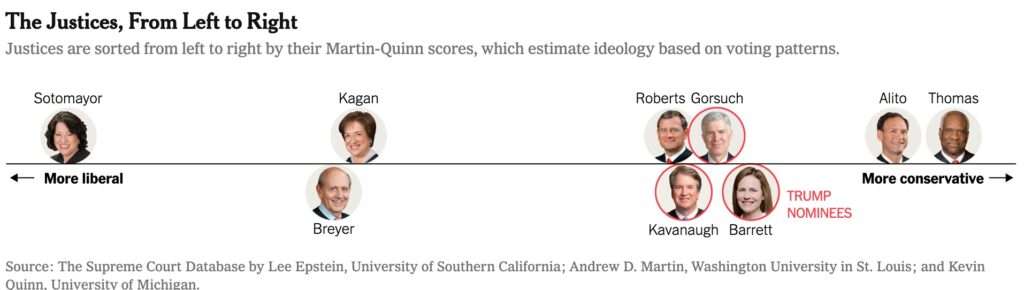
Gorsuch does not fit on a normal ideological scale. For example, the Times plotted him somewhere near Roberts, Kavanaugh and Barrett, but he is not in the center. The same person would dismantle the administrative state but cede half of Oklahoma to Indian tribes. On some cases, he is hard left. On other cases, he is hard right. He is tough to characterize. But, with the law of averages, he falls in the middle.
Justice Kavanaugh wrote two dissents. The first dissent, Concepcion, was a 5-4 case. I think it is possible that Kavanaugh lost the majority opinion in Concepion after Gorsuch flipped, as Sotomayor had two assignments from January. Kavanaugh's second dissent was in Empire Health. The latter case is the sort of nerdy issue that D.C. Circuit judges seem to enjoy.
Justice Barrett wrote two dissents. The first Nance v. Ward, was joined by Justices Thomas, Alito, and Gorsuch. (I believe this was the only time that Thomas assigned Barrett a dissent this term.) The second was Biden v. Texas. Recall that Barrett agreed with the Chief on the merits, but found the Court lacked jurisdiction.
In total, Justice Sotomayor had the most opinions with 24. Justice Thomas trailed behind her with 22, and Justice Gorsuch had 20. The Justices with the fewest opinions were Barrett with 12, and Roberts with 11. Historically, the Chief Justice does not write separately often. And last year, in which Barrett had a partial term, she wrote only one concurrence (Fulton) and three dissents. After the Chief, Barrett seems less likely to write separately.




