I've been tracking with interest the attempts of a couple of frequent litigants to either keep their litigation history secret or to retroactively make it secret, whether through sealing or pseudonymization (see pp. 1390-91 for a brief passage from a law journal article on the subject). Here's the latest judicial response, from Judge William Hayes in McMillan v. Chaker (S.D. Cal.), to one of the litigants, who had earlier had some (though mixed) success in his campaign:
The matter before the Court is the Motion to Seal filed by Defendant Darren D. Chaker …. In his motion, Defendant requests that the Court "seal the entire record" or, alternatively, "replace [Defendant's] name with John Doe and redact all personal information in the record." Defendant contends that sealing is appropriate because he is "a crime victim who has received several threats on his life, resulting in his participation in the [California] Safe at Home program."
"It is clear that the courts of this country recognize a general right to inspect and copy public records and documents, including judicial records and documents." "Following the Supreme Court's lead, 'we start with a strong presumption in favor of access to court records.'" "A party seeking to seal a judicial record [ ] bears the burden of overcoming this strong presumption by meeting the 'compelling reasons' standard." "Under this stringent standard, a court may seal records only when it finds 'a compelling reason and articulate[s] the factual basis for its ruling, without relying on hypothesis or conjecture.'" "The court must then 'conscientiously balance[] the competing interests of the public and the party who seeks to keep certain judicial records secret.'" …
Defendant's sealing request is based on his contention that allowing his personal information to remain in a public record could "lead to [Defendant] being harmed physically or emotionally." In support of this contention, Defendant states that he witnessed a violent crime and subsequently received threats to his personal safety. Defendant states that an unknown person subsequently attempted to enter his home. Defendant states that as a result, he is a current member of the California Safe at Home program.
I'll conclude my time here discussing my new draft on traditionalism with the problem of traditionalism's politics. The problem is pressing because of internecine political discontent that now seems to afflict originalism, in whose shadow traditionalism at present stands. But it is also vital because all interpretive methods have a politics: they may be motivated by a particular set of political commitments; or they may lead systematically to outcomes with a particular political valence; or the adherents of the method may tend to come from a particular political perspective; or some combination of these. Interpretive methods are of course more than their politics, but in this post, I am focusing on this feature of them. To understand traditionalism's politics, it may be helpful to set it in relief against the politics of originalism against which it is emerging.
In its early years, originalism as a sociological movement was a response to the liberal-progressive legal politics that came to dominate constitutional law in the twentieth century. For first-wave originalists, the jurisprudence of the Warren Court was felt to be incompatible with conventional lawyerly craft and led systematically to undesirable political outcomes. Yet as originalists came to suspect that a direct assault on the citadel constructed by the Warren and Burger Courts might backfire, they pivoted to offer an interpretive program that appeared politically neutral and might not be dismissed as mere political tit-for-tat.
As originalism's second wave accelerated, however, the politics of its adherents changed as well, attracting more libertarian and progressive scholars. Methodologically, the second wave no longer conceived constitutional law as the search for the lawmaker's will, but as a quest for the meaning of the Constitution's words. With its constitutionalism of semantics, methods, conventions, and most recently computerized linguistic corpora, originalism hoped to offer something apolitical.
But politics could not be so easily outrun. At first, originalism's positivism, and its putative rejection of politics, was a way of inscribing a fusionist alliance of libertarianism and conservativism into the constitutional realm. The illusion of originalism's political neutrality, however, could last only as long as the subscribing constituencies sensed that they were equal partners in a strategic alliance of method. As fusionism began to unbind, as originalism attracted progressive adherents, and as social conservatives' sense of embattlement and of the consistent failure to win critical cases increased, originalism's political denialism became less tenable.
Did all that change in the 2021 term, in which ostensibly conservative outcomes prevailed in some of the perennial political hothouses of constitutional law?
The Court's popularity has indeed fallen. But its relatively low approval ratings are neither unprecedented, nor worse than those of the other branches of government.
The Supreme Court's low approval ratings in the aftermath of the overruling of Roe v. Wade in the Dobbsdecision has led some to claim that the institution is in a "legitimacy crisis" (e.g. here, here, and here). The Court is indeed less popular now than at most other times in the recent past. On the other hand, its popularity remains as high or higher than that of the other branches of government. And its current poll ratings are not significantly worse than they were on a number of previous occasions over the last twenty years. Thus, claims of a legitimacy crisis are, at the very least, premature.
In the long-running Gallup poll, the most widely cited measure of various institutions' popularity, the Supreme Court's approval rating stood at 43% in July, compared to 55% who disapprove. That's bad. But it's as good or better than the standing of the other two branches of government. Despite some recent improvement, President Biden's approval rating stands at an average of 42.5% in the 538 website's aggregation of polls. He has an average disapproval rating of 53%. Biden sits at 44% approval and 53% disapproval in the most recent Gallup poll. Congress's approval rating is chronically low, most recently clocking in at 17% in the same July poll that gave the Supreme Court its weak 43% rating.
If the Supreme Court's low ratings are enough to create a legitimacy crisis, Biden is in the same boat, and Congress is in far more dire straits than either. Biden's most likely 2024 opponent - Donald Trump - is even more unpopular than Biden himself. Thus, there is a good chance that the presidency will be held by an unpopular figure for years to come.
Of course Biden's popularity might increase. Perhaps even Congress might become more popular. But the same is true of the Supreme Court, which has a long history of bouncing back from negative public reaction to unpopular decisions.
It may be that Congress and the presidency are also facing a crisis of legitimacy. The generally low ratings of all three branches of government may be a sign of declining faith in institutions across the board. But, if so, it's not a problem specific to the Supreme Court, or primarily caused by its recent rulings. Moreover, the unpopularity of the president and Congress weakens their ability to curb the Court's power. In a confrontation between unpopular politicians and unpopular judges, the former could end up losing.
It is also worth recalling that the Court's current relatively low polling numbers are far from unprecedented. It's 43% approval rating today is very similar to the 42% rating (with 48% disapproving) it had in 2005, after the highly unpopular ruling in Kelo v. City of New London. But the Court's ratings soon recovered. I literally wrote the book on why Kelo was an awful ruling. But even I can't seriously claim that it did long-term damage to the Court's standing. The Court also stood at 42% (with 52% disapproval) in the summer of 2016 (a result possibly influenced by the Court's unpopular decision upholding racial preferences in college admissions that year). Again, it bounced back.
Perhaps this time the Court's popularity won't recover, or won't recover to the same extent. It is notable that this year's Gallup numbers are actually similar to those of last summer, when the Court was at 40%. But it is also likely that Dobbs and the negative reaction to it forestalled what would otherwise have been a gradual recovery from last year's low numbers. Such a gradual recovery could happen over the next year or two, as memories of Dobbs recede and public attention focuses on other issues.
Moreover, the numbers could easily go up if the Court makes popular decisions in prominent cases. That is likely to happen as soon as next year, when the Justices are expected to issue a high-profile ruling curbing racial preferences in higher education. Racial preferences in education are overwhelmingly unpopular, and majority public opinion would probably welcome a decision striking them down.
Another sign that the Court may not be facing much of a legitimacy crisis is that, even in the aftermath of Dobbs and other recent conservative rulings, most Democratic politicians are not advocating court-packing or other measures to curb the justices' power, as part of their platform for the upcoming 2022 election. Abortion is, of course, a major issue in the campaign. But measures to clip the wings of the Court are not. If the Court's legitimacy was as damaged as some claim, we should expect Democratic political strategists to seize on that fact, and exploit it. The decision of most of them not to do so is a notable dog that didn't bark - or at least isn't barking very much.
That doesn't mean the Court is entirely out of the political woods. The increasing polarization in perceptions of the Court - with only 28% of Democrats viewing it favorably, compared to 73% of Republicans - is a potential danger. Even if the Court's overall popularity isn't terrible, Democrats could potentially try to move against it, if their political base becomes angry enough.
A Democratic Congress could try to enact court-packing, or a Democratic president could choose to disobey rulings the party's supporters strongly disapprove of. Democrats might ask: If Republicans like Donald Trump can defy political norms and undermine the Constitution when they find it convenient to do so, why not us? I described such scenarios in a 2018 post, but also noted various obstacles to their occurrence. For the moment, nothing of the sort seems likely to happen in the short to medium term.
At the same time, however, court-packing has become a part of mainstream political discourse in a way that wasn't true five or ten years ago. The norm-breaking political behavior of the right has helped weaken norm-based taboos on the left. That doesn't mean court-packing is likely to happen. The odds are still against it, in my view. But it is a much more plausible scenario than it would have been if the idea had remained beyond the pale.
Some, of course, would argue that public opinion is irrelevant to legitimacy. What really determines the Court's legitimacy is not approval ratings, but the quality of its decisions. If you think Dobbs was a horrible ruling that indefensibly gutted a constitutional right, you probably believe that would still be true, even if majority public opinion welcomed the decision. The same goes for other Supreme Court decisions you might consider to be especially awful. Alternatively, maybe legitimacy depends on whether the Court uses the right methodology, such as originalism or living constitutionalism. A wrong decision may still be legitimate if the justices honestly tried to apply the right interpretive theory in the process of reaching it. But not if they reached it by using the "wrong" kind of reasoning.
This may be the correct normative approach to assessing the Court's rulings. I certainly agree that popular rulings are sometimes badly wrong, and unpopular ones right. I also think some methodologies are better than others.
But we should avoid conflating the legitimacy of the Court's decisions with their correctness. At least in one significant sense of the former term, it refers to the Court's political standing, rather than to the soundness of its rulings. In addition, if legitimacy just comes down to the correctness (or lack thereof) of the Court's rulings, then the former ceases to be a useful concept. Any debate over legitimacy will simply devolve into a debate about the quality of the Court's rulings or the soundness of its methodology.
Even if you don't care about the Court's standing for its own sake (I generally don't, myself!), it is important to remember that the Court must have at least some substantial political support in order to ensure that its rulings will be obeyed. As Alexander Hamilton famously wrote, the judiciary doesn't control either the government's "sword" or its "purse" and therefore depends on others to enforce its decisions. For that reason, among others, the Court's legitimacy - defined as its standing with public opinion - does make a difference. If the Court become unpopular enough, the other branches of government could move against it, or just simply ignore its decisions when they don't like the result.
While the Court's popularity has fallen, it has not gotten to the point where its political standing is seriously threatened. A legitimacy crisis could still occur in the future, especially if the justices' popularity declines still further. On the other hand, past history suggests that it could instead rise.
Every generation has a defining moment. For my generation, it was 9/11/2001.
Here are my memories of 9/11/2001. It was a Tuesday.
I was a Senior at Staten Island Technical High School, which is about 20 miles from ground zero. We were about 1 week into the school year. I was sitting in Ms. Endriss's 2nd Period A.P. Political Science class. We were going over some NYC Public School discipline policy, and discussing what kinds of weapons were forbidden in schools (brass knuckles were a no-no). A student walked into the classroom late. He had heard a rumor that a Cessna airplane had hit the World Trade Center. A girl in my class exclaimed that her father worked in the World Trade Center. I could see the look of fear in her eyes, even though none of us had any clue what was going on. She wanted to call her dad. I was the only student in the class with a cell phone, which I promptly gave her. The call did not go through–he worked on one of the upper floors of the tower, and passed away.
We finished second period, apprehensively. I logged onto a computer, and attempted to check the news. I recall one friend told me to check MTV.com for news. At that point, the reports were unclear, and no one knew what was going on. We proceeded to 3rd period A.P. Calculus with Mr. Curry. At that point, someone told us that it was not a Cessna, but in fact a passenger jet. We were all getting nervous, and didn't quite know what was going on. Later in class, a student came into the class and said a second plane had crashed into the other tower. We also heard that there was an explosion at the Pentagon. At that point, we knew it was not an accident.
I remember leaving the class (something I never did) and walked up to the library where I knew there was a T.V. Just as I arrived in the library, I saw the first tower collapse. I watched it live. I was stunned and could not believe what was happening before my eyes. I grabbed my cellphone to call home, and almost immediately after the tower collapsed, I lost all service. I was not able to call my mom in Staten Island, though I could call my dad who was working in Long Island. Long distance calls seemed to work, but local calls were not working. I remember my dad told me that this was a life-changing event, and he had no idea what would happen. I heard some rumors on TV that there were 15 planes that were hijacked, and unaccounted for in the skies.
By lunch time, the school guidance counselor set up a conference room where students could go to talk. I remember seeing student after student who had a family member or friend who worked in the World Trade Center or in Manhattan. A large number of firefighters and police officers reside in Staten Island. Tragically, many of the emergency responders who perished were from Staten Island. What could we even tell those students?
After that, the day become a blur. I remember hearing that the second tower had collapsed, though I did not see it. I remember watching the entire United States Congress sing God Bless America on the steps of the Capitol. I had never been so afraid in my life. Later that night, I took a bus home. The New York City public buses were still running, and I remember the driver was not collecting fares. On the bus, people were talking about the imminent war (against whom, no one knew) and the imminent draft. Some were saying that students were exempt from the draft.
The next morning, September 12, 2001, I woke up and smelled this horrible smell. The air had this pungent odor, that reminded me of burned flesh at a BBQ. I went to school that morning, and attendance was low. In all of my classes, we were talking about war. I asked whether the US would need to use nuclear weapons. My teacher explained that carpet bombing–a phrase I had never heard of–could wreak plenty of damage in Afghanistan. Later that week students began making sandwiches for the relief workers, and collecting goods to donate to the relief effort.
From Staten Island, I could see the smoldering Ground Zero. It was surreal. The skyline looked so very empty. To this day, whenever I look at the Skyline, a sight I had seen thousands of times, I have the most bizarre feeling. Additionally, whenever we saw an airplane fly overhead, we all freaked out. This lasted for months.
For days, weeks, and months after 9/11, people in Staten Island were waiting for their loved ones to come home. Many patients were alive, but were so badly burned that they could not be identified. People prayed that these unnamed patients would soon come home. One woman whose husband was a firefighter waited outside her home every single night for months. She eventually put a candle in her window every night. Later, she put a memorial lamp in her window. He never came home. Others were simply waiting for remains of their loved ones to be returned. Many were never identified.
I ordered a gas mask from eBay, which I kept in my car, fearing a biological weapon attack on New York City. I remember I tried it on once and I almost suffocated. I wanted to order some Cipro for an anthrax attack, but I could not locate any.
It is hard to encapsulate what a New Yorker went through on 9/11. Thinking back on that day, when I was just 17 years old, I realized that I had to grow up awfully quick. It was a new world we were living in.
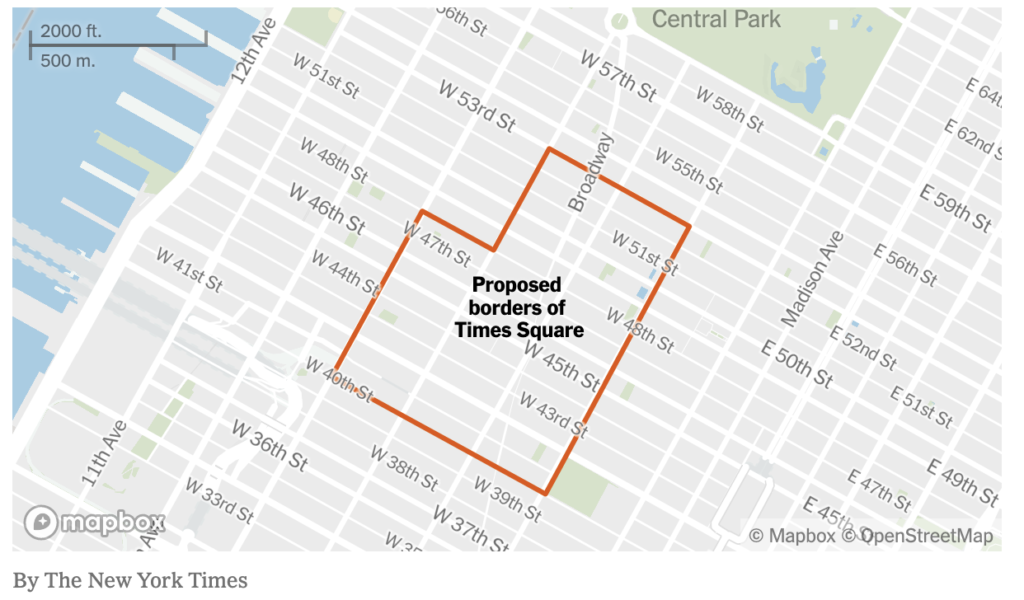
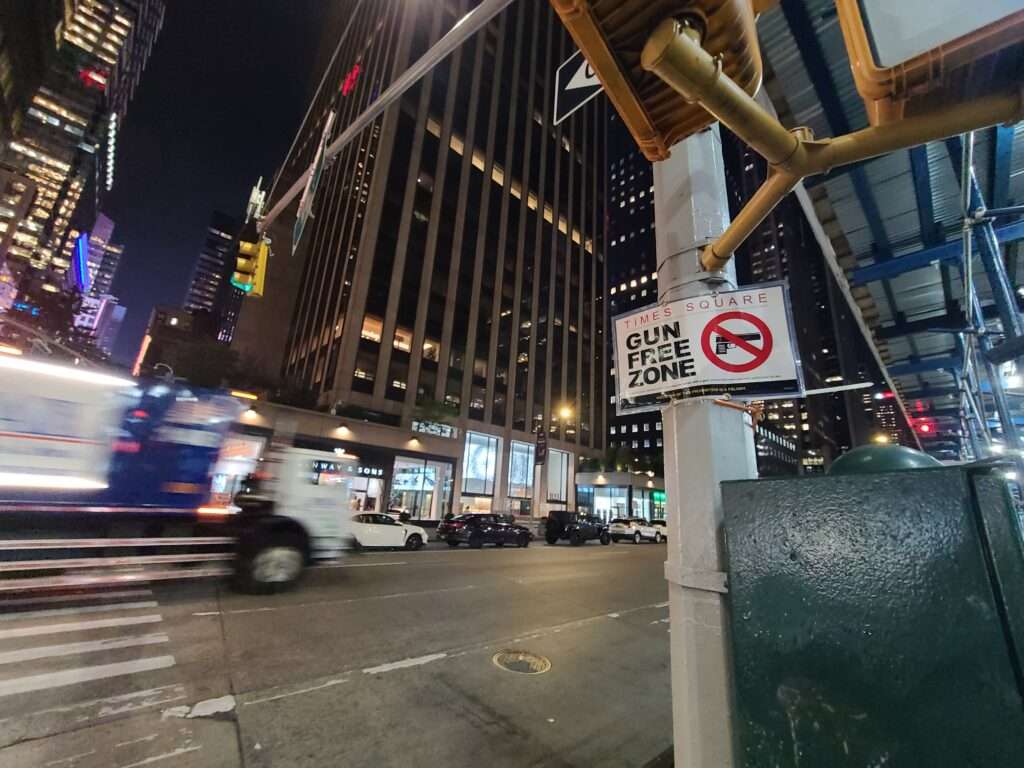
This evening, I took a stroll around Midtown Manhattan with a goal: locate a Times Square Gun Free Zone sign. I entered the Second Amendment safe space at 6th Avenue and 49th Street. But I saw no sign! Then I walked to Broadway and 49th Street. Still no sign! I walked down Broadway to 43rd Street. I saw no signs.
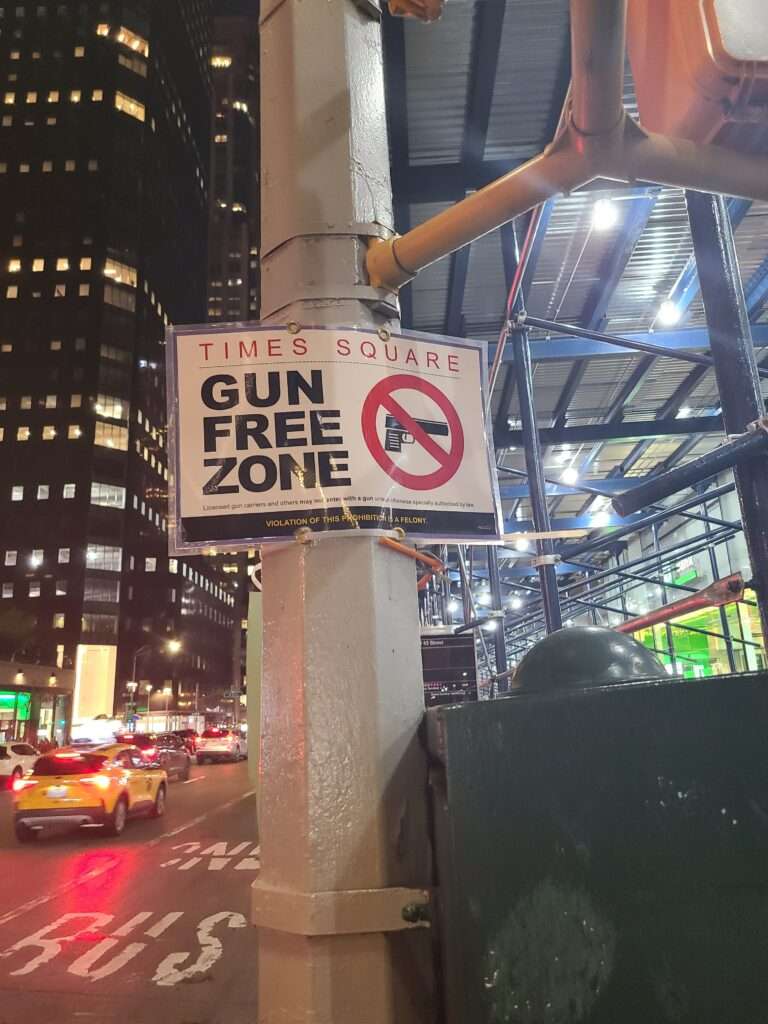
I then turned up 43rd to 6th avenue, and I found it. A sign!
The sign reads:
Times Square Gun Free Zone. Licensed gun carriers may not enter with a gun unless specifically authorized by law. Violation of this prohibition is a felony.
I suspect these signs are temporary. The laminated printouts were attached to the pole with zip ties.
As best as I can tell, the signs were posted along 6th Avenue from 42nd Street through 47th Street. Alas, I entered the Constitutional DMZ at 49th Street. No notice. But still a felony.
From Activision Publishing, Inc. v. Warzone.com, LLC, decided last month by Judge Fernando L. Aenlle-Rocha (C.D. Cal.), but just posted on Westlaw (presumably because it has just been appealed); this seems quite correct:
Warzone.com develops and makes available to the public a browser-based game titled Warzone. Warzone is a free-to-play, turn-based strategy game. Players shift numbers, which represent armies, across a map of the world to take control of countries or territories. Warzone.com markets that game as "Better than Hasbro's RISK game." Warzone.com released Warzone in November 2017, and it is available on Warzone.com's internet website and mobile devices. Warzone is not available on video game consoles.
On or about June 25, 2020, Activision filed applications for registration of the trademarks WARZONE and CALL OF DUTY WARZONE. On October 30, 2020, Warzone.com filed applications for registration of the trademark WARZONE. Warzone.com filed a Notice of Opposition to the registration of the Activision marks and the opposition proceeding is currently pending before the USPTO. On November 20, 2020, Warzone.com's counsel sent a cease-and-desist letter to Activision's counsel, demanding that Activision "change the name of its games, stop using Warzone's WARZONE mark, and abandon the trademark applications." Activision and Warzone.com were unable to resolve the dispute, and Warzone.com indicated it intended to seek injunctive relief and damages against Activision….
[W]hen a trademark is included in an expressive work, the protections afforded under trademark laws must also be balanced against broader First Amendment concerns. In circumstances involving an expressive work, a plaintiff with Lanham Act claims must instead overcome the test articulated in Rogers v. Grimaldi (2d Cir. 1989), which was adopted by the Ninth Circuit ….
In Greer v. Fox Corp., decided Wednesday, Judge Laura Taylor Swain (S.D.N.Y.) largely adopted Magistrate Judge Stewart Aaron's report and recommendation from June 2021; here's an excerpt of that report and recommendation, which the District Judge adopted (and which strikes me as quite correct):
The following is a summary of the allegations contained in the [Complaint] that relate to the legal claims asserted:
Greer is "an expert used by TV and radio for interviews." During the period 2008 through 2013, he appeared as a guest on FBN and Fox News. Defendant [Charles] Gasparino, a reporter for FBN, interviewed Greer and used his news tips.
In 2012, Greer published several Op-Eds and letters in the WSJ [Wall Street Journal]. In December 2012, he approached Dow Jones with an idea about creating a healthcare-related video website as part of the WSJ. Greer's idea "never materialized," but the WSJ pursued the idea on its own, without credit or payment to Greer. However, Greer never pursued litigation about it.
From 2010 to 2013, Greer provided news tips to [Jennifer] Strasburg, who was a reporter at the WSJ, for articles she wrote about "expert networks." Strasberg never informed her editor about Greer's contributions to the articles and Greer "believes that Strasburg was reprimanded by her bosses" as a result. Greer apparently also believes that Strasburg "smeared" his name with other journalists. …
Commencing in 2017, Greer "suspected" that Carlson was misappropriating Greer's written work and using it on Carlson's Fox News show. For example, in 2019 and 2020, Carlson used the term "Demimplosion" on his show, in circumstances where Greer previously had coined the term "Demplosion." In 2019, Carlson "used the words 'civil war' to describe the national unrest," in circumstances where Greer previously had made the "the novel analogy that the partisan division in the country was actually like a second civil war." In 2021, Greer provided news tips to Carlson about the nursing home scandal engulfing Governor Cuomo, but Carlson never gave Greer "due credit for being the person who exposed" the scandal….
Greer sued on various state law theories, including unfair competition, unjust enrichment, misappropriation of hot news, and the like, but the court held that they were preempted by the Copyright Act:
Georgia v. President of the United States (August 26) is a major new case about national injunctions. Seven states brought a challenge to the vaccine mandate for federal contractors, and a trade association intervened (Associated Builders and Contractors). On the merits, the question was whether the contractor mandate went beyond the president's powers under the Procurement Act. The district court said the challengers were likely to succeed on the merits and issued a national injunction blocking enforcement of the mandate. The court of appeals agreed that the challengers were likely to succeed on the merits, and it upheld the injunction as it related to the parties, but the court vacated the injunction as to non-parties. The Eleventh Circuit decision is here.
The opinion of the court is by Judge Grant. (Whether all parts of the opinion should be designated "the opinion of the court" is less clear, but there's no doubt that Part V, on the scope of the injunction, expresses the view of the panel. That part of the opinion was joined by Judge Anderson, who otherwise dissented, and the short concurrence in the result by Judge Edmondson expressly agrees as to the scope.)
The analysis in Judge Grant's opinion is incisive and thorough (and very well written). It moves from Article III to the traditional scope of equitable powers to circuit precedent, and back to the distributed decisionmaking that is characteristic of the federal courts. Most of these points will not surprise those who have been following the debate about national injunctions, but this is an excellent restatement of all the major concerns. There are also some new or distinctive points to highlight:
First, this opinion expressly allows national injunctions in "appropriate" but "rare" cases. This express allowance is based on circuit precedent ("Consistent with these principles, we have said that a nationwide injunction may be issued 'in appropriate circumstances'" (citing circuit precedent)). But the devil is in the details. Some courts say something like that, and then give reasons for a national injunction that could be found in essentially every case, such as a need for uniformity or the equal application of the law (i.e., between parties and non-parties). But this opinion tightens the screws. None of the "factors" that might suggest a broader injunction require one, and in every case the district court must "wrestle" with how to give an injunction that is no broader than needed to address the injury to the parties. After this decision, the result may be that national injunctions are permissible in theory but not in fact.
Second, this opinion is unique in how it gives a wide set of illustrations of how Congress can depart from the norm of letting separate cases, like a thousand flowers, bloom. These illustrations undergird the court's conclusion that "nonuniformity is a deliberate feature of our federal court system, and Congress--not one of the 94 federal district courts or 12 regional circuit courts--is best positioned to choose when to depart from that norm."
Third, the opinion considers injunctions qua injunctions, not the question of what relief is authorized under the Administrative Procedure Act (footnote 16 notes that the plaintiffs dropped an argument for vacatur on appeal). As readers know, I commend John Harrison's work as the gold standard on APA remedies. His latest piece on the subject, Remand Without Vacatur and the Ab Initio Invalidity of Unlawful Regulations in Administrative Law, was the subject of a series of posts last month at the Volokh Conspiracy.
Fourth, the court did not allow remedial principles to get trampled by who the parties were. Seven states sued, and as other commentators have recognized, a recent expansion of state standing has driven the rise of national injunctions. Some courts have acted like a state plaintiff gets to say how federal law applies within the territory of the state (at odds with Massachusetts v. Mellon, among other cases). But this court is more careful, and it treats the state plaintiffs as plaintiffs who represent themselves. Similarly, when a trade association is present, some courts have acted as if the entire industry, or even all affected parties were present. But the court is more careful: the trade association represents its members, full stop. As the court said, "injunctive relief operates on specific parties, not geographic territories, and identifying the plaintiff States and trade association members is possible."
Fifth, the court is careful in how it applies its analysis to different parts of the injunction, distinguishing between contract terms and solicitation of bids. This is well done.
Sixth, and this is something in which I take particular delight, this decision has the support of judges appointed by both Democratic and Republican presidents. At any one moment in time, national injunctions are highly political. They stopped the agenda of President Obama in the second half of his second term; they stopped the agenda of President Trump; now they stop the agenda of President Biden. But the reasons to think they are destructive of our judicial system are not partisan. And I will concede that the principled reasons to support national injunctions (as outlined in Amanda Frost's In Defense of Nationwide Injunctions) are also not partisan. In other words, although the applications tend to be intensely partisan, the principles at play here are not.
Finally, this opinion comes at an odd moment in the debate over national injunctions. Neither Congress nor the Supreme Court has yet eradicated them. They continue to dominate major questions in our public life. But even judges who give them now tend to express regret, as if they recognize there is something tawdry or untoward about this device. In more circuits, judges are expressing concern about their distortive effects (as in Judge Sutton's recent concurrences, one of which is discussed here). And a decision like Georgia v. President of the United States offers a roadmap for how a circuit that has allowed national injunctions in the past can, without any reversal of its precedent, do its part to put the national injunction on a path to extinction.
But wouldn't the arguments in the dissent equally cast doubt on all historical analysis in constitutional cases, or even statutory or common-law cases?
From yesterday's Ohio Supreme Court decision in State v. Philpotts, where one underlying question is whether a ban on gun possession by people who have been indicted but not yet tried for a "felony offense of violence" or felony drug offense violates the Second Amendment:
Sua sponte, parties ordered to file supplemental briefs [within 14 days] addressing the impact, if any, of New York State Rifle & Pistol Assn., Inc. v. Bruen (2022). Supplemental briefs are not to exceed 20 pages, and each side's brief shall be filed within 14 days….
Justice Jennifer Brunner dissented:
… I dissent because even considering whether to apply Bruen at this juncture implicates determining the United States' historical tradition of firearm regulation in relation to Ohio's gun laws. This will require the presentation of evidence that should not be examined in the first instance at the appellate level on an order for supplemental briefing. Determining what the historical record shows in relation to Ohio's gun laws involves determining facts, and the facts should be developed in and determined by a trial court, not an appellate court, especially when the parties have not made relevant arguments to support this examination nor requested that we make it.
Further, I have concerns about how "history" or historiology can become part of a legal analysis, as this court embarks on the legal equivalent of asking whether a modern translation of the Bible accurately conveys the teachings of the original texts.
History changes over time as historians uncover and analyze new information learned through the finding of artifacts, writings, photographs, and new methods of historical analysis. The National Council on Public History, headquartered on the campus of Indiana University-Purdue University in Indianapolis, writes:
From yesterday's Ninth Circuit opinion by Judge Mary Murguia, joined by Judge Marsha Berzon, in Avilez v. Garland:
This opinion uses the term noncitizen unless quoting language from the immigration statutes or past opinions containing the term alien. There are two reasons behind this choice. First, use of the term noncitizen has become a common practice of the Supreme Court, see Patel v. Garland (2022) (Barrett, J.); United States v. Palomar-Santiago (2021) (Sotomayor, J.); Barton v. Barr (2020) (Kavanaugh, J.) ("This opinion uses the term 'noncitizen' as equivalent to the statutory term 'alien.'"), whose lead on matters of style we ordinarily follow, and of the Board of Immigration Appeals, e.g., Matter of Dang (BIA 2022), whose decisions we review.
Second, even if that were not the case, "[c]areful writers avoid language that reasonable readers might find offensive or distracting—unless the biased language is central to the meaning of the writing." Chicago Manual of Style Online 5.253, https://www.chicagomanualofstyle.org/book/ed17/part2/ch05/psec253.html. The word alien can suggest "strange," "different," "repugnant," "hostile," and "opposed," Alien, Webster's Third New International Dictionary 53 (2002), while the word noncitizen, which is synonymous, see Alien and Noncitizen, American Heritage Dictionary of English Language 44, 1198 (5th ed. 2011), avoids such connotations. Thus, noncitizen seems the better choice. Respectfully, we do not see how this choice "comes at a real cost to litigants." Judge Bea Concurrence at 43. Litigants may use either word, and we do not think our choice here will cause judges to "respond negatively" to litigants who use the term alien. See Judge Bea Concurrence at 43.
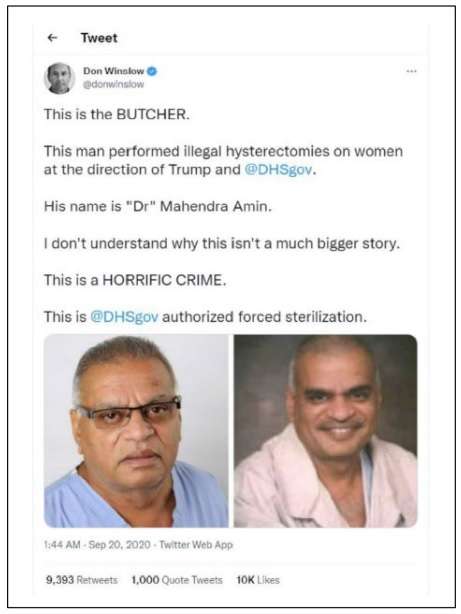
Winslow had accused a doctor working on contract with an immigration detention center of "perform[ing] illegal hysterectomies on women at the direction of Trump and [DHS]."
Plaintiff is a medical doctor and works as an OB/GYN. {For purposes of this order, the Court accepts as true Plaintiff's factual allegations.} Plaintiff provided medical services to patients at the Irwin County Detention Center ("ICDC").
In September 2020, a nonprofit organization sent a letter to the Department of Homeland Security related to reports about high rates of hysterectomies at ICDC. The letter also expressed concern over COVID-19 measures. Plaintiff was not identified in the letter. The organization then shared the letter with several media outlets. In late September, there were various stories on Plaintiff related to medical procedures at ICDC.
On September 20, 2020, Defendant Don Winslow—a New York Times bestselling author—published statements on his Twitter account about Plaintiff:
Defendant has over 600,000 followers on Twitter.
Plaintiff contends the statements are false. Plaintiff alleges he only performed two hysterectomies on patients at ICDC and the procedures were medically necessary. The patients provided their informed consent to the procedures. Moreover, the United States Immigration and Customs Enforcement approved the procedures after it conducted an independent review of the treatment, including review from a nurse and an independent doctor. That review process takes about two weeks.
Five days before the Contested Tweet, it was revealed that the allegations about Plaintiff were not based on first-hand accounts, and ICDC (in addition to the hospital) confirmed Plaintiff only performed two hysterectomies on ICDC patients.
Plaintiff sued for libel, and the court allowed the claim to go forward. It concluded plaintiff wasn't a public official and thus didn't have to prove "actual malice":
Please enjoy the latest edition of Short Circuit, a weekly feature written by a bunch of people at the Institute for Justice.
New on the Short Circuit podcast: A landmark, watershed, and very salubrious ruling from the Michigan Supreme Court on implied rights of action under the state constitution. And also, a starkly different holding from the Tenth Circuit in the wake of Egbert v. Boule.
Guantanamo prisoner is tortured for information, which the government then includes in legal filings in the prisoner's criminal case. No problem, say the feds, we're not using it at trial, just for discovery matters. That's cool, right? On further reflection, the feds remove the info from the filing and promise not to use the torture-obtained info in future filings. D.C. Circuit: So the prisoner's challenge to the use of the info is variously moot, unripe, without standing, and inappropriate for mandamus.
Forget about the judicial reasoning in this run-of-the-mill wrongful arrest case from the D.C. Circuit, what on earth is hiding under the redactions?
Ever fail to click a couple of boxes on an overly confusing computer program and as a result pay an extra $894 mil in principal when you only meant to pay the interest? Well, a guy at Citibank did, and when he and his colleagues realized their mistake the next day—and immediately sent detailed notices asking for the money back—a number of the lenders said "that's funny, but screw you the money's ours now." Were they wrong to keep it? District court: No, life moves fast sometimes. Second Circuit: Yes, they had the money an incredibly short time before the notices went out and should have known something funny was up. Concurrence: This is obvious and why did we take a year to decide? "Possession is not ten-tenths of the law."
Former biopharmaceutical-company employee: As a condition of my employment, I had to give the company a ton of sensitive personal and financial information, which was later accessed by a hacking group and distributed on the dark web. Class-wide damages and equitable relief please. District court: No standing. Third Circuit: She's seeking damages for the release of her personal information on the dark web and she claims, among other things, that her former employer breached its employment agreement with her by failing to secure her info. Sure seems like a controversy to us. Concurrence in the judgment: Agreed, and we could have said so in far fewer words. (Also, Third Circuit, we're capitalizing "Sister Circuits"?)
Texas City, Tex. fire dept. official who does not have the authority to detain anyone nevertheless detains two emergency medical technicians over a permit violation. ("You are detained. You are not allowed to leave. … [G]et the F back into the vehicle.") District court: Could be an unconstitutional seizure, but there's no prior case on point. Qualified immunity. Fifth Circuit: Reversed. Before an official can raise QI as a defense, they must show they were acting within the scope of their authority—an "oft-overlooked threshold requirement." [Ed.: At this very moment, IJ is asking the Supreme Court and asking the Tenth Circuit to remind courts of this requirement.]
Twelve days of Christmas are enough to get you more partridges than you probably wanted, but, says the Fifth Circuit, twelve days of a preliminary injunction before your case is mooted by legislative reform are not enough to make you a "prevailing party" for purposes of recovering fees.
Allegation: Middle-aged man grabs seven-year-old by the neck after the boy accidentally dropped raisins in front of the man's home. When a Fort Worth, Tex. officer arrives, he asks the boy's mother "Why don't you teach your son not to litter?" She does not take kindly to this; after some shouting and jostling, the officer arrests her and her 14-year-old daughter. And then, after the situation had de-escalated, the officer arrests an 18-year-old daughter who had been filming the incident, shoving her against his patrol car, ripping the phone out of her hands, handcuffing her, and then—when she declined to give her name—wrenching her arm behind her back causing "excruciating pain." (Internal affairs officers recommend firing the officer for using excessive force and lying in his affidavit. Instead, he's suspended 10 days.) Fifth Circuit (February): Qualified immunity for everything. IJ amicus brief: Surely not for the arm wrenching? Fifth Circuit (this week): "Nothing in our opinion should be construed as suggesting, much less holding, that officers may use pain maneuvers to force non-resisting individuals to respond to questioning." The 18-year-old was actively resisting arrest. Qualified immunity.
Allegation: Boyd County, Ky. jail staff used excessive force putting inmate into a restraint chair and then tightening straps around his neck until he passed out. As it happens, the DOJ conducted an investigation at the jail, noting that an inmate died of blunt force trauma while in a restraint chair and that at least two other inmates were strapped down with their genitals exposed to passersby. District court: Ah, but the plaintiff can't sue the municipality unless he shows a pattern of mistreatment. Which he can't do because the DOJ report is inadmissible. Sixth Circuit (unpublished): It's admissible, and (over a dissent) a jury might see a pattern.
Allegation: Memphis police subject man to forcible anal cavity search on street in full public view. He tries to obtain public records relating to the incident, but the city conceals the info until after the one-year statute of limitations expires. City: Shouldn't have missed that statute of limitations! Sixth Circuit (unpublished, over a dissent): The man's suit can proceed.
Debt collector sends Missouri bankruptcy attorney a debt-collection letter for one of his clients. Except the client isn't the lawyer's client at all. The lawyer's never heard of the person. So (as one does) he sues the debt collector for violations of the Fair Debt Collection Practices Act. Eighth Circuit: Yeah, the debt collector may have violated the FDCPA, but the statute exists to protect consumers, and you—random lawyer dude—aren't the kind of plaintiff who can sue to enforce it. Dissent: Actually, the statute unambiguously gives the random lawyer dude a cause of action.
Following his arrest for a three-month burglary spree that nabbed about $5k worth of property, 21-year-old Arizona man turns down a plea deal and goes to trial. He's convicted of 25 counts, with all but two of the sentences to be served consecutively. A total of 292 years in prison! Is this punishment so grossly excessive that it violates the Eighth Amendment? Ninth Circuit (over a dissent): Might be wrong, but none of the individual sentences are unconstitutionally excessive, and the Supreme Court has never said we should add them all up, so no habeas for this guy.
Ninth Circuit (2013): Talk therapy is, for First Amendment purposes, not speech but instead a form of medical conduct, no different from brain surgery. Supreme Court (2018): That Ninth Circuit case, specifically, was wrongly decided because it treated speech by professionals different from speech by nonprofessionals. Ninth Circuit (2022): But we've already established that talk therapy is not speech, it's conduct, like brain surgery, so we reach the same conclusion.
Allegation: At DHS officials' instigation, ICE agent is charged with inflating her overtime pay. The criminal case lasts three years until an Orange County, Calif. prosecutor tells the judge it's bogus. District court: But she can't sue the DHS officials under the Federal Tort Claims Act; officials need leeway to do their investigations and present evidence as they see fit; they get discretionary function immunity. Ninth Circuit: Reversed. They don't have discretion to make up false allegations, lie under oath, and doctor evidence. Also Ninth Circuit (unpublished): Nor was she required to file her constitutional claims while the criminal case was still pending. Some of those claims are undismissed as well.
Allegation: Man dies from complications related to alcohol withdrawal at Uintah County, Utah jail after staff failed to give him his medication and sat by while his condition worsened. Defendants: Okay, but none of these earlier cases about deliberate indifference to an inmate's medical needs were about alcohol withdrawal. Tenth Circuit: And yet the law is clearly established. No qualified immunity, and the county may be on the hook too.
What is the secret to eternal youth? If 92-year-old Senior Judge Gerald Bard Tjoflat is any guide, the trick is to voluntarily elect to participate in Eleventh Circuit en banc cases about Article III injury-in-fact (and have your panel dissent vindicated by a majority of the full court).
Do the FAA's new air traffic control measures around south and central Florida airports keep people from getting a good night's sleep? Eleventh Circuit: Doesn't matter. There's no such thing as a right to sleep (unless you're in prison).
And in en banc news, the Fourth Circuit will not reconsider its order denying the defendant (a prominent Baltimore attorney convicted of money laundering) release pending appeal. Dissent: There's no relevant factual difference between this motion and that from former Virginia Governor Bob McDonnell, which we did grant.
And in amicus brief news, IJ is asking the Eleventh Circuit to let a U.S. business and its Bolivian customer challenge the forfeiture of $9k cash that the customer sent to the business via courier—a courier who decided to smuggle some cocaine into the U.S. on the side. As part of his plea deal, the courier agreed to forfeit the cash. The business and its customer want to argue that their transaction was entirely lawful, but the district court dismissed their petition on the basis that they lack standing because of perceived deficiencies in their (perfectly adequate) initial pleadings, which were filed within the strict 30-day deadline. Worse, the court said that—unlike all other civil pleadings—forfeiture petitions can't be amended after the filing deadline. But there's nothing in the statute that imposes these heightened pleading requirements on property owners, and this case should be decided on the merits.
Friends, Brandy Davis is an experienced eyelash extension specialist from Texas who recently moved to Oklahoma. But Oklahoma won't let her work as an eyelash extension specialist unless she spends hundreds of hours obtaining a cosmetology or esthetician license—licenses that require no training in eyelash extensions, only lots of training in other things Brandy does not wish to practice. That does not make sense, and the Oklahoma Constitution protects Oklahomans' right to earn an honest living free from senseless regulations, so this week IJ and Brandy sued the Oklahoma State Board of Cosmetology and Barbering. Click here to learn more.
The court agrees with the defense position that "[w]hatever the utilities of [the Amended Complaint] as a fundraising tool, a press release, or a list of political grievances, it has no merit as a lawsuit."
I'm slammed today, so I can't offer much detail; but I thought I'd include a link and the opening discussion (the opinion was issued yesterday by Judge Donald Middlebrooks (S.D. Fla.)):
Plaintiff initiated this lawsuit on March 24, 2022, alleging that "the Defendants, blinded by political ambition, orchestrated a malicious conspiracy to disseminate patently false and injurious information about Donald J. Trump and his campaign, all in the hopes of destroying his life, his political career and rigging the 2016 Presidential Election in favor of Hillary Clinton." On this general premise, Plaintiff brings a claim for violations of the Racketeer Influenced and Corrupt Organizations Act ("RICO"), predicated on the theft of trade secrets, obstruction of justice, and wire fraud (Count I). He additionally brings claims for: injurious falsehood (Count III); malicious prosecution (Count V); violations of the Computer Fraud and Abuse Act ("CFAA") (Count VII); theft of trade secrets under the Defend Trade Secrets Act of 2016 ("DTSA") (Count VIII); and violations of the Stored Communications Act ("SCA") (Count IX). The Amended Complaint also contains counts for various conspiracy charges and theories of agency and vicarious liability. (Counts II, IV, VI, and X–XVI).
Plaintiff's theory of this case, set forth over 527 paragraphs in the first 118 pages of the Amended Complaint, is difficult to summarize in a concise and cohesive manner. It was certainly not presented that way. Nevertheless, I will attempt to distill it here.
The short version: Plaintiff alleges that the Defendants "[a]cting in concert … maliciously conspired to weave a false narrative that their Republican opponent, Donald J. Trump, was colluding with a hostile foreign sovereignty." The Defendants effectuated this alleged conspiracy through two core efforts. "[O]n one front, Perkins Coie partner Mark Elias led an effort to produce spurious 'opposition research' claiming to reveal illicit ties between the Trump campaign and Russian operatives." To that end, Defendant Hillary Clinton and her campaign, the Democratic National Committee, and lawyers for the Campaign and the Committee allegedly hired Defendant Fusion GPS to fabricate the Steele Dossier. "[O]n a separate front, Perkins Coie partner Michael Sussman headed a campaign to develop misleading evidence of a bogus 'back channel' connection between e-mail servers at Trump Tower and a Russian- owned bank."
Clinton and her operatives allegedly hired Defendant Rodney Joffe to exploit his access to Domain Name Systems ("DNS") data, via Defendant Neustar, to investigate and ultimately manufacture a suspicious pattern of activity between Trump-related servers and a Russian bank with ties to Vladimir Putin, Alfa Bank. As a result of this "fraudulent evidence," the Federal Bureau of Investigations ("FBI") commenced "several large-scale investigations," which were "prolonged and exacerbated by the presence of a small faction of Clinton loyalists who were well-positioned within the Department of Justice"—Defendants James Comey, Andrew McCabe, Peter Strzok, Lisa Page, Kevin Clinesmith, and Bruce Ohr. And while this was ongoing, the Defendants allegedly "seized on the opportunity to publicly malign Donald J. Trump by instigating a full-blown media frenzy." As a result of this "multi-pronged attack," Plaintiff claims to have amassed $24 million in damages {includ[ing] fees amassed in bringing the present action}.
Defendants now move to dismiss the Amended Complaint as "a series of disconnected political disputes that Plaintiff has alchemized into a sweeping conspiracy among the many individuals Plaintiff believes to have aggrieved him." They argue that dismissal is warranted because Plaintiff's claims are both "hopelessly stale"—that is, foreclosed by the applicable statutes of limitations—and because they fail on the merits "in multiple independent respects." As they view it, "[w]hatever the utilities of [the Amended Complaint] as a fundraising tool, a press release, or a list of political grievances, it has no merit as a lawsuit."
I agree. In the discussion that follows, I first address the Amended Complaint's structural deficiencies. I then turn to subject matter jurisdiction and the personal jurisdiction arguments raised by certain Defendants. Finally, I assess the sufficiency of the allegations as to each of the substantive counts….
Many trial courts expect line numbers in pleadings and motions to appear on the left. Since the text is double-spaced, the line numbers are generally likewise double-spaced.
But in my experience, it has been hard to keep the line numbers (entered through a special text box on the right-hand margin, for instance) aligned with the text, especially when some parts of the text (such as headings and block quotes) are single-spaced. I understand that courts don't mind that the single-spaced text itself doesn't match the double-spaced numbers, but often the single-spacing throws off the alignment of double-spaced text later on the page. One can fix this by hand-tweaking the spacing after the single-spaced text, but that's a pain, and can get thrown off when changes are made.
Word, to be sure, has its own line numbering feature, under Layout / Line Numbers, and that yields double-spaced numbers for double-spaced text and single-spaced numbers for single-based text. I think that actually makes the most sense—but it's different from what I've seen to be the norm, and I know many lawyers are reluctant to do something like that.
Any suggestions on the best way to deal with this? If so, please let me know.
[Jack Goldsmith and I will have an article out about the Dormant Commerce Clause, geolocation, and state regulations of Internet transactions in the Texas Law Review early next year, and I'm serializing it here. There is still plenty of time for editing, so we'd love to hear any recommendations you folks might have; in the meantime, you can read the entire PDF of the latest draft (though with some formatting glitches stemming from the editing process) here.]
The same basic analysis [as we laid out for tort law yesterday] applies to laws aimed at protecting not the subjects of speech on internet sites but rather the users of internet sites. Such laws are generally upheld against a Dormant Commerce Clause challenge, at least if they are limited to transactions with users in the state, and the site operators are able to at least roughly determine whether a user is in that state.
Let's begin with the Ninth Circuit's decision in Greater L.A. Agency on Deafness, Inc. v. CNN, Inc.[1] The California Disabled Persons Act (DPA) required CNN to provide closed captioning on programs accessed on the internet in California.[2] Such a requirement would require CNN, which is headquartered in Georgia, to create the closed captioning because California told it to do so. And of course the easiest way for CNN to comply with the California law would be to provide such closed captioning to everyone else in the country, which would affect not just CNN's Georgia-to-California communications (which at least would be "present" in some sense in California) but also its, say, Georgia-to-Texas communications (which would be purely extraterritorial with respect to California).
But, the court held, CNN didn't have to change what it displays to Texans, because modern technology allows it to identify where its users are, and to comply with California law just for Californians. As a result, the court held, the law did not violate the Dormant Commerce Clause: "even though CNN.com is a single website, the record before us shows that CNN could enable a captioning option for California visitors to its site, leave the remainder unchanged, and thereby avoid the potential for extraterritorial application of the DPA."[3] And the court concluded that the DPA's burden on interstate commerce might not be "clearly excessive in relation to [its] significant benefits," partly because "CNN already serves different versions of its home page depending on the visitor's country, . . . and provides no explanation for why it could not do the same for California residents."[4]
The Sixth Circuit's decision in Online Merchants Guild v. Cameron analyzed matters similarly with regard to Kentucky's price-gouging law, which limits charging supposedly "grossly" "excess[ive]" prices during an emergency.[5] An association of online merchants claimed that the law, as applied to sales on Amazon.com, violated the Dormant Commerce Clause's extraterritoriality prong: Amazon requires online third-party sellers to set a single national price for goods and doesn't permit them to withhold sales in specific states, and the association claimed that, since it would have to reduce its prices everywhere to comply with the Kentucky law, the law was impermissibly extraterritorial.
The court, though, upheld the law, because the law's purported extraterritorial impact stemmed not from Kentucky's actions as such, but rather from how Amazon structured its online marketplace: