The Volokh Conspiracy

Mostly law professors | Sometimes contrarian | Often libertarian | Always independent | Est. 2002

The Volokh Conspiracy

Abortion

Arizona Court of Appeals Temporarily Blocks Old Arizona Abortion Ban

|

The Hill (Jared Gans) reports:

The Arizona Court of Appeals has temporarily blocked the state's more-than-a-century-old abortion ban [which bans all abortions "unless it is necessary to save [the woman's] life"] from being enforced after a judge had previously ruled it could be….

The abortion ban was originally enacted in the 1860s, before Arizona became a state. The law was in place until 1973, when the Supreme Court's Roe v. Wade decision protected abortion access nationally. The injunction on the ban was put in place following the decision….

Arizona's legislature had passed other less restrictive bans since Roe was decided, including a 15-week ban … [enacted] before the Dobbs ruling.

Planned Parenthood of Arizona had argued that the subsequent laws should supersede the total ban, but the state judge ruled that Roe was the only reason the injunction was in place, so the law could be enforced….

The Court of Appeals' temporary decision (Planned Parenthood Arizona, Inc. v. Brnovich), written by Presiding Judge Peter Eckerstrom, joined by Chief Judge Garye L. Vasquez and Judge Peter Swann, reasoned:

Read More

A Primo Anniversary: 47 Years Since Our Family's Arrival in the United States

|

Forty-seven years ago today, my mother Anne, my father Vladimir, my brother Sasha, and I arrived in the United States from what was then the Soviet Union (by way of Austria and Italy, where we waited for our visas to come through). Many, many thanks, America!

Why note this on the 47th anniversary, you might ask? A few years ago, a friend of mine announced that she was going to be specially celebrating not her round-number birthdays, but her prime ones. After all, we view 40 and 50 and the like as round numbers just because of the sheer biological accident that we have five fingers on each hand. If we had had six, 48 and 54 would have been round, and 40 and 50 wouldn't be. (To be sure, we'd probably be writing 48 and 54 as "40" and "46," but that's a separate matter.)

But prime numbers are prime all the universe over, regardless of how many fingers or whatever else a math-using creature might have. And of course we're in for a prime number drought between 47 and 53, so 47 is worth noting.

This having been said, I reserve the right to post something for the 50th anniversary as well.

Free Speech

Obvious Gripe Site Isn't "False Personation"

“We conclude no reasonable person would believe Plummer created a website describing himself as vexatious, incompetent, or dishonest.”

|

From Law Offices of Mark B. Plummer, PC. v. Nabili, decided yesterday by the California Court of Appeal (Justice Thomas Goethals, joined by Justices William Bedsworth & Maurice Sanchez):

After a lawyer and two former clients had a dispute concerning the nonpayment of attorney fees, the clients allegedly created a website that included disparaging statements about the lawyer. The lawyer and his law firm sued both clients for defamation, interference with prospective business advantage, false personation, and declaratory relief.

The court allowed part of the defamation and declaratory relief claims to go forward, but not the interference claim (which I won't discuss here further) or the false personation claim:

Plaintiffs' third cause of action is for false personation in violation of Penal Code section 528.5. That provision authorizes a civil action against "any person who knowingly and without consent credibly impersonates another actual person through or on an Internet Web site or by other electronic means for purposes of harming, intimidating, threatening, or defrauding another person …." It adds that "an impersonation is credible if another person would reasonably believe, or did reasonably believe, that the defendant was or is the person who was impersonated." Thus, to prevail on their third cause of action, Plaintiffs had to make a prima facie showing that Dr. Nabili credibly impersonated Plummer through markplummerattorney.com for the purposes of harming him, and that another person would reasonably believe, or did believe, that Plummer created the website.

Plaintiffs have made no such showing. To the contrary, the content of the website excerpts supports the conclusion that Plaintiffs would not have created or endorsed the site. The excerpts claim "Plummer Regularly Sues His Own Clients" and "loses" cases. The information on the site seems to be almost entirely negative regarding Plaintiffs. Moreover, the website never references Plummer or his affiliates in the first person.

Read More

Politics

Short Circuit: A Roundup of Recent Federal Court Decisions

Pretextual stops, consular nonreviewability, COVID on cruise ships.

|

Please enjoy the latest edition of Short Circuit, a weekly feature written by a bunch of people at the Institute for Justice.

Tu stultus es. So writes The Onion in an amicus brief urging the Supreme Court to take up Novak v. City of Parma, an IJ case that asks the question: Can the cops really ransack your home and put you in jail for making fun of them?

  • Did Congress give the executive branch the authority to allow foreigners with student visas to stay and work for a while after they complete their in-class studies? D.C. Circuit: Yes, and this has been happening for over 70 years. Dissent: I'm going to use the word "verbicide" and quote Justice Holmes' father.
  • Regulations adopted under the Americans with Disabilities Act require hotels to make information about their accessibility available on any reservation portal, so that those with disabilities can book a room without having to call the hotel. Serial ADA plaintiff, who has filed hundreds of lawsuits, searches the internet for noncompliant hotels and sues them. Hotel: But the plaintiff, a Florida resident, has no intention of ever visiting our hotel, so the missing information didn't harm her. First Circuit (deepening a circuit split): She had a statutory right to the information and you didn't provide it. That's an injury.
  • Allegation: In retaliation for assisting other inmates with filing grievances at New York prison, guards search inmate's cell, lie about the dangerous nature of contraband found in his cell, and get him sent to disciplinary confinement for several months. Unconstitutional retaliation over his protected speech? District court: Inmates get their cells searched all the time; no one of ordinary firmness would be discouraged from filing grievances because it might result in a cell search. Second Circuit (unpublished): Well, there's the lying too. Case undismissed.
  • Allegation: In retaliation for serving as an informant in an investigation into security issues at Delaware prison, officials punish inmate with isolation, take away privileges, and send him to a security housing unit for a year. Unconstitutional retaliation over his protected speech? Third Circuit (unpublished): Maybe he got sent to solitary for some other reason. Case dismissed.
  • North Carolina inmate with debilitating hip, knee, and ankle pain seeks a handicap pass so that he can access a first-floor prison library instead of having to walk up two flights of stairs to get to the general population library. The prison denies the pass for seven months, aggravating the injuries. The inmate sues under the Americans with Disabilities Act. Fourth Circuit: But compensatory damages are only available if the defendants acted with deliberate indifference to the inmate's rights, and the inmate has failed to establish that. Dissent: There's more than enough here to go to a jury.
  • Pretextual traffic stops "lead to the unnecessary and tragic ending of human life. Here, a child threw a candy cane out the window. Twenty-five minutes later, the driver, her father, was dead." And, says the Fifth Circuit, since video of the shooting doesn't clearly contradict the driver's estate's version of events, granting qualified immunity to an Arlington, Tex. Officer was inappropriate.
  • In 2012, DHS issued a memo announcing DACA, a program pausing deportation of people who had entered the U.S. illegally as children and providing them with certain benefits. Fracas (and much litigation) ensues: The program is expanded, struck down, rescinded, the rescission is struck down, and DHS promulgates a rule in 2022. Fifth Circuit: We'll consider the 2012 memo, which we conclude violates administrative law and is enjoined except as to current DACA recipients. But we won't address the new rule until the district court does so first.
  • We found a Third Amendment case! No, silly, not that Third Amendment. It's doing just fine. We mean the third amendment to the stock agreements between the Treasury Department and Fannie Mae and Freddie Mac made after the 2008 financial crisis. Sixth Circuit: The officer who authorized the amendment was constitutionally in office even though he had never been confirmed by the Senate and had been an "acting" director for three years. Dissent: Anything over six months is too much.
  • South Bend, Ind. officer shoots suspect dead, tells everyone the man was wielding a knife. Man's estate: Between the officer's failure to activate his body cam and his subsequent felony conviction (for ghost employment), a jury might doubt his version of events. Seventh Circuit: And yet it is the only version of events we have to work with. Case dismissed.
  • We found a Ninth Amendment case! But unfortunately for this gentleman, who says he suffered a head injury being thrown into a Rapid City, S.D. police car, the Eighth Circuit (unpublished) says that the "Ninth Amendment does not create rights cognizable under Section 1983."
  • Thanks to the doctrine of consular nonreviewability, judges don't get to look at whether a U.S. consulate has a good enough reason to deny a foreigner's visa all that often. Ninth Circuit (over a dissent): But here, where the consulate refused to tell a man and his U.S. citizen wife the reason for the denial for nearly three years (and then only after being prompted by litigation)—the government's belief that he's a member of MS-13—her due process rights were violated. Remanded for a look at the merits.
  • Remember a few months ago when we reported on a Ninth Circuit Fourth Amendment case about digital seizures where, according to UC Berkeley law professor Orin Kerr, "Holy crap" (his words) "this case just made some crazy-wild law on digital seizures and terms of service without the judges even realizing it" (our words paraphrasing him)? Well, the panel has amended its opinion to take out the crazy-wild stuff, although otherwise the ruling and result are the same. You'll be happy to know that Professor Kerr is pleased.
  • Pretrial detainee in Clear Creek, Colo. jail suffers face fractures, broken jaw, dismembered teeth, and stab wounds after unprovoked attack by another detainee. It takes the two guards, who are responsible for watching 120 detainees in different pods, two minutes to enter the pod. Tenth Circuit (unpublished): The sheriff isn't liable because the detainee failed to show the sheriff was aware of the risk of such attacks in overcrowded, understaffed conditions.
  • A Florida law prohibits cruise lines (among other businesses) from requiring passengers to prove they've been vaccinated against COVID-19. District court: That's a free-speech violation. Law enjoined! Eleventh Circuit: Asking for proof of vaccination is speech, but kicking somebody off the boat when they decline to provide it is conduct, and this law only forbids the second thing. Law un-enjoined! (Dissent: A law prohibiting cruise lines from trying to prevent the spread of COVID-19 on their ships is the exact opposite of a public-health law.)
  • Man is charged with felony murder for his suspected role in Albany, Ga. gang shootout, but after the prosecution is dropped he sues the detective who sought a warrant for his arrest. Eleventh Circuit: Indeed, the detective's affidavit was "skeletal" and "devoid of relevant and reliable facts"; no reasonable officer would have thought it was sufficient to establish probable cause. No qualified immunity.
  • Florida pastor is invited to give an invocation at the start of a Jacksonville, Fla. city council meeting, but quickly turns the prayer political, levying criticisms against the city's executive and legislative branches. The president of the city council admonishes the pastor to no avail, and ultimately cuts off his microphone. The pastor sues, alleging violation of his rights to freedom of speech and free exercise of religion. Eleventh Circuit: The opening invocation was government speech, so the city council had authority to control its content.
  • Man convicted of rape in 1986 moves to Montgomery, Ala. with his common-law wife in order to care for his aging mother. Uh oh! Alabama's sex-offender registry law makes it impossible for him to find housing, forcing him to sleep under a highway overpass (among other inconveniences and indignities). But does the law, enacted long after the man's conviction, violate the Ex Post Facto Clause? Eleventh Circuit (after a seven-year delay): Nope. The scheme isn't designed to punish, so its retrospective application is constitutional.
  • Georgia man who—along with two accomplices—kidnapped, gang-raped, and murdered his ex-girlfriend is convicted and sentenced to death. But was his lawyer's performance so deficient that the sentence must be overturned? Eleventh Circuit (en banc): Even if the lawyer did a bad job, the state courts reasonably found there was no prejudice, and we defer to that finding. Concurrence: We shouldn't defer, but it doesn't matter, because there was no prejudice. Dissent: There's a reasonable probability that at least one juror would have been swayed against the death penalty, and that's enough for resentencing.

Friends, Humboldt County, Calif. officials are dinging residents with $10k per day fines over cannabis-related offenses that … are not real. Using outdated satellite images, officials have assessed millions in fines for nonexistent cannabis without even a cursory investigation. "If the county inspector had asked to swing by, I would have been happy to show him inside my greenhouses," says IJ client Blu Graham, who owns a restaurant. "I've got nothing to hide. It was just a bunch of peppers." Even worse, the county makes residents wait years to simply schedule a hearing to challenge the fines—the fines accruing all the while. Officials refused to give Blu a hearing for nearly five years (and then mysteriously scheduled one and dropped the fines right before we filed suit.) That's all super unconstitutional, so this week IJ filed a federal class action on behalf of thousands of innocent property owners subjected to the county's nuisance abatement regime. Click here to learn more.

Marijuana

Biden Takes Welcome, but Very Limited, Steps Towards Marijuana Legalization

Given widespread public support for legalization, he could easily go further.

|

A cannabis plant.

Yesterday, the White House announced two incremental steps towards loosening federal marijuana prohibition. The president will pardon "all current United States citizens and lawful permanent residents who committed the offense of simple possession of marijuana in violation of the Controlled Substances Act." In addition, he has directed the Attorney General and the Department of Health and Human Services to study whether marijuana should be removed from the list of Schedule I drugs under the Controlled Substances Act (CSA). If marijuana is removed from Schedule I (a decision which the CSA leaves to the executive), penalties for possession and distribution would be reduced.

These are welcome steps. But, as Reason's Jacob Sullum explains, they are very limited. According to the White House's own data, there are currently zero inmates in federal prison incarcerated solely for marijuana possession. Some 6500 people have been convicted under federal marijuana possession charges over the last 30 years, plus a few thousand more in the District of Columbia (to which the president's pardon power also extends). But nearly all of these people have either already been released, or are currently serving time on other charges, as well. Admittedly, I have not yet seen clear data on the effect of this on DC prison inmates. Perhaps a few will actually be freed there.

The fact that the pardons may not actually free any current prison inmates, doesn't mean they will have no effect. Biden rightly notes that the pardons will still help some people who may "be denied employment, housing, or educational opportunities as a result" of their past convictions. A criminal record for marijuana possession might also hurt a parent's chances in a child custody dispute. The pardons can address these issues by effectively wiping these convictions off the books.

But, despite these caveats, the effect of the pardons is actually very limited. The vast majority of people incarcerated on marijuana charges are there for distribution rather than possession. But Biden's pardons deliberately exclude this much larger group, even though there is no good reason to do so, once you agree with him that marijuana use should not be banned. As Sullum puts it:

The moral logic of Biden's distinction between simple possession and other marijuana offenses is hard to follow. He says using marijuana should not be treated as a crime. If so, how can helping people use marijuana justify sending anyone to prison? And why should people convicted of assisting cannabis consumption be saddled with felony records for the rest of their lives?

Biden's use of the pardon power here is far better than Donald Trump's use of that authority, which often focused on cronies and political allies. But being better than Trump in this sphere is a very low standard of comparison.

The ultimate impact of Biden's directive to study marijuana's scheduling remains to be seen. In principle, the executive might even be able to remove marijuana from CSA scheduling entirely. But that would conflict with Biden's long-stated position that marijuana sale and distribution should still be illegal. More likely, the administration will shift marijuana to a schedule category with less onerous penalties attached.

Given the widespread popularity of marijuana legalization, Biden could easily have gone further, with little political risk. Indeed, by doing so, he might even gain popularity at the margin. Almost 70% of Americans support legalization of marijuana, including overwhelming majorities of both Democrats and independents (Republicans are about evenly divided). A 2021 Pew Research poll that specifically asked about recreational use found 60% support (with only 31% opposed). Even a plurality of Republicans backed the idea (47% in favor, compared to 40% against).

This evidence suggests that Biden could easily have endorsed completely abolishing federal marijuana prohibition, at least when it comes to distribution to adults. In the process, he could have backed one of several draft bills to that effect currently before Congress, or proposed one of his own. Presidential backing might have given congressional Democrats stronger incentive to move on the issue.

Some hope that Biden's measures will generate momentum for the five state marijuana legalization initiatives on the ballot this year. That may happen. But, given the popularity of legalization, it is likely all five will pass regardless of what Biden does. Even in conservative Arkansas, a recent survey found 59% support for that state's legalization initiative, as compared to only 29% opposition. In most of the country, marijuana legalization is actually much more popular than President Biden! He probably has more to gain from embracing it than the reverse.

Despite these caveats, Biden's measures are a step in the right direction. And they do go farther than any previous president; though, with the exception of Trump, all previous modern presidents held office at a time when marijuana legalization was vastly less popular than it is today.

As always, the best should not be the enemy of the good. What Biden has done is good, and deserves some credit. But we should also keep in mind that he could easily do much better.

Religion and the Law

No Implicit Requirement of Sharia Mediation or Arbitration

"Movants ... argue[] that Plaintiff's complaint fails to state a claim because the 'loan documents reflect the parties' agreement that Sharia law would govern their contractual relationship' and that '[p]ursuant to age old Islamic principles, parties are to pursue the alternative dispute resolution processes of mediation or arbitration before seeking adjudication of their quarrels.'"

|

From Malayan Banking Berhad v.  Park Place Dev. Primary LLC, decided Monday by Justice Francis Kahn, III of the New York trial court:

This is an action to, inter alia, foreclose on two mortgages … [with a total amount of $174 million] …. Movants … argue[] that Plaintiff's complaint fails to state a claim because the "loan documents reflect the parties' agreement that Sharia law would govern their contractual relationship" and that "[p]ursuant to age old Islamic principles, parties are to pursue the alternative dispute resolution processes of mediation or arbitration before seeking adjudication of their quarrels."

No said, the court:

That the parties structured the disputed transaction to comply with Sharia law does not ipso facto require the agreement be interpreted in accordance with same. The parties expressly agreed in Article 21.16 of the Building Facility Agreement that "matters of construction, validity and performance, this agreement, the notes and the other facility documents and the obligations arising hereunder and thereunder shall be governed by, and construed in accordance with, the laws of the State of New York applicable to contracts made and performed in such state (without regard to principles of conflicts of laws)" [emphasis added]." The parties also expressly and unconditionally waived "any claim to assert that the law of any other jurisdiction governs this agreement, the notes and the other facility documents."

Read More

Berkeley Law's "Jew-Free Zone" Controversy

|

In August, nine student groups at Berkeley law school signed a statement sponsored group Berkeley Law Students for Justice in Palestine pledging not to invite "speakers that have expressed and continued to hold views … in support of Zionism, the apartheid state of Israel, and the occupation of Palestine."

Two things need to be clarified. First, by "support" for "the occupation of Palestine" SJP means "supports the existence of Israel." So any speaker who thinks Israel should exist is forbidden. Second, the pledge is to not invite any speaker on any subject who comes within the scope of the ban. So, for example, if the "Women of Berkeley Law" group wanted to invite a speaker from NARAL to speak about post-Dobbs abortion rights activism, the group would decline to do so if the speaker has ever publicly stated that she's not in favor of Israel being destroyed (the flip side of Israel existing).

In practice, given that the only way Israel will cease to exist in the foreseeable future is via military defeat that would result in the deaths, expulsion, and other horrors inflicted on the 7.5 million Jews in Israel, that nine Berkeley groups have pledged to invited only speakers who favor genocide against these Jews. (Yes, in theory a peaceful transition from Israel to "Palestine" could occur, but let's acknowledge that this is highly unlikely. And let me add that I have yet to encounter any Israel-abolitionist who will say publicly that if the price of creating Palestine is mass oppression of Israel's Jewish population, that this would be too high a price. The late Edward Said, the leading American Israel-abolitionist of his day, for one acknowledged the potential price as unfortunate but one he was willing to countenance.).

Dean Erwin Chemerinsky publicly criticized the pledge, noting that "taken literally, this would mean that I could not be invited to speak because I support the existence of Israel, though I condemn many of its policies."

There things stood until attorney Ken Marcus, former chair of the Department of Education's Office of Civil Rights (and a friend and Distinguished Senior Fellow at my law school's Liberty and Law Center, where I am executive director), wrote an op-ed on the matter, published with the title, "Berkeley Develops Jew Free Zones." Marcus argued that given that the overwhelming majority of Jews support the existence of Israel, and are likely to have said so at some point, the relevant policy would exclude the vast majority of Jews from speaking to the relevant student groups. I would add that such "anti-Zionist" speaker policies are almost always selectively enforced against Jews; it's unlikely that a Brittany Smith would be queried about her views on Israel before being invited to speak, while an Aviva Rosenberg would be much more likely to face such scrutiny.

Marcus' op-ed set off a furor. Dean Chemerinsky responded that Marcus "does not mention is that only a handful of student groups out of over 100 at Berkeley Law did this." I think Erwin is being too cute here. The nine groups in question are all active groups, whereas I doubt there are really 100 active student groups at Berkeley Law, or even close. More important, the nine are affinity groups that at least purport to represent the vast majority of students at the law school: Muslim students, Queer students, Women students, Women of color students, and Asian Pacific students, to name the largest groups.

Chemerinsky also penned an op-ed in which he wrote that "widespread media attention to recent events at Berkeley Law are stunningly misleading and inaccurate." "There is no 'Jewish-Free Zone' at Berkeley Law or on the Berkeley campus."

I'm afraid that Chemerinsky's op-ed, however, is itself misleading and inaccurate. He writes, "At this stage, all some student groups have done is express their strong disagreement with Israel's policies." There is, in fact, no criticism of Israel's policies in the SJP boycott statement. Rather, as noted previously, there is a pledge to disinvite any speaker who thinks Israel should exist, regardless of its policies. And until each of the student groups in question publicly repudiates their pledge not to invite speakers who don't oppose Israel's existence, the media attention has neither been misleading nor inaccurate.

Chemerinsky also notes that the issue has received very little attention on campus. (I spoke to a small audience there last month, and I condemned the organizations in question as antisemitic, and I should have added pro-genocide). But that's exactly the problem. Naked, genocidal hostility to Israel's very existence, resulting in a boycott of predominately Jewish speakers, is met with indifference.

Two professors at the law school responded to the furor by noting that there is an active Israel-related program at the law school, and adding that "panic-mongering around anti-Zionism on U.S. campuses serves no purpose, other than to offer free advertisement for extremist ideas, and to erode needlessly Jews' sense of basic safety and security in places where Jewish life is actually thriving." But the professors also condemned SJP's campaign as "nakedly discriminatory," "bigoted" and "an outrage."

While I agree with these professors that the pro-genocide boycott is not worthy of "panic," surely outrageous, nakedly discriminatory, bigoted action by some large and influential student groups at one of the nation's top-ranked law schools is at least cause for alarm?

UPDATE: My post has been met with the insistence that support for "Zionism" and "occupation of Palestine" does not necessarily mean "Israel's existence." To the extent there was any ambiguity on this issue (and if you understand SJP's politics, we know its intent), it was cleared up when Dean Chemerinsky wrote to the entire law school school student body that because he supports Israel's existence, the rule would apply to him. Neither SJP nor any of the signators responded, "oh, no, we only meant people who support Israel's occupation of the West Bank, or right-wing Zionists."

The reaction of commenters seems part of a pattern in which Western liberals are unable to take the genocidal demands of Palestinian nationalists seriously, even when they are stated explicitly. Hamas, for example, explicitly seeks to replace Israel with "Palestine" and expel all Jews whose ancestors weren't in "Palestine" by 1898. Those remaining would live as second-class citizens in an Islamic state. Nevertheless, when Hamas and Israel are fighting, I consistently see reporters stating that "Hamas objects to Israel's occupation of the West Bank and its blockade of Gaza," as if Hamas's real objection wasn't to Israel's very existence.

Are Hamas's demands both unreasonable and genocidal? Yes. Is that a good reason to not take them seriously? Well, Jews have had some experience with unreasonable, genocidal hostility, and we don't have the luxury of not taking it seriously.


Sometimes the Conspiracy Theorists Might Have Something of a Point: The Konnech Controversy

"District Attorney investigators found that in contradiction to the contract, information was stored on servers in the People's Republic of China."

|

[UPDATE Nov. 21, 2022: The D.A.'s office dropped the charges earlier in November.]

[FURTHER UPDATE Jan. 27, 2024: L.A. County has agreed to pay Yu and Konnech $5 million to settle a lawsuit arising out of the prosecution.]

[1.] From the N.Y. Times Monday:

At an invitation-only conference in August at a secret location southeast of Phoenix, a group of election deniers unspooled a new conspiracy theory about the 2020 presidential outcome.

Using threadbare evidence, or none at all, the group suggested that a small American election software company, Konnech, had secret ties to the Chinese Communist Party and had given the Chinese government backdoor access to personal data about two million poll workers in the United States, according to online accounts from several people at the conference.

In the ensuing weeks, the conspiracy theory grew as it shot around the internet. To believers, the claims showed how China had gained near complete control of America's elections. Some shared LinkedIn pages for Konnech employees who have Chinese backgrounds and sent threatening emails to the company and its chief executive, who was born in China….

Unlike other election technology companies targeted by election deniers, Konnech, a company based in Michigan with 21 employees in the United States and six in Australia, has nothing to do with collecting, counting or reporting ballots in American elections. Instead, it helps clients like Los Angeles County and Allen County, Ind., with basic election logistics, such as scheduling poll workers.

Konnech said none of the accusations were true. It said that all the data for its American customers were stored on servers in the United States and that it had no ties to the Chinese government….

[2.] From the L.A. County D.A. Tuesday:

Read More

Free Speech

Court Rejects Avas Flowers' Libel Claims

"The allegedly defamatory nature of this statement is the implication that Plaintiff holds itself out as a local business when it is not. But truth is an affirmative defense to defamation under Delaware law, and the ... Declaration [submitted by Avas] does not deny that Plaintiff maintains call centers abroad in locations such as Mexico or Asia."

|

An interesting decision on online anonymity and subpoenas in Avas Sales Lead Servs., Inc. v. Doe; the opinion was written Sept. 15, 2022 by Magistrate Judge Sherry Fallon (D. Del.), but her report and recommendation was just adopted today by Judge Maryellen Noreika:

Plaintiff is a flower delivery company offering nationwide floral delivery through three floral networks. To provide flower delivery services, Plaintiff receives orders through its website and obtains flowers from various affiliates. Plaintiff's business has a strong focus on customer service due to the perishable nature of its product, and Plaintiff maintains refund and replacement policies to ensure customer satisfaction. Plaintiff asserts the following facts in its complaint and motion….

Defendant is an anonymous individual who runs the Facebook page "Avas Flowers – Scam," which publishes statements accusing Plaintiff of defrauding its customers and allows Facebook users to publicly post comments regarding their customer experiences with Plaintiff. The Facebook page has been operational since 2015 or 2016. Since that time, Defendant has encouraged commenters on the Facebook page to file formal complaints with the New Jersey Attorney General and to dispute credit card charges from Plaintiff's business….

Plaintiff … [sued] for defamation …. Now pending before the court is Plaintiff's … motion for leave to subpoena Facebook [to determine defendant's identity]….

The court concluded that the subpoena would be enforced only if plaintiff could provide a "prima facie showing" on its claim of defamation, based on "evidence satisfying the summary judgment standard" (the Delaware Doe v. Cahill test):

Requiring facts sufficient to defeat a summary judgment motion before the identity of an anonymous defendant is revealed through the compulsory discovery process "protect[s] against the chilling effect on anonymous First Amendment internet speech that can arise when plaintiffs bring trivial defamation lawsuits primarily to harass or to unmask their critics."

And the court held this wasn't satisfied:

The first allegedly defamatory statement identified in the complaint states as follows:

Yes they claim to be local and the[sic] are very sneaky about it. Tip:.[sic] A real florist will always have a physical address listed. If you go to Ava's[sic] website and look at the very bottom it shows their physical address being in New Jersey, Even[sic] though everybody knows all their call centers are overseas.

Read More

Guns

N.Y. Concealed Carry Restrictions Cut Back, at Least Temporarily, by Court Order

|

Antonyuk v. Hochul, decided today by Judge Glenn Suddaby (N.D.N.Y.), temporarily blocks the following provisions of the New York "Concealed Carry Improvement Act" as to the process for getting a license:

  1. the provisions contained in Section 1 of the CCIA requiring "good moral character" EXCEPT to the extent it is construed to mean that a license shall be issued or renewed except for an applicant who has been found, by a preponderance of the evidence based on his or her conduct, to not have "good moral character," which is defined as "having the essential character, temperament and judgment necessary … to use [the weapon entrusted to the applicant] only in a manner that does not endanger oneself or others, other than in self-defense";
  2. the provision contained in Section 1 of the CCIA requiring that the applicant "meet in person with the licensing officer for an interview";
  3. CCIA requiring the "names and contact information for the applicant's current spouse, or domestic partner, any other adults residing in the applicant's home, including any adult children of the applicant, and whether or not there are minors residing, full time or part time, in the applicant's home";
  4. the provision contained in Section 1 of the CCIA requiring "a list of former and current social media accounts of the applicant from the past three years"; and

It blocks the prohibitions on carrying in various supposedly "sensitive locations," except for:

Read More

Free Speech

Libel Lawsuit by Blackwater Founder Erik Prince Against The Intercept Rejected

A federal court held that Prince was a public figure, and hadn't offered enough plausible allegations that the defendants knew the statements were false or likely false (the so-called "actual malice" showing).

|

From Prince v. The Intercept, decided today by Judge Loretta Preska (S.D.N.Y.):

Plaintiff claims that an August 13, 2020 article … published by The Intercept defamed Plaintiff by portraying him as meeting "with a top official of Russia's Wagner Group and offer[ing] his mercenary forces to support the firm's operations in Libya and Mozambique." {The Article described the Wagner Group as "a semi-private military force that operates in countries or conflicts where the Russian government seeks plausible deniability for its activities, but which is often equipped and supported directly by the Russian Ministry of Defense."}

Plaintiff denies that he (1) met an "official from or representative of the Wagner Group," (2) "offered his services to support the Wagner Group's operations in Libya and Mozambique," or (3) "sent the Wagner Group a proposal to offer his services in Libya and Mozambique." Plaintiff also denies "caus[ing] any third party to meet with or submit a proposal to the Wagner Group on his behalf." Because counsel for Plaintiff conveyed to Mr. Cole Plaintiff's denial that he met representatives of the Wagner Group prior to the Article's publication, Plaintiff contends that Defendants published the statements with knowledge of their falsity. Defendants included this denial in the published Article. …

The opinion is long, and has lots of interesting procedural twists having to do with choice of law and personal jurisdiction; I can't do the full thing justice here right now, but here's what strikes me as the heart of the analysis:

Read More

Today's Physics News

With the most interesting fact you'll hear today (or, perhaps, this year).

|

This year's Nobel Prize in Physics was awarded a few days ago to three scientists (Alain Aspect, John F. Clauser and Anton Zeilinger) for their work on "quantum entanglement" - what Albert Einstein called "spooky action at a distance" - whereby measurement of the state of one particle can instantaneously change the measured state of another particle, even if they are separated by light-years.

At my 50th (gulp!) college reunion this year, I went to a lecture, one of the many organized by the reunion staff for interested alumni, by Prof. Stephen Girvin, the Eugene Higgins Professor of Physics at Yale.  The subject was quantum computing, something I had been trying, with absolutely no success, to understand for a couple of years.

The lecture was outstanding; though I would hardly say that I came away understanding exactly how quantum computers work, I did get at least get a glimpse of the underlying principles, which was considerably more than I had had before.

I found it reassuring to read that in a recent interview, one of the prize-winners, John Clauser, said, "I confess even to this day that I still don't understand quantum mechanics, and I'm not even sure I really know how to use it all that well…"

There was, though, a moment of truly glorious illumination.  Girvin was making the following rather interesting point: Most people understand that theoreticians in physics (and the other natural sciences) have no idea of, and give no thought to, any possible practical applications of their work; they're trying to understand how the universe is put together and how it works, simply for the sake of understanding how the universe is put together and how it works.

Girvin's point, though, was that even the engineers - the ones whose job it is to translate theory into actual things - can't possibly foresee the practical consequences of their work, either.  He illustrated this point with the example of the transistor.

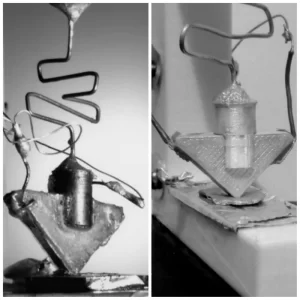
When John Bardeen, Walter Brattain, and William Shockley invented the first transistor in 1947 :

(shown above, for which they were awarded the Nobel Prize in 1956), they could not possibly, in their wildest dreams, have imagined how ubiquitous and fundamentally transformative their device would become. "How many transistors," Girvin asked the audience, "do you think were produced around the globe in 2020?"

Pause.  And then he flashed the answer on the screen:  20 trillion per second.

There as a very audible gasp from the 100 or so people in the audience; I don't think I've ever heard anything quite like it before.  It seems impossibly large; it can't possibly be true.

But it is. While I thought it highly unlikely that the Eugene Higgins Professor of Physics at Yale would put forth a number like that without having checked it pretty carefully, I did a little double-checking myself and it checks out.  Consider: The most recent iPhone contains around 15 billion transistors. Apple sold around 220 million iPhones in 2021.  That means around 10 100 billion transistors were produced each second just for iPhones.  Add the hundreds of millions of other phones, plus all the refrigerators, air conditioners, PCs, automobiles, televisions, etc. etc. etc., every one of which contains many millions or billions of transistors, and you can pretty easily see where the 20 trillion/second figure comes from.

I'm not sure I know what it means, but something tells me it means something important.

Social Media

FIRE Podcast on Free Speech and the Texas Social Media Law

The podcast is a debate between legal scholar Brad Smith and myself.

|

Michele Ursi / Dreamstime.com

The Foundation for Individual Rights and Expression recently posted a video of a podcast on which legal scholar Brad Smith (who is also chairman of the Institute for Free Speech) and I debated the recent Fifth Circuit decision upholding the constitutionality of Texas' social media law, which bars major social media platforms from engaging in most forms of content moderation.

In the podcast, I criticized the Fifth Circuit ruling, expanded on  a post explaining why the Texas is a menace to freedom of speech, addressed the "common carrier" rationale for the Texas law, and also briefly summarized why the law violates the Takings Clause of the Fifth Amendment (an issue that has yet to be litigated in court). Brad largely defended the constitutionality of the Texas law. But it's notable that he was unwilling to endorse some of the major arguments advanced by the Fifth Circuit majority, and by other defenders of the law. We both agree this issue is likely to get to the Supreme Court (in part because the Eleventh Circuit reached a contrary decision in a ruling on Florida's similar law). In my view, the Court has already signaled that a majority of justices believe the Texas law is unconstitutional, when it overturned a previous Fifth Circuit ruling lifting a trial court injunction against implementation of the law.

I would like to thank FIRE for organizing this event, and Brad Smith for his insightful contribution to the discussion.

More