
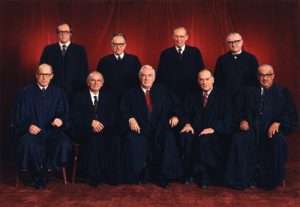
10/12/1977: Regents of the University of California v. Bakke argued.

Mostly law professors | Sometimes contrarian | Often libertarian | Always independent | Est. 2002

10/12/1977: Regents of the University of California v. Bakke argued.
Episode 425 of the Cyberlaw Podcast Looks at the White House "AI Bill of Rights"
It's been a jam-packed week of cyberlaw news, but the big debate of the episode is triggered by the White House blueprint for an AI 'bill of rights'. I've just released a long post about the campaign to end "AI bias" in general, and the blueprint in particular. In my view, the bill of rights will end up imposing racial and gender (not to mention intersex!) quotas on a vast swath of American life. Nick Weaver argues that AI is in fact a source of secondhand racism and sexism, something that will not be fixed until we do a better job of forcing the algorithm to explain how it arrives at the outcomes it produces. We do not agree on much, but we do agree that lack of explainability is a big problem for the new technology.
President Biden has issued an executive order meant to resolve the U.S.-EU spat over transatlantic data flows -- at least for a few years, until the anti-American EU Court of Justice finds it wanting again. Nick and I explore some of the mechanics created by the executive order. I argue that masking the identities of foreign intelligence targets will be bad for the comprehensibility of U.S. intelligence reports and for the privacy of U.S. persons. On the other hand, the quasijudicial system the order creates is cleverly designed to discourage litigant grandstanding.
Matthew Heiman covers the biggest CISO news of the week, the month, and the year – the criminal conviction of Uber's CSO, Joe Sullivan, for failure to disclose a data breach to the Federal Trade Commission. Matthew is less surprised by the verdict than others, but we agree that it will change the way CISOs do their job and relate to their fellow corporate officers.
Brian Fleming joins us to cover an earthquake in U.S.-China tech trade – the sweeping new export restrictions on U.S. chips and technology. This will be a big deal for all U.S. tech companies, we agree, and probably a disaster for them in the long run if U.S. allies don't join the party.
I go back to dig a little deeper on a story we covered with just a couple of hours' notice last week – the Supreme Court's grant of review in two cases touching on Big Tech's liability for hosting the content of terror groups. It turns out that only one of the cases is likely to turn on section 230. That's Google's almost laughable claim that holding YouTube liable for recommending terrorist videos is holding it liable as a publisher. The other case will almost certainly turn on when distribution of terrorist content can be punished as "material assistance" to terror groups.
Brian walks us through the endless negotiations between TikTok and the U.S. over a security deal. We are both puzzled over the partisanization of the TikTok security issue, although I suggest one reason why that might be happening.
Matthew catches us up on a little-covered Russian hack and leak operation aimed at former MI6 boss Richard Dearlove and British Prime Minister Boris Johnson. Matthew gives Dearlove's security awareness a low grade.
Finally, two updates:
Download the 425th Episode (mp3)
You can subscribe to The Cyberlaw Podcast using iTunes, Google Play, Spotify, Pocket Casts, or our RSS feed. As always, The Cyberlaw Podcast is open to feedback. Be sure to engage with @stewartbaker on Twitter. Send your questions, comments, and suggestions for topics or interviewees to CyberlawPodcast@steptoe.com. Remember: If your suggested guest appears on the show, we will send you a highly coveted Cyberlaw Podcast mug!
The views expressed in this podcast are those of the speakers and do not reflect the opinions of their institutions, clients, friends, families, or pets
Professor Natelson versus Professor Ablavsky
The Indian Commerce Clause will be a major issue in the Nov. 9 Supreme Court argument in Brackeen v. Haaland. The questions presented are:
(1) Whether the Indian Child Welfare Act of 1978's placement preferences — which disfavor non-Indian adoptive families in child-placement proceedings involving an "Indian child" and thereby disadvantage those children — discriminate on the basis of race in violation of the U.S. Constitution; and
(2) whether ICWA's placement preferences exceed Congress's Article I authority by invading the arena of child placement — the "virtually exclusive province of the States," as stated in Sosna v. Iowa — and otherwise commandeering state courts and state agencies to carry out a federal child-placement program.
This post examines one aspect of the second question, namely the original meaning of the Indian Commerce Clause.
The Constitution grants Congress the power: "To regulate Commerce with foreign Nations, and among the several States, and with the Indian Tribes." Art. I, sect. 8. The originalist works of two scholars have earned the notice of Justices.
The first such article was Robert Natelson's, The Original Understanding of the Indian Commerce Clause, 85 Denver U.L. Rev. 201 (2007). It was extensively cited in Justice Thomas's concurrence in Adoptive Couple v. Baby Girl, 570 U.S. 637, 658-65 (2013); and in his dissent from denial of certiorari in Upstate Citizens for Equality, Inc v. United States, 140 S.Ct. 2587, 2587-88 (2017).
Responding in part to Natelson's article is Gregory Ablavsky, Beyond the Indian Commerce Clause, 124 Yale L.J. 1012 (2015). That article is cited in the Justice Gorsuch's dissent in Oklahoma v. Castro-Huerta, which was joined by Justices Breyer, Sotomayor, and Kagan. 142 S.Ct. 2486, 2506-07 (2022).
Natelson responds in The Original Understanding of the Indian Commerce Clause: An Update, 23 Federalist Soc. Rev. 209 (2022), and in a separate writing, Cite Checking Professor Ablavsky's Beyond the Indian Commerce Clause (2022).
Ablavsky is a law professor at Stanford. Natelson, a retired law professor, is my colleague at the Independence Institute. My own scholarship on Indian history and law has not focused on the Indian Commerce Clause, but rather on issues related to my textbooks Colorado Constitutional Law and History and Firearms Law and the Second Amendment. I have worked with Natelson extensively on amicus briefs and scholarship involving the Interstate Commerce Clause.
Surprisingly, Natelson and Ablavsky agree on the original meaning of the Indian Commerce Clause: it covered some but not all topics on Indian affairs, and it did not displace all state government power over Indians. Natelson argues that the clause should be read the same way today. Ablavsky argues that the clause should now be construed to support a grant of plenary power, and he says that such a reading is consistent with a "holistic" original understanding of the structure of federal government Indian powers, as opposed to the modern Court's "clause bound" approach to constitutional interpretation.
Below, I summarize the scholarship, and add some of my own analysis.
The executive branch proposes a rule, a district court judge can block it, then one member of the Supreme Court determines if Congress would have approved of that rule.
The Constitution establishes a very precise process by which laws can be enacted. First, a bill must be approved by one house of Congress. Second, the other house of Congress must approve the bill. Third, the President can sign the bill into law. If the bill is vetoed, Congress can override the veto. This process is known as bicameralism and presentment: two houses must pass the bill, which is then presented to the President for his signature.
This process, regrettably, has become rarer and rare. Virtually all major changes to the law occur outside the confines of the traditional form of bicameralism and presentment. Instead, there is a different three-step process.
First, the executive branch proposes a new legal regime. Maybe there is notice-and-comment rulemaking, or maybe it is bypassed. There is always good cause when the need arises. Or an agency issues some sort of non-binding guidance document that regulated entities treat as binding.
Second, after the policy is promulgated, it is challenged in favorable forums. A district court judge then decides if the rule can go into effect, or not.
Third, if the trial court blocks the rule, the case is presented to the Supreme Court. And pursuant to the major question doctrine, the Justices must determine if this is the sort of rule that Congress would have approved of.
In this regard, there is still a familiar three-step process, involving the executive branch, the lower courts, and the Supreme Court. Congress is involved in an imaginative sense, as one Justice gets to decide what Congress would have intended. If all three boxes are checked, federal laws is changed! Call it a new bicameralism and presentment.
Stewart (of the Eurythmics), Grebenshchikov (a Russian singer-songwriter, and one of “the ‘founding fathers’ of Russian rock music”), and Babkin (a Ukrainian singer-songwriter) put out a trilingual song, with harmonies by Stevie Nicks (Fleetwood Mac).
I thought this was very well done: the lyrics work well with the generally understated sound and the intimate visuals. The artists are using the song to raise funds for Ukraine (via the Ukraine government's United24), at CollaborateForPeace.com, but for reasons that elude me they don't seem to have an English translation of the lyrics there. With my mother Anne Volokh's help, I've put together the following, though of course I'd be glad to link instead to an authorized translation should one be made available.
Note that Grebenshchikov, who lives in England, has been protesting the war since at least March 2; for his performance of Vertinsky's anti-war "That Which I Must Say," regrettably a perennial, see here. Stewart and Grebenshchikov have apparently known each other for over 30 years; Stewart produced a 1989 album of Grebenshchikov's band Aquarium, which Wikipedia says was "the first contract of a Russian (then, Soviet) rock musician with a Western label." (Stewart and Nicks also apparently go way back.)
Babkin was the cofounder of 5'Nizza (apparently pronounced as the Russian word "Friday"), a band that was prominent both in Russia and Ukraine; for another of his war-related songs, with an interesting pre-war backstory, see here.
In any event, here are the lyrics:
Prof. McConnell is one of the top constitutional law scholars in the country, and I was delighted that he passed along this item on National Pork Producers Council v. Ross. (Disclosure: He participated in drafting the U.S. Chamber of Commerce amicus brief in the case, but the views expressed here are his own, not those of the Chamber.)
National Pork Producers Council v. Ross may be one of the most consequential cases of the Term, and I don't just mean for the price of pork chops. A few states, most importantly California, are such large markets that—if the Supreme Court does not intervene—they can impose their notions of proper standards of production on every other state in the Union, at little cost to themselves. Because nationwide producers often cannot segment their markets, producers will be forced to follow California rules for the whole country, or face the crippling consequence of exclusion from the California market.
Add to this the fact that these large states—California, Texas, New York—are also one-party states, whose views on social policy are often at one or another extreme. More moderate Americans in other states will be governed by laws they would not vote for, if they had a chance. This is contrary to the democratic postulates of our federal system.
Californians consume 13 percent of all pork produced in the United States, but California farmers produce almost none of it (0.13 percent of breeding pigs, to be exact). But California voters have strong views on the ethical treatment of pigs, at least when other people pay the cost. In 2018, California voters passed Proposition 12, which allows the sale in California only of pork produced under specified conditions far more costly than currently are practiced anywhere else. California regulators will roam the land inspecting farms in other states to enforce the law.
For Californians, this was cheap and easy virtue signaling. Almost no California farmers are affected, yet prices will go up everywhere.
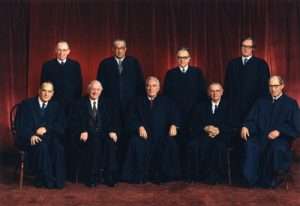
10/11/1972: Roe v. Wade argued.
The Dangerous Cure for "AI bias"
You probably haven't given much thought recently to the wisdom of racial and gender quotas that allocate jobs and other benefits to racial and gender groups based on their proportion of the population. That debate is pretty much over. Google tells us that discussion of racial quotas peaked in 1980 and has been declining ever since. While still popular with some on the left, they have been largely rejected by the country as a whole. Most recently, in 2019 and 2020, deep blue California voted to keep in place a ban on race and gender preferences. So did equally left-leaning Washington state.
So you might be surprised to hear that quotas are likely to show up everywhere in the next ten years, thanks to a growing enthusiasm for regulating technology – and a large contingent of Republican legislators. That, at least, is the conclusion I've drawn from watching the movement to find and eradicate what's variously described as algorithmic discrimination or AI bias.
Claims that machine learning algorithms disadvantage women and minorities are commonplace today. So much so that even centrist policymakers agree on the need to remedy that bias. It turns out, though, that the debate over algorithmic bias has been framed so that the only possible remedy is widespread imposition of quotas on algorithms and the job and benefit decisions they make.
To see this phenomenon in action, look no further than two very recent efforts to address AI bias. The first is contained in a privacy bill, the American Data Privacy and Protection Act (ADPPA). The ADPPA was embraced almost unanimously by Republicans as well as Democrats on the House energy and commerce committee; it has stalled a bit, but still stands the best chance of enactment of any privacy bill in a decade (its supporters hope to push it through in a lame-duck session). The second is part of the AI Bill of Rights released last week by the Biden White House.
Dubious claims of algorithmic bias are everywhere
I got interested in this issue when I began studying claims that algorithmic face recognition was rife with race and gender bias. That narrative has been pushed so relentlessly by academics and journalists that most people assume it must be true. In fact, I found, claims of algorithmic bias are largely outdated, false, or incomplete. They've nonetheless been sold relentlessly to the public. Tainted by charges of racism and sexism, the technology has been slow to deploy, at a cost to Americans of massive inconvenience, weaker security, and billions in wasted tax money – not to mention driving our biggest tech companies from the field and largely ceding it to Chinese and Russian competitors.
The attack on algorithmic bias in general may have even worse consequences. That's because, unlike other antidiscrimination measures, efforts to root out algorithmic bias lead almost inevitably to quotas, as I'll try to show in this article.
Given David Bernstein's and my posts here on this controversy, I thought I'd pass along this statement from various UC Berkeley Law School faculty members, which was released late last week:
We hereby endorse the principle of free and open speech at the law school. This includes the fundamental principle that all students should be freely admitted to all student groups and under no circumstances should any student be denied admission to any student group.
We are highly aware of the extensive discrimination against Jews in World and U.S history. In particular, we note that 2 of 3 Jews in Europe were murdered during the Holocaust and that the United States has engaged in extensive discrimination of Jews during its history.
With this background, we also condemn the discriminatory bylaw adopted by a small minority of our law student groups refusing to accept speakers who have Zionist views or beliefs. We believe this rule is not only wrong but is antithetical to free speech and our community values. These bylaws would also impermissibly exclude a large majority of our faculty from participating in the work of these organizations, including our Dean.
Many Jews (including some of us signing below who are Jewish) also experience this statement as antisemitism because it denies the existence of the state of Israel, the historical home of the Jewish people. For many Jews, Zionism is a core component of their identity and ethnic and ancestral heritage. As an educational institution we hope that the student groups that have now endorsed a "No Zionist speakers" pledge will engage in dialogue on these issues.
[Signatories below.]
Thought this was a pretty amusing headline, from the Babylon Bee. Can't speak to this as a matter of theology, but I liked it as dark humor.
A bonus episode to explore long-term happiness in relationships
I posted the ninth episode of my podcast "Strangers on the Internet" (the direct link for Apple Podcasts is here and for Spotify is here). Psychologist Michelle Lange and I explore this time the academic research on and our personal experiences with maintaining long-term happiness in romantic relationships. How can people apply the Golden Rule (and even better, the Platinum Rule) in this context? Is there anything to the Five Love Languages theory? We take a plunge into the work of John and Julie Gottman, Esther Perel, and other experts.
[This is a guest post by Prof. Jack Goldsmith of the Harvard Law School.]
My friend Judge James Ho recently announced that he is boycotting the hiring of law clerks from my alma mater, Yale Law School, because it "tolerates the cancellation of views" and "actively practices it." I think this is a bad decision, and I hope it might be useful to say why.
I agree with Ho's criticisms about the unfortunate free speech incidents at Yale in recent years. I hope that Yale hears such criticisms and takes steps to fix the problems. For what it is worth, I believe that it has, and will.
Ho can of course hire law clerks from whatever law school he wants, using whatever criteria he wants. I have known many judges who have declined to hire from particular law schools for various reasons. The question for me is whether it is prudent for Ho to announce and encourage a federal judicial boycott of Yale in order to punish it for its "cancel culture" and "send the message" that other law schools should not be like Yale. I think not.
First, I think it is bad for the federal judiciary when a federal judge tries through public threats about clerkship hiring to influence where students choose to go to law school, based on a desire to change a law school's culture. Ho's announcement was a self-consciously political act that was designed to garner the national attention it received. This is unfortunate in an era when many forces are succeeding in creating the impression that judges are politicians in robes. Ho's announcement in particular feeds the erroneous perception of many that conservative federal judges are unduly political.
Second, if the boycott succeeded in driving conservative students from Yale, that would not make one of the nation's top law schools a better place for the values Ho cares about. It would have the opposite impact. It seems bizarre to discourage young conservatives who want to attend Yale from doing so, since Yale is so much better for their presence.
Third, Ho's boycott, if successful, will unfairly hurt conservative students at Yale even though it only applies prospectively. The idea behind prospective application apparently is that students attending Yale starting next year will be on notice of the boycott. But the proposal would still punish conservative students who attend Yale but who were not aware before choosing a law school about the adverse implications for a clerkship years later. It would also punish those students who come to law school without well-formed views about judicial philosophy and over the course of law school develop a conservative judicial disposition.
Fourth, I seriously doubt that Ho's boycott will temper the hiring of Yale law students by top conservative judges. I know that many judges across the spectrum are distressed by speech intolerance at Yale and at other law schools in recent years. But I also know that judges hire based on quality—intelligence, analytical depth, A+ writing skills, fierce work habits, good judgment, and the like. Yale has, and will continue to have, very high-quality students. And that is why top federal judges will continue to hire them.
In sum, I don't understand how a clerkship boycott of Yale students by conservative federal judges helps anyone or any institution—not the judiciary, not Yale Law School, not Yale Law School students, and not the legal profession. But I doubt that top federal judges will join it in any event.
Several student groups at UC Berkeley Law School have signed on to a pledge not to invite any speakers—speaking on any subject—if those speakers "have expressed and continued to hold views … in support of Zionism, the apartheid state of Israel, and the occupation of Palestine." Berkeley Dean Erwin Chemerinsky, a noted liberal constitutional scholar, has condemned that position, but also argued,
I followed this up with a message to the entire Law School community: "The First Amendment does not allow us to exclude any viewpoints and I believe that it is crucial that universities be places where all ideas can be voiced and discussed. In addition, the Law School has an 'all-comers' policy, which means that every student group must allow any student to join and all student group organized events must be open to all students." …
[N]o group has violated the Law School's policy and excluded a speaker on account of being Jewish or holding particular views about Israel. Such conduct, of course, would be subject to sanctions.
When I delved further into this, though, I came to the conclusion that the law school does not already forbid such "exclu[sions] of speakers on account of … holding particular views about Israel"; I've confirmed with Dean Chemerinsky that categorically excluding speakers based on their views on Israel—even when the event has nothing to do with Israel—wouldn't be punished under any current rules.
But could there be such a policy? Could a public university bar student groups from discriminating against speakers based on viewpoint in this way?
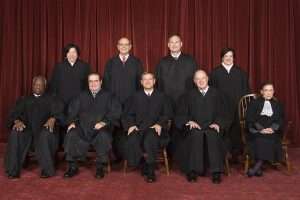
10/10/2012: Fisher v. University of Texas at Austin I argued.
Yahoo! Finance (Adam Sabes) reported yesterday (as did many other sites):
A new PayPal user agreement that threatens to fine users up to $2,500 if they use the service to "promote misinformation," was sent out "in error," a PayPal spokesperson tells FOX Business.
The updated PayPal Acceptable Use Policy effective Nov. 3 included an expansion of "prohibited activities," which includes the "ending, posting, or publication of messages, content, or materials that meet certain criteria."
According to the updated PayPal user agreement, the company states that each violation could result in "liquidated damages of $2,500.00" per violation, which would be withdrawn directly from their account.
One of the violations listed, according to the agreement, is that … "[users] may not use the PayPal service for activities that … involve the sending, posting, or publication of any messages, content, or materials that, in PayPal's sole discretion … promote misinformation."
But it appears that the policy continues to be in effect for other speech, according to PayPal's official Acceptable Use Policy, last updated Sept. 20, 2021:
Violation of this Acceptable Use Policy constitutes a violation of the PayPal User Agreement and may subject you to damages, including liquidated damages of $2,500.00 U.S. dollars per violation, which may be debited directly from your PayPal account(s) as outlined in the User Agreement (see "Restricted Activities and Holds" section of the PayPal User Agreement).
Prohibited activities
You may not use the PayPal service for activities that … relate to … the promotion of hate, violence, racial or other forms of intolerance that is discriminatory or the financial exploitation of a crime ….
The proposals were agreed on by members of the conservative, libertarian, and progressive teams participating in the NCC's earlier constitution drafting project.
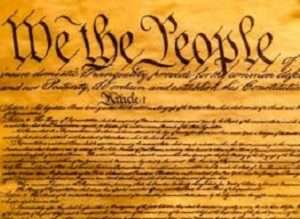
In 2020, the National Constitution Center sponsored a constitution-drafting project in which it named three groups to produce their own revised versions of the Constitution: a conservative team, a libertarian team, and a progressive one - each composed of prominent academics and other experts on constitutional law issues. The exercised revealed some important points of agreement between the three teams (even though they also predictably differed on other issues). This year, NCC reconvened the three teams and asked them to come up with a list of constitutional amendments they could jointly agree on.
This, they have now done, and the resulting consensus amendments are available here, along with introductions by three team leaders: Ilan Wurman (Team Conservative), Caroline Frederickson (Team Progressive), and Ilya Shapiro (Team Libertarian) [Note: despite the similar names, Ilya Shapiro is a different person from me].
Their list of proposed amendments is as follows:
This amendment would limit Supreme Court justices to 18 year terms, with a new justice to be appointed every two years. I summarized the advantages of Supreme Court term limits here. The amendment also fixes the number of justices at nine, thereby eliminating the risk of court-packing.
2. Making impeachment easier
This proposal would allow impeachment of the president and other high officials for "serious abuse of the public trust" as well as for "criminal acts" and would reduce the number of votes needed for a conviction in the Senate to a three-fifths majority (from the currently required two-thirds majority). It also requires a three-fifths majority for the House of Representatives to impeach in the first place (up from the current simple majority).
This makes conviction of a criminal, abusive, or malevolent president (or other high official) easier. But it also reduces the risks of beginning an impeachment process for frivolous reasons, by preventing the House from doing so with a bare partisan majority.
3. Legislative veto
This amendment would reverse INS v. Chadha (1983) and give Congress the power to negate most executive branch actions by a majority vote of both houses. Such "legislative vetoes" would not be subject to the presidential veto in the way other legislative enactments generally are. The point of this amendment is obviously to curb the growth of executive power over federal spending and regulation.
4. Eliminating the requirement that the president be a natural-born citizen
This amendment would make immigrants eligible for the nation's highest office. As the statements by the team leaders make clear, it was the issue on which the three teams came to agreement most easily. I outlined the case for getting rid of the natural-born citizen requirement in this 2020 USA Today op ed, co-authored with Harvard Law School Professor Randall Kennedy (a longtime advocate of this reform).
5. Making the Constitution easier to amend in the future
This measure would make it possible to submit a proposed amendment for ratification by the states if the proposal is supported by 3/5 of both houses of Congress, by a majority of the states, or by state legislatures representing two-thirds of the population. This is reduced from the current requirement of a 2/3 majority of both houses of Congress.
An amendment submitted this way could be ratified "by the legislatures or ratifying conventions of two thirds of the several States, or of States representing three fourths of the population according to the latest national census." This is reduced from the current requirement of ratification by 3/4 of state legislatures.
Another provision of the amendment makes it somewhat easier to propose and ratify amendments by using the mechanism of a convention of the states. This tool exists under the present Constitution, but has never been used (probably because success is so unlikely).
This amendment reflects the broad expert consensus that the US Constitution is too difficult to amend (indeed, harder, than the constitution of almost any other democratic society). That has, in turn, shifted constitutional change to other, more dubious, fora, including creative judicial interpretation.
I support all of these ideas, with the partial exception of the legislative veto. When it comes to the latter, I think it might be desirable to cordon off some types of executive actions from easy legislative reversal, such as - perhaps - certain types of military orders in wartime. But I am not sure exactly where to draw the line.
It's also worth noting, as I previously pointed out in my analysis of the original NCC constitution-drafting project, that the three teams also agreed on abolishing the Eleventh Amendment and getting rid of sovereign immunity, which protects federal and state governments from liability for many of their illegal actions. I do not know why this wasn't included in their list of amendment proposals.
Given the immense political difficulties of getting any constitutional amendment passed, it is unlikely that any of these ideas will be enacted anytime soon. But the exercise is worthwhile, nonetheless, because it highlights several improvements to our constitutional system that command widespread support among experts, cutting across ideological lines.
NOTE: The NCC Constitution Drafting project and these amendment proposals are distinct from its "Restoring The Guardrails of Democracy" project. I was a co-author of the Team Libertarian Report for the latter. But I have no involvement in the constitution-drafting project.
Following up on Friday's post about several major student groups at Berkeley Law pledging not to invite "speakers that have expressed and continued to hold views … in support of Zionism, the apartheid state of Israel, and the occupation of Palestine."
(1) Ken Marcus, whose op-ed on the situation spurred the controversy, responds to his critics here.
(2) Jewish Berkeley Law students talk about their reaction here. Note that Students for Justice in Palestine consulted with every affinity group at the law school before issuing the boycott pledge *except" the Jewish law students group.
(3) One point I didn't mention in my previous post is that SJP's statement seems part and parcel of a nationwide SJP campaign to specifically try to exclude Jews from "progressive spaces" unless they will specifically denounce Israel's existence. To take one of an unfortunately growing number of examples:
Two Jewish students at the State University of New York (SUNY) at New Paltz say they were booted from a support group for sexual assault victims and harassed by members of the group due to their Jewish identity, according to a complaint filed with the Education Department.
One of the victims, student Cassandra Blotner, says members of the support group threatened to spit on her in public for proudly being Jewish, while others called her a "dumb bitch" who supports "mass genocide" due to her support for Israel. The complaint alleges the university was "fully aware of the situation," yet did nothing to protect the students from the anti-Semitic hate campaign.
Again, this is a political strategy, rather than simply isolated incidents. Recall that the Women's March collapsed because its founders decided that Jews were not welcome. Also note that Palestinian lobby mouthpiece Rep. Rashida Tlaib recently stated that you can't be a progressive and support "Israel's apartheid government" and Linda Sarsour similarly remarked that one can't be a feminist and a "Zionist."
(4) But, you might object, that when Tlaib says "Israel's apartheid government" she doesn't mean "Israel," just the policies she objects to. That would make more sense if Tlaib wasn't on the record as supporting the replacement of all of Israel with "Palestine." Similarly, one commenter was quite insistent that when SJP says "Zionism" it does not mean "the existence of Israel," "the apartheid state of Israel" means only Israel's bad policies that they think is akin to apartheid, and the "occupation of Palestine" means only the occupation of the West Bank, not all of Israel. Anyone who knows SJP's history and politics would know that they mean, exactly, that anyone who supports Israel's existence should be forbidden from speaking. But just for the heck of it, I perused SJP Berkeley Law's Facebook page, which talks about "Israel's apartheid" going back to the late 1940s, ie, when Israel was founded, and well before the "occupation" of the West Bank. So when you see Tlaib, SJP, and others talk about "apartheid Israel," there is a very simple question to ask: Is there a time when you think Israel wasn't guilty of "apartheid," and is there anything Israel could do, short of surrendering in favor of a Palestinian Muslim-majority state, that would make Israel "not apartheid?" Once they evade that question, or maybe even answer honestly, you can be convinced, if you aren't already, that in practice the apartheid libel has nothing to do with Israel's policies, and everything to do with opposition to Israel's existence and the desire to replace it with a Palestinian Muslim majority state.
(5) Relatedly, one commenter acknowledges that SJP wants Israel to cease to exist, but adds that I neglect "as a Jewish state that privileges the Jewish majority." Let's assume for the sake of argument that there is something inherently wrong with having one tiny country devoted to preserving and protecting a people that's been subject to genocide and every form of oppression short of it in just the past century or so (mass pogroms during the Russian Revolution, expulsion from Arab countries, Soviet state antisemitism, etc., in addition to the Nazis.). Both the Palestinian Authority and Hamas promise a "Palestine" based on sharia, thus inherently privileging Muslims far more than Israel "privileges" its Jewish citizens. If this bothers any of the activists who claim to oppose Israel because it's "chauvinist," I have yet to encounter it. And as detailed in Benny Morris' One State, Two States, any Palestinians willing to countenance a binational state or similar arrangements were murdered or intimidated into silence by the dominant faction, leaving Jewish advocates of such a solution with nothing to go on.
Finally, the dominant Palestinian nationalist factions want either 2 Palestinian Muslim states, one only Arab-Muslim, and one majority Arab-Muslim with a maybe-tolerated Jewish minority, or one state with few if any Jews, the rest murdered or expelled. Few if any Palestinian nationalists are willing to publicly state that a Palestinian state should be contingent on the rights if Jewish Israelis being protected. Again, this bothers their supporters not at all. So spare me the suggestion that the underlying problem is inequality in Israel. Arab citizens in Israel have far greater equality than Jews in an Arab Palestine could hope for in the best of circumstances. (Which is why the trending trope is that Israeli Jews are "settler colonialists" and therefore have no rights.)
(6) Even that aside, you'd have to be utterly ignorant of the history of antisemitism to think that it "just so happens" that of all the countries in the world, the only people singled out for this boycott are supporters of the existence of Israel, regardless of how the individual might feel about any or all of Israel's policies, and that the only ethnic/religious group, ever, that would be almost entirely excluded by a Berkeley Law student boycott is Jews. It would be pointless for example, ask the Muslim and the MENA student groups why they don't rule out speakers who support Assad's Alawite Syrian dictatorship, responsible for the death of half a million Arabs, primarily Muslims far worse than even the craziest "antizionists" accuse Israel of doing. No Jews involved, so no reason to care.
(7) I can't find the link right now, but Berkeley's chancellor was quoted as stating that there is no legal rationale for prohibiting the student groups in question from exercising their "freedom of speech." I'm not sure that's true. First, California's public accommodations law is very, very broad, basically prohibiting excluding anyone from any public place (defined broadly) for any reason. There was even a case in which a German restaurant was sued by the ACLU for excluding people wearing Nazi insignia. Of course, no one would argue that SJP is obligated to bring in a pro-Israel speaker; that would violate its First Amendment rights. But can Berkeley Law Women decline to invite a speaker on abortion rights because that speaker has endorsed the existence of Israel? I think that's less than clear. Second, it's true that not all Jews support the existence of Israel, and not all people who publicly support Israel's right to exist are Jews. However, imagine an anti-gay rights group on campus got other organizations to sign a pledge that they will not invite any speaker on any topic who professes to support the right of same-sex couples to marry. Would the Chancellor be so confident that this would not be considered by civil rights agencies and courts to constitute discrimination based on sexual orientation, because same-sex marriage is so closely tied to that? I won't be belabor the analogy. I'm actually not a fan of the decisions universally holding that refusing to bake a cake for a same sex wedding constitutes sexual-orientation discrimination even if the patrons are always gay, but if that's going to be the sort of rule we live under, it should also apply to Jews. And going back to point 3, if anyone who *isn't* Jewish has faced harassment on campus for being a "Zionist," I have yet to encounter it.
(8) Adam Pukier of the Jewish Student Association at Berkeley Law, writes: "If I could do it over again, I would have asked LSJP to include the Jewish student group in the conversation. I would have encouraged other groups to seek out Jewish voices on campus. I would have engaged on an individual level in an open dialogue about Zionism and the BDS movement. I would have explained how it is possible for someone to harbor a deep sympathies for the Palestinian people, support the existence of the State of Israel and strongly criticize many of Israel's policies all at the same time — it is possible to be a Zionist and condemn the actions of Israel."
Mr. Pukier's efforts to stand up for Jewish students at Berkeley Law, which is hardly the popular thing to do there, are commendable. But surely he knows that SJP has no interest in having a conversation or dialogue with him or anyone who supports Israel's existence. SJP Tufts, for example, not only refuses "dialogue" with even left-wing groups like J Street that think Israel should exist, but urge others to boycott them entirely.
They are not interested in compromise, hearing other perspectives, or anything else. They want Israel to be replaced by Palestine and they have no other principle. Even the possibility of the genocide of the Jewish population of Israel is not a significant concern. Again, the point of calling Israeli Jews "settler colonialists" is that they should have no human rights, and just as, e.g., there are few regrets on the left for the many Frenchmen killed and ultimately expelled from Algeria, the same is true of Israel. Of course, most would likely prefer that the Jews surrender peacefully, but that's a preference, not a requirement.
As for the rest of Mr. Pukier's paragraph, it's missing something important. It's also possible to have a deep concern for the well-being of the Palestinian people and support the policies in general of the Israeli government, if one believes that it's not the Israeli government's policies that are the barrier to improving the lot of Palestinians, but the refusal, since the 1930s and continuing today, of Palestinian leaders to countenance a settlement that would allow a Jewish state of any borders in "Palestine." By suggesting that only harsh critics of Israel worry about Palestinian well-being, one is wrongly conceding that "Zionists" who are generally sympathetic to Israeli policies are inherently anti-Palestinian and implicitly bad people.
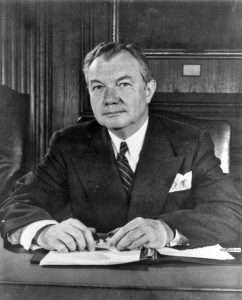
10/9/1954: Justice Robert H. Jackson dies.
Celebrate your independence with a subscription to Reason magazine, your most trusted source of honest, insightful news and analysis.




