The Volokh Conspiracy

Mostly law professors | Sometimes contrarian | Often libertarian | Always independent | Est. 2002

The Volokh Conspiracy

Politics

Short Circuit: A Roundup of Recent Federal Court Decisions

Sikh Marines, MAGA hats, and racist memes.

|

Please enjoy the latest edition of Short Circuit, a weekly feature written by a bunch of people at the Institute for Justice.

If officers point a surveillance camera at a home for eight months without a warrant, is that an unconstitutional search? Earlier this year, the First Circuit ruled that not only is it not unconstitutional, but also that it's not even a search. Phooey! In an amicus brief, IJ is urging the Supreme Court to take up the case and adopt a more common sense approach to its Fourth Amendment jurisprudence: looking for evidence is a search.

Read More

Criminal Procedure Casebooks and Generational Change

Thoughts on revising a classic Crim Pro casebook.

|

I spent the last three months revising the 4th Amendment materials of the Kamisar LaFave & Israel Criminal Procedure casebook for the 16th edition of the book, which will be available for the Fall 2023 semester.   I thought I might say something about the experience, as I think it raises interesting questions about generational change in law school courses and materials — and perhaps about the state of the criminal procedure field today.

First, some context. The Kamisar LaFave & Israel casebook basically invented the field of constitutional criminal procedure as a subject, starting with its first edition in 1965. I've been on the casebook for well over a decade, but until now I had responsibilities for only a small part.  This time around, I am taking over most of the 4th Amendment materials as part of a broader generational shift in the book.  This is a little bit oversimplified, but the basic idea of that generational shift is that Eve Brensike Primus has taken over the interrogation law and right to counsel materials from Yale Kamisar, who passed away earlier this year;  I have taken over the Fourth Amendment materials from Wayne LaFave, who has retired; and Nancy King has taken over the adjudicatory criminal procedure materials from Jerry Israel, who has also retired.

Revising a classic casebook is a daunting prospect.  Each of us "second generation" authors is well aware we are following the footsteps of true giants in the Criminal Procedure field.  But it also seems to me the nature of things that, as one generation of editors moves on to the next, each new generation will recast the materials to fit the new set of authors — and a new generation of readers. Along those lines, I ended up quite considerably rewriting the Fourth Amendment materials of the book.  Much of the basic structure is similar, and many of the main cases are the same (albeit re-edited). And while some of the changes are author preferences — do you spend a lot of time on the facts of cases?  How long do you spend on dissents? etc. — some of them strike me as more generational shifts in how to think of law school casebooks, and the field of criminal procedure, more broadly, that might be of interest to a broader readership.

Below are some of the significant changes in focus I tried to introduce to the Fourth Amendment materials. My understanding is that my colleagues have made similar changes to their materials, too. But as I am writing this in my own capacity, I'll focus on the approach I took in the search and seizure area:

Clear statements of black-letter law.  In an earlier generation of casebooks, it was common to present the cases as cases and to leave the assembly of the doctrine more to the students.  That is now outdated. Students today can get the black-letter rules anywhere, from wikipedia to Youtube to commercial outlines to outline banks online.  Given that the rules are not some sort of carefully-guarded secret anymore,  it seems odd to not integrate the black letter law rules into the casebook itself. I think it's easy, and helpful, to state the rules up front and to then focus the materials on the hard part of how they apply and whether they are persuasively justified.  In redoing the materials, I tried to be clear about what the rules are, at least to the extent the rules are clear, and to say what rules are unclear and why.

Increased attention to history.  In an earlier generation of criminal procedure casebooks, the law was largely about the Warren Court's major rulings.  That is still partly true: The canonical cases are often 1960s-vintage (in Fourth Amendment law, think Mapp, Katz, Terry, etc.).  But the Warren Court ended over a half-century ago, and today the 1960s are more a key part of the story than the entirety of the story. In particular, today's Supreme Court and lower courts interpreting the Fourth Amendment often care a lot about the common law and the origins of the Fourth Amendment.  It seems to me that a casebook today needs to cover that: You can't understand where we are without knowing the pre-Warren Court history.  So my reworked materials start with a section on the history and the development of the Fourth Amendment, starting with Entick v. Carrington (1765).

Increased attention to race and racial justice.  In recent years, especially after the killing of George Floyd, questions of race and racial discrimination in law enforcement have become central issues addressed in law school courses in criminal procedure.  In rewriting the materials, I aimed to make those questions more prominent.  That took different forms throughout the materials, among them: (a) adding commentaries about the role of race in criminal procedure; (b) adding more coverage of topics that were less prominent before, such as the law of excessive force, (c) reporting on empirical studies about racial disparities in search and seizure, and (d) directly addressing areas in which race and doctrine intersected, such as whether the seizure test should incorporate the race of suspects.

Increased attention to social science and empirical studies.  In the last decade or two, there have been a lot of very useful social science and empirical studies that give insights into how the law of criminal procedure works.  Some of the studies are on the scale of the criminal justice system: How many arrests occur each year?  How many warrants are out for persons' arrest, and for what?   Other studies are on how often different doctrinal paths are taken: How often do people consent?  How often does an automobile search lead to discovery of evidence?   Other students are on racial disparities: How often are people of different races subject to Terry stops? How often are people of different races frisked?  Others are on psychology of police-citizen interactions: Why do people consent to search?  When do people feel free to leave?  What influences judicial findings of probable cause?  Students who read Supreme Court cases will want to know how some context of how they work, and I think it's really useful in various places to summarize the empirical studies so students can contextualize the rules.

Increased awareness of state practices. In an earlier generation, it was assumed that the U.S. Supreme Court had federalized the field of criminal procedure.  The Warren Court had made the law uniform, so there was one body of law to learn.  Today, though, state practices have become more important again, in part because the U.S. Supreme Court has limited the reach of some federal doctrines.  A student who goes on to practice criminal law might practice in federal court, or in a state that sticks with the federal standard. But they might practice in a state that has a lot of state limitations that exceed the federal threshold.  You can't go through all the state practices, of course, and the federal standard is still the floor and governs in many places. But it can be useful to point out some areas where state practices differ, and more generally for students to be aware that state practices in a particular state might have state-specific doctrines that go beyond the federal floor.

Those are the main kinds of changes.  Of course, adding these materials meant that other materials had to be taken away.  We're trying to keep the book the same length, and maybe shorten it if we can.  Among the items that I tried to shave down a bit (or even cut out) to make room for new materials included: (a) Trimming or eliminating materials that were "hot topics" in an earlier era, but are less prominent today, such as legal issues involving the War on Terror, (b) Trimming dissents from older cases, some of which were included at great length in earlier editions because those Justices were still on the Court and might have future majorities (as time passes, that becomes less significant; dissents are needed to frame debates, but they can often be shorter because those Justices are no longer on the Court);  and (c) Trimming cases that were recent at the time of earlier editions and may have seemed like important new directions at the time, but that over time have come to seem significantly narrower because they did not actually lead to new paths.

The new 16th Edition of the casebook will be available for the Fall 2023 semester.  I hope professors find the changes helpful, and that students enjoy the experience of reading it.


Journal of Free Speech Law: "Editorial Decision-Making and the First Amendment," by Prof. Adam Candeub (Michigan State)

|

Just published at 2 J. Free Speech L. 157 (2022), as part of the "Non-Governmental Restrictions on Free Speech" symposium; here's the Abstract:

First Amendment protection of "editorial discretion," "editorial control," and "editorial judgment" has a relatively short Supreme Court history. First used in the 1970s, these terms refer to the power that broadcasters, cable systems, and newspapers retain to make decisions about their content within regulatory regimes. Editorial decision-making is an action that editors perform on others' speech—which sometimes expresses and conveys an editor's own message, other times not. When, as in Miami Herald Publishing Co. v. Tornillo, editorial decisions express and convey editors' ideas, they receive First Amendment protection. But, as in FCC v. Midwest Video Corp, when they do not—or the regulatory regime at issue allows editors to express their own views, First Amendment protection is limited or non-existent. If all editorial decision-making were to receive full constitutional protection, long-established common carrier law as well as mandatory carriage of political advertisement and PEG programming would be rendered unconstitutional.

Internet platform content moderation decisions are mostly non-expressive editorial decisions. Platforms' content moderation decisions in toto do not convey a message because, lacking a fixed expression, they are never communicated in toto to anyone—as the platforms do not publicize their decisions. Unlike First Amendment-protected editorial decisions, such as inclusion in an op-ed page, a cable system channel line-up, or a parade, an audience cannot read a list of content-moderation decisions and thereby comprehend an expressed message.

Second, platforms' editorial decisions express little individually. For instance, shadow banning, by which a platform renders a user's posts invisible to all but that user, cannot convey a message because no one knows, except the platform, that it is happening. Invisible editorial decisions are not intrinsically expressive of a corporate policy because, as the Court recognized in Rumsfeld v. FAIR, such conduct only communicates by reference to other speech.

Last, just as telephone companies do not express their customers' conversations, transmitting a message, in the context of a communications network, does not express a social media platform's own editorial decisions or speech, a position that platforms themselves have maintained vociferously in countless section 230 cases. Because content moderation decisions are largely unexpressive, social media laws such as Texas's H.B. 20 are consistent with the First Amendment.

Immigration

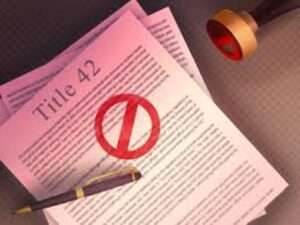
Is Biden Playing a Double Game on Title 42 "Public Health" Expulsions of Migrants?

The Administration claims to want to end the policy. But, as Washington Post columnist Catherine Rampell points out, it is actually expanding its use.

|

Officially, the Biden Administration wants to end Title 42 "public health" expulsions of migrants at the southern border, and the flawed recent Supreme Court decision indirectly requiring them to continue was a defeat for the White House. But, as Washington Post columnist Catherine Rampell explains in an excellent recent article, Biden may actually be playing a double game here. Even as he says he wants to terminate the policy, he has offered only a tepid legal defense of those efforts, while simultaneously actually expanding the use of Title 42 to cover more people:

"Title 42" is shorthand for what is effectively an abuse of a public health authority to circumvent U.S. asylum laws. Beginning in March 2020, the Trump administration used an obscure public health statute to automatically expel migrants without allowing them to first apply for asylum, as is their right under U.S. law and international treaty….

As a presidential candidate, Joe Biden pledged to restore the integrity of the asylum system. He promised that anyone qualifying for an asylum claim would "be admitted to the country through an orderly process." As president, though, Biden dragged his feet in terminating Title 42. He finally agreed to end the program this past spring. But termination has since been delayed by complicated court rulings, which Biden officials seem to have fought only half-heartedly…..

Instead, Biden officials seem to have seized the opportunity to make yet more immigrant groups subject to automatic expulsions.

In October, the Biden administration announced it would begin using Title 42 to expel Venezuelans, who had previously been exempted due to difficulties in deporting them back to their (unstable) home country. And on Wednesday, Reuters reported that the administration plans to soon use Title 42 to expel Cuban, Nicaraguan and Haitian migrants caught at the southwestern border, too. As had been the case with Venezuelans, these groups have generally not been subjected to the automatic expulsion policy, also largely because of diplomatic complications.

Additional evidence of the administration's foot-dragging is that, while they have appealed a federal Texas district court ruling that blocks termination of the policy, they have not requested that the court of appeals stay the district court decision (which means the latter remains in force as litigation continues). This district court ruling is currently the main legal obstacle to ending the policy. The recent Supreme Court decision ties the administration's hands only in so far as it indirectly allows that district court ruling to remain in place.

Furthermore, the Administration has not initiated a notice and comment process for the rule terminating the expulsions. The district court decision blocking the end of the policy is based on the theory that such a process is required by the Administrative Procedure Act. Whether the APA actually requires the use of that procedure here is debatable. If you believe - as I and many other critics  do - that the Title 42 expulsion policy is itself illegal, then it is not protected by the APA. But the Biden Administration (like Trump before it) has taken the position that the policy is legal, which makes it harder (though admittedly not impossible) to defend against the APA claims filed by various GOP state governments. Going through notice and comment would at least have strengthened the Administration's position.

If the Administration is indeed playing a double game, the most likely explanation is that they want to use Title 42 to help alleviate perceptions that there is a crisis at the border. But, as Rampell points out, Title 42 has done little to alleviate the problem, which is actually the result of the lack of legal alternatives for most migrants:

Whatever its intentions, [Title 42] didn't reduce stress at the border; instead, it increased attempted border crossings, as many people expelled without consequence or due process turned right around and tried again to enter the United States….

So what should the administration and Congress be doing instead?

Most important: Create more legal, safe, orderly pathways for people to come to the United States, both to seek protection from persecution and to pursue economic opportunities.

Americans often complain that immigrants should come here "the right way," but for many migrants, showing up at the border unannounced and turning themselves in is the only legal pathway available. If given options to come here that don't require paying gangs and crossing deserts, people would gladly take them — which would in turn alleviate stress at the border.

Among the more obvious steps: Send more resources to border communities, including to the many faith-based organizations assisting migrants. Beef up the asylum system so that cases can be adjudicated more efficiently and expeditiously.

Also, enable asylum seekers to apply for work permits much earlier — currently they must wait six months before they can even submit an application — so they can achieve the financial independence necessary to leave shelters.

Pressure at the border could also be alleviated by empowering state governments that want additional migrants to issue their own state-based visas. The Administration would do well to end the foot-dragging, make a stronger effort to end Title 42, and adopt these ideas instead.

In the meantime, Biden - like Trump before him - is perpetuating a policy that uses public health emergency powers as a pretext for pursuing other ends, undermines the constitutional separation of powers, and inflicts massive cruelty on migrants fleeing poverty and oppression.

The expansion of Title 42 to cover Venezuelans, Cubans, and Nicaraguans is particularly reprehensible, given that these migrants are fleeing brutally oppressive communist and socialist governments. There was a time when conservatives would have condemned Biden for barring refugees from communism. Today, most of them actually support this step and demand its indefinite continuation.

It would be a mistake to conclude that Biden's immigration policies are just a continuation of Trump's. On many issues, he has made major improvements. But when it comes to Title 42 expulsions, he has perpetuated and in some ways even expanded a cruel and illegal policy he had promised to end.

Free Speech

MIT Faculty Senate Statement on Free Speech

|

College Fix (Jennifer Kabbany) reports that the statement was approved by the Faculty Senate by a 98-52 vote:

Free Expression Statement adopted by the MIT faculty 12/21/22

The influential 1949 Lewis Report observed that MIT's mission was "to encourage initiative, to promote the spirit of free and objective inquiry, to recognize and provide opportunities for unusual interests and aptitudes," and to develop "individuals who will contribute creatively to our society." With a tradition of celebrating provocative thinking, controversial views, and nonconformity, MIT unequivocally endorses the principles of freedom of expression and academic freedom.

Free expression is a necessary, though not sufficient, condition of a diverse and inclusive community. We cannot have a truly free community of expression if some perspectives can be heard and others cannot. Learning from a diversity of viewpoints, and from the deliberation, debate, and dissent that accompany them, are essential ingredients of academic excellence.

Free expression promotes creativity by affirming the ability to exchange ideas without constraints. It not only facilitates individual autonomy and self-fulfillment, it provides for participation in collective decision-making and is essential to the search for truth and justice. Free expression is enhanced by the doctrine of academic freedom, which protects both intramural and extramural expression without institutional censorship or discipline. Academic freedom promotes scholarly rigor and the testing of ideas by protecting research, publication, and teaching from interference.

Read More

Free Speech

N.Y. Education Department Overturns No-Trespass/No-Contact Order a School District Got Against Ex-Board-Member

|

From Appeal of Brockway, decided Dec. 13 by Commissioner Rosa of the New York State Education Department:

Petitioner [Andrew Brockway] appeals the extension of a resolution adopted by the Beekmantown Central School District ("respondent") banning him from district property and imposing conditions upon his speech. The appeal must be sustained in part.

Petitioner served as a member of the board from 2013-2019. The record reflects that he was a persistent critic of the superintendent and other colleagues on the board.

During a board meeting on January 8, 2019, petitioner cursed at, and physically intimidated, the superintendent. Petitioner also suggested that the superintendent had an affair with a district employee. Petitioner was thereafter arrested and charged with menacing and harassment in the Town of Beekmantown Justice Court. The court issued a temporary order of protection that directed petitioner to refrain from contacting the superintendent. The order of protection expired in July 2019 and the criminal charges were eventually dismissed.

On January 30, 2019, petitioner resigned from his board position. Respondent thereafter sought an order removing petitioner from office under Education Law § 306, which was denied as moot (Application of the Bd. of Educ. of the Beekmantown Cent. Sch. Dist., 59 Ed Dept Rep, Decision No. 17,718).

In a determination dated February 26, 2019, respondent concluded that petitioner's accusation of infidelity during the January 8, 2019 board meeting constituted harassment on the basis of sex. Specifically, respondent found that the comment "potentially created a hostile work environment" under Title VII of the Civil Rights Act of 1964 and Title IX of the Education Amendments of 1972 ("Title IX decision"). As a remedy for this violation, respondent imposed two conditions.

First, petitioner was "directed not to have any further contact with [the] Superintendent" or the employee whom he accused of having an affair. In this respect, respondent observed that "it is the Board's position that there should be no reason for [petitioner] to have further contact with [these individuals] in their capacity as employees of the District." Second, respondent prohibited petitioner from accessing school property through June 30, 2021 absent prior written permission from the board president. Finally, the board forbade petitioner from "engag[ing] in any action that could be construed as retaliatory" against district employees.

Read More

Property Rights

New York's Ultra-Broad Definition of "Blight" Continues to Enable Eminent Domain Abuse

In this case, it enables the state to declare the area around Penn Station in New York City "blighted" and thereby authorize the use of eminent domain to take property for transfer to private interests.

|

Penn Station, New York City.

The New York Times has a helpful article on how New York's broad definition of "blight" has enabled the state to declare the area around Penn Station in New York City to be declared blighted, and therefore open to the use of eminent domain to condemn property for transfer to private interests:

The congested, chaotic section of Manhattan near Pennsylvania Station, which teems with tourists, commuters and shoppers, is undeniably drab. Does that make it blighted?

New York State has decreed that it is, and Gov. Kathy Hochul has recently likened the Penn Station area to "a Skid Row neighborhood." She was defending the controversial plan to allow developers to build 10 towers around the decrepit train station — the busiest transit hub in the nation — in exchange for some of the $7 billion the state needs to renovate it.

If New York State officials deem an urban area to be "blighted," blocks can be bulldozed and people and businesses can be forced to relocate. And new towers — unbound by limits on size and height as defined by the city's normal planning rules — can rise.

The state's authority to make such a determination and move forward with redevelopment is nearly impossible to contest….


Over the past 15 years, dozens of states have placed limitations on when they can take ownership of private property. But not New York State, which has among the fewest restrictions on its power to rebuild areas in the name of economic development, according to the Institute of Justice, a libertarian policy group that tracks the issue.

To many people, a "blighted" area would be dilapidated, if not beyond repair; the term conjures up images of vacant buildings, overgrown lots and lawlessness. But as defined by the State of New York, the label is both vague and all-encompassing. It can include conditions like traffic congestion and excessive density that would describe much of New York City….


For the Penn Station project, state officials have staked their claims of blight on "substandard and insanitary conditions" and "economic stagnation." The evidence to support those claims was outlined in a neighborhood study commissioned by Empire State Development, the agency overseeing the project and facing the lawsuit from its opponents, and completed by a civil engineering firm in February 2021.

In the 240-page neighborhood report, the firm explored the exterior and interior conditions of every property in the redevelopment area, assigning ratings for each site. The buildings were found to be older, with many built before 1932, and generating lower rental revenue than their peers in surrounding neighborhoods….

Richard Emery, a Manhattan lawyer who represents opponents of the redevelopment project, noted that the state's own assessment found only eight of 61 lots met the definition of blighted. In contrast, the state deemed more than 70 percent of the Atlantic Yards area of Brooklyn to be blighted before it was redeveloped with the Barclays Center, which opened in 2012.


Even under the state's broad definition of "blight," only a small minority of the lots in the area qualified. But that was enough to condemn the whole thing.

To add insult to injury, much of the supposed "blight" was actually in a part of the area owned by a private firm that may benefit from the use of eminent domain if the redevelopment designation goes through:


Some properties with faulty conditions or unresolved violations are owned by Vornado Realty Trust, the neighborhood's largest landowner, which the state has said will develop some of the new towers. Vornado, a public company that is among the city's largest owners of offices, has accumulated more than a dozen properties in the area over the last 20 years, holding onto them in anticipation of a larger redevelopment.

Of the eight sites that would be redeveloped, Vornado owns four of them and a share of another. The sites could give rise to some of the tallest buildings in the city.

In fairness, it is not yet clear to what extent eminent domain will be used in this case. But the redevelopment plan put forward by the state government is likely to require the demolition of numerous existing structures, including a variety of businesses and a 150-year-old Catholic Church.

This is far from the first time New York has used its blight statute to authorize dubious uses of eminent domain, including in situations where private parties who owned some of the "blighted" property stood to benefit. In a 2011 article, I went over two state Court of Appeals decisions that upheld even more abusive land grabs (the Court of Appeals is New York's highest court). Sadly, little has changed since that time.

Both the New York state constitution and the Fifth Amendment federal constitutions only permit the use of eminent domain to take property for a "public use." But the state Court of Appeals has interpreted that to permit the taking of "blighted" property for transfer to private interests under the state's incredibly broad definition of blight. For its part, the US Supreme Court has ruled - in misguided decisions likeBerman v. Parker (1954) and Kelo v. City of New London (2005) - that virtually any potential public benefit qualifies as a "public use."

In addition to harming local property owners, such condemnations often actually destroy more economic value than they create. Among other things, rendering property rights insecure undermines incentives to invest, and thereby impedes longterm economic development. I go over these dangers in detail in my book The Grasping Hand: Kelo v. City of New London and the Limits of Eminent Domain.

In this case, some beneficial development may occur because - as the Times notes - the "blight" designation can enable the state to get around local restrictions on the height and type of new buildings that can be constructed. Building restrictions are indeed a serious problem curtailing valuable development in New York and elsewhere. But the right approach to this problem is simply to abolish or at least loosen the restrictions without simultaneously authorizing the use of eminent domain.

In the aftermath of the US Supreme Court's controversial decision in Kelo v. New London (2005), many states enacted eminent domain reform laws to curb the taking of property for private development. Some of these laws were effective, others much less so. New York was one of only five states that made no changes at all. It continues to have what may be the most permissive eminent domain law in the entire country.

In 2020, the New York Court of Appeals added to its terrible record in this area by upholding the use of eminent domain to seize property for a pipeline that may never get built. That and the same court's blight precedents bode ill for a recently filed lawsuit (also noted in the Times article) challenging the legality of the Penn Central blight designation.

It's possible that the New York Court will rethink its ultra-permissive approach to public use, or that the state legislature will address the problem, as urged by two dissenting judges in the pipeline case. It is also possible that the federal Supreme Court will overrule or limit Kelo v. City of New London, thereby potentially curbing abusive "blight" and "economic development" takings that transfer property to private interests. Last year, three Supreme Court justices signaled an interest in doing just that. But until one of these things happens, New York's expansive blight designations will continue to facilitate eminent domain abuse.


A Guest Post on Plagiarism and ChatGPT

|

As a professor and someone who values academic integrity, I am always concerned about the issue of plagiarism. Plagiarism is the act of using someone else's work or ideas as your own, without proper attribution or citation. It is a serious offense in the academic world, as it undermines the fundamental principle of intellectual honesty and undermines the integrity of the research and scholarship that is being produced.

Recently, there has been some concern about the use of AI language models, such as ChatGPT, in the context of plagiarism. ChatGPT is a powerful tool that can generate human-like text, and it has been used for a variety of purposes, including generating chatbot responses and creating content for websites and social media. While it is certainly an impressive technology, there are also valid concerns about the potential for ChatGPT to be used to produce content that is not entirely original.

There are a few different ways in which ChatGPT could potentially be used to facilitate plagiarism. For example, someone could feed a text or article into the model, and then use the generated output as their own work, without properly citing the source material. Alternatively, someone could use ChatGPT to generate text that is similar to someone else's work, but not identical, in order to avoid detection. In either case, the result would be a violation of academic integrity.

However, it is important to note that ChatGPT is not inherently a tool for plagiarism. Like any technology, it can be used responsibly or irresponsibly, depending on how it is applied. It is up to individuals to use ChatGPT (and other tools) in a manner that is consistent with academic standards of integrity and honesty.

In conclusion, plagiarism is a serious issue in the academic world, and it is important to be mindful of the potential for ChatGPT (and other AI language models) to be used in a manner that violates these standards. However, it is ultimately up to individuals to use these tools responsibly, and to ensure that they are not contributing to the problem of plagiarism.

Read More

Institute for Justice: Totally Worth Your Donations

As I've mentioned before, it's one of the public interest law firms that I admire most.

|

I just gave some money to the Institute for Justice, a first-rate libertarian public interest law firm. I've long much admired IJ: I've litigated some First Amendment cases, but it's not that hard to win them, given how strong First Amendment protections generally are—IJ, on the other hand, has figured out ways of winning even economic liberties cases, where the degree of difficulty is much higher.

Here's IJ's little pitch, which I'm delighted to pass along, with my full endorsement:

Friends, please give us money. We will use it to sue the government, whether it is arresting a grandmother for feeding the hungry, or arresting people for making fun of the police, or framing them for crimes they didn't commit, or prosecuting them for non-crimes, or seizing innocent people's money, or fining innocent people outrageous sums, or charging outrageous fees to build an addition, or outlawing tiny homes on wheels, or outlawing innovative new businesses, or banning the sale of safe homemade foods, or using drones to conduct warrantless searches. Help IJ protect the constitutional rights of all Americans with a secure online donation today at ij.org/standup.

By the way, if you do donate (or have donated in the past), please leave a comment below saying you did, so your fellow readers can see. (No obligation, of course, but I think it might be nice.)

Free Speech

Prof. Amna Khalid (Carleton) on the Hamline Muhammad Painting Controversy

"On Hamline University's shocking imposition of narrow religious orthodoxy in the classroom."

|

Read it in her Banished substack newsletter; here's an excerpt, though the whole thing is much worth reading:

In choosing to label this image of Muhammad as Islamophobic, in endorsing the view that figurative representations of the Prophet are prohibited in Islam, Hamline has privileged a most extreme and conservative Muslim point of view. The administrators have flattened the rich history and diversity of Islamic thought. Their insistence that figurative representations of Muhammad are "forbidden for Muslims to look upon" runs counter to historical and contemporary evidence. As Christiane Gruber, a professor of Islamic art at the University of Michigan at Ann Arbor, reminds us, Muslim artists since the 14th century have depicted Muhammad visually — images that were painted "by Muslim artists for Muslim patrons in respect for, and in exaltation of, Muhammad and the Quran." Such images were, "by definition, Islamophilic from their inception to their reception." Far from being forbidden, many Muslims, even today, appreciate such figurative representations. While more common among Shia Muslims, even Sunnis are known to have made such images. (In fact, the painting the professor showed was commissioned by a Sunni king in the 14th century.)

In dismissing the instructor for alleged "Islamophobia," Hamline has revealed its reductive and simplistic view of Islam, Islamic societies, and Islamic art. In an age when administrators are eager for faculty members to decolonize their syllabi, Hamline's position is a kind of arch-imperialism, reinforcing a monolithic image of Muslims propounded by the cult of authentic Islam. What administrators at Hamline fail to realize is that in privileging this particular version of Islam, which looks to theology for sanction, they have reinforced the very version that is the product of colonial codification.


Free Speech

Journal of Free Speech Law: "Why Social Media Platforms Are Not Common Carriers," by Prof. Ash Bhagwat (UC Davis)

|

Just published at 2 J. Free Speech L. 127 (2022), as part of the "Non-Governmental Restrictions on Free Speech" symposium; here's the Abstract:

In a recent opinion respecting denial of certiorari, Justice Clarence Thomas expressed concerns about the degree of control that a handful of social media platforms exercised over political discourse, and suggested common carrier regulation as a potential solution to this perceived problem. The States of Florida and Texas promptly adopted legislation restricting social media companies' ability to control content and users on their platforms, explicitly citing the common carrier concept in support. In this paper, I argue that even under Justice Thomas's (probably incorrect) definition of common carriage, and certainly under the traditional definition, platforms simply are not common carriers. They do not possess any of the characteristics that Justice Thomas himself cited as typical of common carriers; and, more fundamentally, they lack the necessary characteristic—indifference to the content they carry—that is typical of communications common carriers.

Indeed, and ironically, it is precisely because platforms are not indifferent to content, and act on their preferences (in particular by deplatforming President Trump), that Thomas proposed, and Florida and Texas adopted, platform regulations. These regulations, however, clearly violate the First Amendment, and appear to be headed for rapid judicial invalidation. Social media platforms, in short, are not common carriers, and cannot be forced to become ones by legislative fiat so long as the First Amendment remains in force. This essay concludes by arguing that common carrier regulation of social media platforms is not only unconstitutional, but also a terrible idea as a matter of public policy.

First Amendment

Doing Pickering Balancing Right

It is not a workplace "disruption" that co-workers objected to a MAGA hat

|

Eugene beat me to the punch in posting about the new 9th Circuit case on a teacher wearing a MAGA hat to his school's cultural sensitivity training session, so I will be brief. You can read a longer excerpt from the case in his post below.

I wanted to point out a specific feature of the case, which is how it treated the concept of workplace "disruption" within a Pickering balancing analysis of how government employers can respond to government employee speech. I recently posted about a district court opinion regarding political flyers at a state university that I think did this quite badly. In that case, "the court thought the university had an overriding 'interest in fostering a collegial educational environment,'" and thus could punish professors for distributing flyers on campus criticizing the politics of another professor.

I argue in a forthcoming article that the disruptive workplace component of the Pickering balancing test frequently becomes a means for imposing a heckler's veto on government employees with unpopular political views. Especially in a university context, courts should be extremely sensitive to the possibility that university officials might use the mere fact that some people disagree with a professor's speech as a good reason to suppress the speech. The government employer's legitimate interest in avoiding disruption to the workplace needs to be read much more narrowly, at least in some contexts.

The 9th circuit panel in the MAGA hat case did a much better job, and that court showed itself to be quite sensitive to the dangers of a heckler's veto when a principal threatens to fire a teacher because other teachers found the presence of his hat to be "traumatizing" and "threatening."

From the opinion:

Here, Principal Garrett contends that her interest in preventing disruption among the staff at Wy'east outweighed Dodge's right to free speech. Given the nature of Dodge's speech, she has a particularly heavy burden under the Pickering test. Principal Garrett points to evidence that teachers and staff felt "'intimidated,' 'shock[ed],' 'upset,' 'angry,' 'scared,' 'frustrated,' and 'didn't feel safe'" after learning about Dodge's MAGA hat. But there is no evidence that Dodge's hat "interfered with h[is] ability to perform h[is] job or the regular operation" of the school, or that its presence injured any of the school's legitimate interests "beyond the 'disruption that necessarily accompanies' [controversial] speech."

There is no evidence that Dodge or his hat interfered with the teacher training sessions. Dodge sat in the back of the room quietly during both trainings with the hat either on his table or on his backpack beside him. From the approximately 60 attendees present, fewer than five people complained, including the first presenter who was not a District employee and a teacher who did not work at Wy'east. And regardless, both trainings were completed without incident. Nor did Dodge's expression cause any disruption to school. He had his hat at teachers-only trainings where students and parents were not present, and he told Principal Garrett that he would not wear it "in class, around parents, or in front of kids." No students or parents ever complained about Dodge's MAGA hat.

In sum, while some of the training attendees may have been outraged or offended by Dodge's political expression, no evidence of actual or tangible disruption to school operations has been presented. Political speech is the quintessential example of protected speech, and it is inherently controversial. That some may not like the political message being conveyed is par for the course and cannot itself be a basis for finding disruption of a kind that outweighs the speaker's First Amendment rights.

Bravo.

I'll also just call attention to one disturbing component of the principal's defense of her actions against the MAGA-hat wearer.

Mr. Dodge's decision to wear his MAGA hat on school grounds within weeks of the Trump Administration's loud and publicized initiative to deport as many immigrants as possible was an affront to Wy'east's agenda of cultural inclusivity and interest in creating a safe place for ELL students. [emphasis added]

University officials have likewise embraced the notion that cultural inclusivity and similar commitments are core values of the institution as they denounce speakers on campus who challenge that orthodoxy. It is hardly surprising that a school principal would draw the natural conclusion that anyone seen as questioning the school's "agenda" is ipso facto disruptive and should be sanctioned, even as political expression that is consistent with the school's "agenda" (like Black Lives Matter posters and Bernie Sanders bumper stickers) should be embraced.

The court here correctly, I believe, worked from the assumption that a government school was constitutionally required to be institutionally neutral about political values. The school as such could not prefer Black Lives Matter posters to MAGA hats, and could not base employment decisions on such preferences. It is evident that many university professors, administrators and leaders, at both public and private institutions, would not work from that same assumption.

Free Speech

Court Refuses to Block California Ban on COVID "Treatment or Advice" That's "Contrary to the Standard of Care"

The law bans doctors from providing "treatment or advice" "to a patient" "related to COVID-19" when that treatment or advice includes (1) "false information" (2) "that is contradicted by contemporary scientific consensus" (3) "contrary to the standard of care." The law regulates only speech to patients, not to the public at large.

|

California's recently enacted AB 2098 bars doctors from providing "treatment or advice" "to a patient" "related to COVID-19" when that treatment or advice includes (1) "false information" (2) "that is contradicted by contemporary scientific consensus" (3) "contrary to the standard of care." The law makes such treatment or advice "unprofessional conduct," for which doctors can be disciplined by disciplinary authorities. The law is limited to speech to particular patients; it doesn't apply to speech to the public at large.

Yesterday's decision by Judge Fred Slaughter (C.D. Cal.) in McDonald v. Lawson held that this statute was likely constitutional, on the grounds that it fits within the traditional regulation of doctors' professional conduct:

[California law has long] permitted licenses to be refused or revoked for unprofessional conduct. California courts have found such "unprofessional conduct" to include, in some circumstances, a medical practitioner's speech to patients. See, e.g., Fuller v. Bd. of Med. Exam'rs, 14 Cal. App. 2d 734, 740-41 (1936), abrogated on other grounds as recognized by Hughes v. Bd. of Architectural Exam'rs, 17 Cal. 4th 763, 784-85 (1998) (upholding sanctions on physician charged with unprofessional conduct who made false claims about his ability to treat hernias)….

More generally, "gross negligence," "repeated negligent acts," and "incompetence" are included in the [existing] definition of "unprofessional conduct." Under California law, "gross negligence" is defined as "the want of even scant care or an extreme departure from the ordinary standard of conduct"; "negligence" is a "simple departure" from the current standard of care; and the "term incompetency generally indicates an absence of qualification, ability or fitness to perform a prescribed duty or function." The "standard of care" for medical practitioners is the reasonable degree of skill, knowledge, and care as that of practitioners under similar circumstances….

By its terms, AB 2098 applies to physicians and surgeons licensed in California. The measure's definition of "misinformation" is comprised of three components: (1) demonstrably false information; (2) contradicted by contemporary scientific consensus; and (3) contrary to the standard of care….[T]o be "misinformation" under AB 2098, the state must show that a scientific consensus exists, the information provided by a surgeon or physician both runs contrary to it and is demonstrably false, and providing that information in the context of treatment or advice to a patient would be contrary to the skill, knowledge, and care exercised by a like colleague in similar circumstances. Accordingly, the court finds "misinformation" is not impermissibly vague, in that it requires, by its statutory text, a false statement of information that is contradicted by contemporary scientific consensus, which further runs afoul of the applicable standard of care….

The court noted that Ninth Circuit precedent generally treats regulations of medical practice as regulations of conduct rather than speech, even when the practice involves speech, and added that

Read More

Free Speech

Teacher Can Proceed With First Amendment Lawsuit Over Threatened Punishment for Wearing MAGA Hat to Training

A defendant had argued that she could allow Black Lives Matters posters but forbid MAGA hats on the theory that, "While the Black Lives Matter poster is a symbol of cultural acceptance and inclusivity ... Mr. Dodge's MAGA hat is a symbol commonly associated with white supremacy and other anti-immigrant sentiments." No, says a Ninth Circuit panel.

|

From Dodge v. Evergreen School Dist. #114, decided today by the Ninth Circuit (Judge Danielle Forrest, joined by Judge Michael Daly Hawkins and Court of International Trade Judge Jane Restani):

The question in this case is whether the First Amendment was violated when a principal told a teacher he could not bring his Make America Great Again (MAGA) hat with him to teacher-only trainings on threat of disciplinary action and when the school board affirmed the denial of the teacher's harassment complaint filed against the principal….

Dodge worked as a teacher for the District for over 17 years. For the 2019–2020 school year, he was assigned to teach at Wy'east Middle School (Wy'east) for the first time, and his class was sixth grade science. The week before school started, Dodge attended a cultural sensitivity and racial bias training held at Wy'east presented by a professor from Washington State University. There were approximately 60 attendees at the training. Dodge wore his MAGA hat up to the front doors of the school and then took it off when he entered the building. During the training, Dodge sat near the back of the room and placed his hat either on the table in front of him or on top of his backpack; he did not wear his hat during the training. [More facts excerpted at the end of the post. -EV] …

Principal Garrett allegedly threatened Dodge with punishment for wearing the MAGA hat, and Garrett sued. The court began by concluding that Dodge's speech was protected, even given the greater deference given to the government restricting the speech of its own employees:

Read More

Administrative Law

Ohio Supreme Court Rejects Deference to Agency Statutory Interpretations

A new opinion concludes Ohio courts need not defer to agency interpretations. The justices are not unanimous, but no justice writes in favor of deference.

|

Today the Ohio Supreme Court held, in TWISM Ents., L.L.C. v. State Bd. of Registration for Professional Engineers & Surveyors , that Ohio courts need not defer to state agency interpretations of ambiguous statutes. In other words, the Court held that there is no Chevron deference in Ohio.

Justice Patrick DeWine wrote the opinion for the Court, joined by three of his colleagues: Justices Fischer, Donnelly, and soon(-to-be-Chief) Kennedy. Chief Justice O'Connor and Justices Brunner and Stewart concurred in the judgement only, but none wrote separately to defend deference to agency interpretations. The 4-3 split is also interesting because the justices did not divide along partisan lines.

Justice DeWine begins his opinion this way:

This case involves a dispute about a statute that sets forth the requirements a firm must meet to provide engineering services in Ohio. Specifically, the firm must "designate one or more full-time partners, managers, members, officers, or directors" as in "responsible charge" of its engineering activities. R.C. 4733.16(D). The state agency in charge of administering the statute contends that to be a full-time manager, one must be an employee and cannot be an independent contractor. The court of appeals determined that it was required to defer to the agency's reasonable interpretation of an ambiguous statute and, on this basis, held that the statute precluded an independent contractor from fulfilling the role of full-time manager.

To resolve the dispute, we must answer two questions. The predicate question is: What deference, if any, should a court give to an administrative agency's interpretation of a statute? Second, once we have sorted out the deference issue: What does the statute mean?

We reaffirm today that it is the role of the judiciary, not administrative agencies, to make the ultimate determination about what the law means. Thus, the judicial branch is never required to defer to an agency's interpretation of the law. As we explain, an agency interpretation is simply one consideration a court may sometimes take into account in rendering the court's own independent judgment as to what the law is.

Applying our independent judgment here, we find nothing in the statutory language to preclude an independent contractor from serving as a fulltime manager of an engineering firm. We reverse the contrary judgment of the court of appeals.

While there were prior decisions in which courts had deferred to agencies, Justice DeWine explains that there was never a "deference doctrine" in Ohio equivalent to Chevron. Among other things, this would mean that deference to state agencies could not be based upon the assumption that the state legislature enacts statutes against a background of presumed deference to agency resolutions of statutory ambiguities.

More from Justice DeWine's opinion:

Administrative deference is a frequent topic in the federal courts. Most practitioners are familiar with the framework established by the United States Supreme Court in Chevron, 467 U.S. at 865-866, 104 S.Ct. 2778, 81 L.Ed.2d 694, under which a court is required to defer to an administrative agency's reasonable interpretation of an ambiguous statute. And few topics are more often discussed in legal circles than the efficacy of the Chevron regime. . . .

Ohio's approach to deference is much harder to categorize. Prior to Chevron, on only a couple occasions did this court directly address deference to an agency's legal determinations, and both dealt with deference to a federal agency's interpretation of federal law. . . .

In a few earlier cases, we suggested that a long-standing administrative practice carries weight in the interpretive process. . . . But neither case can fairly be read as setting forth a general rule of deference to agency interpretations. Rather, the principle set forth in those cases is in line with the long-held idea that "certain executive interpretations of legal text should receive 'respect' " because "an ambiguous legal text should be given its contemporaneous and customary meaning." Aditya Bamzai, The Origins of Judicial Deference to Executive Interpretation, 126 Yale L.J. 908, 941 (2017). . . .

It was not until after the 1984 Chevron decision that deference language began to appear in our cases on a regular basis. See, e.g., West Virginia v. Ohio Hazardous Waste Facility Approval Bd., 28 Ohio St.3d 83, 85, 502 N.E.2d 625 (1986). But such instances seemed more a matter of tossing in a few lines here and there to support a particular result than any application of an established doctrine. Fair to say, there is no "Chevron moment" in this court's history. There has never been a case to systematically explain the contours of our deference doctrine, its theoretical justification, and its application in particular cases. . To the contrary, if one parses our caselaw, one can find at least three different—and irreconcilable—formulations by this court of deference standards. . . .

The confused state of our caselaw and our failure to articulate any justification or consistent standard for agency deference suggests that we should take a step back and examine the matter in light of first principles. As we will explain, Ohio's system of separation of powers precludes any sort of mandatory deference to agency interpretations. Furthermore, the principal justification for mandatory deference that has been set forth in the federal courts—that deference is appropriate because the legislature has delegated policy-making authority to an administrative agency—cannot be reconciled with Ohio law.

The relatively brief opinion cites extensively from the relevant academic literature, referencing quite a few folks who are likely familiar to VC readers.

Another interesting tidbit: The Ohio Attorney General's office filed two briefs in the case. One, by Ohio Solicitor General Ben Flowers on behalf of Attorney General Dave Yost, argued against deference. The other, by Michael Hendershot of the AG's office, defended the agency's interpretation (but did not rely upon deference for the argument).

More