The Volokh Conspiracy

Mostly law professors | Sometimes contrarian | Often libertarian | Always independent | Est. 2002

The Volokh Conspiracy

Immigration

Assessing Biden's New Immigration Policies

Analysts differ on whether their net impact is more pro-immigration or more restrictionist. On balance, I think the former is closer to the truth. But there is some uncertainty here.

|

President Joe Biden
President Joe Biden. (Oliver Contreras - CNP/picture alliance / Consolidated News Photos/Newscom)


Last week, President Biden announced a major expansion of private migrant sponsorship programs to cover up to 30,000 entrants per month from Cuba, Nicaragua, Venezuela, an Haiti. But, at the same time, he also imposed new restrictions on asylum seekers and other migrants crossing the southern border, including an expansion of the use of Title 42 "public health" expulsions. What is the net effect of these measures? On that key point, analysts differ.

An extensive Washington Post article concludes the new initiatives are a win for immigration restrictionists within the Administration, who want tighter border controls in order to reduce political risks arising from perceptions of chaos at the border. By contrast, Cato Institute immigration policy expert David Bier suggests the changes are more likely to expand migration than reduce it.

Both assessments make reasonable points, and people interested in these issues would do well to read both in full. On balance, I think Bier is likely closer to the truth. As he points out, the expansion of private refugee sponsorship is coupled with measures making it easier to apply for asylum at legal points of entry. The latter should at least partially offset the impact of expanded Title 42 expulsions and other restrictive measures. In combination, Bier notes, the pro-immigration measures in Biden's new policy could amount to "one of the largest expansions in legal migration in decades."

The addition of up to 360,000 private-sponsorship migrants from the four Latin American countries by itself amounts to more than a third of annual pre-pandemic legal migration to the United States (about 1 million). The asylum measures could add thousands more (though much depends on implementation here). Also, the Uniting for Ukraine program - which has already allowed almost 100,000 people to enter since it began last year - continues. Unlike the extension to four Latin American nations, U4U has no numerical limitations. And, as Bier (who has also often criticized the administration) pointed out in a previous piece, Biden has taken a lot of other pro-immigration measures.

None of this absolves Biden of blame for serious errors and injustices on immigration, such as the double game the administration is playing on Title 42 expulsions. But, on balance, he has done much more to expand migration rights than restrict them.

That said, I will once again reiterate that Biden's most significant pro-immigration measures - Uniting for Ukraine and other private sponsorship initiatives - have two major limitations: they provide residency and employment rights for only two years, and they largely rely on executive discretion. Should the political winds shift, migrants relying on these policies could be left out in the cold, subject to deportation.

Fully fixing this problem requires congressional action. But Biden could improve things by extending the two year period to, say, five years or more. While a future president (or even Biden himself) could try to reverse that step, it is politically and legally harder to reverse an existing policy than to merely let a two-year time period run out "naturally."

The ultimate impact of Biden's immigration policies depends in large part on how much staying power they have over time - especially in the case of the private sponsorship programs. Time will tell.

Parental Rights

"Father Has Held Himself Out as 'the Father,' … But Father Has Also Referred to Himself as 'the Mother'"

Of course, as usual, the resolution of this questions turns on a question of procedure.

|

From In re Adoption of L.U., decided Friday by the Pennsylvania Superior Court (in an opinion by Judge Deborah Kunselman, joined by Judges Carolyn Nichols & Daniel McCaffery):

S.U. (Father), pro se, appeals the orders issued by the Westmoreland County Orphans' Court, which dismissed his petition to terminate the parental rights of C.J. (Mother) regarding three of their Children. Father sought termination, arguing that Mother was merely a "gestational surrogate," who lacked the parental rights guaranteed by the Fourteenth Amendment of the United States Constitution. The orphans' court found that Father, a nonresident, turned to the Pennsylvania judiciary in order to attack the parties' operating custody order, which had been issued in West Virginia, where Mother and the Children reside. The orphans' court concluded it lacked jurisdiction to adjudicate the termination petition under Uniform Child Custody Jurisdiction and Enforcement Act (UCCJEA). After careful review, we affirm….

The parties' first child was conceived through intrauterine insemination (IUI) and is not the subject of this appeal. The remaining three Children were conceived through in-vitro fertilization (IVF). Mother carried the embryos and gave birth to them. Mother was listed as the mother on all three birth certificates, while Father was listed as the father. Mother believed Father's sperm was used to conceive the Children, until she learned during the West Virginia custody litigation that this was not the case. "Before the parties met, Father underwent surgeries to correct unspecified 'anomalies' [….]"

During the West Virginia litigation, Mother became aware that the eggs used in the birth of the parties' Children actually came from Father, who had his own eggs harvested and stored years prior. {During the West Virginia litigation, Father had "testified that he was not a binary male or female at birth, although he has always considered himself to be male." A court granted Father's petition to change the name on his birth certificate to his current name in 2002. Although we are careful not to speculate, the record suggests Father was born with male and female reproductive organs.}

In the record before this Court, Father has held himself out as "the father" in this matter. But Father has also referred to himself as "the mother"—because his eggs were used to conceive the Children—to advance his legal position.

Father's position is that Mother has no parental rights, because the Children were conceived using his eggs, not hers, and because he was listed as the father on the Children's birth certificate. Thus, Father appears to argue that he is the mother in fact, and the father by law. Ultimately, Father's gender and biology is immaterial to our disposition. We highlight these facts only insofar as they clarify Father's legal position and the historical background of this case, which the orphans' court set forth in great detail:

Read More

Judiciary

Just Ketanji Brown Jackson Lands Major Book Deal for Her Memoir

It is becoming a pattern for Supreme Court justices to make significant amounts of money by publishing books.

|

Greg Stohr of Bloomberg reports that Random House has agreed to publish a memoir by Justice Ketanji Brown Jackson, the newest Supreme Court justice. As Stohr notes, this has become something of a trend on the Court.

Jackson's memoir, Lovely One, will tell her life's story, from her childhood in Miami to her confirmation last year as the first Black female justice, according to her publisher, Random House.

It could also make Jackson the fourth current justice to get a book advance of at least $1 million, joining Clarence Thomas, Sonia Sotomayor and Amy Coney Barrett. Although Random House didn't disclose the terms of Jackson's deal, Barrett reportedly secured a $2 million advance from a different imprint at Penguin Random House LLC in 2021. . . .

Sotomayor got a $1.175 million advance in 2010 and all told has collected more than $3 million for her memoir. She has also written a series of children's books. Thomas collected $1.5 million for his 2007 memoir.

Stohr notes some might be "uneasy" with this sort of arrangement, but most of the legal ethics experts he consults do not see an ethical problem with justices getting paid to write books (and they are right).

"I don't see a problem with justices writing books in return for payment under ethics and recusal laws, as long as they are transparent about that and report the income as required under federal law," said Amanda Frost, a University of Virginia School of Law professor who studies judicial ethics.

Stephen Gillers, a judicial ethics scholar at New York University Law School, said that "there is no bar to a justice writing her memoirs and getting handsomely compensated for it."

When Justice Barrett signed her book deal, some progressive commentators were nonetheless scandalized. We will see whether they are as upset by Justice Jackson getting similar treatment.

Academia

The New Yorker Profiles "The Conservative Who Wants to Bring Down the Supreme Court."

Jonathan Mitchell failed in his effort to become a legal academic, so he put his theories into practice instead.

|

The New Yorker has published a profile of Jonathan Mitchell, author of Texas' SB 8 abortion law. The article, written by Jeannie Suk-Gersen, is revealing and paints a very fair portrait of the now-infamous legal thinker and litigator. It is definitely worth a read.

A few portions of the article discuss Mitchell's efforts to become a tenured law professor, and they are quite interesting.

Adam Mortara, who describes himself as Mitchell's "best intellectual buddy and law friend," was his classmate at Chicago, where, Mortara recalled, Mitchell's dream was to join the faculty. In their third year, they both took Federal Courts with David Strauss, a leading proponent of "living constitutionalism," the idea that constitutional meaning evolves along with changing social values. Led by Scalia, conservatives had for decades railed against living constitutionalism as an undisciplined approach that allowed unelected judges to impose their preferences on the populace under the guise of constitutional interpretation. But both Mitchell and Mortara told me that they consider Strauss one of their deepest influences. Strauss showed through his rigorous scholarship that originalism did not constrain judges to the extent that it claimed to, nor was it even the original method for interpreting the Constitution. Mitchell would later suggest in print that some of Scalia's ​opinions "were too quick to find an original meaning in cases where the historical evidence is at best conflicting or unclear."​​ Rather than heartily embrace originalism, as many conservatives did, the duo gravitated toward suspicion of strong judicial review under any method.

As the article notes, Mitchell was briefly a tenure-track professor at George Mason (before it had become the Scalia Law School), but left to serve as the Texas Solicitor General. When he sought to return to academia, however, he had a difficult time.

Mitchell went on the academic job market again but received very little interest. (Strauss, his former professor, said, "I think it's mostly that his scholarship was so doctrinal and kind of narrow-feeling. I think in some places it's undoubtedly because of the politics.") Meanwhile, Trump's 2016 win meant a new Republican Administration was forming, which led him to pursue a job in the White House or the Justice Department. After working on the Trump transition team as a volunteer attorney reviewing draft executive orders, he was promised a senior position in the Office of Legal Counsel. But that, too, did not pan out. "I was vetoed by somebody for some reason. I don't know what or why," Mitchell said. He was then nominated to lead the Administrative Conference of the U.S., a little-known independent agency, but, after Democrats objected to him as too partisan, the nomination languished, with no Senate vote.

Mitchell said, "I needed to figure out something else to do." In 2018, just as a conservative majority solidified on the Supreme Court, he launched a solo law practice that has been active in dozens of suits involving conservative causes. As Goldsmith put it, "Suddenly he starts doing these strange cases. I thought they were strange cases. He didn't have a ton of trial-court litigation experience. But then suddenly he's filing all manner of amazingly consequential, imaginative lawsuits"—some of them on behalf of extreme cultural conservatives.

In one case, Mitchell prevailed in federal district court on behalf of Christian employers seeking a religious exemption from Title VII, the employment-discrimination law, in order to hire and fire according to their religious beliefs about homosexuality and transgender status. In another case, he successfully argued, on behalf of a Christian corporation owned by the G.O.P. donor Steven Hotze, that the Affordable Care Act's requirement that insurance providers cover H.I.V.-prevention drugs violates the company's religious freedom. He has offered to defend Sanctuary Cities for the Unborn ordinances at no cost to the cities. (Mitchell didn't deny that interested groups or individuals have funded his work, but he refused to name them.)

Mitchell said that some of the matters he handles are ones that the big law firms "would never touch with a ten-foot pole" for fear of offending liberals. His attitude has been, "Fine, I will bring those cases." And, "if big law firms were doing this stuff, I wouldn't have any clients," he said. "In a way, I think I found a niche." Mortara noted the irony that, if law schools whose left-wing faculties are displeased with Mitchell had given him a job years ago, he would have been busy trying to get tenure. "And then none of these things would have happened."

And then there is this discussion of Mitchell and one of his former mentors, Professor David Strauss.

Last spring, Mitchell and Mortara were walking on the University of Chicago campus after a Federalist Society event. They bumped into Strauss, their Federal Courts professor, who had been kind to them and for whom they have great esteem and affection. But, as they walked away from the chance meeting, the two shared the feeling that their teacher had seemed unhappy to see them. "It was hurtful . . . and eye-opening," Mortara said. "You're fine when you're just a yappy little dog that can't bite. But, if you grow up to be a big dog that can actually do stuff, then you're probably going to be put down." Mitchell wanted to think that Strauss was just tired or having a bad day.

Strauss told me that what happened was a slight delay in recognizing the two former students, the kind that occurs "when you see people you know perfectly well, but totally unexpectedly." But, he acknowledged, "maybe I did give off some kind of negativity, even though I didn't mean to be anything other than cordial." In truth, he told me, "I feel betrayed by Jonathan." Strauss had recommended him on the job market and "spent some time telling liberals at various schools that, while Jonathan had conservative instincts, he was absolutely a straight shooter, plenty of intellectual integrity, not at all a hack," he said. But S.B. 8 reminded Strauss of what Jim Crow states did before the federal civil-rights statutes were enacted: states could not discriminate on the basis of race, but private individuals could, "so of course all the discrimination got laundered through private action."

Strauss told me, "I'm disappointed that one of the best students I've ever had, whom I very much like personally, has used his enormous talents on behalf of right-wing litigation campaigns—not just S.B. 8—that I think are harmful to the law, and to the country." I asked Strauss how he would have felt if a former student had crafted the same tool as S.B. 8 in order to undermine gun rights. He paused for a long time, and then said, "I would think, as I do with Jonathan, that's a smart person, you're doing a smart thing. I'd think you shouldn't have done it."

The whole article is worth a read.

Guns

En Banc Fifth Circuit Denies Chevron Deference to ATF in Bump Stock Case

A majority of judges concluded the plain language of the statute does not apply to bump stocks, but they also would have denied Chevron deference had they found the statute ambiguous.

|

Today the en banc U.S. Court of Appeals for the Fifth Circuit held a Bureau of Alcohol, Tobacco, and Firearms regulation extending the federal prohibition on machineguns to "bump stocks" is unlawful, as Eugene noted in a post below. In Cargill v. Garland, the judges split 13-3 on the merits, and the 13 in the majority divided on the rationale. Eight of the judges concluded the statute is unambiguous. Five additional judges concluded that, insofar as the statute is ambiguous, it should be interpreted not to cover bump stocks under the Rule of Lenity.

One aspect of the opinion, that appears to be supported by half of the judges on the en banc court, is that even were the statute ambiguous, it would not merit Chevron deference because the agency had not relied upon Chevron. Seven additional judges further concluded that ATF should not get Chevron deference because the statute imposes criminal penalties and the ATF reversed its prior interpretation of the statute. (Judge Oldham joined the first part of the court's Chevron discussion, but not the rest.)

From the en banc opinion:

First, Chevron does not apply for the simple reason that the Government does not ask us to apply it. Indeed, the Government affirmatively argued in the district court that Chevron deference is unwarranted. As other jurists have recognized in this context, that means that the Chevron argument has been waived—not merely forfeited. . . .

That would seem to be the end of the inquiry, but we recognize that one of our sister circuits has held that Chevron cannot be waived. Guedes, 920 F.3d at 21–23; see also Gun Owners of America, 19 F.4th at 899 n.5 (White, J., in support of affirmance). To be sure, we have never held in a published case that Chevron must be raised by the Government in order to apply. . . . But the conclusion is obvious, and flows from well-settled waiver principles. After all, that a court should defer to the Government's expressed interpretation is just a legal argument, and a party waives a legal argument if it fails to raise the argument when presented with the opportunity. . . .

If ordinary waiver principles were not enough, we note also that it would contradict Chevron's central justification to defer to the Government's interpretation without its urging us to do so. The justification is that '"policy choices' should be left to executive branch officials 'directly accountable to the people."' Guedes, 140 S. Ct. at 790 (Gorsuch, J., statement respecting denial of certiorari) (quoting Epic Systems v. Lewis, 138 S. Ct. 1612, 1630 (2018) and Chevron, 467 U.S. at 865)). Here, the Government made a clear policy choice by declining to seek Chevron deference. The very interest underlying Chevron demands that we respect the Government's choice and interpret the statute according to traditional principles of statutory interpretation. . . .

For what it's worth, I think the court is correct on this first point. For Chevron to apply, the agency must conclude that the statute is ambiguous and deliberately exercise the choice to interpret the statute in a particular way. If the agency has not done so, it cannot rely upon Chevron deference.

The court finds additional reasons to reject Chevron.

The Chevron framework does not apply for a second, independent reason: the statute which the Final Rule interprets imposes criminal penalties. As noted above, the primary reason for Chevron is that it allows the executive branch to make policy decisions through the accrued expertise of administrative agencies. But in exchange, Chevron deference shifts the responsibility for lawmaking from the Congress to the Executive, at least in part. That tradeoff cannot be justified for criminal statutes, in which the public's entitlement to clarity in the law is at its highest. . . .

Finally, we note a third reason why Chevron deference does not apply in these circumstances: that ATF has adopted an interpretive position that is inconsistent with its prior position. To apply Chevron here would contravene one of the rule's central purposes: "to promote fair notice to those subject to criminal laws." . . .

If we were required to defer to the Government's position, the Government could change the scope of criminal liability at any time. Indeed, that is exactly what it has done here. Until 2017, the ATF had never classified non-mechanical bump stocks as machineguns. But now the interpretation is reversed, and the Government would criminalize behavior that it long recognized was lawful. . . .

The concern respecting the consistency of agency regulations is nothing new. Indeed, the Supreme Court has long recognized that an agency interpretation that "conflicts with the agency's earlierinterpretation is entitled to considerably less deference than a consistently held agency view." INS v. Cardoza-Fonseca, 480 U.S. 421, 446 n.30 (1987) (internal quotations omitted); . . . The concern is only magnified where, as here, the Government's interpretation of the underlying statute carries implications for criminal liability. As such, Chevron does not apply because the Government has construed the same statute in two, inconsistent ways at different points in time.

This opinion creates a circuit-split on the validity of the ATF's regulation, as well as on some of the Chevron issues, so it would seem to be a strong candidate for certiorari, should the government file a petition for Supreme Court review.

Free Speech

Jen Psaki Was "Apex" Official Who Should Generally Not Be Subject to a Deposition

This is in Missouri's and Louisiana's suit alleging various government officials "are infringing the First Amendment by coercing social media platforms to censor speech."

|

From In re Murphy, decided yesterday by the Fifth Circuit (Judges Edith Brown Clement, Leslie Southwick, and Stephen Higginson):

In May 2022, the States of Missouri and Louisiana, along with five individuals, sued various federal officials and departments in federal district court in Louisiana. The suit alleges the defendants are infringing the First Amendment by coercing social media platforms to censor speech.

In June 2022, the plaintiffs moved for a preliminary injunction and for expedited discovery for the injunctive relief. The district court granted expedited discovery. As relevant here, that discovery included interrogatory responses from the White House Office of the Press Secretary….

[A] party seeking the deposition of a high-ranking executive official must show that "extraordinary circumstances" exist. We agree with other circuits that such a showing is equally applicable to former officials, lest they be ensnared in unnecessary discovery upon leaving office. The district court found, and the plaintiffs do not dispute, that Psaki is high-ranking. Indeed, as a former Assistant to the President, Psaki was one of those in the most senior rank in the White House other than Chief of Staff.

Read More

Guns

Third Circuit Will Consider En Banc Whether Nonviolent Felons Lose Second Amendment Rights

|

The panel opinion, which has now been vacated (as is always done when the court agrees to hear a case en banc) is here (Range v. Attorney General); here's a quick summary of the result of that panel opinion:

Based on history and tradition, we conclude that "the people" constitutionally entitled to bear arms are the "law-abiding, responsible citizens" of the polity, a category that properly excludes those who have demonstrated disregard for the rule of law through the commission of felony and felony-equivalent offenses, whether or not those crimes are violent. Additionally, we conclude that even if Range [who had pleaded guilty in 1995 to a state felony-equivalent charge of welfare fraud] falls within "the people," the Government has met its burden to demonstrate that its prohibition is consistent with historical tradition.

The entire Third Circuit will now consider the matter. Note that Firearms Policy Coalition, for whom I have consulted in the past on other matters, was an amicus in support of Range at the panel hearing stage; but I was not involved in this case.

Guns

Bump Stock Ban Regulation Isn't Authorized by Federal Law, Says Fifth Circuit En Banc

|

From the majority opinion, by Judge Jennifer Walker Elrod, in Cargill v. Garland:

Since the National Firearms Act of 1934, federal law has heavily regulated machineguns. Indeed, as proposed, that law was known to many as "the Anti-Machine Gun Bill." The possession or transfer of a machinegun was eventually banned through the Gun Control Act of 1968 and the Firearms Owners' Protection Act of 1986 [with some guns grandfathered in -EV]. Today, possession of a machinegun is a federal crime, carrying a penalty of up to ten years' incarceration.

This appeal concerns a regulation promulgated by the federal Bureau of Alcohol, Tobacco, Firearms, and Explosives, purporting to interpret the federal prohibition on machineguns as extending to bump stocks. A bump stock is a firearm attachment that allows a shooter to harness the natural recoil of a semi-automatic weapon to quickly re-engage the trigger after firing, enabling him to shoot at an increased rate of speed. When ATF first considered the type of bump stocks at issue here, it understood that they were not machineguns. ATF maintained this position for over a decade, issuing many interpretation letters to that effect to members of the public.

But ATF reversed its longstanding position in 2018, subjecting anyone who possessed a bump stock to criminal liability. ATF reversed its position to a great extent in response to the tragic events that occurred in Las Vegas on October 1, 2017. On that day, a deranged gunman murdered dozens of innocent men and women, and injured hundreds more. To carry out this appalling crime, the gunman used many weapons and utilized many accessories—including bump stocks.

Public pressure to ban bump stocks was tremendous. Multiple bills to that effect were introduced in both houses of Congress. But before they could be considered in earnest, ATF published the regulation at issue here, short-circuiting the legislative process. Appellant Michael Cargill surrendered several bump stocks to the Government following publication of the regulation at issue. He now challenges the legality of that regulation, arguing that a bump stock does not fall within the definition of "machinegun" as set forth in federal law, and thus that ATF lacked the authority to issue a regulation purporting to define the term as such.

Cargill is correct. A plain reading of the statutory language, paired with close consideration of the mechanics of a semi-automatic firearm, reveals that a bump stock is excluded from the technical definition of "machinegun" set forth in the Gun Control Act and National Firearms Act.

Read More

Campus Free Speech

More on Hamline

|

Over at The Dispatch, I have a new piece on Hamline University and its academic freedom struggles.

Here's a taste:

In an extremely competitive field, Hamline University is making a bold bid to be the new standard-bearer for universities willing to cast aside principles of academic freedom and freedom of speech. What really sets Hamline apart is the degree to which the university is sacrificing its core academic mission for the sake of political correctness and the willingness of the university president to be so explicit about what she is doing.

Read the whole thing here.

It is behind a paywall, but if you are not already a subscriber to The Dispatch I'd recommend becoming one. They do good work over there.

UPDATE: Looks like you can access the article by signing up for a free account without making a full commitment to pay for access. Check it out.

A Round-Up of 2022 Neurotechnology Advances

|

A round-up of some major moves in wearable brain-computer Interface (#BCI) in 2022, as the era of consumer #neurotechnology approaches. Will neurotechnology start to replace our existing peripheral devices? Look for brain-sensing electrodes to increasingly become part of our every day lives. Topics that I tackled in my forthcoming book, The Battle for Your Brain (St. Martin's Press 2023):

1.     Snap Inc. buys mind-controlled headband maker NextMind for an undisclosed sum. With NextMind, Snap plans to incorporate #neural interface technology into its #ar glasses the "Snap Spectacles"

2.     NextStem, a MedTech and robotics startup, announced general availability of its NextStem headsets and software development kit. Siddhant Dangi, CEO of NextStem said: "At NexStem, we are exploring the limitless use cases of #BCIs in #vr (virtual reality), #mentalhealth, and everyday use cases – paving the way for the human to become part of the #internet and the #metaverse."

3.     Cognixion introduces Cognixion ONE –a wearable window to the world, offering both speech and an integrated #ai assistant for home automation control and other enrichment" as the "world's first brain computer-interface with augmented realty wearable speech generating device." They secure funding from Verizon and Amazon.

4.     MindMaze, which takes a primarily software-based, gamified approach to treat #neurological-disorders, announced that it has hauled in $105 million in new funding.

5.     Mark Zuckerberg demoed Meta's neural interface wristband, as Meta makes progress toward using #emg technology in its major #metaverse bet. They're not there yet, but making progress.

6.     NextSense, Inc, born from Alphabet's "moonshot" division, has developed #earbuds that can collect #neural data. "Think of it like an Apple Watch or an Oura ring but for the brain, recording key data on sleep patterns and circadian rhythms."

7.     L'Oréal Group's tech incubator partnered with EMOTIV, "to launch a new [#eeg] headset device that helps consumers make accurate and personalized choices around their preferred scent. "When visiting a YSL store, customers will receive a fragrance consultation by donning a multi-sensor EEG-based headset that measures neuron responses and corresponds them to fragrance preferences."

8.     EMOTIV also partnered with X-trodes to make at-home #brain monitoring a new reality.

9.     Kernel released "Kernel Flow" – a wearable #bci device that uses near-infrared light to scan people's brains.

10.  Muse® by Interaxon Inc. (Muse Brain-Sensing Headband) announced $9.5M Series C funding to expand its brain #health and #wellness offerings.

A lot of new consumer neurotech is being previewed at #CES2023 right now. More to come in the days ahead.

Guest Post by Steven A. Mitchell: History & Language in Practice

A New Course at Notre Dame Law School

|

I am happy to share this guest post by Steven A. Mitchell, a law library faculty member at the Notre Dame Law School. It's about an amazing new course that Steven has designed and is teaching this spring at Notre Dame. As the courts increasingly rely on arguments from historical and linguistic sources, I expect courses like the one Steven is teaching will start becoming more widespread.

* * *

One of the delights of being a Research and Instruction Librarian at Notre Dame Law School is having the opportunity to teach legal research courses. In the fall semester, we research librarians — all of whom have both a J.D. and a Masters in Library Science — teach a section or two of 1L students on fundamental principles of legal research. Students learn about the nature of legal information and how to find it, gain experience working with legal databases, and begin to adjust the way they think about research to suit the particular demands of the practice of law.

Then in the spring semester, each librarian teaches a smaller Advanced Legal Research (ALR) elective to 2L and 3L students. Whereas the curriculum for the 1L course is the same across every section, one feature of the ALR courses is they each focus on a particular subject in legal research, building on the foundation of the 1L course (and a summer or two of practice experience) and allowing students to dig deeper into a topic of personal or professional interest. At Notre Dame, recent ALR topics have included: federal law; state and local law; tax law; transactional law; legal analytics; free internet resources; and administrative law.

This spring I am excited to be introducing a new Advanced Legal Research course entitled History & Language in Practice. It is not just a new course at Notre Dame, but it may very well be the first course on this topic at any American law school. To quote the blurb for the course:

In recent decades, judges have taken an increased interest in incorporating interdisciplinary research into their legal decision-making process. This course introduces students to the research sources and methodologies of two areas which have become particularly important with the increased influence of originalism: history and language. Through exercises, research projects, and discussions of readings, students will learn how to critically address the pragmatic and theoretical questions a practicing lawyer should consider in their research: how to identify, find, evaluate, apply, and ethically use historical and linguistic information in the context of legal advocacy.

The idea for the course first germinated over the summer, following the end of the Supreme Court's October 2022 term. As readers of the Volokh Conspiracy will surely be aware, the term closed with a number of decisions where majority, concurring, and dissenting opinions alike all relied on extensive use and analysis of historical sources. This isn't a particularly new development; the use of history to answer legal questions has been in use in our judiciary for decades. For example, in the 2008 Heller decision, Justice Scalia's majority opinion and Justice Stevens's and Justice Breyer's dissents were competing accounts of the history of arms and militias in Anglo-American history, and each took as a given that reference to history was both proper and necessary.

For what is probably a confluence of many socio-political reasons, however, this most recent term seemed to bring the question of the use of history more into public conversation. In the course of my reading through that conversation, two posts in particular got my wheels turning as a law librarian and professor, leading me to develop this course: a column in the Washington Post by William Baude and a post by Olivia Smith Schlinck on the RIPS blog for law librarians. Though they surely have different opinions on law and politics, I found they both identified a lacuna in the way lawyers are trained and think about the use of interdisciplinary research in the practice of law.

The goal of the course is to address that gap. The use of both history and language in judicial decision-making is here and is likely here to stick around for quite a while. Therefore, lawyers should know how to conduct research in these areas and know how to then use the information that their research turns up. With increasingly more judges considering historical and linguistic matters in their decision-making, a good attorney (or a good judicial clerk) should be equipped to make arguments that account for those factors.

Though historical and linguistic arguments are often associated with the theory of originalism, the course very intentionally takes no position on jurisprudence. Rather, the course poses more practical questions: if you are arguing before a judge who considers history in their decision-making, how can you make arguments that the judge 'has ears to hear' and which will be persuasive? If you are clerking for such a judge, how can you find the appropriate resources and present them in your bench memos? And what role does professional and ethical responsibility play in how you use and convey that information? Indeed, the course will ideally be composed of students from multiple perspectives, in order to enrich the class discussions.

The syllabus for the course is conceived as roughly two strains which intertwine throughout the semester. First, students will learn about the various available sources that exist, the context of their creation or compilation, and how to effectively find the sources that meet their research goals. Topics will include English legal documents, American colonial documents, Founding Era documents, 19th-century documents, dictionaries, and historical corpora. (The cutoff for the course is the 19th century mostly for reasons of time; a single semester is only so long! But that cutoff is not entirely artificial, since it allows us to cover material through Reconstruction and the early constitutional and legal histories of a majority of the states, including those which Notre Dame students are most likely to practice in, upon graduation.)

Second, we will discuss the use of those sources specifically in the context of legal advocacy and decision-making. Is historical research in this context different from what a historian is doing, even a legal historian? Should it be? If so, how and what impact does that have? Should courts appoint historians as experts? Or is the use of history in legal advocacy an illegitimate weaponization of the subject? What are the advantages and shortcomings of dictionaries for linguistic research? How should non-legal documents inform questions about legal language? Are historical corpora a reliable compilation of those documents? In short: what constitutes an ethical use of history and language in the practice of law? While the tension between Baude and Schlinck provides the initial framework for these questions, it will be further explored through recent scholarship on these questions, through readings, class discussions, and individual reflections. This practice-oriented approach is where the course diverges from a typical course on legal history, and it is what potentially makes the course the first of its kind.

To that end, the final assignment for the course will not be a typical research paper. Rather, the students will be presented with a fictional case, will be assigned to small groups, and will be tasked with drafting a court brief that draws on historical and linguistic research. Groups will write as advocates for one of the parties or as amicus curiae — something which also gives the us the opportunity to discuss the different roles of advocacy and responsibility between lawyers representing parties in the case and amici arguing on behalf of third parties who have their own distinct interests.

While the focus of this new ALR course is on historical and linguistic resources, its aim is ultimately to further foster in students the skills that librarians refer to as 'information literacy', which I summarize in the final line of the course listing: the ability 'to identify, find, evaluate, apply, and ethically use . . . information'. These are skills which all lawyers should have, but which not all law schools teach well, and which recent developments in our law are increasingly demonstrating a need for in contexts that reach beyond conventional conceptions of 'law'. And by teaching students how to navigate sources they are less accustomed to and to critically think about their research in areas that are less familiar, I hope to also cultivate those same habits in more routine legal research throughout their careers.


Abortion

Idaho S. Ct. Holds Constitution Doesn't Protect Right to Abortion

|

From Justice Robyn Brody's majority opinion yesterday in Planned Parenthood Great Northwest v. State (joined by Justices Richard Bevan and Gregory Moeller):

The Idaho Constitution does not contain an explicit right to abortion. Nevertheless, Petitioners argue that certain provisions implicitly enshrine abortion as a right entitled to heightened protection from the legislature's broad power to regulate conduct. In other words, they contend abortion is a "fundamental" right. If Petitioners are correct, this would place abortion alongside other "fundamental" rights that are expressly granted in the Idaho Constitution, such as: the right to vote, the power of the people to propose laws and enact the same at the polls independent of the legislature (i.e., the voter initiative), and the power of the people to approve or reject at the polls any act or measure passed by the legislature (i.e., the referendum).

For the reasons discussed below, we cannot read a fundamental right to abortion into the text of the Idaho Constitution. Since Idaho attained statehood in 1890, this Court has repeatedly and steadfastly interpreted the Idaho Constitution based on the plain and ordinary meaning of its text, as intended by those who framed and adopted the provision at issue. That is our duty as the judicial branch: to sustain the rule of law—not to promote our personal policy preferences. If we were to jettison that disciplined approach, even in the face of a uniquely emotional and politically divisive policy issue, the Idaho Constitution would no longer be the voice of the people of Idaho—it would be effectively replaced by the voice of a select few sitting on this Court.

The Inalienable Rights Clause in Article I, section 1 of the Idaho Constitution, which lists the rights to life, liberty, and property, provides the textual basis for the recognition of implicit fundamental rights. Indeed, Article I, section 21, while not purporting to be a repository of implicit rights, provides that the listing of rights in the Idaho Constitution "shall not be construed to impair or deny other rights retained by the people." The Inalienable Rights Clause was framed at Idaho's constitutional convention in 1889 and ratified by the people of Idaho later that same year. Thus, for us to read a fundamental right into the Idaho Constitution, we must examine whether the alleged right is so "deeply rooted" in the traditions and history of Idaho at the time of statehood that we can fairly conclude that the framers and adopters of the Inalienable Rights Clause intended to implicitly protect that right.

Read More

Free Speech

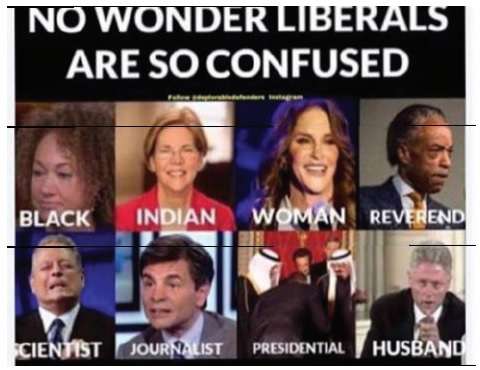
Connecticut Employee Speech Protection Law Might Protect Warren-Not-Indian / Jenner-Not-Woman Meme

|

From Mumma v. Pathway Vet Alliance, LLC, decided Wednesday by Magistrate Judge Thomas Farrish (D. Conn.); for more on the employee free speech protection statutes such as the one in this case, see this article and this one:

On the evening of June 9, 2020, Ms. Mumma posted a meme to her personal Facebook page. Under a banner reading "No Wonder Liberals Are So Confused," the meme contained photos of eight different political and cultural figures with a single word under each. For example, a picture of former NAACP Spokane chapter president Rachel Dolezal was captioned "Black;" a picture of former Vice President Al Gore was captioned "scientist;" and a picture of former President Bill Clinton was captioned "husband." Most relevant to this case, a photo of Senator Elizabeth Warren was accompanied by the word "Indian," and a photo of Caitlyn Jenner was captioned "woman." The meme is reproduced here:

Dr. Moore [a manager at Pathway] saw the meme on either June 9 or June 10. She testified that when she first saw it, she "had some concerns because [she] could see how people would find it offensive." She was particularly concerned about the Jenner and Warren panels, because she regarded them as "potentially very offensive to protected classes of people." With respect to the Warren panel, Dr. Moore observed that the use of the term "Indian" in place of "Native American" "can be taken offensively," but "[i]t was more that the … goal of this meme was to question how people identify themselves." And with respect to the Jenner panel, Dr. Moore "personally [found] it offensive to question how a transgender person chooses to identify themselves." …

Read More

More