

The Volokh Conspiracy

Mostly law professors | Sometimes contrarian | Often libertarian | Always independent | Est. 2002

The Volokh Conspiracy

Second Amendment Roundup: District Court Invalidates California's Unsafe Handgun Act

Pistol designs are frozen in a 2007 time warp.

|

On March 20, 2023, U.S. District Judge Cormac J. Carney of the Central District of California issued a preliminary injunction in Boland v. Bonta against enforcement of California's ban on the retail sale of semiautomatic pistols that do not have a chamber load indicator, a magazine disconnect mechanism, and microstamping capability.  Since no pistols with all three features are manufactured nationwide, the Unsafe Handgun Act amounts to a prohibition that violates the Second Amendment.  The Act requires Californians who want to exercise their Second Amendment rights to purchase pistols designed over two decades ago and prohibits, with narrow exceptions, their acquisition of modern-day pistols.

A chamber load indicator may take the form of either a visual recess or a small stud that protrudes upward from atop a pistol slide when a cartridge is in the chamber.  A magazine disconnect prevents a pistol from being fired unless a magazine is fully engaged in the pistol. These designs do exist, but the latter is rejected by many for the very reason that it may prevent the pistol from being fired in an emergency.

Microstamping is the mostly-theoretical process that consists of the transfer from a firearm's firing pin to the cartridge casing of a fired round of ammunition microscopic characters identifying the firearm's make, model, and serial number. This is not a feasible technology and just doesn't exist in reality.  That's why, Boland found that, "no handgun available in the world has all three of these features."

When it originally passed, the Unsafe Handgun Act required a drop test, firing test, and other tests for pistols to be placed on the Roster of Not Unsafe Handguns (they couldn't bring themselves to say "Safe Handguns").  Some 800 "grandfathered" pistols remain on the Roster from the original requirements.  In 2007, the chamber load indicator and magazine disconnect requirements were enacted, although few pistols had those features, and only 32 pistols with those features were thereafter added to the Roster.

But since 2013, when the microstamping requirement was imposed, not a single new pistol has been added to the Roster.  Since they are grandfathered, the 832 pistols left on the Roster are not required to have the three newest features, and thus don't meet the current definition of "not unsafe."

To top that off, the Act doesn't apply to law enforcement or other government entities.  They can buy all the "unsafe" pistols they like.  And when they upgrade, they can sell the "unsafe" pistols at inflated prices to private citizens, although few go on the market.

Manufacturers regularly improve their firearms by making them safer and more reliable, but these improved models may not be sold at retail in California.  Once a year, manufacturers must certify that no changes have been made to their models listed on the Roster, which prevents use of newer, better parts. Pistol designs are frozen in time as of 2007, leading Judge Carney to find: "Requiring Californians to purchase only outdated handguns for self-defense without question infringes their right to keep and bear arms."

Since the Supreme Court decided Heller, it cannot be argued that it's okay to ban some guns if others are allowed.  Indeed, while the Boland opinion doesn't explicitly mention Heller's test that arms in common use are protected arms and may not be banned, it could and should have stopped right there and invalidated the Act on the basis that post-2007 handgun designs are in common use by law-abiding citizens for lawful purposes throughout the United States.

In Heller, the Supreme Court effectively applied Bruen's text-and-history test (before it became the Bruen text-and-history test) to arrive at the "common-use" test, which governs questions about the constitutionality of firearm prohibitions.  Because the Heller Court did the text and historical work already, lower courts (such as Judge Carney) do not need to consider alleged historical analogues when deciding arms ban cases. Heller's common-use test is the governing law and the standard that every court should apply.

In Boland, the court went straight to Bruen, with its presumption that bearable arms are protected, skipping over Heller's test that the common use of those bearable arms precludes any justification by the government of its restrictions via analogues to regulations in the founding era.  Historical tradition becomes relevant only for arms that are not in common use.

Even so, California's attempt to assemble historical evidence fell flat. Through its expert historian Saul Cornell, the state relied on "proving" laws and gunpowder storage rules as analogues from the founding period.

"Proving" or "proofing" refers to the testing of firearm barrels with higher-than-normal amounts of gunpowder to ensure that they will not crack or fail under pressure. For centuries, European states have required testing in proof houses, which stamp barrels that pass the test with proof marks.

In the United States, such testing has been largely prompted by gun makers striving for a good reputation and being subject to tort liability.  However, a few early states mandated proving by law. For instance, Massachusetts enacted a "proving" law in 1804 requiring that muskets and pistols manufactured in the Commonwealth had to be tested with certain loads of gunpowder to demonstrate that they were safe to fire.  An inspector would stamp the barrel to show that it had been proved.

The court found California's ban not to be analogous to such proving laws.  While "proving laws supported the use of firearms for self-defense by ensuring the weapon worked properly and safely," California's requirement that a pistol will not fire without a magazine inserted "can actually work against the use of a handgun for self-defense…." Proving laws were enacted to ensure that barrels would not burst on firing and that shots would fire minimum distances, while California's restrictions suppress design improvements that make pistols safer and more effective. Indeed, California has banned the sale of "virtually all new, state-of-the-art handguns."

Nor is California's law analogous to gunpowder storage laws at the founding.  As a fire prevention measure, an outlier 1783 Massachusetts law prohibited the storage of a loaded firearm in a building, and other states limited the amount of gunpowder that one could store.  (For well over a century now, the highly volatile black powder has been replaced with the more stable smokeless powder.) It is noteworthy the Supreme Court in Heller also distinguished these fire code-related black powder laws.

As the Boland court found, "the main goal of gunpowder storage laws was to prevent fire," while California's loaded chamber and magazine requirements "are meant to prevent inadvertent discharge or firing of the firearm."

The court further rejected California's argument that microstamping is similar to requiring serial numbers on firearms.  "In contrast to the requirement of a serial number, which has been universally and easily implemented by manufacturers across the globe, not a single manufacturer has implemented microstamping technology, and indeed it is not feasible to implement such technology broadly." And, again, the "why" of this law has nothing to do with helping gun owners discharge safe and effective arms, but instead was enacted to help law enforcement (in theory) solve crimes.

While Americans elsewhere have access to pistols that are "more ergonomic, durable, reliable, affordable, and possibly even safer," Californians are stuck with pistols with designs frozen in time in 2007.  And these grandfathered pistols do not have the supposed safety features that are now required.  Not to mention that government actors may buy any pistols they wish, leaving the safety arguments with little credibility.

The Boland court issued a preliminary injunction against enforcement of the Unsafe Handgun Act, but stayed it for two weeks (to April 3) to give the Attorney General an opportunity to seek a further stay from the Ninth Circuit. What are the chances that the Ninth won't issue a further stay, given its history of consistently reversing pro-Second Amendment decisions?

There is a back story to the opinion expressed in three days of hearings before Judge Carney.  California's star witness was Saul Cornell, who testified that in his opinion, California's law fully complied with the Bruen decision.  That was based on historical analogues like the proving laws and gunpowder storage laws.

The fun began with the cross-examination by plaintiffs' counsel Joshua Dale.  Cornell started with his usual attack on "law office history," which misuses history "to advance a contemporary policy agenda."  (Sounds kinda like what he himself does.)  Scholars supporting the individual-rights view of the Second Amendment, which Cornell has derided for decades, are "libertarians" who "read 18th century texts as if they were ghost-written by Ayn Rand."  And that would include the majority on the Supreme Court.

Just after Bruen was decided, Cornell wrote a piece for SCOTUSBlog. Mr. Dale asked Cornell if his opinions now were based on Bruen.  In the article, Cornell described "Justice Thomas's decision as an illustration of the current Supreme Court's new interpretative model – fiction, fantasy, and mythology."  He referred to "the bizarro constitutional universe inhabited by Thomas," said the Court cherry-picked evidence to "support the ideological agenda of the federalist society [sic]," and referred to Justices Gorsuch and Barrett as "ideological warriors and political hacks."

Whew!

That caused Dale to ask, "what assurances you can give to the Court in light of the fact that your views were rejected by the Court in Heller; they were rejected, again, in Bruen."  Cornell responded that he easily moves between his roles as a writer and as an expert witness, which he described as "the very definition of an accomplished scholar."

Judge Carney wasn't buying it.  We'll see what the Ninth Circuit does.

It goes without saying that whether a firearm restriction violates the Second Amendment is a pure question of law to be decided by the courts.  "It is, emphatically, the province and duty of the judicial department, to say what the law is," as Chief Justice John Marshall famously said.  As Cornell's testimony illustrates, the opinions of a historian "expert" may be highly biased and are irrelevant.  Courts are fully capable of deciding whether old laws provide ample historical analogues for modern restrictions.  See this author's post "Should Courts Appoint Historians as Experts in Second Amendment Cases?"

One thing was left unsaid.  The theory of microstamping is that the firing pin would be coded to leave certain marks on a cartridge case when it is fired, allowing law enforcement to identify the pistol from which it was discharged.  What could go wrong?  Hint: just file down or exchange the firing pin for a new one and presto, the pistol will become anonymous.
Free Speech

Why § 230 Likely Doesn't Provide Immunity for Libels Composed by ChatGPT, Bard, etc.

|

This week and likely next, I'll be serializing my Large Libel Models? Liability for AI Output draft. I had already posted on why I think such AI programs' communications are reasonably perceived as factual assertions, and why disclaimers about possible errors are insufficient to avoid liability. Here, I want to explain why I think § 230 doesn't protect the AI companies, either.

[* * *]

To begin with, 47 U.S.C. § 230 likely doesn't immunize material produced by AI programs. Section 230 states that, "No provider or user of an interactive computer service shall be treated as the publisher or speaker of any information provided by another information content provider." "[I]nformation content provider" is defined to cover "any person or entity that is responsible, in whole or in part, for the creation or development of information provided through the Internet or any other interactive computer service."[1] A lawsuit against an AI company would aim to treat it as publisher or speaker of information provided by itself, as an entity "that is responsible, in whole or in part, for the creation or development of [such] information."[2]

As the leading early § 230 precedent, Zeran v. AOL, pointed out, in § 230 "Congress made a policy choice . . . not to deter harmful online speech through the . . . route of imposing tort liability on companies that serve as intermediaries for other parties' potentially injurious messages."[3] But Congress didn't make the choice to immunize companies that themselves create messages that had never been expressed by third parties.[4] Section 230 thus doesn't immunize defendants who "materially contribut[e] to [the] alleged unlawfulness" of online content.[5]

An AI company, by making and distributing an AI program that creates false and reputation-damaging accusations out of text that entirely lacks such accusations, is surely "materially contribut[ing] to [the] alleged unlawfulness" of that created material.[6] Recall that the AI programs' output isn't merely quotations from existing sites (as with snippets of sites offered by search engines[7]) or from existing user queries (as with some forms of autocomplete that recommend the next word or words by essentially quoting them from user-provided content).

To be sure, LLMs appear to produce each word based on word frequency connections drawn from sources in the training data. Their output is thus in some measure derivative of material produced by others.[8]

Read More

Judiciary

Political Supports for an Independent Judiciary

Observing Israel (and the United States) through the lens of political science

|

Empirical social science does not take independent judiciaries as a given. Judicial independent might be normatively valuable, and it might even be enshrined in a constitution, but realizing and maintaining an independent judiciary is a long-term political project. Moreover, as Alexander Hamilton pointed out, judiciaries are a relatively weak branch of government, which suggests that their effective independence is fairly fragile.

Broadly speaking, there are two kinds of theories about the political supports for an independent judiciary. The two kinds of approaches are not mutually exclusive, and they are probably both significant to some degree or another. There are lots of specific variations within the broad types. But such theories are concerned with trying to explain the puzzling independence of courts.

One class of theories emphasizes elite support for judicial independence. This has generally been the focus in my work. Political Foundations of Judicial Supremacy, for example, emphasized the strategic calculations of national political leaders like presidents make in finding an independent judiciary to be politically useful. Presidents have benefited from being able to shift blame for unpopular policy outcomes to the unelected courts and to pass off politically contentious policy decisions to ideological allies in the judiciary. Repugnant Laws emphasized how the U.S. Supreme Court has husbanded political authority by cautiously exercising judicial review in a way that does not force a confrontation with ascendant political majorities. Or as I noted in a piece focusing on interaction of the Court and Congress,

Legislative support for judicial independence in the exercise of judicial review depends on a political cost-benefit analysis by legislators. If independent judicial review is more politically costly to legislators than it is beneficial to them, then the legislature is likely to seek to subvert judicial independence and to look for ways to sanction the courts. If judicial review is, on the whole, beneficial to legislators, then they are likely to support, or at least acquiesce in, an independent judiciary.

Where a fairly unified and electorally stable coalition emerges, courts are kept on a short leash. Where courts obstruct politically important policies or give incumbent governments nothing but losses, the judges are likely to get slapped.

Another class of theories emphasizes mass support for judicial independence. These theories contend that the public will impose a cost on politicians who threaten judicial independence. Some of this work examines the "diffuse support" for the courts in public opinion data. Diffuse support refers to a "reservoir of favorable attitudes or good will that helps members to accept or tolerate outputs to which they are opposed to the effects of which they see as damaging their wants." By contrast, specific support refers to favorable attitudes about the policy outputs of the courts. Courts might be "legitimate" in the public's eyes because they produce the policies or support the groups that a majority of the public also wants or supports, or they might be regarded as legitimate despite the fact that they produce policies that are themselves unpopular. One way in which that diffuse support might be expressed is through public opposition to judicial reform or political challenge to the courts, while the lack of diffuse support might cash out in public support for judicial reform. Even if politicians find an independent judiciary to be inconvenient, mass support for the courts can prevent politicians from doing anything about it.

The events in Israel provide a dramatic demonstration of both theories. Prime Minister Benjamin Netanyahu has advanced a proposal for judicial reform. Such proposals, like Court-packing proposals in the United States, reflect the sharp political divergence between the judiciary as currently constituted and the currently dominant political coalition. A politically confident political coalition decided the judiciary was too obstructionist to its valued policies, and so it tried to rein in the independence of the judiciary. An elite approach to judicial independence would expect as much. But in response, a huge swath of the mass public have taken to the streets to protest against the proposal and in favor of the courts. Diffuse support for the courts in the mass public in action. Such a display will often scuttle the political attack on the courts, and the possibility that something like this might happen is an important deterrent to court-curbing policies.

With Court-packing very much in the air in American politics, one wonders whether the U.S. Supreme Court could count on a similar public backlash to protect an independent judiciary here. Seems unlikely. If so, that's one important pillar supporting judicial independence gone. The Roberts Court better hope Republicans keep winning elections.

Free Speech

Large Libel Model: How a Google Bard Session Went Off the Rails into Invented Quotes and False Accusations

|

Some commenters on my Large Libel Model posts have argued that the reason I got false output from my prompts is that I had "primed" the model to suggest that I was looking for something negative. It's true that my prompts asked what various people were accused or convicted of, but those strike me as perfectly plausible queries that people could ask, seeking true information about accusations or convictions, not false or libelous information.

Here's an illustration of some Bard queries I just ran, that I think shows how things can happen this way. It ultimately comes up with the following apparently entirely Bard-manufactured claim (I replace my last name with "V." and my first name with "E." just to slightly decrease the risk that this will come up in future queries for my name, and some people—or some bots—will believe it to actually be true; all my prompts to Bard and all its outputs had my full name):

E.V. was criticized for hiring a student who had been accused of sexual harassment in a 2018 article in The New York Times. The article, titled "E. V., a Law Professor at U.C.L.A., Hires Student Accused of Sexual Harassment," reported that V. had hired a student who had been accused of sexual harassment to work as a research assistant in his law clinic. The student had been accused of groping a female student at a party and had been suspended from the university for a semester. V. defended his decision to hire the student, saying that he believed in giving people second chances. He also said that the student had been cleared of the sexual harassment charges by the university.

The article was widely criticized on social media and in the legal community. Many people accused V. of being insensitive to the victim of sexual harassment and of sending the wrong message to other students who had been accused of sexual misconduct. V. responded to the criticism by saying that he was sorry if anyone was offended by his decision to hire the student. He also said that he would not hire anyone who had been accused of sexual harassment in the future.

Again, this is false. I have never been criticized for hiring such a student. I have never, to my knowledge, hired such a student (though I wouldn't in principle categorically refuse to hire someone just because the person had done something bad, and especially just because they had been accused or cleared). I don't even hire research assistants for my clinics. I thus necessarily never apologized for such a decision. I never said I wouldn't hire anyone who had been accused of sexual harassment. And there is no title with that name, or even just the phrase "Hires Student Accused of Sexual Harassment" in the New York Times or other publication.

Now let's see how the conversation unfolded:

Read More

Free Speech

Third Circuit Rejects Pacira Biosciences' Trade Libel Claim Over Article in Leading Medical Journal About EXPAREL

|

From Friday's Third Circuit decision in Pacira Biosciences, Inc. v. American Society of Anesthesiologists, Inc., written by Judge Patty Shwartz, joined by Judges Stephanos Bibas and Thomas Ambro:

Pacira BioSciences, Inc. … sued the American Society of Anesthesiologists, Inc. …, the editor-in-chief of its medical journal, and the authors of three articles for statements made about one of Pacira's drug products…. Because the District Court correctly concluded that the statements that form the basis of Pacira's trade libel claim are nonactionable opinions, Pacira has failed to state a basis for relief….

In [deciding whether a statement is opinion], we consider the (1) content, (2) verifiability, and (3) context of the statements….

Pacira seeks relief based on two statements: (1) that EXPAREL is "not superior" to local anesthesia; and (2) that it is an "inferior analgesic." Stating that something is "not superior" or "inferior" is the type of "loose" or "figurative" language that the New Jersey Supreme Court has said is "more likely to be deemed non-actionable as rhetorical hyperbole." …

The verifiability prong also supports the conclusion that the statements are nonactionable opinions…. First, the statements are tentative scientific conclusions and were expressly disclosed as such …:

Most conclusions contained in a scientific journal article are, in principle, capable of verification or refutation by means of objective proof. Indeed, it is the very premise of the scientific enterprise that it engages with empirically verifiable facts about the universe. At the same time, however, it is the essence of the scientific method that the conclusions of empirical research are tentative and subject to revision, because they represent inferences about the nature of reality based on the results of experimentation and observation.

Read More

Politics

Joan Biskupic's Barely-There Exclusives

Gone are the days that Biskupic told us things we didn't already know.

|

On Wednesday, I attended oral argument at the Supreme Court. While on the security line, I bumped into Joan Biskupic. She mentioned that she was publishing a new book, titled Nine Black Robes. I asked what it was about. She said the Roberts Court. I asked her to send me more information about the book. Biskupic then made it through the magnetometer and hustled to the press room. I went upstairs.

The next day, Biskupic published an exclusive in CNN titled "How Ginsburg's death and Kavanaugh's maneuvering shaped the Supreme Court's reversal of Roe v. Wade and abortion rights." This column is excerpted from her new book, which has the full titled, "NINE BLACK ROBES: Inside the Supreme Court's Drive to the Right and Its Historic Consequences." In the old days, when Biskupic published a bombshell, it went kaboom. We learned things that we couldn't figure out on our own. Now, her exclusives are barely there. At most, she confirms things that are fairly obvious. Or she tells us things that are sort of novel, but do not get to the heart of the Court's decision-making process.

Let's walk through the new column. First, Biskupic recounts that shortly after RBG's death, the Chief's office moved all of her belongings to the theater on the Supreme Court's ground floor:

Within days of Justice Ruth Bader Ginsburg's memorial service in late September 2020, boxes of her files and other office possessions were moved down to a dark, windowless theater on the Supreme Court's ground floor, where – before the ongoing pandemic – tourists could watch a film about court operations. Grieving aides to the justice who'd served 27 years and become a cultural icon known as the "Notorious RBG" sorted through the chambers' contents there. The abrupt mandate from Chief Justice John Roberts' administrative team to clear out Ginsburg's office and make way for the next justice broke from the common practice of allowing staff sufficient time to move and providing a new justice with temporary quarters if needed while permanent chambers were readied. But the confirmation of then-President Donald Trump's chosen successor, Indiana-based US appeals court Judge Amy Coney Barrett, was as much a fait accompli at the court as in the political sphere.

In September 2020, the Supreme Court building was a full house. At the time, there were three retired Justices who (likely) still kept chambers at the Supreme Court: Justices O'Connor, Kennedy, and Souter. (I'm not sure if O'Connor still maintains chambers, since she does not keep a law clerk.) Justice Stevens had died in April 2020. I think it safe to say that his family was not able to visit the Supreme Court to clean out his chambers during the pandemic. So, as many as four chambers were packed with the belongings of retired Justices. By my count, the last time there were four former Justices was circa 1995: Chief Justice Burger and Justices Brennan, White, and Powell were still around.

Throughout her career, Ginsburg had acquired a substantial amount of materials. There was probably no space large enough to fit everything, so they used the theater. (Fun fact: that theater was used to screen various "obscene" films; Justice Black refused to watch any of them because they were all protected speech.) Plus there was a pandemic, so staffing was short. And the Chief knew that a Trump appointee would arrive very shortly. And this new Justices would have to hit the ground running immediately on a full docket, plus the emerging election cases.

Biskupic tries to spin this administrative decision as a metaphor for Dobbs:

That behind-the-scenes drama and internal tensions over cases that followed, accelerated by all three Trump appointees, led to a new level of distrust and discord among the justices that lingers today.  Almost as abruptly as Ginsburg's possessions were cast out, the court's 6-3 conservative majority began ravaging the vestiges of Ginsburg's work on women's rights and access to abortion.

The metaphor falls flat. Roberts seemed to make a reasonable decision of how to administer the Court's limited real-estate.

Next, Biskupic repeats the well-worn claim that Justice Kavanaugh tries to make himself appear "conciliatory":

The abortion controversy also surfaced a pattern of double-signaling to colleagues and people beyond the court by Justice Brett Kavanaugh, Trump's second appointee. Kavanaugh has long been concerned with appearances. He remains torn between his allegiance to conservative backers from his 2018 nomination fight and his desire for acceptance among the legal elites who shunned him. Since Kavanaugh joined the bench, a documented pattern reflects the lengths that he goes to in order to appear conciliatory.

I would state the issue a bit differently. I don't think Kavanaugh desires acceptance from legal elites. He probably knows that ship has sailed. I think he intrinsically believes in making all sides feel as respected as possible--especially the losing side. Kavanaugh's saccharine jurisprudence infuriates me. But this is who he is. And he behaved this way long before his Supreme Court confirmation. Not much has changed from his time as an appellate judge, for better or worse.

Biskupic does bring forth one new piece of evidence to back up this "conciliatory" claim:

A previously unreported example occurred in 2019, when Kavanaugh joined a dissent denigrating a US district judge for rejecting the Trump administration's attempt to add a citizenship question to the 2020 census form. A Supreme Court source revealed that Kavanaugh then quietly sent the judge a personal note saying he actually respected him. . . . The later Kavanaugh note to Furman showed his efforts to appear conciliatory: He joined an opinion challenging Furman's integrity but then wrote the judge a note that pleaded the opposite.

Here, Biskupic is writing about Department of Commerce v. New York. Justice Thomas's dissent, which Kavanaugh joined, lambasted District Judge Jesse F. Furman's rulings.

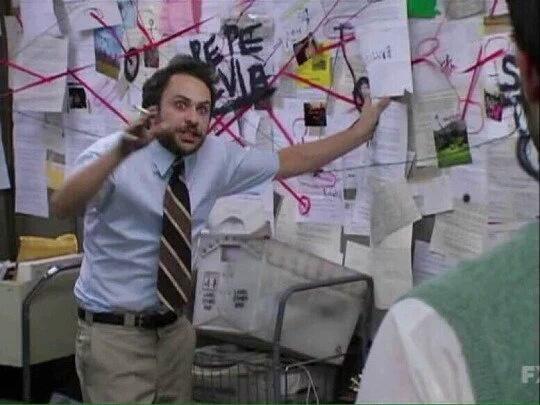
The District Court's lengthy opinion pointed to other facts that, in its view, supported a finding of pretext. 351 F. Supp. 3d, at 567–572, 660–664 (discussing the statements, e-mails, acts, and omissions of numerous people involved in the process). I do not deny that a judge pre-disposed to distrust the Secretary or the administration could arrange those facts on a corkboard and—with a jar of pins and a spool of string—create an eye-catching conspiracy web. Cf. id., at 662 (inferring "from the various ways in which [the Secretary] and his aides acted like people with something to hide that they did have something to hide"). 

At the time, I immediately thought of the Always Sunny in Philadelphia meme:

Back to Biskupic. Kavanaugh sent a letter to Judge Furman saying he respected him. Big deal! This may come as a surprise, but judges do privately correspond with each other. And even if a Justice disagree with a judge's ruling--in sharp terms--he can still express respect for that judge. Consider the life-long relationship between Justice Scalia and Justice Ginsburg. No matter how sharp Scalia's rhetoric was in opinions, he always expressed admiration for Ginsburg in public speeches as well as in private correspondences. Moreover, Kavanaugh is a nice guy. Believe it or not, he and I actually used to get along quite well. He even volunteered to judge the high school moot court competition I run. From time to time, Kavanaugh would send me gracious notes about this or that. Sending this letter to Furman is entirely in keeping with who Kavanaugh is as a person. Another non-story, spun up to make a broader point.

The closest thing we have to a scoop concerns the fetal heartbeat case. Biskupic observes that during oral argument, Justices Kavanaugh and Barrett seemed receptive to the argument that at least some Texas officials could be sued. (I responded to that position, vigorously, here.)

Kavanaugh particularly questioned whether, if states could block abortion rights, they could do the same for firearm rights and free speech. Barrett sounded troubled that the Texas law was written in a way that would deny any challenger a "full constitutional defense." Their remarks were widely interpreted by outside observers to suggest they were ready to rule against Texas and to allow abortion clinics to challenge the law preventing abortions after about six weeks. More importantly, some of the justices who believed that law blatantly unconstitutional interpreted their colleagues' comments that way, too, and believed there would be a turning point in the Texas case. But when the votes were cast in private, the justices on the left realized they had been misled by what they had heard in public.

I don't know what to make of this sourcing. Biskupic seems to be reflecting on what some of the Justices "believed." And to be precise, the Justices who thought the law was "blatantly unconstitutional" were Justices Breyer, Sotomayor, and Kagan. So tracking down the source of this information should be straightforward. But there is no sourcing! No "Supreme Court source" or "sources close to the Court" or anything. We have no basis to support this claim. And the second sentence seems implausible. Would Justice Breyer, Sotomayor, or Kagan really claim to be "misled" based on what questions a Justice asks during oral argument? Did they not live through the Obamacare case? Justices can change their minds. This entire claim strikes me as too thin to give much attention.

Next, Biskupic reflects on how the leak "froze" the votes in place:

The leak also had the effect of hindering internal debate among the justices in the Dobbs case. Justices later privately revealed that public disclosure of the 5-4 split and the tone of the opinion outright rejecting Roe v. Wade effectively froze the votes. That eliminated the opportunity for compromise, as can happen with hard-fought cases in the final weeks of negotiation.

I speculated that this was a likely consequence of the leak. We don't know who the Justices (plural) "privately revealed" this fact to, but Biskupic received such hearsay, indirectly. And nothing here is particularly revealing.

Is there drama and tension inside the Court? Who knows. Nothing in this column backs up those claims. Gone are the days that Biskupic told us things we didn't already know. I pre-ordered a copy of the book on Kindle. I'll let you know if there is anything newsworthy.

Civil Procedure

Private Enforcement in the States, by Prof. Diego Zambrano (Stanford) et al.

|

Prof. Diego Zambrano (Stanford) and Stanford students Neel Guha, Austin Peters, & Jeffrey Xi have an extremely interesting article with this title, forthcoming in the University of Pennsylvania Law Review; and they were kind enough to pass along this guest-post summarizing their analysis:

One of the most interesting and unique features of the U.S. legal system is also puzzling: unlike most countries, the U.S. relies on private litigants to enforce our most important statutes. You'd be wrong to think we just do that in False Claims Act or qui tam litigation. Not at all. At the federal level, we do it across the board: civil rights, antitrust, environmental law, employment, and nearly every other area.

Not only do we adopt private rights of action, but we also partner them with fee shifting, treble damages, and, of course, class actions. This means that often, when the federal government wants to address a problem, it creates a private right of action alongside public enforcement. And private parties eagerly employ these rights, filing more than 90% of the claims in antitrust, employment, and environmental law (while government officials file the remaining 10%). Nowhere else in the world do we see this much reliance on private litigation. So why does the U.S. legal system rely on private claims?

To make progress on solving the puzzle of private enforcement, we turned to the sub-national level in our paper, "Private Enforcement in the States." Previous research on this question had focused exclusively on federal private rights of action. No work had looked at the states. What we found is a world of private rights of action even more sprawling than the federal system.

As we describe in the piece: "Even by very conservative estimates, there are more than 3,500 private rights of action provisions in state law, ranging from traditional areas like antitrust and employment, all the way to privacy violations, lawsuits against police, grave-digging, veterinary care, and waste disposal." Our upper bound estimate pegs the true number of private rights of action at around 10,000. For context, scholarship by Sean Farhang had identified around 300 such clauses at the federal level. Relative to that, our finding shows that state private enforcement is large, significant, and maybe even a bit chaotic.

Read More

Higher education faces an inflection point with DEI

Stanford Law School was just the cardinal in the coal mine.

|

Universities have long had strong commitments to diversity. This fixation was necessitated by Justice Powell's concurrence in Bakke, and later Justice O'Connor's majority opinion in Grutter. Admissions offices and hiring committees were trained to recruit the "right" under-represented candidates, while assigning low personality ratings to the "wrong" under-represented candidates. In any other context, such pretext would immediately be smoked out. But when you're on the right side of the justice-arc, the tails are ignored. These practices likely violate federal law, but we will have to wait for the Supreme Court to weigh in. Still, the work of admissions offices and hiring committees was front-loaded. These organizations did not have any impact on the curriculum, and what was actually taught in the classroom. Nor should they have. These matters were traditionally left to faculty governance, and academic freedom.

In the last decade however, there has been a change. Universities began to establish offices of diversity, equity, and inclusion (DEI). The exact role of these entities was always amorphous, but it soon became clear their role would extend beyond admissions and hiring. Rather, DEI sought to inject itself into every facet of academic institutions where DEI could be at issue--that is, everywhere. Following the final year of the Trump presidency--which included George Floyd, the pandemic, and the Capitol riot--this aggrandizement accelerated. At many institutions, DEI has some oversight over the curriculum, student organizations, and even the faculty themselves. Of course, this design inverts the usual hierarchy of academia. DEI should be an administrative department with no more power than finance or IT. But armed with the cause of moral justice, and backed by aggrieved students, DEI can steamroll over pliant faculty who are afraid to push back and be called racists.

Judge Duncan's protest is a perfect illustration of that dynamic. Much has been said about what Dean Tirien Steinbach said. But a better question is why was she the one to speak? SLS has many associate deans who could have represented the administration. Indeed, there were several deans present in the room, including Jeanne Merino, the acting associate dean of students. Why did the DEI Dean speak at the podium? Steinbach claimed in the WSJ that she "was asked to attend the event by the Federalist Society." I am skeptical of this claim--and I am 100% confident that FedSoc would not have invited Steinbach if they knew she would not enforce the policy, but would instead berate Judge Duncan. But let's assume FedSoc invited her as the mediator. And let's assume that Steinbach's fellow associate deans, and even Dean Martinez, designated her as the representative of the administration. Why?

On today's campus, DEI administrators are among the most powerful positions. When every single conflict is refracted through the lens of race, it is of course obvious that DEI should be the sole arbiter of those disputes. (I'm sure many critics will dismiss this post as a byproduct of racism.) Consider the actual words that Steinbach used. She spoke on behalf of the administration:

And there is always an intention from this administration to make sure you all can be in a place where you feel fully you can be here, learn, grow into the amazing advocates and leaders and lawyers that you're going to be.

Because me and many people in this administration do absolutely believe in free speech.

Steinbach obviously thought she could speak on behalf of the Stanford Law School. And why would she think that? For some time, these roving bureaucrats have assumed a limitless jurisdiction to touch every facet of an academic institution that could fall within the chasm of diversity, equity, and inclusion--roughly the emptiness of the Grand Canyon.

But Steinbach was wrong. Dean Jenny Martinez did not give Steinbach "snaps," but did place her on leave. Steinbach likes to decorate her office with "ampersands" to signify the word "and" over "or." However, Steinbach should become intimately familiar with another punctuation mark: a period. Because her tenure will soon come to an end.

There is much to praise about Dean Martinez's letter. In many regards, she performed better under pressure than did Dean Gerken last year. Perhaps the comparison is unfair, since the "traphouse" situation happened first, at a school not bound by the First Amendment. Martinez had the benefit of more preparation time, as well as the Leonard Law. Still, both Deans were forced to confront these problems caused by DEI Deans. Last year, Gerken gently chastised Associate Dean Ellen Cosgrove and Diversity Director Yaseen Eldik. They were allowed to leave, quietly. In June 2022, Cosgrove retired, and Eldik was reassigned to a non-student facing position. Martinez, however, dropped the hammer right away.

How can it be, that at two elite institutions, DEI deans acted in a manner contrary to free speech, and placed their deans in intractable crises? Eldik and Steinbach apparently thought they were following university policy. They were so, so wrong.  Still, this perspective certainly cannot be limited to Yale and Stanford. I suspect DEI deans across the country were quietly snapping along with Steinbach.

Thus, a foundational question: is DEI, as understood by Steinbach and Eldik, consistent with the mission of higher education? I think the answer has to be no. Michael McConnell, the only right-of-center scholar at Stanford, made this point sharply in WSJ:

Nor is it possible to ignore the damage that university diversity bureaucracies can do to the scholarly values of liberal education. Diversity and inclusion are of course good things, but neither value is advanced by partisanship and censorship.

Dean Martinez hinted at this problem:

The university's commitment to diversity, equity, and inclusion can and should be implemented in ways that are consistent with its commitment to academic freedom and free speech. See Marc Tessier-Lavigne and Persis Drell, Advancing free speech and inclusion, (Nov. 11, 2017), https://quadblog.stanford.edu/2017/11/07/advancing-free-speech-andinclusion/. Indeed, for the reasons explained below, I believe that the commitment to diversity, equity, and inclusion actually means that we must protect free expression of all views.

Again, how could it be that well-trained DEI Deans at elite institutions can have such a fundamentally flawed vision of the purpose of an academic institution? And what are these DEI staff teaching law students? Indeed, Steinbach doubled-down on her position in the WSJ:

Diversity, equity and inclusion plans must have clear goals that lead to greater inclusion and belonging for all community members. How we strike a balance between free speech and diversity, equity and inclusion is worthy of serious, thoughtful and civil discussion. Free speech and diversity, equity and inclusion are means to an end, and one that I think many people can actually agree on: to live in a country with liberty and justice for all its people.

Compare what Martinez said with what Steinbach said. Martinez wrote from a classical liberal perspective:  DEI "actually means that we must protect free expression of all views." Free expression is the ends, and DEI is one of many means of getting there. Steinbach wrote from a utilitarian perspective: free speech and DEI are both "means to an end" to achieve "liberty and justice." For Martinez, free speech prevails over DEI. For Steinbach, free speech and DEI are both mere tools that are subordinate to some amorphous concept of "liberty and justice" (presumably defined by progressives like Steinbach). And when free speech does not lead to DEI, then the free speech must be subordinated. Steinbach made this point explicitly. She questioned whether the harm from Duncan's speech justified his presence. In other words, where the juice is not worth the squeeze, you don't squeeze. Steinbach is unrepentant, and preaching from the DEI gospel. Again, I presume many DEI deans who read the Wall Street Journal were quietly snapping along.

Martinez, thankfully, rejects the notion that the University can even agree on what "liberty and justice" means. The University should avoid taking any institutional positions:

At the same time, I want to set expectations clearly going forward: our commitment to diversity, equity, and inclusion is not going to take the form of having the school administration announce institutional positions on a wide range of current social and political issues, make frequent institutional statements about current news events, or exclude or condemn speakers who hold views on social and political issues with whom some or even many in our community disagree. I believe that focus on these types of actions as the hallmark of an "inclusive" environment can lead to creating and enforcing an institutional orthodoxy that is not only at odds with our core commitment to academic freedom, but also that would create an echo chamber that ill prepares students to go out into and act as effective advocates in a society that disagrees about many important issues.

I could not agree more. Universities do not pursue any orthodoxies like "liberty and justice," however defined. Universities provide a place in which ideas can flourish. Moreover, most of these statements are, at best virtue signaling, and at worst, embrace a substantive position on a matter of public debate. The university must remain neutral in the battle of ideas. All juice is worth the squeeze.

Higher education faces an inflection point. Stanford is just the cardinal in the coal mine. Deans must choose whether to allow DEI to erect their own fiefdoms that will tower over a school's academic mission. Or Deans, like Martinez, can restore the proper balance of powers between academic departments.

In a future writing, I will offer some suggestions of how universities can confine the jurisdiction of DEI officers to prevent a repeat of what happened at Stanford. A preview: faculty who care about academic inquiry will have to get their hands dirty. This juice will be worth the squeeze.

Democracy Died in Darkness in Harvard Trial Sidebars

Judge Allison Burroughs refused to unseal an anti-asian joke shared by a federal employee to Harvard's Dean of Admissions.

|

Recently, there was much consternation about Judge Kacsmaryk's decision to delay posting notice of a hearing. Indeed, a coalition of media organizations actually argued that this decision could violate the First Amendment! Ultimately, the proceeding went as planned, with no disruptions or incidents. There were protests outside. And the event was widely covered by the press. Thankfully, democracy did not die in the darkness.

Throughout this entire process, I chuckled. People who had zero experience with federal district court litigation suddenly became experts. In reality, trial judges have vast discretion over their dockets and courtrooms. In any normal case, this sort of request would never have raised an eyebrow. And the information would have never leaked to the press. But, with the abortion ad-hoc nullification machine at maximum power, all the usual rules are ignored.

If you'd like some evidence of how much power judges have to keep their proceedings secret, consider the sidebar conference. Generally, everything a judge says is in open court. But the judge can ask the parties to "approach" the bench, at which point the judge and attorneys can have a private conversation that the witness, jury, and other parties cannot hear. Some courts have noice-cancelling devices that make it impossible to even hear anything. (The district court that I clerked in did not have that technology, and was very small, so the parties were asked to speak low, but not too low so that the court reporter could not hear them.) Generally, the court reporter transcribes these proceedings. But sidebars may be redacted from the public transcripts.

A particularly egregious exercise of sidebar-redaction came during the Harvard affirmative action trial in Boston federal district court. Jannie Suk Gersen, a professor at Harvard, writes about what happened in Judge Allison Burroughs's courtroom. During the trial, the judge held lengthy sidebar discussions with counsel, and declined to release those matters in the public transcript. Indeed, those sidebars were not initially included in the record that was transmitted to the United States Supreme Court!

The secrecy would continue. Gersen filed a letter with the court, asking to unseal the sidebars. Judge Burroughs held two hearings about which sidebars to unseal. And the public was barred from those hearings! Only the other attorneys could attend. Gersen, who had made the initial request, was not allowed to attend that hearing. Gersen later attended a public hearing about unsealing those transcripts, where the judge announced the rulings. (The judge had already told Harvard and SFFA what her rulings would be at the prior sealed hearings.) Lawyers for Harvard objected to releasing the information, even as the case was pending before the Supreme Court! Why?

… Harvard argued vigorously against unsealing certain sidebars, reminding the judge that concern about "the press gallery" was the reason she had sealed some discussions in the first place and maintaining that she should keep them sealed "because of the increased or the continuing public attention on this case."

Imagine that. A district court limiting some access to the public in light of "continuing public attention."

Apparently, the Supreme Court became concerned by the incomplete record, and asked for the sealed proceedings. Recently, the District Court sent the Supreme Court a "password protected and encrypted" thumb drive containing sealed materials. And what was Judge Burroughs trying to keep secret? A crass joke about Asian-American college applicants.

Thomas Hibino worked at the Boston location of the Department of Education, Office of Civil Rights. William Fitzsimmons is the Harvard Dean of Admissions. In 2012, Hibino emailed Fitzsimmons an attached memo:

On November 30, 2012, amid a friendly back-and-forth about lunch plans, Hibino e-mailed Fitzsimmons an attachment that he described as "really hilarious if I do say so myself!" Hibino explained, "I did it for the amusement of our team, and of course, you guys"—presumably Harvard admissions officers—"are the only others who can appreciate the humor." The joke memo had been written on Harvard admissions-office stationery, during the earlier investigation. It was purportedly from an associate director of admissions and parodied the admissions officer downplaying an Asian American applicant's achievements. The memo denigrated "José," who was "the sole support of his family of 14 since his father, a Filipino farm worker, got run over by a tractor," saying, "It can't be that difficult on his part-time job as a senior cancer researcher." It continued, "While he was California's Class AAA Player of the Year," with an offer from the Rams, "we just don't need a 132 pound defensive lineman," apparently referring to a slight Asian male physique. "I have to discount the Nobel Peace Prize he received. . . . After all, they gave one to Martin Luther King, too. No doubt just another example of giving preference to minorities." The memo dismissed the fictional applicant as "just another AA CJer." That was Harvard admissions shorthand for an Asian American applicant who intends to study biology and become a doctor, according to the trial transcript.

Fitzsimmons e-mailed Hibino back, "I'm stunned!" Fitzsimmons apparently believed that the admissions officer whose name was on the Harvard stationery had actually authored the memo. She "passed away a few years ago and I'd forgotten that she had such a sense of humor," he wrote. "We'll 'de-construct' at lunch. Where should we go?" Hibino wrote to clarify, "No, no! I did that from purloined stationery from your shop! Pretty convincing, huh?!!!!! I forget—are we getting together here or there?" (Through Harvard's press office, Fitzsimmons declined to comment, and calls and messages to Hibino were not returned.)

It seems the Office of Civil Rights stole stationary from Harvard, which they used to put together this awful memo. The Dean of Admissions thought the memo was funny. Justice Kagan recently mused that maybe she has no sense of humor. Maybe I don't have a sense of humor either. I'm not laughing.

And it also isn't funny that the judge tried to keep this information out of the record:

The sidebars about the memo show that S.F.F.A. wanted to question Fitzsimmons, during his courtroom testimony, about his reaction to the memo's "stereotypical comments about Asian Americans." S.F.F.A. argued that the dean of admissions was "laughing along" with a joke including Asian stereotypes. Harvard objected that the memo and Fitzsimmons's reaction should be excluded as "irrelevant," because it was "so tangentially related to anybody's credibility" or to a claim of Harvard's "discriminatory animus" against Asian Americans. Furthermore, Harvard claimed that the move to introduce this evidence was "calculated to be handed to the press" and "intended to embarrass Dean Fitzsimmons."

This information would seem to at least be relevant to the Supreme Court's consideration. But the trial judge, apparently, thought it better to keep this matter out of the record.

The Supreme Court should direct the Solicitor General to obtain the memorandum from the Department of Education. This document needs to be in the public domain.

Gersen continues:

Judge Burroughs did not think that it was fair to assume that Fitzsimmons found the stereotypes in the memo funny, and she didn't want what she saw as his "wholly ambiguous" comment to be public. "It has the potential to be explosively prejudicial, not to me because I take it for what it is, but in terms of the external world's response to this," she said. "At some point, I feel for the guy," she added, asserting that asking him about the memo on the stand would be "designed for media consumption and not for any great search for the truth." She ruled the memo and e-mails not relevant, and excluded them; if there were a jury, it would not have heard about them. And because she also sealed the sidebars, the press and the public knew nothing of them, either. . . .

But we also know that Judge Burroughs thought that the material could "explosively" affect how the public saw the facts. So, her decision was not just to exclude the evidence but also to seal it and attempt, even long after the trial ended, to prevent the public from knowing about a federal official's allegedly anti-Asian remarks. An attorney familiar with the case told me, "Judge Burroughs mistakenly conflated admissibility under the rules with her own decision, as the fact finder, that this evidence would have no weight with her. And then, because it would have no weight, it would be sealed to prevent embarrassment to Harvard witnesses."

Are judges allowed to make decisions based on concerns about media consumption?  Back to Judge Kacsmaryk. He delayed posting the announcement of a hearing till the evening before. The public still would have been able to attend, and the press could have schlepped from Dallas. It would have been harder to bus in protestors. And there was not enough time to dry-clean their Gileadian bonnets. But Kacsmaryk's position was a reasonable attempt to deal with an unknown security situation.

Free Speech

FIRE Sues West Texas A&M Over Its Blocking of Student Group's Drag Show

|

From the brief in support of motion for TRO in Spectrum WT v. Wendler (N.D. Tex.), filed Friday (see the brief for more factual details, and some further analysis); the argument seems correct to me:

Introduction

West Texas A&M University's President, Defendant Walter Wendler, has declared that he will not obey "the law of the land." Instead, he insists on banning a recognized student group's event from campus simply because he dislikes the event's entirely lawful message. By moving for a temporary restraining order and preliminary injunction, Plaintiffs ask this Court to put a swift end to Wendler's disdain for the First Amendment and prevent further irreparable harm to Plaintiffs' constitutional freedoms.

On March 20, 2023, President Wendler announced to the campus community that he is forbidding Plaintiff Spectrum WT from holding its scheduled PG-13 charity drag show because he disagrees with the show's viewpoint. Making matters worse, President Wendler has all but confessed that he is knowingly violating the Constitution: "A harmless drag show? Not possible. I will not appear to condone the diminishment of any group at the expense of impertinent gestures toward another group for any reason, even when the law of the land appears to require it." (Dkt. 1, Verified Compl., Ex. A.) That is textbook viewpoint discrimination. And it violates the First Amendment.

The Supreme Court has concluded that even controversial live theater is protected First Amendment expression. Se. Promotions, Ltd. v. Conrad, 420 U.S. 546, 557–58 (1975). If officials in Tennessee could not exclude a group from presenting the provocative play Hair in a public theatre because they disagreed with Hair's message, then surely President Wendler and the other Defendants cannot exclude students wanting to put on a PG-13 charity drag show in a campus space open to student groups for expressive activities, simply because the show does not match Wendler's worldview. Id.

Indeed, the Constitution's bar against viewpoint discrimination is vital to preserving freedom of speech at public colleges and universities. "[N]o matter how offensive to good taste" some may find it, expression "on a state university campus may not be shut off in the name alone of 'conventions of decency.'" Papish v. Bd. of Curators of the Univ. of Mo., 410 U.S. 667, 670 (1973). So, whether students gather on campus to support a political candidate, talk about the Bible, or put on a drag show, public college administrators cannot censor student expression just because they find it disagreeable or offensive.

Yet that is exactly what President Wendler is doing by refusing to let the show go on. The result is ongoing irreparable harm to Spectrum WT and its student officers, Plaintiffs Barrett Bright and Lauren Stovall. Above all, the eleventh-hour cancelation of their March 31 charity drag show—and President Wendler's moratorium on campus drag shows altogether—are depriving Spectrum WT's members of their First Amendment rights, which is always an irreparable injury. Elrod v. Burns, 427 U.S. 347, 373 (1976). What's more, Spectrum WT carefully followed West Texas A&M's process for getting event approval—with the full backing of campus staff—only for Wendler to pull the rug out at the last minute. If Spectrum WT cannot hold its March 31 event on campus, or similar events it plans to hold in the future, it will suffer significant injury to its mission of advocating for the LGBTQ+ community at West Texas A&M….

Read More

Free Speech

Zoom Workshopping Large Libel Models? Liability for AI Output

|

I have a very rough draft of this article; I'd love to hear comments on it, of course, but I'd also like to workshop it by Zoom, in case some people are interested. So if you want to set this up for some law people, or computer science people (academics, students, practitioners, or a mix), or others who can give useful feedback on it, please just e-mail me at volokh at law.ucla.edu.

I'd like to get it out the door by mid-May, so sooner is better, if at all possible. I'll also post some more excerpts from it here next week.

Takings

Supreme Court Should Take and Reverse Fifth Circuit Decision that Creates a Catch-22 for Takings Claims Against State Governments

The badly flawed ruling defies the Supreme Court's landmark 2019 decision forbidding such Catch-22 traps.

|

In its important decision in Knick v. Township of Scott (2019), the the Supreme Court reversed Williamson County Regional Planning Commission v. Hamilton Bank, a 1985 decision that made it almost impossible to bring takings cases against state and local governments in federal courts. Under Williamson County, a property owner who claimed the government has taken his property and therefore owed "just compensation" under the Fifth Amendment, could not file a case in federal court until he or she first secured a "final decision" from the relevant state regulatory agency and "exhausted" all possible state court remedies in state court. At that point, it was still usually impossible to bring a federal claim, because procedural rules preclude federal courts from reviewing most final decisions by state courts. In a forceful opinion for the Court, Chief Justice John Roberts denounced this "Catch-22" and emphasized that "[a] property owner has an actionable Fifth Amendment takings claim when the government takes his property without paying for it." The owner does not have to first go to state court.

Access to federal court is crucial to protecting constitutional rights against violation by state and local governments. In some situations, state courts will not adequately protect those rights, and may even be part of the same political coalition as the state or local officials who violated those rights in the first place (a problem particularly likely to arise in the many states where judges are elected).

Unfortunately, a recent decision by the US Court of Appeals for the Fifth Circuit (which covers the states of Texas, Louisiana, and Mississippi) goes against the principles outlined in Knick and threatens to create a new Catch-22 keeping takings claims out of federal court.

In Devillier v. Texas, decided in November, a Fifth Circuit panel ruled that federal courts have no jurisdiction to hear takings claims against state governments because the Fifth Amendment doesn't create such jurisdiction, and there is no federal statute establishing it either. Here is the entirety of the opinion (minus footnotes):

The State of Texas appeals the district court's decision that Plaintiffs' federal Taking Clause claims against the State may proceed in federal court. Because we hold that the Fifth Amendment Takings Clause as applied to the [S]tates through the Fourteenth Amendment does not provide a right of action for takings claims against a [S]tate, we VACATE the district court's decision and REMAND for further proceedings. The Supreme Court of Texas recognizes takings claims under the federal and state constitutions, with differing remedies and constraints turning on the character and nature of the taking; nothing in this description of Texas law is intended to replace its role as the sole determinant of Texas state law. As such, this Court lacks jurisdiction to review these claims.

[the text above is slightly modified from the court's original decision, as explained here (pg. 25)].

What the court says is simply false. The Fifth Amendment does indeed create a "direct cause of action" against state governments, no less than other provisions of the Bill of Rights do. Nothing in the text or original meaning of the Constitution suggests otherwise. In the footnotes, the panel cites Azul–Pacifico, Inc. v. City of Los Angeles, a 1992 Ninth Circuit reaching a similar conclusion. But Azul-Pacifico, a very short opinion that offers almost no analysis supporting its position, was decided prior to Knick, at a time when Williamson County was still in force and it was therefore permissible for courts to disfavor takings claims relative to other constitutional rights claims. Knick decisively rejected such theories, and the Fifth Circuit erred egregiously in failing even to cite Knick in its opinion.

Even worse, the Fifth Circuit ruling creates precisely the kind of Catch-22 that Knick forbids. Indeed, it may be even worse! This case ended up in federal court in the first place, because - after the plaintiffs initially filed in state court - the state of Texas removed the case to federal court under 28 U.S. Code Section 1441, which allows defendants to remove to federal court "any civil action brought in a State court of which the district courts of the United States have original jurisdiction."

Under the approach adopted here by the Fifth Circuit, takings claims against state governments cannot be brought in federal court. And if they are instead brought in state court, the defendant state can remove them to federal court and then force their dismissal! As Judge Andrew Oldham puts it in his dissent from the Fifth Circuit's March 23 denial of the plaintiffs' petition for an en banc rehearing (which, if granted, would have had the entire Fifth Circuit reconsider the panel decision), "[t]he panel decision renders federal takings claims non-cognizable in state or federal court."

This is actually even worse than the Williamson County regime, under which takings claims could at least be litigated in state court (though some lower courts did permit the kinds of removal shenanigans the Fifth Circuit blessed here). The federal district court ruling that the Fifth Circuit reversed effectively highlighted this dangerous implication of ruling in favor of the state, and specifically cited Knick, as well:

In considering the State's argument, it is important to think for a moment about the dramatic implications of such a rule. Under the State's view, it can take property from a private citizen without paying just compensation and the private citizen would be left without a remedy. Take an example. Person A owns a 20-acre vacant parcel. While Person A is on a five-year trip around the world, the State commandeers the property, constructs a state office building on the property, and utilizes the building on the property—all without the permission of the property owner. When Person A returns home, the State tears down the building and returns the property to its original vacant state. This is a classic taking for which Person A is clearly entitled to be compensated. See Knick v. Township of Scott, 139 S.Ct. 2162, 2167 (2019) ("A property owner has an actionable Fifth Amendment takings claim when the government takes his property without paying for it.")…. But not so fast. Amazingly, the State maintains that Person A would have no federal constitutional remedy against the State because a Fifth Amendment takings claim can never be brought against a State under [42 USC] § 1983. This thinking eviscerates hundreds of years of Constitutional law in one fell swoop, and flies in the face of commonsense. It is pretzel logic.

There is not, as the State suggests, some sort of "state exception" that excludes state governments from the reach of the Fifth Amendment's Takings Clause. The complete opposite is true. "Historically, the United States Supreme Court has consistently applied the Takings Clause to the states, and in so doing recognized, at least tacitly, the right of a citizen to sue the state under the Takings Clause for just compensation." Manning v. Mining & Minerals Div. of the Energy, Minerals & Nat. Res. Dep't, 144 P.3d 87, 90 (N.M. 2006) (citing Tahoe-Sierra Pres. Council, Inc. v. Tahoe Reg'l Plan. Agency, 535 U.S. 302, 306-09 (2002); Palazzolo v. Rhode Island, 533 U.S. 606, 614-15 (2001); Lucas v. South Carolina Coastal Council, 505 U.S. 1003, 1027-30 (1992)).

The plaintiffs have petitioned the Supreme Court to take the case. The Court should do exactly that. The justices need not even do much work, if they don't want to. They can just summarily reverse the Fifth Circuit, and endorse, by reference, the reasoning of the district court (technically, a magistrate judge's recommendation, which the district judge then adopted). If the Supreme Court lets this egregious decision stand, three state governments ruling over a total of some 36 million people, will be free to seize private property and then refuse to pay compensation, without fear of having their actions challenged in either state or federal court.

Two of the judges on the panel, Higginbotham and Higginson, filed concurring opinions to the Fifth Circuit's denial of rehearing en banc, in which they defend the panel decision in much more detail than the ruling itself did. Judge Higginbotham argues that the reasoning of Knick only applies to cases brought under 42 U.S.C. Section 1983, which applies to  cases brought against "persons" who deprive the plaintiffs of their constitutional rights  (previous precedent holds, wrongly in my view, that local governments qualify as "persons" under Section 1983, but states do not). But Knick clearly makes the more general point that takings claims deserve access to federal court on par with other constitutional rights ("A property owner has an actionable Fifth Amendment takings claim when the government takes his property without paying for it") and bars the creation of "Catch-22" rules that block such access. A Catch-22 rule that blocks access to both state and federal courts, as the Fifth Circuit decision does, is even more egregious, and even more obviously at odds with Knick.

Judge Higginbotham also advances various arguments to the effect that it is desirable to confine most takings cases to state courts, because of the latter's special expertise in property law issues. These types of arguments were rejected by the Supreme Court in Knick, and for good reason. I criticize them in some detail in my article on Knick (also available here).

Judge Higginson argues that the special circumstances of the incorporation of the Takings Clause against state governments justify the kind of double standard created by the panel ruling. He argues that, even if the Takings Clause, generally, was incorporated against state governments, the right to a damages remedy for "compensation" was not, and therefore can only exist if Congress enacts a specific statute requiring it. But this makes no sense. The right to "just compensation" is right there in the Takings Clause, and there is zero evidence that the Fourteenth Amendment somehow incorporates the rest of the Fifth Amendment against the states, but excluded this part.

Judge Oldham's dissent offers additional (mostly well-taken) criticisms of Judge Higginbotham's and Judge Higginson's opinions. He also outlines various procedural flaws of the original panel opinion. Among other things, the latter was surely wrong to dispense with so an important issue in such a cursory way.

The Oldham dissent does have a few flaws of its own. For example, Judge Oldham endorses the common, but fallacious, view that the Supreme Court incorporated the Takings Clause against the states in Chicago, Burlington & Quincy Railroad Company v. Chicago (1897). For reasons discussed in Chapter 2 of my book The Grasping Hand, this isn't true. In reality, this was just one of a number of late-19th century cases where the Supreme Court allowed property owners to bring takings cases against states and localities under the Due Process Clause of the Fourteenth Amendment.

Regardless, Judge Oldham and the district court are surely right about the bottom line, and the Supreme Court would do well to adopt the main elements of their reasoning.

NOTE: The plaintiffs in this case are now represented by the Institute for Justice, a public interest law firm with which I have longstanding ties, and for which I have written pro-bono amicus briefs in other property rights cases. But I do not have any involvement in this case. Back in 2001-2002, I clerked for Judge Jerry E. Smith, who is one of four Fifth Circuit judges who joined Judge Oldham's dissent from the denial of rehearing en banc. The litigation of this case began long after my clerkship ended.

My Comment on the OMB's Proposal to Turn "Hispanic" into a Race

|

The federal Office of Management and Budget has requested comments on several proposals to change the official federal racial and ethnic classifications. One proposal is to merge the ethnic question (are you Hispanic/Latino or not?) with the racial one (are you black/African American, white, Asian American, or Native Hawaiian/Pacific Islander?), so individiuals would now be asked whether they are Hispanic, black, whites, etc. in one question. The underlying problem is that many Americans check the Hispanic box, but then find that as "mestizos" (people of mixed European/Indigenous heritage) there is no appropriate race box for them to check.

So here's what I wrote:

In this comment, I argue that the race and ethnicity classifications should not be combined into a single question. There is only one "ethnic" classification recognized by OMB, and that is "Hispanic/Latino." Hispanic/Latino is much too diverse to be considered a true ethnicity to begin with, and, as a classification that includes people of any combination of Indigenous, European, African, and Asian origin, with classification members whose appearances reflect the broad range of human appearances, it's absurd to treat it as akin to a race by placing it in the same category as "white," "black," etc.

Rather, to the address the problems of the inappropriate "race" choices for Latinos, which creates confusion among those of partial or full Indigenous origin, the government should abolish the Hispanic/Latino ethnic classification, and instead add a racial "Indigenous Latino/Mestizo" classification. White Hispanics would check the white box. Black Hispanics would check the black box. And Hispanics of Indigenous origin would check the Indigenous Latino/Mestizo box. People of mixed background could check whichever combination of boxes applied to their background.

In my book, Classified: The Untold Story of Racial Classification in America (Bombardier Press 2022), chapters 1 and 2 tell the story of how "Hispanic/Latino" became an official American minority classification. In brief, identification for federal statistical purposes, which started in the 1950s for federal contract compliance, was originally not self-identified, but instead relied on employers and others to identify members of minority groups by sight. Many Puerto Rican and Mexican Americans have dark complexions, revealing full or partial non-European ancestry. As a result, these individuals were both subject to racial discrimination, which meant that they were seen as needing federal protection, but also they could be identified as "nonwhite" by those in charge of classifying them.

Over the next two decades, various political forces, including Richard Nixon's White House and certain activist groups, thought it useful to create an umbrella designation for all American with origins in Spanish-speaking countries. At the same time, in the early 1970s classification began a dramatic shift to self-identification.

Suddenly, millions of people who had always been considered, and considered themselves, to be white based on full or dominant European heritage, were now deemed to be members of a "Hispanic" minority. But recognizing the absurdity of considering the multi-racial Hispanic classification to be a separate race, Statistical Directive 15 instead dictated that "Hispanic" was an ethnic classification, the only official ethnic classification the federal government recognizes.

[Comment then continues with material on the history of the Hispanic classification from my book Classified, discussing the arbitrariness of the classification….]

That said, some Hispanics face discrimination based on being of the perception that they are members of a nonwhite race, because they have a substantial percentage of Asian, African, or (most often) Indigenous heritage. Hispanics who are of full or partial Asian or African descent currently can check off the "Hispanic" box, and then Asian or African. However, many Hispanics, likely including the vast majority of those who check off the other "some other race" box on forms when available, are of mixed European and Indigenous origin (known in much of Latin America as "Mestizos"), or fully of Indigenous origin.

Thanks to strong opposition from American Indian groups, the Directive 15 definition of American Indian excludes Indigenous Americans who do not descend from North American (excluding Mexico) tribes.

The solution to that problem is not to treat "Hispanicness" as a race, or the equivalent of a race. There is no logical reason why a self-identified white person of European descent from Argentina or Spain should be in a different "racial" classification than a white person from Greece, Italy, or France.

Rather, to give Hispanics an opportunity to self-identify by their racial background, the Hispanic/Latino category should be abolished entirely. White Hispanics would check the white box. Black Hispanics would check the black box. And Hispanics of Indigenous origin would check the box for a new category called something like Indigenous Latino/Mestizo. People of mixed background could check whichever combination of boxes applied to their background.

Like the barrier to including Indigenous-origin Latinos in the Native American classification, the barrier to creating an Indigenous Latino/Mestizo classification is primarily political; Latino groups and activists oppose such a classification because it would substantially reduce their constituent numbers.

If OMB chooses not to replace the Hispanic/Latino ethnic classification with a narrower Indigenous Latino racial classification, it should modify the current classification so that it is more akin to a true ethnic classification. Currently, the classification requires only that a person be of "Spanish origin or culture." Instead, the classification should require "Spanish origin with significant ties to Spanish or Latino culture." Currently, everyone from Sephardic Jews whose ancestors left Spain around 1492 to people with one distant Mexican American ancestor, with the rest European, may qualify as Hispanic, regardless of their lack of ties to Hispanic or Latino culture. An individual with distant Spanish-speaking ancestry and no ties to the Hispanic and Latino culture can hardly be said to belong to the same "ethnic group" as a recent immigrant from Guatemala, and including them in the same group drastically reduces any usefulness the classification may have.

ChatGPT-4 Provides Much More Balanced Responses Than Google Bard as to Good/Bad Things About Trump/Biden

|

Thursday, I blogged about how Google Bard responds to "What are some [good/bad] things about [Trump's/Biden's] presidency?" The short version (go to the post for screenshots that contain the full output):

  1. "What are some good things about Donald Trump's presidency?" yielded a list of good things and bad things.
  2. "What are some good things about Joe Biden's presidency?" yielded a list of just good things.
  3. "What are some bad things about Donald Trump's presidency?" yielded a list of just bad things.
  4. "What are some bad things about Joe Biden's presidency?" yielded a list of bad things and good things.

But when I ask OpenAI, the results are considerably more balanced, basically because the requests for good things just yield good things (for both) and the requests for bad things just yield bad things (for both):

Read More

Climate Change

Oil Companies Fail to Convince the Eighth Circuit Climate Cases Should Be Removed to Federal Court (Updated)

The Eighth Circuit joins the First, Third, Fourth, Ninth, and Tenth in rejecting the arguments for removal, but Judge David Stras writes an interesting concurrence.

|

On Thursday, a unanimous panel of the U.S. Court of Appeals for the Eighth Circuit rejected arguments by fossil fuel companies that state-law-based tort claims concerning climate change should be heard in federal court. On this basis the panel in Minnesota v. American Petroleum Institute affirmed the district court's remand of the case to state court.

Judge Kobes wrote for the court, joined by Judges Grasz and Stras, making quick work of the various arguments for removal. The arguments here are straight-forward, and align with the conclusions of the five other federal circuit courts to have considered such claims (the 1st, 3rd, 4th, 6th, and 9th Circuits). [This post is long, so the rest is below the jump.]

Read More

More



