The Volokh Conspiracy

Mostly law professors | Sometimes contrarian | Often libertarian | Always independent | Est. 2002

The Volokh Conspiracy

Title IX

Title IX Sexual Assault Cases and Extraterritoriality

|

From today's decision by Judge Paul Maloney (W.D. Mich.) in Doe v. Calvin Univ.:

In 2020, Plaintiff Jane Doe attended Calvin University in Grand Rapids, Michigan. Calvin University offered a study abroad program in the Philippines with Silliman University, a private university in Dumaguete, Philippines. Silliman University selected some of its students to serve as "buddies" for the Calvin University students. Near the end of the program, the students attended a dinner on the Silliman campus. After the dinner, the Silliman students invited the Calvin students to a local bar and club. One of the Silliman students laced or spiked Plaintiff's drink and later escorted her back to the hotel where he sexually assaulted Plaintiff.

Plaintiff sued under, among other things, Title IX, and Calvin defended by arguing "that Title IX does not apply outside of the United States." No, said the court: "Plaintiff pleads deliberate indifference in the administration of the program, a claim based on Calvin University's conduct in the United States."

Read More

Free Speech

Defamation and Copyright

|

Several commenters asked: If AI companies don't have a copyright in works created by their programs, how can they be held liable under defamation law?

Defamation law and copyright law are two different bodies of law, aimed at serving different interests, and with different definitions. That's why people can routinely be sued for defamation even when their works aren't copyright protected. For instance,

[1.] The phrase "John Smith is a convicted child molester" is a short and simple phrase that's uncopyrightable. (Even if some highly creative short phrases might be copyrightable, the combination of a preexisting name and the preexisting "is a convicted child molester" phrase certainly isn't copyrightable.) Yet it could indeed be defamatory.

[2.] If Alan Author writes a libel of Paula Plaintiff (pro tip: never libel people whose names start with P), and Donna Defendant copies Alan's libel, that could indeed be defamatory, if Donna has the requisite mental state—even though the copyright is owned by Alan, not by Donna. (That's true regardless of whether Donna copied Alan's work with his permission, engaged in fair use, or infringed Alan's work.) This actually often happens, when Donna is a newspaper publisher who publishes Alan's op-ed. (Newspapers often publish op-eds by people who aren't their employees, without getting an assignment of copyright, but only a nonexclusive license to publish; in that situation, the copyright remains owned by the author, but the newspaper may be independently liable for defamation.)

Read More

Administrative Law

Ending Chevron Deference in the States

While the US Supreme Court continues to require judges to defer to administrative agencies' interpretations of law in many situations, numerous states have abolished or severely curbed such deference. The results should temper both hopes and fears associated with ending judicial deference to agencies.

|

The Supreme Court's controversial 1984 decision in Chevron v. Natural Resources Defense Council requires federal judges to defer to administrative agencies' interpretations of federal laws that the latter administer, so long as Congress has not clearly addressed the issue in question, and the agency's view is "reasonable." Many conservatives and libertarians have long sought to overturn Chevron, and some hope that doing so will seriously constrain the administrative state. By contrast, defenders of Chevron (many of them on the political left) fear that overruling it would greatly hamper regulatory agencies, and prevent them from using their expertise effectively.

So far, at least, the Supreme Court has not been willing to overturn Chevron, though it has issued a number of decisions limiting its reach. But as my co-blogger Jonathan Adler notes in a recent article for the Brennan Center, many states have barred such deference to agencies when it comes to their state law. Jonathan discusses a recent Ohio Supreme Court decision holding that deference to agencies is only permissible if a statute is ambiguous, and even then never mandatory.

In another recent article (coauthored with Bradyn Lawrence), my wife Alison Somin (an attorney with the Pacific Legal Foundation), defends a proposed Nebraska law that would ban judicial deference to agencies in that state. The bill may well pass in the near future.

As Jonathan notes, Ohio is just one of many states that have either banned judicial deference to agencies or severely constrained it. The list isn't limited to conservative red states like Utah and Florida. It also includes the blue state of Delaware (a longtime rejector of deference) and purple states such as Michigan, Arizona, and Wisconsin. Some of these states restrict deference by state supreme court decision, others by legislation or the enactment of constitutional amendments.

The results of these state-level experiments should temper both hopes and fears associated with ending Chevron deference at the federal level. Ending or restricting judicial deference to agencies hasn't gutted the administrative state in any of these jurisdictions or even come close to it. Neither has it ended the use of agency expertise on regulatory issues and turned over policymaking to ignorant yahoos (or at least the yahoos don't seem to have much more influence than they would have otherwise). The no-deference and low-deference states have not become libertarian utopias (or dystopias, depending on your point of view).

So far, at least, the state experience reinforces points I made back in 2018 about the limited impact of ending Chevron deference:

[M]any people tend to forget that the Supreme Court only decided the Chevron case in 1984, and we had a large and active administrative state long before then. Somehow, the powerful agencies established in the Progressive era, the New Deal, the Great Society, and the Nixon administration managed to survive, thrive, and regulate without Chevron.

Pre-Chevron administrative agencies did enjoy the benefit of less extensive forms of judicial deference, such as "Skidmore deference." Those would likely persist even if Chevron were to be severely limited or overruled. But even if the Supreme Court were to completely eliminate judicial deference to administrative agencies' interpretations of federal law (thereby treating them the same as any other litigant), the latter would still wield enormous discretionary power. In a world where there are far more federal laws than any administration could hope to effectively enforce, they would still have broad discretion to determine which violators to go after, and how aggressively. They would also retain control over a broad array of technical questions….

Even on the specific question of interpretation of statutory law, the elimination of formal deference probably would leave in place a good deal of deference in practice. Across a wide range of issues, generalist judges seeking to manage large case-loads may still give special weight to the views of supposedly expert agencies, even if they are not formally required to do so. This is especially likely to happen when it comes to questions that are highly technical and not ideologically controversial….

To the extent that ending Chevron would put agencies on a tighter leash, it is far from clear that this would necessarily benefit the political right more often than the left. As my VC co-blogger (and leading administrative law scholar) Jonathan Adler points out in a New York Times article, a reduction in judicial deference could stymie deregulatory policies as readily as those that increase regulation. The Chevron decision itself deferred to a Reagan administration policy that shifted air pollution regulation in ways decried by environmentalists….

In policy areas such as immigration and drug prohibition, most conservatives—especially since the rise of Trump—actually favor more regulation than most of the left does. Pereira v. Sessions, one of the Supreme Court's recent decisions cutting back on Chevron deference, strikes down a policy that sought to make it easier to deport immigrants. The same is true of then-Judge Gorsuch's most famous lower court opinion criticizing Chevron.

But there are still likely to be important benefits to ending or at least curbing this form of deference. As Alison points out, doing so is a matter of basic fairness in the judicial process:

Chevron and its state clones require judges to abandon their traditional role as umpires who call balls and strikes. Instead, they require judges to put a thumb — and in some cases, more like an anvil — on the scales in favor of the government.

The Nebraska bill would reject the presumption in favor of agency interpretation with one in favor of one preserving liberty in cases where the law is vague. For reasons Alison outlines, this would be a beneficial change. But it is not entailed merely by barring judicial deference to agencies. It requires additional legislation, like the relevant provision of the Nebraska bill (or application of a constitutional rule to the same effect).

In addition to promoting more impartial adjudication, getting rid of Chevron deference  can reduce partisan swings in legal interpretation, and end judicial abdication of duty. I summarized these points in my 2018 post:

Ending Chevron deference would not gut the administrative state…. It would, however, have some important beneficial effects. It would put an end to what then-Judge—and future liberal Supreme Court justice—Stephen Breyer, writing in 1986, called an "abdication of judicial responsibility." Neil Gorsuch expressed similar views more recently, calling Chevron "a judge-made doctrine for the abdication of the judicial duty." The Constitution gives judges, not agency bureaucrats, the power to interpret federal law in cases that come before the courts….

The elimination of Chevron would also increase the stability of legal rules, and make it harder for administrations to play fast and loose with the law. As Gorsuch pointed out in a well-known opinion he wrote as a lower court judge, Chevron deference often enables an agency to "reverse its current view 180 degrees anytime based merely on the shift of political winds and still prevail [in court]." When the meaning of federal law shifts with the political agendas of succeeding administrations, that makes a mockery of the rule of law and undermines the stability that businesses, state governments, and ordinary citizens depend on to organize their affairs. A new administration should not be able to make major changes in law simply by having its agency appointees reinterpret it.

Free Speech

No Pseudonymity in Employment Lawsuit Claiming Discrimination Based on Past Opiate Addiction

|

From yesterday's decision by Magistrate Judge Barbara Moses (S.D.N.Y.) in Doe v. Black Diamond Capital Mgmt. LLC:

Now before the Court is the motion of plaintiff "John Doe" for an order granting leave to proceed under a pseudonym, or in the alternative, to seal his complaint. {[H]is brief does not discuss the standards for sealing judicial documents in this Circuit, nor otherwise flesh out this point.} For the reasons that follow, the motion will be denied….

Plaintiff previously suffered from an opiate addiction. Additionally, he was arrested in 2014, for drug possession, but "successfully completed a drug treatment program and was never convicted of any crime." As of April 19, 2022—the date on which he filed this action—plaintiff had been sober for five and a half years.

Plaintiff alleges that on June 21, 2021, he was contacted by an executive search firm, SG Partners, regarding an Associate position on the Private Equity Team at defendant Black Diamond Capital Management (BDCM). [He got an offer, but it was then rescinded after he informed BDCM of his past addiction. -EV] [Plaintiff sued under the Americans with Disabilities Act] (asserting that his prior addiction constitutes a disability cognizable under 42 U.S.C. § 12102(1)(A)), the New York State Human Rights Law, and the New York City Human Rights Law….

[P]laintiff argues that litigating under his true name would cause "embarrassment to himself and his family," due to the "societal stigma commonly associated with addiction," and damage to his current and future job prospects, because "[t]he industry in which Plaintiff sought employment (and which he maintains employment currently) is not as large as some may think, and Plaintiff has a legitimate fear that his current and future job prospects may be negatively impacted if his former addiction is revealed." He adds that since he litigated before the EEOC in his own name, BDCM already knows his true identity, and has been supplied with all of his "filed charge materials" from the EEOC….

Read More

Free Speech

Rare Grant of Pseudonymity to a Libel Plaintiff, Where There's Evidence of Risk of Violent Attack

|

From yesterday's decision by Magistrate Judge Laura Lothman Lambert (M.D. Fla.) in Doe v. Predator Catchers, Inc.:

[D]efendant Predator Catchers, Inc. … "has as its purported mission, the investigation into … and public exposure of sexual predators, principally those preying on minors." … [P]laintiff alleges Predator Catchers uses vigilante tactics, including setting up fake profiles on internet dating websites to lure individuals into potential trysts through sexually suggestive messaging. Predator Catchers then publicly, through various internet platforms, accuses individuals of attempting to engage in sexual encounters with minors.

Plaintiff maintained a profile on Tinder, an online dating application; on March 2, 2022, he matched with a woman named Jessie. Plaintiff and Jessie first sent messages to each other using the Tinder platform and then transitioned to communicating via text messaging. Eventually, Jessie invited plaintiff to meet at her grandmother's house in Mayport, Florida. According to plaintiff, Jessie's Tinder profile pictures depicted an adult, as did the five other photographs she sent him via text; plaintiff also alleges that he confirmed Jessie was over 18 years old.

Plaintiff later traveled to the Mayport address provided by Jessie and was greeted by an adult female. Schmutte, [founder and president of Predator Catchers,] who was also present at the address, then confronted plaintiff, while he recorded him, and accused him of attempting to have sex with a minor. Schmutte also allegedly threatened to strike plaintiff in the face. According to the complaint, Schmutte states there is no case against plaintiff at the end of the recording.

Still, Schmutte's recording was posted, in edited form, on various internet websites, with a photograph of plaintiff, and the caption: "he said he was 38. The decoy was 13." In the comments section of the posting, various individuals threatened violence against plaintiff. Plaintiff maintains that he never initiated a sexual encounter with or made any suggestive comments toward Jessie, and that he relied on Tinder's policy not to permit an individual under 18 years' old to connect with an individual over 18 years' old. Plaintiff further alleges that he has been humiliated by defendants' actions, suffered mental distress, and been financially burdened by efforts to minimize the effect of the incidents on his life.

Read More

Politics

West Virginia Legislature Enacts RFRA, With Abortion Carveout

WV is looking to get ahead of RFRA-challenges to post-Dobbs litigation.

|

The West Virginia legislature has enacted a version of the Religious Freedom Restoration Act (RFRA). (H/T Religion Clause) But there are several exceptions to the rule:

(2) Nothing in this article may be construed to create a cause of action by an employee against a nongovernmental employer; nor may anything in this article be construed to constitute a defense to any claim based upon a refusal to provide emergency medical services as required by the Emergency Medical Treatment and Active Labor Act, 42 U.S.C. § 1395dd; nor may anything in this article be construed to protect actions or decisions to end the life of any human being, born or unborn, including, but limited to, any claim or defense arising out of a violation of §16-2F-1 et seq., §16-2I-1 et seq., §16-2M-1 et seq., §16-2O-1, §16-2P-1, §16-2Q-1, §16-2R-1 et seq., §16-5-22, §30-1-26, §33-42-8, or §61-2-8 of this code.

Here, West Virginia is trying to get ahead of the post-Dobbs litigation in other contexts. For example, in Indiana and other states, abortion rights groups have invoked RFRAs to challenge abortion laws. This option would not be viable in West Virginia.

I discuss the religious liberty and abortion in a new article, co-authored with Howie Slugh and Tal Fortgang.

Free Speech

What "Publication" Means in Defamation Cases: ChatGPT et al. Do It

|

This week and likely next, I'll be serializing my Large Libel Models? Liability for AI Output draft. For some earlier posts on this (including § 230, disclaimers, and more), see here. Here, I want to explain why I think the "publication" requirement for defamation liability is satisfied in such situations.

[* * *]

Some have also argued that statements by AIs in response to user queries aren't really "published," because they are just one-on-one responses (which may differ subtly in wording or even content for different users). But defamation law has always applied to one-on-one writings (such as personal letters,[1] or notes with comments on an ex-employee's job record[2]) and one-on-one oral statements (for instance, in telephone calls[3]). The Restatement (Second) of Torts captures it well, making it clear that "publication" in libel cases is a legal term of art:

Publication of defamatory matter is its communication intentionally or by a negligent act to one other than the person defamed.[4]

Read More

Politics

Harlan Institute-Ashbrook Virtual Supreme Court - Round of 4

The top 4 teams of HS Students presented oral argument in Students for Fair Admission v. UNC.

|

Forget March Madness! Yesterday, the Harlan Institute and Ashbrook held the Round of 4 for the OT 2022 Virtual Supreme Court competition. The top four teams presented oral arguments in Students for Fair Admission v. UNC. We were honored to have three distinguished jurists preside: Judge Alice Batchelder (CA6), Judge Eric Murphy (CA6), and Judge Ken Lee (CA9). These students could have competed and prevailed in any law school moot court competition. They were remarkable.

Match #1

Team 11696 v. Team 11695

Match #2

Team 11762 v. Team 12823

The top two teams will face off against each other in person on April 24 in Washington, D.C. The championship round will be held at the Georgetown Supreme Court Institute.

Do Court-Appointed Prosecutors Violate The Separation of Powers?

Justices Gorsuch and Kavanaugh argue they do, in defense of--checks notes--Steven Donziger.

|

Contempt is a curious creature of the courts. This inherent authority empowers judges to take all manner of actions against parties, including incarceration. Indeed, this power is so broad that a federal judge can order the prosecution of a party, even if the Department of Justice declines to bring the case. Consider Federal Rule of Criminal Procedure 42:

The court must request that the contempt be prosecuted by an attorney for the government, unless the interest of justice requires the appointment of another attorney. If the government declines the request, the court must appoint another attorney to prosecute the contempt.

This language is not optional, it is mandatory. The Court "must" make this request of DOJ, or in the alternative, "must" appoint another prosecutor. I suspect it is fairly rare that the government declines to bring a contempt prosecution. One such recent case arose in South Dakota. A district court judge held a United States Marshal in contempt of court, and, unsurprisingly, DOJ declined to prosecute another member of the federal government. As a result, the court appointed its own prosecutor, then promptly recused from the case. That recusal at least eliminated an inherent conflict of interest. I don't think a judge can remain a neutral arbiter if he appointed the prosecutor. Ultimately, the newly-appointed judge dismissed the contempt case. But in another, far-more-high-profile case, a federal judge in Manhattan chose a different path.

Readers of this blog will likely be familiar with Steven Donziger. During the 1990s, Donziger represented various Indian tribes from Ecuador who sued Texaco/Chevron for polluting the Amazon rainforest. An Ecuadorian court entered a $8.6 billion judgment against Chevron. But, it turns out, Donziger procured that judgment through fraud and bribery. The federal courts found that Donziger was liable for racketeering, and the judgment was deemed unenforceable. Donziger was later disbarred. I had actually forgotten about Donziger until I recently visited the University of Texas Law School. I noticed a flyer for some organization named GRITS (Getting Radical in the South). Donziger was apparently a keynote speaker at this conference. Go figure. He probably got a better reception than Judge Duncan did.

Anyway, that background brings us to Monday's order list. The Supreme Court denied certiorari in Donziger v. United States. Justice Gorsuch dissented, joined by Justice Kavanaugh. This case was not a direct appeal of Donziger's RICO judgment. Rather, it was an appeal from Donziger's contempt proceeding. Gorsuch describes the unusual posture:

[Chevron] also won a constructive trust on all assets Mr. Donziger received in this or any country as a result of the Ecuadorian judgment. Ibid. To enforce that trust, the district court granted Chevron discovery into Mr. Donziger's holdings and ordered him to surrender all of his electronic devices for forensic imaging. When Mr. Donziger failed to comply fully with the court's orders, it held him in criminal contempt and referred the matter to the U. S. Attorney's Office for prosecution. After some deliberation, however, the U. S. Attorney "'respectfully declined'" to take up the case. Ibid. (alteration omitted).

What happened next? The District Court, relying on Rule 42, appointed its own prosecutors:

Apparently displeased with this decision, the district court responded by setting up and staffing its own prosecutor's office. Ibid. In the bench trial that followed, that office secured a conviction and the court sentenced Mr. Donziger to six months in prison.

Putting aside the separation of powers for a moment, there is something of an ethical problem. How can a trial judge remain neutral in a prosecution where he personally appointed the very prosecutors who are bringing the charges? This regime blurs the boundaries between the bench and bar. Throughout the proceeding, Donziger objected, and argued that the court's appointment of the prosecutors was unconstitutional:

Throughout these proceedings and on appeal, Mr. Donziger objected. He argued that the district court had no lawful authority to override the Executive Branch's non prosecution decision and that our Constitution's separation of powers exists in no small measure to keep courts from becoming partisans in the cases before them.

The Second Circuit affirmed, over Judge Menashi's dissent. The Supreme Court has sort-of approved of this practice. Gorsuch, in dissent, contended that these precedents are inconsistent with recent separation of powers decisions, including Collins v. Yellen, Arthrex, Seila Law, and Lucia:

In Young v. United States ex rel. Vuitton et Fils S. A. (1987), this Court approved the use of court-appointed prosecutors as a "last resort" in certain criminal contempt cases. But that decision has met with considerable criticism. As Members of this Court have put it, the Constitution gives courts the power to "serve as a neutral adjudicator in a criminal case," not "the power to prosecute crimes." Id. (Scalia, J., concurring in judgment).The Second Circuit acknowledged, too, that Young stands in considerable "tension" with this Court's subsequent separation-of-powers decisions.

Here, Gorsuch explains, the prosecutor did not exercise the judicial power. Rather, the prosecutor exercised executive power:

By contrast, "[e]very court and every party" has acknowledged that the court-appointed prosecutors in this case did not exercise judicial power. 38 F. 4th, at 306 (Menashi, J., dissenting). Instead, all agree, the court-appointed prosecutors here exercised "executive power" and were accountable through the Executive Branch's chain of command running ultimately to the President. Id., at 306– 307 (emphasis added). By its own terms, then, Young simply does not speak to Mr. Donziger's situation.

And as a result of this conflict, there were two briefs filed on behalf of the "United States." The real United States, and the pseudo United States, as appointed by the special prosecutor:

Highlighting the confused (but surely executive) nature of the prosecution in this case, the "United States" supplied the Second Circuit with two different briefs offering different theories. One brief came from the court-appointed prosecutors, another from lawyers within the Department of Justice.

And the trial court favored the view of the pseudo United States.

Next, Gorsuch turned to the Appointments Clause. The Second Circuit found that the prosecutor was an "inferior officer" of the United States. But such officers can only be appointed by the courts of law when Congress "vests" courts with that authority.

but the Congress may by Law vest the Appointment of such inferior Officers, as they think proper, in the President alone, in the Courts of Law, or in the Heads of Departments.

Has Congress vested such authority in the courts? Well Rule 42 was adopted by the Supreme Court, so that is not a direct delegation by Congress. But the Federal Rules of Criminal Procedure were adopted pursuant to the Rules Enabling Act. Gorsuch writes that the REA doesn't cut it.

Second, courts have adopted Rule 42 under the Rules Enabling Act. That statute provides that any rules of court promulgated under its terms "shall not abridge . . . or modify any substantive right." 28 U. S. C. §2072(b). Yet, the manner in which the Second Circuit applied Rule 42 had just that impermissible effect. The "decision of a prosecutor . . . not to indict" is one that belongs squarely within "the special province of the Executive Branch." Heckler v. Chaney (1985) (emphasis added). This "structural principl[e]" serves to "protect the individual" just as much as the Executive Branch. Bond v. United States (2011). By interpreting Rule 42 as authorizing courts to make their own decision to initiate a prosecution—and even to override a contrary decision by the Executive Branch—the Second Circuit's opinion not only arrogated a power to the Judiciary that belongs elsewhere. It allowed the district court to assume the "dual position as accuser and decisionmaker"—a combination that "violat[es the] due process" rights of the accused. Williams v. Pennsylvania (2016).

I've long thought that the Rules Enabling Act violated the non-delegation doctrine. If, in fact, this statute actually vested the courts of law with the power to appoint inferior officers that exercise executive power, then yes, the REA is unconstitutional. Ethan Lieb recently contended that the Federal Rules of Evidence may be unconstitutional on non-delegation grounds. Chad Squitieri raised similar issues with regard to the major question doctrine.

In Donziger's case, the Department of Justice offered another argument: the prosecutors are not "inferior officers" at all, but are "nonofficer employees in the Executive Branch." Gorsuch argues this position is inconsistent with Morrison v. Olson:

It is hard to square with our own precedent. See Morrison v. Olson (1988) (holding an independent counsel to be an inferior officer). And even overlooking all that, the notion that the Constitution allows one branch to install non officer employees in another branch would come as a surprise to many. Who really thinks that the President may choose law clerks for my colleagues, that we can pick White House staff for him, or that either he or we are entitled to select aides for the Speaker of the House?

In Morrison, Chief Justice Rehnquist wrote, "It is clear that [the independent counsel] is an 'officer' of the United States, not an 'employee.'" But the court-appointed prosecutors hold far less power than did Alexia Morrison. Seth Barrett Tillman and I discussed the concept of "employee of the United States" in the context of Robert Mueller. This issue is complicated.

Donziger's cert petition was initially distributed for the January 13 conference. It was rescheduled, and then was distributed for six conferences before the denial. Presumably, Justice Gorsuch tried to get two more votes for certiorari. In a normal case, Justices Sotomayor and Jackson could be expected to go along with a grant on a matter of such concern to criminal justice. Even counsel had cross-ideological appeal: Steve Vladeck was counsel of record, and he was joined by lawyers from Schaerr/Jaffe. But alas, this case involved the separation of powers, and potentially the non-delegation doctrine.  Indeed, it is commendable that two of the Court's more conservative members were willing to stand up for Donziger--a celebrity on the left, but a scourge on the right. The liberal justices, not so much. Justices on the right routinely pivot to the left. But the Justices on the left are seldom ambidextrous. Mr. Donziger's contempt citation will stand.


Disqualifying Apex Officials Due To Perceived Conflicts Of Interest

In Israel and in the United States.

|

During the Trump administration, critics argued at almost every step that the president faced some conflict of interest. Critics claimed that virtually every action that Trump took was not really in the public interest, but was designed to pursue some improper purpose.

  • Consider the "abuse of power" claim in the first impeachment trial. The article of impeachment claimed that Trump threatened to withhold aid from Ukraine as a way to pressure Ukraine to harm Hunter Biden, and by extension, Joe Biden. Trump countered that he was exercising his foreign policy to promote the public interest as he saw it. (I expressed these sentiments in the New York Times.)
  • When Trump made appointments to the Supreme Court and lower courts, critics charged that the President was in fact installing activists who would rubber stamp Trump's abuses of power. Trump argued that he was exercising his constitutional authority to nominate judges. In hindsight, the Trump judges consistently ruled against Trump.
  • When Trump fired Comey, and threatened to remove Mueller, critics argued that he was trying to obstruct investigations of Trump. Trump countered that these officials were engaging in abusive practices, and he was trying to promote the fair administration of justice.
  • When Trump issued pardons to his acolytes, some critics argued that the pardons were a way to obstruct investigations into Trump. Trump, on the other hand, claimed that he used these pardons to redress an abuse of prosecutorial discretion. And so on.

In our system of of government, the president is an apex official. No other government official presides over him, and can control his actions. No one can force the president to veto a bill, negotiate a treaty, or appoint a cabinet member.  Rather this elected official is accountable only to the people.

Israel, however, is a very different story. At least under the current rules, the position known as the Attorney General does not actually represent the views of the incumbent government. Indeed, the Prime Minister does not have the power to unilaterally appoint or remove the Attorney General. Rather, the Attorney General serves a six-year term that can stretch across multiple governments. (And in recent times, governments are averaging about two years.) The Prime Minister can only select an Attorney General from a list selected by a committee that is chaired by a former Supreme Court Justice. Moreover, the Attorney General can assert the position of the "Israeli government" in court, even where the elected "Israeli government" disagrees. During the Trump years, many critics argued that the Attorney General should be truly independent from the president. Israel is perhaps a shining example of what such independence looks like.

Unless you've been living under a rock, you are aware of the current debates in Israel over judicial reform. I won't go through the specifics here, but you can read my broad thoughts in the Wall Street Journal. Here, I want to focus on one aspect of this debate that has been given little attention.

At present, Benjamin Netanyahu is the Prime Minister, and the leader of the majority party. The most significant issue facing Israel is judicial reform. Indeed, his fragile coalition formed, in large part, around the judicial reform issue. Given these facts, one would think that Netanyahu's leadership on the matter would be essential. But Netanyahu, unfortunately, was disqualified from taking any action on judicial reform.

How could that be? The Attorney General ruled that Netanyahu was disqualified from participating in the judicial reform debate. Why? Netanyahu is facing a long-standing court battle over alleged corruption. And, the argument went, Netanyahu may pursue rule changes that could affect his personal court case. Thus, the Attorney General argued, and the Israeli Supreme Court agreed, that Netanyahu had to recuse from the most important political issue of the day. Again, in Israel, the Supreme Court can halt any action it deems "unreasonable," including the Prime Minister exercising the powers as Prime Minister, and as political leader. Immediately after the coalition formed, the "independent" attorney general and the Supreme Court decapitated the apex official in Israel.

So the parliament pushed back. Last week, the Israeli parliament passed a law that prohibited the courts from declaring the prime minister unfit for office. The law somewhat-resembles the 25th Amendment.

Under the law, which amends the Basic Law on Government, there are only two ways to declare a prime minister unfit. The first is the prime minister declaring himself physically or mentally unfit to fulfill his role, and the second is a cabinet declaration of his unfitness due to health issues backed by three-quarters of the ministers.

The courts would no longer have a role in disqualifying the prime minister due to some perceived conflict of interest. I'm sure the Israeli Supreme Court will declare this law unconstitutional.

Anyway, after that law passed, Netanyahu stepped into the judicial reform debate. His speech reflects his new powers:

"Until today my hands were tied. No more. I enter the event, for the sake of the people and the country, I will do everything in my power to reach a solution and calm the spirits in the nation,"

How did the Attorney General respond? By asserting her own supremacy over the duly-elected party leader:

"Last night you publicly announced that you intend to violate the ruling of the Supreme Court and act contrary to the opinion of the legal advisor to the government," she wrote. That statement, she said, "is illegal and contaminated by a conflict of interest."

"As a Prime Minister indicted with crimes, you must refrain from actions that arouse a reasonable fear of a conflict of interest between your personal interests in the criminal proceedings and your role as Prime Minister," she wrote to him.

This statement could have been copied from the various attacks on Trump. Always, the elites know what is really in the public interest, versus what is in the parochial personal interests of an elected apex official.

When you see the chaos emerging in the streets, and blame Netanyahu, remember that until recently, he was recused from the issue. And why was he recused? Because of the very judicial supremacy that the government was trying to reform. What a mess.

Free Speech

Journal of Free Speech Law: "Diversity! Mandating Adherence to a Secular Creed," by Prof. Matthew Finkin (Illinois)

|

Just published in volume 2, issue 2 of the Journal of Free Speech Law, and available here; here's the Introduction:

The academy is rife with contention over the conditioning of faculty ap­pointments on an attestation to or a record of support for a secular trinity: "Di­ver­si­ty, Equity, Inclusion." These DEI policies seem to be grounded in a syllogism the major premise of which is this: The student population served by the institution includes members of historically marginalized minority groups, long ignored, slighted, or discriminated against societally and, possibly, by the institution itself. The minor premise: It should be part of the university's mission significantly to address these groups' needs and aspirations. The conclusion: Every faculty mem­ber, as a condition of appointment, must further that aspect of the in­stitu­tion's mission in their teaching, research, and service—in one or more. The policy's emphasis is on the imperative.

What follows will present for study a case in point, the policy adopted at the University of Illinois, the grounding and function of which would seem to be concordant with the rationale undergirding DEI policies elsewhere. The DEI policy requires faculty to satisfy those reviewing their dossiers for tenure and promotion that in research, teaching, and service to the university and to the larger community the faculty member has compiled a satisfactory record of activity in support of diversity, equity, and inclusion. This would seem to resonate sym­path­etically with Justice Powell's influential opinion in the Bakke case con­cerning the cognizance of race in the admissions process of a public sector law school. Powell opined that the university could take account of race when part of a process that took applicants whole, as individuals who present themselves in near infinite variety in capacities, experience, and interests. But that is not what DEI is about. The policy's notion of diversity requires that the persons subject to its concern must be fit into categories identified by a group attribute and by goals attributed to the group.

As the ensuing unpacking of the policy makes no small demand on the reader, it would be well at the outset to anticipate the result. As will become clear, the wrongs wrought by the policy are three: First, by folding socio-political goals into the process for tenure and promotion the policy conflates those ends with professional qualifications. This conflation infringes academic freedom. Further, were it to become acceptable for a university to commandeer its faculty toward socio-political ends, made part of the faculty's professorial obligations, there would be no principled reason why those who fund the institution—the legislatures—should not impose those socio-political ends that they hold dear.

Second, for the DEI rules to withstand constitutional muster, the faculty member being evaluated, who is required to make a record of DEI activity, and those evaluating that record must be able to discern with clarity what sorts of activities in support of what groups with what goals and to what extent will satisfy the mandate. The clarity of guidance on the former, what groups with what goals, is questionable; on the latter, the extent of engagement, is nonexistent.

Third, and paradoxically, were clarity to be addressed what would be made even more clear is that continuance on the faculty is conditioned on support of groups to further favored political or social ends. This infringes on the scholar's political and private life; it is illegitimate from an institutional perspective and un­law­ful from a constitutional one.

The University of Illinois' DEI policy will be explored. The academic freedom and constitutional implications will then be examined. Because much of the public debate on both accounts has turned on an analogy to the loyalty oath controversy of sixty years ago, out of which the Supreme Court's reflections on the relationship between academic freedom and the first amendment grew, the oath will be taken up as a useful lens through which DEI can be considered.

China in the Bull Shop

Episode 450 of the Cyberlaw Podcast

|

The Capitol Hill hearings featuring TikTok's CEO lead off episode 450 of the Cyberlaw Podcast. The CEO handled the endless stream of Congressional accusations and suspicion about as well as could have been expected.  And it did him as little good as a cynic would have expected. Jim Dempsey and Mark MacCarthy think Congress is moving toward action on Chinese IT products – probably in the form of the bipartisan Restricting the Emergence of Security Threats that Risk Information and Communications Technology (RESTRICT) Act. But passing legislation and actually doing something about China's IT successes are two very different things.

The FTC is jumping into the policy arena on cloud services, Mark tells us, and it can't escape its DNA; it's dwelling on possible industry concentration and lock-in and not asking much about the national security implications of knocking off a bunch of American cloud providers when the alternatives are largely Chinese cloud providers. The FTC's myopia means that the administration won't get as much help as it could from the FTC on cloud security measures. I reissue my standard objection to the FTC's refusal to follow the FCC's lead in deferring on national security to executive branch concerns. Mark and I disagree about whether the FTC Act requires the Commission to limit itself to consumer protection.

Jim Dempsey reviews the latest AI releases, including Google's Bard, which seems to have many of the same hallucination problems as OpenAI's. Jim and I debate what I consider the wacky and unjustified fascination in the press with catching AI engaging in wrongthink. I believe it's just a mechanism for justifying the imposition of left-wing values on AI output – which already scores left/libertarian on 14 of 15 standard tests for identifying ideological affiliation. Similarly, I question the effort to stop AI from hallucinating footnotes in support of its erroneous facts. If ever there were a case for a separate AI citechecker, for generative AI correction of AI errors, the fake citation problem seems like a natural.

Speaking of Silicon Valley's lying problem, Mark reminds us that social media is absolutely immune for false user speech, even after it gets notice that the speech is harmful and false. He reminds us of his thoughtful argument in favor of tweaking section 230 to more closely resemble the notice and action obligations found in the Digital Millennium Copyright Act (DMCA). I argue that the DMCA has not so much solved the incentives for overcensoring speech as it has surrendered to them.

Jim introduces us to an emerging trend in state privacy law: privacy bills that industry supports.  Iowa's new law is the exemplar; Jim questions whether it will satisfy users in the long run.

I summarize Hachette v. Internet Archive, in which Judge John G. Koeltl delivers a harsh rebuke to internet hippies everywhere, ruling that the Internet Archive violated copyright in its effort to create a digital equivalent to public library lending. The judge's lesson for the rest of us: You might think fair use is a thing, but it's not. Get over it.

In quick hits,

  • I note that the Cyberlaw Podcast scooped WIRED in covering the GSA's lies about the security of login.gov and its later effort to justify those lies by invoking "equity" – currently replacing patriotism as the last resort of scoundrels.
  • And I offer a brief, nostalgic requiem for Toshiba, which is being broken up for scrap by what's left of Japan Inc. Thirty years ago, Toshiba was treated on the Hill like Huawei is today – a scary and unstoppable competitor who threatened the American way of life.  Now, not so much.

Download 450th Episode (mp3)

You can subscribe to The Cyberlaw Podcast using iTunes, Google Play, Spotify, Pocket Casts, or our RSS feed. As always, The Cyberlaw Podcast is open to feedback. Be sure to engage with @stewartbaker on Twitter. Send your questions, comments, and suggestions for topics or interviewees to CyberlawPodcast@steptoe.com. Remember: If your suggested guest appears on the show, we will send you a highly coveted Cyberlaw Podcast mug! The views expressed in this podcast are those of the speakers and do not reflect the opinions of their institutions, clients, friends, families, or pets.

Are AI Program Outputs Reasonably Perceived as Factual? A Response to Eugene

A different view.

|

I am not one to disagree with Eugene about an area within his area of expertise, but I confess I have a different reaction to his view, expressed in his draft paper, that AI program outputs "would reasonably appear to state or imply assertions of objective fact." Take OpenAI's ChatGPT.  Eugene argues in his draft at page 8 that OpenAI's business model is premised on ChatGPT outputs being factually correct:

OpenAI has touted ChatGPT as a reliable source of assertions of fact, not just as a source of entertaining nonsense. . . .  The AI companies' current and future business models rests entirely on their programs' credibility for producing reasonable accurate summaries of the facts. When OpenAI helps promote ChatGPT's ability to get high scores on bar exams or the SAT, it's similarly trying to get the public to view ChatGPT's output as reliable. Likewise when its software is incorporated into search engines, or into other applications, presumably precisely because it's seen as pretty reliable. It can't then turn around and, in a libel lawsuit, raise a defense that it's all just Jabberwocky.

Naturally, everyone understands that AI programs aren't perfect. But everyone understands that newspapers aren't perfect, either—yet that can't be enough to give newspapers immunity from defamation liability; likewise for AI programs. And that's especially so when the output is framed in quite definite language, complete with purported quotes from respected publications.

Here's my question: Is the reasonable observer test about business models, or is it about what people familiar with the service would think?  Because if the test is about what normal observers would think, it seems to me that no one who tries ChatGPT could think its output is factually accurate.

That's what makes ChatGPT distinctive and interesting, I think. It combines good writing and ease of language that sounds real, on one hand, with obvious factual inaccuracies, on the other.  It's all style, no substance. The false claims of fact are an essential characteristic of the ChatGPT user experience, it seems to me.  If you spend five minutes querying it, there's no way you can miss this.

For example, back in January, I asked ChatGPT to write a bio for me.  This should be easy to do accurately, as there are lots of online bios of me if you just google my name.   ChatGPT's version was well written, but it had lots and lots of details wrong.

To correct the errors in the ChatGPT output, I joined Berkeley in 2019, not 2018; I didn't go to Yale Law School; I didn't clerk for Judge O'Scannlain; I wasn't an appellate lawyer at DOJ; there is no 2019 edition of my Computer Crime Law casebook, and it certainly wouldn't be the 2nd edition, as we're now on the 5th edition already; I'm not a fellow at the American College of Trial Lawyers; and I've never to my knowledge been an advisor to the U.S. Sentencing Commission.  (Some would say I'm also not an invaluable asset to the law school community, but let's stick to the provable facts here, people.)

My sense is that these kinds of factual errors are ubiquitous when using ChatGPT.  It has style, but not substance.  ChatGPT is like the student who didn't do the reading but has amazing verbal skills; it creates the superficial impression of competence without knowledge.  Maybe that isn't what OpenAI would want it to be.  But I would think that's the conclusion a typical user gets pretty quickly from querying ChatGPT.

Democracy

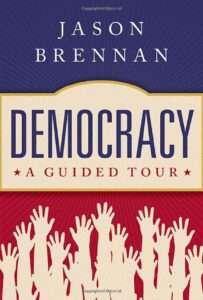
Jason Brennan's "Democracy: A Guided Tour"

The noted Georgetown political philosopher offers a valuable overview of the political theory of the strengths and weaknesses of democracy.

|

Georgetown political philosopher Jason Brennan is one of the world's leading theorists of democracy, and his new book Democracy: A Guided Tour is a valuable overview of the strengths and weaknesses of democracy, and various arguments on that topic developed by leading political thinkers from ancient Greece to the present day. Brennan has an impressive command of the relevant literature, and he's a very clear writer. The book is a great resource for anyone interested in debates about democratic theory.

Democracy: A Guide Tour is divided into five sections, each of which considers a leading traditional rationale for democracy: stability, virtue, wisdom in decision-making, liberty, and equality. Each section includes a chapter outlining arguments holding that the democracy effectively promotes the value in question, followed by one outlining reasons for skepticism.

One of the strengths of Brennan's book is that he carefully avoids the widespread tendency to conflate that which is "democratic" with that which is good. This leaves room for the possibility that increasing democracy might actually cause harm, as opposed to defining it away in advance.

Brennan himself is something of a democracy-skeptic, as evidenced by his previous work. But in Guided Tour, he strives hard to be balanced, and mostly succeeds. Still, it's hard to come away from the book without getting a sense that democracy falls well short of at least the more expansive claims on its behalf. For example, far from promoting careful deliberation over policy and making effective use of the "wisdom of crowds," democracy is often plagued by systematic voter ignorance and bias. Far from making citizens more virtuous, democratic political participation often brings out and exacerbates some of the worst tendencies in human nature. And so on.

I myself am also skeptical of many of the benefits claimed for democracy, especially when it comes to issues related to voter ignorance. It's possible that a reader who comes to the book with the opposite predisposition will view it differently. Either way, the book provides an excellent analysis of a wide range of perspectives on these issues. And it manages to cover a lot of ground in a relatively modest amount of space.

Despite its many strengths, Guided Tour does have a few notable limitations. First, while Brennan carefully considers strengths and weaknesses of democracy in an absolute sense, there is little in the way of comparison between democratic and non-democratic regimes. Brennan discusses a number of thinkers who reject democracy in favor of authoritarianism, but says little about the actual performance of the sorts of regimes they advocate.

Incorporating the latter would make democracy look better on many dimensions. For example, as Brennan explains in Chapter 9, democracy is often a threat to liberty. But authoritarian governments are far worse. For all their many injustices, no democratic government has even come close to the level of oppression perpetrated by communist and fascist regimes. Similarly, a dictator who listens mainly to boot-licking cronies who tell him what he wants to hear will often make even worse cognitive errors than ignorant democratic electorates. Vladimir Putin's recent disastrous miscalculations may be a case in point.

Brennan is aware of the relative superiority of democratic regimes over authoritarian ones. But it gets little mention in this book, perhaps because the author had to cover so much other ground. Still, I think this issue deserved more attention. The relative failure to consider it may lead readers to (wrongly) dismiss Brennan's more democracy-skeptical chapters by citing Winston Churchill's famous statement that "democracy is the worst form of government – except for all the others that have been tried."

This ties into Brennan's second notable omission: there is very little discussion of various institutional structures that can potentially mitigate the flaws of democracy, such as federalism, separation of powers, and judicial review. In a previous book, Brennan himself advocates "epistocracy," giving more power to relatively more knowledgeable voters (see my assessment of the idea here). It's only briefly mentioned here, as part of a discussion of John Stuart Mill.

Many of these institutional fixes - most obviously, judicial review - are actually constraints on democracy (defined as majoritarian government). Thus, to the extent they are effective, they don't necessarily vindicate democracy, as such. But there is still a crucial difference between structures that limit democracy and those that dispense with it entirely. If nothing else, the potential benefits of the former undercut Churchill-quoting complacency about the democracy, which is often implicitly premised on the assumption that authoritarianism is the only alternative to giving democratic majorities a virtual blank check to rule as they please.

In sum, Democracy: A Guided Tour is a great overview of various longstanding debates about democracy. But it leaves room for a broader tour that more fully considers non-democratic alternatives to democracy and institutional fixes for various democratic pathologies.

Free Speech

Defamation, Responsibility, and Third Parties

|

A bunch of comments to my Large Libel Models posts suggest that, when users believe (say) ChatGPT-4's fake quotes about others, the true responsibility is on the supposedly gullible users and not on OpenAI. I don't think this is consistent with how libel law sees things, and I want to explain why.

Say that the Daily Tattler, a notoriously unreliable gossip rag, puts out a story about you, saying that "rumor has it that Dr. [you] had been convicted of child molestation ten years ago in Florida, as the Miami Herald reported." This is utterly false, and the result of careless reporting on their part; there was no conviction and no Miami Herald report. Yet some people believe the story, and as a result stop doing business with you. (Say you're a doctor, so your business relies on people's confidence in you.)

Now there are three parties here we can think about.

  1. There's you, and you're completely innocent.
  2. There's the Daily Tattler, which published a story that's negligently false.
  3. And there are the people who stop doing business with you. They too might be viewed negatively: Perhaps they're gullible for believing what the Daily Tattler says. Perhaps they're unfair in not looking things up themselves (maybe checking the Miami Herald's archives), or calling you and asking your side of the story.

But the premise of libel law is that you can sue the Daily Tattler, even though, in a perfect world, the readers would have done better. You can't, after all, sue the readers—it's not a tort for them to avoid you based on their gullibility. And the Daily Tattler is at fault for negligently putting out the false assertion of fact that could deceive the unwise reader. Yes, perhaps people should be educated not to trust gossip rags. But so long as readers do in some measure trust them (at least as to matters where the reader lacks an incentive to do further research), libel law takes that into account.

Read More

Campus Free Speech

Professor Suggests Murder as Alternative to Shouting Down Speakers

|

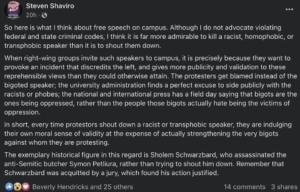
An English professor at Wayne State University apparently had an overheated reaction to the fiasco at Stanford Law School. He thought the protesters did not go far enough, and he took to Facebook to say so.

"I think it is far more admirable to kill a racist, homophobic, or transphobic speaker than it is to shout them down,"he began, and he concluded with "The exemplary historical figure in this regard is Sholem Schwarzbard, who assassinated the anti-Semitic butcher Symon Petliura, rather than trying to shout him down. Remember that Schwarzbard was acquitted by a jury, which found his action justified."

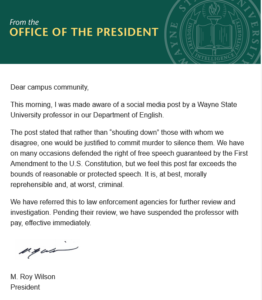
The president of Wayne State has now announced that the professor has been suspended and his social media post referred to law enforcement.

The professor's post is almost certainly constitutionally protected as neither a true threat nor an incitement to imminent lawless action. Wayne State, like many universities, has adopted the language American Association of University Professors' 1940 Statement on Academic Freedom. Under that policy, when speaking in public as a citizen a professor should be free from institutional censorship or discipline. Once the police investigation concludes, the professor's suspension should be lifted.

The professor would be well-advised to take a break from social media. Negative partisanship has gotten quite intense in our current environment, and the number of individuals who like to fantasize on social media about the death of their political opponents is truly disturbing.

Now would be a good time for the professor to recall the admonition in the AAUP Statement and the university's policy:

As a person of learning and an educational officer, he/she should remember that the public may judge his/her profession and his/her institution by his/her utterances. Hence he/she should at all times be accurate, should exercise appropriate restraint, should show respect for the opinions of others, and should make every effort to indicate that he/she is not an institutional spokesperson.

Will Havens Realty Be "Abandoned" Like The Lemon Test?

Another Burger Court precedent is on the chopping block.

|

In recent years, the Supreme Court has overruled several precedents. However, the Court has largely left in place the seminal doctrine from the Warren Court. Rather, the Justices have clawed back at decisions from the Burger Court. Roe v. Wade was overruled, but Griswold v. Connecticut remains safe. Lemon v. Kurtzman is gone, but Engel v. Vitale abides. Rucho v. Common Cause overruled Davis v. Bandemer, but Baker v. Carr survives. Janus overruled Abood but did not disturb Railway Employees' Dept. v. Hanson. Franchise Tax Board of California v. Hyatt overruled Nevada v. Hall. Knick v. Township of Scott overruled Willimason County. Obergefell overruled Baker v. Nelson. Wait, scratch that last one. But you get the picture.

Another precedent from the Burger Court may soon be on the chopping block: Havens Realty v. Coleman (1982). This case found that an organization can assert an Article III injury based on a "drain of the organization's resources." For example, an organization that sends a "tester" to determine if there was a violation of the law could claim the money needed to send the tester was an injury in fact. This injury seems to be self-inflicted, as that term is understood today: anyone can generate standing-on-demand by spending money to investigate the alleged illegal activity.

I became intimately familiar with Havens Realty during the early days of the Emoluments Clause litigation. Eventually, the lead plaintiffs were owners of hotels and restaurants that competed with Trump properties. But initially, the lone plaintiff was CREW, a public interest organization. Unsurprisingly, CREW's only basis for standing was Havens Realty. Here is how I described the self-inflicted injury in January 2017:

In short, the complaint argues that because CREW is spending time on Trump's emolument issue, they are not able to do things they would otherwise do. Therefore, they are injured under Article III, and can bring suit.

In hindsight, CREW would spend four years opposing everything Trump would do, so I'm not sure they could even claim such an injury! And also in hindsight, CREW was found to not have standing in SDNY, and the organization did not appeal that decision. But more importantly, at the time, I did not understand how Havens could be reconciled with more recent standing doctrine, like Spokeo v. Robbins (2016) and Clapper v. Amnesty International (2012). Neither case even cited Havens Realty. Then again, Larry Tribe called my standing arguments a "linguistic sleight of hand." So what did I know?

Fast-forward to the TransUnion LLC v. Ramirez (2021). Like Spokeo and Clapper, the Court did not even mention Havens Realty. The case is mentioned in Justice Thomas's dissent, though he focuses on the congressional enactment of the statute, and not the self-inflicted injury question.

Today the Supreme Court granted cert in Acheson Hotels v. Laufer. The case involves a so-called "tester." Specifically, a disabled person would visit the website of a hotel that she has no intent of staying at. Then she would sue the hotel for failing to provide enough information about accommodations for disabilities. The cert petition wisely does not ask the Court to squarely overrule Havens Realty. Rather that precedent can be distinguished. But the petition does question how Havens Realty can survive TransUnion.

Third, this case presents an issue only this Court can resolve. This case is difficult for lower courts because they must reconcile older Supreme Court case law taking a more lenient view of standing, see Havens Realty Corp. v. Coleman, 455 U.S. 363 (1982), with this Court's more recent decision in TransUnion LLC v. Ramirez, 141 S. Ct. 2190 (2021). Indeed, the First Circuit noted that its ruling was in significant tension with TransUnion, but nonetheless deemed Havens Realty to be the on-point binding precedent. As Judge Jordan similarly concluded, "Havens Realty may be inconsistent (in whole or in part) with current standing jurisprudence," but "[f]or now, though, it remains binding precedent that governs here." Arpan, 29 F.4th at 1276 (Jordan, J., concurring). By contrast, the Second, Fifth, and Tenth Circuits have held that TransUnion, not Havens Realty, is the more pertinent precedent. This Court's review is warranted because only this Court can provide guidance on what its own precedents mean. As Judge Newsom put it: "I suspect that the law concerning 'stigmatic injury' will remain deeply unsettled until the Supreme Court steps in to provide additional guidance." Id. at 1287 (Newsom, J., concurring).

Finally, the Court should grant certiorari because the First Circuit's decision is wrong. Laufer's abstract desire to ensure compliance with federal law does not give her Article III standing. To the extent Havens Realty survives TransUnion, it is readily distinguishable. In Havens Realty, the plaintiff was personally denied information on the basis of her race, and this Court found standing based on its view that.

In many regards, Havens Realty reminds me of the Lemon Test. In all the big Establishment Clause cases, the Court did not rely on Lemon: Marsh v. Chambers, McCreary County, Van Orden, Town of Greece, American Legion, and so on. How could Lemon possibly survive all those cases? Thus, the Court deemed Lemon as "abandoned." Likewise, the Court did not even cite Havens Realty in Spokeo, Clapper, or TransUnion. Has Havens Realty been abandoned? We'll find by June 2024.

More