The Volokh Conspiracy

Mostly law professors | Sometimes contrarian | Often libertarian | Always independent | Est. 2002

The Volokh Conspiracy

Free Speech

Happy 20th Birthday to the Streisand Effect

|

The underlying lawsuit was filed May 20, 2003, and the Effect followed within a few weeks; Mike Masnick (Techdirt) has the details:

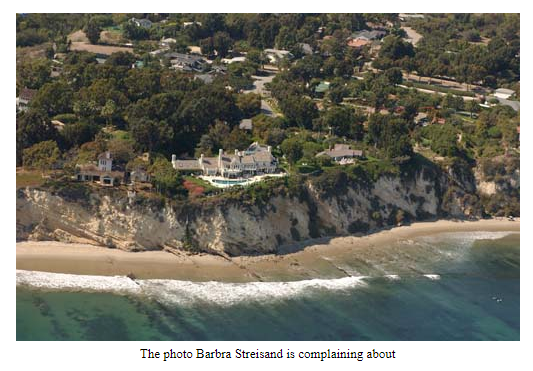
Twenty years ago today, actress/singer Barbra Streisand sued photographer Kenneth Adelman for daring to photograph her coastal mansion as part of his (fascinating) project to photograph the entire west coast of the US from a helicopter to track erosion over time.

In 2002 this was an incredibly ambitious project by Adelman. It was before we all had widespread access to satellite imagery, and before the web worked the way it does today. Adelman set up a pretty incredible website which is still up today in all its 2002-era glory (though he has, as was part of the original plan, updated it with more modern photographs over time).

Either way, one of the thousands of photographs of the coastline include Barbara Streisand's compound:

Read More

"Strangers on the Internet" Podcast Episode 31: The Art of Dating and of Survival

Sociologist Dr. Robin Rogers escaped her violent schizophrenic husband to find herself locked up on a ward

|

The thirty-first episode (Apple Podcasts link here and Spotify link here) of "Strangers on the Internet" with co-host and psychologist Michelle Lange features sociologist Dr. Robin Rogers from CUNY Queens College.

She tells the tale of how she escaped her marriage after her then-husband developed severe schizophrenia, became violent, and killed the family pets. Robin not only got through the six-year court fight to maintain sole custody of her two sons but in fact managed to thrive despite it all.

Her dating goal became all about having life-affirming fun, whether an interaction would lead to a long-term relationship or not. From a spontaneous trip to a wedding in Brazil to an invitation to attend a presidential inaugural ball, Robin got to enjoy many lovely adventures.

In early 2020, her existence was turned upside down when she was involuntarily committed to a terrifying hospital after a family member falsely claimed she had attempted to commit suicide. While her seriously ill ex-husband was never committed at all, Robin was now surrounded by patients who were hitting on her and threatening to rape her. Come find out how she survived even this experience and what life looks like on the other side!

Election 2020

MyPillow CEO Mike Lindell Taken to Court for Refusing to Pay the Person who Proved Him Wrong

Even with the benefit of contest rules he wrote to favor his position, arbitrators ruled against Lindell, and he now faces a court action to make him pay up.

|

MyPillow CEO and noted 2020 election denier Mike Lindell offered to pay $5 million to anyone who could debunk his supposed evidence of Chinese government interference in the 2020 presidential election. A die-hard Trump supporter, Lindell apparently believes that the 2020 election was stolen, and that he has the evidence to prove it. There was a catch, however, as Lindell required that any such claims be submitted to an arbitrator, and the terms were written quite narrowly--but perhaps not narrowly enough.

Robert Zeidman, a computer forensics expert who had apparently voted for Trump twice, took Lindell up on his challenge. He analyzed the supposed evidence and demonstrated it was a steaming pile of digital detritus, and not evidence of any sort of election interference. Indeed, he showed (as Lindell's terms required) that the data had nothing to do with the 2020 presidential election. Lindell, expectedly, refused to pay, and the matter went to arbitration. There, despite Lindell having written the terms to make recovery difficult, the arbitrators sided with Zeidman.

Lindell, whose integrity apparently matches his understanding of election administration, still refuses to pay, prompting Zeidman to file suit in federal court.

Lindell may not have learned much about election administration through these travails, but it appears he is about to learn something about the enforceability of arbitration awards. He will no doubt drag this out as long as he can (and likely cite these travails as he tries to hawk more mediocre pillows), but he will eventually be forced to pay up--unless, of course, he is insolvent by then. Lindell is also facing multiple defamation suits from Dominion Voting Systems and former Dominion executives, and has been hit with legal sanctions for frivolous legal claims.

Ambassador C. Boyden Gray (1943-2023)

|

I am deeply saddened to share that C. Boyden Gray has passed away. It is very hard to put into words all the Gray accomplished throughout his remarkable life. The Washington Post immediately published a pre-written obituary--a sign of his profound reputation in D.C. and nationwide.

Adam White and Jenn Mascott offered their remembrances here:

C. Boyden Gray touched so many people's lives — as a public servant, a trusted counselor, an advocate, a mentor and a friend. The C. Boyden Gray Center for the Study of the Administrative State joins countless others in mourning his passing. For all of us, this is a moment of deep sadness and deep gratitude.

Much will be written of Boyden in the weeks and months ahead, but it seems impossible to do complete justice to his legacy. He loved his family, his friends, and his country. He served his country many times over: in the Marine Corps Reserves, as a Supreme Court clerk, as counsel to Vice President and then President George H.W. Bush, and finally as a U.S. ambassador and special envoy. In 1993, President Bush awarded him the Presidential Citizens Medal.

He loved American institutions, and he took great joy in supporting and building them. He aided and founded institutions in government, in the legal profession, in academia, and throughout his city and his country. The Gray Center was just one of many that benefitted immensely from his support, his tireless effort, and his counsel. He cared especially about the need to create opportunity for those who face the greatest adversity.

In all of this, he drew great inspiration from the public service of his father, the late Gordon Gray, who served his country, led the University of North Carolina, and chaired the National Trust for Historic Preservation. And he cherished the memory of other great friends and mentors, including George H.W. Bush and Lloyd Cutler.

Boyden radiated excitement for history and for ideas. One moment he might be discussing a constitutional issue; the next moment, the republic of Venice. One moment a complicated regulatory issue; the next, the Scottish Enlightenment.

But above all, he loved his family. Our hearts go out to Eliza, Nick, and their children—the grandchildren who, at every mention, caused Boyden to beam with joy.

As stewards of an institution that bears his name, we join all of Boyden's friends, students, and colleagues who mourn his death and celebrate his life. We were lucky to know such a great and good man.

Sincerely,

Adam White & Jennifer Mascott

The C. Boyden Gray Center for the Study of the Administrative State

Antonin Scalia Law School

Rest in peace, Ambassador Gray.

Administrative Law

Summary Reversal of Sixth Circuit in Calcutt v. FDIC Reaffirms the Importance of Chenery I

A welcome reminder that reviewing courts must judge the propriety of agency actions solely by the grounds invoked by the agency.

|

The Supreme Court may be slow at issuing opinions in argued cases this term, but it made quick work of Calcutt v. Federal Deposit Insurance Corporation, summarily reversing the U.S. Court of Appeals for the Sixth Circuit's split decision upholding an action by the FDIC. The Sixth Circuit panel of Judges Boggs, Griffin and Murphy unanimously rejected Calcutt's constitutional challenges to the FDIC's action, but split on the statutory claims. Judge Boggs wrote the majority, joined by Judge Griffin. Judge Murphy dissented. The entire decision below topped 90 pages.

The Calcutt case raised a suite of interesting constitutional and administrative law issues, including the application of the Appointments Clause to FDIC administrative law judges (ALJs). But there was one issue upon which the justices could all apparently agree: Under SEC v. Chenery I, courts are to evaluate agency actions based upon the rationale offered by the agency, and not substitute their own analysis. This is an important principle because, among other things, if agencies are expected to engage in reasoned decisionmaking, judicial review must focus on the reasons the agency actually gave when making its decision, and courts should not substitute their own, more persuasive rationales when agency actions come before them. While there may be cases in which agency missteps constitute harmless error, courts should not excuse a failure to engage in reasoned decisionmaking lightly.

Here is how the Supreme Court's brief per curiam opinion begins:

The Federal Deposit Insurance Corporation (FDIC) brought an enforcement action against petitioner, the former CEO of a Michigan-based community bank, for mismanaging one of the bank's loan relationships in the wake of the "Great Recession" of 2007–2009. After proceedings before the agency concluded, the FDIC ordered petitioner removed from office, prohibited him from further banking activities, and assessed $125,000 in civil penalties. Petitioner subsequently filed a petition for review in the Court of Appeals for the Sixth Circuit. That court determined that the FDIC had made two legal errors in adjudicating petitioner's case. But instead of remanding the matter back to the agency, the Sixth Circuit conducted its own review of the record and concluded that substantial evidence supported the agency's decision.

That was error. It is "a simple but fundamental rule of administrative law" that reviewing courts "must judge the propriety of [agency] action solely by the grounds invoked by the agency." SEC v. Chenery Corp., 332 U. S. 194, 196 (1947). "[A]n agency's discretionary order [may] be upheld," in other words, only "on the same basis articulated in the order by the agency itself." Burlington Truck Lines, Inc. v. United States, 371 U. S. 156, 169 (1962). By affirming the FDIC's sanctions against petitioner based on a legal rationale different from the one adopted by the FDIC, the Sixth Circuit violated these commands. We accordingly grant the petition for certiorari limited to the first question presented; reverse the judgment of the Sixth Circuit; and order that court to remand this matter to the FDIC so it may reconsider petitioner's case anew in a manner consistent with this opinion.

Read More

Free Speech

First Amendment Challenge to Discipline of 8th-Grader for "Racially Insensitive" Instagram Post Can Go Forward

The student had “posted a screenshot of a friend with a cosmetic mud mask on her face with the caption ‘when he says he’s only into black girls’ on her Instagram account.”

|

From R.H. v. Borough of Sayreville Bd. of Ed., decided May 12 by Judge Zahid Quraishi (D.N.J.):

On Saturday, February 11, 2017, A.H., then an eighth-grade student at Sayreville Middle School, posted a screenshot of a friend with a cosmetic mud mask on her face with the caption "when he says he's only into black girls" on her Instagram account. {Plaintiffs explain that the relevant post was made on a "Finstagram" (a contraction of "Fake" and "Instagram") account, which is intended for parody, as opposed to a real Instagram account, which is "for more polished and serious communications.} A.H. did not create the photo or draft the caption. A.H. added her own comment to the post that stated, "Ha, ha, ha! Love her – [laughing face], [laughing face]." A.H. posted the screenshot from her personal phone while she was at home, on an internet network and social media account unaffiliated with the Sayreville school system. A.H.'s friend in the post did not attend school in Sayreville.

On February 16, 2017, the Board received complaints regarding A.H.'s Instagram post. According to Plaintiffs, "[t]here were no altercations at Sayreville Middle School as a result of the post, no classes were canceled, and there was no need for an assembly to discuss the racial issues at the school." Rather "[t]he sole alleged disruption to the Board was to keep a close watch on the [Sayreville Middle School] students in the cafeteria due to the fear these students might confront A.H."

{In 2010, the State of New Jersey adopted what is known as the Anti-Bullying Bill of Rights Act. The Act sets forth the following definition for "Harassment, intimidation, or bullying":

Read More

Free Speech

Race-Related Insulting Complaints to Supervisors in Public University and the First Amendment

|

In Mitchell v. Univ. of N.C. Bd. of Governors, decided April 4 by the North Carolina Court of Appeal, Prof. Alvin Mitchell, "Associate Professor of Justice Studies in the Department of Social Sciences" at Winston-Salem State University, was fired in part based on a letter he sent to Department of Social Sciences co-chair (Dr. Denise Nation). The key facts, from the majority opinion by Judge Toby Hampson, joined in relevant part by Judge Valerie Zachary:

[S]ometime during the 2016-2017 academic year, two students in Petitioner's Research Methods class conducted research to draft a paper. The students learned about a conference in New Orleans—the Race, Gender & Class Conference—where they could present their findings. They approached Dr. Nation to obtain funding to attend the conference, but she did not approve the funding, instead recommending a different conference by the American Society of Criminology (ASC). One of the students believed that Dr. Nation may have encouraged the students to look into the ASC conference because it was primarily Caucasian. When Petitioner learned of the conversation, he wrote a letter to Dr. Nation in response:

Hi Denise, it was brought to my attention that you told a student that the conference I and two of my students are presenting at has no substance or standards, meaning that it is useless and unaccredited, and anyone can present. In addition, you told the student she should try to present at the ASC held in November because it is a better conference and has a lot of substance. You are entitled to your opinion. However, you should not be telling the student things like that, especially with no proof. The Race, Gender & Class conference is locally, regionally, and internationally known and ha[s] scholars from around the world presenting. In addition, the conference has been in existence for over 20 years. Thirdly, this conference does not take anyone. You have to be accepted through their process. It is amazing how you always try to debunk what I do. Yet you complain that I tell students negative things about you. It would have been better to tell the student that you did not want to help fund her instead of telling her falsehoods about the RGC conference and asking her to present on scholarship day. That is not appropriate behavior as a chair.

After all these years, it is amazing that you still think that anything white is better. I looked up the ASC and nothing but a bunch of white men (some white women) are running it. Keep promoting and praising those white folks who are associated with the ASC. As I told you before, you can graduate from and praise their schools, come up with a great theory, hangout with them, praise Latessa and other European professors (you need to ask them about their civil rights record), wear their European style weaves, walk with their bounce, hire them, present at their conferences, and even publish in their journals. In their eyes you will never be equal to them. They still look at you as a wanna be white, an international nigger, an international coon, and an international sambo (lol) because you display that kind of behavior. You will never get it. Wake up.

Mitchell argued that his letter was protected from employer retaliation by the First Amendment, but the majority said no; under the Supreme Court's cases related to public employee speech, such speech is unprotected by the First Amendment unless it deals with "a matter of public concern," and the majority thought this didn't qualify:

Read More

Immigration

Andrew Hyman Responds on Migration and Invasion

I have posted his response to my previous post, along with a rejoinder.

|

In my last post on this subject I critiqued the argument that illegal immigration qualifies as "invasion" under relevant provisions of the Constitution and thereby empowers federal and state governments to use military force to prevent it. Andrew Hyman, one of the advocates of this position whom I criticized, has sent me the following response, which I am posting at his request. Hyman's response is in the block quote. My rejoinder follows, and is in regular text:

A Reply to Professor Somin about Illegal Immigration and "Invasion"

Professor Ilya Somin recently wrote a blog post here titled "Immigration is not 'Invasion'" responding to an earlier blog post of mine at the Originalism Blog.  Among other things, Professor Somin writes, "If you want to know what Madison thought about the claim that immigration counts as 'invasion,' look to the Report of 1800 where he actually discusses that issue."  The repeated attribution of that very broad claim to me is incorrect, I have not said that immigration counts as invasion, which is also alleged in the title of Professor Somin's blog post.  I appreciate the opportunity to explain why I never made that claim, and to also briefly address here the 1800 report by James Madison.  For now, I will skip other points in Professor Somin's blog post with which I may disagree.

Lawful immigration absolutely does not count as invasion, I never said or implied otherwise, and Madison was discussing people who had immigrated lawfully.  I have discussed the current situation on the ground at the U.S. southern border, where (as I wrote) "many of the undocumented immigrants are simply seeking better lives for themselves and their loved ones," but a significant minority of the undocumented immigrants are surely agents of governments with which the U.S. has tense relations, or would-be terrorists, or moles, or convicted criminals set free from prison on condition that they will leave their home countries, or fentanyl distributors, human traffickers, et cetera.  People who immigrate to the United States lawfully, after proper screening, are not invaders by any stretch of the imagination.  My own ancestors were immigrants, and I strongly support legal immigration, as well as generous foreign aid to uplift countries so their people will be happy if they decide to stay where they are.

As to Madison's report of 1800, it is not the best evidence of the 1789 Constitution's original meaning, given its post-ratification date in the middle of a raging political controversy more than a decade after the Constitution came into being.  However, I agree with Professor Somin that the 1800 report can still be useful for describing arguments and doctrines that may have had pre-ratification validity. Using the 1800 report to interpret the 1789 Constitution becomes even harder because our present controversy is very different from the controversy of 1800 which involved (per Madison) "banishment of an alien from a country into which he has been invited." Illegal immigrants and/or undocumented aliens are definitely not invited to the United States, and Madison apparently did not address situations where aliens are prohibited to enter the U.S. in the first place.

Nor have I spotted in the 1800 report other pertinent issues such as whether the war power can be applied against non-state-actors (it can), and whether non-violent acts are sometimes acts of war (they are).  Admittedly, Madison did assert in his 1800 report that, "Alien enemies are under the law of nations, and liable to be punished for offences against it. Alien friends, except in the single case of public ministers, are under the municipal law, and must be tried and punished according to that law only."  Madison thus supported congressional power to use the war power (and also the Define and Punish Clause) against alien enemies, but not against alien friends. But who are alien friends, and who are not?

Madison's report of 1800 repeatedly referred to alien friends as members of nations in "peace and amity with the United States," so an individual is not necessarily an "alien friend" even if his home country is at peace (but not amity) with the United States.  There were also other criteria in the English common law for an individual from one country to be in "amity" with another country; an especially cruel example is Lord Coke's statement that, "All infidels are in law perpetui inimici" (meaning that all Muslims are perpetually out of amity regardless of country of origin).  So, I doubt Madison would have deemed a person who has entered the United States unlawfully to be an "alien friend" just because his home country is in both peace and amity with the United States.  It does not strike me as particularly amicable to trespass into another country, but Madison's report of 1800 did not address that issue.  It instead strikes me as quite "ambitious," which is the word Madison used in 1788 when discussing invasions in Federalist 43.

A chaotic or open border makes it impossible to screen out people who really do very urgently need to be screened out.  The people who are genuinely seeking freedom and opportunity ought to apply lawfully, or else find homes in another country along their journey, instead of cutting ahead of would-be lawful immigrants to the United States.  Preferably, there will be minimal resort to war powers for expelling freedom-seekers, but (as I wrote), "It is unfortunate that the civil power of the states has been so constricted by judicial error that we have to discuss the military power now as well, and the civil power alone might be sufficient were it not for cases like Arizona v. United States."  If the framers had wanted to qualify the word "invasion" in the Constitution, then they probably would have used a qualifier, but under any interpretation unarmed immigrants invited by Congress are not invaders.  In any event, Madison was arguing in 1800 to constrain both civil and military power of the federal government, and to the extent he was correct about constraining federal civil power, that could only enhance state civil power to address the same subject, per the Tenth Amendment.

I am grateful to Mr. Hyman for his thoughtful response. But I remain unpersuaded. To start with a relatively simple point, I did in fact focus on illegal migration in my earlier post. The very first sentence indicates as much, noting that I am responding to claims that "illegal migration across the southern border [qualifies] as an 'invasion.'" Much of the rest of the post also addresses that issue.

James Madison's Report of 1800 is in fact highly relevant to that very issue, despite Hyman's suggestion to the contrary. It is not true that the controversy over the Alien Acts of 1798 (which Madison argued were unconstitutional) was limited to the expulsion of foreigners who have previously entered the US legally.

Section 2 of the Alien Friends Act also gave the president the power to bar reentry by any foreigner expelled under Section 1, and even to impose a prison term as punishment for violations. Moreover, the expulsion power under Section 1 is not limited to people who had been living or working in the United States, but could be used to bar "all such aliens as he shall judge dangerous to the peace and safety of the United States," including those who had just arrived at a port or border area. In sum, therefore, the Alien Act effectively gave the president the power to create a class of aliens who are barred from entering the US so long as the Act remained in force. Madison and others consistently argued that both Section 1 and Section 2 were unconstitutional, and that the "invasion" provision of the Guarantee Clause does not authorize them. If the Guarantee Clause could be used to bar any migrants whose entry was illegal, it could also authorize the Alien Friends Act.

Hyman also quotes Madison to the effect that his argument only applies to aliens from countries at "peace and amity with the United States," and claims that some nations at peace with the US might not be in "amity" with it. I am skeptical that "amity" actually adds anything. "Peace and amity" was just a stock legal phrase of the time. But even if "amity" does have some separate additional meaning for Madison, that term cannot be used to justify barring any significant number of migrants under the "invasion" provision of the Constitution either then or now.

Much of the focus of the debate over the Alien Acts was on immigrants from France and territories controlled by that nation. At the time, France was even waging a kind of undeclared "quasi-war" with the US, including clashes between French and US ships in the Carribbean. Yet Madison and other opponents of the acts still argued that the Alien Acts could not be constitutionally used to expel or bar citizens of France, because France and the US were not at war. If there was sufficient "amity" between France and the US to prevent the use of the "invasion" provision as a justification for barring migration, then such amity is even more clearly present today between the US, Mexico, and virtually all other nations from which migrants crossing the southern border hail.

Hyman is right to note that the Report of 1800 doesn't comprehensively address such issues as  "whether the war power can be applied against non-state-actors (it can), and whether non-violent acts are sometimes acts of war." But it does address the particular question in dispute here: whether migration, as such, can be an act of war that qualifes as an "invasion." It cannot.

it is also true that the Report of 1800 came a decade after the ratification of the Constitution. Had it come earlier, it would have been even more powerful evidence of original meaning. But it is nonetheless by far the most relevant analysis by a leading Framer of the Constitution of the question of whether migration can qualify as "invasion."

Finally, Hyman raises a number of policy issues tangential to the constitutional point. I will not try to go over them in detail here. But I will refer interested readers to previous writings, where I point out that most of the disorder at the southern border is in fact the product of policies that make legal migration difficult or impossible for most would-be migrants. We can largely fix the problem by making legal migration simple and easy. Among other things, that would enable many would-be migrants to avoid the southern land border entirely, and instead come by ship or plane.

In addition, the violent crime rate of migrants (including undocumented migrants) is actually lower than that by native-born Americans. It is simply not true that "a significant minority of the undocumented immigrants are surely agents of governments with which the U.S. has tense relations, or would-be terrorists, or moles, or convicted criminals set free from prison on condition that they will leave their home countries." Unless, of course, the word "significant" applies even to very small numbers of dangerous people among a much larger group. If that kind of "significant" number is enough to qualify as "invasion," then we have been in a state of perpetual invasion through virtually the entire time the US has had significant immigration restrictions.

To the extent that there is a danger at the southern border, it is not one that can be properly addressed by invoking the "invasion" provisions of the Constitution. Ordinary law enforcement powers must suffice.


Justice Mitchell (Alabama): "The New Bar Exam Puts DEI Over Competence."

Curricular changes are being made now to address the NextGen Bar in 2026.

|

In recent years, there have been many shifts in how states administer bar exams. One of the most significant developments has been the expansion of the Uniform Bar Exam (UBE). The upshot of the UBE is that a score is "portable." Someone who receives a passing score in one state can transfer that score to another state. The biggest downside, in my view at least, is that the UBE eliminates the requirement to know any state-specific law. Instead, the UBE focuses on "general" legal principles that apply uniformly across the country. In 2015, I warned that the spread of the UBE would obscure the important flavors of local law, and in the long run, harm federalism.

If law students are trained to believe that there is no difference between laws of different states, then an entire generation of lawyers will have even less regard for the values of federalism, wherein the states can serve as laboratories of democracy. There is an importance in State A and State B being able to approach the same principle of law in different ways. Prioritizing a uniform bar exam will diminish respect for that value.

Alas, my concerns did not prevail.

To date, 40+ jurisdictions have adopted the UBE, including my home state of Texas. And that number will eventually approach 50, as states without the UBE place their law students at a competitive disadvantage. The appeal of portability trumped the appeal of lawyers actually knowing the law of the state in which they'll practice. It is difficult to imagine any of these states could abandon the UBE, and revert to a state-specific exam.

Now that the states are hooked, the National Conference of Bar Examiners (NCBE) is preparing the next generation of the exam. The "NextGen" Exam, as it is known, will be launched in 2026. The 1Ls starting in the Fall 2023 will eventually sit for this exam. Prudent law schools will craft their curriculum, in particular 1L coverage, to ensure students are adequately prepared for the NextGen Exam. As usual, law schools are trying to prepare for a moving target--the details of that NextGen are not yet final. And there is reason for concern.

Justice Jay Mitchell of the Alabama Supreme Court highlights some of the troubling revisions in the Wall Street Journal. For example, Mitchell notes, the exam will no longer test Family Law and Wills and Trusts. Last year, my colleagues and I submitted a letter observing that roughly half of the topics covered in property will be optional--that is, students will only need a "general familiarity" with areas like covenants, recording statutes, and mortgages. If a topic is not covered on the exam, then law students likely will not learn that topic. And, when they venture into actual practice, they will be unprepared. For sure, baby lawyers can learn a topic they are unfamiliar with, and I'm sure all of them will. But the NCBE is proactively creating huge gaps in knowledge for all attorneys.

Beyond the substance covered, Mitchell explains how DEI is undergirding the entire process. And a watered-down exam may further reduce the exam's efficacy to measure a lawyer's fitness to practice.

But perhaps the biggest concern is the NCBE's use of the NextGen exam to advance its "diversity, fairness and inclusion" agenda. Two of the organization's stated aims are to "work toward greater equity" by "eliminat[ing] any aspects of our exams that could contribute to performance disparities" and to "promote greater diversity and inclusion in the legal profession." The NCBE reinforces this message by touting its "organization-wide efforts to ensure that diversity, fairness, and inclusion pervade its test products and services."

What does all this mean—and how does it have any relation to the law? Based on the diversity workshop at the NCBE conference, it means putting considerable emphasis on examinees' race, sex, gender identity, nationality and other identity-based characteristics. The idea seems to be that any differences in group outcomes must be eliminated—even if the only way to achieve this goal is to water down the test. On top of all that, an American Civil Liberties Union representative provided conference attendees with a lecture on criminal-justice reform in which he argued that states should minimize or overlook would-be lawyers' convictions for various criminal offenses in deciding whether to admit them to the bar.

None of this is encouraging. It shouldn't matter who you are or where you come from—if you can demonstrate minimal competency on the bar exam and meet a state's character-and-fitness requirements, you should be allowed to practice law. If you can't, you shouldn't be given a license to handle the legal affairs of others. The bar exam should test the law straight—without respect to ideology and on a race- and sex-blind basis.

It would be helpful if a state could simply opt out of the NextGen exam. But they are all hooked onto the UBE. There's no turning back to the old ways. Mitchell proposes one potential off-ramp:

States, for their part, should push for the option to retain the current exam for at least the next five to 10 years until they can properly assess the effectiveness of the new exam. State courts and bar associations would also do well to insist that the NCBE commit in writing that the new exam will be ideologically neutral and blind to race and sex.

In hindsight, state Supreme Courts that adopted the UBE should have given due regard to federalism. Instead, we are stuck with one completely imperfect solution.

Sotomayor and Kagan "Go Back To School" Each Other in Warhol v. Goldsmith

Does The Relationship Between Justices Sotomayor and Kagan "Have Much Of A Future"? Or was this just their "Fifteen Minutes" of Flame Wars?

|

As a general matter, the Court's progressives vote in lockstep. Last term, Justice Sotomayor agreed with Justice Kagan, at least in part, in 90% of the cases. (The only higher affinity was between Chief Justice Roberts and Justice Kavanaugh at 97%.) In all cases that matter, Sotomayor and Kagan must unite. They are both are left-of-center, but approach the law from radically different perspectives. Sotomayor is firmly committed to her progressive principles, and preaches that message to adoring fans around the globe. In many ways, Sotomayor is like a liberal Justice Thomas--and I mean that as a compliment. By contrast, Kagan is the shrewd tactician who never loses sight of how to achieve her goals over the longterm. I often wonder how many of the votes she casts she actually believes in. In that regard, Kagan is like a liberal Chief Justice Roberts--and I don't mean that as a compliment.

Like the South Bronx and the Upper West side, these two jurists are neighbors, but are worlds apart. And over time, I suspect that quiet conflicts have built up on the left. It must be tough always having to hold your nose and vote together. There have been lots of fortune cookies and paper bags over the years.

Yesterday, those simmering tensions seem to have boiled over in Andy Warhol Foundation v. Goldsmith. Justice Sotomayor wrote the majority opinion for a 7-member majority. Justice Kagan wrote a dissent, which was joined by the Chief Justice. The majority opinion stretched 38 pages, and the dissent was about the same length. (Though the page-count was padded by many pictures.) Both opinions responded to each other, over and over again. And the tone was sharp, and at times, mean. It reads like a Twitter flame war. Let me summarize the case, in the spirit of my past imagined group chats. And, in the spirit of the case, I borrowed liberally from the actual decision without citation.

@Sonia: Apparently @Elena took an art history class in college and an IP seminar in law school and thinks she's an expert on everything. But we are following *actual* law here.

@Elena: Did you actually read Campbell and Google? Did you actually see Warhol's artwork? Warhol is not an Instagram filter. #NothingComesFromNothing

@Sonia: We are judges, not art critics. Goldsmith's photo and Warhol's artwork serve the same essential purpose--a photograph in a magazine article. #NoFairUse

@Elena: They're not similar. #Disembodied #Rotated You doctored the images to make them look similar in #Figure6! #WarGold

@Neil and @KBJ: You two need to take a Twitter timeout.

@Sonia: Elena is focusing on a case that is not even before the Court! #SleightOfHand #Misstatements #Exaggerations

@Elena: Sonia's opinions is getting ratio'd because of its ipse dixit. #SelfRefuting

@Sonia: And, by the way, I actually litigated intellectual property issues. Did you ever litigate anything @Elena?

@TheChief: Yeah, I want to get in on this. I'll join Elena's opinion which gratuitously attacks a member of my Court. #Institution

You're welcome. I just saved you from having to read eighty pages. In candor, Justice Gorsuch's short concurring opinion, which was joined by Justice Jackson, should have been the opinion of the Court. It managed to make all the right arguments in a few page, without this JV-squabbling. Would it have been so hard for everyone else to jump ship? Justice Thomas, assuming he made this assignment, would probably take this one back. I also think had Justice Breyer still been on the Court, he could have defused these clap-backs. The Stevens paper consistently show Breyer lowering the temperature. Now that role falls to (checks notes) Gorsuch and Jackson?

This opinion "will not age well." It does not have "much of a future." Justices Sotomayor and Kagan both need to go "back to school." I hope this "fifteen minutes" of flame war is over.

On a related, tea-leaf-reading notice, I observed that Justice Kagan looked especially dour during oral arguments in Jack Daniels, another IP case. Her narrow view of "parody" and comment about not having a sense of humor makes much more sense now. Kagan's defeat in Warhol spilled over into the whiskey case--or is it squeaked other into the chew toy case. I read so many puns, mixed metaphors, parentheticals, and em-dashes in the Kagan dissent that my brain hurts. I like to think Justice Scalia could have written a far more forceful dissent in about 10 pages. Nothing comes from nothing, but sometimes less is more.

Free Speech

Montana Town Forbids All Protests (Except at City Hall), Because of Planned Protests of "Drag Story Hour"

|

From a Livingston (Montana) Police Department order, posted by the Livingston Enterprise (Sean Batura):

Whereas, a local business is presenting a "drag story hour" hosted by the Livingston Pride Coalition;

Whereas, individuals in drag reading stories to children is a sensitive issue in today's political climate and has garnered national attention;

Whereas, The Livingston Police Department has received credible information of individuals planning to protest the "drag story hour" including groups who are planning to be armed with firearms;

Whereas, the primary function of the Livingston Police Department is to ensure the safety of the citizens of the community, preserve the peace, and mitigate traffic issues;

Whereas, lndividuals have the constitutionally protected right to peacefully assemble and protest;

Whereas, extraordinary measures are required to protect the public health, safety and welfare of the City's citizens;

Whereas, United States Supreme Court Case - United States v. Grace, 461 US 171 (1983) has established the authority of government to enforce reasonable time, place, and manner of protests;

Now, therefore; by direct order of the City Manager, all protests occurring on May 20, 2023, between the hours of 0800 and 1700 hours shall be conducted in the parking lot of City Hall located at 220 E. Park Street, Livingston Montana. This Livingston Police Department General Order is approved and issued on this 18th day of May, 2023. All those found in violation of this order shall be subject to prosecution by the City of Livingston.

Read More

Politics

Language and Abortion

On Press Coverage In The Mifepristone Case.

|

On Wednesday, the Fifth Circuit heard oral argument in Alliance for Hippocratic Medicine v. FDA. You can read a transcript of the two-hour session here. I plan to write more about this case in due course. But here, I will opine on the press coverage of this dispute, and more broadly about abortion and language.

Shortly after the proceeding wrapped, the New York Times published a story titled Appeals Court Seems Skeptical of F.D.A.'s Approval and Regulation of Abortion Pill. As I was reading it through on my phone, one passage jumped out at me:

A lawyer for the plaintiffs, Erin Hawley, claimed that ending a pregnancy with medication — she used the anti-abortion term "chemical abortion" — is extremely unsafe.

At the time, I made a mental note, and planned to blog about it later. By Wednesday evening, I went back to the article on my desktop, and that passage was gone. (For those curious, I created a PDF of the original). Substantial changes were made to the article. Some bits were added, others subtracted. These sorts of changes are common enough when an article goes to print, so I don't think there was any deliberate effort to remove this passage in particular. Indeed, the usage in the Times was not at all atypical.

The choice of language is powerful--especially with regard to contentious social issues. And consistently, the political left gets to define what words are acceptable. "Marriage equality" sounds so much better than "same-sex marriage." "Gender affirming care" sounds so much better than "sex change surgery." "Diversity, equity, and inclusion" sounds so much better than "racial preferences." "Non-citizen" sounds so much better than "illegal alien." "Black" is capitalized but "white" is lowercase. And so on. These linguistic judgments are not value-neutral. They represent a subtle, but deliberate effort to make the progressive position more palatable.

At the same time, conservative positions are derided with negative language. I suspect the Alliance for Hippocratic Medicine would describe its position as "Pro-Life" rather than "Anti-Abortion," just as I suspect Planned Parenthood would call its position "Pro-Choice" rather than "Anti-Life." Yet, it is fairly common in the press to see the phrase "Pro-Choice" paired with "Anti-Abortion."

The now-deleted passage dismissed the term "chemical abortion" as some sort of right wing misnomer. Instead, the Times explained, we should speak of "ending a pregnancy with medication." Is "chemical abortion" so wrong, that the Times needed to dispute it with the anti-abortion moniker?

Merriam Webster defines an "abortion," in part, as "the termination of a pregnancy."

The FDA offers this description of Mifepristone

Mifepristone is a substituted 19-nor steroid compound chemically designated as 11ß-[p-(Dimethylamino)phenyl]-17ß-hydroxy-17-(1-propynyl)estra-4,9-dien-3-one. Its empirical formula is C29H35NO2. Its structural formula is: The compound is a yellow powder with a molecular weight of 429.6 and a melting point of 191-196°C. It is very soluble in methanol, chloroform and acetone and poorly soluble in water, hexane and isopropyl ether.

I am more than a quarter century removed from sophomore year in high school, but I think it is accurate enough to call mifepristone a chemical compound.

"Chemical abortion" seems a passable shorthand to describe the effect of mifepristone. True enough, the phrase has a negative connotation, and depicts the drug in a jaundiced light. By contrast, "ending a pregnancy with medication" sounds like a routine procedure--no different than popping an Advil to end a headache. Take two and call me in the morning.

For elites--including the press and most judges--pro-life terminology is considered inherently biased, while pro-abortion terminology is considered inherently neutral. As a result, language that shines a light on the potentiality for life is eschewed, while language that trivializes the potentiality for life is treated as the default position. By necessity, this choice of language favors the pro-abortion position. This choice of language is not value-neutral.

Judge Kacsmaryk's ruling, which triggered this appeal, included this footnote:

Jurists often use the word "fetus" to inaccurately identify unborn humans in unscientific ways. The word "fetus" refers to a specific gestational stage of development, as opposed to the zygote, blastocyst, or embryo stages. See ROBERT P. GEORGE& CHRISTOPHER TOLLEFSEN, EMBRYO 27–56 (2008) (explaining the gestational stages of an unborn human). Because other jurists use the terms "unborn human" or "unborn child" interchangeably, and because both terms are inclusive of the multiple gestational stages relevant to the FDA Approval, 2016 Changes, and 2021 Changes, this Court uses "unborn human" or "unborn child" terminology throughout this Order, as appropriate.

At the time, critics assailed Judge Kacsmaryk for adopting the language of the pro-life community. What is the alternative? To adopt the nomenclature favored by Planned Parenthood? The standard nomenclature--"fetus"--is favored by the pro-choice community. Unsurprisingly, the very people who favor abortion use a word that diminishes any personhood by the contents of a womb.

You may reply that the medical professionals favor the term, "fetus," so courts should defer to those experts, and use their lingo. Newsflash: leading medical organizations routinely support abortion rights, and urge the courts to rule in favor of Planned Parenthood. The response to the pandemic reaffirmed that so-called public health experts are not neutral. (See Justice Gorsuch's statement in the Title 42 case.) They expressly consider political considerations when they pronounce "science." Indeed, what makes the Alliance for Hippocratic Medicine so unpopular is these doctors generally do not favor abortion rights.

Why do those who support abortion at virtually every stage of the pregnancy get to define the linguistic bounds of discourse? It is a mistake to surrender the grounds of language to these experts. Doctors with white coats cannot define language any more than judges with black robes can.

Unenumerated Rights

Baby Ninth Amendments Part V: Real Life, Potpourri, and the Big Picture

An example of a Baby Ninth in action, some miscellany, and what the story of Baby Ninths means for the U.S. Constitution itself.

|

Thank you to everyone who has read and commented on my posts this week. It's been so much fun! And thanks again to Eugene and his co-conspirators for the opportunity. After this final edition I will go back to assisting my colleague John Ross with his Short Circuit newsletter, which he posts here every Friday.

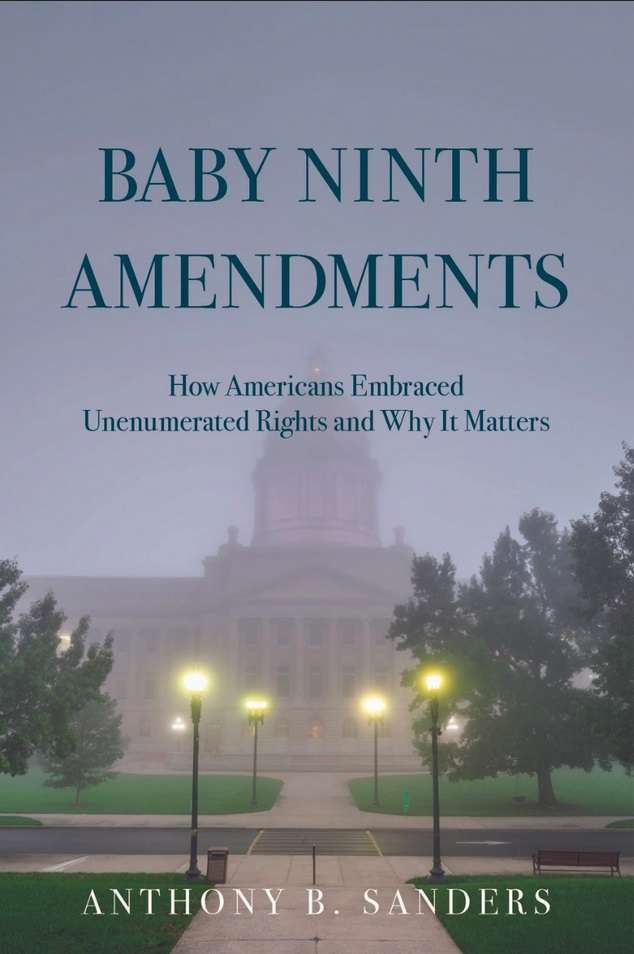
You can see the previous four posts in this series here, here, here, and here, all of which summarize my new book from the University of Michigan Press, Baby Ninth Amendments: How Americans Embraced Unenumerated Rights and Why It Matters (available for free here).

Today I'm going to give an example of how a Baby Ninth should work in practice, briefly address a potpourri of issues I haven't had space for, and close with some big picture thoughts about what Baby Ninths mean for how we look at American constitutionalism more generally.

In the book I talk about some food truck cases we've done at IJ, where cities block food trucks from operating for protectionist reasons that aren't plausibly related to public health and safety. Let's suppose you're one of them. You want to park your truck in the lot of an office building. The building's owners also want you to park there—they like that their tenants can buy lunch from your truck. But there's a city ordinance that prohibits you from parking within 500 feet of a restaurant, even if you're on private property. And there are other restaurants on the building's street within that distance.

Read More

More