
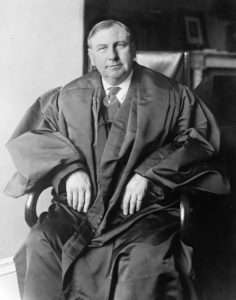
7/3/1941: Chief Justice Harlan Fiske Stone takes oath.

Mostly law professors | Sometimes contrarian | Often libertarian | Always independent | Est. 2002
7/3/1941: Chief Justice Harlan Fiske Stone takes oath.
As the unelected judiciary becomes depoliticized, the elected judiciary becomes more politicized.
In recent years, the Supreme Court of the United States has devolved several important decisions to the states--or more precisely, the state Supreme Courts. Of course, Dobbs extricated the federal judiciary from the abortion issue. In the wake of Dobbs, several states have enacted constitutional protections for abortion. But in other states, state supreme courts have recognized a constitutional right to abortion in the state constitution. Those rights were apparently there all along, but there was no need to see them because of Roe. Go figure!
Unsurprisingly, the stakes of state supreme court races have become far more significant. Look no further than Wisconsin, where a candidate ran, and prevailed, on the not-so-subtle platform of protecting abortion rights. Dobbs unquestionably got the federal courts out of the abortion business, but the locus for judicial overreach shifted to the next option--the state courts.
A similar dynamic is at play with regard to partisan gerrymandering. Rucho v. Common Cause held that the United States Supreme Court would not resolve disputes about partisan gerrymandering. Rather, the state supreme courts would decide those issues under state constitutions. These decisions, of course, may implicate the Election Clause and the Independent State Legislature doctrine. But Moore v. Harper reaffirmed that the state courts have extremely broad power to redraw maps for federal elections. Indeed, it will be extremely difficult for the inferior federal courts to even hear challenges to these maps. Perhaps the only route for review will be through certiorari petitions, which will be routinely denied. (Derek Mueller made this point shortly after Moore was decided.) Once again, the significance of the state courts becomes even more important. Look no further than North Carolina, where the recently-elected Republican state supreme court overruled the "precedent" (but not the "judgment") of the former Democratic majority.
As the unelected judiciary becomes depoliticized, the elected judiciary becomes more politicized. On balance, I am okay with this shift. As Judge Sutton explains, there are 51 imperfect solutions, and just that many imperfect state supreme courts, plus hundreds of imperfect state supreme court justices. Fortunately, it is much simpler to improve a state bench, than to "reform" the highest court of the land. Still, I worry deeply about races like the one in Wisconsin where candidates effectively prejudged cases. Neutrality, or at least the pretense of neutrality, is a bedrock of any judicial system. Otherwise, we are just left with a Council of Revision, which didn't work out too well in New York.
With Justice Kavanaugh by his side, the Chief Justice is back in control.
Flash back to June 2020. The supposedly-conservative 5-4 majority of the Supreme Court, in case after case, swung to the left: McGirt, Mazars, Vance, June Medical, Regents, Bostock, and so on. Things became so bleak I referred to the period as Blue June.
Now, jump forward to June 2022. The expanded 6-3 conservative majority, in case after case, swung to the right: West Virginia, Castro-Huerta, Kennedy, Dobbs, Bruen, Carson, and so on. In my lifetime, I could not recall such a consistent string of decisions that favored conservative jurisprudence. I called the period, fittingly, Red June.
What do I make of June 2023? Well, it is somewhere in between Red June and Blue June. Call it Purple June. There were several significant decisions to the right: 303 Creative, Nebraska, and Students for Fair Admission. (Curiously, all the hard-right decisions came on the last two days of the term--more on timing later.) There were several significant decisions to the left: Moore, Texas, Brackeen, and Milligan. And there were a few significant decisions that are harder to characterize: Groff, Mallory, and Pork Producers. It's a mix.
There will be umpteen efforts to explain this term, but ultimately, a single factor predominates: Chief Justice Roberts and Justice Kavanaugh consistently vote with the Court's progressives to form a five-member block. According to Empirical SCOTUS, Chief Justice Roberts and Justice Kavanaugh have a 95% voting agreement rate since 2018. Moreover, according to the New York Times, this term Justice Kavanaugh was in the majority of divided cases 90% of the time, while the Chief was in the majority 86% of the time. Justice Thomas was in the majority of divided cases only 55% of the time. Shortly after Kavanaugh joined the Court, there were a spate of stories suggesting that Roberts would vote like Justice Kavanaugh. Five years in, we can confirm those early prognostications.
I offered the New York Times this quote:
Some conservatives have been frustrated. Gov. Ron DeSantis of Florida, a Republican and a rival to Mr. Trump for the Republican presidential nomination, recently said that none of Mr. Trump's three appointees "are at the same level" of Justices Thomas and Alito.
Josh Blackman, a law professor at South Texas College of Law Houston, said the critique had force from a conservative perspective, and he questioned the adequacy of the Trump administration's vetting process, which relied on lists of potential nominees compiled by lawyers with ties to conservative legal groups like the Federalist Society and the Heritage Foundation.
"For different reasons, Justices Gorsuch, Kavanaugh and Barrett have and will continue to disappoint conservatives," Professor Blackman said. "I don't know that future 'short lists' are worth much if they are made by the same people who generated the last batch of lists."
Remember that Justice Kavanaugh was not Trump's first list. (Nor was Gorsuch). Justice Kavanaugh's exclusion from the unadulterated, unlobbied list was quite deliberate. He was added, no doubt, so he could be nominated. This term, Justice Kavanaugh voted with Justice Jackson 62% of the time, but voted with Justice Thomas only 48% of the time. Did everyone who vigorously advocated for Justice Kavanaugh predict that he would vote with the author of the Obamacare decision 95% of the time, and be closer jurisprudentially to Ketanji Brown Jackson than to Clarence Thomas? Governor DeSantis is not wrong.
I've now finished all of the opinions of the Court this term. Well, to be precise, I didn't read every word. I skimmed some parts and skipped others. But I've internalized the decisions, and plan to write a bit. Stay tuned.
The ABC News/Ipsos poll reports 52%-32% support for the decision ("Do you approve or disapprove of the recent decision by the U.S. Supreme Court restricting the use of race as a factor in college admissions"):
The majority includes majorities of both white (60%) and Asian (58%) Americans. Latino and Hispanic Americans are split on the ruling (40% approve vs. 40% disapprove), and the majority of Black Americans disapprove ([25% approve vs.] 52% [disapprove]).
Note that the margin of error is necessarily higher for racial subgroups, especially smaller ones, than for the sample as a whole (for that, it's reported as ±3.5%), even though they were slightly oversampled (with the oversamples being statistically accounted for in the overall results). Note also that, despite the race gap, it's clear that no racial group is even close to homogeneous in its views.
The poll also reports …
Submit them to the Journal of Free Speech Law; we'll tell you within 14 days whether we'll accept the submission, and then we can publish it very quickly, if you'd like.
To see more about the articles and authors we've published so far, see our http://JournalOfFreeSpeechLaw.org; to submit, go to ScholasticaHQ. So far we've published articles by Jack Balkin (Yale), Mark Lemley (Stanford), Jeremy Waldron (NYU), Cynthia Estlund (NYU), Christopher Yoo (Penn), Danielle Citron (Virginia), and many others—both prominent figures in the field and emerging scholars. We require exclusive submissions, but we promise to give a response within 14 days, so if we say no, you've lost very little. And then we can publish quickly, which can be particularly valuable for new pieces.
We're also willing to publish short pieces, if they say something genuinely new and smart. We're not generally interested in casenotes that mostly restate the facts and holding of a case, since it's rare for there to be something novel, nonobvious, and useful there. But something that explains how the underlying area of the law (e.g., compelled speech law, the law of threats, the law of solicitation and aiding and abetting, and so on) is changed by the case could be very useful; likewise for how other areas of the law might be affected by the developments in this area.
Of course, we're also continuing to review articles that are unrelated to this Supreme Court Term's cases. (We just accepted one a few days ago, for instance, on platform transparency laws.) But I just wanted to particularly stress our openness to short articles on those cases.
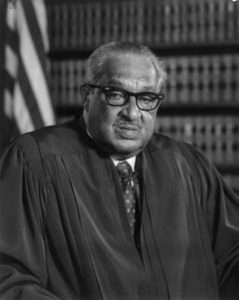
7/2/1908: Justice Thurgood Marshall's birthday.
In Members of the Medical Licensing Board of Indiana v. Planned Parenthood, decided Friday, the Indiana Supreme Court (in an opinion by Justice Derek Molter, joined by Chief Justice Loretta Rush and Justice Mark Massa) concluded that the Indiana Constitution's protection of "life, liberty, and the pursuit of happiness" "protects a woman's right to an abortion that is necessary to protect her life or to protect her from a serious health risk":
Plaintiffs emphasize that abortion procedures are sometimes their only means to save their patients' lives. That is undisputed, and we agree the Constitution—including Article 1, Section 1—does not permit the General Assembly to prohibit abortion in those circumstances. But that is not a basis for enjoining the entirety of Senate Bill 1 in all circumstances, including when abortion is unnecessary to protect a woman's life or to protect her from a serious health risk.
Article 1, Section 1 expressly protects an "inalienable" right to "life," which was a firmly established right long before Indiana became a state. That right to protect one's own life extends beyond just protecting against imminent death, and it includes protecting against "great bodily harm." Although the State disputes that Article 1, Section 1 is judicially enforceable, it recognizes that governmental authority is limited to the police power, and it acknowledges "grave doubt" that the police power would permit the State to prohibit an abortion that was necessary to save a woman's life.
Because this fundamental right of self-protection—whether considered as an exercise of the right to life, an exercise of the right to liberty, a limitation on the scope of the police power, or as a matter of equal treatment—is so firmly rooted in Indiana's history and traditions, it is a relatively uncontroversial legal proposition that the General Assembly cannot prohibit an abortion procedure that is necessary to protect a woman's life or to protect her from a serious health risk.
Reflecting that understanding, all of Indiana's abortion statutes since 1851 have recognized an exception for abortions that are required to protect a woman's life…. And now that the United States Supreme Court has returned broad discretion to the states to determine the legality of abortion, Senate Bill 1's general abortion ban continues to recognize an exception for "when reasonable medical judgment dictates that performing the abortion is necessary to prevent any serious health risk to the pregnant woman or to save the pregnant woman's life."
So the Indiana Supreme Court held yesterday, though it concluded that, as to abortion, this is limited to situations where the abortion is necessary to protect the woman's life or health.
Article 1, Section 1 of the Indiana Constitution (the first section of the Indiana Bill of Rights) provides,
WE DECLARE, That all people are created equal; that they are endowed by their CREATOR with certain inalienable rights; that among these are life, liberty, and the pursuit of happiness; that all power is inherent in the people; and that all free governments are, and of right ought to be, founded on their authority, and instituted for their peace, safety, and well-being. For the advancement of these ends, the people have, at all times, an indefeasible right to alter and reform their government.
Members of the Medical Licensing Board of Indiana v. Planned Parenthood, decided Friday by the Indiana Supreme Court, in an opinion by Justice Derek Molter, joined by Chief Justice Loretta Rush and Justice Mark Massa, concludes that this is a judicially enforceable provision that protects long-established unenumerated rights:
Interpreting Article 1, Section 1 requires us to uncover "the common understanding of both those who framed" our Constitution "and those who ratified it." … The first state constitutional document to include [the guarantees listed in Article 1, Section 1] was the Virginia Declaration of Rights in 1776, which was the first bill of rights adopted through a popularly elected convention. Steven G. Calabresi & Sofía M. Vickery, On Liberty and the Fourteenth Amendment: The Original Understanding of the Lockean Natural Rights Guarantees, 93 Tex. L. Rev. 1299 (2015). A month after Virginia adopted its Declaration of Rights, Pennsylvania adopted a similar provision in its constitution. Around the same time, Thomas Jefferson used the Virginia provision as a model for expressing these same ideas in the Declaration of Independence.
These provisions, known as "Lockean Natural Rights Guarantees," quickly became standard in state constitutions, and they are generally understood as constitutionalizing the social contract theory of the English political philosopher John Locke. Locke believed that before forming a civil society we were in a state of nature where we all had equal freedom to do as we pleased so long as we did not "take away or impair the life, or what tends to the preservation of life, the liberty, health, limb, or goods of another." That freedom included natural rights: "every [person] has a property in [their] own person," the "labour of [their] body," and "the work of [their] hands." But we left the state of nature and entered a civil society, giving up some of our natural rights in exchange for better protection of the remaining natural rights and for the enjoyment of new positive rights (e.g., the right to a jury trial). See generally Michael W. McConnell, Natural Rights and the Ninth Amendment: How Does Lockean Legal Theory Assist in Interpretation?, 5 N.Y.U. J.L. & Liberty 1 (2010).
The Court will consdier whether to invalidate the CFPB's funding, narrow standing, and overturn Chevron, among other things.
The Supreme Court has scarcely filled its docket for the 2023-24 term, but it is already shaping up to a major term for administrative law.
Among the cases accepted for next term with potentially significant implications for administrative law are the following:
That's quite a bit of administrative law for a single year, and there will be more to come. The Court has not even granted certiorari on two-dozen cases yet. Additional cases concerning standing, the Biden Administration's environmental regulations, vaping regulation, and the FDA's treatment of mifepristone could still end up before the justices.
Note to Administrative Law professors: Be prepared to revise your syllabi!
Some end-of-term comments and an assessment of my end-of-term predictions.
After a slow start, and many opinions that confounded expectations, the Supreme Court closed the term with several decisions that split the justices along ideological lines. Yet overall, the 6-3 Court only decided twelve of fifty-seven cases by that margin, and in only five of those cases was the Court split along ideological lines (the two affirmative action cases, Biden v. Nebraska on student loans, 303 Creative v. Elenis on whether a web designer could be required to make websites celebrating same-sex marraige, and Jones v. Hendrix concerning habeas claims).
Several cases previewed as likely to split the justices along ideological lines produced unanticipated agreement (as in Groff v. DeJoy on religious accommodation in employment, Axon & Cochran on challenges to agency adjudication, Glacier NW on labor disputes, and (to some degree), Sackett v. EPA on the scope of federal regulation under the Clean Water Act), while others did not produce the conservative result we were told to expect (Allen v. Milligan on the Voting Rights Act and Brackeen v. Haaland on the Indian Child Welfare Act), and still others splintered the Court in truly unexpected ways (Mallory v. Norfolk Souther Railway on personal jurisdiction and National Pork Producers Council on the dormant commerce clause).
Over at EmpiricalSCOTUS, Adam Feldman and Jake Truscott have compiled some other statistics for the term. Of note, Justice Brett Kavanaugh was in the majority in 96 percent of the Court's cases, more than any other justice, followed closely by the Chief Justice. Interestingly, the Justice least likely to be in the majority was another conservative: Justice Thomas. The overall ranking on this score, as compiled by Feldman and Truscott, is quite unexpected, as shown below.
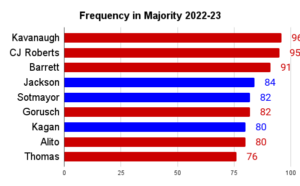
Also worth noting, three pairs of justices voted together in 95 percent of the term's cases (Roberts-Kavanaugh, Sotomayor-Jackson, and Sotomayor-Kagan).
As for the Court's final cases, here's a quick round-up of my end-of-term predictions and how they fared.
Overall, I think I did pretty well with these predictions, and definitely gave readers their money's worth.
I am not about to make any sweeping predictions about next term, other than to note that it is likely to be quite significant for administrative law, particularly given some of the Court's most recent cert grants. I discuss the administrative law cases on tap for next term here.
The Court unanimously ruled the plaintiffs in that case lacked standing. But they might end up getting what they wanted more fully than anyone else involved in the legal battle over student loan forgiveness.

Most of the attention devoted to yesterday's student loan decisions has understandably focused on Biden v. Nebraska, the case in which the Supreme Court ruled the Biden Administration's $400 billion student loan forgiveness program is illegal (I gave my views on that case here). But it's worth giving at least a little consideration to the other loan forgiveness case the Supreme Court decided yesterday: Department of Education v. Brown.
The plaintiffs in that case had a very dubious theory of standing, and the Court unanimously rejected it, in an opinion written by Justice Alito. But it looks like those plaintiffs may end up getting what they wanted, nonetheless.
Unlike virtually everyone else challenging the loan forgiveness program in court, Myra Brown and Alexander Taylor (represented by the conservative Job Creators Network) argued not that the Biden program went too far, but that it wasn't generous enough. Specifically, they wanted a program that would give them more relief than they were eligible for under the Biden plan based on the HEROES Act of 2003. Brown and Taylor also complained that the Biden Administration had not conducted a notice and comment rulemaking procedure in which they would have had a chance to express their concerns and urge the administration to adopt a more expansive plan.
They hoped that, if the HEROES Act plan were struck down, the administration would go back to the drawing board, go through the notice and comment process, and enact a more generous plan under the Higher Education Act of 1965. Even many observers sympathetic to the substantive case against the Biden plan (myself included) believed the Brown standing theory was too speculative to pass muster under current Supreme Court standing precedent. The Supreme Court agreed:
Describing respondents' claim illustrates how unusual it is. They claim they are injured because the Government has not adopted a lawful benefits program under which they would qualify for assistance. But the same could be said of anyone who might benefit from a benefits program that the Government has not chosen to adopt…
At the outset, we reiterate what respondents' claim is not. Respondents are not claiming that they are injured by not being included in the Plan (or, in Taylor's case, by being remunerated by the Plan less generously than he thinks himself entitled to). After all, they think the Plan is substantively unlawful….
Instead, respondents seek relief under a separate statutory source. They name the [Higher Education Act] as that potential source…
The Plan, however, is independent of any student-loan relief the Department might craft under the HEA (or any other statute). A decision by this Court that the Plan is lawful would have no effect on the Department's ability to forgive respondents' loans under the HEA… Thus, the Plan poses no legal obstacle to the Department's choosing to find other ways to remedy the harm respondents experience from not having their loans forgiven. Put differently, the Department's decision to give other people relief under a different statutory scheme did not cause respondents not to obtain the benefits they want.
Justice Alito goes on to say that the adoption of the HEROES Act plan therefore did not cause the plaintiffs' injury in any way, and that any claim that striking down that plan would lead the administration to pursue notice and comment rulemaking and adopt a more generous plan under the HEA is too speculative to justify standing.
All of this makes sense under current Supreme Court standing precedent. Unless you want to simply get rid of all or most current standing requirements (as I do), Brown and Taylor deserved to lose on standing.
But the Brown plaintiffs' logic turns out to be politically valid, even if it was wrong legally. In the aftermath of yesterday's rulings, President Biden announced that he will indeed seek to enact a new loan forgiveness plan under the Higher Education Act of 1965. And the Department of Education is apparently going to go through the notice and comment rule-making process! Brown and Taylor (and others) will be free to file comments urging a more generous plan.
Had the Supreme Court upheld the HEROES Act plan, it is unlikely any of these events would have happened. At least for now, Biden would probably just have stuck to the existing plan.
Thus, Brown and Taylor ended up getting much of what they wanted. Indeed, they may have done so more fully than almost anyone else involved in the loan forgiveness litigation. Most of the other participants either wanted the HEROES Act plan upheld, or wanted it struck down and not replaced with another plan of similar or larger scale.
Of course, it is not certain that the Administration's new HEA plan will give Brown and Taylor more than they would have gotten under the HEROES Act plan. And it is also far from certain that an HEA loan forgiveness plan would fare any better in Court than the Administration's previous plan did (I think the HEA rationale for mass loan forgiveness has serious flaws).
But Brown and Taylor will at least now get the notice and comment opportunity they say they want. They also now have a fighting chance at getting more generous student loan forgiveness. Not a bad showing for litigants whose case was unanimously dismissed by the Supreme Court!
Participants included Prof. Adam Cox (NYU), David Bier (Cato), Kit Taintor (Welcome.US), and myself.

C-SPAN has posted the video of yesterday's Cato Institute event on "Private Sponsorship: Revolution in Immigration Policy." The speakers were Prof. Adam Cox (NYU) (coauthor of the important book The President and Immigration Law), Kit Taintor (VP of Policy and Practice at Welcome.US, the leading organization connecting potential American sponsors with Ukrainian and other migrants eligible for sponsorship), David Bier (Cato Institute), and myself.
The video is available here. Unfortunately, I can't figure out how to embed it on this site.
Here's Cato's description of the event:
The Biden administration recently launched ambitious private sponsorship programs for Ukrainians, Venezuelans, Haitians, Cubans, and Nicaraguans, which could be the largest expansion of legal migration in decades. These initiatives create new legal opportunities for Americans to sponsor foreigners from these troubled countries for legal entry and residence in the United States. The new entry categories have already facilitated hundreds of thousands of legal entries and are helping reduce unlawful migration across the U.S.-Mexico border. What is the sponsorship experience like? How can the government improve upon these policies? What can be done to expand the program to immigrants from other countries? Explore these issues and others with Cato's panel of experts.
Current private sponsorship programs started with Uniting for Ukraine in April 2022, but have since been expanded to include migrants from four other nations beset by violence and oppression, and a pilot program for people from around the world who fit the legal definition of "refugee."
I have previously written about Uniting for Ukraine and other private sponsorship programs here, here, here, and here. While these initiatives have important limitations (most notably, the lack of a provision for permanent residency and work permits in most of them), they are on their way to becoming the largest expansion of legal immigration in a long time.
7/1/1985: Cleburne v. Cleburne Living Center, Inc. is decided.
I have now finished editing 303 Creative v. Elenis. After all the behemoth opinions, this supplement case is a blessedly-short 18 pages: https://reason.com/wp-content/uploads/2023/06/303-Creative.pdf
I promise, I'll have some commentary over the weekend. I have lots of posts in the queue.
The article goes over the main reasons why the Court's decision was justified.
CNN just published my article on today's Supreme Court student loan forgiveness decision. Here is an excerpt:
In a lawsuit brought by six state governments, the Supreme Court on Friday ruled that President Joe Biden's massive $430 billion student loan forgiveness plan is illegal because it was never authorized by Congress, and the Constitution gives Congress – not the president – the power to determine how federal funds are spent. The court made the right decision: If the administration had won, Biden and future presidents would have been empowered to use vague statutes to usurp Congress' constitutional control over the federal budget. Moreover…. it also would have allowed the president to abuse emergency powers for partisan ends….
The Supreme Court…. rightly ruled that the HEROES Act's language comes nowhere near authorizing such a massive loan forgiveness plan. As Chief Justice John Roberts explained in the majority opinion, "The authority to 'modify' statutes and regulations allows the Secretary to make modest adjustments and additions to existing provisions, not transform them." The word "waive" also doesn't give the government the power to forgive loans on a massive scale, because, as Roberts noted, the government conceded that the term "waiver" as used in the HEROES Act cannot refer to waiving loan repayments.
In addition, for the majority of the more than 40 million borrowers the White House claims would be eligible for forgiveness, the government presented no proof that, as a result of Covid, they were placed "in a worse position financially." Over 80% of employed college graduates did not even report a decrease in salary during the pandemic, and few suffered prolonged unemployment, according to data from the US Bureau of Labor Statistics. The lack of evidence that most beneficiaries' ability to pay was impaired by the pandemic seems to me a stronger basis for the court's ruling than Roberts' analysis of the terms "waive" and "modify…"
Presidents of both parties can be tempted to use emergency powers as a pretext to enact policies they otherwise can't pass. In 2019, Trump used a dubious emergency declaration to try to divert Pentagon funds to build a wall along the southern border. Trump's emergency declaration was bogus, and the statutes he cited didn't give him the power to transfer military funds….
Biden's abuse of emergency powers, like Trump's before it, would likely have caused more harm than good. His student loan forgiveness plan would have been a waste of taxpayer funds when the US is already facing a looming fiscal crisis, a regressive policy in that it helps the relatively affluent (former college students) and potentially inflationary…
Those who differ on policy should still be able to agree that it is dangerous to give one politician the power to circumvent the Constitution and divert federal funds to political projects not authorized by Congress. Even if you trust Biden to wield such power wisely, you likely do not have similar faith in the next Republican president – and vice versa.
The administration will try this pathway as an alternative to the HEROES Act of 2003, which pathway was shut down by today's Supreme Court decision.
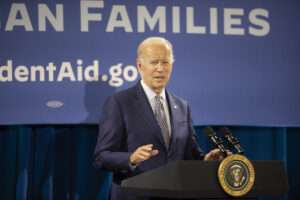
Just a few hours after the Supreme Court invalidated his $400 billion student loan forgiveness plan for which the administration claimed authorization under the HEROES Act of 2003, President Biden announced he will try to push through loan forgiveness under the Higher Education Act of 1965, instead:
Hours after the ruling, Biden announced his administration will be taking a new route. The Education Department filed a notice on Friday to begin the regulatory process of using the Higher Education Act of 1965 to cancel student debt, which does not require relying on a national emergency.
"This new path is legally sound," Biden said during Friday remarks. "It's going to take longer, and in my view is the best path that remains in providing for as many borrowers possible. But I'm directing my team to move as quickly as possible on the law."
The Higher Education Act states that the Education Department can "enforce, pay, compromise, waive, or release any right, title, claim, lien, or demand" related to federal student debt.
I can't say for sure whether the new plan is legal until such time as we have details on what exactly it will do. But the Higher Education Act (HEA) was previously advanced as a possible alternative justification for the plan the Supreme Court struck down today (the administration never used the argument, however). I criticized the HEA rationale for that plan here. Fordham law Professor Jed Shugerman (who is much more sympathetic to the administration's goals than I am), offered criticisms in an article in the Atlantic, though he also argued that the HEA theory was stronger than the HEROES Act approach the administration chose to adopt.
It's too early for any definitive assessment of the administration's potential new loan forgiveness plan. The one thing we can say with confidence is that we are likely to have more legal battles over executive authority to cancel student loans!
The President strongly criticized the Supreme Court's recent decisions, but refuses to endorse radical reform.
In prepared remarks yesterday, President Biden condemned the Supreme Court's decision to dramatically restrict the use of race in college admissions in SFFA v. Harvard. He said he strongly disagreed with the decision. The Court "once again walked away from decades of precedent" and "effectively ended affirmative action in college admissions." When asked by a reporter whether the Supreme Court is "a rogue court," the President responded: "this is not a normal court."
Speaking later to MSNBC, however, the President rejected proposals to increase the size of the Court as a way to shift its ideological balance. Reuters reports:
President Joe Biden said it would be a mistake to expand the membership of the U.S. Supreme Court after it struck down race-conscious admission considerations on Thursday but thinks the institution is out of touch with basic American values. . . .
Biden told MSNBC in New York that the court "may do too much harm but I think if we start the process of trying to expand the court, we are going to politicize it maybe forever, in a way that is not healthy."
Biden also said the court's value system is different and it's not as embracing. . . .
Liberal Democratic lawmakers have proposed expanding the number of Supreme Court justices, possibly ending its conservative majority, but the plan has not been embraced by the White House and other Democrats.
UPDATE: The full MSNBC interview is available here.
Bonus Episode 465 of the Cyberlaw Podcast
Max Schrems is the lawyer and activist behind the first and second (and, probably soon, a third) legal challenge to the adequacy of US law to protect European personal data. Thanks to the Federalist Society's Regulatory Transparency Project, Max and I were able to spend an hour debating the law and policy behind Europe's generation-long fight with the United States over transatlantic data flows. It's civil, pointed, occasionally raucous, and wide-ranging – a fun, detailed introduction to the issues that will almost certainly feature in the next round of litigation over the latest agreement between Europe and the US. Matthew Heiman acted as moderator.
You can subscribe to The Cyberlaw Podcast using iTunes, Google Play, Spotify, Pocket Casts, or our RSS feed. As always, The Cyberlaw Podcast is open to feedback. Be sure to engage with @stewartbaker on Twitter. Send your questions, comments, and suggestions for topics or interviewees to CyberlawPodcast@gmail.com. Remember: If your suggested guest appears on the show, we will send you a highly coveted Cyberlaw Podcast mug! The views expressed in this podcast are those of the speakers and do not reflect the opinions of their institutions, clients, friends, families, or pets.
Celebrate your independence with a subscription to Reason magazine, your most trusted source of honest, insightful news and analysis.




