Plaintiff began this litigation pro se on August 16, 2022, drafting and filing his original Complaint without the assistance of counsel. However, Plaintiff recently retained an attorney, who enrolled in May of 2023. The proposed Amended Complaint, which was drafted by counsel, is largely intended to clean-up the original Complaint. The allegations of race discrimination in violation of Title VII of the Civil Rights Act of 1964 (Title VII), see 42 U.S.C. §§ 2000e-2(a)(1) (disparate treatment and hostile work environment), remain unchanged. Plaintiff does, however, include a jury demand for the first time. See Fed. R. Civ. P. 38 (jury demand)….
Defendant objects to the proposed Amended Complaint because it: (1) includes an untimely jury demand; and (2) now spells out the racial epithet allegedly directed at Plaintiff by his supervisor. Defendant considers the inclusion of this racial epithet to be "scandalous," "prejudicial," and "unnecessary." Compare (On "September 5, 2019 … Mr. Adams referred to me as a "stupid f***ing n***er."), with ("On September 5, 2019, Jason Adams called Plaintiff, 'A stupid fucking nigger.'")….
Defendant claims:
RAMCO asserts that Plaintiff's allegations contained in Paragraph 19 of the Amended Complaint, using the fully spelled out "n-word" are scandalous, are highly and unduly prejudicial and defamatory to Defendant and its business reputation, and should be stricken or redacted from the pleading.
The Plaintiff's use of this word is unnecessary, and the allegation could be sufficiently plead by redacting this word so that it does not appear in its full form or by simply redacting the allegation to allege that a racial slur was used.
Economic secretary Andrew Griffith told the bosses of some of the UK's biggest banks on Wednesday that it is important to protect freedom of expression….
It came after former politician Nigel Farage's bank account with Coutts—a bank for the ultra wealthy—was closed.
The account was shut after Mr Farage's mortgage payments came to an end. Due to extra checks on so-called politically exposed persons (PEPs), Mr Farage and other politicians are expensive to provide services to.
Therefore, when he had paid off his mortgage he fell below Coutts' "commercial criteria" basis. The bank cited this, and his public profile as an at times controversial figure with opinions which it said clashed with the bank, as the reasons for why it terminated his account….
The Treasury said the bank bosses at the meeting had committed to "the principle of non-discrimination based on lawful freedom of expression."
From Ex parte Lee, decided last week by the Tenth District Texas Court of Appeals, in an opinion by Chief Justice Tom Gray, joined by Justices Matt Johnson and Steven Lee Smith:
Allen Michael Lee is charged with one count of aggravated sexual assault of a child and two counts of sexual assault of a child. Bail amounts were set at $400,000 in total for the three charges. He has not been able to make bail. He filed a pre-trial application for a writ of habeas corpus asking to either be released or have bail reduced to $15,000 total. After a hearing, the trial court denied Lee's application.
In one issue, Lee contends the trial court abused its discretion in denying Lee's request for a bail/bond reduction. Specifically, he contends the initial bail set was excessively high and that the trial court abused its discretion by denying his application without an explanation.
In presenting error to this Court, an appellant's brief must contain a clear and concise argument of the contentions made with appropriate citations to authorities and to the record. That has not occurred in this case. In the "Standard of Review" and "Applicable Law" sections of his brief, Lee cites to the general, applicable case law and statutes.
However, in his "Argument" section, where appropriate citations must be included, Lee cites to five cases to support the two sub-arguments to his issue. Only three of those five cases are published. None of the three published cases cited actually exist in the Southwest Reporter. Each citation provides the reader a jump-cite into the body of a different case that has nothing to do with the propositions cited by Lee. Two of the citations take the reader to cases from Missouri. As the State points out, even Texas cases with the same names as those cited by Lee do not correspond with the propositions relied upon. [A footnote lays out the details, quoting the State's brief. -EV]
I'd been following Ha v. Nguyen (E.D. Tex.) because it's a libel case, involving claims of false allegations of (among other things) "being a 'Communist'"; but here's an order from yesterday that's about broader matters, by Judge J. Campbell Barker:
On December 6, 2022, plaintiffs sued defendant for defamation. Defendant did not answer the complaint by the deadline established by Federal Rule of Civil Procedure 12(a)(1)(A)(i). After the answer deadline passed, plaintiffs asked the clerk of court to enter defendant's default; the clerk did so shortly thereafter. Defendant now moves to set aside that entry of default.
Defendant alleges that there is good cause to set aside default. Defendant reports that she was unable to retain counsel and answer the complaint because, among other reasons, she was ill. To support that claim, she furnished to the court a doctor's note attesting to a serious COVID-related illness. That note, dated January 26, 2023—many weeks after defendant's deadline to respond to the complaint—speaks of defendant's being "very ill over this time period." But the note doesn't indicate any period.
Defendant is ordered to furnish to the court by August 9, 2023, a revised note signed by Kelsie Court, MD, identifying the period in which she was under Dr. Court's treatment for her COVID-19 related illness. At minimum, the note should state the exact date that treatment began and the date it ended. Defendant must furnish to Dr. Court this court order before the note is prepared.
I blogged about the underlying libel case, Tera Shanley a/k/a T.S. Joyce & Wicked Willow Press, LLC v. Robyn A. Hutchings a/k/a Terry Bolryder a/k/a Domino Savage two months ago; here's a quick summary of the allegations:
Ms. Shanley and Ms. Hutchings both write paranormal romance fiction. Readers of such fiction gather online to discuss books and promote authors. For instance, Ms. Hutchings avers that she has 8,000 followers on Facebook and 1,500 followers on Instagram. Ms. Shanley and Ms. Hutchings interacted in one online community for four months in 2016.
At diverse times, Ms. Hutchings published various negative comments about Ms. Shanley. She accused Ms. Shanley of being a "known homewrecker[,]" "sexually coerc[ing] and blacklist[ing] male models[,]" and engaging in "white supremacy dog whistling." She asked Ms. Shanley to "come answer for all the cheating and husband stealing[.]" Ms. Hutchings called Ms. Shanley a "repeat offender" rapist who "ruined everyone's rep[utation]" and said, "now its [sic] your turn."
In addition to the rape allegations, Ms. Hutchings accused Ms. Shanley of being "an actual child molester" who "raped a kid[,]" including her own child. She offered one thousand dollars if "anyone brings [Ms. Shanley] … here." And she uploaded a picture of a man with a noose around his neck after a post stating, "I'm really mad [Ms. Shanley] … you existing is like a total blight on humanity."
Even then, defendant Hutchings had apparently not complied well with her discovery obligations, and this "obstreperous litigation behavior" seems to have continued. As a result, in a detailed order issued today Magistrate Judge Jared C. Bennett (D. Utah) imposed serious sanctions on the defendant:
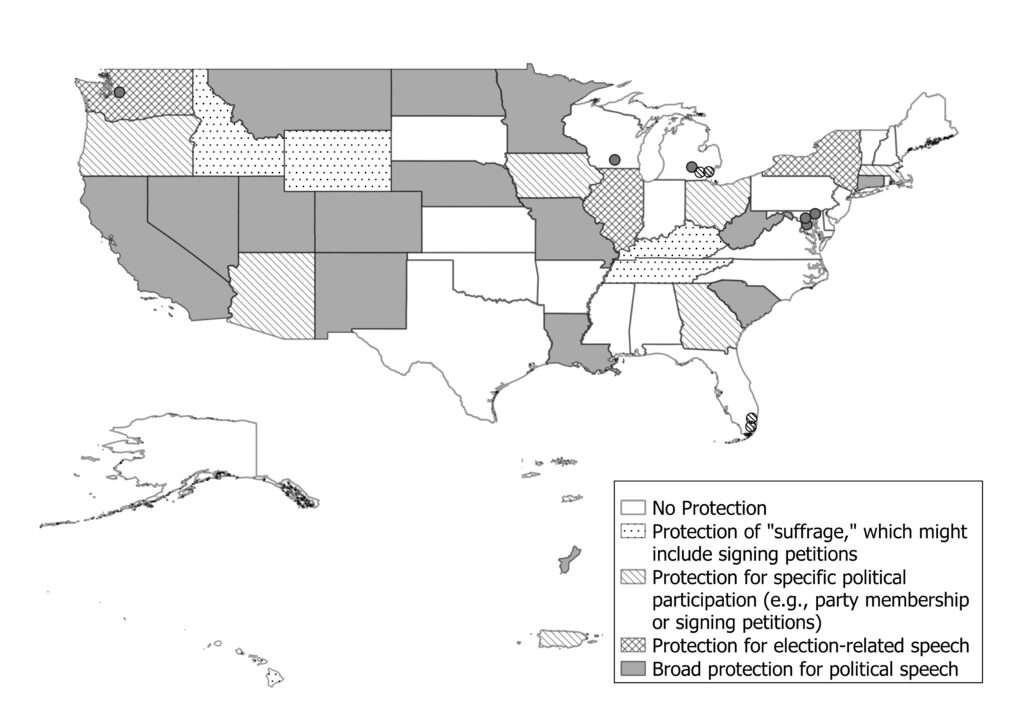
Though the First Amendment generally limits only actions by the government, many states have statutes that limit even private employers' ability to fire employees for their political activities (see this article for more details); some of them broadly cover ideological advocacy, and not just election-related activities:
[Cal. Labor Code § 1101:] No employer shall make, adopt, or enforce any rule, regulation, or policy: (a) Forbidding or preventing employees from engaging or participating in politics … [or] (b) Controlling or directing, or tending to control or direct the political activities or affiliations of employees.
[§ 1102:] No employer shall coerce or influence or attempt to coerce or influence his employees through or by means of threat of discharge or loss of employment to adopt or follow or refrain from adopting or following any particular course or line of political action or political activity.
And Napear v. Bonneville Int'l Corp., decided yesterday by Judge Dale A. Drozd (E.D. Cal.), allowed claims under these statutes to go forward:
In the fictional town of Lake Wobegon, "all the children are above average." It seems many of those wee Wobegonians have been admitted to law school. Two authors surveyed more than six-hundred incoming law students at the University of Illinois College of Law. Their findings suggest that 1Ls vastly over-estimate their ability to perform well:
The average student predicted that they would finish close to the top 25% of the class (74.9 percentile). Virtually all students (94.9%) predicted that they would finish at the 50th percentile or higher. More than three-quarters (78.2%) of students predicted they would finish in the top 30% of the class, half (53.1%) predicted they would finish in the top 20% of the class, and nearly one-quarter (22.4%) of students thought they would finish in the top 10% in the class. Just 6.2% of students thought they would finish in the top 5% of the class, but thirteen students (2.1%) predicted they would finish at the very top of the class.
Unsurprisingly, 95% of the students were not in the top 50% of the class. Students did not accurately predict their performance. But some students predicted worse than others. As it turns out, the students who ended up performing better underestimated their grades, while students who performed worse overestimated their grades:
Given the high estimates made by students across the board, and consistent with the prior literature, the gap between predictions and outcomes was the biggest for those students who performed the least well. Overconfidence is substantial, in particular, for those in the bottom 25% percent of the 1L class. In contrast, and also in line with earlier studies, students finishing in the top quartile slightly underestimated their eventual 1L ranking.
My sense is that most law students were at the top of their undergraduate classes, and generally did well. When they arrive at law school, they bring that same level of confidence. And in some cases, that overconfidence might lead students to under-prepare for class.
On a personal note, I did quite well in undergraduate, and never received a B. I expected I would do well as a law student. My first semester in law school, when I was an evening student working full-time, was not pleasant. I had no idea what I was doing (see my essay on my 1L year). After the first semester ended (as the numbers would suggest) I was in the 50th percentile. I quickly figured out what I was doing wrong, completely changed my student habits, and finished the 1L year in the top 25%. By the end of my second year I was in the top 10%, and I graduated very close to the top 5%. (For these reasons, I am skeptical of judges who hire law clerks who have only received one semester of grades; they systematically exclude prospects who needed more runway to take off).
Students can improve, but they must have realistic expectations about the process. This study should be presented to all 1Ls at orientation. Students need to recognize that their performance in undergraduate is a thing of the past, and says nothing about their future law school grades.
From Redacted v. Barr, decided April 19 by Judge Cormac Carney (C.D. Cal.):
In this case, Plaintiff [Redacted], acting pro se, challenged child pornography statutes in this era of advanced technology. The Court granted Defendants' motion to dismiss on December 11, 2019, and the Ninth Circuit affirmed on April 22, 2021. Recently, Plaintiff was fired from his job and has faced obstacles with respect to future employment opportunities. Based on an email on which Plaintiff believes he was "mistakenly included" that refers to his "extracurricular legal activities," Plaintiff believes that his involvement in this litigation is the reason he was fired and has faced these obstacles. Now before the Court is Plaintiff's unopposed petition to reopen this case in order to redact his name from the docket and proceed instead under the pseudonym "John Doe."
Plaintiff's unopposed petition is GRANTED. There is a "strong presumption" in favor of public access to court records "based on the need for federal courts, although independent—indeed, particularly because they are independent—to have a measure of accountability and for the public to have confidence in the administration of justice."
However, "a party may preserve his or her anonymity in judicial proceedings in special circumstances when the party's need for anonymity outweighs prejudice to the opposing party and the public's interest in knowing the party's identity." In cases when "pseudonyms are used to shield the anonymous party from retaliation," courts determine the need for anonymity by evaluating (1) the severity of the threatened harm, (2) the reasonableness of the anonymous party's fears, and (3) the anonymous party's vulnerability to such retaliation.
On July 14, the U.S. District Court for Oregon issued a 122-page opinion, styled Oregon Firearms Federation v. Kotek Oregon Alliance for Gun Safety, upholding Oregon's ban on magazines holding over ten rounds. Its author is Judge Karin J. Immergut. While the reasoning in the opinion is similar to like decisions by some other district courts, what I found remarkable was the disparate treatment of the expert witnesses for the parties.
Because this is an arms ban case, the court should have applied the common-use test required by the Supreme Court in District of Columbia v. Heller. But it didn't. The court rejected plaintiffs' claim that the Second Amendment protects firearms that are in common use and instead skipped to the next step set forth by the Supreme Court in Heller and in New York State Rifle & Pistol Ass'n v. Bruen, asking whether the magazine ban is "consistent with this Nation's historical tradition of firearm regulation." Bruen resolved the historical issue in that case by direct reference to the historical sources, with no need for experts. Judge Immergut wrongly relied on expert testimony. See my prior post on that issue.
Judge Immergut found that plaintiffs' historical expert was biased, but that the defendants' experts were neutral. Plaintiffs' expert was Ashley Hlebinsky, former curator at the Cody Firearms Museum at the Buffalo Bill Center of the West and current Senior Fellow at the University of Wyoming College of Law's Firearms Research Center. Despite her hands-on knowledge of historical firearms and her M.A. in history, she "lacks background and training as a historian," has received awards from the Second Amendment Foundation, and "[p]erhaps most importantly … is married to" a man who derives his income from the firearms industry.
By contrast, "[d]efendants' experts come from neutral academic backgrounds and possess no economic interest in the sale of LCMs [large-capacity magazines]." "This Court finds the testimony of Defendants' neutral historical experts to be significantly more credible—and entitled to more weight—than that of Ms. Hlebinsky." To determine how "neutral" those experts are, I'll focus on Robert Spitzer, who has a Ph.D. in political science and is a professor emeritus at the State University of New York.
In our last episode before the August break, the Cyberlaw Podcast drills down on the AI industry leaders' trip to Washington, where they dutifully signed up to what Gus Hurwitz calls "a bag of promises." Gus and I parse the promises, some of which are empty, others of which have substance. Along the way, we examine the EU's struggling campaign to persuade other countries to adopt its AI regulation framework. Really, guys, if you don't want to be called regulatory neocolonialists, maybe you shouldn't go around telling former European colonies to change their laws to match yours.
Jeffery Atik picks up the AI baton, unpacking Senate Majority Leader Chuck Schumer's (D-N.Y.) overhyped set of AI amendments to the National Defense Authorization Act (NDAA), and panning the claim by authors that AI models have been "stealing" their works. Also this week, another endlessly litigated and unjustified claim of high-tech infringement came to a close with the appellate rejection of a claim that linking to a site violates the site's copyright. We also cover the AI industry's unfortunately well-founded fear of enabling face recognition and Meta's unusual open-source AI strategy.
Richard Stiennon pulls the podcast back to the National Cybersecurity Implementation Plan, which I praised last episode for its disciplined format. Richard introduces me to an Atlantic Council report in which several domain experts marked up the text. This exposed flaws not apparent on first read; it turns out that the implementation plan took a few remarkable dives, such as omitting all mention of one of the strategy's more ambitious goals. That's the problem with strategies in government. They only mean something if the leadership is willing to follow them.
Gus gives us a quick assessment of the latest DOJ/FTC draft merger review guidelines. He thinks it's a overreach that will tarnish the prestige and persuasiveness of the guidelines.
In quick hits:
Richard updates us on the latest U.S. sanctions on European spyware firms. I offer a dissent from the whole campaign.
Gus covers the latest technopanic and media handwringing over the really very satisfying use of technology to catch serial killers and drug dealers.
Speaking of technopanics, I question the latest narrative expressing shock that an FBI agent searched the 702 database using the name of a Senator being targeted by a foreign intelligence service.
You can subscribe to The Cyberlaw Podcast using iTunes, Google Play, Spotify, Pocket Casts, or our RSS feed. As always, The Cyberlaw Podcast is open to feedback. Be sure to engage with @stewartbaker on Twitter. Send your questions, comments, and suggestions for topics or interviewees to CyberlawPodcast@gmail.com. Remember: If your suggested guest appears on the show, we will send you a highly coveted Cyberlaw Podcast mug! The views expressed in this podcast are those of the speakers and do not reflect the opinions of their institutions, clients, friends, families, or pets.
"The professor, an expert on the opioids crisis, was placed on paid administrative leave and investigated, raising questions about the extent of political interference in higher education, particularly in health-related matters."
So reports the Texas Tribune (Kate McGee & James Barragan); though the leave was lifted after two weeks, this strikes me as quite troubling. (I've reached out to Texas A & M to see if they can provide more of a statement than what is quoted in the Texas Tribune.) Here's FIRE's letter to the Texas A & M Office of the President today (footnotes omitted, moved text indicated with {/}):
FIRE is deeply troubled by The Texas Tribune's report on Texas A&M University's censure and investigation of Clinical Assistant Pharmacy Professor Joy Alonzo for criticizing the Lieutenant Governor. {This letter reflects our understanding of the pertinent facts, based on public information. We appreciate that you may have additional information to offer and invite you to share it with us.} We urge you to take swift, decisive action to ensure the university will meet its First Amendment obligations to respect faculty's core expressive rights.
When citizens criticize public officials, the First Amendment's protection is "at its zenith." Public university faculty also have broad expressive and academic freedom rights to raise those criticisms in their classrooms, which the Supreme Court has held "occupy a special niche in our constitutional tradition," and where "government should be extremely reticent to tread." {Numerous courts—including the Supreme Court and the Fifth Circuit Court of Appeals, whose decisions are binding on Texas A&M—have recognized the First Amendment's protection of freedom of speech is closely intertwined with academic freedom. See, e.g., Buchanan v. Alexander, 919 F.3d 847, 852-53 (5th Cir. 2019) (academic speech enjoys First Amendment protection even if it occurs pursuant to a professor's official duties.); DeJohn v. Temple Univ., 537 F.3d, 301, 314 (3rd Cir. 2008) ("[F]ree speech is of critical importance [at universities] because it is the lifeblood of academic freedom[.]"); Sweezy v. New Hampshire, 354 U.S. 234, 250 (1957) ("academic freedom [is an area] in which government should be extremely reticent to tread.").}
Texas A&M's punishment of Alonzo to please powerful political forces is a stunning abdication of its constitutional obligations, deeply chilling faculty and student expression on campus. It is of no consequence that the Alonzo investigation ultimately resolved in her favor, as the First Amendment prohibits state actors like Texas A&M from any action that "would chill or silence a person of ordinary firmness from future First Amendment activities[.]" Any adverse action taken in response to protected expression—including investigations by state actors with disciplinary authority—can violate the First Amendment.
Today, in a lawsuit brought by the ACLU and other immigrant rights organizations, federal district Judge Jon Tigar of the Northern District of California issued a ruling holding that Biden's new asylum restrictions are illegal. The decision is unsurprising, given that the same judge had previously issued a ruling against a similar Trump policy in 2019 (it was upheld on appeal). The Biden policy, like Trump's before it, violates the plain text of the Refugee Act of 1980, which as Judge Tigar notes, "provides that any noncitizen who arrives in the United States, 'whether or not at a designated port of arrival' and 'irrespective of [their] status, may apply for asylum.'" Asylum can then be granted if the migrant in question is "unable or unwilling to return to" his or her home county "because of persecution or a well-founded fear of persecution on account of race, religion, nationality, membership in a particular social group, or political opinion." Asylum can potentially be denied if the migrant had a "safe option" for refuge in another country.
By contrast, under the new Biden policy, non-Mexican migrants who cross the southern border are presumptively barred from applying for asylum unless they fall within certain specified exceptions:
[U]nder the Rule, noncitizens other than Mexican nationals who cross the southern border are presumed ineligible for asylum unless they (1) have received advance permission to travel to the U.S. to apply for parole; (2) present at a port of entry for a pre-scheduled appointment (or without an appointment, if they can demonstrate an "ongoing and serious obstacle" that precluded pre-scheduling); or (3) have already sought and been denied asylum or other protection in another country en route to the U.S.
The Biden Administration argues that these exceptions distinguish the policy from the previously invalidated Trump rule, which was more restrictive. It is indeed true that innovations such as the "CNVH" parole policy for migrants from Cuba, Nicaragua, Haiti, and Venezuela and the possibility of making an appointment using an electronic app, make the Biden rule less onerous than Trump's was.
But, as Judge Tigar explains, the new rule still violates the Refugee Act, particularly when it comes to migrants who are ineligible for the exceptions or unable to take advantage of them:
As written, the Rule imposes a presumption of ineligibility on asylum seekers who did not apply for or were granted asylum in a transit country regardless of whether that country is a safe option. That noncitizens may try to escape the presumption by satisfying a different exception, or that the presumption of ineligibility may be rebutted in exceptionally compelling circumstances, does not address whether a noncitizen has a safe option in another country. While Defendants are correct that failure to seek protection in a transit country alone may not be dispositive for many noncitizens subject to the Rule, it would be so for the subset of noncitizens for whom the other exceptions are unavailable. and who cannot rebut the presumption….
The Court concludes that the Rule is contrary to law because it presumes ineligible for asylum noncitizens who enter between ports of entry, using a manner of entry that Congress expressly intended should not affect access to asylum. The Rule is also contrary to law because it presumes ineligible for asylum noncitizens who fail to apply for protection in a transit country, despite Congress's clear intent that such a factor should only limit access to asylum where the transit country actually presents a safe option.
Many migrants potentially eligible for asylum cannot take advantage of the various exceptions because they are not from the CNVH nations, have no safe opportunity to apply for asylum elsewhere, and cannot effectively use the often clunky app appointment system. As Judge Tigar notes:
Parole programs are not meaningfully available to many noncitizens subject to the Rule. Though other parole programs exist,…. the Rule generally relies on the parole programs for Cuban, Haitian, Nicaraguan, Venezuelan, and Ukrainian nationals. These programs are country-specific and "are not universally available, even to the covered populations." 88 Fed. Reg. at 31408. The programs are further limited numerically, capped at 30,000 total individuals from Cuba, Haiti, Nicaragua, and Venezuela per month….
Seeking protection in a transit country is similarly infeasible for many asylum seekers subject to the Rule….
Judge Tigar goes on to explain in some detail why many migrants cannot effectively avail themselves of the exception for those who use an app to make an advance appointment.
The judge also ruled against the policy because he concluded that it is "arbitrary and capricious" in violation of the Administrative Procedure Act (APA), and because the rule-making process did not give members of the public (including the plaintiffs) sufficient opportunity to comment on the proposed policy, thereby violating the APA in a different way. I find these arguments less persuasive than the straightforward statutory point. But I will leave them to commentators with greater administrative law expertise.
Regardless, Biden's policy here, like Trump's seems clearly contrary to the text of the Refugee Act. On that point, Judge Tigar's reasoning seems very strong.
The Biden Administration is going to appeal this ruling to the US Court of Appeals for the Ninth Circuit. But unless the Ninth Circuit overrules its decision striking down the Trump asylum policy, it seems likely Judge Tigar's ruling will be upheld. Perhaps the case will then go to the Supreme Court. The conservative justices there tend to be supportive of executive discretion in immigration policy. But should the Court take the case, they might not be willing to go against a statutory text as clear as the one here.
In the meantime, Judge Tigar has stayed implementation of his ruling for 14 days, to give the administration a chance to appeal and apply for a permanent stay. If the Ninth Circuit denies the stay or if it ultimately uphold the lower court decision on the merits, a key part of the Administration's border policy will have been swept away.
In my view, the better approach to border management is not to preemptively bar asylum-seekers fleeing terrible conditions, but to make legal migration easier - thereby obviating the need for many migrants to come to the border at all, and enabling others to quickly move on to their final destinations in the interior. Some of the Biden administration's other policies effectively demonstrate this point.
Regardless, Biden, like Trump before him has tried to bar asylum seekers in a way that blatantly violates the text of the law. Hopefully, this litigation will force the administration to back off and reconsider.
So reports a new Pew Research poll; the view that "The U.S. government should take steps to restrict FALSE information online, even if it limits people from freely publishing or accessing information" polled at 37%-60% (i.e., mostly against) with Republicans, and 40%-57% with Democrats in 2018 (no statistically significant difference there), but now Republicans are 39%-59% against and Democrats are 70%-28% for. Unsurprising, it seems to me: People's views on the question likely depends on how much you trust the U.S. government's judgment of what is "false information," and Democrats today trust it more than do Republicans.
To be sure, the poll question is potentially ambiguous: For instance, if one views "U.S. government" as including state and federal courts, and focuses on libel law as a kind of restriction on false information, one might say yes to the question just because one supports some sort of libel liability. But in practice, I expect that most respondents did focus on broader attempts by the Administration or by Congress to restrict supposedly false information.
Note that the debate in the U.S. about federal government power to restrict false information—including false information that is seen as harmful because it wrongly undermines confidence in the government—is almost as old as the U.S. itself, which dates back to the debates about the Sedition Act of 1798 and similar speech restrictions. The Sedition Act, for instance, banned
From Magistrate Judge Stewart Aaron's Report and Recommendation today in Kelly v. Comm. Workers of Am. (S.D.N.Y.), the factual allegations (assumed to be true for purposes of the motion to dismiss, though of course there hasn't been any finding yet about what the facts actually were):
Plaintiff, a Caucasian male, was employed by Verizon as a Field Technician from February 21, 2000 until May 19, 2021. During this time, Plaintiff was a member of the Union, which was the sole and exclusive bargaining agent of all Field Technicians employed by Verizon. Verizon and the Union are parties to a collective bargaining agreement (the "CBA") that governs the terms and conditions of Union members' employment. The CBA provides that Plaintiff could be terminated from his employment only for cause and includes a grievance and arbitration procedure which provides the exclusive means of enforcing the terms and conditions of the CBA.
On April 6, 2021, when working in the field, not on Verizon property, and during his lunch break, and while sitting on a park bench, Plaintiff took a personal call during which he discussed the news that rapper DMX had been hospitalized and, in discussing DMX's music, used the word "nigga." Unbeknownst to Plaintiff, he inadvertently had answered a call on his company cellular phone, and a Verizon employee who listened to his private call for approximately forty-five seconds overheard him use the word "nigga."
On April 23, 2021, Verizon suspended Plaintiff pending an investigation for discrimination and harassment. On May 10, 2021, Plaintiff was placed on a ten-day suspension pending dismissal and then was informed that he officially would be terminated by Verizon effective May 19, 2021, for violating Verizon's discrimination and harassment policy, the purpose of which was to maintain a respectful, safe and professional workplace, and a work environment free from abusive behavior.
Plaintiff alleges that many non-Caucasian employees routinely used words like "bitch," "cunt," "nigger," "nigga," "kike," and "spic" in the workplace without being reprimanded or disciplined in any way. Plaintiff also alleges that other employees violated Verizon's zero-tolerance policy against violence and never were disciplined for it.
Plaintiff grieved the termination of his employment. Plaintiff alleges that Union officials understood that Verizon's termination of Plaintiff's employment was without cause, but the Union refused to take Plaintiff's meritorious grievance to arbitration. Plaintiff further alleges that Dennis G. Trainor, the Union's Vice President, District 1, informed Plaintiff that the Union officials believed that arbitrating Plaintiff's grievance would have a negative effect upon the Union's reputation with its members and employees because it would be enforcing the rights of a white man who used the word "nigga" and, therefore, that race was a motivating factor in the Union's decision. Plaintiff also alleges that the Union has arbitrated the grievances of the very few African American employees whom Verizon chose to discipline for using the word "nigger" in the workplace….
The court allowed the case to go forward, denying the union's motion to dismiss:
I thought I'd pass along an amicus brief that I submitted earlier this month in Doe v. Sidar, an appeal of a case where the District Court reconsidered its earlier position in favor of pseudonymity. Here's the Summary of Argument:
In deciding this case, this Court ought to be attentive to the costs of one-sided pseudonymity in sexual assault cases—generally, when a plaintiff seeks to sue pseudonymously, but names the defendant. This brief does not take a categorical position on whether such one-sided pseudonymity should always be forbidden in sexual assault cases, but it does seek to explain why there may be an especially strong presumption against it.
In particular:
[1.] While plaintiffs in many cases are understandably concerned that being identified as (for instance) an alleged sexual assault victim is stigmatizing, defendants' being identified as an alleged sexual assaulter is at least as stigmatizing.
[2.] Some plaintiffs may be deterred from filing even meritorious lawsuits, for fear that being publicly identified will damage their reputations—for instance, stigmatize them as litigious employees—or, especially in sexual assault cases, will compromise their privacy. Pseudonymity for plaintiffs is sometimes defended as diminishing this risk. But defendants may be equally deterred from raising even meritorious defenses (such as "I did not do it," or "any sexual behavior was consensual"), for fear that being publicly identified will damage their reputations—especially when defending the lawsuit, rather than settling before it is filed, stigmatizes them as alleged rapists. The case for pseudonymity for sexual assault defendants thus stands on roughly the same footing in this respect as the case for pseudonymity for sexual assault plaintiffs.
[3.] One-sided pseudonymity can also be unfair to the nonpseudonymous sexual assault defendant because of how it affects the process of litigation. One-sided pseudonymity can change the settlement value of a case. Party-witnesses' pseudonymity may diminish their incentives to tell the whole truth. Party pseudonymity may also prevent other witnesses from coming forward. And allowing one party to proceed pseudonymously may signal to the jury that the other party is dangerous and thus perhaps culpable.
To be sure, one possible solution to the problem—mutual pseudonymity—interferes with the public's right of access to court proceedings even more than one-sided pseudonymity does. But on balance, the unfairness of one-sided pseudonymity should generally cut against allowing such pseudonymity, whether or not the optimal solution for a case would be mutual pseudonymity or no pseudonymity.
[4.] In this particular case, where defendant Sidar has already been determined to be liable because of his refusal to provide a DNA sample, there may be reason for this Court to be less concerned about his interests than about Jane Doe's interests. But if this is the basis for this Court's decision, this Court should stress that it is relying specifically on this unusual feature of the case, and is not deciding in favor of one-sided pseudonymity more broadly.
From Full Circle of Living and Dying v. Sanchez, decided earlier this month by Kimberly J. Mueller (E.D. Cal.), denying the parties' joint request to conduct a Final Pretrial Conference remotely:
The court strongly prefers in-person oral argument for its civil law and motion calendar. Attorneys appearing in person are often better prepared, more professional and answer the court's questions more thoroughly, without talking over others. Although the court has previously accepted stipulations for virtual appearance due to the exigencies of the COVID-19 pandemic, as the court has transitioned out of a state of emergency, the court has returned to many of its prior protocols.
The court acknowledges that remote appearances can be useful, as they reduce cost and burden for parties. But the court will no longer routinely grant these requests. Virtual appearance is discouraged.