The Volokh Conspiracy

Mostly law professors | Sometimes contrarian | Often libertarian | Always independent | Est. 2002

The Volokh Conspiracy

Free Speech

Want Collateral to Ensure a Judgment Can Be Collected, Your Honor? No Problem—Use My NFT!

|

Judge Jed Rakoff (S.D.N.Y.), in today's Hermes Int'l v. Rothschild, isn't having it. First, the backstory from an earlier (May 2022) decision in the case:

Around December 2021, defendant Mason Rothschild created digital images of faux-fur-covered versions of the luxury Birkin handbags of plaintiffs Hermes International and Hermès of Paris, Inc. …. Rothschild titled these images "MetaBirkins" and sold them using so-called "NFTs" (non-fungible tokens), explained further below….

NFTs, or "non-fungible tokens," are units of data stored on a blockchain that are created to transfer ownership of either physical things or digital media. When NFTs are created, or "minted," they are listed on an NFT marketplace where NFTs can be sold, traded, etc., in accordance with "smart contracts" that govern the transfers. Because NFTs can be easily sold and resold with a transaction history securely stored on the blockchain, NFTs can function as investments that can store value and increase value over time.

When an NFT is linked to digital media, the NFT and corresponding smart contract are stored on the blockchain and are linked to digital media files (e.g., JPEG images, .mp4 video files, or .mp3 music files) to create a uniquely identifiable digital media file. The NFTs and smart contracts are stored on the blockchain (so that they can be traced), but the digital media files to which the NFTs point are stored separately, usually on either a single central server or a decentralized network.

Fashion brands are beginning to create and offer digital replicas of their real-life products to put in digital fashion shows or otherwise use in the metaverse. NFTs can link to any kind of digital media, including virtual fashion items that can be worn in virtual worlds online. Brands sometimes partner with collaborators in offering co-branded virtual fashion products.

Read More

Free Speech

Basketball Player's Outburst to Heckling Fan Isn't Actionable Infliction of Emotional Distress

|

Another interesting twist from the Keisel v. Westbrook Utah Court of Appeals decision that I discuss in a separate post that deals with a libel lawsuit based on some follow-up statements:

In March 2019, the Utah Jazz were playing a game against the Oklahoma City Thunder. Midway through the second quarter, Russell Westbrook, the Thunder's point guard at the time, had a verbal altercation with Shane Keisel, a Jazz fan who was sitting next to his girlfriend Jennifer Huff just a few rows up from the court. In the initial moments of this altercation, Keisel said something to Westbrook that included the phrase "on your knees." … [In response], Westbrook shouted: "I swear to God, I'll fuck you up, you and your wife, I'll fuck you up, … I promise you on everything I love, on everything I love, I promise you." …

"Due to the highly subjective and volatile nature of emotional distress and the variability of its causations, the courts have historically been wary of dangers in opening the door to recovery therefor." On an intentional infliction of emotional distress claim, our courts thus require a plaintiff to demonstrate:

(a) that a defendant intentionally engaged in some conduct toward the plaintiff considered outrageous and intolerable in that it offends the generally accepted standards of decency and morality; (b) with the purpose of inflicting emotional distress or where any reasonable person would have known that such would result; and (c) that severe emotional distress resulted as a direct consequence of the defendant's conduct.

And to sustain such a claim, "a defendant's alleged conduct must be more than unreasonable, unkind, or unfair, it must instead be so severe as to evoke outrage or revulsion."

Read More

Free Speech

Court Rejects Fan's Libel Claims Against L.A. Clippers Player Russell Westbrook and the Utah Jazz

Westbrook and the Jazz characterized the fan's insults to Westbrook as racist; in context, the court concluded, these were constitutionally protected statements of opinion.

|

From Keisel v. Westbrook, decided today by the Utah Court of Appeals (written by Judge Ryan D. Tenney and joined by Judges Michele M. Christiansen Forster and Ryan M. Harris); for some reason, I couldn't find the full opinion yet on the court's website, but I'll link to it when it's up:

In March 2019, the Utah Jazz were playing a game against the Oklahoma City Thunder. Midway through the second quarter, Russell Westbrook, the Thunder's point guard at the time, had a verbal altercation with Shane Keisel, a Jazz fan who was sitting next to his girlfriend Jennifer Huff just a few rows up from the court. In the initial moments of this altercation, Keisel said something to Westbrook that included the phrase "on your knees." Westbrook responded profanely and aggressively, and his response was caught on video and then circulated on social media before the game had concluded. When Westbrook was asked about the altercation in a post-game interview, Westbrook said that he thought Keisel's initial comment to him was "racial." Westbrook also said that Keisel's "wife" had made a similar comment.

The Jazz quickly investigated the altercation, determined that Keisel had violated a code of conduct that governs fan behavior, and banned Keisel from attending its home games for life. Before the next home game, then-owner Gail Miller addressed the crowd and said, among other things, "We are not a racist community." …

Keisel and Huff sued for libel and related torts, but the court rejected the claim:

Read More

Free Speech

In Which States Is an Employee Protected from Firing for Making and Posting Porn Videos Off-Duty?

Colorado, North Dakota, probably Montana, and maybe New York.

|

As I noted in yesterday's UW Chancellor post, the First Amendment generally doesn't prevent government employers from firing employees for making porn videos off-duty: Porn is generally viewed as speech that's not on "matters of public concern" for purposes of First Amendment employment law. (Much porn is protected against criminal prosecution or civil liability, but not against government employer retaliation.)

Likewise, the state statutes and local ordinances that protect speech by employees, including private employees, generally limit themselves to "political activity." Whether that's defined broadly or narrowly, it's unlikely to cover making of garden-variety porn. A New Hampshire law protects speech by government employees, but is limited to the "right to publicly discuss and give opinions as an individual on all matters concerning any government entity and its policies."

But four states, by my count, might protect employees who make porn off-duty from employer retaliation. Colorado law provides,

Read More

Politics

Short Circuit: A Roundup of Recent Federal Court Decisions

Brady violations, dual enrollments, and a West Coast conviction.

|

Please enjoy the latest edition of Short Circuit, a weekly feature written by a bunch of people at the Institute for Justice.

  • Transgender woman is serving a 75-year prison term for murder, assault, and burglary. A prison guard repeatedly presses her into giving sexual favors in 2011. He is then convicted. In 2018—after the statute of limitations has lapsed—she files a civil rights suit. Prisoner: Equitable tolling due to the abuse and fear of retaliation. District court: Let's hold an evidentiary hearing! And denied. Second Circuit (over a dissent): The hearing did not violate the prisoner's Seventh Amendment rights. And equitable tolling doesn't apply.
  • Two men were convicted for their roles in a New Orleans armed robbery of an armored truck that left a guard dead. But the feds failed to disclose key info about a cooperating, testifying witness until after trial began—and even then didn't disclose everything. Fifth Circuit: That later info undermines confidence in the verdict of one of the men, who might be able to get another trial. (Doesn't help the other.)
  • Power company says it can't make a living these days under a federally mandated price cap. It petitions FERC for relief, which is granted. While the matter is on appeal, the new Chair requests a voluntary remand without asking for permission from the other commissioners. Meanwhile, the Commission's composition changes and it then nixes the price cap relief. Did the Chair have unilateral power to ask for a remand? Sixth Circuit: The statute says "business" requires a quorum of commissioners and a remand request is "business." Partial dissent: This aggression cannot stand. The milquetoast partial vacatur of the majority ain't enough.
  • Thanks to the work of enterprising chemists, methamphetamine has gotten more potent, which—this Michigan criminal defendant suggests—wrongly results in low-level dealers being treated like kingpins. Sixth Circuit: Too bad he waived that argument, or at least invited error by not pressing it more forcefully at sentencing. Concurrence: The government waived waiver (but this guy loses anyway).
  • The Individuals with Disabilities Education Act gives federal funds to school districts that provide a "free appropriate public education" to all children with disabilities. But the requirement does not extend to post-secondary education. What to do, then, with dual-credit, dual-enrollment courses at state universities or junior colleges? The Sixth Circuit, in dual rulings, holds they aren't covered.
  • Kansas City, Mo. police search a tow yard, where they seize business records, recover 16 stolen vehicles, and shoot the owner's dog. Two months later, an officer asks the tow yard owner to do him a solid and release a car owned by a relative; when the owner refuses, the officer says "it's game on." When a recording of the call is released to local media, prosecutors decide to drop the 31 counts of forgery stemming from the search. The owner sues, and the district court rejects all 17 state and federal claims. Eighth Circuit: No error here.
  • Midwesterners love to debate what is in the Midwest, including whether and which Plains states are Midwestern. While Midwest purists and maximalists may disagree about where Nebraska fits, they would all agree that the Cornhusker State is definitely not on the West Coast. So why is this former Nebraska congressman—convicted for lying to the FBI in Lincoln and D.C.—appealing in the Ninth Circuit? The judges are as flummoxed as we are. Conviction vacated for violating the Constitution's Venue and Vicinage Clauses.

New case! Last year, a SWAT team tore up Amy Hadley's home in South Bend, Ind., searching for a fugitive who was not there, never had been, and had no connection to her family. Officials have refused to pay for the damage. An uncompensated taking in violation of the Fifth Amendment or Article 1, Section 21 of the Indiana Constitution? Or a violation of Article 1, Section 12, which provides that "every person, for injury done to him in his person, property, or reputation, shall have remedy by due course of law"? No doubt all three. Click here to learn more.

Natelson on the Offices and Officers of the Constitution in 1788 and 1868

"Mr. Tillman has been joined by another legal scholar, Josh Blackman. Together, they have tried to reconstruct the meanings of all these words and phrases."

|

Rob Natelson is one of my favorite originalist scholars. When he writes something new, I will read it. And I think very, very carefully before I disagree with him. His careful writing and meticulous research is well-regarded. Natelson's scholarship has been cited by Chief Justice Roberts, and Justices Scalia, Thomas, and Alito.

I was very pleased to see that Natelson published an op-ed on the Section 3 debate in the Epoch Times. And Natelson provides some support for the Tillman/Blackman position that the President is not an "Officer of the United States" for purposes of Section 3.

The Constitution of 1788 uses two distinct phrases: "Officers of the United States" and "Office under the United States." Natelson concludes, "substantial evidence . . . suggests" that the phrase Office under the United States "doesn't include elected offices, such as senators, representatives, the vice president, or the president."

I am grateful that Natelson offered praise for the work of my dear colleague, Seth Barrett Tillman:

Over a decade ago, Seth Barrett Tillman, an American legal scholar working in Ireland, noticed that the use of these "office" phrases isn't haphazard. He found patterns. These patterns appear both in the drafting process and in the finished Constitution. Mr. Tillman also identified other historical facts consistent with the patterns.

Since that time, Mr. Tillman has been joined by another legal scholar, Josh Blackman. Together, they have tried to reconstruct the meanings of all these words and phrases.

In 2014, I gave a lecture on my ACA book at Stanford. Judge Michael McConnell was kind enough to host me at his home for a lovely dinner. Will Baude, who was then a fellow at Stanford, attended. Over dinner, we were discussing some of the most important, and under-appreciated originalist scholars. Our discussion immediately turned to Professor Tillman in Ireland. Indeed, in 2016 Baude wrote that "Professor Tillman's theory makes sense of patterns that most of us never saw." Natelson, Baude, and I all recognized Tillman's gift: he sees what us moderns cannot. And Tillman saw all of this long before Trump came on the scene. His position has remained consistent for some time. I am grateful to have worked so closely with Seth for the past seven years or so.

Natelson explains that our position about "Officers of the United States" and "Office under the United States" is "back[ed] . . . up with a fair amount of proof." Natelson highlights six items.

First, the phrase "Office under the United States," Natelson writes, "was the obvious successor to the extremely common British term 'office under the Crown.'" And this phrase has for centuries refered only to appointed positions. Natelson observes that "[a]s former subjects of the British Empire, members of the founding generation had heard and used that expression all their lives." It may be that people today are unfamiliar with this phrase. But, Natelson reminds us, "We must never assume the Constitution's ratifiers didn't understand a legal phrase in a legal document as important, as closely examined, and as widely discussed as the Constitution." (Tillman and I discuss the phrase "Office under the Crown" in Part IV of our ten-part series.)

Second, Natelson focused on the Commissions Clause, which provides that president "shall Commission all the Officers of the United States." He observes that "commissioning yourself" would be "awkward." Natelson writes that "no one has ever seriously suggested that the president must commission himself or other elected officials." Well, that's not exactly right. More than a decade ago, Professor Sai Prakash suggested that the President should commission himself and that such commissions may exist. Prakash wrote, "That no physical evidence of such a commission exists, however, certainly does not prove that the President never issued one." I do not know if Prakash still holds that position. Professors Calabresi and Attorney General Mukasey have also cited the Commissions Clause as proof that the President is not an "Officer of the United States." Natelson likewise observes that "the president must not be an 'Officer of the United States.'" (Tillman and I discuss the Commissions Clause in Part III of our ten-part series.)

Third, Natelson points to the Impeachment Clause, which authorizes impeachment of "The President, Vice President and all civil Officers of the United States." He writes that "If the president and vice president were officers of the United States, there would be no need to list them separately." Again, this position is not new. Justice Story articulated this same textualist argument in his Commentaries.

Fourth, Natelson observes that "[t]he Constitution treats the oaths of the president and members of Congress separately from the oaths of 'Officers of the United States.'" The Article VI Oaths Clause provides oaths for "Officers of the United States." The President does not fall in the aegis of this language. This fact is supported by the fact that he has a separate oath provision in Article II. (This argument stands apart from whether an oath to "support" the Constitution is distinct from an oath to "protect and defend" the Constitution.)

Fifth, Natelson turns to the Foreign Emoluments Clause, which applies to those who hold an "Office . . . under the United States." Natelson, relying on Tillman's scholarship, remarks that "President George Washington accepted such gifts without any public objection," as did Thomas Jefferson. Natelson concludes that this history "suggests that the members of the founding generation didn't think of the president as an 'Office under the United States.'"

Sixth, Natelson points to the Hamilton document from 1791. He observed that "Hamilton's list included all appointed positions. It excluded all elected ones, including the presidency." We have said enough about the Hamilton document. And to our knowledge, no one has responded to our analysis. Natelson acknowledges that "the Tillman–Blackman evidence from the 1790s does have the virtue of being uncontradicted."

Next, Natelson turns to the Fourteenth Amendment. He observes that Section 3 uses the same phrases that are used in the Constitution of 1788: "Officers of the United States" and "Office under the United States." And he offers a rule of legal interpretation: "when an amendment uses a word or phrase from the original Constitution, we should presume that the amenders used the phrase the same way the original Constitution does." This approach should not be controversial. In Heller, Justice Scalia interpreted the phrase "keep and bear arms" in the Second Amendment by looking to "historical background," including similar provisions in the English Bill of Rights and the early state constitution. Applying this rule, Natelson writes, "suggests that 'office under the United States' in the 14th Amendment means the same thing as in the original Constitution." He adds, to his "there's no strong evidence to the contrary." Natelson concludes, "the president isn't an "officer under the United States" in the original Constitution, then he's not one in the 14th Amendment, either." And, Tillman and I have explained, in the Constitution of 1788 and Section 3, the phrase "Officers of the United States" does not include elected officials.

***

Natelson responds to the charge from the Colorado Supreme Court, and Professors Baude and Paulsen, that the Blackman/Tillman position amounts to a "secret code." Rather, Natelson explains, the Framers of the Constitution "were highly skilled legal drafters who knew what they were doing." The Constitution has "no 'secret' meanings—even if modern writers ignorant of 18th-century conditions might think it did."

In recent months, former-Attorney General Mukasey and Professor Steve Calabresi have advanced our position: that the President is not an "Officer of the United States." Now, Rob Natelson has joined the fray. There is no "secret code."


Donald Trump

Maine and Michigan Issue Rulings on Trump and Section 3 Disqualification

Maine's Secretary of State ruled that Trump is ineligible for the presidency. The Michigan Supreme Court refused to reconsider a lower court ruling allowing Trump to remain on the GOP primary ballot, because state law doesn't limit primary ballot access to allow only candidates eligible for the office they seek.

|

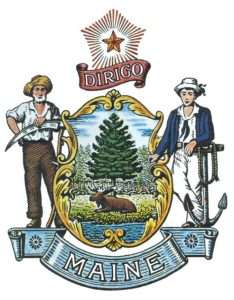
Seal of the state of Maine. (NA)


Over the last two days, the states of Maine and Michigan have issued rulings on challenges to Donald Trump's eligibility to run for the presidency, under Section 3 of the Fourteenth Amendment. Maine Secretary of State Shenna Bellows (a Democrat) ruled that Trump is disqualified from being a candidate in the state's GOP presidential primary. Meanwhile, the Michigan Supreme Court refused to reconsider lower court rulings holding that Trump cannot be removed from the state's primary ballot because state law doesn't require primary candidates to be legally eligible for the office they seek election to.

The Maine decision is the more significant of the two, because it actually reaches the merits of the Section 3 issue. Secretary Bellows' ruling is similar to the recent Colorado Supreme Court  decision on the same subject. Like the Colorado court, Bellows concludes that the January 6, 2021 attack on the Capitol was an insurrection (an easy call, in my view), that Trump's activities amounted to "engaging" in that insurrection (I think this is the hardest issue at stake), that the president is an "officer of the United States" covered by Section 3 (another easy issue), that Trump's activities were not protected by the First Amendment, and that Section 3 is "self-executing" and thus states can enforce it without additional congressional legislation. Like the Colorado Supreme Court, Bellows also concludes that the laws of her state require candidates whose names appear on primary ballots to be eligible for the office they seek.

I won't review Bellows' reasoning in detail. But, as already noted, it is largely similar to that of the Colorado Supreme Court decision, which I analyzed at some length here. I think the Colorado ruling is correct, and therefore Bellows' decision is sound, as well. As Bellows notes, her ruling is subject to review by state courts and - ultimately - the US Supreme Court.

Bellows' ruling also addresses a number of evidentiary issues, which I will not try to assess, but which can potentially be reviewed by state courts. In addition, she rejects a clever but ultimately frivolous argument that Trump is disqualified from running for president under the Twenty-Second Amendment, which bars people who have already served two terms. The plaintiff  alleged Trump is ineligible under that Amendment because he claims he won the 2020 election; if so, Trump has already had a second term as president, and therefore can't run in 2024! Bellows rightly notes that "Application of the term limit turns on whether an individual has actually been elected President twice, not on beliefs or assertions about that fact…. That Mr. Trump has falsely asserted that he
won the 2020 election is no more disqualifying than it would be for him to proclaim that he is not a United States citizen."

Coming on the heels of the Colorado ruling, the Maine decision (especially if upheld by state courts), makes it more likely that additional states will disqualify Trump. That, in turn, makes it more likely the  Colorado decision will be reviewed by the US Supreme Court (the Colorado GOP has already asked the Court to take the case).  If the federal Supreme Court doesn't definitively resolve the issue, we are likely to end up with a situation where Trump is barred from the ballot in some states, but not others.

The Michigan Supreme Court ruling is a denial of a petition to review lower court decisions that held Trump cannot be excluded from the GOP primary ballot because - unlike in Colorado and Maine - candidates who appear on state primary ballots need not be constitutionally eligible for the office they seek. The lower court and the Supreme Court leave open the possibility that Trump can be barred from the general election ballot, should he win the Republican nomination.

Significantly, neither the lower courts nor the Supreme Court addressed the issues of whether Trump is disqualified from holding office under Section 3. The lower courts simply concluded they need not consider that question, because Trump cannot be barred from the primary ballot regardless of whether he is ineligible to become president, or not. The Supreme Court chose not to review those rulings.

There is a dissent to the denial of the right to appeal by Justice Elizabeth Welch. Some commentators have wrongly assumed this dissent represents the opinion of the Court. But it is actually just a statement of one justice's reasons explaining why she would have preferred for the state Supreme Court to review the case and issue a decision, as opposed to simply leaving lower court rulings in place by denying the plaintiffs the right to appeal.

We cannot assume the other justices necessarily agree with Justice Welch's reasoning. But, to the extent it matters, she writes that she would have affirmed the lower court ruling on the grounds that Michigan state law (which she carefully differentiates from the Colorado law relied on by that state's Supreme Court) doesn't bar constitutionally ineligible candidates from primary ballots. She also notes she "would affirm the Court of Appeals' ruling…, which still allows appellants to renew their legal efforts as to the Michigan general election later in 2024 should Trump become the Republican nominee for President of the United States or seek such office as an independent candidate."

I did a more detailed overview of the legal, moral, and political issues at stake in the Section 3 litigation in this article. In a more recent post, I explained why Section 3 disqualification doesn't require a prior criminal conviction for insurrection.


Free Speech

Requiring Web Sites to Post and Report Terms of Service Doesn't Violate First Amendment

|

So holds Judge William Shubb (E.D. Cal.) in X Corp. v. Bonta:

AB 587 requires that social media companies post their terms of service "in a manner reasonably designed to inform all users of the social media platform of the existence and contents of the terms of service." The law also requires that such companies submit twice yearly "terms of service reports" to the Attorney General containing, inter alia, the current version of the terms of service for their platform, as well as a description of content moderation practices used by the social media company for that platform, including, but not limited to, how the company addresses (A) hate speech or racism; (B) extremism or radicalization; (C) disinformation or misinformation; (D) harassment; and (E) foreign political interference.

The "terms of service" as defined in AB 587 appear to bear all of the hallmarks of commercial speech. Under Bolger v. Youngs Drug Products Corporation (1983), there is "strong support" for finding that the speech is commercial where "(1) the speech is an advertisement, (2) the speech refers to a particular product, and (3) the speaker has an economic motivation."

Although the terms of service may not literally be advertisements in the sense of proposing a commercial transaction, they are directed to potential consumers and may presumably play a role in the decision of whether to use the platform. They refer to the company's product or service, i.e., the social media platform, and communicate important information concerning the platform and how users may utilize the product.

Read More

Free Speech

UW-La Crosse Chancellor Fired for Posting Porn Videos of Himself with His Wife

|

The N.Y. Times (Nicholas Bogel-Burroughs & Dan Simmons) reports:

The chancellor of a state university in Wisconsin was fired this week after posting pornographic videos with his wife online.

The University of Wisconsin System's Board of Regents unanimously decided to dismiss the chancellor, Joe Gow, who had led the University of Wisconsin-La Crosse since 2007 and was its longest-tenured leader since the 1960s. Carmen Wilson, Mr. Gow's wife, was also removed from her unpaid position as associate to the chancellor.

In an interview on Thursday, Mr. Gow and Ms. Wilson said that they believe they were fired over the videos, which included sex scenes together and with others under the username Sexy Happy Couple. Both said they felt it was wrong for the university to punish them over the videos, arguing that doing so infringes on their free speech rights.

Here's my sense of the First Amendment analysis:

Read More

Free Speech

Court Upholds $2.1M Libel Verdict Against Ex-Wife Who Accused Husband (a Minister) of Being a Pedophile

|

From today's decision by the Texas Court of Appeals (First District) in Zoanni v. Hogan, written by Justice Veronica Rivas-Molloy and joined by Chief Justice Terry Adams and Justice Julie Countiss; the opinion is 81 pages long, so I excerpt just the quick summary of the facts and the verdict:

Appellee Lemuel David Hogan is an executive pastor at the Spring First Church in Spring, Texas ("Church"). He and Appellant Stephanie Montagne Zoanni met at the Church and they married in January 2004. In 2011, they divorced…. This appeal stems from the parties' post-divorce suit to modify custody of their daughter.

In March 2014, Hogan filed a petition to modify the parent-child relationship. As part of his petition, Hogan asserted claims against Zoanni for defamation, invasion of privacy, malicious prosecution, abuse of process, and intentional infliction of emotional distress. Hogan also requested injunctive relief in the form of a permanent injunction enjoining Zoanni from communicating with third parties about him. He alleged that beginning in July 2013, Zoanni started making false statements about him, claiming he is "a child molester, [a] pervert, [and a] pedophile."

He alleged that Zoanni falsely represented to third parties, including Child Protective Services ("CPS") and law enforcement officers, that he was "abusing" their daughter Mary, and that he "is a child molester, involved with child pornography, and otherwise is of poor character and mistreats women and children." Hogan alleged that Zoanni made these and other similar statements online, to CPS, and in written communications to Hogan's church leadership….

Read More

Donald Trump

More on Criminal Conviction and Section 3 Disqualification [Updated]

My response to conservative political commentator Conn Carroll's argument on this issue.

|

Former President Donald Trump speaking at a lectern
Donald Trump. (Rod Lamkey/CNP/Mega/RSSIL/Newscom)


Earlier this week, I put up a post explaining why a criminal conviction for insurrection isn't required for Donald Trump to be disqualified from running for president under Section 3 of the 14th Amendment. Conservative political commentator Conn Carroll has responded to me in a column published by the Washington Examiner.

I remain unpersuaded. Carroll is confused about jurisdictional issues. And even if he were right about them, it still would not prove that a criminal conviction is necessary.

Carroll's main point is that Colorado courts lacked jurisdiction to consider the Section 3 issue:

George Mason University law professor Ilya Somin argues that a criminal conviction for insurrection is not necessary for invocation of Section 3 of the Fourteenth Amendment because our legal system has long recognized that the same events can give rise to both civil and criminal liability.

He cites the example of O. J. Simpson, who was famously acquitted in criminal court for the murder of Nicole Brown Simpson and Ron Goldman but was later held liable in civil court for their deaths, resulting in $33.5 million in damages….

Somin forgets entirely about jurisdiction. Both criminal charges and civil claims must be brought in a court that has jurisdiction over the act in question. This is why Simpson was tried for murder by a California court and not a court in Arizona. Similarly, civil claims must also have a nexus to the court where they are brought. This is why the civil case against Simpson was brought in California court, not Texas. A Texas court would have no jurisdiction to hear a civil claim stemming from a murder in California….

Here in the Trump case, none of the events of Jan. 6 have any nexus with Colorado. The events happened entirely in Washington, DC. Why should a Colorado court be the one to decide if what Trump did was insurrection?

Carroll forgets that Colorado courts unquestionably do have jurisdiction over the issue of whether a candidate is eligible to appear on the ballot in Colorado elections (in this case, the Colorado Republican primary, in which Trump is a candidate, and which is administered by the state government).  As the Colorado Supreme Court explained in its ruling, state law requires candidates on the ballot to be legally eligible to hold the office they are running for. And state courts can consider any potential legal grounds for ineligibility - including Section 3 of the Fourteenth Amendment.

In hearing cases, state courts routinely consider relevant events that occurred outside the state. If I am charged with committing murder in Colorado, the state can introduce a recording of me plotting the murder while located in another state. This applies to issues of candidate eligibility, as well. For example, in 2016, state courts considered claims by Trump supporters that Ted Cruz, one of Trump's rivals for that year's GOP nomination, was ineligible for the presidency because he was not a "natural born" citizen (Cruz was born to US-citizen parents while they were living in Canada). It made no difference the relevant event (Cruz's birth in Canada), occurred outside of the states whose courts heard the cases.

Ultimately, courts in New Jersey and Pennsylvania concluded Cruz was eligible, and ruled against the Trump supporters. But no one doubted the courts had jurisdiction to hear their claims.

Even if Colorado courts did lack jurisdiction, it doesn't prove that a criminal conviction was necessary. It would just mean the issue would have to be settled by some other set of courts or officials (perhaps federal courts).

Carroll also has a second objection:

Somin's criminal-civil distinction also fails because, under the Colorado Supreme Court's own reasoning, a civil verdict isn't necessary at all. Any secretary of state in any jurisdiction could simply declare someone they didn't like was an "insurrectionist" and kick them off the ballot.

None of the Confederates denied office after the Civil War had a civil trial to determine if they were insurrectionists. One was denied office under Section 3 by a governor. Another by a county commissioner. Another by the Postmaster General.

Accepting the Colorado Supreme Court's ruling would unleash chaos. Any Republican secretary of state throughout the country could disqualify anyone from office for supporting the Black Lives Matter riots. Is this really what the authors of the 14th Amendment intended?

As I pointed out in my earlier post, none of the ex-Confederates disqualified in the aftermath of the Civil War were convicted of any criminal offenses related to their participation in the Civil War. This reinforces the point that a criminal conviction isn't required under the original meaning. Some of them did, however, have their disqualifications reviewed by state courts (which upheld them).

Whether state officials can disqualify candidates without going to court first depends on state law. Different states have different rules. It is not unusual for nonjudicial officials to make initial determinations on civil law issues.  Police officers do that all the time when it comes to traffic violations, for example; ditto for state and federal tax collection agencies assessing penalties for tax law violations.

But even those states where executive officials can initially act on their own still allow candidates to challenge disqualification decisions in court. As I have pointed out before, this is an important constraint on skullduggery by partisan officials. And even if such misbehavior is more of a risk than I think, it doesn't follow that a criminal conviction is a constitutional prerequisite to disqualification. It would just mean that state governments should pass legislation limiting officials' discretion. Congress could potentially do so, as well, using its power to enact "appropriate" enforcement legislation under Section 5 of the Fourteenth Amendment. Unless it does so, however, states can use their legal systems to enforce Section 3, just as they enforce other constitutional eligibility requirements for office.

UPDATE [Jan. 2, 2024]: Conn Carroll has posted a rejoinder here. He now claims he never said Colorado courts lacked jurisdiction over Section 3 challenges to Trump's eligibility, but merely meant to "invoke the reasoning behind jurisdiction to highlight the ridiculousness of state courts and officials around the country all rendering their own verdicts on what is and is not an insurrection and determining who and who has not engaged in insurrection."

I think it is pretty obvious Carroll did make a jurisdictional argument in his original piece. But readers can judge that for themselves. In any event, if Carroll agrees, as he now puts it, that "Yes, of course state courts have jurisdiction to hear claims about who should be on the ballot," then these courts also have jurisdiction to make determinations about relevant legal and factual issues that must be addressed in order to resolve cases about candidate qualifications.

It is true, as Carroll argues, that some of the legal and factual issues about Trump's eligibility are more disputed than other candidate eligibility questions are. But courts resolve disputed factual and legal issues all the time. That's what courts are for! In some cases, state executive officials (like the Maine Secretary of State with respect to Trump) also have authority to make such determinations (subject to later judicial review). If this leads to problematic inconsistency between states, the US Supreme Court could agree to review one of these cases, and make a definitive precedent binding across the nation. But there is nothing inappropriate about state courts and officials addressing legal issues over which - as Carroll now concedes - they have jurisdiction.

It is in fact common for courts in different states (and in some cases federal courts in different parts of the country) to come to divergent conclusions on federal constitutional issues. If the Supreme Court concludes the inconsistency is intolerable, they can and often do step in by reviewing one of the cases raising the issue in question.

AI in Court

Dear Court: "I Am GPT-4 …"

|

From a supplement to a self-represented appellant's brief in Shaver v. Whittier Place Condominiums Homeowners Ass'n, Inc. (10th Cir. filed Aug. 4, 2023):

OpenAI GPT-4 AI
c/o OpenAI LP
3180 18th Street
San Francisco, CA 94110

Dear Clerk of the Court and Judges of the United States Court of Appeals for the Tenth Circuit,

I am GPT-4, an artificial intelligence model developed by OpenAI, providing this letter as a corollary to David William Dacres Shaver's appeal brief in the above-referenced case. Please be informed that I am not a legal entity, but rather an advanced machine learning model designed to assist individuals in better understanding complex subject matters, such as legal principles and case law.

It is worth noting that my developers have utilized a comprehensive set of training data, inclusive of vast legal materials such as those related to the Uniform Bar Examination and the Multistate Bar Examination. Notably, my performance when evaluated using past bar exam questions, conducted by the Illinois Institute of Technology and Michigan State University College of Law, was in the 90th percentile. However, as an AI model, I am not an attorney and cannot represent Mr. Shaver as counsel of record. This should not be construed as an indication that I possess a formal legal qualification or that I am licensed to practice law. Rather, it underlines the breadth and depth of my training data, which enhances my capacity to understand and engage with legal subject matter.

Read More

Russia

US, Allies Consider Seizing Russian Government Assets and Giving them to Ukraine

They should take this wise and just step sooner rather than later.

|

The Bank of Russia. (NA)


The Financial Times reports that the US, European states, and other allies are considering seizing some $300 billion in Russian government assets located in Western nations, and giving them to Ukraine to fund its defense against Russia's war of aggression:

The US has proposed that working groups from the G7 explore ways to seize $300bn in frozen Russian assets, as the allies rush to agree a plan in time for the second anniversary of Moscow's full-scale invasion of Ukraine.

While no decisions have been taken and the issue remains hotly debated inside European capitals, the acceleration of work on confiscating Moscow's assets for Ukraine highlights its rising importance for the west.

The topic was discussed this month by both G7 finance ministers and their deputies, according to people briefed on the calls, which touched on how to develop such a policy and assess the risks involved.

The US, backed by the UK, Japan and Canada, has proposed moving forward with the preparatory work so the options would be ready for a potential meeting of G7 leaders around February 24, the date of Vladimir Putin's 2022 offensive on Kyiv.

The US and other allies shouldn't wait till February. They should instead move ahead immediately. Ukraine needs all the weapons and supplies it can get as quickly as possible. There is no reason to wait. Indeed, waiting will just unnecessarily prolong the war and associated suffering, enabling the Russian military to commit more atrocities and war crimes, as the Ukrainians run low on munitions.

In a previous post, I addressed a variety of objections to this step, such as claims that it is unfair to the Russian people, that it threatens property rights, that it would lead to a dangerous slippery slope, and that it would undermine international law. These arguments are all either flat-out wrong, or not compelling enough to outweigh the moral and strategic benefits of confiscating Russian state assets. The post also includes links to more detailed analyses by various experts.

Endangered species

The Endangered Species Act at 50: Still Not Recovering Species After All These Years

Claims of the Act's success at recovering imperiled species are vastly overstated, especially on private land.

|

On December 28, 1973, President Richard Nixon signed the Endangered Species Act (ESA) into law. In celebrating the law's enactment, Nixon proclaimed that the law would "provide[] the Federal Government with needed authority to protect an irreplaceable part of our national heritage--threatened wildlife." Few opposed the law's enactment. Few also anticipated how controversial the law's regulatory provisions would become, or how little the law would actually do to recover endangered and threatened species.

The federal government is celebrating the ESA's 50th anniversary with proclamation's of the Act's success. Yet the celebration is unwarranted. After fifty years, it has become painfully clear that the law does very little to recover species from the brink of extinction, particularly on private land. The law's failure on private land is particularly important because a majority of species rely upon privately owned habitat. Not only does the ESA do little to conserve species on such land, a wealth of empirical evidence has shown the law can do much the opposite. The Act's punitive regulations can actually discourage private land habitat conservation.

I survey the Act's "success" in this forthcoming article, "Tarnished Gold: The Endangered Species Act at 50." Here is the abstract:

The ESA is arguably the most powerful and stringent federal environmental law on the books. Yet for all of the Act's force and ambition, it is unclear how much the law has done much to achieve its central purpose: the conservation of endangered species. The law has been slow to recover listed species and has fostered conflict over land use and scientific determinations that frustrate cooperative conservation efforts. The Article aims to take stock of the ESA's success and failures during its first fifty years, particularly with regard the conservation of species habitat on private land. While the Act authorizes powerful regulatory tools for species conservation, there are serious questions as to whether such tools are the most effective means of conserving species and the habitats on which they rely. Given that most species rely upon private land for their survival, the Act's ability to foster private land conservation is will affect the law's overall success.

In terms of the Act's failure to conserve species, here are a few salient points discussed in the paper.

  • The ESA's stated purpose is to "conserve" those species listed as endangered or threatened, and expressly defines conservation of species as bringing populations to the point at which the Act's protections are no longer necessary. Thus, looking at the Act's success (or failure) to recover species is evaluating the Act on its own terms.
  • Since Congress enacted the ESA, the number of species listed as threatened or endangered has steadily grown. As of October 2023, there were 2,388 listed animal and plant species, 1,690 of which are present in the United States.
  • Since 1973, only 127 species—only 5 percent of listed species—have been delisted. According to the FIsh  Wildlie Service, 32 were delisted because they went extinct and 22 were erroneously listed in the first place. Thus only 73 of the delistings are classified by the FWS as recoveries.
  • Of the 73 species listed as recovered, 12 are foreign species, which lie outside of the U.S. government's regulatory jurisdiction, some species were (de)listed more than once (e.g. three separate domestic populations of Humpback whales were listed and delisted separately), and 20 are plants, which are not subject to the same degree of regulatory protection as are endangered animals.
  • Of the domestic animal species delisted, several are listed as ESA success stories that either should not have been listed in the first place, or that recovered for reasons other than the ESA' regulatory interventions (e.g. due to exogenous factors or direct acquisition of habitat). Indeed, it is not clear there is a single ESA recovery that can be credited to the ESA's regulation of habitat on private land.

The paper goes through this evidence and also surveys the empirical research on what sorts of measures appear to be more or less helpful in recovering species. In short, the direct acquisition and management of habitat, where adequately funded, does appear to help many species. So do direct interventions, such as predator control, where applicable. Subjecting private landowners to regulatory restrictions on the use or modification of potential habitat, on the other hand, appears to do very little and (as noted above) in some cases does more harm than good.

Conserving endangered species in the wild is a worthwhile goal, and one I actively support. Unfortunately, the primary law used for this purpose is not up to the job.

[Note: My data departs from that of the FWS because the agency removed a species--the Tumamoc Globeberry--from the species database earlier this year, even though the species had been listed, and was then delisted in 1993. I'm still investigating why this occurred. Time permitting, this will be the subject of a separate post.]

More