

City of Columbus v. Mercantile Trust & Deposit Co. of Baltimore, 218 U.S. 645, 663 (1910): "In the case of Atty. Gen. v. Birmingham, the vice chancellor said: 'I am not sitting here as a committee of public safety, armed with arbitrary power to prevent what it is said will be a great injury not to Birmingham only, but to the whole of England; that is not my function.'"
The Volokh Conspiracy
Mostly law professors | Sometimes contrarian | Often libertarian | Always independent | Est. 2002
Antisemitism Lawsuit Filed against Harvard University, Includes Allegations re Harvard Law School
The complaint contains detailed allegations of hostile environment, breach of contract, and disparate treatment. Here is the entire complaint: Kestenbaum v. Harvard (D. Mass. 1-11-24) (complaint) (1)
As in previous complaints related to university antisemitism, I find that the strongest claims are that (a) the university refuses to enforce its own, content-neutral, rules (In this context, for example, I can't see any legitimate reason for HLS to allow pro-Hamas students to take over Casperson lounge); and (b) the university reacts quite differently to complaints of antisemitism than it does to complaints of other sorts of bias, resulting in disparate treatment of Jewish students. Here are the allegations related to Harvard Law School:
50. Harvard PSC, SJP, and similar groups have harassed Jews on campus for years without consequence, exemplifying Harvard's deliberate indifference to its severe antisemitism problem. For example, on April 14, 2016, Harvard Law held an event featuring a speech by Tzipi Livni, a leading Israeli politician. At the event, a student SJP leader accosted Livni, asking her, echoing anti-Jewish stereotypes promoted by, among others, the Nazis: "How is that you are so smelly? It's regarding your odor—about the odor of Tzipi Livni, very smelly." Harvard did not discipline this student, but, instead, the then-dean of Harvard Law—while recognizing that "[m]any perceive [the incident] as anti-Semitic"—responded "that speech is and should be free," notwithstanding that the conduct plainly violated policies including Harvard's Statement on Rights and Responsibilities.
57. In May 2021, in response to a Jewish Israeli student's post in a WhatsApp group, a Harvard Law student, Shayaan A. Essa, messaged, "We shed your blood with stones." A group of Jewish Israeli students reported the incident to Dean Jessica Soban, Deputy Dean I. Glenn Cohen, and Assistant Dean-appointee Catherine Peshkin. In a meeting with the deans, the students explained how this violent threat left them "heartbroken and humiliated" and "no longer feel[ing] comfortable," and asked the deans to denounce Essa's call for violence. The deans refused to do so, instead downplaying the message and telling the students to ignore or respond directly to such harassment. Harvard chose to do the former, and Essa graduated without consequence. Two of the Jewish Israeli students, who are still enrolled at Harvard Law, report that they feel unsafe and have trouble focusing as a result of Harvard's clearly unreasonable response to antisemitism, including Essa's conduct, and the increased anti-Jewish hostility on campus following Hamas's October 7 terrorist attack. One such student told his young children not to speak Hebrew outside their home, out of fear they will be targeted by antisemitic Harvard community members.
59. In October 2021, the Harvard Law Program on Law & Society in the Muslim World and numerous Harvard student groups co-sponsored a pro-BDS event, "Law and Violence in Palestine," at which a speaker was Mohammed El-Kurd, who notoriously espouses antisemitic views, has repeatedly and publicly announced his fantasy of murdering Jews, and claims that Israelis and Zionist Jews eat Palestinians' organs, a vile antisemitic blood libel.
95. On October 16, students chalked antisemitic writings at the entrance to Harvard Law, using phrases such as "from the river to the sea" and "divest from Israeli apartheid." Notwithstanding requests to administrators, no action was taken.
97. The Die-In protesters also harassed and physically assaulted Jewish students. A video that went viral on social media shows a group of students swarming a Jewish Israeli Harvard Business student, holding their keffiyehs open to surround and physically restrain him while screaming, "shame!" over and over again. Ibrahim Bharmal, a Harvard Law Review editor and a Civil Procedure teaching fellow, and Elom Tettey-Tamaklo, a Harvard Divinity student and residential proctor, were among the assailants and are under FBI scrutiny for their assault. Harvard has not imposed any discipline on Bharmal and has done nothing to sanction Tettey-Tamaklo other than relieving him of his proctor responsibilities.
Professor Mark Graber responds to Blackman & Tillman on the 1868 Louisville Daily Journal
In response to the "new source" described in Josh's recent post (and Tillman's recent amicus brief, and earlier in this short SSRN piece by John Connolly) Professor Mark Graber writes at Balkinization:
Eureka Not: The President is an Officer of the United States Redux, Redux . . .
Mark Graber
A long exhaustive search has finally found an article published within ten years of the framing of the Fourteenth Amendment that declares that the President is not an officer of the United States. Congratulations to Josh Blackman and Seth Barrett Tillman for unearthing the Louisville Daily Journal's series of pieces claiming, contrary to what President Andrew Johnson said about his job description, that Johnson was not an officer of the United States. Of course, the comment was not made in respect to Section Three of the Fourteenth Amendment, but apparently that is a trifle. A source does exist. Eureka.
Maybe not. An historian might ask, how representative is the Louisville Daily Journal and what is the Louisville Daily Journal representative of? With respect to the second question, a little newspaper search revealed that the Louisville Daily Journal was a Democratic party newspaper bitterly opposed to the Fourteenth Amendment, the impeachment of Andrew Jackson, and the possible presidency of radical Republican Senator Benjamin Wade of Ohio, the probable president if Johnson was impeached (unless Senators were not officers of the United States). Before Donald Trump was subject to disqualification, originalists thought that the Republicans who voted for the Fourteenth Amendment were the authoritative source on the original meaning of that text. Now apparently Democrats are the higher authority. I look forward to many changes in the Supreme Court's jurisprudence based on how white supremacists and former rebels described the post-Civil War Amendments (hint, black rule is constitutionally mandatory).
With respect to the first question, I decided to do two random searches. The first was the record of the Andrew Johnson impeachment. The second was American newspapers in 1868 (I used the Newspapers Archives site). For the first, I searched "officers of." For the second, I searched "officers of the United States" (I did a narrower search simply because "officers of," which got 71 hits for the impeachment, would have gotten a few thousand for Newspaper Archives, almost all of which would not have been on point. Indeed, I looked at only the first 200 of the more than five hundred hits I got).
The first finding was Common Sense 15, Blackman/Tillman 0*.
Professor Quits Because Some Students Have Bad Beliefs
I read with interest Mauricio Karchmer's Why I Quit My Dream Job at MIT, published Tuesday in The Free Press; but its perspective struck me as rather alien to the very nature of a modern secular American university.
The author begins by pointing to what he sees as MIT's inadequate condemnation of the Hamas attack; some students' "chant[ing] 'Free Palestine' and 'From the river to the sea' with fury and at times glee, like they were reciting catchy songs instead of slogans demanding the erasure of the Jewish people"; several colleagues' "endorsing this behavior"; and the upset this caused to Jewish and Israeli students. But eventually he offers this as the main reason for quitting:
Over 65 percent of students from each MIT undergraduate class—or around 800 students—enroll in my Introduction to Algorithms course every year. When I looked at the names of the leaders of some of the most violent anti-Israel groups on our campus, I found a handful of my students on the list. Then I found out that one of my former teaching assistants—a bright young woman—was one of the organizers of the Coalition Against Apartheid and helped bring Mohammed El-Kurd to campus.
I loved my job. But I realized there and then I could no longer train kids in algorithms, knowing they might one day spread this ideology even further through their advanced knowledge. I knew I could no longer be a part of a system that foments antisemitism. In late November, I sat on the ferry I used to take from MIT's campus back home and decided that I should resign. I have worked hard throughout my professional life to have choices, so I have the luxury of acting on my principles. A few weeks later, on December 13, I handed in my resignation to the head of the department.
My letter stated, in part: "I cannot continue teaching Algorithms to those who lack the most basic critical thinking skills or emotional intelligence. Nor can I teach those who condemn my Jewish identity or my support for Israel's right to exist in peace with its neighbors." …
MIT's mission is to train the next generation of leaders. But right now, I'm terrified of the thought that today's students could lead anything in the future.
Now, of course, if he doesn't want to teach at MIT any more, he has every right to make that choice. But when has there been a rule that professors should expect to teach only morally good students and not morally bad students? What would we think of a professor who quit because there were some anti-abortion or anti-affirmative-action or anti-transgender-athletes-on-women's-sports-teams students in her class, and she just can't teach students whom she perceives as so sexist, racist, transphobic, etc.? I'd think we'd say: The university is, and should be, a place for people with many different moral views to learn. I'd say the same to the author here.
Today in Supreme Court History: January 11, 1830
1/11/1830: Justice John McLean takes oath.
We're In The Section 3 Endgame Now
[This post is co-authored with Seth Barrett Tillman]
On Friday, the Supreme Court granted certiorari in Trump v. Griswold, the Section 3 case from Colorado. On Tuesday, we filed our amicus brief. We have made efforts to think through a fair number of the issues, and we have written about two of the most likely issues that the Court will address and which may resolve the case: (i) that Griffin's Case (1869) provides the rule of decision, that is, Section 3 necessitates federal enforcement legislation; and (ii) that the President is not an "Officer of the United States." The former position is based on a full-length law review article that we shared in August, though we have been developing that position—in particular, the sword-shield dichotomy—since 2021. The latter position has been a subject of our publications for a good many years. Since 2008, Tillman has been writing that the President is not an "Officer of the United States." Circa 2012, shortly after Blackman began teaching, he came round to Tillman's position.
Suffice to say, we have been giving these issues substantial thought for some time. Others less so. For example, a recent, rushed entry in this debate demonstrates the risks of jumping in too hastily. Indeed, several media accounts that relied on that paper have already had to post corrections. We have little doubt there will be more rushed and flawed entries in the debate. Critics with little or no expertise in the field will find something, anything, to prove that we are wrong. No doubt these critics will be unfamiliar with our full body of scholarship, which well exceeds a thousand pages. Critics will attack positions we never took, and ignore the positions we have actually taken. Critics will be unfamiliar with the proper context of sources from the 18th and 19th centuries. And critics will approach their conclusion with absolute certitude that they are right and Tillman/Blackman are wrong. Trust us, we've seen it all before. We could make a list of people who have said we were wrong, and then later had to retract or more. The list keeps growing.
Over the next two months or so, the United States Supreme Court is likely to provide some resolution to one or more of these contentious issues. And, we expect that more than a few will try to leave a mark on this debate in the near term and prior to judicial resolution. They will post new "research" at the last minute knowing full well that those who are in a position to confirm the accuracy of newly reported "research" will have little or no time to do so before the Supreme Court decides this case. And, for a few, that is not a bug, it is the chief feature.
If and how we respond will be a function of what time and other constraints we face in this final, pivotal period. Our candid message to you—the reader—is to approach such new, late-breaking entries in the debate with some caution.
We are in the Section 3 endgame now.
Supreme Court Oral Argument Indicates "Radical Agreement" that there is no "Legislative Exception" to the Takings Clause
That's the big takeaway from yesterday's oral argument in Sheetz v. County of El Dorado. But it's not clear whether the Court will resolve any additional issues, and if so how.
Yesterday, the Supreme Court heard oral argument in Sheetz v. County of El Dorado, an important Takings Clause property rights case. When the Supreme Court decided to take the case, most observers (myself included) thought the main issue would be whether there is a "legislative exception" to takings liability in at least some situations where the Fifth Amendment otherwise requires the government to pay "just compensation." In Nollan v. California Coastal Commission, Dolan v. City of Tigard, and other cases, the Supreme Court previously ruled that state and local governments sometimes violate the Takings Clause when they impose exactions as a condition of letting property owners develop their land. Some lower courts—including the California Court of Appeal in this case—have held there is no Takings Clause liability for land-use exactions in cases where the requirement was imposed by legislation, rather than by executive officials or regulatory agencies.
In Sheetz, a property owner had been barred by the County from building a single-family home on his property unless he first paid a $23,420 "traffic impact mitigation" fee. The official question presented by the case is this:
Whether a building-permit exaction is exempt from the unconstitutional-conditions doctrine as applied in Nollan v. California Coastal Commission and Dolan v. City of Tigard, Oregon simply because it is authorized by legislation.
If yesterday's oral argument is any indication, the Supreme Court won't have any trouble concluding the answer is "no." All or nearly all of the justices seem to agree there is no legislative exception. Indeed, even counsel for the County of El Dorado agreed.
In answer to a question by Justice Thomas, she stated that the answer to the question of whether a permit condition qualifies as a taking cannot be answered "by looking at whether there is some sort of legislation." Chief Justice John Roberts immediately noted that her "answer to the question presented is, I think, the same as the Petitioner [the property owner]."
Justice Neil Gorsuch later said he "thought we had taken the case address [the] question of whether Nollan and Dolan simply [do not] apply to legislative enactments of any kind," but oral argument revealed there is "radical agreement" on that issue. Gorsuch is a conservative justice and strong advocate of constitutional property rights. But liberal Justice Elena Kagan similarly stated there "there is radical agreement…. that you don't get a pass from unconstitutional conditions analysis just because you've passed generally applicable legislation. And that's, of course, true in unconstitutional conditions analysis generally, and so too it's true of unconstitutional conditions analysis in the property area."
With such unaccustomed consensus between the justices and the parties to the case, I think it overwhelmingly likely the Court will rule there is no such thing as a "legislative exception" to takings liability. The justices may even be unanimous on that issue (though I am not entirely sure Justice Sotomayor will agree, so they may not). For reasons summarized here, I think this resounding rejection of the legislative exception theory will be the right result.
That, however, still leaves the difficult question of what kinds of regulatory fees qualify as takings, and which do not. Over the course of the oral argument, the justices struggled with this issue. It's hard to tell what they will say if they try to resolve it, and how broad the resulting ruling will be.
A number of questions focused on the issue of whether tolls and user fees qualify as takings if the property owner prevails. I think the answer is "no," because there is a crucial distinction between the government charging a fee for the use of public property (such as a highway), and charging a fee in exchange for letting the owner use his or her own property, as in this case, where Sheetz must pay a large sum just to be able to build a house on his own land. Some justices also raised the perennial issue of how to distinguish takings from property taxes.
The Court could avoid these problems entirely by limiting its holding to the legislative exception issue (which, after all, was the focus of the official question presented), and remanding the rest to the lower courts. Gorsuch and Thomas appeared to want to do just that. But I don't know if there are three other justices who will go along with that approach. If not, it's hard to predict how much further the Court will go with its holding and what it will say.
For more analysis of the Sheetz oral argument, check out posts by Robert Thomas at Inverse Condemnation, and Tim Mulvaney at PropertyProfblog. Mulvaney has helpful additional details on what the Court might do if they decide to go beyond simply rejecting the legislative exception theory.
NOTE: The property owner is represented by the Pacific Legal Foundation, which is also my wife's employer. However, she is not part of the litigation team working on the case.
Louisville Daily Journal (April 1868): The President is not an "Officer of the United States"
A new source in the debate over Section 3 of the Fourteenth Amendment.
[This post is co-authored with Professor Seth Barrett Tillman]
In our view, the phrase "Officers of the United States" does not refer to the President. This was true in 1788, was true in 1868, and is true today. A common refrain from Professor Mark Graber and others is that we have pointed to no one who publicly stated that view "within a decade" of the Fourteenth Amendment's ratification. Graber has also narrowed that window to the 1860s. He wrote, "No evidence exists that any member of Congress, member of a state legislature, political activist, journalist, or hopeless crank during the 1860s thought a president was not an officer of the United States." Is the relevant time frame from 1858 to 1878 (i.e., a decade before and after ratification), from 1860-1870 (i.e., the decade of ratification), or from 1866 to 1868 (i.e., the ratification period)? Relatedly, Michael Stern wrote "there is no record of anyone else, eminent thinker or otherwise, saying" that the President does not hold an Office under the United States "in the Constitution's first two centuries." We have long faced shifting evidentiary targets, since January 6, 2021 and since the beginning of Section 3 litigation. Those who have made and relied upon these and similar categorical empirical claims took a risk: that no such statement actually existed. They made a falsifiable claim, and here in this post, we will show that the claim is false. We discussed these articles and issues in our recently-filed amicus brief before the U.S. Supreme Court.
In April 1868, the Louisville Daily Journal published a series of articles contending the President is not an "Officer of the United States" as that phrase is used in the Constitution. Albeit, these newspaper articles did not address the meaning of that phrase with respect to Section 3. Still, we submit that the text of the Fourteenth Amendment would have been well-familiar to the public during this pivotal juncture. At the time, state ratification of the Fourteenth Amendment remained ongoing. Still, even timing aside, these newspaper articles are instructive for the Section 3 analysis. Why? The newspaper articles used the same mode of analysis that we have repeatedly used to understand the meaning of the phrase "Officers of the United States": considering how the phrase "Officer of the United States" is used in the Commissions Clause and the Impeachment Clause; established practices of the government since 1788; parsing the records from the Blount impeachment trial; relying on analysis from Justice Story's Commentaries on the Constitution; and more.
To be sure, in 1868, as today, there were debates about whether the President is an "Officer of the United States." Indeed, the Louisville, Kentucky newspaper responds to a Cincinnati, Ohio newspaper article that took the opposite position. In short, the same debates being held today about textualism and purposivism, and how those methodologies should be applied to the Constitution's "officer of the United States"-language, were also held 150 years ago.
Here, we give all credit to John Connolly, who located these Louisville Daily Journal sources, along with several related contemporaneous newspaper articles. Again, these statements were made in a newspaper from Louisville (where Blackman fondly lived for a year during his clerkship). We have no reason to believe these statements were not understood. We have no reason to believe that these views were rejected by all, or even most citizens, as less than reasonable. And we have no reason to suspect that the reasoning here was so obscure that similar statements do not appear elsewhere. How few or how many such similar statements might exist in other sources is yet to be published.
Louisville Daily Journal, April 11, 1868, Page 1
The first of the three articles in the Louisville Daily Journal was published on Saturday, April 11, 1868. The article asked and answered the threshold question:
Today in Supreme Court History: January 9, 1919
1/9/1919: Schenck v. United States argued.
Canada Reverses Blocking of Citizenship for Russian Migrant Convicted of "Crime" of Speaking Out Against Russian Atrocities in Ukraine
Good that sanity prevailed on this issue.

Last week, I wrote about the case of Maria Kartasheva, a Russian immigrant whose application for Canadian citizenship was blocked because a Russian court convicted her of the "crime" of speaking out against Russian atrocities in Ukraine. She could even potentially have been deported back to Russia, where an eight-year prison sentence awaited her. For reasons outlined in my earlier post, this was a truly ridiculous decision. Fortunately, Canada's Ministry of Immigration, Refugees, and Citizenship has now announced a reversal of this previous action, and Kartasheva will be granted citizenship, after all:
A Russian antiwar activist living in Ottawa has been granted Canadian citizenship after all, despite a conviction in Russia that threatened to disqualify her.
Maria Kartasheva, 30, has lived in Ottawa since 2019.
She was convicted under a Russian law passed shortly after the full-scale invasion in of Ukraine in February 2022. The law prohibits "public dissemination of deliberately false information about the use of the Armed Forces of the Russian Federation."
Her convictions stem from two blog entries from March 2022, when she posted photos and wrote in Russian expressing her horror at the Bucha massacre…..
Under Canadian immigration rules, if an applicant is charged with a crime in another country that could be indictable under Canada's Criminal Code, their application can be revoked or refused….
According to a December letter from Immigration, Refugees and Citizenship Canada (IRCC), the crime she committed in Russia "would equate to false information under subsection 372(1) of the Criminal Code of Canada…."
On Tuesday afternoon, Canadian Minister of Immigration, Refugees and Citizenship Marc Miller said in a social media post that Kartasheva "will not face deportation and has been invited to become a Canadian citizen."
I am happy that sanity prevailed in this case. But it's ridiculous the issue was ever in doubt in the first place. Speaking out against horrific war crimes is surely not the kind of "crime" that can ever justify denial of citizenship or deportation from any liberal democracy worthy of the name.
Since the start of the conflict, I have been making the case that the US and other Western nations - including Canada - should open their doors to Russians fleeing Vladimir Putin's increasingly repressive regime. Even for those who wouldn't go as far in this direction as I advocate, the case of a dissenter facing imprisonment for speaking out against Putin's war war should be a no-brainer.
Notre Dame Professor's Lawyers Argue: Student Newspaper's Mission to Defend Notre Dame's Catholic Character Means …
that it’s probably not “‘trying to advance the public exchange of ideas’ essential to a healthy democracy.”
Prof. Tamara Kay's lawyers' response to the motion to dismiss her libel lawsuit against the Irish Rover newspaper argued that the articles about her were unprotected by the First Amendment, partly because:
[G]iven that the mission of the Irish Rover is "to articulate and defend the Catholic character of the University," it seems improbable if not impossible that in publishing the October 12 and March 22 Articles, the Irish Rover and its faculty advisors and other Notre Dame faculty were trying to advance "the public exchange of ideas" essential to a healthy democracy.
As I mentioned in an earlier post, the trial court was unimpressed, and dismissed Prof. Kay's libel claim.
Professor's Lawyers Argue: Private University Student Newspapers Are "Not Entitled to First Amendment Protection"
The lawyers also argue that the speech in the newspaper was “not made pursuant to its right of free speech, but to instead to advance the personal agendas of male faculty members at Notre Dame [and others].”
From the response to the motion to dismiss in Kay v. Irish Rover Inc. (filed by Kimberly D. Jeselskis, B.J. Brinkerhoff, and MacKenzie A. Watson of Jeselskis Brinkerhoff and Joseph LLC) (emphasis added):
[A.] Defendant's Motion Should Be Denied Because the Irish Rover's October 12 and March 22 Articles Regarding Professor Kay Were Not in Furtherance of the Right to Free Speech.
The Irish Rover presumes that as a student newspaper it is somehow automatically entitled to the protections of the First Amendment or the Indiana Constitution. However, this is simply not true. The Irish Rover is not entitled to First Amendment protection as it is a private student newspaper at a private university. The First Amendment was designed by its framers to foster unfettered discussion and free dissemination of opinion dealing with matters of public interest and governmental affairs. Mills v. Alabama, 384 U.S. 214, 218-219 (1966). The First Amendment, however, does not protect rights of speech and assembly against interference or impairment by private individuals. Lloyd Corp. v. Tanner, 407 U.S. 551 (1972).
Notre Dame Pro-Abortion-Rights Professor Loses Libel Lawsuit Against Student Newspaper
Prof. Tamara Kay, a sociology professor at Notre Dame, sued a student newspaper (The Irish Rover) for libel. Prof. Kay's position was apparently that these statements—in an October article, a March article, and a Tweet regarding the October article—"were not made in good faith and with a reasonable basis in law and fact" (see also the Complaint):
- Keough School Professor Offers Abortion Access to Students
- Abortion assistance offered to students despite IN law, ND policy
- Notre Dame Professors Help Students Obtain Abortions
- Kay used this panel as a platform…complementing her work to bring abortion to Notre Dame students.
- The letter "J" on office doors denotes Notre Dame professors who are willing to help students access abortion.
- Much of Kay's efforts to help students obtain abortion services…
In yesterday's Kay v. Irish Rover Inc., Judge Steven David (St. Joseph County, Indiana) held that the statements were basically accurate, and as a result granted defendant's "anti-SLAPP" motion to dismiss; an excerpt:
On September 15, 2022, Indiana S.B.1 took effect, limiting abortion in Indiana, although the law was enjoined shortly thereafter.
In addition, on the same day, Dr. Kay affixed a poster to her office door that read: "This is a SAFE SPACE to get help and information on ALL healthcare issues and access –confidentially and with care and compassion. My non-ND email is reprohealthahumanright@pm.me." Dr. Kay also put a J surrounded by a circle on her door.
Around this same time, Dr. Kay tweeted: "Such a devastating day to be a woman in IN. But women faculty @NotreDame are organizing. We are here (as private citizens, not representatives of ND) to help you access healthcare when you need it, & we are prepared in every way. Look for the "J" Spread the word to students!"
Dr. Kay also tweeted links to organizations providing Plan B and Plan C abortifacient pills. Both Abortion Finder and Catholics for Choice provide information on how to receive reimbursement for costs for traveling out of state for abortion and how to get abortion pills by mail and describe what the woman will have to do if her state does not legally permit such abortions.
The Catholics for Choice tweet publicized a Twitter account "@PlanCpills," which provides a guide for abortion pills by mail in all 50 States and encourages women to "Get Abortion Pills Now, Just In Case." See id. Dr. Kay's September 16, 2022, tweet, in which she shared photos of "Need to be un-pregnant" stickers with QR codes that led to "PlanCPills.org," preceded by the text, "DM me if you want some physical stickers. A lot have been ordered. Sharing information is still legal in Indiana!"
The J symbol, which was on Dr. Kay's door, was commonly understood by some people on Notre Dame's campus, and some people outside Notre Dame to symbolize those who were upset about abortion bans/or fighting for abortion rights/access.
Dr. Kay maintained that the "J" in the tweet was only meant to indicate that she was an advocate for victims of sexual assault. The Court finds that the "J" on Dr. Kay's door, particularly when read in context with the other words and statements on her door, and her statements and tweets and work that was being done contemporaneous to this relevant time, can most reasonably mean to infer something much broader than just being an advocate for victims of sexual assault but was being used, in conjunction with the other statements on the door, and her other statements, tweets, writings and social media, to identify her as one who is "willing to help students access abortions," including abortion pills, as well as assist victims of sexual violence. This is consistent with her position on abortion as set forth in her articles and social media communications.
New Univ. of Texas Law Class on "Understanding Conservative Legal Thought"
I thought this item from Prof. John Greil at Texas was much worth passing along; he is still developing the syllabus, and comments and suggestions are welcome at john [dot] greil [at] law [dot] utexas [dot] edu:
Next fall semester, I'll be teaching a new course at Texas Law—Understanding Conservative Legal Thought. It's modeled largely off what Steve Sachs and Ernie Young did at Duke, as well as what Judge Katsas and Alida Kass are doing at George Washington. I want to give students a chance to grapple with the big legal debates happening right-of-center today, as well as teach students the skills to effectively advocate in front of today's judges.
The course will likely be seven 2-hour sessions, with (I'm hoping) some excellent guests joining us. In addition to the content, I'm really excited about the structure, where I aim to bring some of the seminar experience I had in Notre Dame's Great Books program (the Program of Liberal Studies) to the classroom. To that end, I plan to have students lead discussions and grade (partially) based on an oral exam.
I'd love to get feedback on the list, and I think your readership is the best place to get that feedback. [The readings largely include excerpts from the cited sources, not the entire works. -EV] I'm especially interested in pieces that work well with newcomers to the debates. The biggest problem (which is a good one to have!) is too much great stuff, and not enough time. I'm doing a one-credit course to get a feel of it, and hope to expand it the year after.
Session 1: What is a seminar?
- Vincent Lloyd, A Black Professor Trapped in Anti-Racist Hell, Compact Magazine (Feb. 10, 2023)
- Paula Marantz Cohen, The Lost Art of Academic Conversation, The Chronicle of Higher Education (Mar. 14, 2023)
- Stephen E. Sachs, Institutions and Platforms, The Volokh Conspiracy (Oct. 26, 2020), https://reason.com/volokh/2020/10/26/institutions-and-platforms/
What is a Conservative?
- F. A. Hayek, Why I am Not a Conservative, in The Constitution of Liberty (Ronald Hamowy ed., 2011) (1960).
- William Baude, FedSoc is a They, not an It, Summary, Judgment (Nov. 21, 2019), https://www.summarycommajudgment.com/blog/fedsoc-is-a-they-not-an-it.
Amicus Brief Filed in Trump v. Griswold On Behalf of Professor Seth Barrett Tillman
"By contrast, a holding that the President is not an 'Officer of the United States' would authoritatively resolve the Section 3 case against the Petitioner. In that event, it will be the people, and not judges, or state officials, or Congress, who will decide."
On Friday, January 5, the Supreme Court granted certiorari in Trump v. Griswold, the Section 3 case from Colorado. Today, my co-counsel and I filed an amicus brief on behalf of Professor Seth Barrett Tillman in support of the Petitioner. (The Court set January 18 as the deadline for amicus briefs, but we filed early.)
Here is the summary of the argument:
This case turns on two threshold questions: "Can States enforce Section 3 in the absence of federal enforcement legislation?" and "Is the President an 'Officer of the United States'?" Both of these questions were settled long ago. In Griffin's Case, Chief Justice Chase recognized that Section 3 of the Fourteenth Amendment required federal enforcement legislation. And a historical tradition stretching back to the Early Republic establishes that "Officers of the United States," as used in the Constitution, are appointed, and not elected. Yet, this settled tradition was unsettled in the wake of January 6, 2021. The Colorado Supreme Court discarded Griffin's Case and ignored all textual evidence that the President is not an "Officer of the United States."
This Court should reverse on both grounds. First, Griffin's Case settled the meaning of Section 3, is consistent with the longstanding sword-shield dichotomy in federal courts' jurisprudence, and reflects a core premise of reconstruction: Congress, and not the distrusted States, was empowered to enforce Section 3. Second, the four provisions of the Constitution of 1788 that use the phrase "Officers of the United States" do not refer to the President. And the Framers of Section 3 used that older, extant, limited language, in particular the Oaths Clause, and in doing so carried forward the meaning of "Officers of the United States" from that "old soil." In 1788, 1868, and today, "Officer of the United States" in the Constitution extends exclusively to appointed positions and not to elected positions.
A ruling on the first ground would immediately halt the litigation in Colorado and other States. A ruling on the second ground would authoritatively resolve the Section 3 case against Petitioner in the leadup to January 6, 2025.
I am grateful to my co-counsel: Robert Ray, R. Scott Reisch, Jessica L. Hays, and C. Thomas Ludden.
After the jump, I've included key excerpts from the brief.
Triangulating Apple
Episode 486 of the Cyberlaw Podcast
Returning from winter break, this episode of the Cyberlaw Podcast covers a lot of ground. The story I think we'll hear the most about in 2024 is the remarkable exploit used to compromise several generations of Apple iPhone. The question we'll be asking is simple: How could an attack like this be introduced without Apple's knowledge and support? We don't get to this question until near the end of the episode, and I don't claim great expertise in exploit design, but it's very hard to see how such an elaborate compromise could be slipped past Apple's security team. The second question is which government created the exploit. It might be a scandal if it were done by the U.S. But it would be far more of a scandal if done by any other nation.
Jeffery Atik and I lead off the episode by covering recent AI legal developments that simply underscore the obvious: AI engines can't get patents as "inventors." What's more interesting is the possibility that they'll make a whole lot of technology "obvious" and thus unpatentable. Speaking of obvious, claiming that companies violate copyright when they train AI models on New York Times content requires a combination of arrogance and cluelessness that can only be found at, well, the New York Times.
Paul Stephan joins us to note that the National Institute of Standards and Technology (NIST) has come up with some good questions about standards for AI safety.
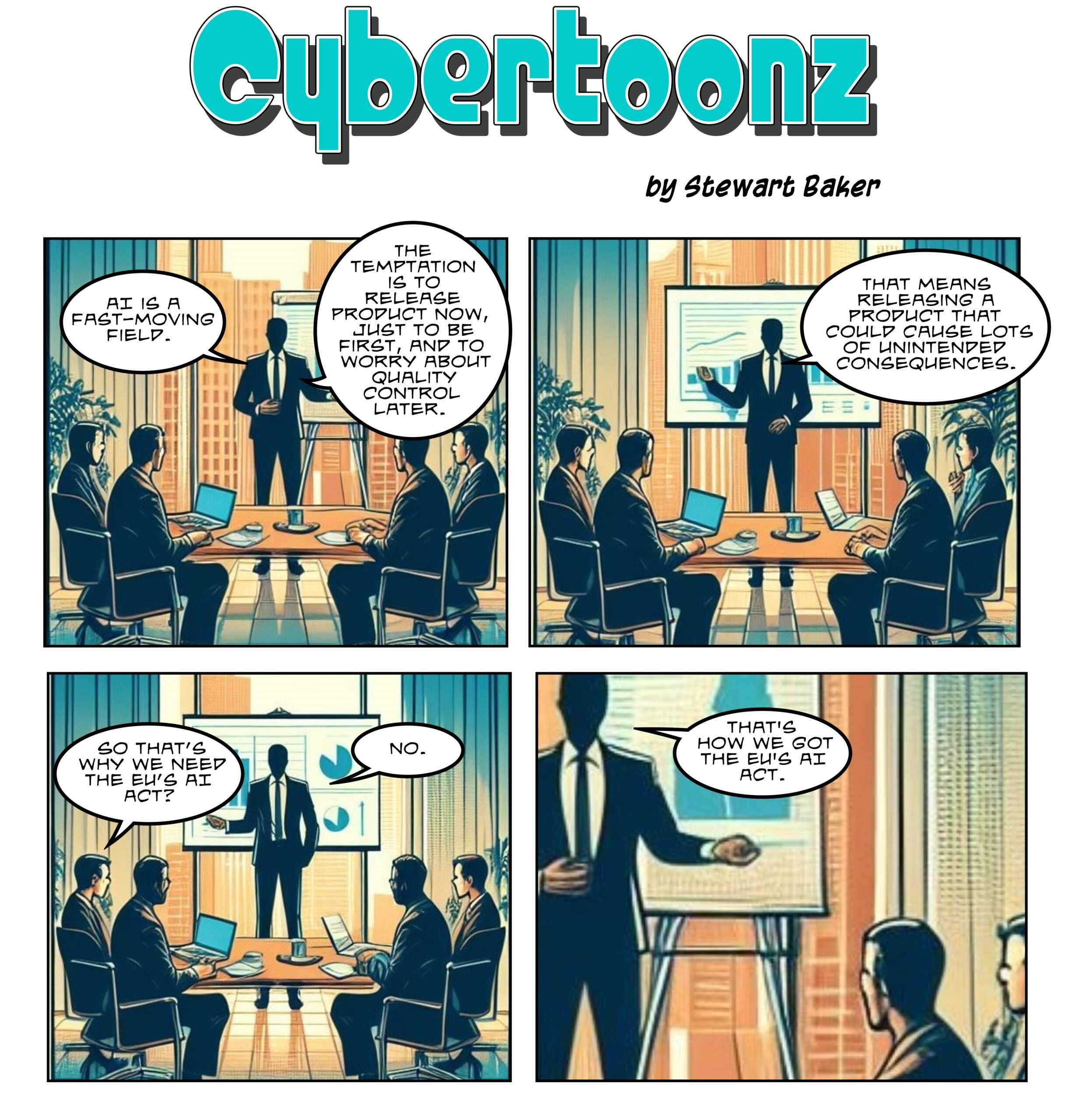
Jeffery notes that U.S. lawmakers have finally woken up to the EU's misuse of tech regulation to protect the continent's failing tech sector. Even the continent's tech sector seems unhappy with the EU's AI Act, which was rushed to market in order to beat the competition and is therefore flawed and likely to yield unintended and disastrous consequences, a problem that inspires this week's Cybertoon.
Paul covers a lawsuit blaming AI for the wrongful denial of medical insurance claims. As he points out, insurers have been able to wrongfully deny claims for decades without needing AI. Justin Sherman and I dig deep into a New York Times article claiming to have found a privacy problem in AI. We conclude that AI may have a privacy problem, but extracting a few email addresses from ChatGPT doesn't prove the case.
Finally, Jeffery notes an SEC "sweep" examining the industry's AI use.
Paul explains the competition law issues raised by app stores – and the inconsistent outcome of app store litigation against Apple and Google. Apple's app store skated free in a case tried before a judge, but Google lost before a jury and has now entered into an expensive settlement with other app makers. Yet it's hard to say that Google's handling of its app store monopoly is more egregiously anticompetitive than Apple's.
We do our own research in real time to address an FTC complaint against Rite Aid for using facial recognition to identify repeat shoplifters. The FTC has clearly adopted Paul's dictum, "The best time to kick someone is when they're down." And its complaint shows a lack of care consistent with that posture. I criticize the FTC for claiming without citation that Rite Aid ignored "false positive" racial bias in its facial recognition software. Digging into the research, I conclude that, if the FTC itself was subject to penalties for unfair and deceptive marketing, this filing would lead to sanctions.
The FTC fares a little better in our review of its effort to toughen the internet rules on child privacy, though Paul isn't on board with the whole package.
We move from stories about the government regulating Silicon Valley to stories about Silicon Valley regulating the government. Apple has decided that it will now require a judicial order to give government's access to customers' "push notifications." And, giving the back of its hand to crime victims, Google decides to make geofence warrants impossible by blinding itself to the necessary location data. Finally, Apple decides to regulate India's hacking of opposition politicians and runs into a Bharatiya Janata Party (BJP) buzzsaw.
Paul and Jeffery decode the EU's decision to open a DSA content moderation investigation into X. We also celebrate the welcome failure of X's lawsuit to block California's content moderation law.
Justin takes us through the latest developments in Cold War 2.0. China is hacking our ports and utilities with intent to disrupt (as opposed to spy on) them. And the U.S. is discovering that derisking our semiconductor supply chain is going to take hard, grinding work. Justin looks at a recent report presenting actual evidence on the question of TikTok's standards for boosting content of interest to the Chinese government.
And in quick takes,
- I celebrate the end of the Reign of Mickey Mouse in copyright law
- Paul explains why Madison Square Garden is still able to ban lawyers who have sued the Garden
- I note the new short-term FISA 702 extension
- Paul predicts that the Supreme Court will soon decide whether police can require suspects to provide police with phone passcodes
- And Paul and I quickly debate Daphne Keller's amicus brief for Frances Fukuyama in the Supreme Court's content moderation cases
You can subscribe to The Cyberlaw Podcast using iTunes, Google Play, Spotify, Pocket Casts, or our RSS feed. As always, The Cyberlaw Podcast is open to feedback. Be sure to engage with @stewartbaker on Twitter. Send your questions, comments, and suggestions for topics or interviewees to CyberlawPodcast@gmail.com. Remember: If your suggested guest appears on the show, we will send you a highly coveted Cyberlaw Podcast mug! The views expressed in this podcast are those of the speakers and do not reflect the opinions of their institutions, clients, friends, families, or pets
The EU AI Act
Cybertoonz explains EU tech law in four panels
As covered in this week's Cyberlaw Podcast, the AI Act is getting some poor reviews -- from the US Congress as well as Europe's tech sector. How could something like this happen in the home of the vaunted "Brussels Effect?" Fear not. Cybertoonz has the explanation.
Eighth Circuit Upholds Ban on Material Lies on Certain Employment Applications, When Speaker Intends to Cause Injury
From today's opinion in Animal Legal Defense Fund v. Reynolds, by Judge Colloton, joined by Judges Grasz and Kobes:
In Animal Legal Defense Fund v. Reynolds (8th Cir. 2021) ("ALDF I"), this court considered an Iowa law that prohibited (1) accessing an agricultural production facility by false pretenses and (2) making a false statement or misrepresentation as part of an application for employment at such a facility. We concluded that the prohibition on accessing a facility by false pretenses did not violate the free speech clause of the First Amendment. But we ruled that the prohibition on making false statements in an employment application was insufficiently tailored and unconstitutional, because it encompassed statements that were not material to an employment decision.
A new Iowa law solves the materiality problem in the employment provision by forbidding the use of deception "on a matter that would reasonably result in a denial of an opportunity to be employed." The statute also narrows the scope of both prohibitions by adding an intent element: the law forbids the use of deceptive speech only when the person gains access or employment "with the intent to cause physical or economic harm or other injury" to the agricultural production facility. After several organizations challenged the new law, the district court concluded that the intent requirement renders the law "viewpoint-based" and unconstitutional under the First Amendment. We respectfully disagree, and therefore reverse….
The challenged statute includes two provisions—an "Access Provision" and an "Employment Provision." Both regulate false or deceptive speech. This type of speech is not per se unprotected, but the State may proscribe "intentionally false speech undertaken to accomplish a legally cognizable harm." ALDF I.
The Access Provision and the Employment Provision do just that. The Access Provision proscribes false speech used to commit a trespass. The harm flowing from trespass is legally cognizable. The Employment Provision proscribes gaining employment through false speech on matters that are material to hiring. As the plurality in Alvarez explained, where false claims are made to secure offers of employment, "it is well established that the Government may restrict speech without affronting the First Amendment."




