The Volokh Conspiracy

Mostly law professors | Sometimes contrarian | Often libertarian | Always independent | Est. 2002

The Volokh Conspiracy

Preventing Sales of Personal Data to Adversary Nations

An interview with Lee Licata -- Bonus Episode 496 of the Cyberlaw Podcast

|

This bonus episode of the Cyberlaw Podcast focuses on the national security implications of sensitive personal information. Sales of personal data have been largely unregulated as the growth of adtech has turned personal data into a widely traded commodity. This in turn has produced a variety of policy proposals – comprehensive privacy regulation, a weird proposal from Sen. Wyden (D-OR) to ensure that the US governments cannot buy such data while China and Russia can, and most recently an Executive Order to prohibit or restrict commercial transactions affording China, Russia, and other adversary nations with access to Americans' bulk sensitive personal data and government related data. 

To get a deeper understanding of the executive order, and the Justice Department's plans for implementing it, I interview Lee Licata, Deputy Section Chief for National Security Data Risk.

Download 496th Episode (mp3)

You can subscribe to The Cyberlaw Podcast using iTunes, Google Play, Spotify, Pocket Casts, or our RSS feed. As always, The Cyberlaw Podcast is open to feedback. Be sure to engage with @stewartbaker on Twitter. Send your questions, comments, and suggestions for topics or interviewees to CyberlawPodcast@gmail.com. Remember: If your suggested guest appears on the show, we will send you a highly coveted Cyberlaw Podcast mug! The views expressed in this podcast are those of the speakers and do not reflect the opinions of their institutions, clients, friends, families, or pets

Senators McConnell, Cornyn, and Tillis Send Letters To Chief Judges About Judicial Conference "Policy"

"It is Congress that decides how cases should be assigned in the inferior courts and Congress has already spoken on this issue in an enacted statute."

|

The fallout from the Judicial Conference "policy" continues. (What that policy is, I still cannot tell you, since it is not publicly available, so I'll continue to rely on the press release.) In previous posts, I explained that it is for Congress, and not the courts, to determine how to handle this mess. And recent communications from three Senators demonstrate this point. Senators McConnell, Cornyn, and Tillis sent a letter to chief judges throughout the country, including to Chief Judge David Godbey of the Northern District of Texas. (I previously wrote about Senator Schumer's letter to Godbey, and Godbey's reply.)

The Senators explain that "The assignment of cases within district courts is governed by federal statute." As I explained my earlier post, 28 U.S.C. 28 U.S.C. § 137(a) gives each District Court, and not the Judicial Conference, power to adopt rules about assignment. The Senators point out that there was an attempt to modify Section 137(a) to "require random assignment," but this bill does not pass. From what I've gathered, this policy is at most "subregulatory guidance" that the lower courts can consider.  That is not the message that was conveyed to the media.

And for that matter, why was the media given a private briefing by Judge Sutton? Is that common for a single federal judge to speak to the press at length about a policy that no one outside the judiciary has seen? In some regards, I see the press rollout of this policy as a way to "lock in" votes, hoping that the media inertia is strong enough to persuade everyone to go along with it--to create an air of inevitability. And if any district courts reject the proposal, the fault will be placed on these rogue judges, and not the Judicial Conference.

In a message that I think was tailored to Judge Sutton, the Senators explain that Congress should decide this issue:

To state the obvious, Judicial Conference policy is not legislation. It is Congress that decides how cases should be assigned in the inferior comts and Congress has already spoken on this issue in an enacted statute: Congress gave that power to the individual district courts. Whatever the Judicial Conference thinks you ought to do, what you actually choose to do is left to your court's discretion under the law.

It is significant that Senator Tillis signed the letter. The press release cited a letter that Tillis sent along with Senator Leahy, who "raised concerns about a concentration of patent cases filed in single-judge divisions." This reference to Tillis and Leahy was an effort to give the proposal a patina of bipartisanship. But the policy says nothing at all about patent forum shopping. It only addresses nationwide injunctions. I have to imagine that Tillis was unhappy to be dragged into this mess. Again, when Judges try to be apolitical, they usually have the exact opposite effect.

Moreover, the policy says nothing about bankruptcy forum shopping. This is an issue that Senator Cornyn, in particular, has been writing about for nearly two decades; see his op-ed to Senator Biden's response from 2005. And with bankruptcy and patent cases, decisions are reviewed with deferential standards of review. By contrast, APA and constitutional law issues are reviewed de novo, and channels exist to seek emergency stays from the Court of Appeals and the Supreme Court. If the Judicial Conference was serious about addressing a real problem, they would have started with patent and bankruptcy reform. But the real law professors of Twitter don't care and the trial bars enjoy these cushy forums too much, so these issues are not a priority.

McConnell gave a speech on the Senate floor that I think got things exactly right:

"But, Mr. President, didn't Chief Justice Roberts say, quote, 'there are not Obama judges or Trump judges'? What, exactly, is the problem that demands such a drastic solution?

"Here's what this policy won't do: it won't solve the issues caused by nationwide injunctions. If Democrats are right about the practical effects of this policy, any remaining incentive they have to work with Republicans on this issue will vanish.

"'Nationwide injunctions for me, but not for thee'.

"And, needless to say, if Republicans see a federal judiciary that is using its procedural independence to wade into political disputes, any incentive we may have to defend that procedural independence will vanish, as well.

"This was an unforced error by the Judicial Conference. I hope they will reconsider. And I hope district courts throughout the country will instead weigh what is best for their jurisdictions, not half-baked 'guidance' that just does Washington Democrats' bidding."

I too hope the Judicial Conference reconsiders this proposal.

The Case for Caution on Reacting to the Judicial Conference Press Release on Forum-Shopping

We should wait until we know what (if anything) is happening.

|

My co-bloggers Josh Blackman and Sam Bray have offered very different reactions to the Judicial Conference's press release about a new policy on forum-shopping. Josh is strongly critical on a long list of procedural and substantive grounds,  while Sam welcomes the development.

My own view is that we need to wait, as we have no idea yet what the Judicial Conference has in mind.

In particular, we don't know who wrote the press release or whether it accurately describes whatever the Judicial Conference has in mind.   It's entirely possible that the "policy" is merely a recommendation that circuits and districts are free to ignore, as suggested by an unnamed judge who wrote in to David French and Sarah Isgur on the latest episode of Advisory Opinions.  It's also possible that whatever was approved by the Judicial Conference is so soft a suggestion that it doesn't even rise to a policy, which might explain why the text of any policy isn't known.  We just don't know yet.

Perhaps there's a story here, and if so we can react when we have more details. But I think it may be prudent to wait.

Property Rights

Matt Yglesias on the Takings Clause and Curbing Exclusionary Zoning

Prominent political commentator and zoning reform advocate comments on my work on this topic (with Joshua Braver).

|

Illustration: Lex Villena; Lev Kropotov

In a post at his Slow Boring website on what the federal government can do to alleviate our massive shortage of affordable housing, prominent progressive political commentator and zoning reform advocate Matt Yglesias comments on my forthcoming Texas Law Review article arguing that exclusionary zoning violates the Takings Clause of the Fifth Amendment (coauthored with Josh Braver):

[I]n mid-February Ilya Somin and Joshua Braver published a law review article calling on the Supreme Court to either reverse or sharply limit the 1926 Euclid v. Amber decision and hold that exclusionary zoning is a "taking" under the meaning of the 5th Amendment. I try not to opine on matters of constitutional law, because I think it's mostly just people making stuff up. But the Euclid doctrine is genuinely bizarre. As I first learned by playing SimCity on DOS, the basic point of zoning is to separate industrial, residential, and commercial uses in order to avoid undesirable pollution and facilitate transportation planning. But from the beginning, land use regulation has clearly been put to other uses. Back in the 1917 case of Buchanan v. Warley — decided at a time when racism was mainstream in America — the Supreme Court held that local government couldn't reserve certain neighborhoods for white people and others for Black people. This was long before the Civil Rights Act and also before the school desegregation cases that struck down the concept of "separate but equal."

Then, nine years later in Euclid, they turned around and it said was fine to exclude all apartment buildings from a neighborhood, because rental housing for working class people was a "mere parasite" on single-family homes, which is just rhetoric that doesn't engage with any empirical information. I understand that a lot of people have concerns about expanding the takings doctrine (Somin is a right-wing guy), but I do think that the courts asking that land use regulation have real public purpose would be constructive.

Yglesias is right that the exclusionary zoning approved by the Supreme Court in Euclid turned out to be a backdoor to racial exclusion. Indeed, this was predicted by the lower court judge whose decision the Supreme Court overruled (see discussion in Part I of our article). In that respect, Euclid predictably undercut much of the beneficial effect of Buchanan v. Warley. He's also right that the policy rationale for Euclidean exclusionary zoning is flimsy at best. As the district court put it, "[i]n the last analysis, the result to be accomplished is to classify the population and segregate them according to their income or situation in life."

It's not clear to me what Yglesias means by "courts asking that land use regulation have real public purpose." But, as we argue in the article, the best way to ensure that local government can't use zoning to exclude large numbers of middle class and poor people is to rule that doing so without compensation violates the Takings Clause.

Regulations that protect against substantial threats to health and safety may be exempt from takings liability under the "police power" exception (see Section II.C of our article). This may lessen some of the "concerns about expanding the takings doctrine" that Yglesias referred to.

Expanded takings liability would still likely reach some regulations progressive zoning reformers like. But that tradeoff is likely worth it, given the truly enormous harmful impact of exclusionary zoning, which cuts off millions of people from jobs and opportunity, particularly the poor and minorities (see Part I of our article, and many of Yglesias' own writings on this topic). More generally, judicial protection of almost any constitutional right involves some tradeoffs. Freedom of speech requires tolerating communists and Nazis. Protecting criminal defendants' rights means some guilty criminals will go free. And so on.

Yglesias also implies that the "concerns" may be heightened by the fact I am a "right-wing guy." Whether I am left-wing or right-wing depends on which issues you focus on. I do indeed hold some conventionally right-wing views, such as advocating massive cuts in government spending and the welfare state. On the other hand, I also favor abortion rights, open borders immigration, and abolishing the War on Drugs (all of it, not just marijuana prohibition).

Perhaps more importantly, my co-author, Josh Braver, is unimpeachably progressive. If I'm a "right-wing guy," he's a left-wing one. The article is an experiment in cross-ideological cooperation. The policy case against exclusionary zoning has long cut across partisan and ideological lines, as Yglesias himself recognizes. Josh and I argue the constitutional case can, as well. As we explain, both originalist theories favored by many on the right, and various living-constitution theories popular on the left converge on similar results here.

We recognize that judicial review  probably cannot solve the problem of exclusionary zoning by itself. But, as described in Part IV of the article, it can be effective in conjunction with political reform efforts. That, we argue, is the lesson of many previous successful reform movements that combined litigation with political action, such as the civil rights movement, the LGBT movement, gun rights activists, and others.

Finally, Yglesias is at least partly right that many constitutional arguments involve people just "making stuff up." But, of course, the same is true of many moral and policy arguments, as well. In law, as in policy, the way forward is to try to separate out good arguments from bad ones.

Academia

Study Finds Law Professor Contributions to Political Campaigns Skew Overwhelmingly Democratic

Notre Dame law Prof. Derek Muller so finds in a new analysis of law professor political donations between 2017 and 2023.

|

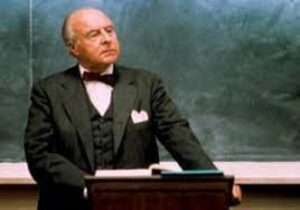
A.E. Houseman plays Harvard law Prof. Kingsfield in the classic 1973 movie, "The Paper Chase." (NA)


Notre Dame law Professor Derek Muller - a leading election law scholar - has posted a study he conducted of the partisan distribution of political donations by law professors between 2017 and 2023. Not surprisingly, they skew overwhelmingly towards Democratic candidates:

I identified 3148 law faculty who contributed only to Democrats in this 5+ year span—95.9% of the data set of those identified as contributing to either Democrats or Republicans in this period. Another 88 (2.7%) contributed only to Republicans. And 48 others contributed to both Democrats and Republicans.

The dollar figures were likewise imbalanced but slightly less so. About $5.1 million went to Democrats in this period, about 92.3% of the total contributions to either Democrats or Republicans. About $425,000 went to Republicans. (Around $6000 went to others.)

The overall result here is far from surprising. Lots of previous studies find that law professors are skew towards  the political left. Still, the extent of the imbalance is notable. Exclusively Democratic contributors outnumber exclusively Republican ones by over 35 to 1. That's a larger disproportion than in previous studies.

In addition, Democratic contributors outnumber Republican ones at every single school included in the study, usually by large margins. My own law school (George Mason University) is often considered right-wing. Nonetheless, Muller finds we had 11 Democratic contributors and only six Republican ones; two people contributed to candidates of both parties [I was one of the Republican contributors, for idiosyncratic reasons explained in an update at the end of this post]. That figure of six is the highest number of exclusive GOP donors at any school in the study.  By contrast, there are many schools with dozens of Democratic contributors.

The disproportion is comparably large measured by money totals, rather than numbers of contributors. Faculty at only two schools (Northwestern and Wayne State) contributed more to Republicans than Democrats. In the case of Northwestern, the disproportion is very great: $167,245 contributed to Republicans versus $64,460 given to Democrats. But this figure is misleading. Muller's data shows that Northwestern had 32 faculty who contributed to Democrats, compared to only one who gave to Republicans (this individual apparently also gave money to at least one Democratic candidate, as well). This one professor is so committed to the GOP that he or she gave more than twice as much to their campaigns as his 32 Democratic-contributing colleagues gave to the Democrats combined!

Muller notes a few caveats about the data, most notably that faculty with strong political views don't necessarily donate to candidates. For example, Muller's own school, Notre Dame, had 14 Democratic contributors during the time-frame studied, and no Republican ones. But Notre Dame does in fact have several prominent conservative or libertarian legal scholars. Similarly, Northwestern had more than one right-of-center faculty member during this period (I know of about four or five). There are cases like this at other schools, too.

In addition, the time-frame likely reduces the number of Republican donors, compared to previous eras. The period covered in the study (2017-23) is the era of the Trump takeover of the GOP, which famously alienated many highly educated people who previously backed the party. Almost by definition, lawprofs fall in the highly educated group. I myself stopped voting for the GOP in presidential elections during the Trump era, and likely some other conservative and libertarian lawprofs did the same. A 2005 study of elite law school faculty campaign contributions also found a large Democratic skew, but a bit smaller than that in Muller's study of the 2017-23 period.

Another caveat is that people might donate to a candidate because they think he or she is a lesser evil compared to the available alternatives, not because they actually like that person's ideology or the agenda of their party. I voted for Hillary Clinton and Joe Biden in 2016 and 2020 on such lesser-evil grounds, even though I have little love for them or their party. I just found Trump to be even worse. While I did not donate any money to Clinton or Biden, myself, it's possible some lawprofs donate to lesser-evil candidates as well as vote for them. We cannot always assume that people who donate to a candidate or party necessarily share their ideology.

Finally, a disproportionate number of non-left wing legal academics are libertarians (myself included). For obvious reasons, they may be disinclined to contribute money to candidates from either major party. Some might instead give to the Libertarian Party or its candidates (Muller found a total of only $6000 in donations to third-party campaigns). But many might not because they believe the LP has no chance of winning or because they are disillusioned by the awful Mises Caucus takeover of the party in 2022 (near the end of the study period).  Studies focusing on campaign contributions probably undercount libertarians.

There are likely other limitations to the data, as well. Still, when all is said and done, the ideological and partisan imbalance in legal academia is very large. Muller's data further confirms it.

At this point, readers may wonder why it matters what law professors' views are. It's not like lawprofs are an important voting bloc, or a major source of campaign funds (with the possible exception of the big GOP donor at Northwestern!). I explained why lawprofs' views matter in a previous post:

[L]aw professors can influence the views of law students, who—of course—go on to be the next generation of lawyers. Lawyers, in turn, have disproportionate influence on a wide range of public policies. A high proportion of politicians and other policymakers are lawyers, as—of course—are nearly all judges. Maybe lawyers shouldn't have so much influence. But they do.

Finally, a good many lawprofs have a direct influence on the development of law and public policy. Courts often adopt ideas that were first developed by academics….

Even outside the courts, lawprofs sometimes have significant influence on government policy. For example, Harvard law Prof. Cass Sunstein has helped influence governments around the world to adopt policies based on "nudging" and other forms of "libertarian paternalism."

Because of this influence, it would be good if there were more ideological diversity in legal academia. Studies indicate that ideological diversity can improve the quality of discourse and scholarship. If all or most scholars in a given field have similar views, that increases the likelihood that some key issues and arguments will be ignored or at least relatively neglected.

As I have emphasized before (e.g. here and here), the desirability of greater ideological diversity doesn't mean schools should adopt affirmative action for non-left-wing legal academics, or that we should strive for a legal academy that "looks like America" in terms of the distribution of partisanship and ideology. But much can be achieved simply ending or significantly reducing ideological discrimination in faculty hiring.

As with racial, ethnic, and gender discrimination, ideological discrimination not only reduces diversity, but also reduces the quality of scholarship and teaching. Lower-quality candidates with the preferred views get hired in preference to better-qualified dissenters. Thus, we can potentially increase diversity and quality at the same time.

Even if discrimination ended completely, we would likely still have a disproportionate number of left-wing and Democratic lawprofs relative to the proportions of these groups in the general population. Among other things, highly educated people - especially in the Trump era - tend to skew left, or at least against the conservative right. But ending discrimination would nonetheless make legal academia more ideologically diverse than it is now.

UPDATE: In the original version of this post, I said I had not made any political contributions during the period in question. However, my wife reminds me that, back in 2017, I made a $250 contribution to anti-Trump Republican Senator Jeff Flake's abortive reelection campaign (who also had a lot of libertarian leanings). I did not donate to any Democratic campaigns during this time, though I did vote for the Democratic nominee in both the 2016 and 2020 presidential elections. Thus, I am included in Muller's data as one of George Mason's six Republican contributors! This is one of those cases where the donation data doesn't accurately reflect a person's overall partisan/ideological leanings.


The Judicial Conference's New "Policy" Demonstrates Why Judges Should Not Make Policy

The way to depoliticize the courts is to depoliticize the courts.

|

It is a cliche that judges should not "legislate" from the bench. As we hear all-too-often, judges lack the expertise, knowhow, and accountability to make policy. Judges are at their best when they carefully scrutinize a law someone else wrote, and apply it to a given set of facts. To be sure, judges do have some formal policymaking power, such as the promulgation of the Federal Rules of Civil Procedure or the Federal Rules of Appellate Procedure. But those processes are transparent, open, and involves a public comment period from all interested stakeholders.

The Judicial Conference's new "policy" illustrates why judges are not equipped to make policy on their own. (I put "policy" in scare quotes because we have no idea what the policy actually says, or if the language is even final.) Though this policy is framed as addressing some sort of nationwide policy, in reality, it will affect a handful of single-judge divisions in Texas and Louisiana, and possibly a few other states. All of those judges were appointed by Republican presidents, and most were nominated by President Trump. And almost all of the appeals lie with the Fifth Circuit.

My friend Sam Bray is correct that "Democratic state attorneys general seek national injunctions in friendly district courts," but as best as I can recall, Democratic Attorney Generals do not seek nationwide injunctions in single judge divisions--they don't have to. Filing a law suit in Brooklyn or San Fransisco has the same effect as filing in Amarillo or Lubbock--without the need for a layover in DFW.

The Judicial Conference's policy is targeted at a very small number of federal judges who have issued nationwide relief against a Democratic administration, which the Supreme Court has consistently stayed. Is it any surprise that most press accounts of this policy include a photo of Judge Matt Kacsmaryk? The Judicial Conference is feeding a media narrative about these rogue Republican judges who are abusing the nationwide injunction.

In some regards, this Judicial Conference proposal reminds me of Justice Barrett's well-intentioned but horribly-misguided concurrence in Trump v. Anderson. Barrett was trying to explain why the Court should avoid politics and turn down the temperature on these sorts of election issues. Of course, her concurrence backfired big-league, and instead highlighted the right-left split on the Court. The Judicial Conference proposal operates in a similar sphere. The judges on that body are attempting to reduce what they see as partisan judge-shopping, and in the process propose a rule that is targeted only at a handful of Republican judges. Ironically, the same judges that the Texas AGs are shopping for, the Judicial Conference is trying to divest of jurisdiction.

Sam Bray, like Chief Judge Sutton and perhaps Chief Justice Roberts, may think that this law removes the judiciary from politics. But that perspective is myopic. The choice of how district courts are divided is an inherently political topic. The process of selecting district court judges is more complex than you can probably imagine. Perhaps Sutton and Roberts are fearful of potential legislation and would prefer to handle things in house. Again, this perspective is myopic. Who decides? If any body must inject itself into this mess, it's Congress. And if Congress won't act, as we are often told, it is not for the judiciary to clean up the mess. The way to depoliticize the courts is to depoliticize the courts.

A Welcome Judicial Reform: Towards Random Case Assignment

|

I was delighted to see the Judicial Conference of the United States is acting to promote random case assignment in certain declaratory judgment and injunction cases. You can read the press release here.

It will be important to see the details, but as outlined, this policy change will ameliorate the consequences of forum-shopping in the federal courts, particularly when that forum-shopping allows plaintiffs to essentially select the judge who will hear the case. Allowing a plaintiff to select her own judge is inimical to the rule of law and brings disrepute on the judiciary.

To be clear, it is not the fault of the judge, who is open for business to anyone who files a complaint that meets the various jurisdictional and venue requirements. Similarly, it is hard to blame a plaintiff for trying to find the most advantageous place to sue. The duty of zealous advocacy may even require it. And even though there is an uneven distribution of single-judge divisions, I think the primary problem is not a partisan one--Republican state attorneys general seek national injunctions in friendly district courts, and Democratic state attorneys general seek national injunctions in friendly district courts, and I don't have to tell you where those are (the pattern holds in national injunction cases from the second half of the second Obama term to the present). Even so, the problem is greater in degree if a plaintiff is able to select a single judge.

As is often the case with structural problems, each actor can act rationally, by her own lights, but the collective action can go badly wrong. That's true here. The status quo is deeply messed up and I don't know why anyone would want to defend it. Good judicial practice should be preferred to partisan advantage every single time. It is a welcome development for the Judicial Conference to address this.

The argument is sometimes made that we should wait and let Congress fix the problem. But everyone is waiting for someone else to do something about it. It's good for the federal judiciary to act to get its own house in order.

Two final observations:

  1. There are a number of structural forces that have gotten us to this point, where the stakes are so high and the forum-shopping options are so high-powered. One is the expansion of state standing after Massachusetts v. EPA (though that seems to be ebbing after the Court's last term, as Will Baude and I explain here). The shift to abstract plaintiffs--coalitions of states--matters because there will be so many places to sue. Another is changes in preliminary injunction practice that make forum-shopping easier (more on that in a paper I'm writing). Still another, of course, is the rapid rise of the national injunction in the last ten years, a development that makes the stakes much higher and the forum selection more salient.
  2. As outlined in the statement from the Judicial Conference, the policy will apply to "civil actions that seek to bar or mandate state or federal actions, 'whether by declaratory judgment and/or any form of injunctive relief.'" To me that seems exactly right. The declaratory judgment and the injunction are the two relevant remedies. It is noteworthy that there is no mention of vacatur. That is correct: vacatur is not a remedy (this is true under the text and structure of the APA, and it is true in the law of remedies for reasons I could elaborate at great length). If I am reading the Judicial Conference's statement correctly, the reference to "any form of injunctive relief" is meant to be broad enough that if a court insists on acting like vacatur is a remedy, and acting like it is an injunction, then the court's action is covered, but all without committing the doctrinal error of actually calling vacatur a remedy.

Bottom line: this is a welcome and overdue development. Three cheers for the Judicial Conference.

The Judicial Conference Legislates From The Shadow Docket

The Chief Justice and his associates target only one type of forum shopping in response to political criticism through a secret policy that will not be released for months.

|

On Tuesday afternoon, a reporter from the Washington Post called to ask me about a new policy from the Judicial Conference  designed to limit forum shopping. I inquired if she had a copy of the policy. She said no, but there was a press release. I was tempted to reply, "Democracy dies in darkness." Still, all we have is a press release.

The Judicial Conference of the United States has strengthened the policy governing random case assignment, limiting the ability of litigants to effectively choose judges in certain cases by where they file a lawsuit.

The policy addresses all civil actions that seek to bar or mandate state or federal actions, "whether by declaratory judgment and/or any form of injunctive relief." In such cases, judges would be assigned through a district-wide random selection process. . . .

The amended policy applies to cases involving state or federal laws, rules, regulations, policies, or executive branch orders. District courts may continue to assign cases to a single-judge division when they do not seek to bar or mandate state or federal actions, whether by declaratory judgment and/or any form of injunctive relief.

How will this policy operate? When does it actually go into effect? How are litigants to know what types of remedies will trigger the policy? Who the hell knows? Not even the district court judges have seen a copy of the policy. They learned about it when we did. Courthouse News reported that the policy will be circulated to judges later this week, and the chief judges will "have to meet to discuss the change." You think?

After years of complaints about the secretive "shadow" docket, the Chief Justice of the United States, the Chief Judges of the Circuit Courts, and various District Court judges, have the temerity to announce a secret policy that no one can see that will fundamentally change the way litigation operates in federal courts. Maybe it is posted on top of a tall column, like in Nero's day. Worse still, this policy change was plainly motivated by the same critics who harp about the shadow docket. The courts should resist the political currents, but here, the Judicial Conference has kowtowed to Senators Schumer and Whitehouse, and some scholars.

Chief Judge Randy Crane of the Southern District of Texas expressed some doubts to the Reuters:

The chief judge of Texas' Southern District, Randy Crane, in a statement said the Judicial Conference's policy raised questions that need to be addressed before it could be implemented by courts. He said it also "seems to be a response to decisions adverse to certain political interests, given its timing."

And Judge Jim Ho of the Fifth Circuit Court of Appeals gave me permission to share his response:

"Judges are supposed to follow the laws enacted by Congress, not bend the rules in response to political pressure. If reformers are sincerely troubled by venue shopping, they can start by examining the serious concerns that have been voiced about our Nation's bankruptcy and patent dockets."

I've heard other judges may make similar statements. I'm happy to post any other remarks.

This rollout was poorly executed. Why would the Judicial Conference blindside the very judges who have to implement this policy? And why not make the policy publicly available so litigants can understand it? But the botched rollout is just the tip of the iceberg. This policy is badly flawed, and I doubt it will actually achieve what it was intended to achieve. Here are a few quick reactions.

First, I suspect it will be easy enough to circumvent this policy. Step 1, file a complaint that does not seek the triggering relief. Step 2, wait for the case to be assigned. Step 3, amend the complaint as a matter of course within 21 days, seeking the triggering relief. Perhaps this sort of behavior will give rise to Rule 11 sanctions, but why should lawyers be sanctioned for availing themselves of FRCP Rule 15(a)(1)(A). If courts prohibit the amended-complaint route, litigants can try other approaches. They can seek to certify a nationwide class, which has the effect of a non-party without using that label. But who knows? Maybe Rule 23 certifications will also give rise to sanctions? What other aspects of FRCP and the U.S. Code will this policy wipe out? State Attorneys General have very smart attorneys on staff who will figure out workarounds. Or maybe they can ask Chat GPT for advice, unless that too is barred by the federal courts. I suspect this policy will become obsolete as soon as it is released--whenever that may happen.

Second, is this policy consistent with federal statutes? Congress has established fairly intricate rules concerning venue, and the establishment of judicial districts. 28 U.S.C. § 124 establishes the four judicial district of Texas. And 28 U.S.C. § 137(a) provides:

The business of a court having more than one judge shall be divided among the judges as provided by the rules and orders of the court. The chief judge of the district court shall be responsible for the observance of such rules and orders, and shall divide the business and assign the cases so far as such rules and orders do not otherwise prescribe. If the district judges in any district are unable to agree upon the adoption of rules or orders for that purpose the judicial council of the circuit shall make the necessary orders.

As I read the statute, each division within a district court--including single judge divisions--needs to comply with Section 137. And the Judicial Council "of the circuit" can only step if the district judges are "unable to agree." For example, the Fifth Circuit Judicial Council can intervene if the Northern District of Texas cannot agree upon rules. I don't see how the Judicial Conference of the United States can override the "rules and orders of the court." Congress expressly denied the Judicial Conference any such power. At most, this policy can be advisory. That message was not conveyed to the press. Section 137 reinforces how it should be Congress that changes rules, not judges pretending to be legislators. Accordingly, I told the Washington Post:

But Josh Blackman, a professor at South Texas College of Law, questioned the Judicial Conference's authority to create the policy and said the issue should be decided by elected lawmakers. "I think the solutions come from Congress," Blackman said. "I don't know that this policymaking body has the authority to do what it did — even if they did, I think it's better coming from the legislature."

Imagine that: the Judicial Conference legislates from the shadow docket. A litigant who has his case reassigned can probably challenge the lawfulness of this policy. It won't be difficult for a judge, or an appellate court, to find the rule ultra vires.

Third, is this policy consistent with binding circuit precedent? There are volumes of caselaw that govern intradistrict and interdistrict transfers. For example, under Fifth Circuit precedent, you can only override a plaintiff's choice of venue within the district if it is "clearly more convenient." Can the Judicial Conference trump Fifth Circuit precedent, and force a case to be reassigned by random draw? This is a huge power grab by the Judicial Conference.

Fourth, the impetus of this policy was perceived abuses of the patent system. (Speaking of patents, I'm glad Chief Justice Roberts and Chief Judge Kimberly Moore found something productive to work on together, as Judge Pauline Newman remains trapped in Article III purgatory). Yet the press release does not even mention how the rules for patent selection have changed, nor does it mention judge shopping in bankruptcy and other areas. The Court is targeting a method of forum shopping used primarily on the right. Attorneys General in California or New York don't have to forum shop because virtually every judge in San Francisco or Brooklyn will be philosophically simpatico--even if nominated by a Republican president. And I don't need to remind people that it is virtually impossible to draw a conservative federal judge in Austin--and the press should stop calling a Reagan-appointee from Hawaii who sits in Austin, and has consistently ruled against Texas, a judicial conservative.

Fifth, this policy simply nibbles at the edges of the problem. I understand that many conservative judges do not like nationwide injunctions. I'm sympathetic to those criticisms. Chief Judge Sutton of the Sixth Circuit, who seems to be the lead spokesperson of this new policy, has highlighted the problem of nationwide injunctions in his opinions. And he expressed a similar sentiment in his briefing to the press:

But on Tuesday, Sutton stressed that the policy change isn't "something that relates to just one state." "I actually think the story is about national injunctions. That's been a new development, really [in] the last 10 years and maybe the last two or three administrations, where that has become a thing. And it makes sense that some advocates are going to do the best by their clients. And, you can understand how some of those pressures work depending on who's running the administration. But I, for one, I'm really proud that we did this. I thought it was a really good idea," Sutton said.

"The current issue relates to nationwide injunctions or statewide injunctions, so when it comes to those claims, it's a little hard to say you need one division of one state to handle it since by definition it extends at a minimum throughout the state and possibly to the whole country," Sutton added.

Congress, and not the obscure Judicial Conference should take the lead at addressing single-judge divisions. If this policy is indeed just advisory--a message that did not come through in the press release--it seems to be little more than virtue signaling.

Single judge divisions have been problematic for generations. Those problems go far beyond nationwide injunctions. Judge William Wayne Justice, who deliberately moved around his single judge division assignments, single-handedly controlled the Texas prison system for nearly two decades. And throughout the Civil Rights Era, litigants routinely judge shopped to single-judge divisions. The Judicial Conference has historically been silent in the face of such judge-shopping. And unlike with nationwide injunctions, which the Supreme Court consistently stays, localized injunctions are unlikely to attract appellate review.

The upshot of this ruling is that conservative litigants will have greater difficulties obtaining nationwide relief while liberal litigants can continue business as usual. This is unilateral disarmament that targets specific conservative judges for their rulings. The message is clear: Judge Kacsmaryk cannot be trusted to issue nationwide injunctions but every likeminded judge on the Northern District of California-San Francisco Division can be trusted. In any other context, such a reactive policy would be viewed as retaliation. I suspect something is lurking in the background: Chief Justice Roberts is tired of reversing the Fifth Circuit at his day job, so he used his side-hustle to divest those pesky Trump judges of jurisdiction.

There are more problems, but that is enough for now. As a general matter, the Judicial Conference has remained silent about serious abuses of power (Judge Moore's stealth impeachment of Judge Newman and Judge Sullivan's sitting on the judicial selection committee). Meanwhile, the Judicial Conference caves into criticism from Schumer and others, without even the courtesy of seeking comments from the District Court Judges nationwide. This is a body that operates in the shadows, and lacks fortitude.

I do not know if dissents are permissible from the Judicial Conference, but none have been published. Thankfully, it's not too late for secret policy to be reconsidered. Or the District Court Judges can tell the Judicial Conference to mind their own business.


Upcoming Pacific Legal Foundation Symposia on Regulatory Takings and the Antiquities Act

PLF seeks submissions by scholars.

|

The Pacific Legal Foundation, a prominent libertarian-leaning public interest firm is sponsoring two upcoming symposia, and soliciting contributions from legal scholars and other experts. The first is on regulatory takings. Here is the announcement and information on how to submit a proposal:

Pacific Legal Foundation and George Mason University's Journal of Law, Economics & Policy seek papers for a symposium titled "Too Far: Imagining the Future of Regulatory Takings," to be held at George Mason University Antonin Scalia Law School in October 2024.

A century ago, Oliver Wendell Holmes, speaking for the Supreme Court, assured us that "[t]he general rule at least is that while property may be regulated to a certain extent, if regulation goes too far it will be recognized as a taking." In the ensuing one hundred years, courts have struggled to draw the line defining "too far." Some still wonder whether such a line should even exist. As Justice Clarence Thomas recently said, "If there is no such thing as a regulatory taking, we should say so. And if there is, we should make clear when one occurs."

Applicable Research Topics

Pacific Legal Foundation seeks papers that offer fresh ideas on how to make "too far" more just, more concrete, and more principled. We welcome proposals that look at this problem from legal, economic, political, historical, and related angles, including empirical and nonempirical approaches.

Honorarium, Deadlines, and Submission Details

Please submit a brief proposal that describes your thesis and how your paper will contribute to the legal issues described above. Proposals should be submitted by April 15, 2024, to Ethan Blevins at eblevins@pacificlegal.org.

Authors of accepted papers will receive a $2,500 honorarium. In addition, papers will be presented at a symposium in October 2024 and published in a special edition of the Journal of Law, Economics & Policy.

Contact Details

For questions regarding the call for papers, please contact Ethan Blevins at eblevins@pacificlegal.org.

The second is about the Antiquities Act:

The Pacific Legal Foundation seeks papers for a research roundtable on "Answering the Chief Justice's Call on the Antiquities Act" to be held this July at our offices in Arlington, Virginia.

Here is a writeup of the background law, and the following is an excerpt from the call for papers at PLF's website:

In a 2021 statement accompanying the Supreme Court's order denying certiorari in Massachusetts Lobstermen's Association v. Raimondo, Chief Justice John Roberts made an open solicitation for "other and better opportunities" to consider "what standard might guide our review of the President's actions" under the Antiquities Act. The Chief Justice's call to the bar is overdue.

We seek papers that answer Chief Justice Roberts's call.

  1. We are looking for ideas that get directly to the query posed by Chief Justice Roberts: "What standard might guide [the Court's] review of the President's actions" under the Antiquities Act?
  2. Between hard-look review and no review, there must be some alternative. We are looking for proposed frameworks to fill this crucial gap in the law.
  3. Is it possible to give meaning to the Act's "smallest area compatible" requirement without upsetting stare decisis (that is, by overturning Franklin v. Massachusetts and/or Dalton v. Specter)?
  4. Can a novel standard of review for presidential authority be gleaned from the early-20th-century (pre-Administrative Procedure Act) jurisprudence?
  5. Do pleading requirements have a role in judicial review of the president's statutory powers, as held by at least one circuit court?
  6. Is it possible to distill certain of the "hard-look" factors into an appropriate framework for judicial review of the president's statutory powers?
  7. In setting a standard of review for the president's statutory authority, does it matter that the Antiquities Act is a domestic statute, and the president cannot draw upon any independent Article II authority (as the president is able to do for delegations that implicate foreign policy)?
  8. Could the Court's major questions or nondelegation doctrines inform a framework for judicial review of the president's statutory powers under the Antiquities Act?

Honorarium, Deadlines, and Submission Details

Please submit a brief research proposal that describes your thesis or research question(s) and intended methodology. Proposals should be submitted by March 25 to Will Yeatman at wyeatman@pacificlegal.org.

Authors of accepted papers will receive a $2,500 honorarium and will further benefit from feedback on their research at the workshop. Papers will be published on the PLF website.

I participated in a previous PLF symposium, and got a lot of useful exposure and feedback for my article "The Constitutional Case Against Exclusionary Zoning" (coauthored with Joshua Braver), which has since been accepted by the Texas Law Review.

NOTE: My wife, Alison Somin, is an attorney at PLF, but is not involved in assessing proposals for either of these symposia. Nor am I myself doing so. Please send proposals to the persons indicated above, not to me.

The National Cybersecurity Strategy – How Does it Look After a Year?

Episode 495 of the Cyberlaw Podcast

|

We open this episode by exploring the first National Cybersecurity Strategy, issued almost exactly a year ago. Since the only good way to judge a strategy is by its implementation, we pull in Kemba Walden, who was first the principal Deputy and then the Acting Cyber Director as the strategy came together. She is generally positive, and urges us to wait for the soon-to-be-released posture report from her old office. Kemba, meanwhile, has joined the Paladin Global Institute, designed to further Kemba's (and Paladin's) interest in aligning private investment and public security.

Turning from the strategic to the tactical, Sultan Meghji and I dig into the ransomware attack on Change Healthcare, and the heavy financial and human costs it imposed.

We also cover the sometimes overlooked response of America's adversaries to U.S. cyber strategies. I note that decoupling goes both ways, as China is slowly but surely extirpating U.S. tech from its infrastructure, and Chinese consumers have joined the campaign, at great cost to Apple. Meanwhile, Russian online disinformation, laughably overrated in 2016, is reported to be more effective in 2024, at least in countries with large Russian minorities.

The latest infrastructure supply chain concern is in U.S. ports, where Chinese-made cranes have achieved deep market penetration, despite suspicious components. Kemba, a veteran of port security debates, chronicles the history of the issue and of the U.S. response.

Brandon Pugh and Sultan remind us that even big companies with valuable secrets can be victimized by employees stealing intellectual property.

Brandon also analyzes the President's state of the union references to protection of kids on line, seen by some as a boost to the Kids Online Safety Act.

We dive deep into recommendations from Bruce Schneier on How Public AI Can Strengthen Democracy – essentially an effort to bring the healthcare "public option" model to the development of AI. Kemba is open to the idea; Sultan questions whether we need it.

Brandon reports on two bills unanimously approved by the House Commerce Committee. The first would force divestment of TikTok; the second would bar the sale of personal data to adversary nations like China and Russia. I can't resist weighing in, even though I'll be doing an entire bonus episode (496) this week on a White House executive order to restrict data transfers to adversaries.

Download 495th Episode (mp3)

You can subscribe to The Cyberlaw Podcast using iTunes, Google Play, Spotify, Pocket Casts, or our RSS feed. As always, The Cyberlaw Podcast is open to feedback. Be sure to engage with @stewartbaker on Twitter. Send your questions, comments, and suggestions for topics or interviewees to CyberlawPodcast@gmail.com. Remember: If your suggested guest appears on the show, we will send you a highly coveted Cyberlaw Podcast mug! The views expressed in this podcast are those of the speakers and do not reflect the opinions of their institutions, clients, friends, families, or pets.

Free Speech

Court Orders Harvard's Investigative Report in Francesca Gino v. Harvard Largely Unsealed

|

The quick backstory on the litigation, from my "Scholar of Dishonesty Accused of Research Dishonesty Sues for Libel, Claiming Accusers Were Dishonest" post last year:

Prof. Francesca Gino, a celebrated scholar studying dishonesty, was recently put on unpaid leave by Harvard, based on allegations that she had fabricated data in her studies; the allegations had been raised and discussed by three professors who run Data Colada (Uri Simonsohn of ESADE Business School in Barcelona, Leif Nelson of the University of California, Berkeley, and Joseph Simmons of the University of Pennsylvania). Yesterday [Aug. 2, 2023], in Gino v. Harvard Univ., Gino sued Harvard for employment law violations (basically, discrimination and breach of contract) and both Harvard and Data Colada for libel….

Today, Judge Myong Joun (D. Mass.) concluded that "[t]he final report of the Harvard Business School investigation committee" dealing with the underlying controversy "is a judicial record, to which there exists a presumptive right of public access," and that the presumption wasn't rebutted (except that "the plaintiff's private health information, as well as the names and identifying information of third-party witnesses" may be redacted).

Congratulations to Katie Townsend (Reporters Committee for Freedom of the Press) and Robert A. Bertsche (Klaris Law PPLC), who argued in favor of unsealing. Their motions to intervene and unseal (filed on behalf of the Reporters Committee) were denied as moot, but just because the court itself decided to largely deny the motions to seal, and I expect that the motions may have played a role in influencing the court's decision.

Free Speech

Lawsuit Against Society for Creative Anachronism Thrown Out Because It's Untimely

and also because private clubs generally have broad discretion in interpreting their internal rules.

|

From Parker v. Society for Creative Anachronism, decided yesterday by Judge Robert Bryan (W.D. Wash.):

The SCA is a nonprofit private club "devoted to the research and re-creation of pre-seventeenth century skills, arts, combat, and culture." The SCA is governed by a board of directors. It is divided into twenty regions called "kingdoms, which, in turn are divided into subchapters." The SCA's medieval structure creates leadership positions in the individual kingdoms called "monarchs," collectively referred to as "the Crown."

The SCA has a handbook containing the "Corpora," by-laws, corporate policies, and articles of incorporation. Pursuant to the SCA's Sanctions Procedures and Policies Manual, "the Crown" may impose temporary sanctions against members for "violations of any provision of the Corpora, SCA Corporate Documents, and/or Kingdom Law." {According to the SCA's By-Laws, the "corpora" are the documents "defining the structure of the medieval organization used by the SCA in its recreations and including minimum requirements and guidelines for that organization."} Sanctions include exile from that kingdom.

If a member is sanctioned by the Crown, the member must be given notice; the board is also sent notice of the sanction. The board may "[u]phold or overturn the sanction" and/or "[e]xtend the sanction and request [an officer] investigate the matter for a determination of the need for additional action up to and including Revocation of Membership and Denial of Participation." The board serves as the final "court of appeals" for disputes. Permanent membership revocation and participation bans may be made by the board for violation of the by-laws or Corpora of the SCA or on a "formal recommendation arising out of procedures for the purpose defined in Corpora for medieval structure of the SCA." …

The Plaintiffs were members of the "Kingdom of An Tir, Barony of Blabtha an Oir" from 2006 to 2021. Plaintiff Lori Parker served in a leadership position for the Kingdom of An Tir's Youth and Family Achievement group. This was an unpaid volunteer position. Id. She contends that she was harassed while in that position and was removed from that position on October 22, 2017. Mrs. Parker moved to a leadership position at the "society" level but testified that she is not basing any harassment claims on events that occurred while she was in that position. When asked to point to other examples of harassing events, Mrs. Parker points to Mr. Parker allegedly being called a "Nazi" and Mrs. Parker being called "abusive" by another SCA member before "the polling for Baron and Baroness" in 2019. Mrs. Parker contends that she and Mr. Parker were being attacked online by several SCA members and that they were subjected to "passive aggressive" behavior by some members.

Read More

Crime Victims Rights Act

The Third Circuit Affirms Sanctions Against the Philadelphia D.A.'s Office for Failing to Confer with Crime Victims

The Circuit concludes that the district court appropriately sanctioned the D.A.'s Office for making misleading statements about whether it had conferred with a crime victim's family.

|

On Friday, the Third Circuit unanimously affirmed a district court sanctions order against the Philadelphia District Attorney's Office for failing to protect crime victims' rights. The opinion is an important reminder that prosecutors may not ignore crime victims' rights and should confer with them during criminal prosecutions.

I previously blogged about the case here.  As recounted in that post, the case arose from brutal murders committed by Robert Wharton and his accomplice. Wharton murdered Bradley and Ferne Hart in their own home and left their seven-month-old baby daughter, Lisa, to die—the horrific climax of a months-long campaign of terror against the family.  After Wharton strangled and drowned Ferne in a bathtub, and his accomplice stomped and strangled Bradley in the basement, Wharton sadistically shut off the home's heat in the dead of winter, leaving baby Lisa to freeze and starve.  Miraculously, she survived—discovered three days later among the carnage when Bradley's father visited the home and heard her cries.

A jury found Wharton guilty of two counts of first-degree murder in 1985 and returned two death sentences. At first, Wharton adjusted to prison poorly. He tried to escape while leaving the courtroom in an unrelated robbery case. To stop him, an officer had to shoot him twice. The Office prosecuted him for that attempted escape, and he pleaded guilty.

As the Third Circuit recounted, over the next six years, Wharton had a mixed prison record. Some of his behavior was good. But he also racked up six prison misconducts, including two serious ones for having makeshift handcuff keys.

In 1992, after Wharton's first sentence was reversed for a jury-instruction error, a jury sentenced him to death again. After state courts rejected his challenges, Wharton filed a federal habeas petition, which the district court denied.

In 2018, the Third Circuit remanded to the district court on the single issue of whether Wharton had adjusted well to prison—and whether Wharton's counsel was ineffective in failing to present such an argument to the jury. The Circuit ordered the district court to hold an evidentiary hearing on the subject. The Circuit specified that the hearing needed to cover not only "the mitigation evidence that went unmentioned" but also "the anti-mitigation evidence that the Commonwealth would have presented [in] rebut[tal]."

But less than a month later, before the district court could hold that hearing, the Philadelphia D.A.'s Office filed a notice of concession. In that notice, the Office asserted that it had decided to concede relief "[f]ollowing review of this case by the Capital Case Review Committee…, communication with the victims' family, and notice to [Wharton's] counsel." Yet it did not explain its about-face. Read More

More