On Wednesday, District Court Judge Michael Fitzgerald of the Central District of California dismissedGenesis B. v. Environmental Protection Agency, another "kids climate suit" against the federal government. In this case, as in the Juliana litigation, the plaintiffs sought to argue that the federal government is constitutionally obligated to take more aggressive action to control greenhouse gas emissions.
Among other things, the Genesis plaintiffs sought to argued that discounting future harms from climate change constitutes invidious age discrimination under the Equal Protection clause. As extravagant as such substantive arguments were, the plaintiffs here faced a larger threshold problem: Demonstrating federal court jurisdiction to hear the claims.
In the order, Judge Fitzgerald noted that there was no basis upon which to distinguish this case from the Juliana case, which the Ninth Circuit ordered dismissed on standing grounds. However, Judge Fitzgerald did grant the plaintiffs leave to amend, offering them another opportunity to reformulate their claims. No doubt the plaintiffs will file an amended complaint, but I am skeptical it will produce a different result.
In responding to criticism of the question, the journalist says that he's not anti-Israel (see here), and I have no reason to doubt that. He also notes, "everyone struggles with some thoughts on this matter":
Eden Golan brings risk and danger to Malmo as a singer of her beautiful country - even if it is a broadcasting competition. Crazy supporters of Hamas can take advantage of the situation and the interest in the [Eurovision Song Contest] for various activities. This was the question and nothing else
Here's my thinking: Of course someone has to consider the risk posed by the presence of people who are potential targets for attack—whether prominent Israelis, or Salman Rushdie, targets of crazed nonpolitical stalkers, or anyone else. It's the job of security people to consider those very risks, in deciding how to effectively protect the event (and I hope not in deciding to exclude the potential victim). And of course other people may indeed struggle with their own thoughts on this matter. Worry about risk of violence is a natural human reaction.
But the implication of the journalist's question wasn't, I think, just "Did the risk cross your mind?" Rather, the implication was, "Shouldn't you feel obligated to stay away because of the risk that people might attack you and in the process injure bystanders?," with the answer to that implied question being "Yes."
And that, it seems to me, isn't right. A proper response to such threats of violence generally has to be to defy them, and not to allow them to control our lives, as a matter of law or as a matter of morals. On balance, a norm that requires people to give in to such threats, and to stay away from events because of the risk to bystanders, will cause more long-term harm than a norm that people have the right to ignore such bystander risk. (Just to be clear, if the target of the threat doesn't want to defy it, I don't want to add to her problems by insisting that she defy it—my point is simply that such defiance is a proper response, and not one that should be faulted.)
Here's an analogy from the legal world (and of course I realize that the journalist's question had to do with moral obligations, not legal ones). The case is Governors Ridge Office Park Association v. McBrayer (Ga. Ct. App. 2021), where neighbors sued an abortion clinic owner for nuisance, partly on the grounds that
At my direction, very early this morning, the encampment on Kresge lawn was cleared. The individuals present in the encampment at the time were given four separate warnings, in person, that they should depart or face arrest. The 10 who remained did not resist arrest and were peacefully escorted from the encampment by MIT police officers and taken off campus for booking.
I write now because this is an unprecedented situation for our community, and you deserve a clear explanation of how we arrived at this moment.
But let me start by emphasizing that, as president, my responsibility is to the whole community: to make sure that the campus is physically safe and functioning for everyone, that our shared spaces and resources are available for everyone, and that everyone feels free to express their views and do the work they came here to do. As you will see, in numerous ways, the presence of the encampment increasingly made it impossible to meet all these obligations.
A timeline of key events
Here's a quick timeline, familiar from my past notes to you:
This is specific to Princeton in its context, but I thought my new op-ed would be of broader interest given the encampments across the country and the many activists on and off campus who are insisting that universities must come to the table to meet their "demands" and must not punish or arrest students who violate university rules and criminal laws.
Rules and laws exist for a reason, even on a university campus. Sometimes it might be necessary to engage in civil disobedience or even take direct action to try to stop the machinery of injustice. But taking such actions have consequences, and the mere fact that some wish to take those actions does not mean that anyone else must conclude that their actions were either laudable or justified or should be either encouraged or rewarded. When members of the campus community engage in conduct that violates the rules that allow the many diverse people on campus to coordinate their varied interests and activities, they are properly subject to disciplinary action. When protesters move from trying to persuade to trying to compel compliance with their demands, the correct response is simply to tell them "no" and to take what steps are necessary to restore the proper functioning of the University.
On Friday, the Supreme Court decided Warner Chappell Music, Inc. v. Nealy. This case involved the statute of limitations and remedies under the Copyright Act. The Copyright Act provides that a plaintiff must file suit "within three years after the claim accrued." 17 U. S. C. §507(b). When does a claim accrue? When the infringement occurred? Or when the plaintiff discovered the infringement? The circuits have divided on this question. Justice Kagan laid out the split:
Under the Copyright Act, a plaintiff must file suit"within three years after the claim accrued." §507(b). On one understanding of that limitations provision, a copyright claim "accrue[s]" when "an infringing act occurs." Petrella v. Metro-Goldwyn-Mayer, Inc., 572 U. S. 663, 670 (2014). So a plaintiff can complain about infringements going back only three years from the time he filed suit. If that rule governed, many of Nealy's claims would be untimely, because they alleged infringements occurring as much as ten years earlier. But under an alternative view of the Act's limitations provision, a claim accrues when "the plaintiff discovers, or with due diligence should have discovered," the infringing act. Ibid., n. 4. That so-called discovery rule, used in the Circuit where Nealy sued, enables a diligent plaintiff to raise claims about even very old infringements if he discovered them within the prior three years.
Until fairly recently, I had never given this issue any thought. I never took an IP class in law school, and know very little about the subject. Until recently, at least.
In 2013, I published a blog post that included a copyrighted photograph. I had long ago forgotten about the post. And in the past decade, the post had about twenety views. Yet, in 2023, someone representing the copyright holder found the post, and sent me a demand letter. I promptly removed the copyrighted photograph, but the letter demanded that I pay damages.
My immediate reaction was, surely this claim was barred by the statute of limitations. But I did some research, and discovered there is a split of authorities about when a claim occurred. After giving the issue some thought, I reached a settlement, which disposed of all of the claims. Still, I was irked that courts had applied a discovery rule to the Copyright Act. My blog post was open to the public, was indexed by Google, was promoted on my social media channels, and could have been discovered shortly it was published. There was no attempt to conceal the information. It was, in the language of adverse and possesesion, open and notorious. (All of my posts are notorious.)
I wasn't the only person bothered by this rule. Warner Chappell Music's cert petition posed the following question presented:
Whether the Copyright Act's statute of limitations for civil actions, 17 U.S.C. 507(b), precludes retrospective relief for acts that occurred more than three years before the filing of a lawsuit.
The question on which this Court granted certiorari is"[w]hether, under the discovery accrual rule applied by the circuit courts," a copyright plaintiff "can recover damages for acts that allegedly occurred more than three years before the filing of a lawsuit." Ibid. That question, which theCourt substituted for Warner Chappell's, incorporates anassumption: that the discovery rule governs the timeliness of copyright claims. We have never decided whether that assumption is valid—i.e., whether a copyright claim accrues when a plaintiff discovers or should have discovered an infringement, rather than when the infringement happened. See Petrella, 572 U. S., at 670, n. 4. But that issue is not properly presented here, because Warner Chappell never challenged the Eleventh Circuit's use of the discovery rule below.
Justice Kagan suggests in Footnote 1 the discovery rule issue was waived. She seemed annoyed:
"Contrary to what many have tried to sell you – no, Judaism cannot be separated from Israel. Zionism is, simply put, the manifestation of that belief."
Throughout the recent campus tumult, media outlets have always been careful to say the Jewish students are part of the "mostly peaceful" protests. The press has dutifully reported about shabbat dinners and Passover seders at the encampments. The message is clear: how can these protests be anti-semitic if Jews are involved? Indeed, the Jewish students at these encampments insist that the Jewish faith is separate from Israel--they maintain that real Jewish values are inconsistent with Zionism.
These arguments have brought to the forefront an issue that has pervaded Judaism for millennia: there is no single Jewish religion. There is one Catholic church, and one set of doctrine. There are a range of Protestant faiths, but when there are broad disagreements, there is a schism, and branches go in different directions. (For an example, look at recent developments in the Methodist church). But for Jews, a formal schism is impossible, and really unnecessary, because different groups within the faith can and have adopted radically different understandings.
This dynamic presented itself (trigger warning) in debates about Judaism and abortion. Some Jewish people claim that scripture imposes something like a religious obligation to have an abortion in certain circumstances. And, they asserted that RFRA compels the state to grant an exemption for women to have an abortion in those circumstances. Other Jewish people vigorously dispute and contest this reading of religious teachings. But for purposes of RFRA, it doesn't matter. The courts can probe sincerity of belief, but they cannot mediate what are and are not the tenets of a particular faith.
This history brings us back to Israel: is Zionism essential to Judaism? The Jewish students wearing kaffiyehs and N95s on the upper west side will tell you the answer is emphatically no. Other Jewish students will say yes. Today, more than 500 Jewish students at Columbia signed a letter to explain why the occupiers have gotten Zionism so wrong.
I'll include some excerpts here, but you should read the entire letter:
Over the past six months, many have spoken in our name. Some are well-meaning alumni or non-affiliates who show up to wave the Israeli flag outside Columbia's gates. Some are politicians looking to use our experiences to foment America's culture war. Most notably, some are our Jewish peers who tokenize themselves by claiming to represent "real Jewish values," and attempt to delegitimize our lived experiences of antisemitism. We are here, writing to you as Jewish students at Columbia University, who are connected to our community and deeply engaged with our culture and history. We would like to speak in our name. . . .
We proudly believe in the Jewish People's right to self-determination in our historic homeland as a fundamental tenet of our Jewish identity. Contrary to what many have tried to sell you – no, Judaism cannot be separated from Israel. Zionism is, simply put, the manifestation of that belief. . . .
Our religious texts are replete with references to Israel, Zion, and Jerusalem. The land of Israel is filled with archaeological remnants of a Jewish presence spanning centuries. Yet, despite generations of living in exile and diaspora across the globe, the Jewish People never ceased dreaming of returning to our homeland — Judea, the very place from which we derive our name, "Jews." Indeed just a couple of days ago, we all closed our Passover seders with the proclamation, "Next Year in Jerusalem!"
How do the Jewish students at the encampments respond to this article? I'm not entirely sure. You'd have to ask them. But one rather common approach is to simply disregard certain religious doctrines that are inconsistent with modern-day values. For example, on Yom Kippur, the tradition is to read a well-known passage from the Book of Leviticus: "Do not lie with a male as one lies with a woman; it is an abhorrence." Some temples have re-interpreted this provision such that it does not actually prohibit homosexual sodomy. Other congregations simply skip it. Yes, on the holiest day of the year, they just jump over the text, as if it is not there.
It is entirely possible to treat the connection between Judaism and Israel in the same fashion as some treat Leviticus 18:22. Again, there is no equivalent of a pope to mediate what the right Jewish reading of scripture is, or what the right Jewish understanding of Zionism is. Ditto for how Judaism addresses abortion and LGBT issues.
The letter makes several other important points, one of which I have advanced oflate: antisemitism manifests itself in every generation in different ways:
This sick distortion illuminates the nature of antisemitism: In every generation, the Jewish People are blamed and scapegoated as responsible for the societal evil of the time. In Iran and in the Arab world, we were ethnically cleansed for our presumed ties to the "Zionist entity." In Russia, we endured state-sponsored violence and were ultimately massacred for being capitalists. In Europe, we were the victims of genocide because we were communists and not European enough. And today, we face the accusation of being too European, painted as society's worst evils – colonizers and oppressors. We are targeted for our belief that Israel, our ancestral and religious homeland, has a right to exist. We are targeted by those who misuse the word Zionist as a sanitized slur for Jew, synonymous with racist, oppressive, or genocidal. We know all too well that antisemitism is shapeshifting.
You should not blithely assume that because Jewish people are part of the protest, it cannot be anti-semitic. As we are reminded often, Justice Thomas, one of the most important African-Americans in American history, is racist because he opposes progressive views on race. Throughout history, regrettably, Jewish people have been on the side of antisemitism--often as part of an attempt to assimilate with the prevailing currents of modern society. There is nothing new under the sun.
A letter, currently with over 800 signatures, has been circulating among Jewish faculty to oppose the Antisemitism Awareness Act, in particular its codification of the use of the IHRA definition of antisemitism as a factor in determining anti-Jewish intent in Title VI cases. I wrote about the Act here, and explained that much of the opposition has been hysterical and counter-factual. If one had hoped an academic letter would be more reality-based, one would be disappointed.
The letter begins:
Criticism of the state of Israel, the Israeli government, policies of the Israeli government, or Zionist ideology is not – in and of itself – antisemitic.
We accordingly urge our political leaders to reject any effort to codify into federal law a definition of antisemitism that conflates antisemitism with criticism of the state of Israel.
This includes ongoing efforts to codify the International Holocaust Remembrance Alliance's (IHRA) working definition of antisemitism, which has been internationally criticized for conflating antisemitism with legitimate criticism of Israel.
The IHRA definition of antisemitism, however, never says that criticism of Israel, etc., is "in an of itself" antisemitic. Indeed, it specifically says "criticism of Israel similar to that leveled against any other country cannot be regarded as antisemitic." (my emphasis) The fact that it's been "internationally criticized" for doing what it does not do is irrelevant, especially because many of those critics want to protect antisemitic criticism of Israel from charges that it's antisemitic. (Relatedly, I just saw a letter signed by over half the faculty at a respected liberal arts college. The letter, among other things, referred to Israel and Zionism as "Jewish supremacist." David Duke may have invented, but certainly has been the leading popularizer of, the notion that Israel is "Jewish Supremacist." If you go back a few years, he was pretty much the only person of any prominence using that phrase. May I point out that when you are borrowing memes about Israel from David Duke, it might be tainted with antisemitism?)
The letter continues:
Whatever our differences, we oppose the IHRA's definition of antisemitism. If imported into federal law, the IHRA definition will delegitimize and silence Jewish Americans–among others–who advocate for Palestinian human rights or otherwise criticize Israeli policies. By stifling criticism of Israel, the IHRA definition hardens the dangerous notion that Jewish identity is inextricably linked to every decision of Israel's government.
The Antisemitism Awareness Act codifies the IHRA definition of antisemitism with regard to a narrow set of evidentiary issues in Title VI civil rights cases. But note that the Education Department started using the definition on its own initiative in 2018. President Trump signed an executive order in 2019, still in effect, requiring all federal agencies charged with enforcing Title VI to consider the IHRA definition when making or enforcing relevant law and policy.
Not only have Jewish critics of Israel, indeed Jews who don't think Israel should exist, not been silenced, it seems like they never shut up. The latter group is a tiny fringe of the Jewish community, but they appear disproportionately in both mainstream and social media.
And speaking of the media, no one who has been paying attention to any sort of media over the last few months could possibly believe that criticism of Israel has been stifled.
As for the "dangerous notion that Jewish identity is inextricably linked to every decision of Israel's government," this is a ridiculous strawman. I have never met a Jew of any variety who believes this, nor one who is in agreement with every decision of Israel's government. Indeed, many of the most passionate pro-Israel Jews are also the most critical of Israeli government policy, whether from the right or from the left, because they care.
I expect very little from the academy these days, so I'm not surprised to see over 800 signatories on this (at best) hyperbolic letter. I am at least a little disappointed to see some prominent law professors on the list, given that they should at least be cognizant that (a) the Antisemitism Awareness Act would not change the legal status quo; and (b) the legal status quo has not led to any of the parade of horribles predicted in the letter. But maybe I should reduce my expectations of the legal academy, too.
In Bradford v. U.S. Department of Labor, a divided panel of the U.S. Court of Appeals for the Tenth Circuit rejected a challenge to a Labor Department rule requiring federal contractors, including some permittees, to pay their workers a $15 per hour minimum wage. The majority concluded that this requirement was authorized by the Federal Property and Administrative Services Act (FPASA, sometimes referred to as the "Property Act" or the "Procurement Act"), which grants the President broad authority to impose requirements on federal contractors. The third judge, however, concluded that FPASA violates existing nondelegation doctrine precedent and is thus unconstitutional in a very interesting opinion. (The case is also interesting because the Supreme Court has had very little to say about FPASA over the years.)
The majority opinion, by Judge Holmes and joined by Judge Ebel, summarizes the case:
Plaintiffs-Appellants Duke Bradford, Arkansas Valley Adventure (AVA), and the Colorado River Outfitters Association (CROA) appeal from the District of Colorado's order denying their motion to preliminarily enjoin a Department of Labor (DOL) rule requiring federal contractors to pay their employees a $15.00 minimum hourly wage. The DOL promulgated the rule pursuant to a directive in Executive Order (EO) 14,026, which President Biden issued on April 27, 2021. EO 14,026 imposed the minimum wage requirement on most federal contractors, and it rescinded an exemption for recreational services outfitters that operate pursuant to permits on federal lands, which President Trump had adopted in EO 13,838. President Biden issued EO 14,026 pursuant to his authority under the Federal Property and Administrative Services Act ("FPASA"), 40 U.S.C. §§ 101–1315, which authorizes the President to "prescribe policies and directives that the President considers necessary to carry out" FPASA and that are "consistent with" FPASA, 40 U.S.C. § 121(a). One purpose of FPASA is to "provide the Federal Government with an economical and efficient system for . . . [p]rocuring and supplying property and nonpersonal services." 40 U.S.C. § 101(1).
Appellants argue that the district court erred in concluding that FPASA authorizes the minimum wage rule as applied to recreational services permittees because the government does not procure any services from them or supply anything to them. They also argue that the DOL acted arbitrarily and capriciously in promulgating the minimum wage rule without exempting recreational service permittees.
Exercising jurisdiction under 28 U.S.C. § 1292(a)(1), we affirm. We first conclude that Appellants have not shown a substantial likelihood of success on the merits that the DOL's rule was issued without statutory authority. Specifically, the district court did not err in concluding that FPASA likely authorizes the minimum wage rule because the DOL's rule permissibly regulates the supply of nonpersonal services and advances the statutory objectives of economy and efficiency. Furthermore, we hold that Appellants have not shown a substantial likelihood of success on the merits that the DOL's rule is arbitrary and capricious. In sum, we conclude that the district court did not err in denying Appellants' motion for a preliminary injunction.
Judge Allison Eid dissented, and not merely because the federal government sought to impose this minimum wage requirement on federal permittees who are not, in any traditional sense "federal contractors." Rather, she concluded that FPASA has a nondelegation problem. Her opinion begins:
Today, in Culley v. Marshall, the Supreme Court reached a dubious decision in an asset forfeiture property rights case, holding that the seizure of property through civil forfeiture requires a "timely hearing," it does not require "a separate preliminary hearing to determine whether the police may retain the car pending the forfeiture hearing." The justices split 6-3 along ideological lines. However, a concurring opinion by Justice Neil Gorsuch (joined by Justice Clarence Thomas) suggests there may be a majority in favor of a more fundamental challenge to the abusive asset forfeiture regimes that exist in many states.
Civil asset forfeiture enables the government to seize property that has allegedly been used in the commission of a crime, even if the owner has never been charged or convicted of anything. In many states, including Alabama (whose policies are at issue in Culley), law enforcement can then hold on to the property for many months before the owner is allowed to contest the seizure. Moreover, many states allow law enforcement to keep the proceeds from seized property, thereby creating an incentive to take as much as possible. Culley involves two Alabama cases where the owners of cars were subject to asset forfeitures as a result of the use of the vehicles by other people to conduct illegal drug transactions. The owners eventually managed to prevail in state court. But that process took many months. In the meantime, they were deprived of their vehicles, without any compensation.
Critics have long argued that such practices violate the Due Process Clauses of the Fifth and Fourteenth Amendments, which bar the government from depriving "any person of life, liberty, or property, without due process of law." If the police can seize property and hold on to it for months on end without any meaningful process at all, that surely is not "due process of law."
In an opinion written by Justice Brett Kavanaugh, the Supreme Court nonetheless ruled that a separate "preliminary hearing" is not required in such cases, for two reasons. First, they contend the issue was resolved in two earlier Supreme Court precedents:
Ultimately, we need not reweigh the competing due process arguments advanced by the parties because this Court's decisions in United States v. $8,850, 461 U. S. 555 (1983), and United States v. Von Neumann, 474 U. S. 242 (1986), already resolved the issue. After a State seizes and seeks civil forfeiture of personal property, due process requires a timely forfeiture hearing but does not require a separate preliminary hearing….
The dispute in $8,850 arose when the Customs Service seized currency from an individual entering the United States, but then waited before filing for civil forfeiture of the currency…. The property owner argued that the delay violated due process….This Court concluded that a post-seizure delay "may become so prolonged that the dispossessed property owner has been deprived of a meaningful hearing at a meaningfultime." Id., at 562–563. The Court elaborated that timeliness in civil forfeiture cases must be assessed by "analog[izing] . . . to a defendant's right to a speedy trial" and considering four factors: the length of the delay, the reason for the delay, whether the property owner asserted his rights, and whether the delay was prejudicial. Id., at 564… Those factors are appropriate guides in the civil forfeiture context, the Court explained, because the factors ensure that "the flexible requirements of due process have been met…."
In Von Neumann, the Court addressed whether a timely forfeiture hearing, without more, provides the process that is due in civil forfeiture cases. See 474 U. S., at 249–251. The property owner there failed to declare the purchase of his new car upon driving it into the United States. See id.,at 245. A customs official determined that the car was subject to civil forfeiture and seized it. See ibid. The plaintiff filed a petition for remission of the forfeiture—in essence, a request under federal law that the Federal Government exercise its discretion to forgive the forfeiture. See id., at 245–246. The Government did not respond to that petition for 36 days. See id., at 246. The plaintiff sued, arguing that the Government's 36-day delay in answering the remission petition violated due process…. Justice Brennan's opinion for the Court broadly held that due process did not require a pre-forfeiture-hearing remission procedure in the first place….
This Court's decisions in $8,850 and Von Neumann resolve this case. As the Court stated in Von Neumann, a timely forfeiture hearing "satisfies any due process right" with respect to a "car" that has been seized for civil forfeiture. 474 U. S., at 251; see also id., at 249. The Due Process Clause does not require a separate preliminary hearing.
The second reason why the majority rejects the need for a pre-forfeiture hearing is the originalist argument that Founding-era evidence suggests it wasn't required:
Historical practice reinforces the holdings of$8,850and VonNeumannthatdueprocessdoesnotrequire preliminary hearings in civil forfeiture cases. Since the Founding era, statutes have authorized the Government to seize personal property and hold it pending aforfeiturehearing,withoutaseparatepreliminary hearing.For example, the first federal forfeiture law, the Collection Act of 1789, authorized the civil forfeiture of ships,goods,andmerchandiseinvolvedinsuspected violations of the customs laws….The collector then filed a forfeiture action, which a court would "hear and determine . . . according to law."§36,id., at 47. While that action was pending, the seized property could remain in the custody of the collector."§25,id., at 43.…
The Collection Act did not require a separate preliminary hearing before the forfeiture hearing. Rather, the forfeiture "trial" supplied the opportunity for the property owner to challenge the collector's case.
In a forceful concurring opinion that reads more like a dissent, Justice Gorsuch outlines serious due process flaws in the current asset forfeiture regime, and in the process undermines the majorities arguments. Like Justice Sotomayor in her dissent for the three liberal justices, Gorsuch emphasizes the abusive practices of the modern asset forfeiture regime, and the fact that most of it is of relatively recent origin, arising from the growth of the War on Drugs. This puts it in serious tension with text and original meaning:
To my mind, the due process questions surrounding these relatively new civil forfeiture practices are many. Start with the most fundamental one. The Fifth and Fourteenth Amendments guarantee that no government in this country may take "life, liberty, or property, without due process of law." As originally understood, this promise usually meant that a government seeking to deprive an individual of her property could do so only after a trial before a jury in which it (not the individual) bore the burden of proof. See, e.g., 1 W. Blackstone, Commentaries on the Laws of England 134– 135 (1765) (Blackstone); Vanhorne's Lessee v. Dorrance, 2 Dall. 304, 315 (CC Pa. 1795) (Patterson, J.); Wilkinson v. Leland, 2 Pet. 627, 657 (1829) (Story, J.). So how is it that, in civil forfeiture, the government may confiscate property first and provide process later?
The answer, if there is one, turns on history. If, as a rule, the Due Process Clauses require governments to conduct a trial before taking property, some exceptions are just asdeeply rooted. And for just that reason, these exceptions, too, may be consistent with the original meaning of the Fifth and Fourteenth Amendments.
Gorsuch goes on to note that the Founding-era and Supreme Court precedents cited by the majority may not be generally applicable, because they arose in " the discrete arenas of admiralty, customs, and revenue law." That's true of the Collections Act, and also of $8850 and Von Neumann, the two modern precedents emphasized by Kavanaugh. But, as Gorsuch points out, these areas are likely to be special cases, exceptions to the general rule that the government may only seize property after a trial:
The reasons for the law's traditionally permissive attitude toward civil forfeiture in those three contexts may merit exploration, too. From a brief look, it seems they were sometimes justified for reasons particular to their fields. In the early Republic, for example, once a ship involved in violations of the Nation's piracy or customs laws slipped port for a foreign destination, American courts often could not exercise jurisdiction over it or its crew, let alone its owners…. In many instances, the law recognized that seizing the ship, subject to postdeprivation procedures, represented "the only adequate means of suppressing the offence or wrong, or insuring an indemnity to the injured party." Harmony v. United States, 2 How. 210, 233 (1844) (Story, J.); see also 3 Blackstone 262 (1768) (justifying civil forfeiture in customs cases as necessary "to secure such forfeited goods for the public use, though the offender himself had escaped the reach of justice"). But if history sanctions that line of thinking, it's hard not to wonder: How does any of that support the use of civil forfeiture in so many cases today, where the government can secure personal jurisdiction over the wrongdoer? And where seizing his property is not the only adequate means of addressing his offense?
How indeed?
Notice that Gorsuch's reasoning effectively disposes of both of the main arguments advanced by the majority: $8850 and Von Neumann are not dispositive precedents, because both were customs cases, which are a special, distinct situation. For the same reason, the Founding-era evidence cited by Kavanaugh is also inadequate. It too focuses on customs legislation.
More generally, if Gorsuch is right to conclude that "a government seeking to deprive an individual of her property could do so only after a trial before a jury in which it (not the individual) bore the burden of proof," then the Alabama laws at issue in this case are clearly unconstitutional! A procedure under which the government can seize and hold on to property for many months before providing any kind of hearing clearly doesn't meet that standard. Ditto for the way in which Alabama (like many other states) effectively shifts the burden of proof onto the property owner.
Thus, by their own reasoning, Gorsuch and Thomas should have dissented. Even if a "separate preliminary hearing" isn't required, the government still may not seize property without holding a trial first, and a procedure that, as Gorsuch puts it, allows "it take and keep private property without a warrant or any other form of prior process" is clearly unconstitutional, and violates the requirement of a "timely" hearing.
Justice Sotomayor's dissenting opinion offers additional constitutional criticisms of the Alabama asset forfeiture system, and others like it. Like Gorsuch, she also highlights the perverse incentives created by the current system (which allows law enforcement to profit from seizures), ways in which that system disproportionately burdens the poor and disadvantaged, including property owners who don't have the resources for a prolonged legal battle. Losing the use of your car for many months may be only a moderate burden for the relatively affluent. It's a much bigger one for a poor or working class person. She also points out additional flaws in the majority's use of precedent.
From the standpoint of civil libertarians and property rights advocates, there is a silver lining to today's otherwise terrible decision: at least five justices seem open to issuing a broader ruling curbing asset forfeiture. In his concurring opinion, Gorsuch comes close to inviting litigants to file a broad challenge arguing that most asset forfeitures require a prior jury trial:
Why does a Nation so jealous of its liberties tolerate expansive new civil forfeiture practices that have "led to egregious and well-chronicled abuses"? Leonard, 580 U. S., at 1180 (statement of THOMAS, J.). Perhaps it has something to do with the relative lack of power of those on whom the system preys. Perhaps government agencies' increasing dependence on forfeiture as a source of revenue is an important piece of the puzzle…. But maybe, too, part of the reason lies closer to home. In this Nation, the right to a jury trial before the government may take life, liberty, or property has always been the rule. Yes, some exceptions exist. But perhaps it is past time for this Court to examine more fully whether and to what degree contemporary civil forfeiture practices align with that rule and those exceptions.
If Justice Sotomayor's dissent is any indication, the three liberal justices also seem open to a broader attack on at least the more egregious current asset forfeiture practices, prevalent in many states. Defense lawyers and public interest organizations should take note - and take up Gorsuch's thinly veiled invitation. Victory may yet be snatched from the jaws of today's defeat.
At Law & Liberty this week, I review Yale Law Professor Jack Balkin's new book on tradition in law, Memory and Authority. Tradition is having a moment in constitutional law, and Prof. Balkin offers an interesting and, in some respects, persuasive analysis. For example, he correctly observes that lawyers use tradition selectively, highlighting aspects of the past that support their clients' positions and downplaying others. (No great surprise there; lawyers want to win cases). He points out that traditions are often contested and that appeals to tradition depend on listeners' identification with the past and desire to honor it--which isn't always the case, especially in 21st century America.
Notwithstanding these problems, though, Balkin argues that progressives like him should embrace traditionalism in law and adapt it to their own agendas. Prof. Balkin already considers himself an originalist; it turns out he is a traditionalist, too. I'm basically sympathetic to tradition in law, though I recognize the problems, and it's always nice to have allies. But Prof. Balkin's definition of tradition is so broad that it's not clear he's really talking about tradition at all:
[T]here are limits to how elastic tradition can be, and Balkin's own understanding of collective "constitutional memory" is so expansive that at times it hardly seems like tradition at all. For example, he praises Obergefell v. Hodges, which held that the Constitution confers a right to same-sex marriage, for its correct use of tradition. True, there is no "history of specific legal guarantees for same-sex marriage in American law." But he argues that American tradition should be understood in a broader, more sensitive way, as a commitment to animating principles. The Obergefell Court correctly saw that the reasons why Americans historically have supported marriage generally obtained in the new context of same-sex marriage as well, and applied those reasons to reach a satisfactory present-day result. One can "alter or even reject existing practices," he writes, "while being faithful to the country's traditions of liberty."
Now, one can praise or criticize the Court's reasoning in Obergefell. But to paraphrase something Grant Gilmore said about Oliver Wendell Holmes in a different context, the magician who can traditionalize Obergefell can, the need arising, traditionalize anything. Tradition refers to concrete practices and accommodations that endure across time in a community, not abstractions like "liberty" or "equality" or "dignity" or "justice." And one cannot plausibly claim that same-sex marriage is an American tradition in that sense. One must choose which traditions to follow and which to discard; that is the essence of modernity. But one cannot decide a case according to an abstract, indeterminate principle and call oneself a traditionalist. One may as well say that one is doing something new—that one is deciding a case based on one's normative commitments and leave it at that.
Memory and Authority encourages lawyers who have sympathy for the role of tradition in law to own up to the fact that they inevitably must pick and choose among the traditions that make up our legal heritage and to account for the objections of their fellow Americans who do not have the positive feelings about the past that they do. In that, the book is very valuable. In terms of constructing a persuasive argument for the use of tradition in law, though, the book does not really deliver. Balkin's "usable past" turns out to be much more about what is "usable" than what is "past," such that tradition seems to mean whatever broad principle works to get you to your present goal. That may be good or bad, but tradition it's not.
Interested readers can find the whole review here.
Today's U.S. v. Duarte, written by Judge Carlos Bea and joined by Judge Lawrence VanDyke, concludes that the Second Amendment protects some felons (at least after the end of their criminal sentences). The majority begins with the principle that:
[The Supreme Court's decision in] Bruen instructs us to assess all Second Amendment challenges through the dual lenses of text and history. If the Second Amendment's plain text protects the person, his arm, and his proposed course of conduct, it then becomes the Government's burden to prove that the challenged law is consistent with this Nation's historical tradition of firearm regulation.
It reasons, much historical analysis later, that:
A more faithful application of Bruen requires the Government to proffer Founding-era felony analogues that are "distinctly similar" to Duarte's underlying offenses and would have been punishable either with execution, with life in prison, or permanent forfeiture of the offender's estate.
And, the majority concludes, this defendant's particular past convictions—for vandalism, drug possession, evading a peace officer, and being a felon in possession of a firearm—did not qualify.
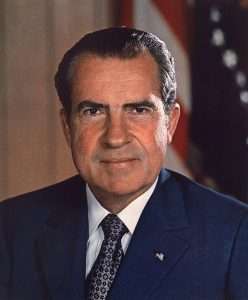
5/9/1974: Resolution to impeach President Nixon introduced in the House of Representatives. On 7/24/1974, the Supreme Court would decide U.S. v. Nixon.
I have written before here at the blog about why I disagree with judges boycotting particular law schools in an effort to influence law school culture. Over at David Lat's substack, Judge Lee Rudofsky, who is considering whether to join the Columbia clerk boycott, offers a perspective on the role of judge that is relevant to that discussion and that I think is worth addressing:
Regardless of whether I join or not, I generally (and mournfully) agree that Columbia University has become an incubator of antisemitism and anti-Americanism. And I do think that, at some point, judges must step up to the plate as leaders of the bar to help stop the spread of the virulent Jew hatred that is being normalized on college campuses and elsewhere across the country.
Judges have an important role to play in our society beyond the work we do in the courtroom or in chambers. We have a special responsibility to stand up for the rule of law and to stand against mob violence, especially where such violence echoes an age-old evil that once led to the murder of 6,000,000 Jews and millions of other innocents.
I respectfully disagree. As I see it, judges as judges do not have an important role to play in our society beyond the work they do in the courtroom or in chambers. They shouldn't be stepping up to the plate, and they shouldn't be trying to help American society solve problems like anti-Semitism, in any kind of official capacity.
In the specific case of federal judges, people who are federal judges were given power because they fit a particular profile. They had the right age, the right education, and the right set of views that a President and a Senate were looking for to fill judicial positions. Being nominated and confirmed gives them a judicial power to decide cases. That is an extraordinarily important job, and we should all thank judges for their public service.
With that said, nothing in that process qualifies a judge for some broader role in society. Judges are not overseers of our culture, or specialists in mob violence or how to address it. If, as individuals, judges want to take on a broader role in society, they are free to step down from the bench and pursue it. But I don't think they should take on that role as judges.
The problem, it seems to me, is that the "special responsibilities" Judge Rudofsky suggests judges have can be hard to distinguish from politics. I don't mean politics in the Republican versus Democrat sense (although it's presumably no coincidence that all of the judges who have publicly joined the boycott are Trump appointees). I mean politics in the broader sense of how our society resolves competing claims about justice and fairness. When those claims don't happen to involve a legal claim brought by a party in court, turning that question of politics into a question of law, I think judges acting in their official capacities should sit on the sidelines.
Of course, if judges want to weigh in on law reform questions, or write law review articles or other legal commentary, that's of course fine. They have the same right to do that as anyone else. But it seems to me the boycott framework crosses an important line: It uses judges' official government power to employ law clerks in an effort to influence the world of culture and politics. And I don't think that line should be crossed.
The lottery winner is suing an ex-girlfriend based on a non-disclosure agreement aimed at concealing his identity. (The motion to unseal, at this point, is aimed at just unsealing various sealed documents in the case, not at disclosing the parties' names.)
From Judge John Woodcock's opinion today in Doe v. Smith (Sigmund D. Schutz and Alexandra A. Harriman of PretiFlaherty and I represent the media intervenors, and my student Timon Amirani worked on our motion):
An intervening local newspaper brings a motion to unseal the sealed court docket entries in a case in which the winner of a lottery has filed suit to enforce the provisions of a non-disclosure agreement against his former partner, the mother of their minor child….
On November 14, 2023, John Doe, acting under a pseudonym, filed a civil action in this Court against Sara Smith, another pseudonym, asserting that she breached a Non-Disclosure Agreement (NDA) and caused the Plaintiff damages. The Plaintiff also sought equitable relief, including an injunction against Ms. Smith. In the complaint, Mr. Doe alleges that he was the winner of the Maine State Lottery, that Ms. Smith is the mother of his minor daughter, and that Ms. Smith entered into a NDA to "promote the safety and security of John Doe, [herself], and their daughter" and to avoid "the irreparable harm of allowing the media or the public in general to discover, inter alia, John Doe's identity, physical location, and assets."
Mr. Doe filed several motions to seal documents filed in this case based on his view that the revelation of his name will cause him irreparable harm, and the Court has granted those motions. Since then, the Magistrate Judge has suggested that the "Plaintiff appears to be under the misimpression that this case will be conducted entirely under seal" and reminded the Plaintiff that if he wants a document sealed, he must comply with Local Rule 7A….
The court largely granted the motion to unseal (1) various motions to seal, (2) the motion to proceed pseudonymously, (3) the nondisclosure agreement, (4) a motion for sanctions, (5) the proposed amended complaint, and some related items (except for some discovery-related matters and some modest redactions of things such as the parties' names, their child's name, and other identifying information). An excerpt:
From today's decision in Doe v. Bonta, written by Judge Mary Schroeder and joined by Judges Patrick Bumatay and Salvandor Mendoza:
California's DOJ maintains two databases relevant to this case. The first database relates to purchasers of firearms and applicants for CCWs. It is called the Automated Firearm System ["AFS"]. The second relates to purchasers of ammunition and is known as the Ammunition Purchase Records File ["APRF"]…. California has long permitted disclosure of information from these databases to a wide range of public officials, primarily for law enforcement purposes….
DOJ is statutorily required to include in the AFS the following personal information about gun purchasers and CCW holders: name, address, identification, place of birth, telephone number, occupation, sex, description, and legal aliases. The APRF contains similar information collected from ammunition vendors. Plaintiffs do not object to the existence of these databases or to dissemination of the information for law enforcement purposes….
The legislation at issue in this case, AB 173, became effective in September 2021. It amended the existing statutes to require DOJ to disclose data from these databases to researchers. The statute itself names as a recipient of the information the California Firearm Violence Research Center at University of California-Davis. The Center is a state institution the legislature created to do research on firearm violence, in order to inform policy and assist the legislature in enacting appropriate legislation. The statute also permits DOJ in its discretion to share information from these databases with other accredited, non-profit research institutions studying firearm violence. Currently, Stanford University houses the only institution so authorized.
Several gun owners sued, but the court rejected their arguments. First, as to the right of privacy:
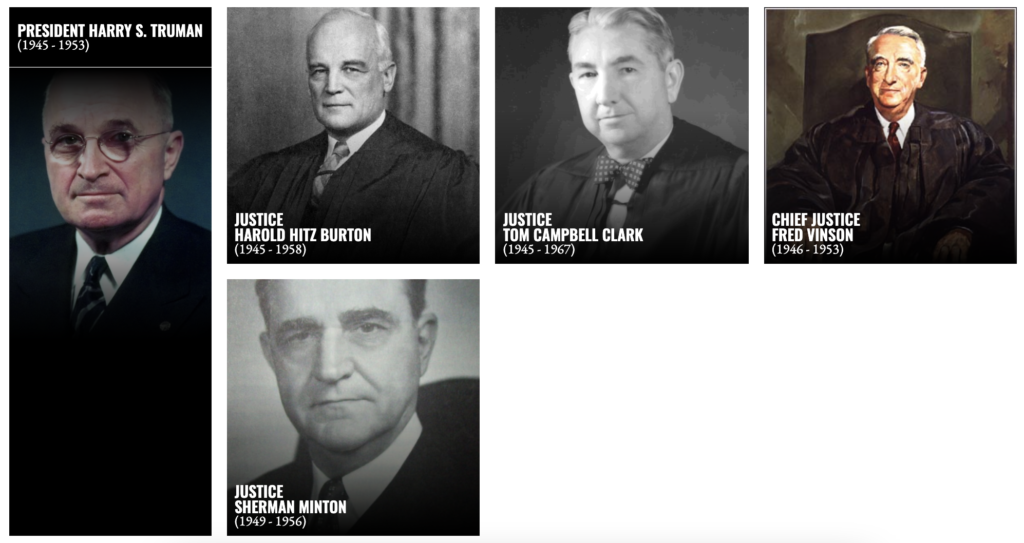
5/8/1884: President Harry S. Truman's birthday. He would make four appointments to the Supreme Court: Chief Justice Vinson, and Justices Burton, Clark, and Minton.