From Friday's decision in Del Biaggio v. Bansen, written by California Court of Appeal Justice Jeremy Goldman, joined by Justice Tracie Brown and Marin County Superior Court Judge Andrew Sweet:
Del Biaggio's opening brief does contain fictitious quotations, and not on tangential points…. In a declaration in support of his opposition to the motion, Floyd [Del Biaggio's lawyer] states that his office "uses generative AI" in a manner "consistent with State Bar guidance," with "protocols requiring human verification of all outputs using primary sources." He attributes the failures here to a "communication error," explaining that he added the quotations at issue during trial recesses in another case, and asked his paralegal to verify them but she understood he had already done so. He writes that he "deeply regret[s] any errors and affirm[s] they were not willful or AI-driven without review." The paralegal writes in her declaration that she verified all sources in a previous draft, but "based on a brief exchange" believed that Floyd had already verified his later additions to the draft.
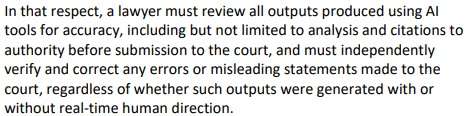
First, even if the communication error had not occurred, Floyd's protocol would not comply with the State Bar guidance to which he refers. It provides that "a lawyer must review all outputs produced using AI tools for accuracy, including but not limited to analysis and citations to authority before submission to the court." (State Bar of California, Standing Committee on Professional Responsibility and Conduct, "Practical Guidance for the Use of Generative Artificial Intelligence in the Practice of Law" (Practical Guidance), p. 9, italics added.)
We glean from Floyd's declaration that he used generative AI to make additions to the opening brief during trial recesses in another case without ever planning to review personally—or even to have any other lawyer review—the case law he added. Rather, he intended to have his paralegal simply check the citations before filing the brief. This plan would have been inappropriate even if it had not gone awry. (See Noland v. Land of the Free, L.P. (Cal. App. 2025) ["it is a fundamental duty of attorneys to read the legal authorities they cite in appellate briefs or any other court filings to determine that the authorities stand for the propositions for which they are cited"].)