
Is Title IX Holding Back U.S. Men's International Soccer?
The obvious answer is no. Title IX's application to college soccer is essentially irrelevant to the talent pipeline for the men's international team. And it is also increasingly irrelevant for the women's team. Professional training now produces America's elite international athletes.

In the wake of the World Cup soccer defeat of the U.S. Men's National Team (USMNT), analysts have been wondering what the U.S. can do better to improve its talent in international competitions. In the 4-1 defeat to Belgium, it seemed apparent that other countries (often European countries) have done a better job of developing a talent pipeline for men's soccer than the U.S. Why hasn't the U.S. developed better men's talent?
As an avid fan of the U.S. men's (and women's) national soccer teams, I have been following the debate closely. Commonly identified culprits include: America's "pay to play" system of youth soccer, diversion of some of America's best athletes to other sports, and the alleged lack of a true American soccer "culture."
But on Friday, Scott Yenor of the Heritage Foundation tried to add a new suspect to the list. He offered his view that America's Title IX regime was "a factor behind the underperformance of U.S. men's soccer on the international stage." I'm not sure whether his article was intended mainly to provoke. But the article is so disassociated from the current realities surrounding soccer talent development that a brief response may be warranted.
As Yenor tells the tale, Title IX's prohibition of sex-based discrimination in college sports programs has created "perverse incentives." According to Yenor, Title IX forces universities with (American) football teams to balance things out by padding the rosters of their women's teams in other sports—and, in some cases, cutting men's soccer teams. Yenor displays statistics showing that soccer participation by sex in National Collegiate Athletic Association (NCAA) Division I programs has changed over time, so that women now outnumber men.
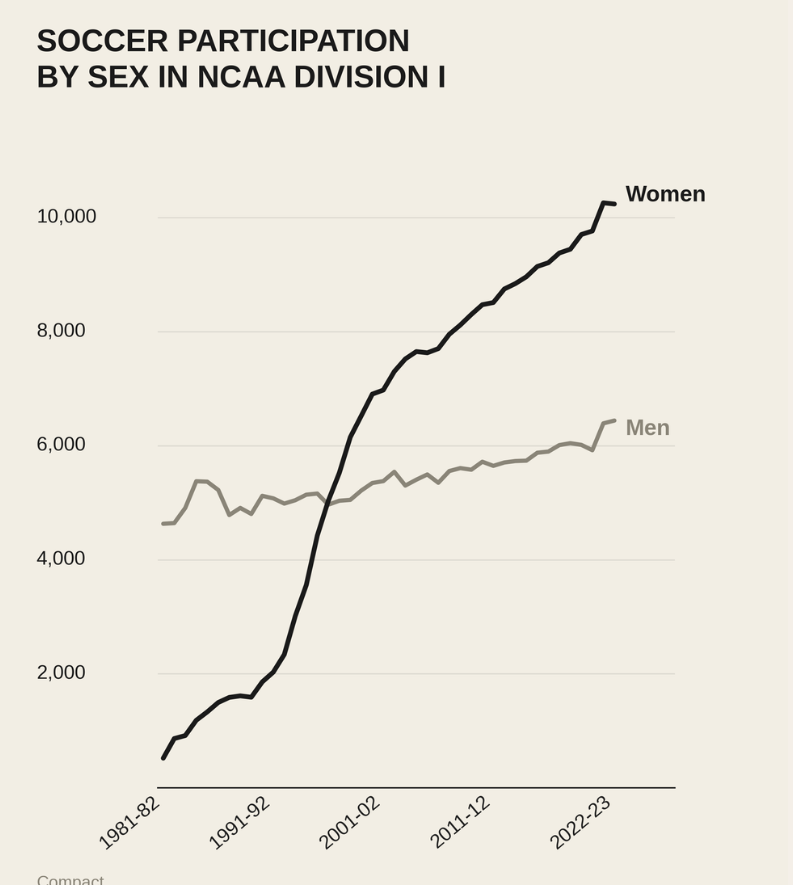
According to Yenor, these statistics show that, while "America's women's soccer has a world-class pipeline … Title IX prevents men's soccer from building one." Yenor provocatively concludes that "[o]nly when America drops its sports sex-quota system will the American men stop being humiliated by Belgium."
In my view, Yenor's argument betrays a lack of any clear understanding of how talent pipelines of men in international soccer work. Because he does not seriously engage with the real debate over how to improve the USMNT, his policy recommendation misses the mark.
Starting with his graph, his timeline shows little connection to the World Cup performances by America's men's (and women's) national teams. Title IX became effective in the mid-1970s. The men's team did not qualify to participate in any World Cups for many years both before and after. Focusing on the modern era, the U.S. men did not qualify to play between 1954 and 1986. The U.S. men did qualify in 1990—more than a decade after Title IX went into effect—and reached the Round of 16 at the next opportunity, in 1994. In 2002, the USMNT reached the quarterfinals. In its last four appearances—in 2010, 2014, 2022, and 2026—the men played consistently, reached the Round of 16 each time … but progressed no further.
To be sure, Title IX's enactment no doubt helped propel the U.S. women to success. They won the first women's World Cup in 1991. They were also champions in 1999, 2015, and 2019. But in its most recent appearance, in 2023, the U.S. Women's National Team (USWNT) disappointingly only reached the Round of 16. This trendline—consistent, long-standing success followed by a sharp drop in the most recent tournament—bears little relation to the escalating college participation over decades by women that Yenor depicts.
The core problem with Yenor's argument is its focus on the very backend of the talent pipeline—players entering college soccer programs. But as has been widely discussed—both before and after the USMNT's defeat against Belgium—developing international-level talent requires starting much earlier than college. The Athletic has a good summary of the discussion. It quotes Marije Elferink-Gemser (a Dutch professor who studies sports and talent development). She explains that, in soccer, "the ball-handling skills are so difficult that you really need to do it from a young age on." It appears that "golden age" for developing skill acquisition is the first six years of a child's life, although some might argue that the age extends all the way to age twelve.
After a child learns basic ball handling skills, the next step in the process is intensive training in soccer skills—again, well before a boy (or girl) enters college. As is commonly discussed in the soccer talent debate, many European (and other) countries have soccer "academies," where budding stars begin training as young as age nine. As an example, consider perhaps the best player in the world: France's Kylian Mbappé. Mbappé began training with his local club at age six. Then he moved to the French national football academy—Clairefontaine—where his impressive performances led to many professional European teams trying to sign him. At age 14, Mbappé joined the youth academy of the French soccer power, Monaco. By age 16, he became a first-team player for Monaco. At age 18, he completed a move to France's best professional club team (Paris Saint-Germain) for a price of €180 million. Ever since he has been an internationally recognized star.
To develop top-tier, international-level talent, the U.S. is going to need to replicate this kind of intensive professional training at a young age for some of its elite, budding soccer players. From a talent-pipeline perspective, it makes no sense to debate whether changes in Title IX might slightly upgrade the men's soccer programs at the University of Texas or University of Florida (examples cited by Yenor, where only university club teams exist). There are already more than 6,000 men's soccer players playing in NCAA Division I. A few more players at the end of the bench in college soccer isn't going to change America's international standing.
And, of course, Yenor is assuming that changing Title IX to add additional scholarships at U.S. universities will result in more American players; but many scholarship athletes come from other countries. As one example, consider the 2024 NCAA Division I men's final between Vermont and Marshall. According to one tabulation, 73% of the starters were international players from countries such as Germany, Japan, and Brazil; Marshall's squad of 28 players contained only three who were American.
The declining importance of college participation to the USMNT is easy to see by looking at U.S. World Cup rosters. To be sure, college soccer was once the central pipeline for the U.S. men's national team: every player on the 1990 World Cup roster appears to have played U.S. college soccer, and roughly three-quarters of the 1994 and 2002 rosters did. But by the modern era, that share had fallen sharply. In the last two World Cups, it appears that only about 8 of the 26 players had done so—and only a few of them were starters. Of the USMNT starters on the field against Belgium this month, only goalkeeper Matt Freese (Harvard) and 38-year-old defender Tim Ream (Saint Louis) appear to have been former NCAA soccer players.
The trend towards fewer ex-college players is attributable to several factors that have nothing to do with Title IX regulations on NCAA scholarships. One of the most important factors is the rise of Major League Soccer (MLS) academies in the U.S., designed to compete with the well-developed European soccer academies. More than two dozen U.S.-based MLS teams exist. All teams have strong academies designed to develop local talent, either to supplement their rosters or to generate income by selling these players in the international transfer market.
The next generation of U.S. talent may well come from these academies. The Athletic already has an interesting projection of which new players are most likely to make the 2030 World Cup roster of the USMNT. Assuming that 14 current players return, it is then possible to project an additional 16 new arrivals, broken into the categories of "just missed" (#15-20) and "next generation" (#21-30), with ages and current club affiliation listed:
Just Missed in 2026
15. Noahkai Banks (19) — FC Augsburg
16. Johnny Cardoso (24) — Atlético de Madrid
17. Tanner Tessmann (24) — Olympique Lyon
18. Aidan Morris (24) — Middlesbrough FC
19. Patrick Agyemang (25) — Derby County
20. Diego Luna (22) — Real Salt Lake
Next Generation in 2030
21. Zavier Gozo (19) — Real Salt Lake
22. Cavan Sullivan (16) — Philadelphia Union
23. Adri Mehmeti (17) — New York Red Bulls
24. Julian Hall (18) — New York Red Bulls
25. Peyton Miller (18) — New England Revolution
26. Mathis Albert (17) — Borussia Dortmund
27. Rokas Pukstas (21) — HNK Hajduk Split
28. Julian Eyestone (20) — Brentford
29. Diego Kochen (20) — Lyngby Boldklub, on loan from FC Barcelona
30. Josh Wynder (21) — SL Benfica (B team)
Of this list of sixteen potential players, only three appear to have previously played college soccer (or seem likely to do so in the future): Aidan Morris, Patrick Agyemang, Julian Eyestone. Notably, two of these three also went to an MLS academy (Morris, who spent three pre-college years at the Columbus Crew academy; and Eyestone, who joined the FC Dallas academy at around age 10). And only one of the three — Agyemang, the oldest player on the list — played four years of college soccer. Morris played one fall season at Indiana, before leaving to sign with the Columbus Crew; Eyestone played one fall season at Duke, before signing with Brentford in England. By my count, eleven of the sixteen went to MLS academies and several of the others went to foreign academies (Banks at FC Augsburg, Cardoso at Brazilian academies, and Kochen at Barcelona's famous La Masia academy) and Josh Wynder went to a Louisville City/USL academy (the second-tier league below MLS).
Part of the reason that U.S. men's players (such as Morris and Eyestone) want to leave NCAA soccer programs quickly is that the NCAA requires that athletes be students first, and soccer players second. Generally speaking, the NCAA rules cap the amount of "countable athletically related activities." During the playing season, the standard Division I limit is 4 hours per day and 20 hours per week, with required days off. And the season lasts only a few months of the year.
There are occasional NCAA exceptions allowing more training for Olympic-level athletes. But the last thing that American soccer would want to encourage is its top athletes going into NCAA-regulated college soccer programs. For an elite soccer talent, the NCAA rules are major constraints. A professional environment can offer, well, professionalism: such things as daily training throughout the year, individualized technical work, strength and conditioning, recovery, nutrition, film study, reserve-team matches, and first-team integration. The NCAA season is compressed in a fall window of about three months, with some stretches of three games in eight days—a bad program for training. There are other problems as well. But the general point is that as fewer elite American men go into college soccer programs, that likely improves our talent pool by putting them in more competitive and professional environments.
An excellent scholarly analysis of the rise in non-college pathways to the USMNT comes from Samford University's Center for Sports Analytics. In a report published this May, the Center presciently predicted something like the USMNT's round-of-16 exit in July. The report's title is "The 2026 USMNT Is the Best American Soccer Team in History. It Still Isn't Good Enough." The report carefully explains, comparing the 1994 and 2026 USMNTs, far fewer of today's players are arriving from college soccer. Instead, four additional pathways, apart from the historical college path, exist to arrive at the USMNT: (1) the Youth Export, (2) the MLS-Academy-to-Foreign-League; (3) the MLS "Lifer"; and (4) the Foreign-Raised Dual-National.
And, interestingly, the report notes that the "further up the pitch [i.e., field] you go on the 2026 USMNT, the more European the system that produced the player becomes." The report explains that, currently, even the MLS does not produce America's match-deciding players. European clubs do … and American teenagers are now competing for academy spots at those clubs alongside the world's best young players. The report also impressively presents detailed analytics, showing that the key metric for predicting how a national soccer team will perform at the World Cup is total playing time for a country's nationals in the five elite European soccer leagues over the just-completed season. By that metric, the U.S. currently sits just outside the top eight teams (in tenth position)—exactly where the team finished in this year's World Cup.
So on the men's side, the college pipeline has little relevance to World Cup performance. But what about the women's side? Yenor also argues that, compared to the U.S. men, the U.S. women have built a "world-class pipeline" through college soccer. To be sure, Title IX's enactment in the 1970s helped to propel the U.S. women's team to the top. The timing gave American women's soccer a jump start ahead of other countries.
But here again, Yenor's chart (reproduced above) bears little connection to that jump start. The chart shows increasing women's participation in NCAA Division I over the last several decades. But the development of players for the USWNT has always been heavily concentrated in a handful of elite college programs. The fact that (for example) such schools as Mercyhurst University, Lindenwood University, and others have recently added Division I women's soccer programs is disconnected from the national team program.
NCAA development of international-level women's soccer players has always been heavily concentrated in the most competitive schools. The prime example is UNC, where the amazing Tarheels women's program won 16 of the first 19 national titles. More recently, schools like Stanford, Santa Clara, Penn State, Notre Dame, and a few others have been involved. But increasingly USWNT players are turning pro and never playing college soccer.
The trend of avoiding NCAA soccer is due to a recent change in the legal environment that now allows strong American girls to turn professional at a young age. Olivia Moultrie was the trailblazer here. Moultrie started playing soccer when she was four years old. By fifth grade, she was homeschooled so that she could focus on soccer and became the first girl on a boys' club team to play in the U.S. Soccer Development Academy system. At 11, she accepted a full scholarship offer to play soccer for the UNC Tar Heels when she reached college age, becoming the youngest female soccer player to publicly accept a college offer at the time. Shortly thereafter, she traveled to Europe to train. When she was 13, she began training with the Portland Thorns (of the National Women's Soccer League or "NWSL").
In 2021, when she was 15, Moultrie filed an antitrust lawsuit against the NWSL in district court in Oregon. She alleged that the NWSL, as the "only acquirer of talent in the [professional] market," violated the Sherman Antitrust Act with its age-requirement that players be 18 years old. Her lawsuit asked for a temporary restraining order against the age rule so that she could play during the 2021 pro season. U.S. District Judge Karin Immergut granted a temporary restraining order and preliminary injunction, ordering the league to lift its age limit and allow Moultrie to compete for a roster spot on the Thorns. Moultrie became the youngest player in NWSL history to score a goal and appear in a NWSL championship game.
Unsurprisingly, Moultrie has also featured for the USWNT, where she has made a total of 18 appearances, including 7 during 2026. And Moultrie is hardly alone in taking this professional path. Recently, many of America's brightest young USWNT stars have skipped college. Consider what a projected "starting eleven" lineup for the U.S. women's team might look like next year in the 2027 Women's World Cup in Brazil, arranged from oldest to youngest player, with any college experience noted:
- Emily Fox (28 years old) — North Carolina, 2017-2020.
- Mallory Swanson/Pugh (28) — Enrolled at UCLA but left before playing an official NCAA season; no NCAA soccer.
- Phallon Tullis-Joyce (27) — Univ. of Miami, 2014-18.
- Tierna Davidson (27) — Stanford, 2016-2018.
- Naomi Girma (26)— Stanford, 2018-2021.
- Sophia Wilson/Smith (25) —Stanford, 2018-2019; only two NCAA seasons.
- Trinity Rodman (24) — Turned pro directly; no NCAA soccer.
- Jaedyn Shaw (21) — Turned pro at 17 rather than playing college soccer; no NCAA soccer.
- Gisele Thompson (20) — Signed directly with Angel City rather than playing at Stanford; no NCAA soccer.
- Olivia Moultrie (20) — Turned pro with Portland; NWSL debut at 15; no NCAA soccer.
- Lily Yohannes (19) — Ajax/Lyon pro pathway; no NCAA soccer.
Of the eleven players on this list, only five played NCAA soccer, and only four played for the full four years. And the difference between the older players and younger players is stark: Of the five youngest players on the possible projected starter list (such as Moultrie), none played NCAA soccer.
As with the men's team, recent scholarly research about the women's team highlights the importance of these non-college pathways to the USWNT. And given the rising strength of women's soccer teams in other countries—apparently fueled by professional training opportunities at professional clubs—the need for these non-college pathways is increasing. The U.S. women exited the last World Cup in 2023 earlier than ever before—in the Round of 16. A new generation of professionally trained players is needed to return America to the top.
As the recent pathways for top players joining both the U.S. men's and women's national teams demonstrate, NCAA college soccer is fading into obscurity as part of the international talent pipeline. There may be arguments for modifying some of Title IX's rules to expand athletic opportunities for men in soccer or other sports. (I take no position on that issue here.) But the claim that changing Title IX's rules could have any meaningful benefit for the American men's international soccer team is but a provocative diversion from the real issues. To beat the best professionals, the top U.S. men—and women—need to follow the most professional paths.
***
Note: In the interests of brevity, in this post I have referred to the "World Cup" and "Women's World Cup," because those are the official names of the competitions as given by FIFA. I acknowledge that using the sex modifier for the women's game but not the men's might be viewed as relegating the women's game to second-class status. But, at this time, this linguistic approach appears to be conventional.
Update: I've corrected an embarrassing mistake on my list of projected 2027 USWNT starters, swapping in goalkeeper Phallon Tullis-Joyce. Thanks to David Nieporent for catching my embarrassing roster projection error. That correction means that five of the projected starters for the USWNT in 2027 played NCAA Division I soccer. (As a fan of the Utah Royals, I hope that Mandy McGlynn secures the goalkeeper spot. She played for Virginia Tech, 2016-19.)
Further update: I've correct a couple of small typos pointed out by William of Brooklyn and others.