The Volokh Conspiracy

Mostly law professors | Sometimes contrarian | Often libertarian | Always independent | Est. 2002

The Volokh Conspiracy

The Left's Attack on the Secret Ballot and on Same Day Voting

Mail in voting over a period of weeks with drop boxes eliminates the secret ballot, and the need for everyone to vote on the same day, with the same headlines in mind, and not over the period of a month.

|

Using the the Covid pandemic as an excuse, the Left in 2020 massively changed the way presidential elections are held in this country. Whereas previously the secret ballot and same day voting was the norm, and one needed an excuse to get an absentee ballot, suddenly the Left declared it was essential to switch to mail in voting, for any reason at all, over a period of many weeks.

Swarms of Democratic vote canvassers knocked on the doors of thousands of people who had not yet voted "by mail" and offered to "help" them "make their vote count". Ballots were filled in by voters at home. possibly with canvassers or family members, "observing" how each person voted. Canvassers then "offered" to deliver the "harvested ballots" to "drop boxes" saving voters the trouble of turning them in themselves. The net result was that Donald Trump got more votes in Pennsylvania in 2020 than Barack Obama had in either 2008 or in 2012, but he still fell 80,555 votes short of Joe Biden because "mail-in" voting with no secret ballot and canvassers conveying your ballot for you to the polls or a drop box was such a hit.

In 2008, Barack Obama got 3,276,363 votes for President in Pennsylvania. In 2012, Barack Obama got 2,990,274 votes for President in Pennsylvania. In 2020, Donald Trump topped both of Obama's vote numbers in 2008 and in 2012 by getting 3,377,674 votes for President in Pennsylvania. Donald Trump exceeded Barack Obama's 2008 vote total in Pennsylvania by 101,311 votes.  Trump "lost" the "counted vote" in Pennsylvania in 2020 by 80,555 because Joe Biden got an "astonishing" 3,458,229 votes in Pennsylvania in 2020.

I do not myself believe that there was fraud in the counting of ballots or voting machine malfunctions. I do believe, however, that the unprecedented use of mail in voting over a period of many weeks, with the loss of the secret ballot, and drop boxes, produced a fundamentally illegitimate Biden victory in 2020 in Pennsylvania and elsewhere. I simply do not believe that in an honestly held traditionally run presidential election that Joe Biden would get 181,866 more votes for President in 2020 in Pennsylvania than Barack Obama got in 2008.

As a result, many Republicans, myself included, thought that the 2020 presidential election was probably stolen, even though that fact could not be proved in a court of law. President Trump himself did not claim right after the election that mail in voting and the loss of the secret ballot had altered the vote count in the 2020 election. He waited for two weeks and asked for hopeless recounts instead. No recount in Pennsylvania was ever going to erase an 80,555 Biden lead in votes counted at the polls. The margins Trump lost by in Pennsylvania, Wisconsin, Nevada, and Arizona were simply too big to change after endless recounts. Some Republicans, including me, therefore acquiesced in Joe Biden taking office because we thought we had to do that to preserve a facade of democracy absent concrete proof of vote fraud.  But deep down in our guts we thought that Joe Biden's campaign had probably won with dirty tricks, although that could not proved in a court of law.

We did not side with President Trump on January 6, 2021 because we did not want the GOP controlled state legislatures of Pennsylvania, Georgia, Wisconsin, and Arizona to declare Trump re-elected given the returns at the polls. The question was what outcome was worse for our democracy? Going by the vote count on Election Day or letting state legislators pick the President, which had never before been done in American history. Reluctantly, we went along with allowing Joe Biden to be crowned the winner based on the vote count on election day, but we felt then and will always feel that Biden may well have been an illegitimate President.

We disapproved of Trump's behavior on January 6, 2021, not because his claim of election fraud was wrong, but because he as President did not articulate this claim in anything remotely resembling  a compelling way nor did he call on his supporters to forgo violence in the way of a Martin Luther King or a Mahatma Gandhi, and as a result five people died in a riot. The election fraud that wrongly cost Trump his victory in 2020 was caused by mail in voting, drop boxes for ballots, and the loss of the secret ballot. President Trump's mistake was in not complaining much more loudly before the vote was counted that the rules of the game had been rigged against him to produce an undemocratic outcome.

Biden said as a candidate in 2020 that he was a moderate liberal, but he proceeded to govern like Bernie Sanders or Elizabeth Warren except for the refusal of two brave Democrats, Joe Manchin and Kyrsten Sinema, to go along with that nonsense. Manchin and Sinema will both be booted out of the Senate come January 3, 2025, as a result. Biden said as a candidate that he would depoliticize the criminal justice process. Instead, his Department of Justice has used an unconstitutionally appointed Special Prosecutor to indict former President Donald Trump -- the first time in history that a former President has been indicted. Hillary Clinton was given a pass on the misuse of classified documents, but not so Donald Trump. Biden's Democrats even got Trump unconstitutionally convicted for altering business records to conceal the Trump Organization's involvement in First Amendment protected speech in a New York State trial that was truly a charade.

We are now about to choose again between Donald Trump and Joe Biden in a presidential election year - 2024 - which is totally free of the fears of infection in public places caused by Covid. Here are three things we should insist on: 1) a return to truly secret ballots cast in polling booths with the curtain shut behind the voter; 2) no use of drop boxes, and 3) that everyone votes on the same day, with the same headlines in mind, and not over the period of a month.

The loss of the secret ballot, the use of drop boxes, and of same day voting is a huge change in our democracy, which ought to be abandoned now that Covid is gone. You cannot fill out a ballot at home in most cases without your family members knowing how you voted and that means the sudden loss of the secret ballot. Partisan canvassers may also observe how people vote, intimidating them and undermining their independence.

The secret ballot is of central importance in elections, especially when candidates generate the passionate feelings of hatred that are generated by Donald Trump and Joe Biden. This is a hatred that pits family members and even long-time friends against one another sometimes ruining long-cherished relationships. If ever, there was to be a presidential election for which the secret ballot was essential, it is this year's rematch between President Trump and Joe Biden.

It is equally important that all Americans vote on the same day, after the same news cycle, with the same information before them. Ballots arriving by mail day after day, after Election Day, discourages confidence that an election has been fair. If you are in the military or have some other good reason for needing an absentee ballot, you should be allowed to have one. But, if we want elections the outcomes of which people have confidence in, we simply have to return to our traditional system of the secret ballot, no use of drop boxes, and same day voting. Otherwise, our democracy is doomed.

[UPDATE 6/8/24 19:25 pm: This post was corrected, to further make clear that the concern is about influence on voters rather than fraud in the counting of votes or vote machine error; see the post above.]
Book Advances for the Justices in 2023

Gorsuch ($250,000), Kavanaugh ($340,000), Jackson ($893,750).

|

One of my proposals for bilateral judicial reform would be to cap advances on book royalties for the Justices. I've written at length about the $1.2 million book advance for Justice Barrett in 2021 (here, here, and here). Now, the annual disclosures reveal the book deals for other Justices in 2023.

Yesterday, Axios reported that Justice Kavanaugh is writing a memoir. This was a well-timed scoop, given that today, Kavanaugh disclosed that his advance is $340,000. About a third of what ACB earned. Yikes. But still more than the other Trump nominee. Justice Gorsuch received an advance of $250,000 for his latest book with Janie Nitze, Over Ruled.

Justice Jackson, whose book deal was announced a few months ago, disclosed an advance of $893,750. I don't know if this is the full amount, or part of the advance. In any event, still a drop from Barrett peak in 2021. Maybe the market dried up for books about Justices?

For what it's worth, Justice Jackson received free tickets from Beyonce, but Justice Kavanaugh had to pay for his own Taylor Swift tickets.

Each year, Gorsuch receives a few hundred dollars in royalties from Princeton University Press for his 2006 book on assisted suicide and euthanasia. But as best as I can tell, Gorsuch has not received any royalties from his first book, A Republic, beyond the $250,000 advance. It's possible that all future royalties are assigned to his co-authors. Or, I think it is more likely that he hasn't earned back the $250,000 advance from 2021. In any event, Harper Collins has given Justice Gorsuch another $250,000 advance, which he may not earn back. People and groups are unlikely to buy his old book when the new book is on the market.

As I wrote in Bilateral Judicial Reform, I am skeptical any of these Justices will earn back these prodigious advances. These are interest free loans that are perfectly valid under the rules.

There are many headlines about Justice Thomas receiving valuable gifts. The insinuation is that he is profiting off his position. Much the same can be said about a Justice who writes a book. These are not normal business decisions. The Justices will only be able to make back these advances if they hold many events, where groups will feel at least some pressure to buy the books. And there are all sorts of conflicts there. I think the publishers are unlikely to ever get back the advance, but see some prestige by having a Justice on their label, which helps with other aspects of business.

Politics

Short Circuit: A Roundup of Recent Federal Court Decisions

Frothy fonts, unprofessional death threats, and books about butts and farts.

|

Please enjoy the latest edition of Short Circuit, a weekly feature written by a bunch of people at the Institute for Justice.

New on the Bound By Oath podcast: the story of Berman v. Parker. In which the Supreme Court, in 1954, abandoned previous constitutional limits on the gov't's power to take property from Person A to give it to Person B, greenlighting the era of urban renewal. Which was a bad era.

New at Fox News: Ever since Berman, cities have been able to take "blighted" neighborhoods, bulldoze them, and give them to private developers. But Brentwood, Mo. officials are threatening to take property that is not remotely blighted. Does "blighted" mean blighted, or does it instead mean "coveted by the gov't"?

Read More

Free Speech

Fifth Circuit Blocks Order Requiring Defendants' Lawyers "to Attend 'Religious-Liberty Training' as a Sanction"

|

From today's decision in Carter v. Southwest Airlines, Inc. (consolidated with Carter v. Local 556, Transport Workers Union of Am.), decided today by Judge Edith Brown Clement, Kurt Engelhardt, and Cory Wilson (for my earlier post on the case, see here):

On August 7, 2023, the district court held Southwest Airlines in contempt for failing to comply with a Title VII judgment and ordered company lawyers to attend "religious-liberty training" as a sanction…. [W]e GRANT Southwest's motion for a stay pending appeal because the order likely exceeded the district court's civil contempt authority….

A jury found that Southwest Airlines violated Title VII and the Railway Labor Act by firing flight attendant Charlene Carter because of her religion; specifically, for publicly posting and privately messaging to another Southwest flight attendant images of aborted fetuses in furtherance of her religious beliefs. As part of its judgment, the district court ordered Southwest to, among other things, post the verdict and judgment on company bulletin boards and to email the same to all flight attendants, informing them of their Title VII and RLA rights (the "notice requirement").

{The district court also enjoined Southwest "from discriminating against Southwest flight attendants for their religious practices and beliefs, including—but not limited to—those expressed on social media and those concerning abortion" and "from failing to reasonably accommodate Southwest flight attendants' sincerely held religious beliefs, practices, and observances."}

To comply with the judgment, Southwest reinstated Carter, posted the verdict and judgment in all flight-attendant breakrooms, and emailed all flight attendants the verdict and judgment. The email stated that "a federal court in Dallas entered a judgment against Southwest" and "ordered us to inform you that Southwest does not discriminate against our Employees for their religious practices and beliefs." Southwest also published an internal memo stating that Southwest believed Carter's messages were "inappropriate, harassing, and offensive," "extremely graphic," and "in violation of several Company policies." The memo further stated that, although Southwest would implement the judgment, Southwest was "extremely disappointed with the court's ruling and [was] appealing the decision to the Fifth Circuit Court of Appeals."

Carter moved the district court to hold Southwest in contempt, arguing that these communications—the email and memo—violated the judgment. Carter contended that the email violated the judgment because it said that Southwest "does not discriminate" rather than "may not discriminate," which was the language the court's order required. As for the memo, Carter claimed that it demonstrated that Southwest could continue to discriminate against flight attendants' religious beliefs and practices. The district court agreed that Southwest had violated the notice requirement and therefore held Southwest in contempt. As contempt sanctions, the district court directed Southwest to circulate a statement—verbatim—to its flight attendants "to set the record straight" and ordered three of Southwest's in-house lawyers to attend religious-liberty training with the Alliance Defending Freedom {"a nonprofit, public-interest legal organization that provides litigation services, funding, and training to protect First Amendment freedoms and other fundamental rights"}.

Read More

Libertarianism

David Boaz, RIP

One of libertarianism's greatest and most principled advocates passed away today.

|

David Boaz. (Cato Institute)


David Boaz passed away today. Liberty has lost one of its greatest and most principled advocates. As the Cato Institute's longtime vice president for public policy and executive vice president for over forty years, he - more than any other single person - built Cato into the world's leading libertarian think tank. His 2015 book The Libertarian Mind is one of the best and most accessible introductions to libertarian ideas. In an edited volume, The Libertarian Reader, David compiled a wide range of classic libertarian writings by leading thinkers.

Central to David's thought was the idea that libertarianism requires both a broad conception of the range of liberties that must be protected, and a broad view of the range of people entitled to that full protection. Thus, he advocated radically cutting back on government policies that violated economic liberty, such as taxation and welfare state spending. But he was equally concerned about those that threatened liberty of other kinds, such as immigration restrictions and the War on Drugs. And he repeatedly emphasized that the full range of liberties must be available to everyone - whether they be black or white, gay or straight, men or women, immigrants or natives.

Thus, in a 2010 article, he cautioned libertarians against nostalgia for an imagined past, where liberty was supposedly greater. While some types of government intervention were less prevalent in the 18th and 19th centuries, it was - he noted - also an era of slavery, segregation, and other forms of oppression that have since been at least in large part overcome.

David also repeatedly reminded libertarians that we must be concerned about dangers to liberty from both right and left.  Unlike some, he did not minimize or ignore the threat of right-wing authoritarian ethno-nationalism exemplified by the rise of Trump in the US, and similar movements in Europe. In his contribution to National Review's 2016 "Against Trump" symposium, David wrote that "From a libertarian point of view…. Trump's greatest offenses against American tradition and our founding principles are his nativism and his promise of one-man rule." He was right then, and remains right today.

I knew David for over thirty years, since I was an intern at Cato in 1992, during the summer after my freshman year in college. A small incident from that time illustrates David's simultaneous commitment to high standards and intellectual outreach.

In those days, Cato was housed in a small building, which included a storage room filled with books published by the Institute. I liked to go there and browse - it was more fun than the work I was assigned to do! Early one morning, David happened by the storage room, and saw me reading a book there.

"Mr. Somin," he asked, "did your paycheck come on time this week?"

"Yes, sir," I answered.

"Then, why," David inquired, "are you late to work?"

Whether they were a vice president or an intern, everyone at Cato had a job they should be focused on. David had little tolerance for slackers.

Duly chastened, I moved to get back to work. But David also made sure to point out that Cato interns were entitled to free copies of Institute publications. If I wanted to read that book (or any other Cato book), he said, I should simply take it home with me - and read it on my own time. He never forgot that developing and spreading ideas was the main focus of a think tank's mission.  And that is how I got copies of David's excellent edited volumes, Liberating Schools, and The Crisis in Drug Prohibition.

That same commitment to ideas and outreach made David a great promoter of libertarian thought to a wide range of audiences. He had the rare skill of always maintaining civility, while also never pulling his punches.

In later years, I became a Cato adjunct scholar, and - eventually - the Institute's Simon Chair in Constitutional Studies (in addition to my primary employment as a law professor at George Mason University). Over that time - thanks to David's support - Cato co-published two of my books, and I did various other projects with the Institute, as well. Thus, I often had the opportunity to work with David and learn from him. I could not help but admire both his unfailingly high standards, and his commitment to principle. Cato and other libertarian institutions should strive to continue his legacy.

In closing, I would like to extend my condolences to David's family, friends, and colleagues.

The Cato Institute has posted a summary of David's career, and tributes by many Cato scholars, here.

A Kerfuffle at the Columbia Law Review

Misbehaving editors intent on publishing ideologically driven claptrap provoke a controversy.

|

I have an op-ed in the Washington Free Beacon about an ongoing controversy involving the Columbia Law Review. It begins:

Law reviews are typically sleepy, student-edited journals that publish turgid scholarship. The articles may be read by specialists, and they are often read by no one beyond the author and editors. But Columbia University law school's law review has received a rare burst of public attention this week.

According to various media outlets, the law review's board of directors, composed of faculty and alumni, tried to censor an article critical of Israel. Except that's not what happened at all. The true story involves a faction of the law review secretly breaking all procedural rules and customs to publish a piece of ideologically driven claptrap.

I explain the relevant chain of events in detail at the Beacon link.

Three Bad Ideas about Race in America

|

My forthcoming article, Three Bad Ideas about Race in America, has been posted on SSRN.

Here is the abstract:

In this Essay, prepared for a symposium honoring Brown v. Board of Education's seventieth anniversary, I examine and critique three influential propositions regarding race promoted by some academic theorists and pundits.

Part I discusses and rejects the notion that differences in socioeconomic status among different American subgroups are best explained by the power relationships groups have with the dominant white majority.

Part II considers the claim that racial categories define collective actors who inevitably have common interests and outlooks. This Part concludes that this idea is flawed and perhaps incoherent.

Part III addresses the proposition that white Americans should be encouraged to cultivate a "white racial consciousness" so that whites will recognize their privilege and become "antiracists." Part III concludes that such encouragement is both wrongheaded and dangerous.

Those who promote the ideas discussed and critiqued in this essay share several premises: pessimism about the US overcoming its racist history; what I consider a naïve belief in an identitarianism shaped by antiracist ideology as the best way to mitigate racism; and a concomitant belief that preserving the salience of existing socially (and legally) constructed racial categories is both inevitable and mostly desirable.

These premises, in turn, are ultimately based on a skepticism of or hostility to the ability of liberalism to overcome racism. In other words, they represent a rejection of the optimistic racial liberalism prevalent among civil rights activists when Brown was decided.

And here is an excerpt:

One explanation provided for the success of some nonwhite minority groups is that these groups became "white adjacent," or "honorary whites" via social evolution. This permits them to succeed in a white supremacist society. This theory lacks explanatory power. For example, it cannot explain why Chinese Americans but not Cambodian Americans are "white adjacent," unless white-adjacentness is a tautology—the more successful members of a minority group are, the more the group is "white adjacent."

Sociologist Eduardo Bonilla-Silva argues that skin color rather than race itself explains these differences. Thus, within the Asian American group, Chinese, Filipinos, Korean, and Japanese, whom he says have relatively fair complexions, qualify as honorary whites. Darker-complexioned Southeast Asians, such as, Vietnamese, Cambodians, and Laotians, however, are relegated to being part of the "collective black," and thus are doomed to lower socioeconomic status.

Granting arguendo that the color line Bonilla-Silva draws makes sense, there are still empirical gaps his theory cannot explain. For example, why were Filipino Americans among the poorest ethnic groups in the US in the late 1960s, but now have higher average incomes than Japanese or Chinese Americans, who in turn are wealthier on average than are white Americans? What do we make of Asian Indian Americans, who often have dark complexions yet have the highest income of any national-origin group? If their Caucasian physiognomy gives them an advantage, why don't other South Asian Americans, such as Pakistani, Bangladeshis, and Nepalese, have the same advantage? Why are Appalachian whites, despite being of white Protestant origin and resident in the US for centuries, at the bottom of the socioeconomic indicators pile? Why are Ethiopian and Somali Americans, whose physiognomy is relatively close to Europeans, less economically successful than are Nigerian Americans, who have a more distinctively African appearance?

Federalism

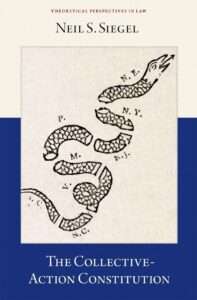
The Collective-Action Constitution in an Era of Polarization and Animosity: An Elegy?

Fifth in a series of guest-blogging posts.

|

Oxford University Press.

The study conducted by The Collective-Action Constitution offers several lessons. First, when states disagree about the existence or severity of collective-action problems, such problems do not simply exist or not in a technical, scientific way. Cost-benefit collective-action problems have an objective structure, but their existence and significance require assessing the extent to which states are externalizing costs that are greater than the benefits they are internalizing, and such assessments may require normative judgments in addition to factfinding.

Second, the assessor that matters most is either the Constitution itself or the governmental institution with the most democratic legitimacy to make such judgment calls. This institution is Congress—the first branch of government—where all states and all Americans are represented, in contrast to individual state governments, where only one state and some Americans are represented. In McCulloch v. Maryland (1819), Chief Justice Marshall explained this key difference between the democratic legitimacy of the states and the people collectively in Congress and the democratic legitimacy of states individually outside it. Congress is also more broadly representative of all states and all people than is the presidency, which does not include both political parties at a given time, or balance interests to anywhere near the same extent that Congress does.

Third, if it is acting within its enumerated powers, Congress need only comply with the voting rules set forth in the Constitution; Congress need not first establish that all or most states agree that a collective-action problem exists and is sufficiently serious to warrant federal regulation. In other words, Congress need not poll states apart from establishing sufficient support in the federal legislative process. Because states are represented in Congress—because congressional majorities represent (albeit imperfectly) the constitutionally relevant views of the states collectively—proceeding otherwise would overrepresent the states, effectively letting them vote twice. One main reason that the Constitution is too difficult to amend, Chapter 10 argues, is that Article V essentially lets states vote twice.

Fourth, Congress's central role in deciding whether and how to solve collective-action problems for the states connects constitutional provisions, principles, and ideas that may otherwise seem to have little to do with one another. These include, for example, the Interstate Compacts Clause (see Chapter 3), the Interstate Commerce Clause (Chapter 5), the congressional approval exception to the dormant commerce principle (Chapter 5), Article III's opening clause, which lets Congress decide whether to create lower federal courts (Chapter 7), Article IV's provisions expressly or implicitly authorizing Congress to legislate (Chapter 8), and democratic-process rights and theory (Chapter 9).

Congress's paramount role in the constitutional scheme raises questions (explored in Part III of the book) about the operation of the Constitution's system of separated and  interrelated powers in contemporary times. It is one thing  to argue that the Constitution was originally intended, and designed, to render the federal government operating through (super)majority rule more likely to solve multistate collective-action problems than the states operating through unanimity rule. It is another thing to show that this is generally true in practice. As George Washington implied in his letter accompanying submission of the U.S. Constitution to the Confederation Congress that begins The Collective-Action Constitution, to protect state autonomy and individual liberty, the Framers created a bicameral legislature and a separation-of-powers system, both of which make it more difficult to legislate than in a unicameral legislature and a parliamentary system. But the Framers did not imagine that the availability of veto threats would come to dominate the policymaking process in situations having nothing to do with perceived encroachments on the presidency or bills that the president thinks unconstitutional. Nor were the Framers responsible for modern subconstitutional "veto gates" in Congress, especially the Senate filibuster, which makes it even harder to legislate. Finally, the Framers did not foresee the polarized, antagonistic nature of contemporary American politics.

These developments have meant that bicameralism and the separation (and interrelation) of powers often do not merely qualify Congress's ability to legislate. The horizontal structure and contemporary politics likely make it too hard for Congress to do so, particularly given the magnitude and geographic scope of the problems facing the nation and the extent to which Americans look mainly to the federal government, not the states, to solve them. The Constitution's greatest defect in modern times is probably that Congress often cannot execute its legislative responsibilities in the constitutional scheme. A result has been power shifts from Congress to the executive branch, the federal courts, and the states. The main workaround for congressional gridlock has been more frequent unilateral action by the executive. Other partial and potentially worrisome workarounds include efforts by federal courts to "update" the meaning of federal statutes and greater exercises of state regulatory authority. Sufficient solutions to the problem of gridlock may not exist any time soon given the practical impossibility of amending the Constitution, the unlikelihood that veto practice will become more restrained, and the long periods required for political realignments to occur. Ending the legislative filibuster in the Senate by majority vote would, however, have the likely salutary (but not cost-free) consequence of changing the typical voting threshold in this chamber from a three-fifths supermajority to majority rule.

Given the difficulty of legislating in the current era, it might be thought that The Collective-Action Constitution offers an elegy—an account of how the U.S. constitutional system was supposed to function or used to function but functions no longer. To readers who regard the book as an elegy during an era of presidential administration, judicial supremacy, and assertive state legislation, I offer the words of Richard Hooker, who long ago deemed his own book an elegy and justified writing it anyway: "Though for no other cause, yet for this; that posterity may know we have not loosely through silence permitted things to pass away as in a dream." (My learned colleague, H. Jefferson Powell, furnished this quote.)

In truth, however, The Collective-Action Constitution does not offer an elegy.  The constitutional structure still has much to commend it relative to relying on the states to act collectively outside Congress. When problems are national or international in scope, the relevant comparison is not between Congress's ability to combat a problem and one state's ability to do so, but between the ability of the political branches to act and the ability of the states to act collectively through unanimous agreement. Collective-action problems would almost certainly be more severe if the federal government were dissolved and states had to unanimously agree to protect the environment; regulate interstate and foreign commerce; build interstate infrastructure; conclude international agreements; contribute revenue to a common treasury and troops to a common military (or coordinate separate militaries); disburse funds held in common; respond to economic downturns; provide a minimum safety net; and handle pandemics, among many other problems. Congress still legislates today, and it does so much more frequently than most (let alone all) states form interstate compacts.

As for the executive branch, Presidents lack the ability to legislate in a formal and legitimate fashion, and so they cannot address the above problems and those with a similar structure to anywhere near the same extent that Congress can. Presidential action is less enduring and far reaching than legislation. Normatively, moreover, executive unilateralism poses risks of democratic deficits and backsliding that congressional power does not.

The federal judiciary's most important job is largely (although not entirely) to get out of the way. The Collective-Action Constitution cautions the U.S. Supreme Court and lower federal courts—both of which can be substantially more assertive than the Founders envisioned in reviewing the constitutionality of federal laws (see Chapter 7)—not to significantly restrict federal power in the years ahead, whether through constitutional-law holdings contracting congressional power or administrative-law decisions diminishing agency power. The nation will continue to face pressing problems that spill across state (or national) borders, so federal action will be needed to address them effectively. In general, the federal government has the authority to act. And given the horizontal structure and the era of partisan polarization and animosity in which Americans will continue to live, there are already major impediments to the ability and willingness of members of Congress to overcome their own collective-action problems and legislate. Especially in modern times, legal doctrine should facilitate, not impede, realization of the Constitution's main structural purpose—its commitment to collective action.

Politics

Baude & Paulsen v. Blackman on Section 3

Video from the 2024 Originalism Works-in-Progress Conference

|

On February 8, the Supreme Court heard oral argument in Trump v. Anderson. Two days later, I debated Will Baude and Mike Paulsen on Section 3 at the 2024 Originalism Works in Progress Conference. I blogged about the event at the time, and shared my slides.

I am happy to share the video, which was posted in April, but I only recently learned of. My opening remarks are from about the 10 minute mark till the 20 minute mark. Even if you are not persuaded, you will be entertained. You might even get Tillmanized.

Given how the actual arguments went, and how the case came out, my exchange with Baude and Paulsen was probably the most meaningful discourse on this topic we have seen, and will be for some time.

Free Speech

Journal of Free Speech Law: "True Defamation," by Prof. Jeffrey S. Helmreich

An article from the Defamation: Philosophical and Legal Perspectives symposium, sponsored by the Center for Legal Philosophy at UC Irvine.

|

The article is here; the Abstract:

Until the late 18th century, defamation was often treated as an actionable wrong even when the defamer's claims were undeniably true (indeed, sometimes especially when true, as reflected in the slogan, "the greater the truth, the greater the libel"). In the following centuries, however, truth became a complete defense to defamation lawsuits. Even outside the law, falsity became an essential element of the common understanding of "defamation," to the point that today most English dictionaries and many extralegal discussions of the defamatory treat it as necessarily untrue.

Here I challenge the new understanding of the wrong of defamation that took flight under the law's wing, arguing that it is unduly narrow. Accurate defamation is a serious wrong and current understandings—and tort practice, in particular—harmfully hide this fact. Privacy law, moreover, does not provide adequate redress for it either, for reasons I set out.

Free Speech

Plaintiff's Idaho Murder Libel Claim Beats Defendant's "Tarot Readings" and "Psychic Intuition"

"[T]he only support for Defendant's statements about Plaintiff is that Defendant's 'spiritual investigation' into the murders using 'intuitive tarot readings' led her to Plaintiff."

|

From today's decision by Chief Magistrate Judge Raymond Patricco in Scofield v. Guillard (D. Idaho):

This case arises out of the tragic murder of four University of Idaho students in November 2022. Plaintiff Rebecca Scofield is a professor at the University of Idaho. She alleges that, despite never meeting any of these students or being involved with their murders in any way, Defendant Ashley Guillard posted over 100 sensational TikTok (and later YouTube) videos falsely claiming that Plaintiff (i) had an extramarital, same-sex, romantic affair with one of the victims; and then (ii) ordered the four murders to prevent the affair from coming to light. Plaintiff sent cease-and-desist letters to Defendant in the following days and weeks. When Defendant did not stop, Plaintiff initiated this action. Plaintiff asserts two defamation claims against Defendant: one is premised upon the false statements regarding Plaintiff's involvement with the murders themselves, the other is premised upon the false statements regarding Plaintiff's romantic relationship with one of the murdered students….

The court concluded that Guillard's allegations against Scofield (discussed in more detail in the full opinion) were defamatory as a matter of law, and that Scofield was entitled to summary judgment as to their being false—to the point that there was no need to leave the true-or-false question to the jury:

To begin, Plaintiff states in no uncertain terms that (i) Defendant's statements are false; (ii) she was never in a romantic relationship with [K.G.]; (iii) she was not involved in the murders of the four University of Idaho students; (iv) she never met any of the murdered students; (v) she never taught any of the murdered students; (vi) she did not personally know any of the murdered students; and (vii) she was in Portland, Oregon at the time of the murders. Moreover, in response to Plaintiff's subpoena, the University of Idaho confirmed that it has no records of the murdered students ever being enrolled in a class taught by Plaintiff, any investigation into Plaintiff having an inappropriate relationship with [K.G.], or any investigation into Plaintiff's involvement with the murders. Finally, there is no indication that Plaintiff is—or has ever been—even remotely considered a suspect in the murders…. To be sure, Mr. Kohberger was arrested and has been charged with the murders.

This is powerful evidence at the summary judgment stage. It not only substantiates Plaintiff's argument that Defendant's statements about her are false, it also highlights the complete lack of any corroborating support for Defendant's statements. In this way, Plaintiff has sufficiently demonstrated the absence of any genuine issue of material fact relating to the falsity of Defendant's statements about her.

Read More

Upcoming Talks in Britain [Updated]

I will be giving four talks during an upcoming trip to the UK in July.

|

NA

The Somin family will be in the UK in July, and I will be giving four talks there. Two are open to the public, and a third by invitation, which I should be able to obtain for interested academics, policy experts, members of the media, and the like. The last is restricted to participants in the relevant program. Below are the times, locations, and information on how to come.

I might be able to add additional events. Contact me if you represent an academic or policy organization that may be interested.

July 3, 1-2 PM (doors open at 12:30), Institute of Economic Affairs, 2 Lord North St., London: "Immigration and the Economic Freedom of Natives" (based in part on my article of the same name). Lunch will be served. This event is by invitation, but I can likely get you one if you are an academic, policy expert, reporter, or have some other connection to the issue. Contact me if interested. IEA is tentatively planning to publish a revised version of the article as a briefing paper, including some data and analysis specifically relevant to the British situation.

July 8, 12-1:30 PM,  King's College, Bush House NE 9.03, London: "The Case Against Nationalism" (based in part on my coauthored article of the same title, but with many points adapted to the British context). I think there will be free food, but am not completely sure.

July 9, 1-2:15 PM, University of Miami British Politics and Policy Seminar, London: "The Case Against Nationalism." This event is restricted to participants in the University of Miami summer program on British Politics and Policy

July 10, 1-3 PM, Vinson Centre Seminar Series, University of Buckingham, Enterprise Hub, Vinson Building, Buckingham UK: "Free to Move: Foot Voting Migration and Political Freedom" (based on my book of the same name). RSVP and other additional information here.

Free Speech

Does the First Amendment Protect Speech on Private Property?

Yes, when the restriction is being imposed by the government.

|

I've recently heard some people (serious people, though not First Amendment experts) argue that private universities have a duty to suppress certain kinds of anti-Semitic speech—or perhaps, more broadly, anti-Israel speech—when it creates a "hostile educational environment" based on national origin. Title VI of the Civil Rights Act of 1964 bans race and national origin discrimination in federally funded programs, and courts have read that as requiring such programs (including at universities) to prevent such hostile environments. And, this particular argument goes, applying this legal requirement to anti-Semitic/anti-Israel speech doesn't violate the First Amendment because the First Amendment doesn't apply to private universities.

This argument, I think, is wrong, because it misunderstands the nature of the "state action" doctrine. It is true that the First Amendment generally doesn't protect speakers against private action (by private universities, private employers, private social media platforms, and so on). But it does protect speakers against government action, and the threat of civil liability (or withdrawal of federal funds) under Title VI is government action. And this protection extends even when the speakers are on private property.

Consider a few familiar examples. Does the First Amendment protect speech in ads in the New York Times? Well, it doesn't protect such speech from the Times' editorial decisions; you and I have no First Amendment right to force the Times to carry our speech. But when the government imposes civil liability on such speech, that civil liability may violate the First Amendment, because it's the government that's imposing it. Those are, of course, the facts of New York Times Co. v. Sullivan (1964); note that the defendants there weren't just the newspaper but also the individuals responsible for the advertisement.

Read More

Free Speech

Lawsuit Filed by Jewish Students Against UCLA

|

The case is Frankel v. Regents, filed yesterday; two of the plaintiffs are UCLA law students. (I have not been involved in the lawsuit, and first heard about it today, the day after it was filed.) The allegations mostly relate to actions outside the law school, but some mention the law school as well (paragraphs 197, 272-283).

I can't vouch for the factual allegations, but in my experience the Becket Fund—a 30-year-old, ecumenical, highly experienced, and generally respected religious freedom advocacy group—does a pretty good job of fact investigation. Note also that one of the lawyers is Paul Clement, the former Solicitor General and now one of the most prominent appellate lawyers in the country. A brief excerpt from the very long and detailed allegations:

Starting on April 25, 2024, and continuing until May 2, 2024, UCLA allowed a group of activists to set up barricades in the center of campus and establish an encampment that blocked access to critical educational infrastructure on campus.

The activists chanted antisemitic threats like "death to the Jews," "free Palestine from the hand of Jews," and "from the River to the Sea, Palestine will be free," proudly trumpeting their hatred of the Jewish people. But their actions went well beyond such chants.

With the knowledge and acquiescence of UCLA officials, the activists enforced what was effectively a "Jew Exclusion Zone," segregating Jewish students and preventing them from accessing the heart of campus, including classroom buildings and the main undergraduate library. In many cases, the activists set up barriers and locked arms together, preventing those who refused to disavow Israel from passing through.

To enter the Jew Exclusion Zone, a person had to make a statement pledging their allegiance to the activists' views and have someone within the encampment "vouch" for the individual's fidelity to the activists' cause. While this may have prevented a pro-Israel Christian from entering the Zone and permitted access for a Jewish person willing to comply with the enforcers' demands, given the centrality of Jerusalem to the Jewish faith, the practical effect was to deny the overwhelming majority of Jews access to the heart of the campus.

Read More

Federalism

A Collective-Action Theory of the Constitution's Federal Structure

Fourth in a series of guest-blogging posts.

|

Oxford University Press.

Part II of The Collective-Action Constitution develops a collective-action theory of the Constitution's federal structure and identifies limits of this theory.

Chapter Three examines the states' potential role in solving collective-action problems that arise for them by forming interstate compacts and other agreements. The chapter also explains, however, why the third clause of Article I, Section 10 (if not doctrine to date) presumptively bars interstate compacts and requires congressional consent to overcome the presumption. Proposed compacts may undermine federal supremacy or harm sister states, and states may disagree about whether compacts solve or cause collective-action problems. The Constitution does not compel one answer to such questions, which are also historically contingent and normative, not just scientific or technical. Rather, the Constitution assigns main responsibility for deciding them to Congress, where, as Chief Justice Marshall explained in McCulloch v. Maryland (1819), the interests of all states and people are represented.

In addition to potentially raising normative concerns, interstate compacts are difficult to form. Many parties within compacting states must approve, and compacts require unanimous agreement among the compacting states. Moreover, impediments to collective action tend to increase sharply with the number of states that must act together. In general, if proposed compacts must encompass many states to accomplish their purposes, free rider, holdout, and disagreement problems are likely to paralyze them. This is a lesson of early American history and subsequent experience, and it helps explain why, according to the book's arithmetic, compacts usually involve few states and why only around 200 exist today.

Chapter Four argues that, because nationalist Founders did not expect the states regularly to be able to act collectively, the Constitution empowers Congress to solve many multi-state collective-action problems. The constitutional text and structure reflect the conviction that the federal government operating through (super)majority rule will be more likely to find solutions that elude states trying to cooperate or coordinate through unanimity rule. George William Van Cleve writes in his history of the Confederation period that the Constitution emerged from "the states' and sections' willingness to confer fundamental new powers on the national government and to permit them to be exercised by majority vote." Thus, the eighteen clauses of Article I, Section 8, mainly authorize Congress to address various kinds of collective-action problems for the states.

Foremost among the Section 8 powers is Congress's taxing authority—and, relatedly, its powers to spend and borrow. After detailing the main structural problems with the Articles of Confederation and the ways in which nationalist Framers sought to address them in drafting Resolution VI of the Virginia Plan and Section 8, this chapter analyses Congress's powers to tax, spend, and borrow. Its theory of Congress's tax power was largely adopted in NFIB v. Sebelius (2012), and its account of psychological externalities justifies broad federal power to spend for the "general Welfare."

Chapter Five leverages collective-action reasoning to explain the origins of the Interstate Commerce Clause, critique the Supreme Court's formal distinctions in interpreting this clause, and identify a functional replacement: the distinction between collective and individual action by states. This chapter reads the Interstate Commerce Clause textually and structurally as authorizing legislation where Congress has identified a multi-state collective-action problem caused by interstate spillovers that produce economic (not psychological) effects. Under this approach, Gibbons v. Ogden and decisions from 1937 to the 1990s are correctly decided. A collective-action approach also explains why the contemporary Court has decided most interstate-commerce cases correctly, albeit for reasons other than what its doctrine states. This chapter next questions the categorical nature of the Court's anti-commandeering principle and defends its dormant commerce doctrine.

The chapter then leverages collective-action logics to illuminate the Founding history and scope of the Foreign and Indian Commerce Clauses. The states must act collectively, not individually, to act effectively in their commercial relations with other nations. Moreover, "Commerce" in these clauses should be interpreted how it is structurally best understood in interstate-commerce cases: to include interactions and affairs outside markets in addition to trade and other economic activities. Finally, this chapter discusses the principle that valid federal law supersedes conflicting state law. Preemption flows directly from a collective-action account of the Constitution.

Chapter Six examines the rest of Section 8. It begins with the collective-action rationales for authorizing Congress to define and punish certain offenses with national-security implications and provide for the nation's defense. It then examines the postal and intellectual-property powers. Like the military-defence clauses, both powers enable Congress to internalize positive interstate externalities. The chapter next explains why Congress can require national uniformity in regulating naturalization and bankruptcy, after which it considers standards, currency, and counterfeiting, which also implicate concerns about the collective costs of divergent state regulations. The chapter concludes with the powers to create lower federal tribunals and govern federal enclaves. These powers not only facilitate federal administration but also solve multistate collective-action problems.

Chapter Seven examines Articles II, III, and VI. Federal laws that aim to solve multi-state collective-action problems would have little impact without their enforcement against states and private parties that violate or seek to undermine them. Likewise, constitutional or congressional prohibitions on state legislation that undermines federal solutions or causes collective-action problems for the states would be largely meaningless without enforcement of these prohibitions to ensure federal supremacy. Articles II and III create independent executive and judicial branches and authorize them to enforce federal law.

Article II also empowers the President to energetically conduct diplomacy and national-security operations—functions that states and members of Congress could not perform without overcoming daunting collective-action problems. Article III gives the federal judiciary its own responsibilities in foreign relations and national security, as well as domestic peace. By umpiring international or interstate disputes, including when attempts to form interstate compacts fail, federal courts solve or prevent collective-action problems for the states. Article VI's Supremacy Clause and oath requirement for state officials advance the same supremacy objective as Article III by helping ensure the efficacy of the solutions to collective-action problems provided in the Constitution, federal statutes, and treaties, and by reinforcing the prohibitions on state conduct that compromise such solutions or generate collective-action problems.

Chapter Eight analyzes the Constitution's under-appreciated role in defining the relationship among the states themselves. Article IV's two initial sections either limit what states may do or empower Congress to act. The Full Faith and Credit, Effects, Privileges and Immunities, and Extradition Clauses promote political and economic union by preventing collective-action problems for the states. Distressingly, the same was true of the Fugitive Slave Clause. The collective-action rationale for federal power to enforce this clause underscores the significance of constitutional rights as limits on what Congress can do, and states cannot do, to solve or prevent multistate collective-action problems.

Article IV's third section turns from the movement of persons across state lines to control over territory. The Territories Clause gives Congress exclusive power to dispose of and regulate federal lands and property, and the Admissions Clause gives Congress exclusive power to admit new states. These clauses both empower Congress to solve collective-action problems for the states and prevent states from causing them. Their placement together may reflect an original expectation that federal territories would become states. That has not always happened, however, which raises troubling questions about the democratic legitimacy of contemporary American empire.

Chapter Nine examines a main modern role of the Constitution: protecting individual rights against states. Collective-action reasoning helps explain some rights, including those secured by dormant commerce doctrine and the Full Faith and Credit Clause. This chapter identifies additional rights that both protect individual liberty or equality and prevent states from causing collective-action problems. They are the rights protected by the Privileges and Immunities and Guarantee Clauses, and the right to enter and leave other states.

Enforcement of most rights does not, however, primarily reflect collective-action logics. The main structural achievement of the Reconstruction Amendments was to empower federal courts and Congress to regulate states' internal policy choices on certain subjects regardless of collective-action problems facing states. Most rights exist principally to protect people from unconstitutional action by their states, not to prevent states from causing collective-action problems. Although The Collective-Action Constitution cannot primarily explain most such rights, it helps account for those that protect the democratic process. It also provides secondary justification for equality rights, which must be protected to make meaningful the right to travel through states for minority groups.

Immigration

Forty-Five Years in America

Today is the 45th anniversary of the Somin family's arrival in America.

|

The Statue of Liberty (NA)


In addition to being the 80th anniversary of D-Day, today is the 45th anniversary of the Somin family's arrival in America! I wrote about our experience of immigration from the Soviet Union to the United States in a 2010 memoir, written for the Hebrew Immigrant Aid Society (HIAS), which helped us gain admission to the US, and continues to assist refugees from around the world, to this day.

Reflecting on this experience, I am profoundly grateful to my parents for making the decision to come to the US, and also to those who fought at D-Day, Gettysburg, and elsewhere to establish, expand, and protect the freedoms that make America a haven for immigrants seeking liberty and opportunity from around the world.

Reflection also inspires humility. I am vastly better off than my peers who remained in Russia. But virtually all of that difference is the result of the difference between American  institutions and Russian ones, not any merit of mine. Over the last two years, that difference has been accentuated by the Putin regime's horrific war of aggression against Ukraine, and the accompanying repression. We should strive to ensure that more people are able to enjoy liberty and opportunity unconstrained by arbitrary circumstances of ancestry and place of birth.

At its worst, America is susceptible to the same types of ethnic, religious, racial, and nationalistic prejudices as all too many other nations. Sadly, a dangerous illiberal nationalism is increasingly influential in our politics.

But at its best, this is the nation where freedom and opportunity can be yours regardless of who your parents are, or where you were born; the nation where immigrants are accepted more fully than in almost any other. It is difficult to gain full acceptance as a Frenchman, German, or Japanese if you are not a native-born member of the majority ethnic group in those countries. Not so here; or at least far less so.

And America is also a nation where many thousands of ordinary people work to welcome refugees from war and oppression. We have recently seen that with those who have stepped forward to support migrants from Ukraine, Cuba, Venezuela, and elsewhere under private sponsorship programs like Uniting for Ukraine, CNVH, and Welcome Corps.

In 2022, a newly arrived Ukrainian refugee told me she chose America because it is the nation where there are people from many backgrounds and all are "equal … regardless of nationality, skin color or religion." Her words reminded me of those of George Washington, who envisioned the US as "an Asylum for the poor and oppressed of all nations and religions." Too often, we fall short of these high ideals. But great things happen when we live up to them.

It is fashionable to assume that only people who are themselves members of a particular identity group can truly understand its experience. If so, perhaps only immigrants can fully grasp the value of immigration. Thus, some readers may assume that my work on "voting with your feet," migration rights, and the perils of nationalism is an outgrowth of personal experience.

But, in truth, it began with my engagement with the political economy literature on federalism (which helped me grasp the importance of domestic foot voting). Later, the writings of scholars such as Bryan Caplan, Michael Clemens, and Joseph Carens, helped me see that international migration is an even more significant pathway to expanding human freedom and opportunity; not just one liberty among many, but one of the great issues of our time. To my knowledge, all of them are themselves native-born citizens of western liberal democracies. Yet it was they who enlightened me about the broader significance of migration rights, rather than vice versa. They saw clearly where I long had a blind spot.

It is a small, but telling example of how understanding often comes through logic and evidence, not just personal experience accessible only to members of a particular group. It also offers a measure of hope that we can expand liberty for both immigrants and natives with the help of many who never personally experienced the injustices they seek to end.

NOTE: This post updates and expands one I published in 2019, on the 40th anniversary of the same event.

More