I've now finished reading and editing the Court's 119 page decision in Trump v. United States. Even though the Court is deciding fewer and fewer cases, I feel like I am reading more and more, but learning less and less. This one was a tough slog.
I distilled the case down to about 33 pages for the 2024 Barnett/Blackman supplement. You can download it here. I imagine this case will appear in the next edition of the casebook, replacing Clinton v. Jones and Trump v. Vance. More likely than not, we will just include Chief Justice Roberts's majority and parts of Justice Sotomayor's dissent. Justice Thomas's concurrence has important implications for the Appointments Clause (which I will write about later), but it doesn't have much bearing on the presidential immunity issue. Were Justice Barrett the fifth vote, her concurrence would be quite significant, but as the sixth vote, it probably will not have much lasting impact. ConLaw students will probably not have much interest in the evidentiary issue that she thought important. Sometimes, less is more. I thought Justice Jackson's dissent had some insights into the framework behind punishment, though it was largely duplicative of what Justice Sotomayor wrote.
I feel like a bit of a slacker. The term is over, and I still haven't finished reading Jarksey (98 pages), Grants Pass (74 pages), NetChoice (96 pages), and Corner Post (70 pages). That totals more than 300 pages. I wrote several posts on Chief Justice Roberts's majority opinion in Loper Bright, but I haven't had time to write about the concurrences and dissents. Those will come soon.
As the Moody v. NetChoice majority noted, the parties focused on Facebook's and YouTube's main feeds. The majority similarly focused on those main feeds in its extensive discussion of First Amendment principles, and, as co-blogger Ilya notes, it left little doubt about the unconstitutionality of the Texas and Florida statutes as applied to them. NetChoice didn't invalidate the laws on their face because of uncertainty about how the statutes apply to other services that were barely discussed (if at all) in the briefing below.
The article that co-blogger Eugene links to in his 12:19pm post today made probably the strongest argument in favor of the Texas and Florida laws at issue in NetChoice (and both states' lawyers cited Eugene's article in their oral arguments): that platforms can be treated like common carriers such that the regulation of the hosting of users does not implicate the First Amendment. The Alito opinion (concurring in the decision to remand but rejecting the majority's application of the First Amendment to the statutes as issue) largely agreed with Eugene's reasoning, but the majority did not.
Eugene says that "the majority did not decide whether the First Amendment extends to platforms' many other functions—such as platforms' decisions whether to 'deplatform' users in a way that keeps readers from seeing the user's posts even when they deliberately seek out those posts," and I think that's correct for platforms other than the curated ones like Facebook's and YouTube's main feeds. I could easily imagine that the Court might find that some platform like Gmail cannot deplatform anyone based on their viewpoint, on the theory that Gmail does not engage in expression for First Amendment purposes. But Texas and Florida did not enact these statutes to quash Gmail's exclusion of users based on their viewpoint.
Is there any argument that under NetChoice regulating the exclusion (i.e., deplatforming) of users from the kinds of main feeds that the majority focused on does not implicate the First Amendment? I don't think so. The passages that Ilya quotes (and many other passages like it in the opinion) are very clear about the application of the First Amendment to these platforms. Beyond that, the logic of applying the First Amendment to the exclusion of messages (which the majority clearly does) also applies to the exclusion of users. A platform can exclude pro-KKK messages as part of its own communication that it abhors those messages. Similarly, excluding the KKK as a group, or the Grand Wizard of the KKK as a person, such that their posts cannot be seen by other users, would communicate that it wants nothing to do with the KKK. As the majority stated,
Suppose, for example, that the newspaper in Tornillo had granted a right of reply to all but one candidate. It would have made no difference; the Florida [right-of-reply] statute still could not have altered the paper's policy.
As the majority noted, the platforms rely on algorithms to implement their exclusion standards. A decision to implement an algorithm excluding all messages relating to the KKK (or the Kentucky Derby) would be covered by the First Amendment. And if one of the ways they chose to implement that exclusion was to exclude all messages from the Grand Wizard of the KKK, or the Kentucky Derby organization, they are still making an editorial decision that constitutes speech for First Amendment purposes. We might object that their decision excludes more speech than we would like (what's wrong with the Kentucky Derby?), just as we might object to the decisions made by the parade organizers in Hurley or the newspaper in Tornillo. But that doesn't change the fact that they are communicating by doing so.
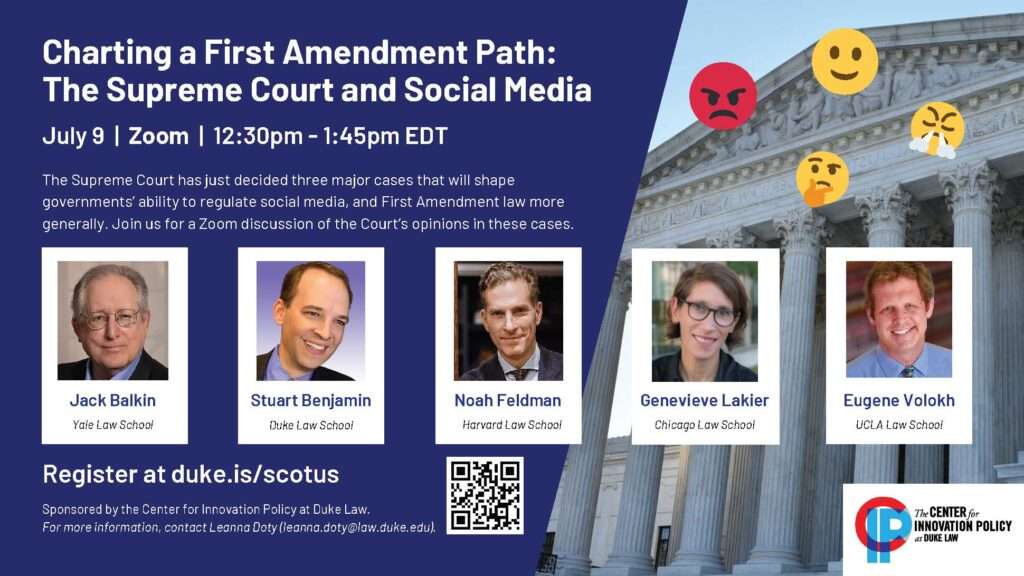
Anyway, I'm guessing Eugene and I will discuss this at the upcoming online symposium on these cases. See below to sign up for what passes for fireworks among law professors.
It was not my plan to publish two media articles on the same day, and certainly not on a day when there are also major Supreme Court decisions. But today, the Spectator, a British publication, posted my new article on why opening doors to immigration is not merely charity for immigrants, but also benefits receiving-country natives. I did not intend for this piece to come out on the same day as my Dispatch article on the somewhat related issue of wokeness and nationalism. But that's how the two publications' timing worked out. Conspiracy-mongers (and not justVolokh Conspiracy-mongers) will, of course, suspect collusion!
Unfortunately, the Spectator does not generally include hyperlinks, which is why there are none in this article. However, the article is based in large part on a longer paper that is scheduled to be published by Institute of Economic Affairs. The IEA paper builds on material from my 2023 Public Affairs Quarterly article, "Immigration and the Economic Freedom of Natives." I will post a link to the IEA paper when it's up. In the meantime, here's an excerpt from the Spectator piece:
The 2024 general election 'should be the immigration election', Nigel Farage has said. The Reform leader's wish has been granted: the topic of immigration is a major focus of debate. It's also a big issue in the United States' presidential election. Much of the debate in both countries depicts immigrants as a burden that receiving countries should accept (if at all) only out of altruism or a sense of obligation. But this is misleading, and ignores the many benefits of migration to Britain and other receiving countries.
Accepting migrants is the right thing to do, in part because it saves many thousands of people from what would otherwise likely be a lifetime of poverty and oppression…. But opening doors to such people also benefits Britain. Immigrants work, start businesses, and contribute to scientific innovation, often at higher rates than native-born citizens. That greatly benefits current UK citizens, as well as migrants themselves….
The United States is often considered the 'nation of immigrants'. But Britain also has a long history of welcoming immigrants and benefiting from their contributions. Huguenot Protestant refugees fleeing repression in 17th and 18th century France played an important role in the early development of Britain's economy, and the beginnings of the industrial revolution. More recently, Jewish and other refugees fleeing Nazi Germany contributed to scientific development, including weapons systems crucial to winning World War II. In the post-war era, British economic growth and scientific research was significantly bolstered by migrants from South Asia, Africa, the Caribbean, and elsewhere….
Today, in Britain, as in the US, immigrants play a disproportionate role starting new businesses. A 2023 study found that 39 per cent of the 100 fastest-growing UK companies have an immigrant founder or co-founder, even though immigrants are only 14.5 per cent of the UK population. UK immigrants are also substantially more likely to start businesses than natives, and engage in other types of entrepreneurship. Such businesses contribute to growth and innovation, and provide valuable job opportunities for both immigrants and natives….
The benefits of immigration can be literally life-saving. The first two successful Covid-19 vaccines were developed in large part thanks to immigrants or the children thereof. Some fear that immigration will overburden the government budget. But most immigrants actually contribute more to the public purse than they take out. The economist Jonathan Portes finds that government data showed that recent increases in migration (which allowed in about 350,000 more migrants than previously expected) could, on net, increase government revenue by about £5 billion per year. The long-term fiscal benefits of higher immigration are likely to be much greater….
Other parts of the article address the issue of illegal migration, and the argument (increasingly prominent in the UK) that migration causes housing shortages.
I am about to depart for a trip to the UK, where I will be giving several lectures and talks, including on migration-related topics.
The laws, from Florida and Texas, restrict the ability of social-media platforms to control whether and how third-party posts are presented to other users … [including by] requir[ing] a platform to provide an individualized explanation to a user if it removes or alters her posts….
Analyzing whether these requirements are sound, the majority held, "means asking," as to each kind of content moderation decision, "whether the required disclosures unduly burden" the platforms' own expression:
[R]equirements of that kind violate the First Amendment if they unduly burden expressive activity. See Zauderer v. Office of Disciplinary Counsel of Supreme Court of Ohio (1985). So our explanation of why Facebook and YouTube are engaged in expression when they make content-moderation choices in their main feeds should inform the courts' further consideration of that issue.
For more on that "main feeds" question, and on the Court's not deciding the First Amendment questions raised by any of the platforms' other functions, see this post. As to the Zauderer "unduly burden expressive activity" standard, especially as applied outside the original Zauderer context of commercial advertising, see NIFLA v. Becerra(2018).
All this suggests that the individualized-explanation requirement are more likely to be invalid as to decisions about what to include in the "main feeds," and more likely to be valid as to decisions about whether to delete a post outright, or ban a user outright. But even that is not entirely clear. For a thoughtful, detailed treatment of the laws' practical effects (which is what the majority seems to be calling for), see Daphne Keller's Platform Transparency and the First Amendment article.
The majority opinion makes clear that social media content moderation is an activity protected by the First Amendment. That likely dooms large parts of the state laws restricting content moderation.
In today's ruling in Moody v. NetChoice, addressing challenges to Texas and Florida laws severely limiting social media content moderation, the Supreme Court declined to issue a final ruling on the merits, for procedural reasons. But in remanding the cases to the lower courts, Justice Elena Kagan's majority opinion also established standards under which the major provisions of the two laws would almost certainly have to be ruled unconstitutional. I was highly critical of last week's decision denying standing to plaintiffs challenging the federal government's efforts to pressure social media firms to take down posts. Today's ruling is far better. Hopefully, the Court will eventually make clear that the government is presumptively barred from either forcing social media providers to take down posts it disapproves of or forcing them to post material the website owners object to.
The reason why the Court decided not to issue a final decision is that the lower courts did not engage in extensive enough fact-finding and analysis to consider a facial challenge to the constitutionality of the laws as a whole:
Today, we vacate both decisions for reasons separate from the First Amendment merits, because neither Court of Appeals properly considered the facial nature of NetChoice's challenge. The courts mainly addressed what the parties had focused on. And the parties mainly argued these cases as if the laws applied only to the curated feeds offered by the largest and most paradigmatic social-media platforms…. But argument in this Court revealed that the laws might apply to, and differently affect, other kinds of websites and apps. In a facial challenge, that could well matter, even when the challenge is brought under the First Amendment. As explained below, the question in such a case is whether a law's unconstitutional applications are substantial compared to its constitutional ones. To make that judgment, a court must determine a law's full set of applications, evaluate which are constitutional and which are not, and compare the one to the other. Neither court performed that necessary inquiry…..
To succeed on its First Amendment claim, NetChoice must show that the law at issue (whether from Texas or from Florida) "prohibits a substantial amount of protected speech relative to its plainly legitimate sweep." Hansen, 599 U. S., at 770. None of the parties below focused on that issue; nor did the Fifth or Eleventh Circuits. But that choice, unanimous as it has been, cannot now control. Even in the First Amendment context, facial challenges are disfavored, and neither parties nor courts can disregard the requisite inquiry into how a law works in all of its applications. So on remand, each court must evaluate the full scope of the law's coverage. It must then decide which of the law's applications are constitutionally permissible and which are not, and finally weigh the one against the other. The need for NetChoice to carry its burden on those issues is the price of its decision to challenge the laws as a whole.
But in remanding the cases, the majority lays out "relevant constitutional principles, and explain[s] how" the Fifth circuit "failed to follow them" when it upheld the Texas social media (the Eleventh Circuit had invalidated most of Florida's law). The Court's three principles are devastating to the states' laws:
First, the First Amendment offers protection when an entity engaging in expressive activity, including compiling and curating others' speech, is directed to accommodate messages it would prefer to exclude. "[T]he editorial function itself is an aspect of speech." Denver Area Ed. Telecommunications Consortium, Inc. v. FCC, 518 U. S. 727, 737(1996) (plurality opinion)….. And that is as true when the content comes from third parties as when it does not. (Again, think of a newspaper opinion page or, if you prefer, a parade.) Deciding on the third-party speech that will be included in or excluded from a compilation—and then organizing and presenting the included items—is expressive activity of its own. And that activity results in a distinctive expressive product. When the government interferes with such editorial choices—say, by ordering the excluded to be included— it alters the content of the compilation. (It creates a different opinion page or parade, bearing a different message.) And in so doing—in overriding a private party's expressive choices—the government confronts the First Amendment…
Second, none of that changes just because a compiler includes most items and excludes just a few…. That was the situation in Hurley. The St. Patrick's Day parade at issue there was "eclectic": It included a "wide variety of patriotic, commercial, political, moral, artistic, religious, athletic, public service, trade union, and eleemosynary themes, as well as conflicting messages." 515 U. S., at 562. Or otherwise said, the organizers were "rather lenient in admitting participants." Id., at 569. No matter. A "narrow, succinctly articulable message is not a condition of constitutional protection." Ibid. It "is enough" for a compiler to exclude the handful of messages it most "disfavor[s]." Id., at 574….
Third, the government cannot get its way just by asserting an interest in improving, or better balancing, the marketplace of ideas. Of course, it is critically important to have a well-functioning sphere of expression, in which citizens have access to information from many sources. That's the whole project of the First Amendment. And the government can take varied measures, like enforcing competition laws, to protect that access…. But in case after case, the Court has barred the government from forcing a private speaker to present views it wished to spurn in order to rejigger the expressive realm.
Central elements of the Texas and Florida laws are unconstitutional under this approach. Social media firms are undeniably "compiling and curating others' speech" and under the state laws, they are "directed to accommodate messages [they] would prefer to exclude." The firms may choose to exclude only a small percentage of the vast rage of speech users might want to post. But the Court's second principle rightly says that doesn't matter.
Finally, if "the government cannot get its way just by asserting an interest in improving, or better balancing, the marketplace of ideas," that destroys the central rationale for the two state laws. As the Court notes later in its opinion, "improving" or "better balancing" the "marketplace" of ideas is precisely the objective of Texas's law, which was largely motivated by concerns that the social media platforms were biased against various types of right-wing speech.
Later in the opinion, Justice Kagan notes the implications for the Texas law:
The platforms may attach "warning[s], disclaimers, or general commentary"—for example, informing users that certain content has "not been verified by official sources." Id., at 75a. Likewise, they may use "information panels" to give users "context on content relating to topics and news prone to misinformation, as well as context about who submitted the content…."
But sometimes, the platforms decide, providing more information is not enough; instead, removing a post is the right course. The platforms' content-moderation policies also say when that is so. Facebook's Standards, for example, proscribe posts—with exceptions for "news-worth[iness]" and other "public interest value"—in categories and subcategories including: Violence and Criminal Behavior (e.g., violence and incitement, coordinating harm and publicizing crime, fraud and deception); Safety (e.g., suicide and self-injury, sexual exploitation, bullying and harassment); Objectionable Content (e.g., hate speech, violent and graphic content); Integrity and Authenticity (e.g., false news, manipulated media). Id., at 412a–415a, 441a–442a…. The platforms thus unabashedly control the content that will appear to users, exercising authority to remove, label or demote messages they disfavor….
Except that Texas's law limits their power to do so. As noted earlier, the law's central provision prohibits the large social-media platforms (and maybe other entities6) from "censor[ing]" a "user's expression" based on its "viewpoint."§143A.002(a)(2); see supra, at 7. The law defines "expression" broadly, thus including pretty much anything that might be posted. See §143A.001(2). And it defines "censor" to mean "block, ban, remove, deplatform, demonetize, deboost, restrict, deny equal access or visibility to, or otherwise discriminate against expression." §143A.001(1).7 That is a long list of verbs, but it comes down to this: The platforms cannot do any of the things they typically do (on their main feeds) to posts they disapprove—cannot demote, label, or remove them whenever the action is based on the post's viewpoint….
And we have time and again held that type of regulation to interfere with protected speech. Like the editors, cable operators, and parade organizers this Court has previously considered, the major social-media platforms are in the business, when curating their feeds, of combining "multi-farious voices" to create a distinctive expressive offering. Hurley, 515 U. S., at 569. The individual messages may originate with third parties, but the larger offering is the platform's. It is the product of a wealth of choices about whether—and, if so, how—to convey posts having a certain content or viewpoint. Those choices rest on a set of beliefs about which messages are appropriate and which are not (or which are more appropriate and which less so). And in the aggregate they give the feed a particular expressive quality.
I think the Court's principles are broad enough to justify facial invalidation of the Texas and Florida laws, because ruling that the restrictions on social-media content moderation are unconstitutional is enough to show that the laws "prohibit… a substantial amount of protected speech relative to [their] plainly legitimate sweep." But even if the facial challenges fail, the social media firms could easily file as-applied challenges focusing more narrowly on content moderation. And those would almost certainly succeed.
In his opinion concurring in judgment, Justice Samuel Alito (joined by Gorsuch and Thomas) claims the Court's discussion of First Amendment standards is merely nonbinding dicta. But it pretty obviously sets out principles the lower courts must follow on remand.
Alito also argues that not enough is known about the firms' content moderation policies, and how their content moderation policies work, in part because the firms have not fully revealed how their algorithms function. But, as the majority shows, we do know enough to see that the major social media firms do restrict posts based on content, and that they favor some messages, while disfavoring others. That's exactly why the states decided to enact the challenged laws in the first place!
The dissent's argument that there are different social media platforms with different contents also doesn't do much to undercut the majority. All of the major platforms have extensive expressive content, and all impose editorial restrictions based at least in part on the subject matter and viewpoint. Perhaps this is less true of some platforms (such as Etsy) which mainly just let users sell products, rather than convey messages. But the Texas and Florida laws cover enough political and social commentary that they clearly "prohibit… a substantial amount of protected speech relative to [their] plainly legitimate sweep."
Justice Alito also alludes, briefly, to the major social media platforms' extensive reach and influence. Interestingly, this issue - much focused on by commentators on these cases - plays almost no role in the majority's analysis, and only a minor one in the dissent. The same goes for the argument that social media firms' content moderation policies can be regulated because the firms are similar to "common carriers." The majority doesn't explicitly mention this theory, though much of its analysis implicitly rebuts it, by pointing out the many ways in which social media firms do not simply serve all comers. Justice Alito only briefly mentions the common carrier theory in a footnote. I criticized the common carrier and influence arguments in detail here.
In sum, while the Court did not reach a decision on the merits, the standards it lays out are an important win for the social media firms - and for freedom of speech.
Today, The Dispatch published my article entitled "Wokeness is Awful. Nationalism is Far Worse." Many of my center-right and libertarian friends and acquaintances fear wokeness more than any other current ideological trend. I have long wanted to do a piece on why that prioritization is misguided. This is it. Here is an excerpt:
But concerns about wokeness have distracted many on the center-right from a more serious danger, one far more likely to gain widespread support and cause great harm: nationalism. Terrible woke ideas should be criticized. However, their impact is limited by the smaller numbers of their proponents. Nationalists are far more numerous. And if nationalists acquire the power they seek, they would implement an agenda that does great harm to the lives, freedom, and well-being of millions of people.
Wokeness should neither be neglected nor treated as harmless. But when comparing the two, the nationalist threat should take priority. It's long past time for right-leaning critics of both ideologies to treat nationalism for what it is: the greatest threat to liberal democratic institutions today….
For all their mutual hostility, right-wing nationalists and left-wing wokeists actually have much in common. Both groups treat racial and ethnic identity as fundamental and largely immutable. Both want the government to actively promote the interests of some ethnic or cultural groups relative to others. And most of all, both assume a zero-sum world where gains for one group can only come at the expense of others.
But though wokeists and nationalists engage in a similar identity politics, the latter are far more dangerous. Why? In large part, because an identity politics movement promoting the supposed interests of the ethnic majority has a much greater chance of political success in a democratic society than one focused on minority groups….
History also shows nationalist movements are a menace to liberal political institutions. Whether in 1930s Germany or present-day Russia, nationalist movements have subverted liberal democracy and installed brutal dictatorships in its place. By contrast, not a single wokeist egalitarian movement has achieved such a result….
The rest of the article substantiates these points in greater detail.
Worth noting, perhaps, that communists did, of course, install horrific dictatorships in many countries. But communism isn't a woke ideology focused on racial and ethnic grievances. It's a universalist ideology, one that routinely repressed ethnic minorities where it comes to power.
In today's Moody v. Netchoice, LLC, the Supreme Court sent back to lower courts the cases considering whether (and when) the Florida and Texas limits on social media content moderation are constitutional. The decision was complicated and limited, so here's a general summary.
[1.] Remember that the lawyer's true superpower is to turn every question into a question about procedure. Here, that procedural question was whether Netchoice—a consortium of internet technology companies—can challenge the Florida and Texas laws on their face as "overbroad," or must challenge the laws "as applied" to particular company practices. The Supreme Court unanimously concludes that the lower courts erred in deciding the overbreadth question; here's Justice Kagan's majority opinion on this, though all Justices generally agree on this point:
The courts mainly addressed what the parties had focused on. And the parties mainly argued these cases as if the laws applied only to the curated feeds offered by the largest and most paradigmatic social-media platforms—as if, say, each case presented an as-applied challenge brought by Facebook protesting its loss of control over the content of its News Feed.
But argument in this Court revealed that the laws might apply to, and differently affect, other kinds of websites and apps. In a facial challenge, that could well matter, even when the challenge is brought under the First Amendment. As explained below, the question in such a case is whether a law's unconstitutional applications are substantial compared to its constitutional ones.
To make that judgment, a court must determine a law's full set of applications, evaluate which are constitutional and which are not, and compare the one to the other. Neither court performed that necessary inquiry.
[2.] Justice Kagan's five-Justice majority (written for herself, Justice Sotomayor, Chief Justice Roberts, Justice Kavanaugh, and Justice Barrett) concludes that the First Amendment likely protects the rights of platforms to pick and choose what appears in those "curated feeds," in particular "Facebook (or YouTube) … using its content-moderation standards to remove, alter, organize, prioritize, or disclaim posts in its News Feed (or homepage)."
Consider, for instance, how platforms use algorithms to prioritize and remove content on their feeds. Assume that human beings decide to remove posts promoting a particular political candidate or advocating some position on a public-health issue. If they create an algorithm to help them identify and delete that content, the First Amendment protects their exercise of editorial judgment—even if the algorithm does most of the deleting without a person in the loop. In that event, the algorithm would simply implement human beings' inherently expressive choice "to exclude a message [they] did not like from" their speech compilation.
But what if a platform's algorithm just presents automatically to each user whatever the algorithm thinks the user will like—e.g., content similar to posts with which the user previously engaged? The First Amendment implications of the Florida and Texas laws might be different for that kind of algorithm.
And what about AI, which is rapidly evolving? What if a platform's owners hand the reins to an AI tool and ask it simply to remove "hateful" content? If the AI relies on large language models to determine what is "hateful" and should be removed, has a human being with First Amendment rights made an inherently expressive "choice … not to propound a particular point of view"? In other words, technology may attenuate the connection between content-moderation actions (e.g., removing posts) and human beings' constitutionally protected right to "decide for [themselves] the ideas and beliefs deserving of expression, consideration, and adherence." So the way platforms use this sort of technology might have constitutional significance."
Likewise, see Justice Alito's concurrence in the judgment, joined by Justices Thomas and Gorsuch:
Corporations, which are composed of human beings with First Amendment rights, possess First Amendment rights themselves. But foreign persons and corporations located abroad do not. Agency for Int'l Development v. Alliance for Open Society Int'l, Inc. [II] (2020)….
What if the platform's corporate leadership abroad makes the policy decisions about the viewpoints and content the platform will disseminate? Would it matter that the corporation employs Americans to develop and implement content-moderation algorithms if they do so at the direction of foreign executives? Courts may need to confront such questions when applying the First Amendment to certain platforms.
I will have more about the core issues in the Netchoice cases soon, but composing that post will take some time; for now, I just wanted to flag this discrete issue (and another one, in a coming post).
One of my pet peeves is the way the modern academic left insists on seeing all ethnic and racial conflict through the lens of the American black-white racial dynamic. One example is the notion that Nazi Germany was "white supremacist." Some Jewish leftists trying to fight antisemitism on the left run with this, arguing that the Nazis did not consider Jews to be white, and thus their leftist colleagues should stop treating Jews like white oppressors.
However, as a recent post by Daniel Saunders at the Times of Israel notes:
The Nazis wanted an Aryan race that was pure in blood, not white of skin. They focused on a range of what they saw as markers of "impure" blood, such as cranium size, nose shape and the presence or absence of ear lobes. Impure blood, as a notion, was all the more insidious for being largely invisible. That an Aryan could interact with a Jew without knowing it made the Nazis worry more, not less, about Jews than they did about people with more visible differences.
More importantly, the Aryan race which the Nazis consider the German people to exemplify, was not considered synonymous with some kind of "white race" by the Nazis, even though contemporary neo-Nazis do make such a connection.
The Nazis did not see their Aryan race as originating in Europe. They were very much aware that 'Aryan' is cognate to 'Iranian' and saw their race as originating in that part of Asia. The Nazis focused on the so-called Aryan race, a tiny subset of all the people who would be considered white today.
Almost all of the Nazis' victims would be considered 'white' in the politics of the contemporary West, not just Ashkenazi Jews, but Poles and Slavs, "gypsies" (another inaccurate term, for Roma, Sinti and Lalleri peoples), the physically disabled and the mentally ill, homosexuals and even prostitutes and congenital petty criminals. All were seen as not conforming to the "racial community" and potentially "contaminating" it if allowed to procreate as well as being seen in many cases to pose a more conventional military risk or drain on scarce resources. Anti-social behaviours such as petty crime, sex work or even alcoholism were seen as inherited and in need of removal from the racial community through "racial hygiene," lest these traits spread at the expense of more desirable ones.
One might retort that the Nazis may not have cared if Jews were racially white, but in modern parlance they believed the Jews lacked "whiteness," a neologism that essentially means not being an accepted part of the dominant group in society. That's true, but it also disclosed to show how the modern understanding of whiteness in the academy does not correlate well with the actual historical understanding of race and racism in both the US and abroad. (Similarly, as I have noted previously, "white ethnics" in the United States such as Jews, Italians, and Irish Americans, may have lacked "whiteness," but were most definitely considered to be racially white.)
One of my pet peeves concerns the naming of Supreme Court cases. Noel Canning v. NRLB, for example, cannot be abbreviated as Canning. There is a canning and bottling company in Washington named "Noel Canning."
Likewise, I've already seen some people refer to the Chevron case as just Loper. No, that does not work. The name of the company is "Loper Bright Enterprises." I would accept "Loper Bright" for short.
Still, I regret the case was not called Relentless. Relentless has 11 characters, while Loper Bright has 12 characters. Over the lifetime of this precedent, think of how many additional characters will be wasted!
The debate and its aftermath have crystallized some things in my mind, and I thought I'd note them. This subject is outside my academic area of expertise, so I appreciate that I might be mistaken in most or all of my observations. I also expect that others have put all this much better than I have. But I thought I'd pass along my thoughts, just as one American to others.
[* * *]
[1.] It seems to me that the current situation highlights the major problems with the Democratic Party. Many Democrats must have been aware of Biden's cognitive decline. They must have been aware that it's a danger to the country, and a danger to their own election prospects.
They had ample opportunities to press the President to step aside graciously in time for a substitute candidate who could exploit Trump's vast political weaknesses. To the extent they were worried that Harris would be the obvious substitute, and that she would make a losing candidate, it didn't take a masterful political chess player to anticipate in 2020 that this might be a problem. And even though it's obviously difficult to get a President to step down—indeed, though it's difficult to get most people to acknowledge their own cognitive decline—the job of a well-functioning party is to be able to accomplish such tasks.
[2.] The current situation highlights the major problems with the Republican Party. Even if you support Trump, and agree with his policies, answer honestly: Would you have, twenty years ago, wanted someone like him as your candidate? Set aside whether you think he's the lesser evil: Do you trust him to be calm and collected in a foreign policy crisis? Do you think he's an inspirational leader? Do you think he's a worthy heir to the presidents you admire (whether Washington, Lincoln, Reagan, Coolidge, or whoever else)?
The mark of an iconic Supreme Court decision is timelessness. With every read, the opinion teaches new insights and provides new lessons on our Constitution. Each semester when I prepare a case like Marbury or McCulloch, I learn something new.
Opinions from Chief Justice Roberts, however, are just the opposite. They are best read once. After the first read, you will come away entirely persuaded that Roberts's analysis was not only the best answer (to use the Loper Bright framing), but the only conceivable answer, as any contrary positions are unfounded. That's the first read.
But when you read a Roberts decision a a second, a third, and a fourth time, all of the fancy veneers and window dressing start to come off. You realize that John Roberts never stopped being an effective advocate, and he remains an effective advocate. The client is now whatever John Roberts himself thinks the Supreme Court should be. All the talk about "institutionalism" was always introspective--what does John Roberts himself think the Court should look like as an institution?
This is how I read Loper Bright. On the first read, I came away extremely impressed by how tight the analysis was. He did everything in about 30 pages--no easy feat! And he kept all members of the Court on board. Whatever urges Justice Barrett had to "Kisorize" Chevron seem to have been eliminated by the Chief's powerful opinion. (I need to give some more thought to why Barrett did not write separately, as the Loper Bright join seems to undermine several of her most recent opinions).
But as I stewedabout the Loper Bright majority opinion for a few days, the wheels have started to fall off.
Then again, Roberts's prose is still lovely. This sentence was one of my favorites: "For any landlubbers, 'F/V' is simply the designation for a fishing vessel."
Even when the Supreme Court changes course, the lower courts do not always fall in line. Old dogs do not like new tricks. The archetypal example is Heller. Even after the Supreme Court recognized an individual right to keep and bear arms, the lower courts actively resisted the case for more than a decade. Judges didn't like guns, and Heller didn't change much. Virtually every gun control measure survived scrutiny. Not much changed before and after Heller. Perhaps Bruen was a brief respite from that change, though Rahimi may usher in more of the same.
Will Loper Bright be treated in a similar fashion? For decades, lower-court judges have been content to defer to the executive branch on difficult legal questions. With Chevron gone, the courts will now have to find the "best" answer. (I kept thinking of Melania Trump's "Be Best" campaign). As the Chief Justice sees things, that task will involve independent legal judgment. But would we really know if a judge decides, as a matter of course, that the answer provided by the government is the "best" answer? After all, they have the requisite expertise. Call it Chevron in exile.
How much will change because of Loper Bright? I know there are many empirical studies about how often the government wins when Chevron is applied. Chief Justice Roberts scoffed at one such study by Kent Barnett, Christina Boyd, and Chris Walker:
Citing an empirical study, the dissent adds that Chevron "fosters agreement among judges." Post, at 28. It is hardly surprising that a study might find as much; Chevron's second step is supposed to be hospitable to agency interpretations. So when judges get there, they tend to agree that the agency wins. That proves nothing about the supposed ease or predictability of identifying ambiguity in the first place.
Perhaps in a few years, similar studies can be performed about the new regime. Has the executive branch's win-loss rate changed substantially? How much will Loper Bright really change things?
Two year ago, the Court decided Dobbs, the most important decision ever concerning stare decisis. How many times does Chief Justice Roberts cited Dobbs in Loper Bright? Zero. I suspect the Chief would prefer to pretend that Dobbs never happened. Indeed, Justice Kagan's dissent calls out Roberts for not citing his own Dobbs concurrence, where it is directly on point!
On the other side of the balance, the most important stare decisis factor—call it the "jolt to the legal system" issue—weighs heavily against overruling Chevron. Dobbs, 597 U. S., at 357 (ROBERTS, C. J., concurring in judgment). Congress and agencies alike have relied on Chevron—have assumed its existence—in much of their work for the last 40 years.
But the failure to cite Dobbs raises questions about what is the appropriate stare decisis framework for constitutional law decisions. Roberts never calls Chevron "egregiously wrong." He only goes so far as to say that Chevron was "fundamentally misguided" and that Chevron "gravely erred." Much more temperate language. Instead, he goes back to Knick and Janus:
Stare decisis is not an "inexorable command," Payne v. Tennessee, 501 U. S. 808, 828 (1991), and the stare decisis considerations most relevant here—"the quality of [the precedent's] reasoning, the workability of the rule it established, . . . and reliance on the decision," Knick v. Township of Scott, 588 U. S. 180, 203 (2019) (quoting Janus v. State, County, and Municipal Employees, 585 U. S. 878, 917 (2018))—all weigh in favor of letting Chevron go.
Chief Justice Roberts takes a page from the stare decisis analysis in Janus: a "crumbling precedent" that has been whittled away is on a shaky foundation:
This Court, for its part, has not deferred to an agency interpretation under Chevron since 2016. See Cuozzo, 579 U. S., at 280 (most recent occasion). But Chevron remains on the books. So litigants must continue to wrestle with it, and lower courts—bound by even our crumbling precedents, see Agostini v. Felton, 521 U. S. 203, 238 (1997)—understandably continue to apply it.
The experience of the last 40 years has thus done little to rehabilitate Chevron.
Still, even though Dobbs was not cited, there are overlaps with that case.
Long ago, Chief Justice Roberts signaled that he doesn't very much care what academics think. What admin law professors think about Chevron is no different than what Bulgarian evidence professors think about Immanuel Kant. And Roberts was sure to tell us that in Loper Bright:
[Chevron's] flaws were nonetheless apparent from the start, prompting this Court to revise its foundations and continually limit its application. It has launched and sustained a cottage industry of scholars attempting to decipher its basis and meaning.
Underneath the scorn, there is something to this statement. Over the past two days, admin law professors have had something of an existential moment: the world they have known for four decades was extinguished. The "cottage industry" they've propped up is no longer. The expertise they've developed, and imparted to generations of law students, is now obsolete. This is not a pleasant feeling. For example, if the Court were to come out and reject originalism--imagine after some Court packing--what would I do? I'd be adrift at sea.
On the relevance of law professors, I remain uncertain of how Chief Justice Roberts actually views Justice Barrett. She would seem to embody the sort of person Roberts would want nowhere near Article III--a lifetime academic with no real-world practice. Professor Scalia, at least, mixed practice with scholarship. Ditto for Bork. But what about Barrett? I'm sure Roberts can flash his charm with anyone, but what does he really think of her?
Update: In my post, I initially attributed the following quote to Chief Justice Roberts, but it was from Justice Gorsuch's dissent:
The dissent suggests that we need not take the APA's directions quite so seriously because the "finest administrative law scholars" from Harvard claim to see in them some wiggle room. Post, at 18 (opinion of KAGAN, J.). But nothing in the APA commands deference to the views of professors any more than it does the government. Nor is the dissent's list of Harvard's finest administrative law scholars entirely complete. See S. Breyer et al., Administrative Law and Regulatory Policy 288 (7thed. 2011) (acknowledging that Chevron deference "seems in conflict with . . . the apparently contrary language of 706"); Kagan 212 (likewise acknowledging Chevron deference rests upon a "fictionalized statement of legislative desire").