
8/24/1946: Justice James McReynolds dies.

Mostly law professors | Sometimes contrarian | Often libertarian | Always independent | Est. 2002
8/24/1946: Justice James McReynolds dies.
Before we get to Brandon, let's detour to Bethel School Dist. No. 403 v. Fraser (1986). Matthew Fraser gave this nomination speech for a friend who was running for high school vice-president:
I know a man who is firm—he's firm in his pants, he's firm in his shirt, his character is firm—but most … of all, his belief in you, the students of Bethel, is firm.
Jeff Kuhlman is a man who takes his point and pounds it in. If necessary, he'll take an issue and nail it to the wall. He doesn't attack things in spurts—he drives hard, pushing and pushing until finally—he succeeds.
Jeff is a man who will go to the very end—even the climax, for each and every one of you.
So vote for Jeff for A.S.B. vice-president—he'll never come between you and the best our high school can be.
You'll note that none of the words here were what one might colloquially call "vulgarities," but the Court concluded that the school was entitled to discipline Fraser for engaging in "vulgar" speech. (Some language in the opinion suggests that the doctrine might be limited to speech before audiences at school assemblies, but courts have generally read it more broadly than that.)
Today's decision by Judge Paul Maloney in D.A. v. Tri County Area Schools (W.D. Mich.) applies this general principle to D.A.'s wearing a "Let's Go Brandon" T-shirt (multi-asterisk expurgation, as you might gather, in original):
Nonaggressive dogs, tactical vests, and the entire internet.
Please enjoy the latest edition of Short Circuit, a weekly feature written by a bunch of people at the Institute for Justice. Read More
The amicus briefs come from several organizations and people, some liberal (e.g., the ACLU), some conservative, and some apolitical.
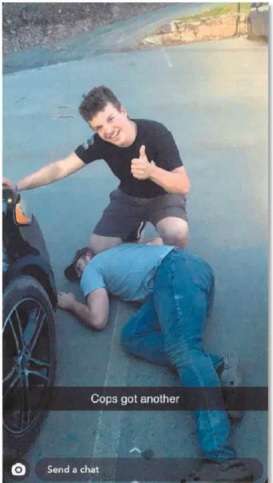
The Second Circuit will be hearing the appeal of the district court decision in Leroy v. Livingston Manor School Dist.; here's the summary of the facts from Leroy's opening brief (the image involved is included above):
On April 19, 2021, while still a Livingston Manor student, Leroy was socializing with three friends after school hours, away from school property. The four were in a dance studio parking lot to pick up Leroy's friend's sister. While there, one friend told Leroy that there had been a noise coming from his car on the drive over and Leroy laid on the ground in front of the car to investigate. While he was there, another friend knelt on Leroy's back and had the third friend take a picture.
The three friends each posted the picture to their personal Snapchat accounts, with Leroy adding the caption, "Cops got another."
Another posted the same image but with a "Black Lives Matter" logo overlayed. Upon receiving several disapproving private messages on the Snapchat platform, Leroy deleted his post and asked the others to do the same, which they did. All told, the images were accessible to others for around seven minutes….
Within the seven minutes that the posts were available, a fellow Livingston Manor student, Leroy's former girlfriend, "Grace" …, captured a screenshot Leroy's post, and reposted it on Facebook and other online platforms to "condemn" Leroy. Apparently to amplify any public response, Grace also jointly posted another, out-of-context photo of two other Livingston Manor students taken by Leroy in March of 2021. An activist, Gem Amber Sun Helper reposted the images with commentary asserting that Livingston Manor "surpassed its dark history of being a Sundown Town with its own KKK Chapter." Helper or a later commentator shared this post and the phone number for Livingston Manor Central school, telling viewers to "dm" direct or private message her for additional contact information.
The justices are hearing future cases, but that has not sped up their work.
The Supreme Court hears fewer cases than it used to, and justices write more separate opinions. Another change in the Court's docket has been that it's increasingly backloaded. The Court doesn't grant enough cases in the spring for the coming Fall, so the next term's cases get pushed later, contributing to the June (or even July) crunch of opinions at the end.
Kimberly Robinson of Bloomberg reports:
The justices have so far granted more than two dozen cases to be heard in their upcoming term, a handful short of the number needed to fill the court's first three argument sittings in October, November, and December. For a court that's hearing around 60 cases a term, that's a significant share of the workload pushed back.
The slow start means the justices will have to make up the deficit, creating a domino effect when hearing more cases later in the term means more opinions will stack up at the end, too. That's typically in late June, but last term slipped to early July. . . .
The court's rules contemplate approximately 115 days from when a case is granted to when it is argued—45 days for the initial brief, 30 for the response, 30 for the reply, and at least 10 days for the justices to review the briefs.
Because the court takes a summer recess from approximately July to October, that means any cases to be argued in the fall must generally be granted from mid-January to the end of the term. That's right when the court is the busiest, preparing for oral arguments and drafting opinions.
Taking fewer cases has not resulted in cases being decided more quickly, but it may have contributed to a proliferation of opinions (and longer opinions too).
The number of concurring opinions has gone up in recent terms, according to data compiled by Adam Feldman, of the blog Empirical SCOTUS. The percentage of total opinions that have been concurrences has fluctuated between 25% and 34% between 2017 and 2023, according to Feldman.
The justices last term penned more concurring opinions, 62, than majority ones, 59, accounting for almost 40% of total decisions issued in argued cases, a Bloomberg Law analysis showed. . . .
And those separate opinions have gotten longer. The average length of a concurring opinion has ballooned from 815 words in the court's 2016 term to 2,155 words last term, according to statistics compiled by Feldman and University of Florida political science professor Jake Truscott. . . .
Like concurrences, majority and dissenting opinions have also become longer, according to Feldman and Truscott's statistics.
Majority opinions have grown by nearly 800 words since 2016 to just over 5,000 words and dissents have more than doubled in that same period to around 5,900 words.
I've written about some other such cases in my Overbroad Injunctions article; this case involves a somewhat different set of facts than the ones I discussed there, but I thought it worth noting as well. (I agree that some citizen behavior related to officials—such as violence or true threats of crime—should indeed be enjoinable and even criminally punishable; but, unsurprisingly, protective order statutes that aren't limited to violence or true threats are sometimes used to target behavior that isn't violence or true threats.)
From Frenchko v. Shook, decided Monday by Ohio Court of Appeals Judge Eugene Lucci, joined by Judges Mary Jane Trapp and Robert Patton; note that the opinion is long, and this excerpt necessarily omits some details about Shook's background (and alleged past mental health problems):
On November 14, 2023, {Niki (Michele Nicole)} Frenchko, a Trumbull County Commissioner, filed a petition requesting the trial court to issue a CSPO {Civil Stalking Protection Order} against appellee, Shawn Shook, a resident of Warren Township in Trumbull County, Ohio, who frequently attends the commissioners' meetings.
The trial court denied the CSPO request, and the Court of Appeals affirmed that decision. Here's an excerpt from Frenchko's factual allegations:
Frenchko provided evidence pertaining to Shook's behavior and comments at commissioners' meetings and other events during this time period. Frenchko introduced into evidence video of portions of the commissioner's meetings at which Shook made comments after the public was invited to speak on matters "for the good of Trumbull County."
In his comments, Shook questioned Frenchko as to her mental health; maintained that her behavior of "playing with [her] hair, taking [her] glasses on and off, shuffling [her] papers, [and] scraping out [her] fingernails" were "games" and part of her "playbook"; maintained that Frenchko had criticized others for not coming to work or not parking in the correct locations, when Frenchko herself did not come to work and parked in designated handicapped spaces. During these comments, Shook made references to Frenchko's attendance at events outside of the commissioners' meetings.
During her testimony, Frenchko maintained that Shook's comments at the commissioners' meetings were unrelated to county business, and she believed Shook's intent was to intimidate her and to demonstrate to her that he was tracking her whereabouts. Further, Frenchko maintained that Shook obtained some of the information related to her location from her personal Facebook page, which she had blocked him from viewing.
Two organizations (Benbrook Law Group and the First Amendment Coalition) with which I've worked closely, and which I think highly of, are looking for California lawyers; application instructions are at the links.
[1.] Benbrook Law Group, a two-lawyer firm with which I've litigated some interesting First Amendment gun-related cases, is hiring a lawyer who will likely handle interesting free speech and gun cases, as well as other business cases:
We regularly represent one of America's most active firearms advocacy groups in a variety of cases surrounding the possession, carry, and sale of firearms, including Second Amendment claims and administrative disputes with the federal and state governments. We litigate race and gender preference cases. We regularly handle First Amendment claims….
We also represent businesses in disputes against regulators. A material portion of our work (sometimes up to 50%) involves all sorts of traditional business and commercial litigation on behalf of plaintiffs and defendants. As we grow, we will take on more contingent fee litigation, particularly cases consistent with the goal of enhancing liberty and equal opportunity.
A pair of related cases raising important First Amendment content-discrimination issues in the context of adult entertainment.
This last Wednesday, I argued for appellants in the Georgia Supreme Court in the pair of related cases, Georgia Ass'n of Club Executives v. Georgia and Georgia Ass'n of Club Executives v. O'Connell. It's an interesting case involving some cutting-edge issues of First Amendment law! This is the same case I argued (in the same court) three years ago, now back after a remand, and now in-person instead of on Zoom.

Anyone interested in watching the oral argument can see it on this page (it's the third video on the page). If you want to read the briefs, here's our brief, the state's brief, our reply brief, and our (short) supplemental brief.
Also, here's an article I recently published on the subject in the Journal of Free Speech Law: Taxing Nudity: Discriminatory Taxes, Secondary Effects, and Tiers of Scrutiny.
Thanks to Gary Freed and the legal team at Freed Grant LLC, without whom none of this would have been possible!
Its lawyers just filed a notice of voluntary dismissal, and UCLA announced this to employees, with a link to FAQs "to help employees understand how to carry out their responsibilities consistent with the requirements of the preliminary injunction." Some excerpts from the FAQs, which generally strike me as consistent with the injunction:
University policy states that no individual or group of individuals may prohibit or obstruct any student from accessing any ordinarily available campus areas, programs or activities on the basis of their religion, race, or any other protected characteristic, or on the basis of their political or other viewpoints, including their beliefs about the state of Israel. Individuals must also comply with all of the University's time, place, and manner policies and other policies that may impact campus events or expressive activities.
If any individual or group of individuals is prohibiting or obstructing students from accessing ordinarily available campus areas, programs or activities in violation of University policy, University officials will act to promptly restore access to students, while also limiting risks of substantial disruptions to campus operations or risks to health and safety. That includes by:
[This is the tenth, and final post in my series on my mission to Israel. You can read Parts I, II, III, IV, V, VI, VII, VIII, and IX.]
Our mission to Israel was on July 9 through 11. It took me nearly six weeks to publish the ten posts in this series. But it did not take me nearly that long to write them. I wrote most of the first five installments on the twelve-hour flight back from Israel. These initial posts, which focused on the legal issues, came out naturally. I could approach them somewhat objectively, and offer pointed criticisms of the Israeli legal system. But the second batch of posts took a different path.
The final installments focused on the human cost: the hostages, the surveillance footage, the kibbutz, and the music festival. With the exception of the surveillance footage, I was able to document with photographs and videos almost everything that I saw. I promptly uploaded these media to YouTube and the Volokh Conspiracy, but I didn't hit "publish." Instead, I sat on them. I waited. I needed time to reflect. Never before in my life had I been exposed to such profound suffering and trauma. And it was difficult to translate into words what I felt. I am not one to have writer block, but these posts--especially the one on the surveillance footage--were among the hardest things I have had to write. After finishing the surveillance post, I had to watch a funny movie just to clear my mind. That sort-of worked, for a short while.
I was writing, in part, to help me parse through the confusing and confounding situations I witnessed. That's how I think--I write. I was also writing to help others make sense of what they have not seen. I did not think that my writings would persuade anyone on the Israel-Gaza issue. That was not my intent, and I made no effort at advocacy. My goal was simply to relate what I had seen. As the months and years from October 7 pass, and as memories fade, these posts will remain as my personal remembrance of that horrific day.
I also do not pretend that I have any insights about the path away from the current conflict. If anyone tells you they know how to solve things, don't listen to them. Even if a "ceasefire" is reached, and some or most or all of the remaining hostages are freed, the underlying grounds for war remain. The hostilities can re-emerge at any time. To quote Gitlow v. New York, "A single revolutionary spark may kindle a fire that, smouldering for a time, may burst into a sweeping and destructive conflagration."
All I can do is take a step back and reflect on the millenia-long history of the Jewish people in Israel. The period between 1948, when Israel declared independence, and 2024, is but a mere blip. We are barely eight decades removed from the Holocaust. Nothing is fixed in stone. And I no longer take for granted that Jews will always be welcome in America.
I hope to visit Israel again with my family. I do not know when that will be.
8/23/2007: John Yates, aboard the Miss Katie boat, threw fish overboard to avoid an inspection. He was prosecuted for destroying property to prevent a federal seizure. In Yates v. United States (2015), the Supreme Court held that the fish was not a "record."
What's on your mind?
Walz is wrong to attack Vance for leaving home to go to Yale. Vance is wrong to support policies that would close off similar opportunities to others.

Over the last few days, Democratic VP nominee Tim Walz has repeatedly attacked his GOP opponent, J.D. Vance, for leaving home to attend Yale Law School:
"Like all regular people I grew up with in the heartland, J.D. studied at Yale," Walz said sarcastically at the rally…. Come on, that's not what middle America is," Walz continued.
The governor, in a recent interview on MSNBC's Morning Joe, expanded on that point, saying, "None of my hillbilly cousins went to Yale, and none of them went on to be venture capitalists, or whatever…."
He made much the same point in his acceptance speech at the Democratic National Convention: "I grew up in the small town of Butte, Nebraska, population 400. I had 24 kids in my high school class, and none of them went to Yale."
There are many legitimate lines of attack against Vance, whom I am no fan of. But this isn't one of them. There's nothing wrong with leaving home in search of opportunity - including by attending an elite educational institution in another part of the country. America was built by people who "voted with their feet" for such opportunities, through both international migration and the internal kind. And such mobility doesn't somehow become wrong when "hillbillies" do it. Ironically, among the speakers preceding Walz at the DNC was former President Bill Clinton, who grew up in a poor white family in Arkansas, and (like Vance) went on to attend Georgetown and Yale Law School. Does Walz mean to suggest Clinton should have stuck to his "hilbilly" origins and stayed in Arkansas?
I have to admit I take this kind of attack somewhat personally. I too went to Yale Law School, the first person in my family to attend college in the United States. My wife grew up in the quintessential working class city of Allentown, Pennsylvania. Her parents (both public school teachers), and most of her other family members attended local colleges. But she chose to go to Dartmouth College, a more elite out-of-state institution that offered better opportunities. Doing that wasn't wrong, and certainly wasn't somehow a betrayal of her origins.
The real problem with Vance is not that he left home to go to Yale, but that he and Donald Trump support policies like severe migration restrictions and exclusionary zoning that close off such opportunities to others. I wrote about this in a previous post on Vance:
If you read [Vance's]… book, it's hard to avoid the conclusion that his life was transformed by [mobility]: leaving home to join the Marine Corps, get a college degree at Ohio State University, and eventually going to Yale, opened up opportunities that he probably would never have had if he had not left home….
In my later book Free to Move, I pointed out that Vance's story of success through domestic foot voting is also similar to that of people who transformed their lives through international migration. Almost all the standard arguments against allowing the latter also apply to the former.
Over the last several years, Vance has undergone a kind of ideological transformation, becoming a prominent advocate of the MAGA populism he previously opposed. Sadly, the policies Vance now advocates would destroy opportunities for immigrants and natives alike, and in the process make America weaker and poorer.
In addition to mass deportations and other harsh migration restrictions, Vance and Trump also support exclusionary zoning, which blocks millions of native-born Americans from moving to opportunity, including many poor whites with backgrounds similar to Vance and Walz. That not only harms those prevented from moving, but also harms American society as a whole, by slowing down innovation and economic growth.
Walz's record on such issues is less bad, but still highly equivocal. Sadly, the man is not the YIMBY some praise him for being. The Democratic ticket supports a number of dubious housing policies that, if enacted, would make the problem worse, though they also have some modestly good ones.
In sum, Walz is wrong to bash Vance for seeking opportunity by going to Yale. Vance, however, is wrong to advocate policies that would predictably close off similar opportunities for others. Both men - and their respective parties - would do well to work to empower more people to vote with their feet for better educational and job opportunities.
The claim was brought too late, the court holds, and the associated defamation claim is barred by the judicial proceeding privilege.
From Judge Wendy Beetlestone's opinion today in Pratico v. Giannopoulos (E.D. Pa.):
According to his Complaint, well-pleaded allegations from which are taken as true, Praticò is a professor at Temple University, where he researches "clinical pharmacology …." Giannopoulos graduated from Temple with a PhD in 2015. While he was at Temple, Praticò served as his advisor, and he conducted original research in Praticò's lab, which helped form the basis for his doctoral dissertation. Praticò also helped Giannopoulos publish that data, including in a journal from Springer Nature Academic Publishing … in 2018 and 2019.
As part of that process, the parties communicated via email, and Praticò notified Giannopoulos that his data was being put together and that he would "be in the authorship." The first article lists Praticò and Giannopoulos as authors, while the second article lists them and another person named Jian Chiu as authors. Giannopoulos allowed the Springer Nature papers to be featured on his profile on the website ResearchGate.
In March 2020, individuals challenged the accuracy of the data underlying these articles on a website called Pubpeer. Praticò responded by "email[ing] Dr. Giannopoulos to schedule a conversation." Giannopoulos did not, at this point, "say anything about [the] authorship" of these papers. Later, in 2023, further criticism of Giannopoulos's work came out.
Gore Vidal's classic film on presidential nominations holds up
Just in time for this week's DNC, I have an essay over at Law & Liberty on the 60th anniversary of Gore Vidal's classic film on presidential nominating conventions, "The Best Man." I've always enjoyed the film for its portrayal of the fun and banality of democratic politics--as well as its ironic take on the whole thing. Here's an excerpt:
This year marks the 60th anniversary of perhaps the greatest political film of all time, 1964's The Best Man. Based on a play of the same name by Gore Vidal, who also wrote the screenplay, The Best Man tells the story of a deadlocked political convention at which two candidates vie for their party's presidential nomination. Sixty years on, the film remains tremendously entertaining: clever, suspenseful, with an exceptional cast. The dialogue is outstanding. Considering what we have witnessed in the current presidential campaign—and it's only August—Americans might again find interest in Vidal's depiction of the backroom intrigue that determines a nomination.
The Best Man holds up for its mordant but profound observations about American democracy. There's not much idealism here. The film's most principled character has flaws that make him unfit to lead and the ultimate nominee is a "nobody" whose lack of record is his best quality. But there are important lessons about the sort of person who seeks high office in a democracy—and the sort of person high office requires. Perhaps surprisingly, given that Vidal was a man of the Left and had a rather acid personality, The Best Man offers a basically fair, even forgiving, depiction of progressives and conservatives. Neither are wholly good nor wholly bad, just human.
You can read the whole essay here.
Authoritarian states increasingly resort to this tactic. Immigration restrictions enacted by liberal democracies exacerbate the problem.

In its new report "No Way In or Out: Authoritarian Controls on the Freedom of Movement," Freedom House, highlights authoritarian states' growing use of mobility restrictions as a tool of repression. Immigration restrictions enacted by liberal democracies contribute to the problem; authoritarian regimes aren't the only ones that enact unjust mobility restrictions. Here's a summary of the Freedom House report's findings:
At least 55 governments around the world restrict freedom of movement in order to punish, coerce, or control people they view as threats or political opponents.
The four main tactics for controlling mobility are revoking citizenship, document control, denial of consular services, and travel bans.
Restrictions on the freedom of movement can be a less visible form of authoritarian control. They are often informal or imposed arbitrarily, leaving targets without a means to effectively challenge them. Restrictions are also frequently combined with other forms of repression, including asset seizures, smear campaigns, and bogus criminal charges.
The impacts of coercive mobility controls are severe and far-reaching—including the loss of legal status, family separation, inability to pursue educational or professional opportunities, and psychological distress. They interfere with people's ability to express dissent and participate in prodemocracy activism, and signal to would-be government critics that they may face similar consequences.
Democratic governments should seek to hold those applying these tactics accountable, and review their own migration policies to ensure that they do not contribute further to the hardship inflicted on individuals facing coercive restrictions on their freedom of movement.
The report includes a variety of recommendations, including that democratic "Governments should review migration and asylum policies to ensure that they do not contribute to the hardship inflicted on individuals facing coercive mobility restrictions. This includes avoiding penalizing individuals who are unable to produce a valid national passport due to the application of mobility controls with fines, obstacles to education or health care, or restrictions on the ability to register newborn children or marriages."
I endorse these ideas. But they only address the tip of a much larger iceberg of policies enacted by liberal democratic governments that end up reinforcing authoritarian repression. The most important is that migration restrictions exclude many people fleeing authoritarian repression. The right to exit an authoritarian state is worth little if not coupled with the right to enter a freer society.
Most democracies do have laws granting asylum to people who qualify as "refugees." But the legal definition of "refugee" embedded in international and US law is a very narrow one that excludes many people fleeing terrible violence and oppression. It only covers people whose "life or freedom would be threatened on account of [their] race, religion, nationality, membership of a particular social group or political opinion." This effectively excludes may who are fleeing what I have called "equal-opportunity" repression and violence, doled out to everyone who lives under the rule of an oppressive government, as oppose to just members of specific defined social groups.
Even many people who meet legal definition of "refugee" are often expelled under rules like the Biden Administration's new asylum policy, which bars most migrants crossing the border from trying to apply for asylum, including many who might have a strong legal case. Many Republicans advocate even more severe asylum and migration restrictions. They seek to shut down legal pathways of migration for people fleeing brutal repression, including at the hands of socialist regimes conservatives rightly condemn, like those of Cuba and Venezuela. Opening Western doors to migrants fleeing repression is both the right thing to do, and a good way to boost our economies, and reduce budget deficits.
Liberal democracies' mobility restrictions are generally not as bad as those of authoritarian states. But our governments are not as far superior to theirs as they should be, and there is plenty of room for improvement. We can start by expanding the definition of "refugee" to cover all people fleeing oppression and violence, and ending other arbitrary restrictions on asylum rights. Giving asylum seekers the right to work legally would also help.
Donald Trump, Rick Perry, and more.
At a rally in Wilkes-Barre, Pa., President Trump said this:
[H]ow courageous were our justices of the United States Supreme Court? What they did—they're saving our country. They're actually saving our country….
And I just have such respect for the job they've done against—and, you know, the radical left plays the ref. You know the great Bobby Knight? He supported me. He used to fight with the referees all the time. Scream at him, "Bobby, Bobby, please, don't do that." It's not going to work. He said, "You're right. It's not going to work now." It's going to work for the next one. And the next call, there'd be a flagrant foul, and they wouldn't call it. They didn't want to get screamed at.
The radical left harasses our judges and harasses our justices. They scream at them. They call them names. They say they're incompetent, they're horrible, they're this, they're that, they should be impeached. They're constantly saying they should be impeached. But they're screaming. And you know what? It has an effect on some people.
But so far, they've been very strong. It's really horrible. I believe it's illegal what they do. And it's a—I'm trying to give you things that you've never heard before, and this is true. I believe they are playing the ref. They're constantly criticizing our great—some of our greatest justices and a lot of great judges.
You know, I kept hearing so much about the Florida case because, you know, they weaponized our system, our government, totally weaponized. The first time it's ever happened. And they said, "My biggest case is in Florida, Florida, Florida." And we had a very brilliant—I don't know the judge—but a fair and very brilliant judge who took tremendous abuse. It would have been so easy for her to just rule against me. But she didn't do that.
She ruled for—she threw out the whole case. It was thrown out. That was a big case. And I have such respect for her—— because she is, in fact, brilliant. But they were hitting her so hard. She's going too slow. She's that. She should be removed immediately from office.
These people are horrible. I really think—I really think it's illegal what they do with judges and justices. They're playing the ref no different than Bobby Knight….
[W]e can't let these radical left thugs constantly scream at our judges and say, we're going to impeach him, we're going to take him out of office, or her. We're going to do horrible things to him. Continuous—when you heard Schumer get up on the stairs of the courthouse, Supreme Court, and talk about, "Kavanaugh, we're going to get you, Kavanaugh. We're going to hit you," or whatever the hell he said. If a mobster said that, they'd be put in jail immediately. He, frankly, should have been put in jail or certainly spoken to very strongly….
Now there's a lot going on here:
The plaintiff says she "thought the whole time it was going to be confidential"—but court cases are public.
From yesterday's decision by Magistrate Judge Patricia Cohen (E.D. Mo.) in Contejean v. Ameren:
This matter is before the Court on self-represented Plaintiff's letter to the Court requesting that her "case be removed from the internet[,]" which the Court interprets as a motion to seal the "case." On July 22, 2024, Plaintiff filed a complaint bringing claims of race and age discrimination and retaliation under the Civil Rights Act of 1964 and the Age Discrimination in Employment Act of 1967.
Plaintiff requests the Court to "remove all information regarding her case from "the internet" because "people ask me about this[.]" Plaintiff states she "thought the whole time it was going to be confidential." Plaintiff further states that "[i]f there is another process [she needs] to follow in order to have it removed please advise."
Celebrate your independence with a subscription to Reason magazine, your most trusted source of honest, insightful news and analysis.




