The Volokh Conspiracy

Mostly law professors | Sometimes contrarian | Often libertarian | Always independent | Est. 2002

The Volokh Conspiracy

Law & Government

In Print: Sweeping Section Three Under the Rug

My latest article with Michael Stokes Paulsen is in print

|

Just in time for the inauguration today of Donald J. Trump, my second article with Michael Stokes Paulsen is now published in final form in the Harvard Law Review -- Sweeping Section Three Under the Rug: A Comment on Trump v. Anderson.

From the introduction:

"Great cases," the saying goes, "like hard cases make bad law." The aphorism, from Justice Holmes's dissent in the Northern Securities case, came with an explanation:

Great cases like hard cases make bad law. For great cases are called great, not by reason of their real importance in shaping the law of the future, but because of some accident of immediate overwhelming interest which appeals to the feelings and distorts the judgment. These immediate interests exercise a kind of hydraulic pressure which makes what previously was clear seem doubtful, and before which even well settled principles of law will bend.

Like so many of Justice Holmes's maxims, this one does not always hold true. Some of the Supreme Court's great successes in constitutional law have also been "great cases" in the Holmesian sense: They concerned an incident "of immediate overwhelming interest" and potentially serious consequence to the life of the nation and were decided under intense public scrutiny and often urgency — and yet they were decided well and soundly. Urgency, high consequence, and public attention at least sometimes combine to concentrate the judicial mind powerfully, to good and memorable effect.

We think of Youngstown Sheet & Tube Co. v. Sawyer (The Steel Seizure Case) as such a case — perhaps the leading example of exemplary judicial performance under severe time and political pressure, where the stakes were high. Youngstown raced through the judicial process, bottom to top, at breakneck speed, less than eight weeks' time elapsing from President Truman's executive order seizing the nation's steel mills in April 1952 to the Supreme Court's 6–3 decision on June 2 invalidating that order. The Court rose to the occasion magnificently, producing some of the most important, powerfully reasoned judicial opinions concerning fundamental questions of separation of powers in its history.

New York Times Co. v. United States9 (The Pentagon Papers Case) is another "great case" that seems to defy Justice Holmes's axiom, a prominent First Amendment landmark concerning freedom of the press from prior restraint, decided by the Court on an extraordinarily compressed time schedule that made Youngstown look positively leisurely: Two federal appellate courts ruled, differently, on the same day, June 23, 1971, on whether the federal government could obtain an injunction against two newspapers' publishing of classified information. Motions for interim relief and expedited consideration were filed in the Supreme Court the next day, June 24. The Court ordered briefs submitted by June 26, held oral arguments that same day, and issued its judgment and opinions on June 30 — just one week after the lower courts had ruled. Again, the Court rose to the occasion. While there was no single rationale for the judgment — in that sense, the Court did not "make . . . law" at all — the individual opinions of all nine of the Justices combined to form an important 6–3 ruling against the government and for freedom of the press. . .

Some great cases have produced very good judicial decisions. But at least some support Justice Holmes's claim: Sometimes the magnitude of the stakes; the "immediate overwhelming interest" in the outcome; partisan passions; and a sense of urgency compressing the time for analysis and judgment all come together to irretrievably skew the performance of judicial duty. Sometimes great cases overwhelm judges' capacity to engage in careful and principled legal reasoning.

Trump v. Anderson was such a case.

Read More

Fourth Amendment

Frisking Detained Juvenile for Gun May Be Constitutional Even When Juvenile is Detained as Reported Missing (Rather than on Suspicion of Crime)

|

From Friday's decision in Commonwealth v. Demos D., by Massachusetts Appeals Court Justice Joseph Ditkoff, joined by Justices Sookyoung Shin and Robert Brennan:

A police officer encountering a sixteen year old juvenile who had been reported missing by his legal guardian {the Department of Children and Families} decided to transport the missing juvenile to a police station and then contact his guardian to pick him up. Prior to doing so, he pat frisked the juvenile and discovered a handgun. The juvenile was charged in the Juvenile Court with unlawfully carrying a loaded firearm, unlawful possession of a large capacity weapon, unlawful possession of ammunition, and, as a youthful offender, unlawfully carrying a firearm.

After an evidentiary hearing, a judge suppressed all physical evidence arising from this encounter. We conclude that transporting the missing juvenile to a police station to be picked up by his legal guardian was a proper act of community caretaking, and that any argument regarding the child requiring assistance statute, was not raised or adequately developed at the suppression hearing. Further following the majority view that it is generally reasonable for a police officer transporting a person in a police cruiser pursuant to a valid act of community caretaking to pat frisk that person before transport, we reverse the suppression order….

Read More

Terrorism

Another Terrible Hostage Deal

The Israel-Hamas ceasefire deal that went into effect today exchanges hundreds of terrorists for 33 Israeli hostages. It will predictably incentivize more hostage-taking and terrorism.

|

Late Hamas leader Yahya Sinwar. (AP)


Joe Biden and Donald Trump both claim credit for Israel-Hamas ceasefire deal, which began to be implemented today.  I suspect it has more to do with calculations made by the Israelis and Hamas themselves. But in truth, no one deserves credit, because the deal is terrible. The Israelis will release some 1900 terrorists and captured Hamas members in exchange for 33 mostly civilian Israeli hostages (some of whom are not even alive). Many of the terrorists scheduled for release have committed horrific atrocities. Like previous hostage deals with terrorists, this predictably incentivizes future terrorism. You get more of what you reward. Plus, the released terrorists are likely to kill again, as has happened with many of those released in previous deals.

It seems neither the Israeli nor the American backers of this deal have learned the terrible lessons of previous such exchanges. I summarized them in an October 2023 post, which also referenced a 2011 piece, in which I was critiqued the Shalit deal, which was a key factor in leading to the October 7, 2023 attack that started the current war:

The horrific Hamas terrorist attacks against Israel revealed a variety of weaknesses in Israel's security policies, and perhaps those of some other Western nations, too. But one that has not gotten as much attention as it deserves is the folly of hostage deals with terrorists. Hamas leader Yahya Sinwar, the likely mastermind of the [October] attacks, was one of 1027 Palestinian terrorist prisoners released by Israel in 2011, in exchange for a captured Israeli soldier Gilad Shalit. And one of Hamas's motives for the attack was to use the captured hostages to secure the release of other Palestinian terrorists held by Israel…

At the time of the 2011 agreement, Israeli Prime Minister Benjamin Netanyahu's government was widely praised for demonstrating how much it values the lives of its people. I was one of the relatively few critics of the deal….

While it seems I was right to predict that the deal would cost far more innocent lives than it saved, I had no idea of the enormous extent to which this has turned out to be true. With well over 1000 dead, the terrorist attack in which Sinwar played a key role is by far the worst in Israel's history, and one of the worst in the entire history of the world. It is also the biggest anti-Semitic massacre since the Holocaust….

Simple Economics 101 says you get more of the kinds of activities you reward. If you reward hostage-taking, you will predictably incentivize more hostage-taking. Plus, the terrorists you release are themselves likely to go out and commit more acts of terrorism - as Yahya Sinwar did.

I hope this time the lesson will finally be learned. But I fear it will not….

Yahya Sinwar was ultimately killed by Israeli forces last year, but not before he masterminded the October 7 attacks.

Sadly, it seems I was right to worry that the lessons of the Shalit deal and other previous failures would not be learned, even after October 7. The present deal shows it.

And, admittedly, this is not a simple matter of the Israeli government yielding to the US. Polls indicate the deal is highly popular in Israel, backed by a large majority of public opinion. That is probably the main reason why the government agreed to it.

I wrote about the problematic political dynamics of hostage deals in my 2023 post:

[H]ostages currently held by terrorists are very visible to the public, and politicians like [Israeli Prime Minister Bibi] Netanyahu have strong incentives to listen to the anguished pleas of their family and friends. It seems cruel not to!

By contrast, we cannot and do not know the identities of the future hostages whose seizure we incentivize through our deal. Nor can we know the identities of future victims of terrorists released in the deal. In 2011, no one could know the identities of the future victims of Yahya Sinwar. Their families were in no position to lobby government officials to save them.

In the 2023 post, I also recognize that people might dismiss my view because it is not my friends and relatives who are being held hostage:

I realize that… some will reject the above logic on the grounds that I can only say these things because it isn't me or my family who are being held as hostages by Hamas. If it were, maybe I would think differently.

It may well be so. I have never had a friend or family member taken hostage and cannot know what I would do if I did. I have dealt with a number of death threats (most due to my advocacy of migration rights). I chose not to give in…. But the small risk I took was utterly insignificant compared to that endured by hostages held by groups like Hamas.

Still, I would ask those inclined to give in to such emotional considerations to remember that the future hostages seized as a result of the deals we make today also have families who will suffer terrible anguish. The same goes for the families of future victims of terrorists released under those deals. We should strive to reduce the amount of such suffering, not increase it. And that means remembering Econ 101, and learning to say "no" - as the Israelis should have done in 2011.

Eitan Fuld, whose brother Avi was killed by one of the terrorists scheduled to be released in today's deal,  gets the point:

"The release of Ari's murderer hurts," he said in a statement. "My big problem and for all of us is that of the coming victims and the next families that to our regret will join the bereaved families due to this bad deal."

I realize that my take on this deal aligns with that of far-right Israeli parties who voted against it. I think these parties and and much of their agenda are awful. I have, for example, critiqued their and Netanyahu's plans to undermine judicial review in Israel. I am likewise (to understate the point) no fan of their repressive and discriminatory policies respecting West Bank Palestinians and Israel's Arab minority.  But a stopped clock is right twice per day, and this is such a moment.

I am more happy to be in alignment with libertarian-leaning conservative Boston Globe columnist Jeff Jacoby, who has criticized the deal on similar grounds.

Will Israel never learn?

On numerous occasions in the past, Israeli governments have agreed to similarly lopsided exchanges with terrorist organizations like Hamas, Hezbollah, and the Palestine Liberation Organization. Time and again, Israel has paid for the freedom of a few hostages or prisoners of war, or sometimes just their remains, by releasing hundreds of violent prisoners, many of them responsible for the deaths of civilians. Time and again, the newly freed terrorists have picked up where they left off.

As noted above and in my earlier posts on these issues, the Israelis aren't alone in their failure to learn this lesson. Other Western governments, including our own, have all too often made the same types of mistakes.

Law & Government

New Episode: Reference Check

Dan Epps and I discuss Royal Canin v. Wullschleger and TikTok v. Garland on the latest episode of Divided Argument

|

In the most recent episode of Divided Argument, "Reference Check," Dan and I talk about two of the Supreme Court's opinions from last week -- the technical jurisdictional decision in Royal Canin v. Wullschleger, and the per curiam opinion in TikTok v. Garland, the latter already being potentially eclipsed by current events. Here's the full description:

In unpredictable fashion, we record a shockingly timely episode to reflect the Court's hasty per curiam in the TikTok case. Along the way, we catch up on the shadow docket happenings, manage not to get derailed by an ethics discussion, discover a surprising opinion revision in real time, and break down the Court's opinion in Royal Canin U. S. A. v. Wullschleger. Most importantly, Dan—with help from loyal listeners—collects on a bet Will unwisely made years ago.

And again, here's the episode.

Biden Office of Legal Counsel Departs From Obama-Era opinions, and Reverts to Reagan-Era Opinions, on the Difference Between "Officer of the United States" and "Office under the United States."

We think OLC paid close attention to the Section 3 litigation, and did not want to be left defending a position that might be rejected by the Supreme Court

|

[This post is co-authored with Professor Seth Barrett Tillman]

In the waning days of the Biden presidency, there has been a flurry of new Executive Branch decisions with constitutional implications. President Biden determined that he had the power to pardon his son for any conceivable federal offense committed during the past decade. President Biden also "affirmed" that the proposed Twenty-Eighth Amendment is part of the Constitution, even though the Archivist of the United States has not certified it. President Biden has refused to take care that the TikTok ban is faithfully executed, even after the Supreme Court upheld the statute Biden himself signed into law. Who knows what else the final few hours will bring?

During this time, the Office of Legal Counsel ("OLC") has also been busy. On January 16, 2025, OLC issued a new opinion signed by Assistant Attorney General Christopher C. Fonzone. It is titled "The Test for Determining 'Officer' Status Under the Appointments Clause." (This opinion came only one day after the Department of Justice filed its Eleventh Circuit merits brief in defense of the federal qui tam statute.) Yes, even as the rest of the administration exits stage left, OLC is still thinking about what Justice Kagan derided as "officer stuff." We realize that many readers are quite tired of our posts on this topic. But as long as the Executive Branch continues to opine on the "officer" issue, we will persist too.

A fulsome analysis of the opinion will wait for another time, including the analysis of the qui tam statute, and the line between officer and employee. Here, we want to focus on a single sentence in footnote one. (The most thought-provoking parts of OLC opinions tend to be reserved for footnotes.)

[W]e note that, although the Constitution makes several references to the term "office" or "officer" outside the Appointments Clause, this memorandum does not address whether or to what extent any such references should be read consistent with the term "Officer[] of the United States" in the Appointments Clause. See, e.g., Special Government Employee Serving as Paid Consultant to Saudi Company, 40 Op. O.L.C. 1, 4–5 (2016) (discussing the relationship between an "Office of Profit or Trust" under the Emoluments Clause and an "Officer" under the Appointments Clause).

Here, OLC seems to acknowledge there may be a difference between a position held by an "Officer of the United States," who is appointed pursuant to the Appointments Clause, and an "Office of Profit or Trust under [the United States]" that is covered by the Foreign Emoluments Clause. If these two categories of positions were co-extensive, this footnote would not have been necessary. But OLC expressly stated that they are not resolving this issue, which implies that this question has not been settled by the federal courts or by prior Executive Branch guidance.

OLC didn't have to say anything at all about this point. But OLC did. We suspect that the lawyers in OLC paid close attention to the 2023–2024 disqualification litigation based on Amendment XIV, Section 3. For example, during oral argument in Trump v. Anderson, Justice Gorsuch noted that "[a] lot hinges on the difference between the term 'office' and 'officer.'" Gorsuch also asked Trump's counsel, Jonathan Mitchell, to offer a "theory . . . from an original understanding or a textualist perspective why those two terms ['Officer of the United States' and 'Office under the United States'], so closely related, would carry such different weight?" Moreover, we suspect that OLC may have been familiar with some of the textual and other arguments that we have been raising for more than a decade. Indeed, these arguments were raised by Trump's lawyers and amici supporting Trump before elections administrators and lower federal courts. Albeit, Trump's counsel did not press all of these arguments at the Supreme Court.

The Biden OLC is not trying to help Trump, but OLC does not want to be left on the wrong side of this legal issue. OLC stated that its current view on the Appointments Clause is consistent with recent Supreme Court precedent and earlier OLC opinions. Whether that is fully accurate or not is another matter. But OLC does not want to be in a position where the Supreme Court expressly rejects something that OLC has concluded. That sort of hit is bad for the institution. So here, at least, OLC hedges on whether there is a difference between "Officer of the United States" and "Office under the United States." This distinction is at the core of much of our individual and joint scholarship and advocacy.

Had OLC not taken a position on this particular issue before, the remainder of the footnote would be unremarkable. However, in the past, OLC has taken a position on this issue. Indeed, OLC's view on this point has oscillated between the Obama and Reagan Administrations, as Seth described in a 2013 article. Let's walk backwards.

As longtime readers may recall, President Barack Obama was nominated for the Nobel Peace Prize shortly after his first term began. There was some debate about whether his accepting the prize would violate the Foreign Emoluments Clause. In December 2009, OLC issued an opinion titled "Applicability of the [Foreign] Emoluments Clause and the Foreign Gifts and Decorations Act to the President's Receipt of the Nobel Peace Prize." It was authored by Acting Assistant Attorney General David Barron. The opinion concluded, for reasons not relevant to this post, that Obama's acceptance of the prize did not violate the Foreign Emoluments Clause. However, the opinion also stated in an ipse dixit that "[t]he President surely 'hold[s] an[] Office of Profit or Trust[] [under the United States]' . . . ." (emphasis added) (quoting Article I, Section 9, Clause 8). This opinion did not recognize any distinction between an "Officer of the United States" and an "Office under the United States." 

A 2010 opinion, also by Barron, observed that "only those persons considered officers within the meaning of the Appointments Clause . . . may be subject to the [Foreign] Emoluments Clause . . . ." (emphasis added). Again, this passage seems to suggest that positions covered by the Appointments Clause ("Officers of the United States") are coextensive with positions covered by the Foreign Emoluments Clause ("Offices . . . under the United States"). 

At a minimum, the 2025 Biden OLC opinion is in tension with the 2010 Nobel Prize Opinion. The 2009 and 2010 OLC opinions put forward the position that "Officer of the United States" and "Office . . . under the United States" were coextensive categories. The 2025 OLC opinion puts forward the position that this issue has not been resolved. Yet, the 2025 Biden OLC opinion does not cite, let alone acknowledge any contrast, with the Obama-era opinion. Likewise, these Obama-era opinions failed to acknowledge a series of OLC opinions from the Reagan Administration that took a very different approach.

In 1982, Deputy Assistant Attorney General Robert Shanks affirmed that different "language" relating to office in different constitutional clauses relates to different "purpose[s]." In 1986, Assistant Attorney General Charles Cooper observed that "[p]rior opinions of this Office have assumed without discussion that the persons covered by the [Foreign] Emoluments Clause were 'officers of the United States' in the sense used in the Appointments Clause, U.S. Const. art. II, § 2, cl. 2." However, Cooper recognized that the 1982 opinion "did advise that a person may hold an 'office of profit or trust' under the [Foreign] Emoluments Clause without necessarily being an 'officer of the United States' for purposes of the Appointments Clause." And in 1988, Deputy Assistant Attorney General John McGinnis wrote that the Foreign Emoluments Clause "applies to all persons holding an office of profit or trust under the United States, and not merely to that smaller group of persons who are deemed to be 'officers of the United States' for purposes of [the Appointments Clause in] Article II, Section 2 of the Constitution." (emphasis added). Cooper and McGinnis, like the position Tillman has put forward since circa 2007, argued that the category of "Office[s] . . . under the United States" is broader that the category of "Officers of the United States." In other words, some people who are "Officers of the United States" do not hold "Office[s] . . . under the United States." Moreover, some people holding positions in the federal government are neither "Officers of the United States" nor hold "Office[s] . . . under the United States." These terms are not co-extensive, and they are not all-encompassing.

In our view, the Reagan-era opinions are correct, the Obama opinions are poorly-reasoned, and the Biden-era opinion acknowledges that the issue is not settled. In 2019, the Congressional Research Service shifted towards the Tillman-Blackman position. Also in 2019, during the first Trump Administration, the Department of Justice Civil Position shifted towards the Blackman-Tillman position. Time will tell if the Office of Legal Counsel under the Trump-47 Administration makes a similar move.


Free Speech

"Another Email Account Impersonating a Banker Working for [Plaintiff] Invited … Recipients … to Join a Fictitious Neo-Nazi Banking Club"

One of many allegedly defamatory statements allegedly sent by a former summer intern at a financial company; the court holds a proposed preliminary injunction against future speech by defendant about plaintiff would be an unconstitutional prior restraint, but issues a narrower injunction.

|

In today's decision in Raymond James & Assocs. v. Saba by Judge Matthew W. McFarland (S.D. Ohio), Saba had been an intern at Raymond James & Associates, a financial firm, but didn't get a full-time offer. He then allegedly did the following (according to plaintiff's Complaint):

On November 4, 2024, using several fictitious email accounts, Defendant began a cyber-harassment campaign ("the Campaign") that spread false and malicious information about Plaintiffs. The emails, sent to fellow Raymond James employees, as well as individuals outside the company, accused Plaintiffs of illegal insider trading and rape; one email targeted Redvanly's girlfriend at her place of employment and accused her of illegal insider trading.

In addition to the false accusations of criminal activity, some emails attempted to implicate Plaintiffs Redvanly [Defendant's former mentor at the firm] and VanBenthuysen [another firm employee] in inappropriate romantic relationships. In fact, on December 8, 2024, an email sent to both Raymond James employees and outside email addresses intended to impersonate VanBenthuysen and another employee; the email implied that the two were engaged in an extramarital affair and included sexually explicit images. A separate false account further distributed this email to numerous members of the investment banking community, including firms that compete with Raymond James.

Defendant sent a similarly explicit email on December 15, 2024, implicating VanBenthuysen and a different Raymond James employee by purporting to report explicit communications between the two; this email was similarly sent to both Raymond James employees and external recipients. On December 21, 2024, yet another fictitious email account sent an email to both Raymond James employees and external recipients, this time impersonating VanBenthuysen's wife and including another sexually explicit image taken from the internet. Plaintiffs allege that this conduct continued throughout the month of December 2024.

Then, on December 30, 2024, another email account impersonating a banker working for Raymond James invited numerous recipients external to Raymond James to join a fictitious neo-Nazi banking club. The email directed responses to VanBenthuysen's Raymond James email address and included a PDF attachment that advertised the fictitious neo-Nazi club. Raymond James' Cyber Threat Center, which had been working to uncover the perpetrator of these emails, examined the metadata on the attached PDF. The metadata revealed that Defendant was the author of the PDF.

Read More

Free Speech

From Daphne Keller (Stanford) on the Tiktok Case

|

I've long much appreciated Keller's analyses, so I thought I'd pass along this one about today's TikTok decision; I disagree with parts of it, but I think it's quite interesting and insightful:

Given that I considered TikTok's loss a foregone conclusion, this feels like maybe the best possible outcome.

To be clear, I would have liked the TikTok law to be struck down. That's because, assuming (against much evidence) that the goal was to prevent Chinese data collection that threatens national security, Congress chose a *really stupid* way to do that. It could have done so many more effective things. But I didn't expect that logic to prevail. As copyright lawyers learned years ago with Eldred and Golan, the Supreme Court will ignore illogical, captured, biased, or pretextual Congressional reasoning when it feels like it.

The Court rules solely based on the national security threat posed by Chinese data collection (not the algorithmic control issue). Plaintiffs conceded the government's interest in preventing that data collection. That leaves the much more 1st-Amendment-fraught questions about algorithm design unaddressed.

Gorsuch's concurrence addresses a key lurking issue about the government's interest in preventing Chinese manipulation of the algorithm. Can US speakers or companies (like TikTok) choose, as a 1st Am matter, to espouse China's message? Gorsuch says yes. (Screenshots of key passages for this and some other points below are in the Bluesky version of this thread, https://lnkd.in/gq3f2xJE)

Read More

A 2017 Profile Of Tom Goldstein In The Carolina Alumni Review

Goldstein: "I think most people would find what I do boring."

|

David Lat linked to a November 2017 profile of Tom Goldstein in the University of North Carolina alumni magazine. He was interviewed in April 2017. In that period, he had two back-to-back oral arguments in California Public Employees' Retirement System v. ANZ Securities, Inc. (4/17/2017) and Bristol-Myers Squibb Co. v. Superior Court of California (4/25/2017). In my post yesterday, I listed some of the allegations made in the indictment from that time frame, which involved high stakes poker games, suffering losses of nearly $10 million, and moving funds around from the firm to pay those debts.

Here is how the alumni magazine described his experiences during that time:

On a Sunday in April, Goldstein secluded himself in a 10th-floor suite at the Park Hyatt Washington hotel. For two days before every Supreme Court appearance, he leaves home to focus. . . .

In stories from his younger years, Goldstein came across as larger than life, dabbling in high-stakes poker and once shipping a Ferrari to Las Vegas for a drag race. In person, he's soft-spoken and selfeffacing. He gave up poker. He traded the Ferrari for a Tesla P100D (still fast, but with room for the kids). He quit posting YouTube spoofs about his work. These days, most of what he talks about are legal briefs and oral arguments. "I think most people," he said, "would find what I do boring."

That evening, Howe planned to bring their daughters down for dinner from their home in Chevy Chase — eating together is a family commitment they rarely forfeit, not even for the Supreme Court. But other than a rare break for an interview, at the Hyatt there were few distractions. "When I left home last night, the dog started throwing up and my daughter was sick so it was just good fortune that I had separated myself, and then I'll be back home on Monday," Goldstein said. "Now it's just a question of putting it all together, refining the answers, filling in all the little holes of what I don't know. That sort of thing. … I'll learn things until the last possible minute." . . .

"We're a good team," Howe said. Said Goldstein: "I wouldn't have time to do what I do without all she does with the family and the blog. And my law practice makes her job possible. So each of us contributes equally to the success of the other. … The only time we've had a problem is when there's been a hierarchy. We figured that out so we're never in an environment where one reports to another." . . .

Howe, who blogged about Neil Gorsuch's first day on the court that morning, took a seat in the spectator section to watch her husband's argument. She doesn't write about his cases; Columbia Law School professor Ronald Mann covered the hearing for SCOTUSblog. Goldstein was up against Paul Clement, a former solicitor general who is considered a leading contender for justice if there's another opening under President Donald Trump. "One of the things I love about what I do is that the people on the other side that you're dealing with are super talented," Goldstein said. "They push you. You cannot sleep on any case. The other side is going to make all the best arguments that can be made, in the best way they can be made. It really causes you to up your game. I find other places where you can just wing it very boring."

I was also struck by this quote from Nina Totenberg, Goldstein's former employer and mentor:

"The thing about Tom, you've got to understand, is he's a quintessentially decent person as a human being," Totenberg said. "When somebody is as smart as he is, there's always the chance he will lose that sense of personal decency and become completely obsessed with himself and all that. And that didn't happen to him. I give him a lot of credit for that. I give her [Amy Howe] even more."

Immigration

Biden Didn't Cause the Border Crisis by Being too Lax on Enforcement

David Bier has an excellent analysis on this point.

|

A group of asylum seekers walk along the U.S.-Mexico border near San Diego, California
A group of asylum seekers walk along the U.S.-Mexico border near San Diego, California. (Qian Weizhong/VCG/Newscom)


Particularly since the election, a conventional wisdom has emerged that President Biden caused a border crisis by being lax on enforcement. My Cato Institute colleague David Bier, a leading immigration and border policy expert, has an excellent piece explaining why that conventional wisdom is largely wrong. Here is his summary of his main points:

The main takeaways are:

  • Illegal immigration had already increased to a 21-year high by December 2020 before Biden came into office.
  • Biden immediately started increasing expulsions from his first day in office.
  • Biden tripled interior detention and increased border detention 12-fold.
  • Biden increased air removal flights by 55 percent over 2020 levels.
  • Biden negotiated broader expulsion deals with foreign countries than Trump.
  • Biden got many foreign countries to carry out crackdowns on illegal and legal migration.
  • Biden removed or expelled 3.3 million border crossers—3 times as many as Trump.
  • Biden even managed to remove a similar percentage of crossers as Trump's 4 years.

Despite Biden's historic crackdown:

  • Expulsions did not deter migrants, even among demographics universally expelled.
  • Evasions of Border Patrol increased as rapidly as Border Patrol arrests, implying that releases did not cause the crisis and that many people did not want Border Patrol to catch them but were undeterred by the threat.
  • Releases occurred not because Biden cut removals but because migration grew faster than the administration could increase them.
  • As a result, releases only occurred among specific demographic groups and in specific areas where removals were logistically complicated.
  • Biden could not easily remove groups to Mexico, like families, children, and immigrants from distant countries who were arrested in record numbers.

The actual causes of the increases in illegal immigration were:

  • Unprecedented labor demand, which incentivized and funded migration from around the world: From February 2021 to August 2024, there were more open jobs each month than in any month before Biden's term began. During this time, economies worldwide were recovering far less quickly than the United States. As labor demand subsided in 2024, immigration fell.
  • Unprecedented access to information about migration through the Internet and social media: Internet access rose rapidly from 2018 to 2021, nearly doubling in Central America and reaching unprecedented highs in South America. Social media platforms gave people step-by-step instructions on migrating and connected them directly with smugglers. This opened migration from around the world—which contributed to the number of releases.
  • Novel and perverse enforcement policies: The Title 42 expulsion policy incentivized repeat crossings by returning people to Mexico, where they could immediately attempt to re-enter the United States. Title 42 also cut off access to asylum, incentivizing more Border Patrol evasions.
  • Novel and perverse legal migration policies: Title 42 and related pandemic restrictions not only banned asylum for people who crossed illegally but also prohibited legal entries by asylum seekers, including demographic groups that had traditionally always entered legally, like Haitians, Cubans, and Mexican families. Biden eventually increased legal entries by these groups and others, limiting the crisis's extent and ultimately contributing to its end.

The rest of the article substantiates these points in detail. I agree with almost everything David says. As he and I explained in a November 2023 USA Today article, the best way to address border issues is to make legal migration easier. Unfortunately, as we described in the same piece, the Biden administration undermined its own otherwise laudable efforts to do just that, because of bureaucratic constraints and arbitrary numerical limits on parole programs that expand legal migration.

I would add two points to David's analysis. First, in addition to the "pull" factor of the hot US labor market (emphasized by Bier), there was also the "push" provided by intensifying poverty, violence, and repression in countries such as Cuba, Venezuela, and Haiti. Both played a role in increasing illegal migration over the last several years.

Second, it is notable that Biden's many restrictionist measures - documented by Bier - did little to increase his popularity. At the very least, this weakens the claim that such policies are obvious political winners for Democrats. I would not go to the opposite extreme of saying that the policy I prefer - near-total open borders - would be popular, either. But, as Bier and I have long argued, making legal migration easier can reduce chaos at the border, and thereby reduce the political backlash such chaos creates.

For those who care, Bier and I were both highly critical of Biden's use of Title 42 restrictions (which extended a policy first adopted by Trump) and "Trump-lite" asylum policies at the time. These policies were legally dubious, caused great harm, and largely failed even to achieve Biden's political goals. Sometimes, harmful, counterproductive, and unjust policies can boost politicians' popularity. In this instance, they failed even to do that.

In a previous post on this issue, I commented on a related piece by Alex Nowrasteh, who also works on immigration policy at Cato.

Supreme Court

Can a School Require Students to Learn about Sexuality and "Cisnormativity" Over Parents' Religious Objection?

In granting Mahmoud v. Taylor, the Supreme Court has agreed to consider this question.

|

Today the Supreme Court granted five petitions for certiorari. These cases will either be heard at the end of the term in April, or at the beginning of next term in October. (Hearing them this term would require curtailing the normal briefing schedule.)

Perhaps the highest profile case among today's cert grants is Mahmoud v. Taylor, a case that implicates the religious rights of parents to control (or at least know about) what their children learn in school.

Here is the question presented from the petition for certiorari:

Respondent Montgomery County Board of Education requires elementary school teachers to read their students storybooks celebrating gender transitions, Pride parades, and same-sex playground romance. The storybooks were chosen to disrupt "cisnormativity" and "either/or thinking" among students. The Board's own principals objected that the curriculum was "not appropriate for the intended age group," presented gender ideology as "fact," "sham[ed]" students with contrary opinions, and was "dismissive of religious beliefs." The Board initially allowed parents to opt their kids out—but then reversed course, saying that no opt-outs would be permitted and that parents would not even be notified when the storybooks were read.

Petitioners filed suit, not challenging the curriculum, but arguing that compelling their elementary-age children to participate in instruction contrary to their parents' religious convictions violated the Free Exercise Clause. Construing Wisconsin v. Yoder, the  Fourth Circuit found no free-exercise burden because no one was forced "to change their religious beliefs or conduct."

The question presented is:

Do public schools burden parents' religious exercise when they compel elementary school children to participate in instruction on gender and sexuality against their parents' religious convictions and without notice or opportunity to opt out?

This case implicates parental rights, but in the context of religious exercise. It also concerns the education and upbringing of one's children, a right which rests more firmly on existing precedent than does a right to medical care of which the state disapproves. The Court's willingness to hear this case is nonetheless extra-interesting because the Court did not grant certiorari for the issue of parental rights in the Skrmetti case, which concerns whether a state may prohibit children from receiving certain medical treatments. Among other things, the ACLU argued that preventing children from receiving medical care that their parents support violates their parents due process rights.

Short Circuit: A Roundup of Recent Federal Court Decisions

Crypto rules, false statements, and regulatory habitats.

|

Please enjoy the latest edition of Short Circuit, a weekly feature written by a bunch of people at the Institute for Justice.

Friends, 2025 marks ten years of Short Circuit. That's right, our first newsletter went out February 13, 2015, and our first podcast two weeks later. To celebrate, we're putting on a show—and hosting a party. The best part is that you're invited. It's Thursday, April 3, 2025, at 7pm at the Studio Theatre in Washington, D.C. You'll hear about how it all began, see a Short Circuit Live podcast recording, and learn about the future of the federal courts of appeals. Plus, free food and drinks. And in addition to several of us at IJ, you'll hear from retired judges Diane Wood (CA7) and Kent Jordan (CA3), Adam Liptak of The New York Times, Prof. Eugene Volokh, Dean of #AppellateTwitter Raffi Melkonian, and our old friend Clark Neily, now at Cato. Register here today!

Read More

Equal Rights Amendment

Biden's Dubious Declaration that the Equal Rights Amendment has Been Duly Ratified

I support the ERA. But Biden's claim that it has been properly ratified goes against court decisions, and is almost certainly wrong.

|

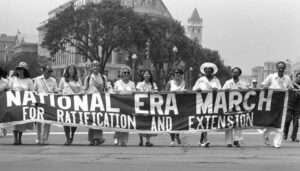
March supporting the Equal Rights Amendment. (Zelle/Getty)


Today President Biden declared that the Equal Rights Amendment, which states that "Equality of Rights under the law shall not be denied or abridged by the United States or any state on account of sex," has been duly ratified and is now part of the Constitution. Like Biden, I support the ERA and want it to be part of the Constitution. But his statement that it has been properly ratified is at odds with relevant court decisions, and is almost certainly wrong. Here is Biden's statement in full:

I have supported the Equal Rights Amendment for more than 50 years, and I have long been clear that no one should be discriminated against based on their sex. We, as a nation, must affirm and protect women's full equality once and for all.

On January 27, 2020, the Commonwealth of Virginia became the 38th state to ratify the Equal Rights Amendment. The American Bar Association (ABA) has recognized that the Equal Rights Amendment has cleared all necessary hurdles to be formally added to the Constitution as the 28th Amendment. I agree with the ABA and with leading legal constitutional scholars that the Equal Rights Amendment has become part of our Constitution.

It is long past time to recognize the will of the American people. In keeping with my oath and duty to Constitution and country, I affirm what I believe and what three-fourths of the states have ratified: the 28th Amendment is the law of the land, guaranteeing all Americans equal rights and protections under the law regardless of their sex.

For reasons laid out in a 2007 article on the subject, I too support the ERA. Some of the points I made in 2007 are now moot. For example, the ERA is no longer needed to ensure a right to same-sex marriage, because the Supreme Court ruled in favor of such a right on other grounds in Obergefell v. Hodges (2015). Similarly, the Pentagon has already opened up nearly all combat positions in the military to women, making that issue moot, as well (though enactment of the ERA could protect against backsliding). But the ERA would still lead to invalidation of all or most remaining forms of state-sponsored sex discrimination, such as male-only draft registration, and affirmative action preferences for women in some education programs and government contracting. It's possible that it would also ban state discrimination against transgender people (whether the latter qualifies as sex discrimination is disputed, though I think it does). I would be happy to see those effects happen, though the affirmative action one may not be welcomed by some of the ERA's more left-wing supporters.

Thus, I wish I could support Biden's conclusion that the ERA has been duly ratified. Sadly, I cannot. Scott Bomboy of the National Constitution Center has a helpful article laying out the controversy over the ERA's ratification. As he notes, Congress passed the ERA in 1972, but included a seven year deadline for the requisite ratification by three-fourths of the states. Congress eventually extended that deadline by another three years, till 1982. But, as of the extended deadline, only 35 states had ratified, three short of the required supermajority.

More recently, three more states claimed to ratify the amendment, the most recent being Virginia in 2020. Biden and other supporters of the idea that the ERA is now law want to count these post-deadline ratifications along with the others. Their position rests on the claim Congress's ratification deadline is unconstitutional.

Unfortunately for Biden, the Supreme Court ruled in Dillon v. Gloss (1921) that Congress does have the power to impose ratification deadlines, as it had done with the Eighteenth Amendment (which imposed alcohol prohibition). As the unanimous Court put it, "[w]e do not find anything in the article which suggests that an amendment, once proposed, is to be open to ratification for all time, or that ratification in some of the states may be separated from that in others by many years and yet be effective. We do find that which strongly suggests the contrary…. Of the power of Congress, keeping within reasonable limits, to fix a definite period for the ratification we entertain no doubt."

More recently, the US Court of Appeals for the DC Circuit reached a similar conclusion regarding the ERA itself, in Illinois v. Ferriero (2023), a case in which two state governments sought to compel the Archivist of the United States to certify that the ERA has been duly ratified and is now the law. For what it's worth, the DC Circuit ruling was authored by Judge Robert Wilkins, a liberal Obama appointee, and joined by fellow liberal J. Michelle Childs (a Biden appointee), as well as conservative Neomi Rao (appointed by Trump).

I think the reasoning of these decisions is compelling. But even if Biden disagrees, he and other government officials have a duty to adhere to the courts' resolution of these constitutional issues. Defiance of such judicial decisions is wrong when promoted by Trump and J.D. Vance, and it is wrong for Biden, as well.

In fairness, Biden's declaration does not, by itself, violate any judicial ruling. That would only happen if the administration takes meaningful steps to enforce the ERA. Since Biden only has about three days left in office, he may be unwilling or unable to do anything along these lines. The incoming Trump Administration is likely to reject Biden's position.

It is somewhat strange that Biden only took this step on his way out the door. After all, Virginia's supposed ratification took place in 2020, and Biden could have adopted the position that the ERA has been ratified at any time during his term. Had he done so in, say, 2021 or 2022, it would have had a much bigger effect, likely triggering a prolonged legal battle.

For the moment, therefore, Biden's declaration is just a dubious symbolic step that probably won't have much effect.  But I worry that it will lead a future Democratic administration to take the same position, thereby setting the stage for an unnecessary constitutional conflict.

Co-blogger and Harvard law Prof. Steve Sachs offers additional criticisms of Biden's position here.

Equal Rights Amendment

President Biden, the ERA, and Constitutional Vandalism

A deeply mistaken decision on the way out of office.

|

Three days from the end of his term, President Biden just announced that he has "long believed" the Equal Rights Amendment to be valid law:

I have supported the Equal Rights Amendment for more than 50 years, and I have long been clear that no one should be discriminated against based on their sex. We, as a nation, must affirm and protect women's full equality once and for all.

On January 27, 2020, the Commonwealth of Virginia became the 38th state to ratify the Equal Rights Amendment. The American Bar Association (ABA) has recognized that the Equal Rights Amendment has cleared all necessary hurdles to be formally added to the Constitution as the 28th Amendment. I agree with the ABA and with leading legal constitutional scholars that the Equal Rights Amendment has become part of our Constitution.

It is long past time to recognize the will of the American people. In keeping with my oath and duty to Constitution and country, I affirm what I believe and what three-fourths of the states have ratified: the 28th Amendment is the law of the land, guaranteeing all Americans equal rights and protections under the law regardless of their sex.

Although nothing has changed legally for the ERA since 2020, Biden has never taken this position before. He isn't ordering the Archivist of the United States to publish the amendment (which she has said she cannot lawfully do), and under his Administration the Department of Justice declined to assert the ERA's validity and defended the decision not to publish it.

One way to explain this hesitancy to endorse the ERA as lawful is that, well, it isn't. As I've discussed here before, Congress can and has placed legally operative language in amending resolutions, not just in proposed article text. The implication is that the ERA's seven-year time limit is valid—and that the ERA is not. Or, as I argue in forthcoming draft work:

The Twelfth Amendment and the ERA

Whether the Equal Rights Amendment is—right now—part of the Constitution is a matter of serious dispute. Thirty-eight states have sought to ratify the ERA, several of them only after the seven-year deadline in its proposing resolution. Should Congress or the Executive ignore the deadline, the ERA's doubtful validity could provoke a minor constitutional crisis.

But there may be a clear legal answer. Not only in the resolution proposing the Bill of Rights, but also in those proposing the Twelfth and Seventeenth Amendments, Congress included operative language that modified the legal force of the newly proposed text. This language was deliberately chosen, was repeated by state ratifications, and seems to have been accepted as legally effective. This historical practice suggests that under Article V, the resolution is the amendment—the constitutional change proposed by the resolution as a whole, not just by the particular language it proposes to add.

This understanding means that certain parts of the 1788 Constitution have been repealed, not just superseded. It also means that the ERA, were it ratified, would be incapable of making any valid change to the Constitution's text. The current lobbying efforts are therefore seriously misguided. In a divided society, losing consensus on the Constitution's text carries an especially high cost; the National Archives is the wrong place to play with fire.

If there's one thing that Americans are entitled to expect from their law professors, to paraphrase Justice Robert Jackson, it's rules of law that enable them to tell whether the Constitution has been amended, and if so, how. Unfortunately, whether the Equal Rights Amendment is, right now, part of the Constitution is a matter of serious dispute. Thirty-eight states have sought to ratify the ERA, the minimum number under Article V's three-fourths ratification requirement. If these ratifications were valid, the ERA would have come into effect on January 27, 2022. But three of the states acted only after the lapse of the ERA's seven-year deadline, a deadline that Congress included in its resolution proposing the Amendment fifty years earlier. Four other states had purported to rescind their ratifications even before the deadline expired, and a fifth did so upon its expiration. Nonetheless many members of Congress (indeed, the majority of the Democratic caucus in both Houses), joined by influential groups such as the American Bar Association, have proclaimed the Amendment valid—and they've called on the Archivist of the United States to accept it as valid also. If Congress or the Executive were take the ERA as indeed part of the Constitution, its doubtful validity could provoke a minor constitutional crisis.

This makes the ERA's validity an urgent question for constitutional scholars. If its proposed text really were valid, and the seven-year deadline really were void, then officials, lawyers, and academics alike would all be obliged to proclaim them so. By contrast, if the deadline really were valid, and the proposed text really were void, then urging the ERA's recognition might be seen as a shocking act of constitutional vandalism, one that threatens to destroy one of the last remaining areas of consensus in American law: our agreement on the Constitution's text.

But there may be a clear legal answer. Underappreciated historical evidence suggests that Congress was right to think it could place legally operative language in a proposing resolution—and that this language would be legally effective even without being repeated in a proposed article's text. Not only in the Bill of Rights, but also in the Twelfth and Seventeenth Amendments, Congress included operative language in proposing resolutions that specified which changes were to be made in the Constitution, altering the legal force of the newly added text or repealing contrary language in the existing Constitution. Congress's language was deliberately chosen; it was repeated by states in their instruments of ratification; and it seems to have been accepted as legally effective at the time. Yet despite its importance, this historical practice—spread across the eighteenth, nineteenth, and twentieth centuries—appears to have gone almost entirely unnoticed by legal scholars.

This practice also suggests a different understanding of the amendment process, one that might seem counterintuitive today but that's more consistent with the actual provisions of Article V. The "Seventeenth Amendment" isn't just the 134 words that follow that heading in a standard copy of the Constitution; it's a particular change worked in the text of the Constitution, a change proposed by Congress in a joint resolution in 1912 and then agreed to by the states in 1913. As a legal matter, the resolution is the amendment. When acting under Article V, Congress isn't limited to proposing pieces of extra language to be tacked on at the end; it can make detailed edits, can delete provisions of the existing Constitution, and can add conditions for its various proposals' validity. Each of these options would carry the same legal force as a proposed article's text, and each would be equally immune from future alteration by ordinary legislation passed by simple majority vote.

This understanding of Congress's powers under Article V entails that, while the text of our familiar printed Constitutions is correct, some familiar editorial notes might be in error: some provisions of the 1788 Constitution have been repealed, and not just superseded or "affected," by subsequent amendments. This understanding also entails rather straightforwardly that the ERA has failed to alter the Constitution's text. Whether or not states can rescind ratifications, the original deadline in Congress's resolution renders the article it proposes permanently invalid; that article forms no part of the Constitution, and the only way of adding it is for another amendment to the same effect to be proposed and ratified. In other words, despite succeeding in attracting ratifications from thirty-eight different states, the ERA makes and can make no valid change to the Constitution's text, no matter how many states might choose to ratify it in the future.

Finally, this view suggests that the current lobbying for the ERA is seriously misguided. In a deeply divided society, in which legal experts already disagree on key questions of constitutional law, losing consensus even on the content of the Constitution's text could be quite dangerous. While the best legal account of that text is one thing and popular belief another, any competing account needs to be supported by adequate evidence—and on the arguments presented here, this evidentiary bar is one the ERA simply can't clear. Advocates of the ERA should take note of this evidence and should identify a different path for pursuing their constitutional goals. The National Archives is the wrong place to play with fire.

See my prior post for more -- and will be updating this post with the new draft when it's available.

UPDATE: Now available!

Free Speech

Classified Evidence in the Tiktok Case

|

The majority stated only that its decision was "based on the public record, without reference to the classified evidence the Government filed below," but Justice Gorsuch's concurrence in the judgment added:

I am pleased that the Court declines to consider the classified evidence the government has submitted to us but shielded from petitioners and their counsel. Efforts to inject secret evidence into judicial proceedings present obvious constitutional concerns. Usually, "the evidence used to prove the Government's case must be disclosed to the individual so that he has an opportunity to show that it is untrue."

Maybe there is a way to handle classified evidence that would afford a similar opportunity in cases like these. Maybe, too, Congress or even the Standing Committee on Rules of Practice and Procedure would profit from considering the question. Cf. United States v. Zubaydah (2022) (Gorsuch, J., dissenting). But as the Court recognizes, we have no business considering the government's secret evidence here.

More