The Volokh Conspiracy

Mostly law professors | Sometimes contrarian | Often libertarian | Always independent | Est. 2002

The Volokh Conspiracy

The Birthright Citizenship Executive Order

|

Much has been written about President Trump's executive order concerning birthright citizenship. I'll add a few thoughts here.

First, this order did not tie the denial of birthright citizenship to the invasion order. Rather, it is far broader. A child born to any mother who is not lawfully present, or a mother who only lawfully present for a temporary period, would not be a birthright citizen. This position can be refined in the inevitable litigation.

Second, the order only applies prospectively to children born 30 days after the issuance of the order. But if this order is successful, there is nothing that would prevent this policy from being enforced retroactively. Trump would not have to denaturalize people. It would be sufficient to deny them documentation of citizenship.

Third, the order simply withholds the issuance of certain identity documents:

It is the policy of the United States that no department or agency of the United States government shall issue documents recognizing United States citizenship, or accept documents issued by State, local, or other governments or authorities purporting to recognize United States citizenship . . . .

This order brings to mind Zivotofsky v. Kerry (2015). Justice Thomas's concurrence found that the President has a "residual foreign affairs power" to regulate passports, but the President has no such power over "consular reports of birth abroad." Perhaps one of the most significant exercises of this power was when the Lincoln Administration issued passports to Black Americans, notwithstanding that Dred Scott ruled that such people could never become citizens. Remember, Lincoln did not defy Dred Scott; he simply limited that ruling to the named parties. If Thomas is right, then Congress has no power, whatsoever, over passports. Would Trump argue that the President's residual foreign affairs power over passports gives him any special authority to interpret Section 1 of the 14th Amendment? There may be something more here. I need to think about it some more.

By contrast, in Zivotofsky, Justice Scalia's dissent rejected Thomas's analysis.

The concurrence's stingy interpretation of the enumerated powers forgets that the Constitution does not "partake of the prolixity of a legal code," that "only its great outlines [are] marked, its important objects designated, and the minor ingredients which compose those objects [left to] be deduced from the nature of the objects themselves." McCulloch, 4 Wheat., at 407. It forgets, in other words, "that it is a constitution we are expounding." Ibid.

This is one of the rare cases where Scalia and Thomas disagree, and vigorously so, on an originalist question.

The ACLU challenged this birthright citizenship order in New Hampshire. And two dozen blue states, led by New Jersey, filed suit in Massachusetts. I guess it was determined the First Circuit would have jurisdiction over this claim. That makes sense, since the First Circuit has ruled over the status of Puerto Rico, which is adjacent to the insular cases. There is probably some favorable precedent there.

I watched as Trump signed this order. He did not seem particularly confident that he would win this case, as opposed to some of his other actions. The Court will almost certainly rule against Trump. But in the process, does John Roberts tell us what "subject to the jurisdiction thereof" actually means? Is it just the children of diplomats who are excluded? Who else is not covered? You can be sure Trump will respond accordingly. Indeed, maybe that is the point of drawing the categories so broadly. Any wiggle room that the Court leaves will be wiggled.
President Trump's Executive Order on the U.S. Refugee Admissions Program

The timing of this order seems structured to moot a Supreme Court appeal in 90 days.

|

During the first Trump Administration, there were three iterations of the travel ban. Just as one version got to the Supreme Court, it lapsed, and another version came shortly thereafter. This strategy frustrated the litigation, and made it tougher to get a final judgment. President Trump's new order on the U.S. Refugee Admissions program will likely follow a similar pattern.

First, President Trump invokes Section 1182(f), the statute at issue in the travel ban. He deems the entry of all refugees to be detrimental to American interests. And he orders the denial of their entry.

Sec. 3. Realignment of the U.S. Refugee Admissions Program. (a) I hereby proclaim, pursuant to sections 212(f) and 215(a) of the INA, 8 U.S.C. 1182(f) and 1185(a), that entry into the United States of refugees under the USRAP would be detrimental to the interests of the United States. I therefore direct that entry into the United States of refugees under the USRAP be suspended — subject to the exceptions set forth in subsection (c) of this section — until a finding is made in accordance with section 4 of this order. This suspension shall take effect at 12:01 am eastern standard time on January 27, 2025.

The order goes into effect one week after the inauguration. This provides for a pre-enforcement challenge--a bit more orderly than the travel ban order that went into effect by surprise. And the order remains in effect until Trump makes some future finding (see below). Unlike the travel ban, which was indefinite, this order has some theoretical end point. This fact will aid in the litigation.

Second, there is not a categorical ban. Trump allowed for the exercise of prosecutorial discretion. In theory, at least, some refugees can be admitted, so long as they do not pose a threat to American interests.

(c) Notwithstanding the suspension of the USRAP imposed pursuant to subsections (a) and (b) of this section, the Secretary of State and the Secretary of Homeland Security may jointly determine to admit aliens to the United States as refugees on a case-by-case basis, in their discretion, but only so long as they determine that the entry of such aliens as refugees is in the national interest and does not pose a threat to the security or welfare of the United States.

Third, there is a ninety day clock. In theory at least, in three months, there will be a careful review which can be used to support the policy.

Sec. 4. Resumption of the U.S. Refugee Admissions Program. Within 90 days of this order, the Secretary of Homeland Security, in consultation with the Secretary of State, shall submit a report to the President through the Homeland Security Advisor regarding whether resumption of entry of refugees into the United States under the USRAP would be in the interests of the United States, in light of the policies outlined in section 2 of this order. The Secretary of Homeland Security, in consultation with the Secretary of State, shall submit further reports every 90 days thereafter until I determine that resumption of the USRAP is in the interests of the United States.

It may take about three months to get this case up to the Supreme Court. Just as it gets there, the Secretary of Homeland Security will release a report, which will likely force the Supreme Court to remand the case to the District Court, with instructions to consider the new policy. This structure will make it very hard to obtain a final judgment. And I think this structure reflects lessons learned from the travel ban litigation.

When The Resistance Tail Catches The DOGE

The Resistance sues a non-existent entity based on an irrelevant statute.

|

Mere moments after President Trump his oath, a group of progressive public interest groups filed suit to challenge DOGE. Of course, DOGE had not yet been created. It wasn't even clear what DOGE was. And who has standing to challenge a non-existent entity? But Resistance demands being the first to file.

The complaints assumed that DOGE would be some sort of advisory committee outside the aegis of the federal government. These committees may be subject to the Federal Advisory Committee Act (FACA). In 1993, a federal district court found that the President's Task Force on National Health Care Reform, chaired by Hillary Clinton violated FACA. However, the D.C. Circuit reversed that decision, finding that the task force was not subject to FACA. (This is a rare case where Judge Silberman reversed Judge Lamberth.)

But there's a problem for the Resistance. DOGE is not an advisory committee. It is not subject to FACA. The President's order explains that DOGE will be housed within the Executive Office of the President:

Sec. 3. DOGE Structure. (a) Reorganization and Renaming of the United States Digital Service. The United States Digital Service is hereby publicly renamed as the United States DOGE Service (USDS) and shall be established in the Executive Office of the President.

(b) Establishment of a Temporary Organization. There shall be a USDS Administrator established in the Executive Office of the President who shall report to the White House Chief of Staff. There is further established within USDS, in accordance with section 3161 of title 5, United States Code, a temporary organization known as "the U.S. DOGE Service Temporary Organization". The U.S. DOGE Service Temporary Organization shall be headed by the USDS Administrator and shall be dedicated to advancing the President's 18-month DOGE agenda. The U.S. DOGE Service Temporary Organization shall terminate on July 4, 2026. The termination of the U.S. DOGE Service Temporary Organization shall not be interpreted to imply the termination, attenuation, or amendment of any other authority or provision of this order.

(c) DOGE Teams. In consultation with USDS, each Agency Head shall establish within their respective Agencies a DOGE Team of at least four employees, which may include Special Government Employees, hired or assigned within thirty days of the date of this Order. Agency Heads shall select the DOGE Team members in consultation with the USDS Administrator. Each DOGE Team will typically include one DOGE Team Lead, one engineer, one human resources specialist, and one attorney. Agency Heads shall ensure that DOGE Team Leads coordinate their work with USDS and advise their respective Agency Heads on implementing the President's DOGE Agenda.

DOGE will be within the government, and be staffed by government employees. There may be "Special Government Employees," such as Elon Musk. But that is not a FACA issue.

How embarrassing for the Resistance. Will any of these groups explain to their donors how they sued a non-existent entity based on a completely irrelevant statute? I hope the Resistance takes it easy. It will be a long four years.

President Trump's TikTok Executive Order

|

Four days ago, the Supreme Court upheld the TikTok ban. Even before that decision was issued, President Biden announced that he would not enforce the policy for the final 36 hours of his presidency. (In hindsight, he may have been too busy signing pardons.) Yet, for a short while, TikTok went dark. And then TikTok turned on again, in anticipation of Trump's inauguration. On his first day in office, Trump signed an executive order concerning TikTok.

The order echoes President-Elect Trump's amicus brief. Trump asserts that the law impinges on his authority over national security:

I have the unique constitutional responsibility for the national security of the United States, the conduct of foreign policy, and other vital executive functions. To fulfill those responsibilities, I intend to consult with my advisors, including the heads of relevant departments and agencies on the national security concerns posed by TikTok, and to pursue a resolution that protects national security while saving a platform used by 170 million Americans. My Administration must also review sensitive intelligence related to those concerns and evaluate the sufficiency of mitigation measures TikTok has taken to date.

Like in the brief, Trump refers to the timing of the statute as "unfortunate." This timing was no accident. Congress intended this decision to fall to President Biden.

The unfortunate timing of section 2(a) of the Act — one day before I took office as the 47th President of the United States — interferes with my ability to assess the national security and foreign policy implications of the Act's prohibitions before they take effect.

And Trump repeats his refrain that he can make a deal.

This timing also interferes with my ability to negotiate a resolution to avoid an abrupt shutdown of the TikTok platform while addressing national security concerns.

Trump directs his administration to take no action against anyone for seventy-five days.

Accordingly, I am instructing the Attorney General not to take any action to enforce the Act for a period of 75 days from today to allow my Administration an opportunity to determine the appropriate course forward in an orderly way that protects national security while avoiding an abrupt shutdown of a communications platform used by millions of Americans.

Trump doesn't quite say that the statute is unconstitutional. There is no basis, then for an Article II override. Rather, this seems to be purely an act of prosecutorial discretion. But it is more than that. Trump promises that no future penalties will be imposed on companies that work with TikTok.

Sec. 2. Action. (a) I hereby order the Attorney General not to take any action on behalf of the United States to enforce the Act for 75 days from the date of this order, to permit my Administration an opportunity to determine the appropriate course of action with respect to TikTok. During this period, the Department of Justice shall take no action to enforce the Act or impose any penalties against any entity for any noncompliance with the Act, including for distributing, maintaining, or updating (or enabling the distribution, maintenance, or updating) of any foreign adversary controlled application as defined in the Act. In light of this direction, even after the expiration of the above-specified period, the Department of Justice shall not take any action to enforce the Act or impose any penalties against any entity for any conduct that occurred during the above-specified period or any period prior to the issuance of this order, including the period of time from January 19, 2025, to the signing of this order.

In theory at least, the next administration could choose to bring an action within the statute of limitations. But that is unlikely. What makes this more unlikely is that the Attorney General must issue a non-enforcement letter:

(b) The Attorney General shall take all appropriate action to issue written guidance to implement the provisions of subsection (a).

(c) I further order the Attorney General to issue a letter to each provider stating that there has been no violation of the statute and that there is no liability for any conduct that occurred during the above-specified period, as well as for any conduct from the effective date of the Act until the issuance of this Executive Order.

I am fairly certain that these sorts of letters can be relied upon in the event of any future enforcement action. Alan Rozhenstein flags Zach Price's article about reliance on non-enforcement. Alan makes some fair points, but as a matter of realpolitik, I doubt there will ever be a prosecution. And that is enough for the lawyers at Oracle and Akami.

Apart from the estoppel argument, I see here a fairly clear violation of the Take Care Clause. This is not simply an exercise in discretion. The President is authorizing the violation of a statute that was just upheld by the Supreme Court. And this order, like others, issues direct orders to the Attorney General about how to exercise prosecutorial discretion. Trump is making clear that he sees the Attorney General as his subordinate. I am inclined to agree with this view of Article II, but it represents a departure from how past presidents have interacted with their Attorneys General.

Finally, the Attorney General can take steps to block enforcement of the ban by private parties or states.

(d) Because of the national security interests at stake and because section 2(d) of the Act vests authority for investigations and enforcement of the Act only in the Attorney General, attempted enforcement by the States or private parties represents an encroachment on the powers of the Executive. The Attorney General shall exercise all available authority to preserve and defend the Executive's exclusive authority to enforce the Act.

I'm a bit confused, as I don't see any private causes of action under the statute.

As a coda to signing the order, President Trump announced one possible deal:

The order, one of Mr. Trump's first acts after taking office, instructs the attorney general not to take any action to enforce the law so that his administration has "an opportunity to determine the appropriate course forward." The order is retroactive to Sunday.

As he signed the order, Mr. Trump told reporters that "the U.S. should be entitled to get half of TikTok" if a deal for the app is reached, without going into detail. He said he thought TikTok could be worth a trillion dollars.

The order could immediately face legal challenges, including over whether a president has the power to halt enforcement of a federal law. Companies subject to the law, which forbids providing services to Chinese-owned TikTok, may determine that the order does not provide a shield from legal liability.

Trump said: "If I do the deal for the United States, I think we should get half."

After Trump filed his brief, I wrote:

After nearly a decade, I think people still do not understand Trump. He doesn't play like everyone else does, and that is what infuriates people. When he says something that people deem outlandish, it is merely an opening bid, not the final offer. I think he views this case like he views just about everything else--as a deal to be made.

All his proceeding are going to plan.

President Trump's Executive Order About Exclusion and Removal of Aliens

The order would exclude and remove aliens who "bear hostile attitudes" to our "founding principles."

|

In immigration law, there are two broad categories of executive actions: exclusion and removal. The former policy prevents aliens from entering the country, and the latter policy removes aliens already in the country. As a general matter, aliens in the United States benefit from a host of constitutional, statutory, and treaty-based protections, reinforced by robust judicial review. But aliens seeking entry stand in a different position. They generally lack any constitutional rights and can only apply for admission through fairly intricate statutory or treaty-based processes. And a denial of a visa is generally subject to a doctrine of consular non-reviewability. In practice, an alien can't sue the federal government if a visa is denied.

Still, American citizens and other organizations can sponsor, or seek the admission of certain aliens. Indeed, the courts have held that when the government denies entry to an alien, that denial can violate the First Amendment rights of U.S. Citizens. This doctrine stems from the case of Kleindienst v. Mandel (1972). American professors were allowed to challenge the denial of entry of a Marxist professor from Belgium, on the ground that the professors wanted to hear the professor's message. I've long thought Mandel was wrongly decided. The professors should have no basis to challenge the denial of entry of an alien based on the professors' asserted First Amendment interest. Indeed, with the age of Zoom, the notion that the United States has to admit a professor to talk to college students does not fly.

Four decades later, a fractured Court in Kerry v. Din (2015) held that an American citizen has some due process interest to ensure a family member can seek entry to the United States. I do not think Justice Kennedy's plurality opinion in that case stands for much anymore. More recently, Trump v. Hawaii (2018) broadly read the President's power to exclude aliens. And, despite unified Democratic government, Congress did not actually modify that statutory authority. It should be no surprise, then, that President Trump seeks to use this authority.

One of President Trump's new orders provides some broader parameters over who will be admitted--but it also speaks to the types of aliens in the United States who will be removed.

The policy provides:

And the United States must ensure that admitted aliens and aliens otherwise already present in the United States do not bear hostile attitudes toward its citizens, culture, government, institutions, or founding principles, and do not advocate for, aid, or support designated foreign terrorists and other threats to our national security.

I'm sure immigration groups will seize upon this standard as a violation of the First Amendment. Again, Aliens inside the United States have some First Amendment rights. Although, under Bluman v. FEC (2012), they do not have full rights to support political campaigns. And the courts are divided about whether aliens have Second Amendment rights.

The order also seeks to remove aliens who have hostile attitudes to the American government:

(c) Whenever information is identified that would support the exclusion or removal of any alien described in subsection 2(b), the Secretary of Homeland Security shall take immediate steps to exclude or remove that alien unless she determines that doing so would inhibit a significant pending investigation or prosecution of the alien for a serious criminal offense or would be contrary to the national security interests of the United States.

Again, aliens in the United States, even if here unlawfully, can assert First Amendment rights.

Section 1182(f) provides that the President can deny entry to "any class of aliens into the United States would be detrimental to the interests of the United States." The statute does not define what "detrimental" means. Generally, that term has concerned some national security interest. But Trump would go further:

(c) Evaluate all visa programs to ensure that they are not used by foreign nation-states or other hostile actors to harm the security, economic, political, cultural, or other national interests of the United States.

What does it mean for an alien to harm the "cultural" interests of the United States?

Moreover, entry is denied to people who have undermined "fundamental constitutional rights" including free speech and freedom of religion.

(d) Recommend any actions necessary to protect the American people from the actions of foreign nationals who have undermined or seek to undermine the fundamental constitutional rights of the American people, including, but not limited to, our Citizens' rights to freedom of speech and the free exercise of religion protected by the First Amendment, who preach or call for sectarian violence, the overthrow or replacement of the culture on which our constitutional Republic stands, or who provide aid, advocacy, or support for foreign terrorists;

If I'm reading this right, certain students who participated in anti-Israel protests will be denied visas. Universities were prudent to encourage their students to return to the United States before January 20. But their visas may not be renewed.

Finally, the order calls for a policy of "proper assimilation."

(f) Evaluate the adequacy of programs designed to ensure the proper assimilation of lawful immigrants into the United States, and recommend any additional measures to be taken that promote a unified American identity and attachment to the Constitution, laws, and founding principles of the United States; and

There are no specifics here.

Free Speech

FBI Director Nominee Kash Patel Loses Libel Appeal Against CNN

|

An excerpt from today's Virginia Court of Appeals decision in Patel v. CNN, Inc., decided by Judge Rosemarie Annunziata, joined by Judge Vernida Chaney (the opinions weigh in at over 12,000 words, so I only excerpt some key passages):

Generally, Patel alleged in an amended complaint that CNN defamed him by reporting that the House Permanent Select Committee on Intelligence (Intelligence Committee) had uncovered evidence that "connected" him to President Trump's efforts to (1) spread conspiracy theories about then-Vice President Joseph R. Biden, Jr. and (2) coerce Ukraine into announcing an investigation into Vice President Biden and his son, Hunter Biden….

It is undisputed that Patel is a public official and the challenged statements involve a media company's reporting on a widely publicized political issue. Thus, for Patel's claims to survive demurrer, he was obliged to allege facts with "sufficient definiteness to enable" the conclusion that CNN published the challenged statements with actual malice [i.e., knowledge that the statements were false or likely false -EV]. Yet his amended complaint was comprised of unspecified conclusions, contradicted by the attached documents, and did not otherwise allege specific instances of conduct "sufficient … to enable [a] court to find the existence of a legal basis for its judgment." …

Patel argues that the "aggregate" of his allegations demonstrated that CNN published the challenged statements "with knowledge that they were false or with reckless disregard for whether they were false." He alleged that CNN "harbored extreme professional and personal animus, bias, spite and ill will" toward him, and published the statements to "sensationalize the 'news,'" "profit from … its false statements," and "insult" him.

He maintains that CNN's "agents" were "present during the House impeachment inquiry" and had read the Ukraine Report, so CNN "knew" that no "evidence" was actually "'uncovered' connecting [him] to" conspiracy theories or "any 'diplomatic back channel led by … Giuliani.'" Consequently, he alleged, CNN "manufactured" the challenged statements "out of whole cloth." In doing so, CNN "abandoned all journalistic integrity," "violated its own code of ethics," and "ignored its own prior reporting and reliable information that contradicted" the challenged statements. Indeed, Patel alleged that CNN "purposefully avoided … the truth" by publishing the challenged statements despite knowing that he had denied the allegations….

[U]nder the actual malice standard, a public official must plead with sufficient definiteness, even for media companies that harbor ill will and ordinary malice, that specific persons within those companies who were responsible for the challenged statements knew the statements were false or had "a high degree of subjective awareness of their probable falsity." Yet Patel's allegations do not enable such a conclusion because they do not sufficiently "bring home" the actual malice standard to a person or persons at CNN responsible for publishing the challenged statements.

Read More

Free Speech

Free Speech and Private Power: Uncertainty About Disclosure Rules

|

[I am serializing my short Harvard Law Review Forum essay titled "Free Speech and Private Power", responding to the Harvard Law Review's publication of Evelyn Douek & Genevieve Lakier's excellent new article, Lochner.com? I actually agree with much of what Douek & Lakier say, but offer a somewhat different perspective on the matter, mostly asking what the Court's recent cases mean going forward, rather than trying to critique them.]

Sometimes, private power can be constrained by transparency requirements rather than outright hosting mandates. The Moody Court suggested that such requirements, as applied to social media moderation policies and decisions, must be judged under Zauderer v. Office of Disciplinary Counsel, a case that dealt with compelled disclosures in lawyer advertising. In this regard, the Court echoed the Fifth Circuit's decision in NetChoice, LLC v. Paxton, which said that the "control[ ling]" Zauderer precedent "established that States may require commercial enterprises to disclose 'purely factual and uncontroversial information' about their services."

Yet the quoted material in Zauderer comes from a sentence that relies on the disclosure being within "commercial advertising"—and the Moody disclosure rules weren't limited to compelling disclosures in social media platform ads, or even more broadly compelling disclosures as part of commercial transactions that the platforms entered into with their users. They would apply even in the typical relationship between social media platforms and users, where no money changes hands.

Read More

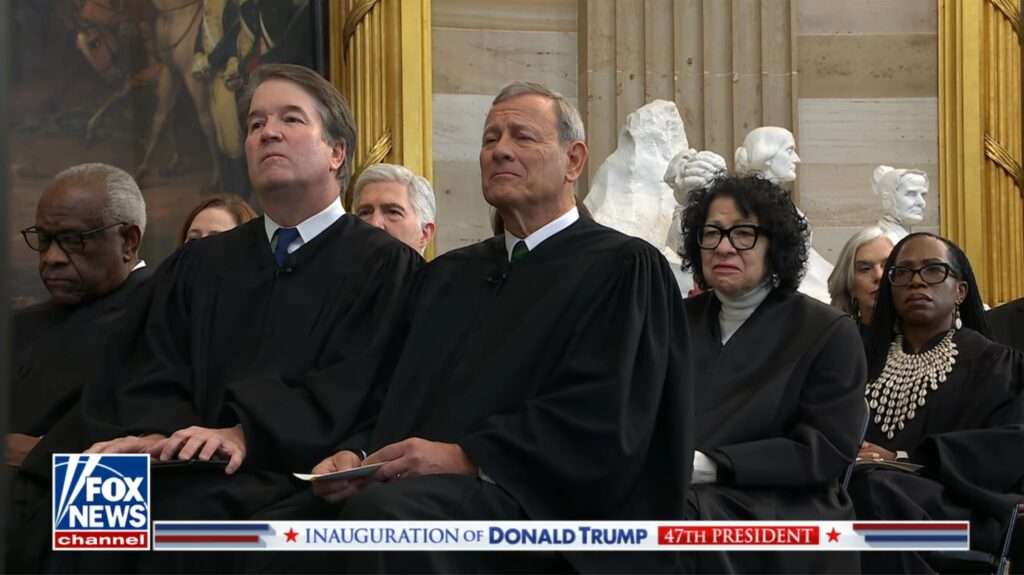
Justice Jackson Did Not Wear A Dissent Collar To The Inauguration. She Apparently Wore A Talisman To Ward Off Evil.

Does anyone still want to talk about Martha Ann Alito's flags?

|

As I watched the Justices enter the Capitol Rotunda, I noticed that Justice Jackson was wearing a distinctive collar. I asked whether it was a dissent collar.

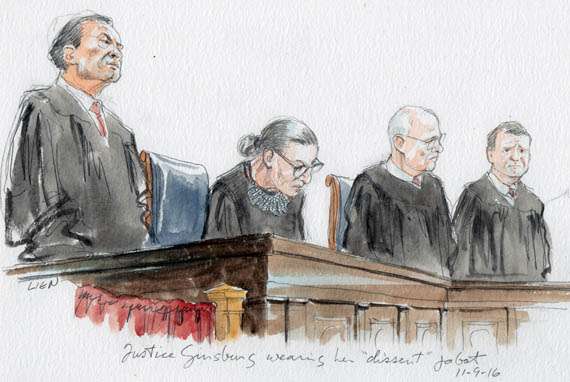
Remember, that RBG wore her dissent collar the day after Trump's 2016 election.

It may be even worse than I thought.

This report in Vogue (which I cannot vouch for) explains:

Over her black robes, the Justice wore a collar made of cowrie shells along with a pair of matching earrings. While the shell was used as currency in a variety of ancient cultures around the world, it was especially prized in African cultures, where it signified prosperity and protection. Meanwhile, the National Museum of African American History and Culture notes that, in America, the shell is thought to be a totem used to resist enslavement. Justice Jackson herself is a descendant of enslaved people. The connection feels particularly prescient on Martin Luther King Jr. Day, which happened to coincide with the Inauguration. (This has only happened once before, on Bill Clinton's 1997 Inauguration Day.)

Beyond its status as a protective talisman, the cowrie is also associated with womanhood and fertility. During his first term, Trump—who was found liable for sexual abuse in May 2023—made continuous efforts to erode women's rights, which included appointing Brett Kavanaugh, who was accused of attempted rape, to the Supreme Court. Even after Trump left office, his insidious, anti-women agenda continued to rear its head when the conservative-leaning Supreme Court overturned Roe v. Wade in June 2022.

While Justice Jackson has yet to explain the exact meaning of her Inauguration collar, the cowrie shell's multiple meanings point to a sartorial expression of her dissent.

The Justice's symbolic choice followed in the tradition of the late Supreme Court Justice Ruth Bader Ginsburg, whose roster of collars communicated her opinions—from the beaded jabot she wore to read a majority ruling, to the metallic necklace that telegraphed her dissent. While she has been photographed on the bench in a variety of statement-making jabots, Justice Ketanji Brown Jackson's collar for President Trump's swearing-in ceremony sent a particularly powerful message.

Others made the same observation.

Above the Law blares that "Ketanji Brown Jackson Wears Protection From Evil At Trump's Inauguration."

Even if Justice Jackson did not intend to convey this message, there is clearly the (literal) appearance of impropriety. This is not just, as I thought, a fashion faux pas.

Yet, there is not a word about whether this move violates any ethical rules. People praise Jackson like they praised Ginsburg's political sartorial choices. Remember, Justice Jackson is attending the Inauguration, only a few yards away from Trump. But she apparently deems it necessary to wear a talisman to ward off evil? Will Jackson face any recusal motions for all Trump-related cases? Jackson, of all members, should be grateful there is no "binding" Supreme Court ethics code.

Meanwhile, there are never-ending efforts to attack Justice Alito based on the non-political flags his wife chose to fly at their home. Remember almost every single attack on "legal ethics" is just interference, and an attempt to force conservative justices to recuse. There is no there there.

Kelo

Our Amicus Brief Urging the Supreme Court to Hear Case on Overruling Kelo v. City of New London

The brief is on behalf of the Cato Institute and myself.

|

Susette Kelo's famous "little pink house,"which became an iconic symbol of the Kelo case. (Institute for Justice)


Last month, I wrote about Bowers v. Oneida County Industrial Development Agency, a case in which the Institute for Justice seeks to  persuade the Supreme Court to overrule Kelo v. City of New London (2005). Kelo was the controversial case in which the  Court held that the government could use eminent domain to take property in order to promote private "economic development." Although the Fifth Amendment states the the government may only take private property for "public use," a narrow 5-4 Supreme Court majority built on earlier precedents to rule that virtually any potential public benefit qualifies.

Today, the Cato Institute and I filed an amicus brief urging the Court to take the case. Here is a summary of our argument that I prepared for the Cato website:

Bowers Development, LLC was under contract to purchase land in Utica, New York, planning to construct a medical office building.  Central Utica Building, LLC, a business competitor to Bowers—asked the Oneida County Industrial Development Agency ("OCIDA") to condemn the land so that Respondent could build a parking lot for a medical office building on adjoining property. Because Central Utica's project might stimulate the local economy, and improve the community, OCIDA agreed to condemn the land and give it to Central Utica. Bowers objected to this private-to-private taking as beyond the scope of the Fifth Amendment's Public Use Clause, which only allows the use of eminent domain to take property for a "public use."  A New York state court upheld the taking because it was "rationally related to a conceivable public purpose," namely "mitigating parking and traffic congestion." . The Appellate Division based its ruling in part on Kelo v. City of New London, 545 U.S.  (2005).

Kelo is one of the most severely flawed and much-criticized decisions in modern Supreme Court history. The Court's holding that private "economic development" qualifies as a "public use" sufficient to authorize the use of eminent domain to take private property is deeply at odds with text and original meaning, and based on a variety of other errors. Justice John Paul Stevens, author of the Court's majority opinion in Kelo, later admitted its reasoning was based, in part, on an "embarrassing to acknowledge" error in interpreting previous precedent.

In addition, Kelo has generated widespread confusion in state and lower federal courts because of its lack of clarity on what qualifies as a "pretextual" taking that remains invalid even under the Court's otherwise highly deferential approach to review of condemnations under the Public Use Clause.

Part I outlines the confusion Kelo has created in the lower courts. State and federal courts have adopted five distinct approaches to determining what qualifies as a pretextual taking. Some emphasize the subjective intentions of the government officials who decided to condemn the property; some focus on the distribution of benefits from the condemnation; some on whether there is a private beneficiary whose identity is known in advance; some on the extent of the planning process behind the taking; and some adopt a posture of near-total deference.

Part II explains how this case is an excellent vehicle for resolving the confusion. All four of the possible indicia of a pretextual taking identified by lower courts are present: dubious intentions, a highly skewed distribution of benefits, a known private beneficiary, and the absence of any extensive planning process. Thus, the Court can use the case as an opportunity to consider the relative significance of these factors.

Part III outlines the reasons why the Court should take this opportunity to overrule Kelo. The ruling is deeply at odds with the text and original meaning of the Public Use Clause. It also includes other serious errors in reasoning, including a crucial one admitted by Justice Stevens, author of the Court's majority opinion.

Overruling Kelo would be consistent with the Supreme Court's precedent on criteria for reversing previous decisions, as outlined in rulings such as Knick v. Township of Scott (2019). Reversing Kelo would also help resolve the confusion engendered by the ruling's vague criteria for determining what qualifies as a pretextual taking.

The Supreme Court should grant the petition, and overturn Kelo. Even if the Court does not wish to reverse Kelo, it should still grant the petition to clarify the proper standard for pretextual takings.

The brief is partly based on arguments developed in my book about the Kelo case, The Grasping Hand: Kelo v. City of New London and the Limits of Eminent Domain.

Offices and Officers of the Constitution, Part V: The Elector Incompatibility, Impeachment Disqualification, Foreign Emoluments, and Incompatibility Clauses

Everything you ever wanted to know about the Foreign Emoluments Clause.

|

Exactly eight years ago, President Trump was sued for violating the Foreign Emoluments Clause. Most people had never heard of this provision of the Constitution. Ultimately, none of the various cases made it to a final judgment. President Biden's inauguration in January 2021 ended all of the litigation.

Four years later, we expect litigation over the Emoluments Clause to resume at any minute.

I am happy to share the fifth installment of my ten-part series with Seth Barrett Tillman on the offices and officers of the Constitution.

Josh Blackman & Seth Barrett Tillman, Offices and Officers of the Constitution, Part V: The Elector Incompatibility, Impeachment Disqualification, Incompatibility, and Foreign Emoluments Clauses, 63(3) S. Tex. L. Rev. 237–425 (Oct. 2024), <https://ssrn.com/abstract=4527680>;

Here is the abstract:

The Constitution of 1788's original seven articles include twenty-two provisions that refer to "offices" and "officers." Some clauses use the words "office" or "officer," standing alone and unmodified. Other clauses use the word "office" or "officer" followed by a modifier, such as "of the United States," "under the United States," or "under the Authority of the United States." We refer to the language in these twenty-two provisions as the Constitution's divergent "office"- and "officer"-language.

This Article is the fifth installment of a planned ten-part series that provides the first comprehensive examination of the offices and officers of the Constitution. The first installment introduced the series. The second installment identified four approaches to understand the Constitution's divergent "office"- and "officer"-language. The third installment analyzed the phrase "Officers of the United States," which is used in the Appointment Clause, Impeachment Clause, Commissions Clause, and Oath or Affirmation Clause. The fourth installment traced the history of the "Office . . . under the United States" drafting convention.

This fifth installment will discuss how the "Office . . . under the United States" drafting convention is used in the Constitution. The Appointments Clause defines the phrase "officers of the United States." The Constitution, by contrast, does not provide a similar definition for the phrase "Office . . . under the United States." Here, the Framers relied on a phrase that was not expressly defined in the Constitution. This decision has led to some confusion. Of course, the phrase "Office . . . under the United States" is not unique in this way. The Framers used other such phrases that were not expressly defined by the Constitution's text. Rather, these phrases took their meaning from historical usage.

We also took a very deep dive in gifts given to Presidents. Much of this research, as best as we can tell, has not been published in the context of the Foreign Emoluments Clause. Here is a summary:

Section V traces the relationship between the Foreign Emoluments Clause and the presidency, from Washington to Trump. In total, we will discuss foreign gifts given to more than thirty presidencies. We divide these presidencies into seven categories. Only a handful of these foreign gifts have been studied in past scholarship and litigation concerning the Foreign Emoluments Clause. Category #1 includes four presidents from the Early Republic, who took actions that are consistent with our position that the President is not subject to the Foreign Emoluments Clause: Presidents George Washington, Thomas Jefferson, James Madison, and James Monroe. Category #2 includes presidents who expressly asked Congress to dispose of foreign gifts: Presidents Andrew Jackson, Martin Van Buren, John Tyler, and Abraham Lincoln. Category #3 includes presidents who unilaterally disposed of foreign gifts in government archives: Presidents John Quincy Adams, Abraham Lincoln (yes, Lincoln again), and Rutherford B. Hayes. Category #4 includes six presidents who unilaterally donated foreign state gifts to the Smithsonian Institute: Presidents Franklin Pierce, James Buchanan, Andrew Johnson, Grover Cleveland, Theodore Roosevelt, and Calvin Coolidge. Category #5 includes presidents who (likely) accepted foreign gifts and did not surrender them. We hedge for reasons that will be discussed below. Category #6 discusses four first ladies who accepted valuable foreign gifts: Mary Todd Lincoln, Eliza Johnson, Eleanor Roosevelt, and Jacqueline Kennedy. Category #7 turns to three modern presidents: Presidents Richard Nixon, Barack Obama, and Donald Trump. Admittedly, the chronology does not follow a straight path. It seems presidential efforts to comply with the Foreign Emoluments Clause peaked in the 1830s—and went downhill from there. There are no clear streams of authority. The history is a muddled puddle. Section V concludes by trying to make sense of these categories with two principles: practices during the Early Republic are more probative than later-in-time practices; and traditions of defiance trump traditions of surrender.

We expect to publish Part VI in 2025, and the remaining four parts to follow in due course.

Why Did Merrick Garland Want To Release Volume II Of The Smith Report To Ranking Members of Congress?

|

Today, Judge Cannon granted an emergency motion to block the release of Volume II of the Jack Smith report to ranking members of Congress. One lingering question I have had for some time is why Attorney General Garland wanted to transmit the report to congressional leaders. Judge Cannon explains that the government could not identify any reason:

With respect to the Department's assertion of congressional interest in Volume II, there has been no subpoena by Congress for review or release of Volume II. There is no record of an official request by members of Congress for in camera review of Volume II as proposed by the Department in this case. There is, however, a recent letter by some of those same members urging Attorney General Garland to release Volume II to the public immediately, even if doing so requires dismissal of the charges as to Defendants Nauta and De Oliveira. Finally, although the Department refers generally to "legislative interest" concerning special counsels as a basis to deny Defendants' Emergency Motion as to Volume II [ECF No. 703 p. 3 n.2], the Department has identified no pending legislation on the subject or any legislative activity that could be aided, even indirectly, by dissemination of Volume II to the four specified members whom the Department believes should review Volume II now.

At most, the government implied that Attorney General Garland wanted to transmit the report before his term concluded:

According to the Department, this in camera disclosure to four members of Congress is necessary right now—before the conclusion of criminal proceedings—because Attorney General Garland has "limited time" left in his tenure as the head of the Department and wishes "to comply with the historical practice of all Special Counsel," and also because there is "legislative interest in information about Special Counsel investigations, in order to consider possible legislative reforms regarding the use of special counsels" [ECF No. 703 p. 3 n.2].11 These statements do not reflect well on the Department. There is no "historical practice" of providing Special Counsel reports to Congress, even on a limited basis, pending conclusion of criminal proceedings.

Indeed, there is no indication that Jack Smith himself wanted to transmit the report to Congress:

Special Counsel Smith left no indication in his report or in his transmittal letter to Attorney General Garland that he favored congressional release or review of his report prior to conclusion of criminal proceedings [ECF No. 693-1 p. 5]. . . . In short, the Department offers no valid justification for the purportedly urgent desire to release to members of Congress case information in an ongoing criminal proceeding.

When the government cannot provide a valid reason for their actions, they do not have. valid reason for their actions.

During the tax return litigation, various congressional committees made requests for Trump's tax returns to aid in the development of legisation. That justification was always a pretext. They wanted to release the tax returns as a way to harm Trump. Indeed, while there was unified Democratic control of government, was there any serious effort to actually pass legislation concerning the President's tax returns? One bill never even made it out of committee.

One wonders why Attorney General Garland was so intent on giving this report to Democratic members of Congress. Even if the document was reviewed in camera, nothing would prevent the members from talking about it to the press. Judge Cannon explains:

And if Volume II gets released in whole or in part to the public in contravention of those promises, the Department assures, then Defendants need not worry because this Court can "cure" any damage caused by crafting jury instructions in the future and/or dismissing the charges [ECF No. 703 pp. 5–6]. These assertions flounder on multiple levels and do nothing to detract from the obvious. Given the very strong public interest in this criminal proceeding and the absence of any enforceable limits on the proposed disclosure, there is certainly a reasonable likelihood that review by members of Congress as proposed will result in public dissemination of all or part of Volume II. See S.D. Fla. L.R. 77.2(a). That reasonable likelihood risks substantial prejudice to the due process rights of Defendants, who remain subject to the protective order in this case [ECF No. 27]. This Court lacks any means to enforce any proffered conditions of confidentiality, to the extent they even exist in memorialized form. And most fundamentally, the Department has offered no valid reason to engage in this gamble with the Defendants' rights. The bare wishes of one Attorney General with "limited time" in office to comply with a non-existent "historical practice" of releasing Special Counsel reports in the pendency of criminal proceedings is not a valid reason. And surely it does not override the obvious constitutional interests of Defendants in this action and this Court's duty to protect the integrity of this proceeding.

Moreover, since the report would be kept sealed, the press could not verify or "fact check" whatever those Democrats said. The ranking members would have the final say on the matter. If Garland found it so important to release the report, he could have dismissed the indictments against the two co-defendants. But they are intent on having Judge Cannon's decision vacated, so they cannot do that.

Judge Cannon concludes:

Prosecutors play a special role in our criminal justice system and are entrusted and expected to do justice. Berger v. United States, 295 U.S. 78, 88 (1935); Banks v. Dretke, 540 U.S. 668, 696 (2004); Robert H. Jackson, Attorney General of the United States, Speech to the U.S. Department of Justice, The Federal Prosecutor (Apr. 1, 1940), available at https://www.justice. gov/ag/speeches-attorney-general-robert-houghwout-jackson. The Department of Justice's position on Defendants' Emergency Motion as to Volume II has not been faithful to that obligation.

I realize it is popular to dismiss Judge Cannon as a partisan hack. But her efforts here have uncovered a glaring hole in the supposed neutrality of Merrick Garland's prosecution. Did Garland ever actually resign? Was he removed?

A common theme that we have seen, again and again, is that to save democratic norms from Trump, we must destroy democratic norms to stop Trump. Rinse and repeat.

Donald Trump

Trump's Birthright Citizenship Order is Even Worse than Expected - and Even More Blatantly Unconstitutional

It applies to children of large numbers of legal visa-holders, as well as those of undocumented immigrants.

|

NA

Yesterday, I pointed out that Trump's promised executive order denying birthright citizenship to undocumented immigrants was likely to be unconstitutional because it blatantly violates Section 1 of the 14th Amendment, which grants citizenship to anyone "born … in the United States and subject to the jurisdiction thereof." We now have the text of the order, and it is even worse than expected.

The order doesn't just deny birthright citizenship to children of migrants who entered the US illegally. It also denies it to children of those who entered the US on perfectly legal temporary work and tourism visas. As Reason immigration writer Fiona Harrigan explains, this will affect children of many thousands of work visa holders, including H-1B visa holders much-loved by Elon Musk, among others.

In a recent Just Security article, I critiqued the (very weak) arguments that children of undocumented immigrants aren't entitled to birthright citizenship because they are not "subject to the jurisdiction" of the United States. These arguments are even more absurd when it comes to children of legal visa holders. The latter and their parents are completely subject to US laws, arguably even more so than the undocumented. And the weak argument that children of undocumented immigrants don't qualify because their parents are "invaders" is still more ridiculous when it comes to children of people who entered legally.

The executive order only applies to children born after February 19 of this year. But if the legal logic behind it is sound, nothing would prevent the administration from applying it retroactively. Indeed, if children of these types of immigrants really are excluded from birthright citizenship, retroactive application might be constitutionally required.

If the order stands, it would also create a bureaucratic morass that threatens to engulf even children of native-born citizens. In order to secure citizenship for your child, it would no longer be enough to provide documentation of parentage or place of birth. You would also presumably need to show the parents had the appropriate legal status - and their parents before them, potentially all the way back to the first member of the family who entered the US, perhaps decades or centuries ago. After all, if there is even one break in the legal status of the family tree, it could potentially render succeeding generations ineligible for birthright citizenship! At the very least, this is likely to be a serious burden for poorer and lesser-educated parents, who may not have easy access to documentation going back decades.

Lawsuits challenging the order have already been filed by the ACLU (on behalf immigrant groups), and 18 state governments. I won't go into the procedural issues in detail. But I expect many, if not all, these plaintiffs will have standing to sue, and overcome other procedural hurdles. This is particularly likely in the case of some of the ACLU clients, who are expectant mothers on temporary visas, scheduled to give birth after February 19. Supreme Court precedent on state government standing is murky. But I tentatively predict at least some of the states should be able to get standing based on the fact that the citizenship status of residents affects funding streams for various federal grants to the states.

I also hope and expect that courts will ultimately strike down this order.


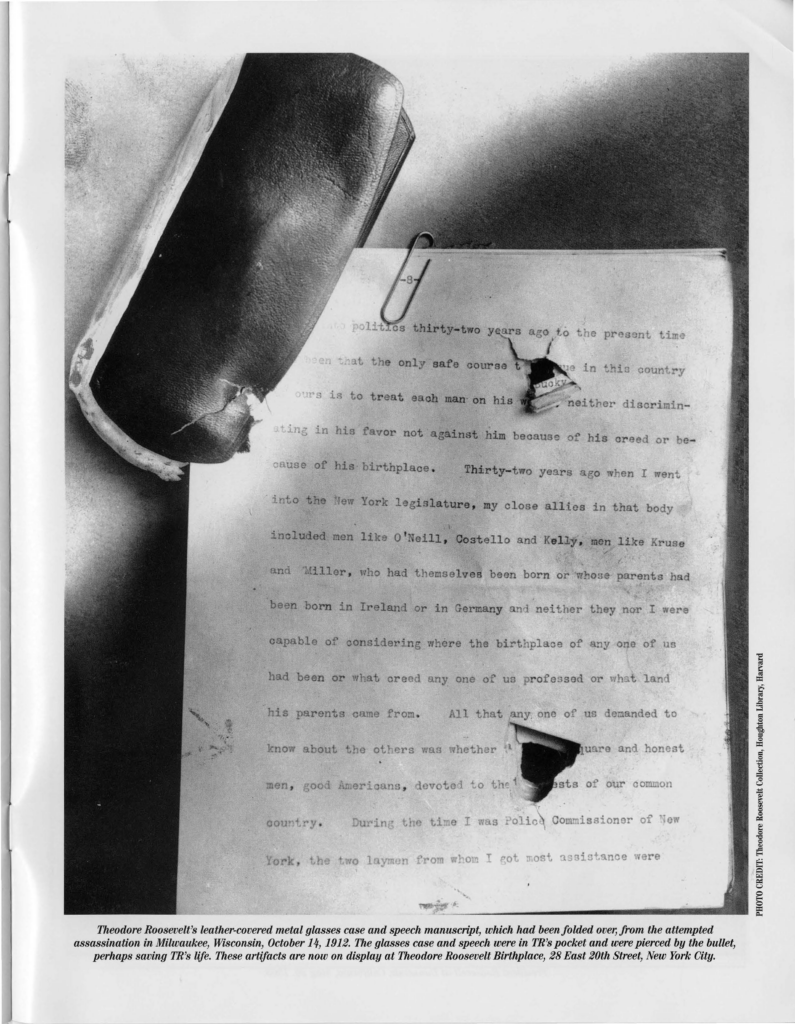
How Presidents Theodore Roosevelt and Ronald Reagan Responded To Their Assassination Attempts

|

Yesterday, I wrote about how George Washington and Donald Trump reacted to bullets missing them.

I thought to check on two other Presidents who survived assassination attempts.

On October 14, 1912, shortly before the presidential election, Theodore Roosevelt was shot at a campaign rally. The bullet was impeded by a copy of Roosevelt's speech and his glasses case. Roosevelt famously chose to continue delivering the speech. He began:

Friends, I shall ask you to be as quiet as possible. I don't know whether you fully understand that I have just been shot; but it takes more than that to kill a Bull Moose. But fortunately I had my manuscript, so you see I was going to make a long speech, and there is a bullet - there is where the bullet went through - and it probably saved me from it going into my heart. The bullet is in me now, so that I cannot make a very long speech, but I will try my best.

Here is a photograph of the manuscript and eyeglass case

Here is a statement from Theodore Roosevelt after his assassination in October 1912:

It is of course perfectly true that in voting for or against me consideration must be paid to what I have done in the past and to what I propose to do. But it seems to me far more important that consideration should be paid to what the Progressive Party proposes to do. I cannot too strongly emphasize the fact upon which we Progressives insist that the welfare of any one man in fight is wholly immaterial compared to the great and fundamental issues involved in the triumph of the principles for which our cause stands. If I had been killed, the fight would have gone on exactly the same.

Judge Ben Lindsey and the hundreds of other men now on the stump are preaching the doctrines that I have been preaching and stand for and represent just the same cause. They would have continued the fight in exactly the same way if I had been killed, and they are continuing it in just the same way now that I am for the moment laid up.

On March 30, 1981, President Ronald Reagan survived an assassination attempt. The following day, Reagan closed his diary entry with this sentence:

Whatever happens now I owe my life to God and will try to serve him in every way I can.

Free Speech

"TikTok's Tech Partners Face Massive Legal Risks by Relying on Trump's Promises Not to Enforce the Ban Law, …

as courts rarely protect defendants who count on executive non-enforcement," writes Prof. Alan Rozenshtein (Minnesota).

|

An excerpt from his Lawfare post:

An important feature of the [entrapment-by-estoppel] doctrine in lower courts [on which the tech companies would presumably rely in any enforcement proceeding -EV] is that it incorporates a reasonableness requirement. This test demands not only that the government "affirmatively told the defendant that the proscribed conduct was permissible," but also that the defendant "reasonably relied on the government's statement"—i.e., if a defendant "sincerely desirous of obeying the law would have accepted the information as true, and would not have been put on notice to make further inquiries."

Courts could be expected to apply this reasonableness standard more stringently when evaluating claims by sophisticated actors. Corporate entities with substantial legal resources and regulatory expertise should face greater scrutiny of their reliance claims, as they possess the capacity to independently evaluate legal requirements rather than relying solely on executive statements….

The non-enforcement promise offers minimal security. As discussed above, courts rarely treat such promises as binding, even when defendants face serious consequences from relying on them. Trump could change his mind at any time or selectively enforce against companies that fall from political favor, and a future administration, taking advantage of the five-year statute of limitations, would almost certainly be free to pursue violations regardless of Trump's stance.

I'm not an expert on the subject, but I've generally found Prof. Rozenshtein's analyses to be quite thoughtful and interesting, so I thought I'd pass this along. Naturally, I'll be glad to also pass along links to serious contrary arguments.

Free Speech

Man Sues HBO, Claiming He Is the Pseudonymous Satoshi Nakamoto, Inventor of Bitcoin

But "[n]othing in Plaintiff's conclusory assertions suggest that Plaintiff could plead facts plausibly linking his identity with that of the pseudonymous Satoshi Nakamoto."

|

From Chief Judge Laura Taylor Swain's decision in Swaby v. HBO (S.D.N.Y.) Friday:

Plaintiff Errol Jacob Jones Swaby, a citizen of California who appears pro se, … sues Home Box Office, Inc…. Plaintiff asserts state law claims of libel, and seeks the following alternative relief:

1) that [HBO] cease and desist [its] airing of [a documentary in which another person, not Plaintiff, is credited as the creator of Bitcoin, a person known under the pseudonym Satoshi Nakamoto] or 2) [HBO] can air it with an open apology to Satoshi Nakamoto for airing it and disregard his wish to separate himself from a tool built for civilization, or 3) air it and sign [Plaintiff to] an exclusive contract designating HBO as the only media outlet [Plaintiff] can respond to the public through as well as [to] an agreement to sit with [HBO] for one interview per month for the duration of 1 year. Afterw[a]rds[,] the contract can be renegotiated or withdrawn by either party. The contract must include a payment schedule of 25 million [dollars] upfront and 1 million [dollars] per completed interview.

Read More

Property

Choice of Law in Takings Cases After Tyler v. Hennepin County (II)

The Court's approach to the choice of law question (or, federal courts doctrine for property lawyers).

|

In yesterday's post, I recounted what happened in Tyler v. Hennepin County, Minnesota, and I restated questions lawyers might reasonably ask about the case. In Tyler, Chief Justice John Roberts, the author of the Court opinion, held that surplus equity—the proceeds left over after a creditor forecloses and sells real estate to pay off a debt—constitutes "private property" sufficient to support claims under the Takings Clause. To justify that conclusion, Roberts cited Magna Carta, a 17th-century Act of Parliament, Blackstone, a Founding Era act of the U.S. Congress, Founding Era state practice, its own precedents, and several Minnesota statutes about debtor-owners' rights in foreclosure proceedings. But the Court's justification will strike many lawyers as strange. Black-letter takings doctrine seems to hold that, "[b]ecause the Constitution protects rather than creates property interests, the existence of a property interest is determined by reference to existing rules or understandings that seem from an independent source such as state law." Why didn't the Court determine whether Tyler had property relying solely on the relevant Minnesota statute—which made clear that foreclosed-on owners don't retain property in surplus equity after foreclosure?

I am going to answer that question in two posts. I do so in large part because I suspect that different readers will bring different expectations to the relevant issues. For example, federal courts specialists might find the question I asked a bit overdrawn, or belaboring the obvious. If any such readers are having reactions like those, I ask them to bear with me today. Many property lawyers are asking the question I asked above, in the tone in which I asked it. Today, then, I'd like to recount choice of law principles that federal courts specialists know well, for the benefit of property lawyers. The property lawyers get their day tomorrow.

The nerve of the answer to my question comes in a passing quote in Tyler. Roberts paid lip service to the standard black letter in takings litigation; he granted that the Court "draws on 'existing rules or understandings' about property rights" when it determines whether plaintiffs have private property for constitutional purposes. But Roberts insisted that that black-letter rule has limits, that "state law cannot be the only source" of a claimant's property. To back that limit up, Roberts quoted a Sixth Circuit opinion in a similar case, by Judge Raymond Kethledge: "the Takings Clause would be a dead letter if a state could simply exclude from its definition of property any interest that the state wished to take."

Read More

More