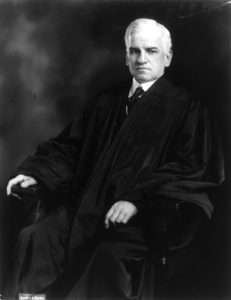
I am making my way through Justice Barrett's new book, Listening to the Law. I'll put the praise up front. This is a very well-written book. It is tight, well-organized, and enjoyable. I think a non-lawyer could pick up this book and learn a lot about the Supreme Court. It is also clear to me that Justice Barrett wrote this book herself, and enjoyed writing it. She has a very distinct writing style that comes through on every page. There was no ghost-writer used here.
In due course, I will offer some more in-depth comments, but here, I'd like to highlight some of the new things we learn from the book. In particular, I'll focus on Chapter 4, where she walks through her process of deciding cases.
First, Barrett explains her process before oral arguments. Barrett will read the brief from the Petitioner, Respondent, and when available, the Solicitor General. Barrett is very clear that she does not read amicus briefs "at the outset of [her] preparation." At a recent confirmation hearing, a Senator worried about the dark money that funds amicus briefs. I think this concern is misplaced. Barrett said she will "read some amicus briefs, like those filed by state governments." But she finds less helpful briefs that "dwell on policy arguments." I would know nothing about such briefs!
Second, after reading the briefs, she will read the clerk's bench memo. By contrast, when she served on the Seventh Circuit, she would read the bench memo before the briefs. Why the change? Barrett writes, "At the Supreme Court, by contrast, the question presented is crystallized, and the quality of briefing is almost always superb." Barrett wants to form her own "preliminary views" before reading the recommendation.
Third, Barrett explains that the clerk authoring the memo chats with her co-clerks, as well as the clerks in the other eight chambers:
Though the memo is the clerk's own work product, she doesn't prepare it in a vacuum. In the course of working through the arguments, she has conversations with her co-clerks, as well as with the clerks working on the same case in the other eight chambers.
I don't think this practice has ever been publicly confirmed by a Justice. I find it fascinating that all of the clerks will chat about the case. I suspected this type of shuttle diplomacy happens after a case is heard, but it apparently happens before as well.
If you think Students for Justice in Palestine would at least pretend not to support antisemitic violence to make its cause look better, you would be wrong.
Anti-Israel activists in the US have rallied behind Tarek Bazrouk, a New York resident who confessed to carrying out antisemitic attacks against three Jews.
In June, Bazrouk, 20, pleaded guilty in a federal court in New York to attacking the individuals because of their Jewish or Israeli identity. The victims of the attacks, which took place surrounding anti-Israel protests in 2024 and early 2025, were all wearing Jewish or Israeli symbols or were otherwise identifiable as such.
According to SJP, Bazrouk is a "political prisoner." Rather than being a perpetrator of antisemitic violence who deserves a long prison sentence, Bazrouk is instead a victim of "repression" by the United States government as part of a campaign "to silence the movement for Palestinian liberation."
Lest you charitably suspect that SJP only wishes to ensure that Bazrouk not receive a disproportionate sentence for political reasons, SJP pledges "unwavering support of him and demands his immediate liberation."
And it's not just SJP that is cool with attacking random Jews on the street: "Other prominent activist groups that have backed Bazrouk include the Palestinian Youth Movement, Within Our Lifetime, Pal-Awda, the anti-Israel campus coalition Columbia University Apartheid Divest, and other student groups around New York City."
What more do we know about Bazrouk?
A US Justice Department statement said Bazrouk self-identified as a "Jew hater." He wrote to acquaintances, regarding Jews, "They are worthless," "Allah get us rid of them," derided a Jewish man as a "Fucking Jew," and threatened to shoot Jews. He also told a friend he was "mad happy" to find out he has family who are Hamas members while he was visiting the West Bank and Jordan.
On Instagram, he posted a video of a Jewish child, told his followers to "get him," and posted the name of the child's Jewish school.
If for some reason you doubted that SJP and its allies are antisemitic hate groups, this should erase those doubts.
UPDATE: Perfect timing for this letter by a group of (at best) useful idiots:
We write, specifically, as Jewish Americans who condemn the charge of antisemitism being leveled against student activists – many of whom are Jewish – for their legitimate criticisms of Israel's violence in Gaza and their universities' connections to the Israeli occupation," the letter states. "That this accusation is being used as a pretext to abrogate students' rights to free speech, and to deport non-citizen students, should raise the highest level of alarm.
Let's review: The most prominent activist group, SJP, is calling for the "immediate liberation" of a guy who attacked Jews on the streets of New York City on three separate occasions. The same criminal is getting support from a wide range of other "pro-Palestine" activist groups. This is worse than mere antisemitism, it's an explicit endorsement of antisemitic violence. But nothing to see here.
Eugene has written a few posts about how the Jimmy Kimmel incident would be analyzed under NRA v. Vullo. I think another relevant precedent to consider is Murthy v. Missouri. In this case, Justice Barrett found that no one had standing to challenge the Biden Administration's "jawboning" of social media companies, despite an overwhelming evidentiary record.
First, here is the test Barrett put forward:
Putting these requirements together, the plaintiffs must show a substantial risk that, in the near future, at least one platform will restrict the speech of at least one plaintiff in response to the actions of at least one Government defendant. On this record, that is a tall order.
I'm not sure that Jimmy Kimmel could meet this test were he to sue FCC Commissioner Brenden Carr. First, unlike with Vullo, there was no actual state action taken against Kimmel. At most, Carr made some statements on a podcast about what might happen in the future. Seems speculative. By contrast, in Vullo, the New York government had taken discrete acts against the NRA
Second, consider the traceability prong. It would be difficult to show that ABC's suspension of Kimmel could be traced to Carr's statements. As I understand the facts, several prominent affiliates made the decision to preempt coverage of Kimmel's show due to his statements about Charlie Kirk. ABC, a business entity, may have decided that airing Kimmel's show would be bad for business, and not worth the headache. Relatedly, Comedy Central took a show that mocked Kirk out of the broadcast rotation. Indeed, in light of the cancellation of Colbert's show, ABC may use this suspension as an excuse to cut the costs of a non-profitable late-night show. Again, more business decisions.
Justice Alito's Murthy dissent criticized Justice Barrett's demanding standard for traceability:
What the Court seems to want are a series of ironclad links—from a particular coercive communication to a particular change in Facebook's rules or practice and then to a particular adverse action against Hines. No such chain was required in the Department of Commerce case, and neither should one be demanded here.
Barrett responded:
By acknowledging the real possibility that Facebook acted independently in suppressing Hines' content, we are not applying a "new and heightened standard," as the dissent claims. . . . Nor is our analysis inconsistent with Department of Commerce v. New York, 588 U. S. 752 (2019).
Here, there is a "real possibility" that ABC "acted independently" in taking Kimmel's show off the air. That would seem to be a valid business interest, in ways that suppressing COVID posts was not. I do not see any "ironclad links."
Third, let's turn to redressability. How can a lawsuit against Brendan Carr put Jimmy Kimmel back on the air? Barrett writes:
Far from holding plaintiffs to a "certainty" standard, ibid., we simply conclude that an injunction against the Government defendants is unlikely to stop the platforms from suppressing the plaintiffs' speech. . . . Facebook might continue to remove Hines' posts under a policy that it adopted at the White House's behest (thus satisfying traceability). But if the White House officials have already abandoned their pressure campaign, enjoining them is unlikely to prompt Facebook to stop enforcing the policy (thus failing redressability).
An injunction would not help Kimmel, therefore, there is no obvious redressability.
I don't see how Kimmel would clear the standing bar in Murthy.
To be clear, I vigorously disagree with Murthy. Whatever good that Justice Barrett did in CASA does not come close to making up for her analysis in Murthy. But whatever standing rule applies to the red team should apply to the blue team.
The Trump Administration's recent abuses of the agency's powers lend weight to longstanding libertarian arguments for abolishing it, going back to Nobel Prize-winning economist Ronald Coase's classic 1959 article.
The Trump Administration Federal Communications Commission's (FCC) recent efforts to intimidate broadcasters into taking anti-Trump comedians off the air are blatant violations of the First Amendment. They also lend weight to longstanding libertarian arguments for abolishing the FCC.
FCC Chair Brendan Carr threatened to pull ABC's broadcast license unless it stopped broadcasting comedian Jimmy Kimmel's show (which ABC quickly did). Earlier, the FCC similarly threatened CBS, which then canceled Stephen Colbert's show (Colbert is another anti-Trump comedian). Trump now threatens to use similar tactics against other broadcasters who air shows that attack him. Even if there were good market or quality-control reasons to get rid of Colbert or Kimmel, the government has no business trying to coerce such decisions.
Robert Corn-Revere, First Amendment and media expert at FIRE, has a helpful analysis of the reasons why such coercion is unconstitutional. As he notes, just last year, in NRA v. Vullo, the Supreme Court unanimously reiterated the principle that "the First Amendment prohibits government officials from relying on the threat of invoking legal sanctions and other means of coercion . . . to achieve the suppression of disfavored speech."[quotations omitted]. In Vullo, the Supreme Court struck New York officials efforts to coerce the NRA into curbing its pro-gun rights speech, at the behest of liberal Democratic Gov. Andrew Cuomo. That reasoning applies to Trump and Carr, as well. If anything, their unconstitutional motives are even more blatant than Cuomo's were.
If the Trump FCC targets more broadcasters, hopefully they will sue and win. But there is a deeper problem here: an agency that has broad power to grand or deny licenses to broadcasters is an inherent danger to freedom of speech. That's especially true when officials hide their unconstitutional motives more carefully than Trump and Carr have done.
Until now, recent presidents have not used the FCC as abusively as FDR, JFK, and LBJ did. But the danger remained, and Trump is now exploiting it. Even if open attempts at censorship are struck down by the courts, the FCC can still intimidate broadcasters by using its powers to deny and grant licenses, restrict mergers, and the like, citing seemingly neutral pretexts. Fear of such action may be why ABC and CBS have - so far - chosen not to go to court.
In his classic 1959 article, "The Federal Communications Commission," the great libertarian economist Ronald Coase warned of this danger, and advocated the abolition of the FCC (Coase later won the Nobel Prize in Economics in part for this work):
The situation in the American broadcasting industry is not essentially different in character from that which would be found if a commission appointed by the federal government had the task of selecting those who were to be allowed to publish newspapers and periodicals in each city, town, and village of the United States. A proposal to do this would, of course, be rejected out of hand as inconsistent with the doctrine of freedom of the press. But the broadcasting industry is a source of news and opinion of comparable importance with newspapers or books and, in fact, nowadays is commonly included with the press, so far as the doctrine of freedom of the press is concerned.
If newspapers and magazines had to be licensed by the government before being allowed to publish, there would be obvious opportunities for favoritism and abuse. The exact same danger exists with broadcast licensing.
The standard rationale for broadcast licensing by the state is that broadcast frequencies are scarce resources that government must protect from "interference." If two networks try to broadcast on the same frequency, chaos might ensue and neither would be effectively transmitted. Networks that broadcast on adjacent frequencies might also interfere with each other. But the same is true of traditional media. Printing presses, ink, and other production supplies are also valuable scarce goods. Two newspapers cannot use the same printing press at the same time, or print their publications on the same pieces of paper. Yet we rightly rely on markets and private property rights, not government licensing and central planning, to allocate these resources.
As Coase explained, the same system of property rights can work with broadcast frequencies. It can prevent competing firms from broadcasting on the same frequency, and from interfering with each other when broadcasting on adjacent ones. Let private broadcasters own individual frequencies, and let free exchange and market competition decide who uses which one.
This solution is even better with the rise of cable television and then internet broadcasting. No longer is it plausible to argue that a fully private system would be dominated by just a handful of major networks, as was perhaps true in the pre-cable age. Owners of individual broadcast networks, radio stations, and websites can decide what viewpoints they want to platform. Market forces will incentivize new entrants to promote viewpoints that incumbents neglect, but audiences might like to see. We have seen how right-wing networks like Fox and Newsmax arose to challenge more liberal traditional media. More recently, there is no shortage of websites (including social media sites) espousing a range of different ideologies. Elon Musk's generally right-wing Twitter/X site, for example, contrasts with more left-wing Bluesky (among others). I am one of many users who have accounts on both.
I oppose Musk's politics and disapprove of many of his policies for managing X. I don't always love everything that goes on at Bluesky either. But I support both sites' rights to manage the speech on their property without government interference.
This market system isn't perfect. I myself have long argued that consumers do a poor job of acquiring and processing political information, in part because they have bad incentives. That applies to our consumption of both traditional broadcast media, and more recent internet and social media products. But market competition and private property are far preferable to allowing the FCC to decided who gets a license, and to intimidate critics of the incumbent president into submission or self-censorship.
Elsewhere, I have assessed a number of possible approaches to dealing with the problems of misinformation and political ignorance. There is no easy answer, though some options are potentially promising. Letting the FCC intimidate and coerce broadcasters isn't one of them. It's long past time to recognize that Ronald Coase was right, and the FCC should be abolished.
The Atlantic quietly agreed to pay more than $1 million early this summer to settle a lawsuit by the writer Ruth Shalit Barrett, who had accused the magazine of defamation after it took the rare step of retracting an article she had written and replacing it with an editor's note, according to a person with knowledge of the settlement….
The lengthy article, "The Mad, Mad World of Niche Sports," published online in October 2020 and in the November 2020 print issue, explored how wealthy parents were pushing their children into extreme training in sports like fencing and lacrosse as a pathway into Ivy League colleges.
The article was published under the byline Ruth S. Barrett. In the 1990s, while writing for The New Republic as Ruth Shalit before she married and was becoming known as a rising star in the journalistic world, the writer was accused of two instances of plagiarism. She said both were inadvertent and apologized. She left the magazine several years later.
Within days of the Atlantic article's publishing, Erik Wemple, then a media critic at The Washington Post, began raising concerns about the article, including the veracity of some details and whether the different byline misled readers….
There's more in the Times article; here's a post of mine from a year ago excerpting a court decision that allowed the claim to go forward (in part).
Plaintiffs Dan and Jennifer Mead have a daughter, G.M., who attended a middle school in the Rockford Public School district. G.M. asked the school to refer to her using a masculine name and pronouns. The school followed G.M.'s request but did not inform G.M.'s parents of her request. Plaintiffs ultimately discovered the situation. Plaintiffs filed this lawsuit alleging that the school violated their constitutional rights by actively concealing from them information about their daughter….
The court allowed plaintiffs' Fourteenth Amendment parental rights claim to go forward:
The right of parents to direct their children's upbringing originated from three Supreme Court cases: Meyer v. Nebraska (1923), Pierce v. Society of Sisters (1925), and Farrington v. Tokushige (1927)…. The Court affirmed the life of this right in Troxel v. Granville (2000). There, the Court held that "the interest of parents in the care, custody, and control of their children [] is perhaps the oldest of the fundamental liberty interest recognized by this Court." … In addition, parents have a fundamental right to control their child's health. See Parham v. J.R. (1979). "The law's concept of the family rests on a presumption that parents possess what a child lacks in maturity, experience, and capacity for judgment required for making life's difficult decisions." So "[s]urely, [a parent's right] includes a 'high duty' to recognize symptoms of illness and to seek and follow medical advice." …
From Paul Mirengoff (Ringside at the Reckoning); much worth reading. Mirengoff and his coauthor Bill Otis are my go-to people for hardheaded, pragmatic, but principled conservative views. They tend to be somewhat more conservative than I am, but I always find their work interesting (and well-written). An excerpt:
ABC pulled Kimmel off the air shortly after Carr's remark. However, the suspension also followed media giants Nexstar and Sinclair saying they would no longer carry Kimmel's show on their affiliates.
Thus, one can argue that Carr's statement did not cause the suspension of Kimmel's show. Maybe it was just Nexstar and Sinclair that caused it. And maybe Nexstar, which like Disney and Sinclair, has business before the FCC (such as seeking approval to acquire Tegna, another media company, in a $6.2 billion dollar deal), wasn't influenced by what Carr said. Maybe Kimmel's weak rating caught up with him.
But even if the decision to suspend Kimmel's show was based purely on market considerations and nothing Carr said, the head of the FCC had no proper business saying what he did. The government shouldn't threaten to use its licensing and other powers for the purpose of coercing TV networks into taking action against hosts who say things the government doesn't like….
Back in 2023, the U.S. Supreme Court agreed to hear NRA v. Vullo, where the National Rifle Association alleged that New York government officials violated the First Amendment by pressuring financial intermediaries to cut off or reduce their business ties to the NRA. At that point, the ACLU and its then-National Legal Director David Cole agreed to represent the NRA before the Supreme Court; indeed, Cole argued the case (extremely effectively, I thought).
This decision was controversial within the ACLU; indeed, the New York affiliate of the ACLU (the NYCLU) put out a public statement "strongly disagree[ing]" with the ACLU's decision to represent the NRA. The ACLU of New Mexico likewise dissented. But the ACLU leadership went ahead with the representation, presenting what I thought was a powerful Left-Right coalition before the Court.
And I take it that the ACLU's rationale wasn't just that the NRA deserved to have its rights vindicated; I assume that they also recognized that what New York was doing to a conservative speaker, conservative states (or a conservative federal government) could do to liberal speakers. First Amendment precedents protecting (or restricting) speakers on the left have long been later used to protect (or restrict) speakers on the right, and vice versa. For an explicit statement by Cole along these lines in a different NRA case brought by the New York AG, see here: "If the New York attorney general can do this to the NRA, why couldn't the attorney general of a red state take similar action against the ACLU, the AFL-CIO, Common Cause, or Everytown for Gun Safety?"
It is trite, but it is true: "[T]he freedoms … guaranteed by the First Amendment must be accorded to the ideas we hate or sooner or later they will be denied to the ideas we cherish." Wise people, left and right, have long recognized this. The national ACLU recognized it in NRA v. Vullo. I hope people on the right likewise recognize it today.
ABC is free to suspend Jimmy Kimmel's show for whatever reason it wants to (at least unless there's some contractual limit on that, which I doubt). The First Amendment doesn't constrain private companies such as ABC; indeed, it protects networks' right to choose what programs to air.
But if the government coerced ABC into suspending the show, through threats of retaliation, that would have likely violated the First Amendment. And we know that because of last year's Supreme Court decision in NRA v. Vullo.
In NRA v. Vullo, financial companies cut off or limited ties to the NRA, allegedly because they were pressured to do so by the New York state Department of Financial Services. If the companies had acted on their own, that wouldn't have violated the First Amendment, since the First Amendment doesn't generally apply to actions by private businesses. But the Court held that, if New York had coerced them, that coercion by the government would be unconstitutional. (The case came before the Court early, before there was any factfinding, so the Court left it to lower courts to resolve those factual questions.) To quote the Court:
Government officials cannot attempt to coerce private parties in order to punish or suppress views that the government disfavors. Petitioner National Rifle Association (NRA) plausibly alleges that respondent Maria Vullo did just that. As superintendent of the New York Department of Financial Services, Vullo allegedly pressured regulated entities to help her stifle the NRA's pro-gun advocacy by threatening enforcement actions against those entities that refused to disassociate from the NRA and other gun-promotion advocacy groups. Those allegations, if true, state a First Amendment claim.
The same legal framework would apply here. Carr seemingly threatened ABC on the Benny Johnson podcast:
My Hoover Institution colleague Philip Zelikow was kind enough to pass this along; he is an emeritus history professor at the University of Virginia, but also a lawyer:
As a lawyer and historian who also served in five administrations of both parties, including much involvement with wars and emergencies, it was interesting to read the clashing opinions of the Federal Circuit decision in the tariffs case, now before the Court. That clash was recently rehashed in the Executive Functions substack by Jack Goldsmith and Bob Bauer. I am on an amicus brief in that case, supporting the view that the presidential tariffs are unconstitutional. Like Goldsmith and Bauer, both sides in the appellate court pick at pieces of the history here, but miss much of the broader context. Understanding that history of how Congress has handled trade makes the case much clearer.
With tariffs, the need to balance domestic concerns and foreign affairs flexibility was already apparent when the Constitution was written and the tariff power was explicitly assigned to Congress. Also, the debate has missed the deep way in which the President's actions in April 2025 junked the entire tariff approach that both pro-tariff and anti-tariff sides in America had adopted more than a hundred years ago, an approach founded on the principles of reciprocity, equal treatment, and non-discrimination.
Understood in its historical context, IEEPA makes sense, especially in the context of the historic Trade Act of 1974 that complemented and substantially replaced the previous landmark Trade Expansion Act of 1962. Congress had covered all the bases, including concerns of balance of payments or national security worries about sectoral protection.
Once the history is understood, it seems obvious that Congress, in passing IEEPA in 1977, did not mean to empower a president to disregard it all, something no president—including Nixon in 1971—had done. This point carries over to those concerned about flexibility in foreign affairs, since—as in 1787—tariffs set at executive whim had the foreseeable danger, even more present today, of introducing impractical chaos into foreign affairs and the terms of trade even with America's friends.
From Judge Lawrence Vilardo (W.D.N.Y.) Tuesday in U.S. v. Gendron:
A federal indictment charged [Payton] Gendron with twenty-seven felony counts in connection with a shooting that killed ten people and injured three at a Tops grocery store in Buffalo, New York, on May 14, 2022. On January 12, 2024, the government filed a notice of intent to seek the death penalty. That notice included nine aggravating factors that the government proposed asking the jury to consider when deciding whether Gendron should be sentenced to death.
The Federal Death Penalty Act ("FDPA") enumerates certain aggravating factors and allows the jury to consider "other aggravating factor[s]" as well. The government alleged four enumerated factors in this case: grave risk of death to additional persons, substantial planning and premeditation, vulnerable victim, and multiple killings and attempted killings. And the government added five other aggravating factors: victim impact, injury to surviving victims, racially motivated killings, attempt to incite violence, and selection of site.
The court refused to dismiss most of the aggravating factors, but did dismiss the attempt to incite violence factor:
Fox News' Gillian Turner noted during her interview with [Secretary of State Marco] Rubio that Deputy Secretary of State Christopher Landau had been "calling out on social media foreigners who he says are celebrating, glorifying" the fatal shooting of Kirk in Utah last Wednesday.
Landau had indicated in his Thursday post that the State Department would review the legal status of immigrants "praising, rationalizing, or making light" of Kirk's killing and Turner asked Rubio about plans for those U.S. visa holders.
Rubio said a visa "means you're a visitor to the United States" and "we are not in the business of inviting people to visit our country who are going to be involved in negative and destructive behavior."
People who "celebrate the murder, the execution, the assassination, of a political figure" should not be allowed in the country, he said. "And if they're already here, we should be revoking their visa."
Is that legal?
[1.] Since 2005, federal immigration law (8 U.S.C. § 1182(a)(3)(B)(i)(VII), (B)(iii)) has provided that:
Any alien who … endorses or espouses terrorist activity or persuades others to endorse or espouse terrorist activity or support a terrorist organization … is inadmissible….
And "terrorist activity" is defined very broadly; it's not limited to actions by designated foreign terrorist organizations, and it's not even limited to actions by organized groups. Rather,
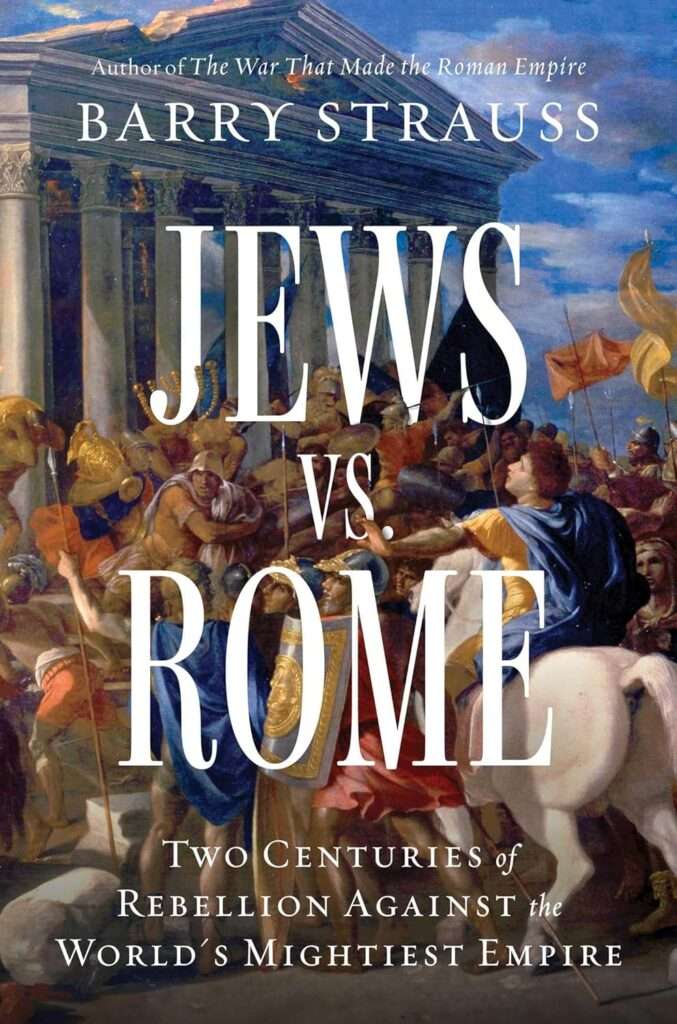
I recently flew to Israel on El Al, Israel's national airline. I was on my way to teach a summer course at Shalem College and to give a public lecture at the Menachem Begin Center on my new book, Jews vs. Rome: Two Centuries of Rebellion Against the World's Mightiest Empire (Simon & Schuster, 2025). I was surprised to discover that among the movie choices there was a Clint Eastwood retrospective. On reflection, it doesn't seem surprising.
As far as I know, Eastwood is not a public advocate of Israel although he may support it privately. The former Israeli consul general in the USA, Ido Aharoni Aronoff, reported in 2015 that Eastwood told him that "I am a big supporter of Israel." Aronoff posted a picture of the two of them together.
But the issue is less what Eastwood says than what he and his films represent. I googled "Clint Eastwood" and "Israel" after I landed and discovered that a blogger named Sebastian Wright had noticed an affinity. A few months ago he wrote that "Eastwood's works touch upon themes that resonate deeply with Israeli culture," namely "moral dilemmas, the complexities of war, and the quest for justice."
I would add that both Eastwood movies and Israeli life take place in tough neighborhoods. "Mystic River," for instance, the 2003-Oscar-winning neo-noir that I watched on the flight, is set in a hardscrabble part of Boston. It's a world of violence and family bonds where law enforcement must struggle to prevail.
The two panels walked through how originalism has changed in the academy and the judiciary over the past four decades:
Panel I | Originalism in Theory and Practice: Insights from the Legal Academy
Charles J. Cooper, JD, Founding Member and Chairman, Cooper & Kirk, PLLC
Kurt Lash, JD, E. Claiborne Robins Distinguished Chair in Law, University of Richmond School of Law
Randy E. Barnett, JD, Patrick Hotung Professor of Constitutional Law, Georgetown University Law Center and Faculty Director, Georgetown Center for the Constitution
Josh Blackman, JD, Senior Editor, The Heritage Guide to the Constitution and Centennial Chair of Constitutional Law, South Texas College of Law Houston (moderator)
Panel II | The Originalist Turn: A Judicial Perspective
The Honorable William H. Pryor Jr., Chief Judge, U.S. Court of Appeals for the Eleventh Circuit
The Honorable David R. Stras, Judge, U.S. Court of Appeals for the Eighth Circuit
The Honorable Elizabeth L. Branch, Judge, U.S. Court of Appeals for the Eleventh Circuit
John G. Malcolm, Executive Editor, The Heritage Guide to the Constitution and Vice President, Institute for Constitutional Government, The Heritage Foundation (moderator)
Amazon is currently selling the pre-order at 40% off. I would place your order now!
Today, Rebecca Taibleson had her confirmation hearing. Despite some opposition from conservative groups, I did not see any indication that a single Republican Senator would oppose her nomination. She should be confirmed easily. Though, following up on my post yesterday about Rebecca's faith, I did want to flag one exchange with Senator Cruz that the WSJ picked up:
"I have had people reach out to me on this nomination more than any other judicial nomination in the second Trump term," Sen. Ted Cruz said Wednesday at a hearing for Ms. Taibleson, a 42-year-old Wisconsin federal prosecutor. The anxieties on the right, Mr. Cruz added, "boil down to a concern that you're secretly a closet liberal, and that you'd be an activist on the bench."
Ms. Taibleson replied ably. "I was raised by a very conservative law professor," she said. "It has stuck." (Her father is George Mason University's Michael Krauss.) Growing up, "it felt like we were the only conservatives at our Jewish day school in the 1990s," she added. "Especially back then, if you were Jewish and conservative, you had to really mean it, and we did."
Sen. Cruz gave Taibleson an opportunity to respond to her critics. I've been at this for a while and I don't think I've ever seen an answer quite like it. pic.twitter.com/OKDjduzDlH
To start, I give Senator Cruz some credit. He walked a tightrope here. It was obvious he was responding to concerns raised by various conservative groups that he respects. At the same time, he recognized that Rebecca should be able to address concerns about her own political views. I've seen Senator Cruz destroy nominees from the dais. This was not Cruz's mission today. She was given space. Mike Fragoso aptly observed, "I've been at this for a while and I don't think I've ever seen an answer quite like it." Cruz was respectful, but probing.
Rebecca's answer was perfect in ways that most people will not understand. And I can relate as a Jew, and a conservative. At least since the New Deal, the experience of the American Jew was to be a Democrat. Period. Growing up, there was not a single member of my extended Jewish family who was a registered Republican. I heard stories that my late grandmother voted for Nixon in 1972--a 49 state landslide--and she was still mocked for it. My family managed to vote against Reagan, twice. In 1998, then Representative Chuck Schumer spoke to my Hebrew school class while campaigning for the Senate. In 2000, I advocated for Al Gore and Joe Lieberman! This was the default rule for Jewish people.
After 9/11, I started my journey to the political right. And I felt the backlash. Conversations at the Passover table were unpleasant. My grandfather wanted to ban all guns and could not understand why I owned one. My family could not understand how I could back President George W. Bush. They could not fathom why I would oppose President Obama. And once President Trump came on the scene, I was ostracized. My family was at the Woman's March! It got to the point where I simply would not talk about politics with my family. If they ever asked me about something political, I would smile and try to change the topic. It drove my late mother crazy, but I used the pivot as a defense mechanism. This approach was essential to preserve shalom bayit (peace in the house). My silence infuriated them even more since I would express my views publicly on TV and radio. One of my last conversations with my mom was about the Dobbs case. I ducked it. I would have just made her upset, which I didn't want to do.
To quote Rebecca, to be a politically conservative Jew, you really had to mean it. You have to be willing to express your views, even in a community where you will be shunned. I have to imagine that being a conservative Jew might be something like being a conservative black person: liberals looks at you like a traitor for abandoning the cause. And it takes some fortitude to push back against those liberal orthodoxies. (I attended a fascinating conference at Heritage today, titled "Black Family Blueprint," which I would recommend to everyone.) This is the point that Rebecca was conveying, and it is a message that should resonate with anyone who read Justice Thomas's biography.
In my initial post on Rebecca, I focused a lot on her father, Professor Michael Krauss. And I did so quite deliberately. If a person was raised in a politically conservative Jewish family, it will be very hard to avoid absorbing those values. And if a person's father was Michael Krauss, the most influential professor I've ever had, it would be damn near impossible. To be sure, conservatives can arise from a liberal Jewish family (see me). But the opposite is much more unlikely.
Thankfully, the number of conservative Jews is on the rise. Look to President Trump's judicial nominees: David Stras, Neomi Rao, Steve Menashi, Dan Bress, Robert Luck, Roy Altman, Lee Rudofsky, Matt Solomson, Steve Schwartz, and others. Now, there is Rebecca Taibleson. If you consider the percentage of Trump's Jewish judicial nominees against the percentage of Jews in America, we are punching way above our weight class. Plus, the Trump Administration is stacked with Jewish people. A friend remarked that he recently had dinner with about ten Orthodox Jews who work in the administration.
In popular culture, I can look to Mark Levin and Ben Shapiro, who are leading conservative talk radio hosts. I recently spoke at NatCon 25, which is led by Yoram Hazony, an Orthodox Jew from Israel. I've never been at a conference with so many Jewish people. I was nudged to join a Whatapp group to organize minyans for daily prayers. In the legal sphere, friends like Josh Hammer and Ilya Shapiro demonstrate that there is a place for Jews on the right. The Federalist Society and the Israel Legal Fellowship are taking bold steps to forge relations to Jewish lawyers in Israel.
I hope that our public advocacy, as proud Jews, gives space to other right-curious Jews to speak up. I also hope that more conservatives come to understand Jews as natural and capable allies.
The complaint for Donald Trump against the New York Times reads like a long press release. It says little to show the falsity of the factual statements it identifies, and mainly praises Trump. Among the many examples: in its second paragraph it states that in the 2024 election "President Trump secured the greatest personal and political achievement in American history." Or from paragraph 12:
Thanks solely to President Trump's sui generis charisma and unique business acumen, "The Apprentice" generated hundreds of millions of dollars in revenue, and remained on television for over thirteen years, with nearly 200 episodes. "The Apprentice" represented the cultural magnitude of President Trump's singular brilliance, which captured the zeitgeist of our time.
Beyond that, what jumped out at me is the complaint's repeated references to the subjective "malice" that the complaint says the defendants have toward Trump. As every law student who has taken a First Amendment class knows, "actual malice" in New York Times v. Sullivan is a term of art – the Court has repeatedly made clear that it is an objective standard that focuses on whether the defendant was reckless about the possible falsity of a factual claim, and not on the defendant's hatred, ill will, or enmity. But the complaint's references to actual malice focus on subjective hostility to Trump. For example, paragraph 117 begins:
Defendants' actual malice manifested in numerous ways. Defendants launched investigations into President Trump, his family, and his businesses for the express purpose of harming all three.
In the claims for relief, the complaint says that the defendants were aware of falsity but emphasize subjective dislike of Trump. Paragraphs 139 and 153 both say:
The statements were published by Defendants with actual malice, as part of a long term pattern, with oppression and fraud in that they were aware at the time of the falsity of the publication and thus, made said publications in bad faith, out of hatred and ill-will directed towards President Trump without any regard for the truth.
I assume that the lawyers know that judges who care about the law will focus on the objective standard as laid out by the Supreme Court. So why the focus on hatred and ill will? It's possible they think this will help persuade the public, but it's hard to imagine that many members of the public (other than Volokh Conspiracy readers!) will learn anything about this complaint, much less care. Maybe they believe that the judge who will hear this case is likely to be a political hack who will like the invocations of ill will, but even then an ordinary complaint seems like the smarter move, as it would give a political hack more cover to be political. Maybe they think this will persuade journalists, but journalists who are not ardent Trump supporters will likely call lawyers or law professors and be told that actual malice is an objective standard.
My guess is that the answer is tied to the lavish praise of Trump I noted at the beginning of this post: I think the complaint centrally has an audience of one (Trump), and more broadly his hardest core supporters. It's not written to persuade, but instead to affirm – that Trump is the greatest and that his opponents are deranged (from paragraph 107: "Defendants baselessly hate President Trump in a deranged way"). So maybe it reads like a press release because it is a press release – to the most devoted devoted sliver of his base.
[Edit: I initially used the term "brief" to avoid having readers think I was talking about a complaint in the ordinary sense rather than the legal sense, but a user comment led me to conclude otherwise, so I changed it to "complaint."]



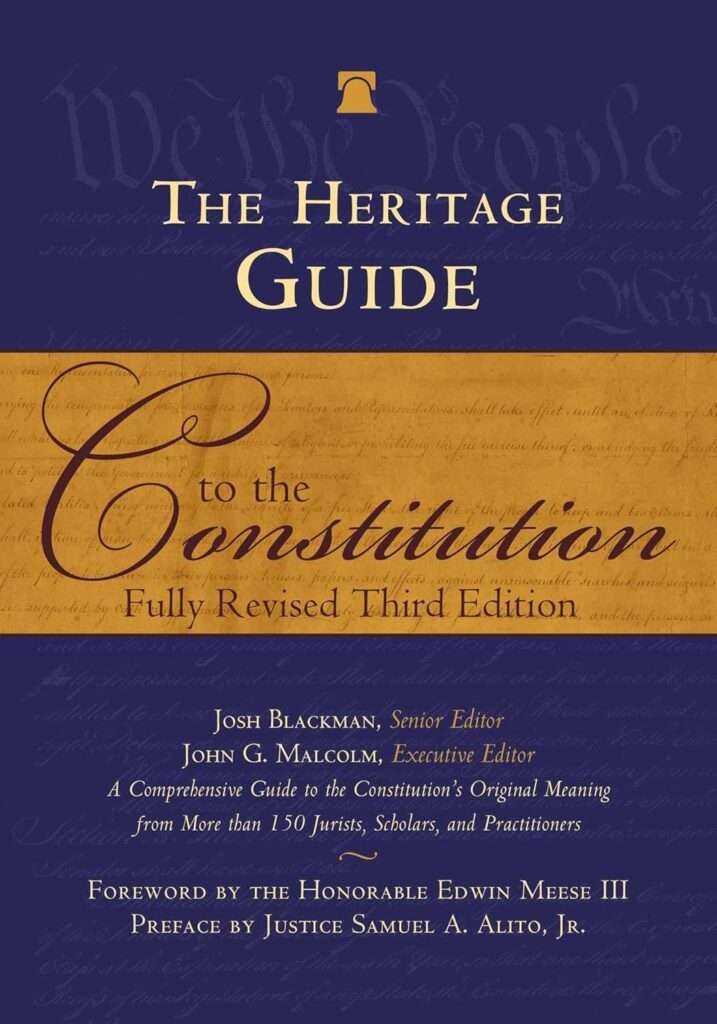 On Constitution Day, the Heritage Foundation hosted the launch event for