The Volokh Conspiracy

Mostly law professors | Sometimes contrarian | Often libertarian | Always independent | Est. 2002

The Volokh Conspiracy

The As-Applied/Facial Fad Comes for the Equal Protection Clause

Justice Kagan ponders at great length about whether there can be an as-applied challenge based on the Equal Protection Clause.

|

At times, the Supreme Court goes through jurisprudential fads. I am not referring to any particular substantive doctrine. Rather, some idea gets in the ether, and the Justices try to apply it in different contexts.

In recent terms, the Justices seem to be going through a fad based on as-applied and facial challenges.

United States v. Hansen (2003) cast some doubt on the ability of plaintiffs to bring facial overbreadth challenges under the First Amendment. In Rahimi (2024), the Court treated the motion to dismiss as a facial challenge, rather than an as-applied challenge, and upheld 922(g)(8) under the Salerno test. Justice Gorsuch's concurrence seemed to agree with this framing. In NetChoice (2024), all nine members of the Court agreed that both the Fifth and Eleventh Circuits failed to apply the proper standard for a facial challengeRahimi and NetChoice were decided back-to-back, and it was not clear to me why the facial challenge bar was lower for the First Amendment than for the Second Amendment. And in Trump v. United States (2024), Justice Barrett conceived of the immunity doctrine in terms of as-applied challenges. On July 2, I wrote "The other story of this term is that the Justices have absolutely no idea what to do with facial challenges--see Rahimi, Trump, and NetChoice."

In TikTok v. Garland (2025), the Court ruled that the prohibition was "facially content neutral," but would not consider an exclusion in the statute which was "not within the scope of petitioners' as-applied challenge." In Williams v. Reed (2025), Justice Thomas in dissent faulted the majority for ruling on an as-applied challenge, when the petition raised only a facial challenge. In Bondi v. VanDerStock (2025), the Court recharacterized the plaintiffs' as-applied challenge into a facial challenge under the Salerno test. (I was counsel in this case, and can attest how the Court botched the record.) At the time, I speculated whether Salerno would replace Chevron, as another doctrine to make it harder to challenge federal regulations. Treating a case as a facial challenge is just another way of making sure the plaintiff loses. And indeed, a recent JREG post suggests that DOJ is attempting to use Salerno with VanDerStock as a new deference doctrine.

Maybe all of these cases were a coincidence. But I think it is a fad. Somehow, this issue has gotten into the minds of the Justices, and they keep bringing it up in different cases, even where it is not needed to decide the case.

The oral arguments in Hecox and B.P.J. suggest that the Court is still focusing on the line between facial and as-applied challenges.

Equal protection claims are brought facially. I never even considered the alternative. For example, consider an affirmative action case like Students for Fair Admission. The group argued that Harvard and UNC used unconstitutional racial classifications against all applicants. To be sure, the plaintiffs showed they were injured to establish standing. But the volumes of data submitted in this case turned on the admission policies more generally, and not the particulars of the plaintiffs.

The same approach applied to Fisher v. University of Texas, Austin. Abigail Fisher had to show she was injured to establish standing: she applied to UT, paid an application fee, and was rejected. But the case did not turn on how Fisher's individual file was reviewed. Rather, it considered UT's policy more generally. Again, she brought a facial challenge. And the requested remedies in the affirmative action cases were the wholesale invalidation of the policy, not an order that Fisher or members of SFFA had to be admitted. Indeed, by the time Fisher II was decided, the plaintiff had already graduated from LSU, and was no longer seeking admission to UT.

Is it possible to have an as-applied challenge based on the Equal Protection Clause? I'll admit, before Tuesday, I had never considered the issue. (I have not followed the Fourth Circuit litigation closely.) The closest I could think of was Village of Willowbrook v. Olech (2000). This largely-overlooked per curiam opinion held that a plaintiff could establish a class of one under the Equal Protection Clause even "where the plaintiff did not allege membership in a class or group." The Court noted that a class of one equal protection claim is made "where the plaintiff alleges that she has been intentionally treated differently from others similarly situated and that there is no rational basis for the difference in treatment." Of course, it is very difficult to prevail under a rational basis test, but in egregious cases such as Olech it is possible. One of my first articles posited that individual homeowners could bring Olech equal protection claims to block eminent domain seizures. Creative, perhaps, but the idea did not catch on. Indeed, the Court has only cited Olech a few times over the past quarter-century.

In Hecox and B.P.J., Justice Kagan spent some time asking if it was even possible to bring an as-applied equal protection claim.

Consider this colloquy between Justice Kagan and Idaho Solicitor General Alan Hurst.

Read More

Sanctuary Cities

Trump's Unconstitutional Plan to Withhold all Federal Funding From Sanctuary Cities and States

The plan violates multiple constituitonal provisions and goes against Supreme Court precedent. If somehow allowed to stand, it would gravely imperil federalism and the separation of powers.

|

NA

Donald Trump recently announced he plans to withhold all federal funds to sanctuary jurisdictions which restrict assistance to federal immigration deportation efforts, beginning February 1:

President Donald Trump said Tuesday that starting Feb. 1 he will deny federal funding to any states that are home to local governments resisting his administration's immigration policies, expanding on previous threats to cut off resources to the so-called sanctuary cities themselves.

Such an action could have far-reaching impacts across the U.S., potentially even in places that aren't particularly friendly to noncitizens.

This plan is blatantly unconstitutional, violating both federalism and the separation of powers. Courts have repeatedly struck down similar Trump efforts during both his first term and the current one. See my analysis of recent court decisions on these issues here, here, and here. See also my Texas Law Review article surveying and assessing litigation arising from Trump's first-term attacks on sanctuary jurisdictions. There and in other writings, I also explain why immigration sanctuaries (and conservative gun sanctuaries) are beneficial, and help protect our constitutional system.

Courts have repeatedly ruled that Trump cannot withhold funds from sanctuary jurisdictions because Congress, not the president, determines federal spending and attached conditions, and because even congressionally authorized conditions are subject to constitutional constraints, including that they cannot be coercive, and that they must be related to the purposes of the grants.

Trump's most recent plan is even more blatantly unconstitutional than most of his previous efforts, because it appears to cover all federal grants to sanctuary jurisdictions, not just some subset of them. Thus, it would be an even bigger usurpation of congressional power, and even more obviously coercive and violative of the relatedness requirement. If Trump goes forward with it, I hope and expect courts will rule against him.

Conservatives and others who may be inclined to support Trump on this should ask whether they would want the next Democratic president to be able to use similar tactics to pressure red states into adopting left-wing policies on gun control, transgender rights, environmental policy, and any number of other issues. And, for those keeping score, I have repeatedly made similar points about the Biden Administration's (less extensive, but still unconstitutional) attempts to pressure conservative "gun sanctuary" jurisdictions (most recently here).

There are good reasons to cut a variety of federal grants to state and local governments, in order to reduce dependence and incentivize competition for "foot voters." But that cannot and should not be accomplished by executive usurpation of congressional power, and the use of grants to coerce states and localities into doing the president's bidding.

Second Amendment Roundup: Important Wolford Brief Addresses Bruen Methodology

Prof. Alicea explains the proper way to apply Bruen.

|

Hawaii's "default no-carry" rule for private property is being defended with a familiar move in Second Amendment litigation: describing history and any underlying principles at such a high altitude that almost any modern restriction can be made to look "analogous." In his amicus brief in Wolford v. Lopez, Professor Joel Alicea argues that this is nothing less than the fulcrum on which Bruen either stands as a real constraint on government power, or collapses into a Rorschach test where judges can always find a historical "tradition" of firearm regulation by choosing the right level of abstraction.

The brief's core claim is simple: under Bruen, courts must identify whether a modern gun regulation is "relevantly similar" to historical firearm regulations in both how it burdens the right and why it does so. But "how" and "why" are infinitely malleable if courts are free to redescribe historical laws at whatever level of generality they want. If you characterize an old statute with maximal specificity, few modern laws could match. If you characterize it as "regulating arms in the public interest," everything matches. The entire enterprise turns on a threshold question: which features of the historical laws are essential and which are incidental?

Alicea's proposed solution is a return to first principles. The point of Bruen's history-and-tradition test is to illuminate the original contours of the pre-existing right the Second Amendment was codified to protect. So, the relevant "level of generality" is the one the ratifying generation would have understood as bearing on the substance of the right. That requires judgment, and even normative reasoning, but not the free-floating interest-balancing that Bruen rejected. The normative premises are supplied by the ratifiers' worldview, and one key "guiderail" is nonnegotiable: courts cannot define a historical "tradition" in a way that effectively nullifies the constitutional text's protection of the right to "bear Arms."

The appropriate level of generality matters here because Hawaii's law flips the ordinary rule for much of public life. It requires affirmative consent before carrying firearms onto any private property, including private property held open to the public, like grocery stores, restaurants, gas stations, gyms, and banks. The Ninth Circuit upheld the law by pointing to a handful of historical enactments that, in its view, show a tradition of requiring permission to carry on private land.

Alicea argues that those analogies fail once history is described at the right level. The "tradition" the Ninth Circuit invoked is better understood as a narrow anti-poaching regime: laws aimed at preventing trespassing with guns for unauthorized hunting, typically limited to "improved" or "enclosed" lands, private property not generally open to the public. The "why" was anti-poaching; the "how" was restricting armed entry onto lands where hunting trespass would occur. Those limitations are not incidental trivia. They are precisely what kept such laws from destroying the general right to carry arms in public for self-defense. Strip those features away and you manufacture a broader tradition that can be deployed to justify Hawaii's sweeping default rule. But that move, Alicea contends, is exactly what Bruen forbids because it eviscerates the right by redefining historical limits so broadly that the right becomes largely theoretical.

The brief also demonstrates how the two "dead-ringer" statutes that the Ninth Circuit relied on are not relevantly similar to Hawaii's law. New Jersey's 1771 law, Alicea argues, is transparently an anti-poaching measure by its title and structure. It should not be read as a general ban on carrying across all private property for all purposes.  (It bears recalling that, as Blackstone observed, the English game laws had the purpose of "disarming the bulk of the people.")

And Louisiana's 1865 law, which prohibited carrying firearms on another's premises without consent, is part of the post–Civil War Black Codes, an effort to suppress the rights of newly freed Black citizens. In his concurrence in Rahimi, Justice Kavanaugh wrote that lower courts should not rely "on the history that the Constitution left behind" when determining the constitutionality of a modern firearm regulation. A racist law enacted to nullify constitutional rights cannot credibly supply the historical "tradition" that defines those rights and would be better read as an illustration of the sort of evils the Second Amendment is designed to prevent.

The point is not that property owners lack authority to exclude firearms; they plainly can. The point is that government cannot convert private exclusion into a near-universal public disarmament by default, then call it "history." If Hawaii can do this, Alicea warns, Bruen's protection of public carry becomes an empty promise, contingent on a patchwork of affirmative permissions most people will never obtain. The Court, he argues, should reverse.

* * *

A few other reflections come to mind on reading Prof. Alicea's brief.  First, in terms of historical traditions, at a high level of generality, it is understood that in authoritarian regimes, one may not act without first getting permission, while in free societies one is allowed to act unless prohibited.  Hawaii's default law requires permission before acting.  Second, what would happen if Hawaii prohibited a person from wearing a MAGA baseball cap into a store without first getting permission?  Any First Amendment problem there?  And third, if Hawaii is such a champion of "property owners' rights," why did it prohibit mere possession of firearms in bars, financial institutions, and swimming pools, leaving the owners no choice to consent?

For more detail on this issue, see J. Joel Alicea, Bruen Was Right, 174 U. Pa. L. Rev. 13 (2025), which I summarized here.  See also Mark W. Smith, The Third Rails of Second Amendment Jurisprudence, Harvard JLPP (Sept. 2025) (explaining guardrails or "disqualifiers" that signal when a court has derived an underlying principle too broadly); Stephen Halbrook, Text and History or Means-Ends Scrutiny? 24 Fed. Soc. Rev. 54 (2023).

Second Amendment Roundup: An Opportunity to Clarify 1791 vs. 1868

Time period to assess Second Amendment rights may arise in Wolford argument.

|

As the Supreme Court prepares for oral argument on Tuesday next week in Wolford v. Lopez, it should consider resolving the relevant time period for interpreting the scope of the Second Amendment.  The issue arises in contexts as diverse as the federal prohibitions on certain classes of people (see post here) and whether adults aged 18 to 20 have Second Amendment rights (see post here).  It is pertinent to the Wolford issue of Hawaii's default rule of no guns on private property open to the public without prior consent.

In New York State Rifle & Pistol Association v. Bruen, the Supreme Court rejected interest-balancing under the Second Amendment, instead requiring that laws that implicate the plain text of the Second Amendment be "consistent with this Nation's historical tradition of firearm regulation." In doing so, Bruen reiterated the Supreme Court's assurance, offered many times before, that rights applied to the states have the same scope when applied to the federal government. And it further stated that it had "generally assumed that the scope of the protection applicable to the Federal Government and States is pegged to the public understanding of the right when the Bill of Rights was adopted in 1791." (Some lower courts have decided that the Supreme Court was incorrect when it so "assumed" and have purported to decide that 1868 is the better date.)  And when it came time to reviewing late-nineteenth century evidence, the Court said that such evidence has no more than confirmatory value "of what the Court thought had already been established [by earlier sources]."

To be sure, the Court in Bruen acknowledged a "ongoing scholarly debate" over whether courts should rely on evidence from the ratification of the Bill of Rights in 1791, or on evidence from when the Fourteenth Amendment was ratified in 1868. The Court's statements throughout the rest of the opinion, and its prior precedent establish that 1791, not 1868, is the proper period to look for evidence of the original public meaning of the Second Amendment.

Start with the principle that the Second Amendment means the same thing applied against the federal government and the states. The ratifiers of the Fourteenth Amendment did not think that they were incorporating different rights against the states than those that were recognized at the Founding; to the contrary, they thought they were taking existing rights and expanding where they applied and to whom. The Supreme Court has acknowledged this principle time and again in cases like Ramos v. Louisiana (2020) (jury right) and Timbs v. Indiana (2019) (excessive fines), holding that the provisions of the Bill of Rights must be given the same scope regardless of what level of government they constrain.

In McDonald v. Chicago (2010), the Court quoted Malloy v. Hogan (1964) (self-incrimination) to say that the Fourteenth Amendment does not apply to the states "only a watered-down, subjective version of the individual guarantees of the Bill of Rights." Perhaps the best example of this was the Court's Espinoza v. Montana Dep't of Revenue (2020) decision where it rejected 30 State laws contrary to the Court's finding of the original meaning of the First Amendment's Free Exercise Clause.

Furthermore, whether a right applies to both the federal government and the states, the meaning of that right is fixed when it is adopted and does not change over time. As the Court stated in Bruen, the Constitution's "meaning is fixed according to the understandings of those who ratified it." Again, this is a very old principle of constitutional interpretation. Justice Thomas's concurrence in McIntyre v. Ohio Elections Comm'n (1995) (free speech) notes that since the 1838 decision in Rhode Island v. Massachusetts, the Supreme Court interprets the Constitution based on "the words of the constitution and the meaning and intention of the convention which framed and proposed it for adoption and ratification to the conventions." Thus, constitutional texts, such as the Bill of Rights, have the same meaning when ratified as they do now.

These two premises lead to an obvious conclusion. When interpreting the Second Amendment, the time immediately surrounding its ratification in 1791 is the proper time period to look to for historical evidence of firearm regulation.

Reconstruction evidence standing alone cannot provide an authoritative interpretation of the Second Amendment. The Fourteenth Amendment incorporated the Bill of Rights and its fixed meaning against the states. Thus, under current Supreme Court precedent, the Fourteenth Amendment did not change the scope of the right incorporated against the states. Any late-breaking Reconstruction-era tradition that regulated the right to keep and bear arms in a way contrary to the Founding generation's understanding of the right should be rejected as inconsistent with the original public meaning of the Second Amendment.  For a comprehensive analysis, see Mark W. Smith, Attention Originalists, Harvard JLPP (Fall 2022).

The Supreme Court declined to make this issue one of the questions presented in Wolford, but it nevertheless has the opportunity to settle the issue in that case or at least to emphasize that 1791 must deserve pride of place, if not exclusive consideration, in Second Amendment cases.

The Transgender Athletics Cases

They were not as combative as I would have expected, and maybe even not 6-3.

|

I have now finished reading the 250 pages of transcript in Little v. Hecox and West Virginia v. B.P.J. My global reaction was that the Justices were surprisingly not combative. After Skrmetti and Mahmoud last term, I was expecting a much more vigorous and contentious argument. But it was just the opposite. The Justices were surprisingly restrained. I don't think the vote here is 6-3. It might be 7-2, or maybe even 8-1 in favor of the government in both cases. Title IX is different than Title VII, and the Equal Protection issue here is different than the Equal Protection issue in Obergefell.

Perhaps the defining feature was Justice Kagan having a two-hour long discussion with all five lawyers about whether a plaintiff could bring an as-applied challenge for an equal protection claim. This was such a genuine and nerdy discourse. The advocates seemed surprised, and a bit frustrated, with how much time was being devoted to it. I'll talk about this issue later.

Maybe something could be said for the sequencing of the cases. Skrmetti and Mahmoud involved very thorny issues of parental rights to obtain medical treatment and parental rights to opt out of LGBT instruction. But Hecox and B.P.J. involved far simpler Title IX and Equal Protection analyses (putting aside the as-applied stuff for now). I think people genuinely do not understand all the nuances of transgender medicine but anyone who has ever watched a sporting event gets the issues in Hecox and B.P.J. I don't even think this issue is particularly polarizing. This is what Trump would call an 80-20 issue.

If the athletics case had come to the Court before Skrmetti and Mahmoud, the arguments could have been more contentious. Indeed, what if Grimm v. Gloucester County School Board, a bathroom case, was granted before Bostock was decided?

I think of Obergefell in a similar fashion. Thirty years ago, who would have thought that the Supreme Court would find a right to same-sex marriage five years before finding that Title VII bars LGBT discrimination. Sometimes, the Court does things out of order.

Finally, I think we have to account for the changing tides with regard to transgender issues. The public sees these matters far differently than a decade ago. The somewhat sedate arguments yesterday can be traced to the path already laid down.

Guns

Cavalier Knight's Challenge to N.Y. Bricks-and-Mortar Requirement for Gun Dealers Can Go Forward

|

An excerpt from Knight v. City of New York, decided yesterday by the Second Circuit, in an opinion by Judges Denny Chin, Richard Sullivan, and Maria Araújo Kahn:

Cavalier D. Knight, a would-be gun dealer residing in New York City [challenges a New York City regulation requiring] applicants for firearms dealer licenses to "maintain a place of business in the city," which effectively requires the applicant to maintain a brick-and-mortar location.

The trial court concluded Knight lacked standing to bring the challenge, but the appellate court reversed, and sent the case back down for a substantive Second Amendment analysis:

To satisfy Article III's standing requirement, "a plaintiff must demonstrate: (1) injury-in-fact, which means 'an actual or imminent' and 'concrete and particularized' harm to a 'legally protected interest'; (2) causation of the injury, which means that the injury is 'fairly traceable' to the challenged action of the defendant; and (3) redressability, which means that it is 'likely,' not speculative, that a favorable decision by a court will redress the injury." For an injury in fact to be concrete and particularized, it must "actually exist" and "affect the plaintiff in a personal and individual way." …

As alleged, the City informed Knight that without a brick-and-mortar location, he would be ineligible for a dealer license. The district court, however, held that this aspect of Knight's claim is not redressable because even with a dealer license, unchallenged New York City zoning provisions would prohibit Knight's contemplated business.

Read More

Is Australian Attorney and Activist Randa Abdel-Fattah an "Extremist Terrorist Sympathizer"?

|

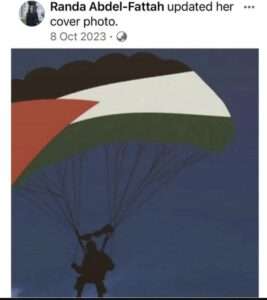
Randa Abdel-Fattah is an Australian writer, attorney, and "antizionist" activist of Egyptian and Palestinian descent. This is what she posted on Oct. 8, 2023, while terrorists who entered Israel on hang gliders and proceeded to massacre, kidnap, and brutalize civilians were still at large:


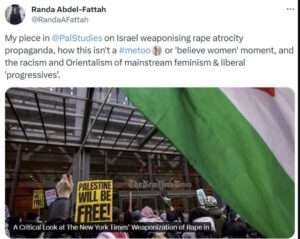
In January 2024, she published an article dismissing (true) reports of sexual assault of Israeli women by Hamas terrorists as "atrocity propaganda."


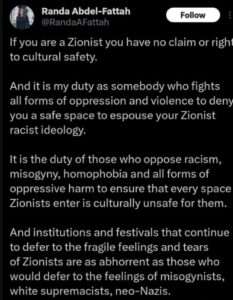
Here she is expressing her commitment to harassing "zionists:"


In February 2024, she was one of ten authors who signed a letter demanding the Adelaide Book Festival to disinvite Thomas Friedman because he's a "zionist."

Her reaction to the massacre of fifteen Jews celebrating Hanukkah in December was to decry those "quickly surrendering to the agenda of those who are using a horrific act of antisemitism to entrench anti-Palestinian racism," and its exploitation "Zionists, white supremacists, the far right to advance their racist, violent, and oppressive agendas."

The Adelaide Book Festival chose to disinvite her thereafter, on the vague grounds that it would not be "culturally sensitive" to have her after the Bondi atrocity.

In response, she accused the Festival of anti-Palestinian racism, which in turn led to widespread withdrawals of other authors from the Festival on either anti-censorship or anti-racism grounds, which in turn led to the cancellation of the Festival this year.

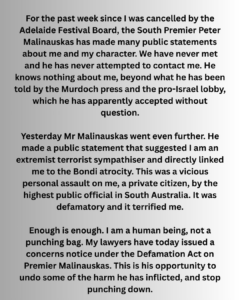
She has now posted the following statement:


I can't imagine that in a country where the loser pays the winner's legal fees, she really wants a trial on whether calling her an extremist and terrorist sympathizer is false.

Free Speech

Multi-Billion Dollar Corporation Drops Suit Against Inter-American Development Bank, After Court Holds It Can't Sue as "Doe Corporation"

The case helps illustrate why the legal rules surrounding when parties can litigate under pseudonyms are so important.

|

Here's a paragraph summary from Chief Judge James Boasberg's initial decision denying pseudonymity to the company, in Doe Corp. 1 v. Inter-American Development Bank (D.D.C.):

Plaintiffs are corporate entities who have filed this lawsuit against the Inter-American Development Bank, claiming that the IDB has improperly initiated sanctions proceedings against them. Doe Corporations allege that those proceedings violate both Defendant's governing charter and its contracts with Plaintiffs. Concerned that revealing that they are the subjects of the IDB's sanctions proceedings would result in "reputational harm," "crater new business," and "jeopardize existing projects," Doe Corporations now move to proceed under pseudonyms….

The D.C. Circuit upheld that decision (disclosure: I filed a friend of the court brief arguing that the company indeed shouldn't be able to sue pseudonymously). Yesterday, that decision essentially became final (the D.C. Circuit issued its mandate to the lower court), and then yesterday the company dropped the case:

Pursuant to Federal Rules of Civil Procedure 41(a)(1)(A)(i) and 41(a)(1)(B), Plaintiffs Doe Corporation 1, Doe Corporation 2, Doe Corporation 3, and Doe Corporation 4 [which all seem to be affiliates of one company -EV], by and through undersigned counsel, hereby voluntarily dismiss all their claims in this action without prejudice. No answer or motion for summary judgment has been served by Defendant Inter-American Development Bank in this action.

And while it's hard to know for sure why the company did that, it seems likely that it's because of what was said in its argument for pseudonymity: Identifying itself as the plaintiff would damage its future prospects with other business partners.

Now I think that pseudonymity should indeed be unavailable in such cases; here's the Summary of Argument from my brief, which goes into a good deal of detail on the subject.

Read More

Politics

Zen and the Art of Persuasive Writing, Word Choice

Distrust badverbs.

|

Adverbs were invented to serve other words and phrases, like Robin to Batman, literary sidekick to superhero, offering color and commentary about verbs and adjectives. They come in at least five flavors:

Adverbs of time tell the reader when something has or will happen, pointing to a date on the calendar (today, yesterday, tomorrow) and general time periods (forever, soon).

    • Don't worry, I'll eventually get to it.

Adverbs of frequency tell the reader how often something has or will happen (constantly, frequently, rarely, always, daily, weekly, monthly, yearly).

    • Nick usually cared when a close friend died.

Adverbs of manner tell the reader how something happened (slowly, beautifully, loudly, wisely). Adverbs of manner often stand next to the main verb.

    • She harmlessly fired a weapon into the air.

Adverbs of degree tell the reader that something is intense (very, clearly, totally).

    • It's very

Adverbs of place tell the reader where something happened (everywhere, here, there, under, somewhere).

    • It's sunny somewhere.
  1. Badverbs

Adverbs are not your friend. I believe the road to hell is paved with adverbs, and I will shout it from the rooftops.  —Stephen King

Adverbs do many things for writers. They are frequently used in the law to intensify and hedge. I distrust hedge and intensifier adverbs, which I call badverbs, because they tell the reader what to think with no support or explanation. Badverbs are not your friend. They compromise the cause of clarity and distract from the message, breeding doubt in the reader's brain and raising questions that harm, not help, your cause.

i. Intensifier Adverbs

Surely: the adverb of a man without an argument.  —Edward St. Aubyn

Read More

Second Amendment Roundup: Hawaii Sticks to Its Black Code Precedent

Its Amici in Wolford v. Lopez abandon the embarrassing “analogue.”

|

On Tuesday, January 20, the Supreme Court will hear oral argument in Wolford v. Lopez, which concerns whether the Ninth Circuit erred in holding that Hawaii may prohibit the carrying of handguns by permit holders on private property open to the public unless the property owner affirmatively gives express permission.  The Ninth Circuit upheld the ban under Bruen based on the existence of merely two purported historical analogues, a 1771 New Jersey law on poaching and an 1865 Louisiana Black Code law.

As I explained in a previous post, I filed an amicus curiae brief on behalf of the National African American Gun Association, extensively detailing the nature of the Louisiana law as part of the Black Codes intended to limit the freedom of movement and the right to bear arms of the newly-freed slaves.  As explained in the New York Tribune, March 7, 1866, the statute making it unlawful to "carry firearms on the premises or plantations of any citizen" without consent was part of "a code of laws [for blacks] establishing a system of serfdom, forbidding the free passage of blacks from one plantation to another, and under the form of apprenticeship and Vagrant laws reenacting slavery in fact."

But in Respondent's Brief, Hawaii doubles down on its reliance on the Louisiana law.  After all, it's one of only two supposed historical "analogues" offered.  It cites a handful of other laws, but they concerned private property not open to the public.  As to the Louisiana law, Hawaii wants to have it both ways: "The Black Codes are undoubtedly a relic of a shameful portion of American history.  But that does not mean that the laws contained within them are irrelevant to the Second Amendment's historical analysis."  No explanation is offered as to why.

Hawaii tries to soften the blow by asserting that "contemporary opponents of the Black Codes agreed that the Second Amendment did not authorize armed entry without the consent of a property owner."  But it cited just one such opponent, who said quite the opposite.  General D.E. Sickles, Commander of the Department of South Carolina, issued a decree in 1866 providing that, while the "constitutional rights of all loyal and well-disposed inhabitants to keep and bear arms will not be infringed, nevertheless this shall not … authorize any person to enter with arms on the premises of another against his consent."  Entering "against" one's consent is quite the contrary of entering "without" one's consent.

Eight of the usual suspects filed amici curiae briefs in support of Hawaii, but not a single one mentioned the embarrassing 1865 Black Code law of Louisiana.  Everytown for Gun Safety danced around the issue but kept the law in the closet.  Its brief scolds the United States and petitioners for "contend[ing] that a firearms regulation is per se unconstitutional if it has a purportedly improper purpose to frustrate Second Amendment rights…."  Pray tell, exactly which regulations are being referred to?  You've got to read the amicus brief of the United States or the brief of petitioners to find that Everytown is referring to the 1865 Louisiana law.

Everytown next berates the United States and petitioners as being "wrong to argue that modern firearms regulations are consistent with the Second Amendment only if the government can marshal some minimum number of historical regulations that mirror the contemporary law."  Given that the Ninth Circuit found only two measly laws as purported analogues, that shows the absence of a National tradition of regulation.

As Everytown points out, Bruen relied in part on treatises and historical newspapers to illuminate the meaning of the Second Amendment. But none of the sources it cites support Hawaii's law, least of which did The Loyal Georgian, Feb. 3, 1866, an African American newspaper that celebrated the Second Amendment and concluded: "All men, without distinction of color, have the right to keep and bear arms to defend their homes, families or themselves."  (I located that article in researching my 1998 Freedmen book (reissued as Securing Civil Rights), which Heller repeated.)

The brief of the Brady Center cites just a handful of irrelevant historical laws, but conspicuously missing is the 1865 Louisiana law.  The brief of Professors of Property Law mustered up a total of five mostly colonial laws to cite in a footnote but failed to discuss their contents.  The brief of what it self-characterizes as "the Amici States – the District of Columbia" et al. (sic) cites no historical laws.

As Bruen held, "when the Second Amendment's plain text covers an individual's conduct, the Constitution presumptively protects that conduct. To justify its regulation, the government may not simply posit that the regulation promotes an important interest. Rather, the government must demonstrate that the regulation is consistent with this Nation's historical tradition of firearm regulation."  Hawaii may not have an easy time at oral argument explaining how it has met its burden.

Federal Officer Removal in Plaquemines Parish

Justice Barrett is thinking about Chief Judge Pryor's holding that Mark Meadows could not remove the Georgia criminal prosecution to federal court.

|

On Monday, the Court heard oral argument in Chevron v. Plaquemines Parish. The question presented is whether the energy company, a federal contractor, could remove a case to federal court "when sued for oil-production activities undertaken to fulfill a federal oil-refinement contract." I don't have terribly strong thoughts about this particular question, but my ears perked up when Justice Barrett brought up officer stuff. Yes, you can never get away from officer stuff.

ACB inquired abut Chief Judge Pryor's decision in Georgia v. Meadows (2023). As you might recall, the Fulton County DA indicted President Trump and several of his associates, including former Chief of Staff Mark Meadows, for events arising from the 2020 election. But by the time the case arrived to the Eleventh Circuit, Meadows no longer held that position. Judge Pryor found that the federal-officer removal statute does not apply to former federal officers.

In that case Georgia conceded that the Chief of Staff was an "officer" position, and the Eleventh Circuit relied on that concession. I'm not so sure about that concession. There is some reason to think the Chief of Staff is neither a principal nor an inferior officer of the United States. He just might be an employee, in which case he could not avail himself of the federal officer removal statute at all. But that issue was not litigated, so I'll leave it here. And for those with short memories, Seth Barrett Tillman and I argued that Trump, as President, was not an "Officer of the United States," and thus could not remove the case to federal court. Judge Hellerstein, who has been in the news of late with the Maduro case, "believe[d]" in dictum that the President was an "Officer of the United States" for purposes of Federal Officer Removal Statute.

Anyway, back to Meadows. Paul Clement represented Meadows, and filed a cert petition in June 2024. It was denied in November 2024, without any relists, or dissents. At the time, I suspected the Court wanted to get as far away from J6 as possible, and in any event, this was not the ideal vehicle to resolve the issue. Judge Pryor held in the alternative that even if Meadows could remove the case, the events giving rise to the indictment were not related to Meadows's official duties.

Fast-forward to Plaquemines Parish (which is close to where ACB grew up in New Orleans.) Chevron was represented by (who else) Paul Clement. And Justice Barrett asked about Judge Pryor's opinion:

JUSTICE BARRETT: The other thing is we've never addressed whether the federal officer has to be a federal officer now or at the time the conduct occurred. And in the Meadows case, which was pretty recent, Chief Judge Pryor said, well, it has to be at the time currently, which would not apply to your clients.

So if you could address those two.

MR. CLEMENT: Well, there's a lot there. I mean, first --and --and let me make sure I don't forget either piece.

JUSTICE BARRETT: Yeah.

So, on your second question, well, what can I say? I mean, Chief Judge Pryor got that badly, badly wrong. I asked on behalf of Mr. Meadows for this Court to take a look at it and fix it. This Court wasn't interested. But, you know, the arguments are overwhelmingly strong that that's --that the Eleventh Circuit decision is wrong. But even the Eleventh Circuit, my understanding is, has not applied that in the government contractor case because, you know, one of --I mean, there's a lot wrong with that approach, but one of the things is it's really hard to apply in the government contractor case because what are you saying? Like, the contract officer that gave us the contract in World War II still needs to be alive or still needs to be on the job? I mean, that doesn't make any sense.

JUSTICE BARRETT: Well, I don't --I don't know whether it makes sense or not because, as you say, we didn't take up that question before. I just don't want to implicitly resolve it here because it's a live one.

MR. CLEMENT: It's not a live one on the Fifth Circuit on remand. You know, if you want to drop a footnote and say you're not deciding that case or that issue in the opinion, you know, that --that --that would be an appropriate approach, I think.

I think there are only a handful of advocates who could stand at the podium and stay that the Chief Judge of the Eleventh Circuit was "badly, badly wrong." And there are even fewer advocates who can complain that their cert petition in another case was denied. Paul Clement did both things in the span of a few moments.

Now, onto the transgender cases. Many more posts to come.

Sign Up For Advancing American Freedom's Judicial Clerkship Training Academy

The deadline is January 30.

|

I am pleased to announce that Advancing American Freedom is hosting a Judicial Clerkship Training Academy in Washington, D.C. on March 18-20. I will be on the faculty, teaching a seminar on statutory interpretation. This is a great opportunity for future law clerks to learn about the job. The deadline is soon--January 30--so sign up quickly. Here are the details:

Judicial Clerkship Training Academy

Wednesday, March 18 – Friday, March 20, 2026

Applications due by Friday, January 30.

Please click here to apply.

Topics covered include legal writing, originalism, textualism, and practical discussions with prominent judges and former clerks. Speakers will include federal judges, professors who teach at well-known law schools, and legal practitioners. The program is designed for attendees who have already accepted offers for judicial clerkships with start dates in 2026.

Court "Order for Lunch"

|

You can see such orders in court dockets, mostly in the Eastern District of Pennsylvania, and might be curious just what's on the menu. Unfortunately, the document doesn't include the lunch order as such, but rather a court order authorizing the purchase of lunch for jurors. The Northern District of California also sometimes issues orders for jury breakfast, most recently in Elon Musk v. Samuel Altman (to be delivered through AI-using delivery robots, doubtless).

As I understand it, most courts don't routinely provide meals for jurors, but at least some courts do it at least some of the time, for instance during jury deliberations. I assume that courts in other federal districts likewise at least sometimes provide meals for jurors as well without requiring a court order. But I'm happy to be corrected if I'm mistaken on that.

More