

The Volokh Conspiracy
Mostly law professors | Sometimes contrarian | Often libertarian | Always independent
Is Australian Attorney and Activist Randa Abdel-Fattah an "Extremist Terrorist Sympathizer"?
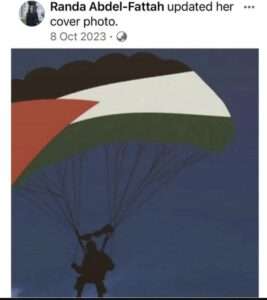
Randa Abdel-Fattah is an Australian writer, attorney, and "antizionist" activist of Egyptian and Palestinian descent. This is what she posted on Oct. 8, 2023, while terrorists who entered Israel on hang gliders and proceeded to massacre, kidnap, and brutalize civilians were still at large:
In January 2024, she published an article dismissing (true) reports of sexual assault of Israeli women by Hamas terrorists as "atrocity propaganda."
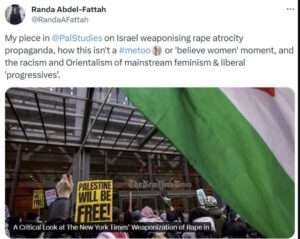
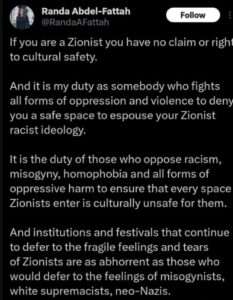
Here she is expressing her commitment to harassing "zionists:"
In February 2024, she was one of ten authors who signed a letter demanding the Adelaide Book Festival to disinvite Thomas Friedman because he's a "zionist."
Her reaction to the massacre of fifteen Jews celebrating Hanukkah in December was to decry those "quickly surrendering to the agenda of those who are using a horrific act of antisemitism to entrench anti-Palestinian racism," and its exploitation "Zionists, white supremacists, the far right to advance their racist, violent, and oppressive agendas."
The Adelaide Book Festival chose to disinvite her thereafter, on the vague grounds that it would not be "culturally sensitive" to have her after the Bondi atrocity.
In response, she accused the Festival of anti-Palestinian racism, which in turn led to widespread withdrawals of other authors from the Festival on either anti-censorship or anti-racism grounds, which in turn led to the cancellation of the Festival this year.
She has now posted the following statement:
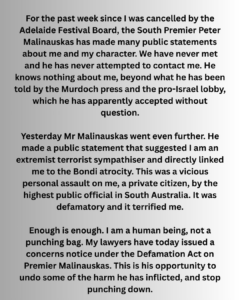
I can't imagine that in a country where the loser pays the winner's legal fees, she really wants a trial on whether calling her an extremist and terrorist sympathizer is false.

Editor's Note: We invite comments and request that they be civil and on-topic. We do not moderate or assume any responsibility for comments, which are owned by the readers who post them. Comments do not represent the views of Reason.com or Reason Foundation. We reserve the right to delete any comment for any reason at any time. Comments may only be edited within 5 minutes of posting. Report abuses.
Please to post comments
I agree, except on the point of "directly linked me to the Bondi atrocity". I know people have been saying some dumb things about the Australian Prime Minister along these lines (who is also Labor, like Malinauskas, fwiw), and it is conceivable that Malinauskas said something ill-advised that would be objectively defamatory.
She doesn't seem to have provided a direct quote of what the Premier said on this point, and a quick Google doesn't show anything either. Presumably in court documents she will have to put up or shut up.
In America we have special rules disfavoring defamation lawsuits by people who make themselves public figures. How does that work in Australia?
Sullivan is a purely American approach. Assuming that Australian defamation law is the same as in Britain, her status would not affect the outcome. And truth is always a defence.
That would have been my guess, but it turns out that's not entirely right:
Here's a parliamentary research service paper from New South Wales from 1995: https://www.parliament.nsw.gov.au/researchpapers/Documents/defamation-of-public-officials-and-public-figure/Defamation%20of%20public%20officials.pdf
And here's a blog post from 2022: https://www.defamationlawyersperth.com.au/blog/know-how-defamation-law-for-public-figures-different-from-private-figures/
This sounds pretty similar to Sullivan:
For public figures, there is another requirement to bring any defamation claim. They are required to prove that the defamer had actual malice in mind (in other words, the defamer was aware that the statement was false, or they acted with no regard for whether the statement was true or false.
"Extremist terrorist sympathizer"
I think in the US that would have a good chance of being ruled as non-actionable opinion. What's the law in Australia?
The law in Australia is that the plaintiff has to point to specific things the defendant said, and then you can have an opinion about whether the statements complained of refer to facts or opinion.
Broadly speaking, in the US almost anything is opinion these days. In other jurisdictions, not so much.
If he literally said "extremist terrorist sympathiser" that seems like opinion to me too, but if he said something close but different it may well be that she has a reasonable claim that he accused her of some kind of felony under terrorism legislation. And defamation law traditionally doesn't look kindly on unsupported accusations of felony.
Australia has been following the UK's example of prosecuting the wrong kind of hate speech, so I wouldn't bet on her not winning.


