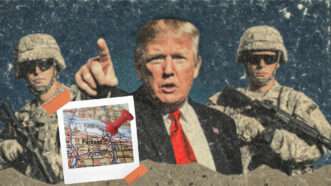
DOJ Brings Kilmar Abrego Garcia Back to the U.S. After Insisting It Couldn't
The Department of Justice brought the deported Salvadoran back to U.S. soil for trial, reversing its long-held contention that he would "never" return.
Yoo's criticisms are off the mark, for a variety of reasons. But, tellingly, he actually agrees Trump's IEEPA tariffs are illegal, merely disagreeing with the court's reasons for reaching that conclusion.
Karoline Leavitt's threat against ABC News is an attack on free speech.
The CIT ruling is much stronger than Prof. Goldsmith contends. The same is true of a related ruling by federal District Court Judge Rudolph Contreras.
Trump's domestic use of the military to counter anti-deportation protests in LA is so far very limited. But that could change. A big part of the root of the problem is the lawless behavior of federal immigation-enforcement agencies.
Those accused of wrongdoing have the right to challenge the evidence against them before the government takes away their liberty.
Trump v. Hawaii may block a challenge based on unconstitutional discrimination. But it does not preclude a nondelegation case. Other recent developments may actually bolster that approach.
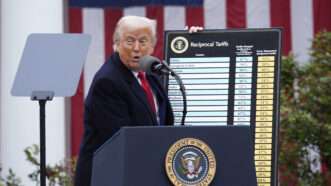
Most imports to the U.S. are raw materials, intermediate parts, or equipment—the stuff that manufacturing firms need to make things.
The Trump Administration returned the illegally deported migrant from imprisonment in El Salvador after repeatedly claiming they could not do so.
Neither Russia nor Ukraine has a clear path to victory. The Ukrainian drone attack last week and the Russian air raids on Friday don't change that.
Next week could be a pivotal one, as a federal appeals court could decide whether to restore an injunction against Trump's tariffs.
The case against Michelino Sunseri exemplifies the injustice caused by the proliferation of regulatory crimes—the target of a recent presidential order.
This crucial procedural issue is now before the US Court of Appeals for the Federal Circuit. Its resolution will determine whether the tariffs are immediately suspended, or get to continue so long as the case is stil being litigated.
In a petty, public war of words, Trump threatens to cut off federal support to Musk's companies after the billionaire attacked his deficit-busting budget bill.
Plus: A cynical take on Zohran Mamdani, Florida's drinking water threatened, and more...
Without such intervention, he warns, the government "could snatch anyone off the street, turn him over to a foreign country, and then effectively foreclose any corrective course of action."
A new comprehensive review finds the negative effects of trade with China have been significantly exaggerated.
Plus: Trump's travel ban, NYC mayor candidate cites bad stats on child hunger, and more...
Plus: A love letter to the heavy metal band Slayer.
He has banned nearly all new immigration and other entry by citizens of twelve countries, and imposed severe restrictions on seven more.
The poll finds 55% approve and only 30% disapprove of the recent ruling against his IEEPA tariffs.
Media coverage of our tariff case has mostly been fair and accurate. But there are a few examples of unfortunate misconceptions, mainly having to do with libertarianism and its relationship to conservatism.
A leading conservative legal scholar explains why striking down Trump's IEEPA tariffs is vital to protecting the separation of powers.
House members who discovered objectionable elements only after voting for the package nevertheless underline the unseemly haste of the legislative process.
Democrats keep trying to out-hawk Republicans, even though the mood in America has shifted toward diplomacy.
The president treats legal constraints as inconveniences that can be overridden by executive fiat.
Even when the administration has cut from seemingly obvious sources, Trump has redirected federal spending toward sources closer to his heart.
Links to my writings about our case against Trump's "Liberation Day" Tariffs and related issues.
Plus: Drilling in the Alaskan wilderness, Harvard tries "wastefulness" argument, Stephen Miller tells on himself, and more...
Trump's trade war has created a carve-out bonanza for industries with political connections and big lobbying budgets.
The brief was filed on behalf of the Brennan Center, the Cato Institute, law-of-war scholar Prof. John Dehn, and myself.
Plus: A listener asks if the "big beautiful bill" will decrease the deficit.
The MAGA loyalty that Trump demands is anathema to everything that originalism is supposed to be about.
The real case for free trade is not "my enemies hate it" or "it's cheaper for me, personally" but "it makes the world richer, freer, and more peaceful."
Out-of-control housing costs helped Trump win the 2024 election. Is he about to make the problem worse?
The podcasts cover the case and its relationship to the more general problem of abuse of emergency powers.
The disgraced former Democratic senator was convicted of accepting almost $1 million in bribes in exchange for, among other things, favors benefiting foreign governments.
DOGE says regulatory changes will save $29.4 billion, but that does not amount to a reduction in government outlays, the initiative's ostensible target.
In a legal filing this week, Trump argued that routine edits to a CBS News interview he did not participate in caused him "confusion and mental anguish."
For both practical and constitutional reasons, this is the obvious way out of the chaos Trump's tariffs have created.
It explains how the ruling is a win for separation of powers and the rule of law.
Hawks in Washington often make it sound hard to end conflicts with other countries, but the United States and Syria are fixing relations overnight.
The Wall Street Journal, CBC, and Time published good articles on the story behind the case filed by the Liberty Justice Center and myself.
Some of the more informative interviews I have done about our win in the case against Trump's tariffs, in lawsuit filed by the Liberty Justice Center and myself.
The decision by Judge Rudolph Contreras of the US District Court for the District Columbia holds IEEPA doesn't authorize the president to impose tariffs at all.
President Trump is entitled to try to execute his immigration policy. He is not entitled, however, to violate the Constitution.
This is a standard order imposing a brief stay of the trial court ruling, while the parties litigate the issue of whether a longer stay should be imposed.
The case involved a fully permitted railroad track in Utah that has yet to break ground because of environmental lawsuits.