
The Federal Government Collected $5.4 Trillion. It Still Can't Pay Its Bills.
Entitlement spending, defense spending, and interest payments on the debt continue to climb.

Entitlement spending, defense spending, and interest payments on the debt continue to climb.
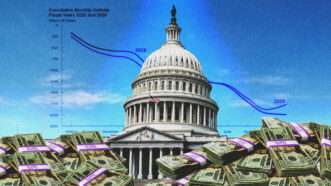
Tax revenue increased by about 3 percent last year, but spending increased twice as fast. And interest payments on the debt cost more than $1.1 trillion.

Congress hasn’t balanced the budget in 25 years.
President Donald Trump has surpassed Barack Obama's record for most debt amassed by a president.

Even the best-case scenario means less investment, slower wage growth, and a budget increasingly spent on past obligations.

Plus: Data center backlash, Anthropic job-loss predictions, and more...

Plus: ICE chillin', Moderna-Merck melanoma advances, and more...

Plus: Democrats reckon with the rise of the DSA, Trump scales back America's military presence abroad, and the case for letting kids play outside

It's almost like there is no real underlying principle guiding the Trump administration's tariff policies.

Once the trust fund is empty, Social Security can pay out only what it collects. Yet few candidates are talking about this in any serious way.

There are only a handful of ways to shore up Social Security. Sens. Bernie Moreno and Elizabeth Warren are backing one of the most expensive.

Congress cannot sit by and hope for AI to fix the deficit.
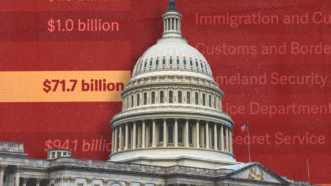
The party of fiscal responsibility strikes again.
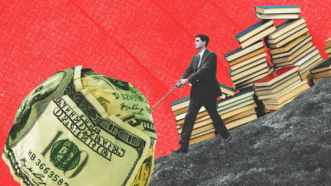
Less than half of the Class of 2024 took out college loans averaging $30,000—a manageable amount that buys over $1 million in extra lifetime earnings.

It would be easy to wave it away and move on. But that's how the U.S. got in such a dire fiscal situation.

The proposal is "an enormous waste of taxpayer dollars and would make Americans less, not more, safe." Thankfully, Congress is unlikely to adopt it.

Trump's ridiculous, grandiose promise tells us something about the federal government's fiscal affairs and the president's approach to policy.

Growing federal debt hobbles the government’s ability to respond to crises.

A sad commentary on the sprawling size and eye-watering cost of the government.

The truest measure of government in our lives is the federal budget, which is out of control.

A 2018 class action lawsuit argued that Chicago was unlawfully overcharging residents for parking and sticker fines.
The cost of paying the interest is now the central story, and it's a grim one.

Inflation is a silent tax—and the most painful way to finance government promises.

A new Congressional Budget Office outlook expects entitlement spending and the national debt to explode in the next decade.

A new Cato Institute study provides the most comprehensive analysis of this issue to date.

Plus: More evidence that immigrants are good for America, Trump's call to "nationalize" elections, and more...

Maintaining a uniformed domestic security force is pricey in terms of life, liberty, and dollars.


America's large and growing national debt is not just a budgetary liability, but increasingly a geopolitical one too.

If interest rates stop being market signals and become policy decisions, what survives may look less like capitalism—and more like permanent crisis management.

Has the Department of Government Efficiency delivered on promises to downsize federal employment, cut regulations, and reduce federal spending?

The decision isn't a value judgment. It's a recognition that nursing school is usually cheaper than medical school.

The Trump administration's pivot toward socialism did not come without warning.

Ultra-long mortgages create the illusion of affordability but lock borrowers into decades of extra interest because leaders won’t fix the supply crunch.

Democrats defend every entitlement and dream up new benefits. Republicans demand more defense spending and still more tax cuts.

As of mid-2025, there were roughly 50 simultaneous national emergencies in force.

For the fiscal year that ended on September 30, the federal government spent more than $7 trillion and ran a $1.8 trillion deficit.

Reason's Peter Suderman and Eric Boehm discuss the government shutdown live at 3 p.m. Eastern time today.

A previous pilot program found free access slowed down buses in New York City, which already has the slowest buses in the nation.

Don't comfort yourself with wishful thinking that millionaires and billionaires could take the entire burden of the deficit off our hands.

The president's clear attempt to interfere in the Federal Reserve is not a one-off crisis.

Big city mayors' progressive ambitions are on a collision course with fiscal reality.

Federal overspending is squeezing states and cities, forcing them to raise taxes, slash services, or pile on more debt.

It's time to ask what level of spending Americans truly want with the money we actually have.

The executive branch wants to use the Federal Reserve as a tool to accommodate the government's frenzy of reckless borrowing.

This is what Washington calls compromise: The House proposes $1, the Senate proposes $2, and somehow, the government ends up spending $3.

A more effective reform is to let the market curb waste and reward innovation.

Plus: The anti-socialist moment, muscle-building drugs counteract Ozempic, arsony gunman in Idaho, and more...
Celebrate your independence with a subscription to Reason magazine, your most trusted source of honest, insightful news and analysis.




