

Trump's Call for a $1.5 Trillion Military Budget Is Irresponsible, Wasteful, and Unrealistic
The proposal is "an enormous waste of taxpayer dollars and would make Americans less, not more, safe." Thankfully, Congress is unlikely to adopt it.
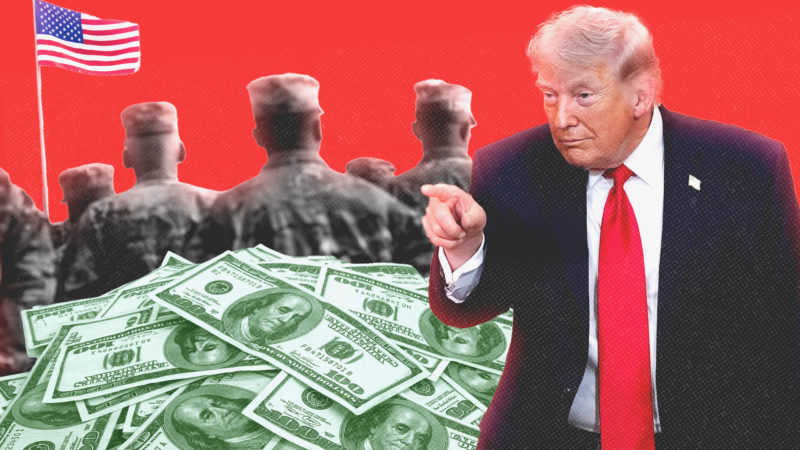
President Donald Trump is asking Congress to spend nearly $1.5 trillion on the military next year—a 43 percent increase to the Pentagon's budget.
The White House included that massive increase in military spending in a budget request sent to Congress on Friday. It formalizes the proposal that Trump has been teasing for months. In percentage terms, it would be the largest year-over-year increase in military spending since the Korean War.
Some of the new military spending would be offset by cuts to other parts of the discretionary budget. The White House's budget proposal would trim $73 billion from other programs. Overall, the White House's budget envisions discretionary spending increasing from about $1.9 trillion to nearly $2.2 trillion next year.
Trump's proposed military budget would be "an enormous waste of taxpayer dollars and would make Americans less, not more, safe," says Ben Freeman, coauthor of The Trillion Dollar War Machine and a director at the Quincy Institute for Responsible Statecraft. Freeman says the proposal would encourage more aimless wars and would add to the federal government's already soaring debts.
"Fortunately, it's not going to happen," he added, noting that political and budgetary pressure make it very unlikely that Congress will be able to fulfill the White House's request. Right now, it's not even clear that Congress will approve the much smaller request for $200 billion in supplemental funding for the Iran war. "This is a negotiating tactic, not a serious request," Freeman believes.
Even so, the president has made it clear that boosting the military's budget is a top priority, even if it comes at the expense of other government programs.
While speaking at the White House this week, Trump said the military budget was his top priority. "It's not possible for us to take care of day care, Medicaid, Medicare—all these individual things, they can do it on a state basis. You can't do it on a federal," Trump said. "We have to take care of one thing: military protection. We have to guard the country."
The impulse to push more responsibility to the state level is a good one, but Medicare and Medicaid will continue to be a huge part of the federal budget.
That's the real story here—and in every other debate over how much the federal government should be spending. So-called "mandatory spending" on entitlements like Social Security, Medicare, and Medicaid will cost an estimated $4.8 trillion in fiscal year 2027, according to the Congressional Budget Office's (CBO) latest projections. Interest payments on the debt will cost another $1.1 trillion that year.
Meanwhile, the CBO expects the federal government to collect about $5.8 trillion in tax revenue that year.
It doesn't take a math whiz to see the problem here. The budget is already running a deficit before any discretionary spending, including the military, is on the table.
The White House proposes cutting hundreds of billions in spending from some discretionary programs to use for the military budget. In reality, the entirety of that $1.5 trillion proposal is being borrowed and added to the debt, because entitlement spending and payments on the national debt have effectively crowded everything else. We are putting the whole federal discretionary budget on the national credit card.
"Exploding the Pentagon budget will not make us safer. It will explode the debt. It will waste taxpayer dollars on programs that don't work or that we simply don't need," said Steve Ellis, president of Taxpayers for Common Sense, in a statement on Friday. "It will crowd out funding for other national security priorities that the Pentagon doesn't address, like disaster mitigation and response, pandemic preparedness, food security, and reining in the debt."
In a historical context, Trump's military budget proposal looks less extreme. Spending $1.5 trillion on the military would mean the Pentagon consumes roughly 5 percent of America's total economic output. During the height of the Cold War, the military consumed up to 10 percent of America's gross domestic product (GDP), as advocates of a beefed-up Pentagon budget like to point out.
Of course, the rest of the government cost a lot less back then, and it wasn't spending $1 trillion to pay interest on the national debt.




