A Federal Indictment Charges an ICE Officer With Lying About a Shooting That DHS Eagerly Defended
The habitually dishonest department uncritically accepted a story that was immediately contradicted by video footage and physical evidence.
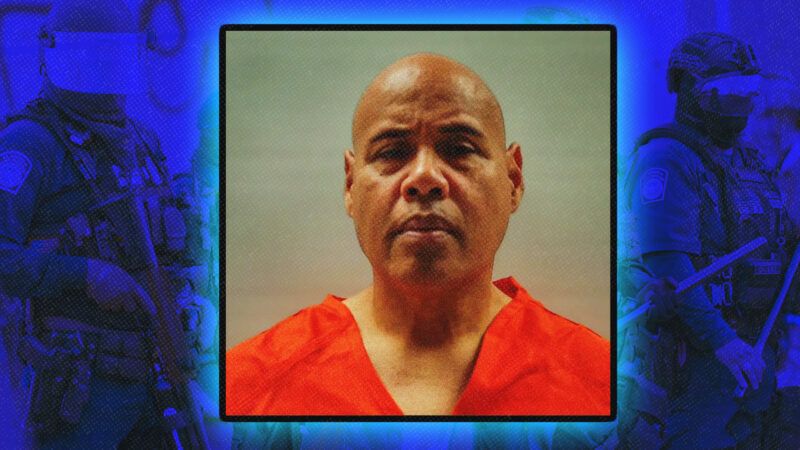
After Immigration and Customs Enforcement (ICE) officer Christian Castro shot Julio C. Sosa-Celis in Minneapolis on January 14, the Department of Homeland Security (DHS) portrayed that use of potentially lethal force as fully justified. "Fearing for his life and safety as he was being ambushed by three individuals," it said in a press release the next day, Castro "fired a defensive shot to defend his life," striking Sosa-Celis in the leg.
As the DHS told it, Castro "attempted to apprehend" Sosa-Celis, "a criminal illegal alien from Venezuela," who "began to resist and violently assault the officer." Castro was on the ground, wrestling with Sosa-Celis, when two other men "came out of a nearby apartment and attacked the law enforcement officer with a snow shovel and broom handle." Then Sosa-Celis "got loose and began striking the officer with a shovel or broom stick." Kristi Noem, then the DHS secretary, described "an attempted murder of federal law enforcement" in which Castro "was ambushed and attacked by three individuals who beat him with snow shovels and the handles of brooms."
According to an indictment that a federal grand jury approved on Wednesday, none of that was true: Castro made the whole thing up. Compounding Castro's dishonesty, the DHS uncritically accepted his version of events, and Noem went further, embellishing his story by multiplying the number of imaginary weapons that his supposed assailants allegedly used to attack him.
That is par for the course at the DHS, which has a history of reflexively defending its employees, rushing to judgment before all the relevant facts are known. This is by no means the only case in which the government's initial account of a DHS shooting has unraveled in the face of contrary evidence. But it is unusual in one respect: The government ultimately admitted that its account was based entirely on a DHS employee's self-serving lies.
What actually happened that day? According to the DHS press release, "federal law enforcement officers were conducting a targeted traffic stop in Minneapolis for Julio Cesar Sosa-Celis," who "fled the scene in his vehicle, crashed into a parked car, and proceeded to flee on foot." But the very next day, FBI agent Timothy Schanz told a different story in an affidavit supporting federal charges against Sosa-Celis and Alfredo A. Aljorna, who shared a duplex apartment with Sosa-Celis and supposedly joined him in assaulting Castro.
According to Schanz, Castro and another ICE officer spotted "a silver/grey Ford Focus" with a license plate registered to Joffre Barrera. Records indicated that Barrera "was illegally in the United States." The officers assumed the man driving the car, Aljorna, was Barrera, even though Aljorna was 50 pounds heavier, five inches taller, and about a decade older. In any event, it was Aljorna, not Sosa-Celis, who "fled the scene" when ICE tried to pull him over and "hit a light pole" (as opposed to "a parked car") on North 24th Avenue after a car chase that lasted "15 to 20 minutes." Then Aljorna ran toward his home.
As Castro chased Aljorna, Schanz said, he "saw a separate Hispanic male," later identified as Sosa-Celis, "standing on the porch" of the duplex. After Aljorna "slipped and fell," Castro caught up with him and "began tussling with him on the ground." Then Sosa-Celis grabbed "a red-handled broom" and "began hitting" Castro with it "in the face," saying "something to the effect of, 'Let him go.'" Castro saw "a third Hispanic male approach with a snow shovel." That man "began striking" Castro with the shovel. When Aljorna "wiggled out of his shirt or sweater and freed himself" from Castro's grip, the ICE officer called out for help from his partner but realized he was not there.
Castro, who estimated that he "had been fighting/tussling" with Aljorna for three minutes, "was exhausted, alone, on the ground, and in fear of his safety," Schanz said. Sosa-Celis "passed the broom" to Aljorna, who "attempted to hit" Castro "in the face or head." Castro, who "was struck repeatedly by the broom," "used his left hand to block a strike," which "caused a cut or gash to the palm of his left hand." While "blocking strikes with his left hand," Castro "struggled to draw his service pistol with his right hand and pointed it in the direction of his assailants."
When the men saw Castro "draw his pistol," Schanz said, they "dropped the broom and the snow shovel" and "began to run" toward the duplex where they lived. Castro "simultaneously fired one round from his service pistol towards the vicinity of the assailants," who "ran inside" the building and "closed the front door."
If three men participated in the alleged attack on Castro, why were only two charged? Schanz did not say. But as he could have discovered if he had bothered to investigate Castro's claims, the ICE officer's account was inconsistent with video and physical evidence. Surveillance camera footage of the incident did not show any assault with a broom or a snow shovel. Nor did it document a prolonged violent struggle like the one that Castro described.
The struggle with Aljorno lasted about 12 seconds, and Castro "was not hit by a shovel or a broom," Hennepin County Attorney Mary Moriarty would later note. "In fact, he was not hit at all." After Aljorna and Sosa-Celis escaped into their home, she added, they "presented absolutely no threat to him or anyone else." And contrary to what Castro claimed, that was when he fired his gun, as a bullet hole through the front door showed.
After charging Aljorna and Sosa-Celis with assault and various other felonies, federal prosecutors belatedly noticed the problems with Castro's story. "Newly discovered evidence in this matter is materially inconsistent with the allegations" against Aljorna and Sosa-Celis, Daniel N. Rosen, the U.S. attorney for Minnesota, told U.S. District Judge Paul A. Magnuson on February 12, nearly a month after the shooting. The next day, Magnuson granted Rosen's request to dismiss the charges with prejudice, meaning they could not be filed again.
"Video evidence has revealed" that Castro "appears to have made untruthful statements," Acting ICE Director Todd Lyons said the day the charges were dismissed. "Lying under oath is a serious federal offense. The U.S. Attorney's Office is actively investigating these false statements."
That investigation culminated in this week's indictment, which remains sealed but reportedly charges Castro with six counts of making false statements to FBI agents, a federal felony punishable by up to five years in prison. That charge implies that Castro was not justified in shooting Sosa-Celis, meaning he may also be guilty of "willfully" violating Sosa-Celis' Fourth Amendment rights under color of law, a federal felony punishable by up to 10 years in prison when it causes "bodily injury."
Federal prosecutors in Minnesota "pressed for more serious civil rights charges but said that their Washington counterparts had so far been unwilling, limiting the indictment to accusations of lying," The New York Times reports, citing "two people with knowledge of the case." According to "a Justice Department official," the Times says, "federal prosecutors are still investigating the shooting and have not ruled out adding civil rights charges."
On Tuesday, ProPublica reports, the prosecutor assigned to Castro's case, Assistant U.S. Attorney Matthew Evans, said in an email that he "objected in the strongest possible terms" to a decision by Rosen and "Main Justice" against charging Castro with violating Sosa-Celis' constitutional rights. CBS News reports that Evans was fired after that dispute.
In May, Moriarty announced state charges against Castro. The ICE officer "was not under any physical threat when he fired his weapon, or even beforehand," Moriarty said, explaining her decision to charge Castro with four counts of second-degree assault and one count of falsely reporting a crime.
That case has stalled. After the shooting, ICE transferred Castro to Texas, where Gov. Greg Abbott resisted Minnesota's extradition request, saying he needed more time to consider it. Although Castro was arrested based on that request, he was released last week after three months of detention, the maximum allowed by state law in extradition cases.
It remains unclear whether Castro will be held accountable for his unjustified use of force as well as his mendacity. But either way, the case highlights the perils of believing anything the DHS says after its employees fire their weapons.
A week before Castro shot Sosa-Celis, ICE officer Jonathan Ross fatally shot Minneapolis protester Renee Good. A couple of weeks after that, DHS employees fatally shot Alex Pretti, another Minneapolis protester. In both cases, the story that the DHS told, which cast Good and Pretti as would-be murderers, was inconsistent with video of the incidents.
Although the outcome was less serious in this case, the DHS followed the same playbook, depicting Aljorna and Sosa-Celis as bent on homicide—a claim that likewise was contradicted by video evidence. Beyond the issue of whether the shooting was justified, the DHS was egregiously sloppy in reporting the basic facts of what had happened, confusing Sosa-Celis with Aljorna, who in turn was misidentified as the initial ICE target.
The DHS not only credulously accepted Castro's fictional claims. It added made-up details, pluralizing the single broom and single snow shovel he described. It also implied that Aljorna and Sosa-Celis had previously shown violent tendencies. These were "criminal illegal aliens," it said. Yet Aljorna's "crime" was illegally entering the United States, while Sosa-Celis' criminal record was limited to a conviction for driving without a license and an arrest for "giving a false name to a peace officer."
In a sense, the federal case against Castro sets the record straight. But far from apologizing for misleading the press and the public, the DHS has not even bothered to retract or correct its statement about the shooting, which remains on the department's website with all the original errors and misrepresentations.
"In case after case" across the country, Reason's C.J. Ciaramella noted last October, the DHS has shown "a willingness to put false information out to the public and never correct it." The department seems unable to break that dangerous habit, which builds distrust and invites disbelief with every defamatory and tendentious press release.