

Clarence Thomas Doubled Down on Presidential Power
The conservative justice pushed for greater executive authority even in cases in which Trump won.
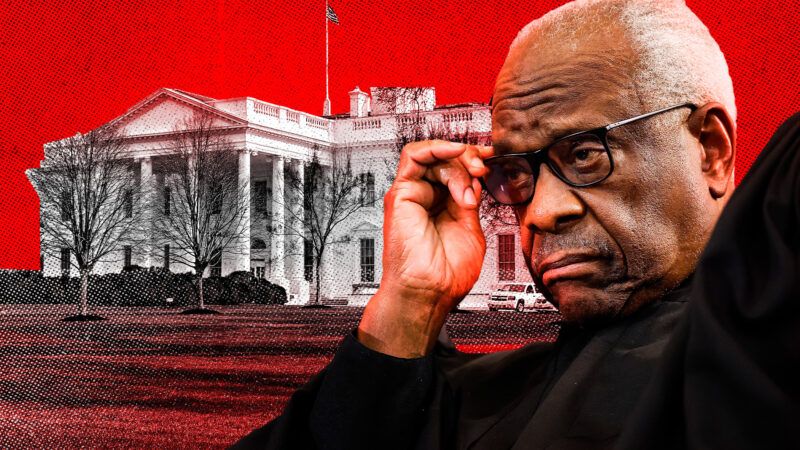
What are the limits of executive power, and how should such limits be enforced by the courts?
If there was a single dominant theme in the U.S. Supreme Court's recently concluded 2025–2026 term, then those two questions capture it in a nutshell. This was a SCOTUS term uniquely focused on the debate over the proper scope of presidential authority.
That makes sense, given the current occupant of the White House. In his second term, President Donald Trump has pursued an agenda of maximalist executive power on every front. Trump was not the first president to bypass Congress and seek to govern via executive fiat alone, of course. But the brazenness of Trump's executive overreach still stands out.
Trump did ultimately lose some of these cases when they finally reached the Court. But he was not without certain dependable allies on the bench. Indeed, one justice in particular made it clear that if it were up to him, Trump would have prevailed in every single case that tested the scope of his executive power.
You’re reading Injustice System from Damon Root and Reason. Get more of Damon’s commentary on constitutional law and American history.
Consider the tariffs case. Six members of the Supreme Court, including two justices appointed by Trump himself, argued that the president violated the separation of powers by wielding a tariff-making authority that he did not lawfully possess. Writing in dissent, however, Justice Clarence Thomas not only maintained that Trump deserved to win, but also argued that the tariff-making power—which the Constitution places in the hands of Congress only—could be surrendered entirely by Congress to the president without raising a single constitutional eyebrow.
Congress "has many powers that are not subject to the nondelegation doctrine," Thomas asserted in Learning Resources v. Trump. Among them, he claimed, are "the powers to raise and support armies" and "the power to regulate external affairs." In other words, according to Thomas, the president may act unilaterally in such vastly important areas and Congress, the branch of government actually vested with such powers under the Constitution, would suffer no constitutional injury at all.
Consider also the legal wrangling over immigration. In Mullin v. Doe, a 6–3 majority led by Justice Samuel Alito affirmed the Trump administration's decision to strip Haitian and Syrian nationals of a legal protection known as temporary protected status (TPS). Thomas joined Alito's majority opinion in full. But Thomas also wrote separately to argue that Trump should have won the case on even broader grounds.
The Haitian nationals involved in the case had pointed to numerous discriminatory statements made by the president to argue that the decision to strip them of TPS was motivated by racial animus, thus violating the constitutional guarantee of equal protection. Alito's majority opinion rejected that claim, holding that Trump should win because there was a plausible "race-neutral" explanation that could also account for what happened.
In his solo concurrence, Thomas argued that the Court had no business even weighing the Haitians' equal protection claim in the first place because "'courts cannot examine' 'the President's actions on subjects within his "conclusive and preclusive" constitutional authority,' regardless of whether he violates the Constitution in exercising that authority." For Thomas, this is yet another area in which the president may act unilaterally without facing any constitutional check from any other branch of government, including judicial review by the Supreme Court. Notably, not even Alito, another reliable vote for Trump, was willing to go that far.
The president of the United States—both Trump and every president who comes after him—is now more powerful than before, thanks in part to the Supreme Court. Had Clarence Thomas gotten his way this term, the executive would be even stronger still.




