

Reason.com - Free Minds and Free Markets
Reason logo Reason logo
  • Latest
  • Magazine
    • Current Issue
    • Archives
    • Subscribe
    • Crossword
  • Video
    • Reason TV
    • The Reason Roundtable
    • Free Media
    • The Reason Interview
  • Podcasts
    • All Shows
    • The Reason Roundtable
    • The Reason Interview With Nick Gillespie
    • Freed Up
    • The Soho Forum Debates
  • Volokh
  • Newsletters
  • Donate
    • Donate Online
    • Ways To Give To Reason Foundation
    • Torchbearer Society
    • Planned Giving
  • Subscribe
    • Reason Plus Subscription
    • Print Subscription
    • Gift Subscriptions
    • Subscriber Support

Log In

Create new account

First Amendment

Two Senators Offer a Bipartisan Solution to Censorship by Proxy

The JAWBONE Act would let Americans sue government officials who try to restrict their speech by pressuring social media platforms, broadcasters, or AI companies.
Jacob Sullum | 6.11.2026 2:55 PM

Share on FacebookShare on XShare on RedditShare by emailPrint friendly versionCopy page URL Add Reason to Google
Media Contact & Reprint Requests
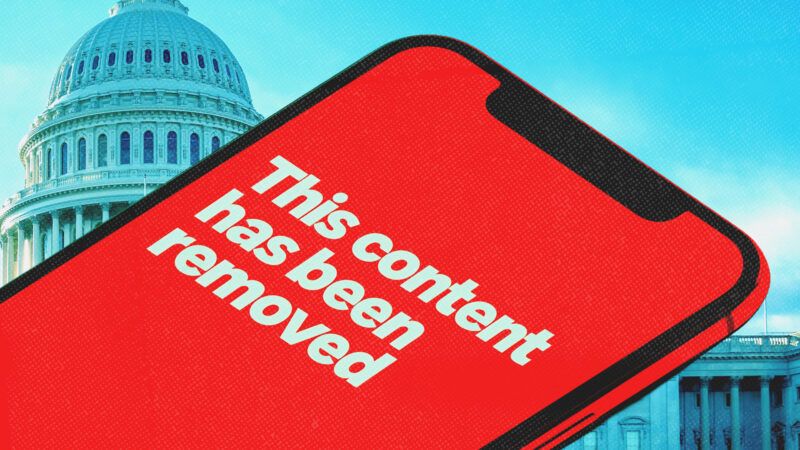
A cellphone with the message "this content has been removed," against a backdrop of the U.S. Capitol | Akophotography/Envato/Midjourney
(Akophotography/Envato/Midjourney)

President Donald Trump and his allies rightly condemn the Biden administration's censorial meddling with social media, which sought to suppress constitutionally protected speech that federal officials viewed as dangerous. Trump, who issued an executive order aimed at "restoring freedom of speech and ending federal censorship" on the first day of his second term, promised to end such bullying. Yet he has not been shy about using the influence of his office to restrict speech, as illustrated by his demands that ABC punish late-night comedian Jimmy Kimmel for saying things he did not like.

Sens. Ted Cruz (R–Texas) and Ron Wyden (D–Ore.) have teamed up to offer a more consistent and principled response to the dangers of "jawboning," a form of indirect censorship that operates via government pressure on third parties such as social media platforms and TV networks. On Thursday, Cruz and Wyden introduced the JAWBONE Act, which would allow Americans affected by such pressure to seek damages from officials who exert it.

"JAWBONE" stands for "Justice Against Weaponized Bureaucratic Overreach to Networked Expression." While that reach for an apt acronym is awkward and barely comprehensible, the bill itself makes considerably more sense.

"Holding the government accountable and giving Americans the tools to fight back is essential," Cruz says. "The JAWBONE Act ensures the First Amendment is protected, not undermined." Wyden adds that "nearly all of Americans' speech—including TV news, online streams and social media—flows through private corporations that are highly susceptible to government pressure." Since "regular Americans can't count on those companies to stand up to government jawboning," he says, "they need a way to level the playing field."

A summary of the bill says it would create "a cause of action against any government agency or employee that jawbones companies involved in social media, AI, or broadcasting, regardless of whether the jawboning succeeds." Plaintiffs could seek "money damages and reasonable attorney fees." The bill also aims to increase transparency and accountability by requiring agencies to publicly disclose relevant communications with "social media companies, AI companies, and broadcasters."

The JAWBONE Act has been endorsed by a bunch of civil liberties groups, including the American Civil Liberties Union, the Knight First Amendment Institute, the Center for Democracy and Technology, the Institute for Free Speech, Public Knowledge, Americans for Tax Reform, the Internet Accountability Project, and the Foundation for Individual Rights and Expression (FIRE). The bill "would mark major progress toward addressing indirect and unconstitutional government censorship of Americans' speech," FIRE says.

Beginning with the 1963 case Bantam Books v. Sullivan, which involved implied government threats against distributors of "objectionable" books and magazines, the Supreme Court has held that such "informal censorship" violates the First Amendment. The Court reaffirmed that principle in the 2024 case National Rifle Association v. Vullo, which involved a state regulator's attempts to discourage financial institutions from doing business with the gun rights group. But as illustrated by the outcome in Murthy v. Missouri, which the Court decided a month later, it can be difficult for victims of informal censorship to vindicate their First Amendment rights.

That case involved plaintiffs who claimed their online speech had been suppressed as a result of the Biden administration's crusade against "misinformation" about COVID-19. But the majority, which questioned the asserted causal link, held that none of the plaintiffs had standing to sue, adding that they had not adequately alleged that they were apt to suffer future injuries in the absence of an injunction.

Under current law, FIRE notes, victims of jawboning face several obstacles. First, they may not know their speech was deleted or downgraded because of covert government pressure. FIRE offers an example: Suppose you criticize the IRS on Facebook, triggering a private demand from an IRS official who says, "Delete this user or we're going to start launching tax audits of Facebook executives." Although "your First Amendment rights were violated," FIRE says, "you have no idea it even happened." The JAWBONE Act aims to remedy that problem by requiring disclosure of such communications.

Second, FIRE says, "the government can get away with attempted jawboning when the third party does not act." The JAWBONE Act addresses that issue by allowing lawsuits based on such attempts.

Third, establishing a link between government action and ostensibly private decisions can be challenging, especially when companies that succumb to jawboning are not inclined to cooperate with potential plaintiffs. The JAWBONE Act "makes it easier for plaintiffs to obtain discovery, requiring the government to share more information about their jawboning," FIRE says. "This will help victims prove their case in court."

Finally, when jawboning involves federal officials, the statute that authorizes lawsuits alleging violations of constitutional rights, 42 USC 1983, does not apply. The JAWBONE Act fills that gap by expressly allowing lawsuits against federal officials.

"The JAWBONE Act enforces Americans' First Amendment rights by making clear that the federal government cannot pressure [third parties] to censor speech," says Greg Y. Gonzalez, FIRE's legislative counsel. "Multiple administrations of both parties have engaged in jawboning, reflecting a broad and enduring problem. When federal officials cross this line, the JAWBONE Act ensures they can finally be held accountable. It's a bipartisan solution for a bipartisan problem."

Start your day with Reason. Get a daily brief of the most important stories and trends every weekday morning when you subscribe to Reason Roundup.

This field is for validation purposes and should be left unchanged.

NEXT: Social Security Is Going Bankrupt Because Its Benefits Are Too Generous

Jacob Sullum is a senior editor at Reason. He is the author, most recently, of Beyond Control: Drug Prohibition, Gun Regulation, and the Search for Sensible Alternatives (Prometheus Books).

First AmendmentFree SpeechFree PressCensorshipSocial MediaNetworksTelevisionArtificial IntelligenceDonald TrumpTrump AdministrationJoe BidenBiden AdministrationCongressLegislationLitigationTransparencyAccountabilityTed CruzRon WydenFoundation for Individual Rights and ExpressionSupreme Court
Share on FacebookShare on XShare on RedditShare by emailPrint friendly versionCopy page URL Add Reason to Google
Media Contact & Reprint Requests

Hide Comments (43)

Editor's Note: As of February 29, 2024, commenting privileges on reason.com posts are limited to Reason Plus subscribers. Past commenters are grandfathered in for a temporary period. Subscribe here to preserve your ability to comment. Your Reason Plus subscription also gives you an ad-free version of reason.com, along with full access to the digital edition and archives of Reason magazine. We request that comments be civil and on-topic. We do not moderate or assume any responsibility for comments, which are owned by the readers who post them. Comments do not represent the views of reason.com or Reason Foundation. We reserve the right to delete any comment and ban commenters for any reason at any time. Comments may only be edited within 5 minutes of posting. Report abuses.

  1. Rick James   2 months ago

    I'm all for it.

    1. mad.casual   2 months ago

      I feel, again, like I'm taking crazy pills.

      1791: Congress shall make no law... abridging the freedom of speech... or the right of the people... to petition the Government for a redress of grievances.

      1991: "CompuServe was merely a distributor, rather than a publisher of content on its forums, and hence could only be liable for defamation if it knew, or had reason to know, of the defamatory nature of the content."

      1995: "In so holding, the court distinguished the case from an earlier one involving CompuServe, which was found merely to be an "electronic for-profit library" or repository and thus a passive distributor. In particular, the court pointed to Prodigy's creation of an "editorial staff of Board Leaders who have the ability to continually monitor incoming transmissions." The court noted, however, that bulletin boards should normally be considered distributors when they do not exercise significant editorial control, as Prodigy had done."

      1997: "Protection for private blocking and screening of offensive material." (In passing the Communications Decency Act of 1996, which, among other things, established immunity for internet service providers for publishing "information provided by another information content provider," 47 U.S.C. § 230(c)(1), the House explicitly stated its intent to overturn the result reached in the Prodigy case. See H.R. Conf. Rep. 104-58, at 194.)

      2026: "The JAWBONE Act creates a cause of action against any government agency or employee that jawbones companies involved in social media, AI, or broadcasting, regardless of whether the jawboning succeeds. The JAWBONE Act allows the plaintiffs to obtain money damages and reasonable attorney fees, keeping meritorious claims alive."

      Since the last two were penned by the SAME MOTHERFUCKING GUY! can we now at least admit that, intentionally or not, S230 does exactly what some of us have been saying it does since 1997?

      I mean a second bandaid on top of the first bandaid is better than hemorrhaging out full speed I guess. But, at least at one point, libertarians understood what a self-licking ice cream cone was and could call it out when they saw it. At this point, on the verge of the AI/data center ascension (or bubble), it's already been well into the peta-Watt hours of gaslighting on the issue.

      I'm seriously wondering if this Act doesn't make it legal to sue the government for enacting the CDA and S230 in the first place or at all going forward. Instead, once again, repeal S230. 86 Ron Wyden. And let the courts get back to parsing the Compuserves from the Prodigys the way the Founders intended when they said 'Congress shall make no law controlling speech one way or the other and the right of the people to petition their government for redress of grievances shall not be abridged'

      1. mad.casual   2 months ago

        I'm seriously wondering if this Act doesn't make it legal to sue the government for enacting the CDA and S230 in the first place or at all going forward.

        I know we've got the 21st Amendment that undoes the 18th, but those are Amendments, not laws passed by Congress. If you have to pass the JAWBONE Act in order to fix the fuckup of what *remains* of the Communications Decency Act then wasn't the whole fucking CDA so ambiguous as to be struck down in its entirety?

      2. mad.casual   2 months ago

        Since the last two were penned by the SAME MOTHERFUCKING GUY! can we now at least admit that, intentionally or not, S230 does exactly what some of us have been saying it does since 1997?

        *If* S230 was supposed to prevent a tsunami of hyperlitigious trolls from the fringes of society from strangling the nascent internet as we knew it and dooming us all to a perpetual Information Stone Age, doesn't this law explicitly and intentionally give them the ability to sue their way back to at least The Inquisition?

        Again, personally, I remain suspicious that we are (still) in or at the pinnacle of any sort of Information Age but, if we are, isn't this The Camp of Saints Law?

    2. SCOTUS gave JeffSarc a big sad   2 months ago

      Getting rid of the democrat party would solve most of these problems.

  2. JesseAz (RIP CK)   2 months ago

    How far we've come from "muh private business."

    But how does this hold up against the other claims during covid that SV wanted to push censorship because they agreed with Biden?

    This will end up one sided to only go after conservatives.

    Look at the SPLC hearings yesterday. SPLC was pushed as a non government government entity. Behind debanking and censorship. And democrats were applauding those efforts.

    This proposal will be one sided to benefit the left.

    The left will use NGOs and think tanks, sponsored with tax dollars, to do these tasks for them. Then this bill will disallow the government to intervene in that alliance.

    1. SCOTUS gave JeffSarc a big sad   2 months ago

      Ultimately, the democrat party has to go. Anyone who believes there can be coexistence with millions of rabid murderous communists is delusional.

  3. MWAocdoc   2 months ago

    The only solution to censorship by proxy is to criminally prosecute any government official who knowingly engages in the practice. Lawsuits for damages have always been a poor substitute for holding officials accountable for upholding the Constitution.

    1. Nelson   2 months ago

      I would argue that the reasons corporate officials are largely shielded from criminal responsibility for acts that violate the law would apply equally here.

  4. Clipton   2 months ago

    Amazing. Sullum managed to get through an entire article without blaming Trump.

    1. Fats of Fury   2 months ago

      Paragraph 1, last sentence.

      1. Clipton   2 months ago

        Good catch. I guess I read it too fast....

      2. mad.casual   2 months ago

        JFC, now that you say that, when I read "Networked Expression", I'm like 80% sure that at least Wyden means protecting Jimmy Kimmel and CBS from Trump, not protecting signatories of The Great Barrington Declaration from Biden and Fauci.

        Expressions from TV Networks will be protected. Private speech within interconnected "private" networks and platforms of privately-owned computers will not be.

        The only real question is whether Cruz is a dupe acting in good faith agreement under the opposite definition, or whether he understands that as soon as a Democrat is in office, every at home audience member of The View is going to pull an E. Jean Carroll.

        JFC what a self-licking ice cream cone of shit.

        1. SCOTUS gave JeffSarc a big sad   2 months ago

          Doing anything TJ’s torotects the democrats is insane. We already have to overcome Democrat judges and Democrat juries. If anything, we should be passing g laws criminalizing the practice of Marxism.

          1. mad.casual   2 months ago

            You know all the stochastic martyr networks and "radicalizing people to the religion of peace" recruitment videos?

            How much you want to bet that the law allows "legal immigrant student protesters" to sue ICE for chilling their free speech "regardless of whether the jawboning succeeds"?

            The longer I think about this law, the more terrible it becomes.

        2. Juliana Frink   2 months ago

          "...whether Cruz is a dupe acting in good faith..."

          They don't call republicans "The Stupid Party" for nothing. The more I think about it, negotiating ANYTHING with the democrats is about as hopeful as negotiating with Iran. (Including the current peace "deal" - If it survives past the midterms I'll reconsider.)

        3. Nelson   2 months ago

          “ protecting Jimmy Kimmel and CBS from Trump, not protecting signatories of The Great Barrington Declaration from Biden and Fauci”

          A principled person would recognize that both should be protected from government interference.

          You seem to be a “it depends on who’s ox is being gored” guy.

          1. SCOTUS gave JeffSarc a big sad   1 month ago

            Free from government interference? So you’re willing to go after the democrats for their near total control over corporate media?

            I favor using FEC and RICO laws to destroy them. And rightfully so.

  5. Fats of Fury   2 months ago

    How is this different from the Anti-Weaponization Fund?

    1. Murray Rothtard   2 months ago

      - It would be a law passed by congress, our constitutional lawmaking body, not a slush fund fabricated from a pretend settlement between a man and himself.

      - it creates a legal pathway for citizens to have their case heard in a court of law, rather than in front of a kangaroo tribunal beholden to one man

      - it addresses jawboning instead of vindictive prosecution. While there is considerable overlap in vibes they are distinct.

      There's a ton of other differences too, but I should probably apologize for taking your question seriously.

      1. Social Justice is neither   2 months ago

        But Obama's payments to Leftist advocacy groups out of the Treasury from DOJ settlements were fine, or his non-authorized and unconstitutional payments to insurance companies? Funny how you commie scum only care this time when the circumstances are more valid despite your lies.

      2. JesseAz (RIP CK)   2 months ago

        Retard still has never heard of sue and settle despite all the examples he has been given. Amazing buddy.

        Keepseagle v. Vilsack was a landmark class-action lawsuit settled in 2011 against the U.S. Department of Agriculture (USDA) for systemic discrimination against Native American farmers and ranchers in farm loan programs between 1981 and 1999. The total settlement value was $760 million, comprising $680 million in damages and $80 million in outstanding farm loan debt forgiveness.

        https://www.ncai.org/news/ncai-calls-keepseagle-settlement-between-american-indian-farmers-and-usda-long-awaited-justice

        Explain the difference. Handled through obamas executive against claims.

        I'll wait.

        1. Murray Rothtard   2 months ago

          There's isn't much of one. Sue and settle was wrong when Biden and Obama did it. It's still wrong now. I don't care who the president is.

        2. Murray Rothtard   2 months ago

          You keep trying to "gotcha" me with terrible shit the left does.

          Some day you'll learn im not a leftist. Just a lonely libertarian.

          1. Nelson   2 months ago

            They have a rather different set of definitions than rational people.

            To them:
            -Those who usually support Donald Trump are called RINOs.
            -Those who always support Donald Trump are called moderates.
            -Those who will sell out any principle or ideal for Donald Trump are called conservatives.
            -Those who object to things Donald Trump does are leftists.

            Libertarians, because they tend to be comfortable calling out people who betray core Constitutional and liberty principles, fit into the latter category.

          2. SCOTUS gave JeffSarc a big sad   1 month ago

            Pedo Jeffy claimed to be a libertarian for years too. The mask finally came off recently. He’s a far left Neo Marxist, and always was.

            So we’re not just going to take you at your word, given your undue defense of democrats here.

    2. James K. Polk   2 months ago

      Other than in every possible way, no difference.

      1. JesseAz (RIP CK)   2 months ago

        Now learn about sue and settlements. Which this was.

        I'll wait.

        Leftists always argue from ignorance.

        Keepseagle v. Vilsack was a landmark class-action lawsuit settled in 2011 against the U.S. Department of Agriculture (USDA) for systemic discrimination against Native American farmers and ranchers in farm loan programs between 1981 and 1999. The total settlement value was $760 million, comprising $680 million in damages and $80 million in outstanding farm loan debt forgiveness.

        https://www.ncai.org/news/ncai-calls-keepseagle-settlement-between-american-indian-farmers-and-usda-long-awaited-justice

        One of many examples.

        Explain the difference.

    3. mad.casual   2 months ago

      Computational complexity and diffusion/decentralization/subversion.

      A nominal one-hundredy-bajillion dollar lawsuit to a POTUS icon turns into several hundredy, eleventy-bajillion dollar payouts to no-name "stochastic" martyrs. Even if you don't like the former because the money actually does wind up going to cronies rather than actual victims, you see it and can nominally bring a relative handful of receipts to show where the payments went. As opposed to decades of the SPLC funding Klan rallies and The Governor of Minnesota running for POTUS off a multitude of various, fraudulent, SLAPP, and sue and settle schemes.

  6. Vernon Depner   2 months ago

    JS;dr

  7. PatH   2 months ago

    On paper this sounds reasonable...and two strange bedfellows...Cruz and Wyden (and who said Cruz doesn't "legislate") coming together.

    I wonder however in practice how much this will reduce government "over reach", i.e. if the government is the defendant and/or the ultimate PAYOR if found guilty, and NOT the individual, I'm not sure how much this will suppress government over reach..If the penalties are not coming out of the individual's pocket (and/or not being reimbursed) I'm not optimistic this bill will have that much of an impact?

    Thoughts?

    1. mad.casual   2 months ago

      I wonder however in practice how much this will reduce government "over reach"

      None. As I indicate above, whether Cruz realizes it or not, as soon as Trump is out of office, everybody who tuned into The View, Jimmy Kimmel, and Stephen "The Vac-Scene" Colbert is going to sign up to get a chunk of the class action suit.

      Who cares that Stephen Colbert was literally running propaganda for Fauci and the CDC to force people to get vaccinated? The important thing is, people who liked Jimmy Kimmel's show got their feelings hurt.

      I mean, it's not like we all saw that Trump was mandated to unmute people from his personal Twitter account in direct violation of either the 1A, S230, or both, and then kicked off of Twitter in a diametric double-reverse Uno of the same violation.

    2. Nelson   2 months ago

      I hear where you’re coming from, but liability would change it from a partisan political attack, which most people ignore because that’s what partisan political parties and people do, to something that was put in front of a jury and proved beyond a reasonable doubt.

      Additionally, it would involve identifying specific officials who approved the action, creating increasing resistance from the middle-management officials who wouldn’t have the shield that higher officials would have (because they aren’t important enough to get any political cover) and wouldn’t have a career to protect (unlike the entry-level people who would execute the plan).

      Elsewhere in this thread I compared it to corporate officials having certain immunities in regards to crimes committed by their company and I think it would work similarly.

      I don’t think anything will stop efforts from a determined enough (or high-ranking enough) official, but this seems like it would decrease the behavior in general. And it would establish a clear-enough red line that those getting close to it would at least think twice.

      It won’t be a panacea for illiberal efforts by the government, but it would be a good step in the right direction.

  8. MollyGodiva   2 months ago

    The devil is in the details. How would "government pressure" be defined? If a website is saying there is going to be a big hurricane, can a government employee let them know that it is false? How about a website that is attempting to mislead voters so that their vote won't count, can they be asked to stop?

    I think this is going to be a bad bill, a solution looking for a problem.

    1. MWAocdoc   2 months ago

      The solution to problems created by government regulatory bureaucracy is NEVER to add more layers of government regulatory bureaucracy on top. The solution to problems created by government regulatory bureaucracy is to remove layers of government regulatory bureaucracy. In this case the Constitution forbids the government from regulating broadcast networks and social media platforms in the first place. All regulations in regard to broadcast media and social media networks should be struck down by the Supreme Court.

    2. Nelson   2 months ago

      “ How about a website that is attempting to mislead voters so that their vote won't count, can they be asked to stop?”

      I feel like this is already covered by election-oriented laws. If not, it’s easy to pass a law that criminalizes this sort of fraud.

      You seem to forget that lying is pure First Amendment expression. It doesn’t only protect free, true speech. It protects free, false speech as well. This is why the Illinois Nazis won their case back in the day, because hateful lies are protected by the First Amendment.

      I, for one, would never trust the government to define what is true and what isn’t. Truth is often subjective because there are very few things in life that are clearly true or false. People interpret things according to their personal biases and worldview.

      If I say “Aliens definitely don’t exist” and someone else says “Aliens definitely do exist”, why should the government get to choose whether one or the other is true and then suppress the one they disagree with? And what if the subject becomes whether God exists or not?

      Some things are too important to allow the government to decide, let alone act on.

      “ I think this is going to be a bad bill, a solution looking for a problem.”

      This isn’t a GOP election integrity law. It’s about free speech. The presumption should always be to protect free speech. The government deciding that Covid-19 misinformation was something they should stop was a terrible thing. It wasn’t illegal, though. This would solve that problem. It would also stop the Donald Trump actions against Jimmy Kimmel and Steven Colbert, or any other person who angers him.

      Free speech needs to be defended whether or not you like what is being said. The ideal attributed to Voltaire, “I disagree with what you say, but I will defend to the death your right to say it”, is now denigrated by partisans of both parties. The MAGA version is “I disagree with what you say, so I will make sure you can’t say it any more by threatening your employers”. The Covid version was “I disagree with what you say, so I will make sure you can’t say it any more by threatening your social media platform”. Both are awful, but each fringe has declared that their version isn’t illegal (and, predictably, that the other’s is).

      So let’s make it illegal. Let’s get the government out of the determining-the-truth game entirely. Having people lie to you literally happens every day to every human. The cure for bad (or untrue or disingenuous or any other version of misleading) speech is more speech, not less.

      This bill addresses a real problem and prevents the government from stopping speech it doesn’t like in roundabout ways. That is important.

    3. Squirrelloid   1 month ago

      A jury gets to decide.

      As to your examples:
      Website claims a hurricane is coming. Government disagrees. Government *CAN* say it disagrees. What it can't do is pressure the ISP to take down the website.

      Website claims votes won't count. Government can say they're wrong. If they're breaking the law, government can arrest them and prosecute them. (No comment on what the law actually is, as I don't know the specifics well enough on these minimal hypothetical facts to say.) Government can't pressure the ISP to take down the website.

      You're generally allowed to say false things, and the government can't stop you from speaking without going through a court and proving you don't have a right to say those things.

  9. TJJ2000   2 months ago

    Hahahahahahahahahahs .... Are you seriously going to compare hundreds of official Gov letter threats to a public comment that someone should be fired?

    Of course you are. TDS does that.

  10. MollyGodiva   2 months ago

    Would this cause liability?
    https://www.whitehouse.gov/mediabias/

  11. Gregdn   2 months ago

    Any correspondence between the government and social media should be in the public sphere, not private.
    If an official tries to influence a tech outfit by private means he or she could be charged with a crime.
    I don't believe you can stop the government from pressuring social media, but making it public will sure as hell kill it.

    1. Nelson   2 months ago

      “ Any correspondence between the government and social media should be in the public sphere, not private.”

      Absolutely, and specifically accessible by FOIA request.

      “ If an official tries to influence a tech outfit by private means he or she could be charged with a crime.”

      I wouldn’t go that far. Criminalization of behavior that causes harm isn’t allowed to touch corporate officers, so I think the same reasoning applies here. But the government should absolutely be liable for damages of they improperly suppress speech, and it can’t be allowed to operate in the obscene way qualified immunity dies.

      “ I don't believe you can stop the government from pressuring social media, but making it public will sure as hell kill it.”

      I agree. No system is perfect, so there will always be ways to beat any system. But if we could shut down 75% of government attempts to suppress speech and expose the government to liability for the other 25%, I’ll take it any day.

      1. MollyGodiva   2 months ago

        "specifically accessible by FOIA request."

        FIOA is a very slow process and agencies will always try to deny requests.

  12. Bowerick Wowbagger   2 months ago

    Oh dear lord, the irony is bountiful and delicious

Please log in to post comments

Mute this user?

  • Mute User
  • Cancel

Ban this user?

  • Ban User
  • Cancel

Un-ban this user?

  • Un-ban User
  • Cancel

Nuke this user?

  • Nuke User
  • Cancel

Un-nuke this user?

  • Un-nuke User
  • Cancel

Flag this comment?

  • Flag Comment
  • Cancel

Un-flag this comment?

  • Un-flag Comment
  • Cancel

Latest

Brickbat: Waiting on Hold

Charles Oliver | 7.28.2026 4:00 AM

The Peptide Gray Market Is Already Here. The FDA Is Just Catching Up.

Meagan O'Rourke | 7.27.2026 4:45 PM

'AI Kill Switch Act' Won't Stop Rogue AI, but It Will Slow Down Innovation

Reem Ibrahim | 7.27.2026 3:10 PM

Waltz: Interceptor Shortage Is Biden's Fault, Fake News, and Illegal To Discuss

Matthew Petti | 7.27.2026 12:37 PM

No, Remote Work Is Not Making Us Miserable

Elizabeth Nolan Brown | 7.27.2026 12:16 PM

Recommended

  • About
  • Browse Topics
  • Events
  • Staff
  • Jobs
  • Donate
  • Advertise
  • Subscribe
  • Contact
  • Media
  • Shop
  • Amazon
Reason Facebook@reason on XReason InstagramReason TikTokReason YoutubeApple PodcastsReason on FlipboardReason RSS Add Reason to Google

© 2026 Reason Foundation | Accessibility | Privacy Policy | Terms Of Use

This site is protected by reCAPTCHA and the Google Privacy Policy and Terms of Service apply.

Reason's July 4 Special!

For America's 250th, Get 2 Years of Reason for $17.76

Celebrate your independence with a subscription to Reason magazine, your most trusted source of honest, insightful news and analysis.

Subscribe to Reason


