
Reason.com - Free Minds and Free Markets
Reason logo Reason logo
  • Latest
  • Magazine
    • Current Issue
    • Archives
    • Subscribe
    • Crossword
  • Video
    • Reason TV
    • The Reason Roundtable
    • Free Media
    • The Reason Interview
  • Podcasts
    • All Shows
    • The Reason Roundtable
    • The Reason Interview With Nick Gillespie
    • Freed Up
    • The Soho Forum Debates
  • Volokh
  • Newsletters
  • Donate
    • Donate Online
    • Ways To Give To Reason Foundation
    • Torchbearer Society
    • Planned Giving
  • Subscribe
    • Reason Plus Subscription
    • Gift Subscriptions
    • Print Subscription
    • Subscriber Support

Log In

Create new account

Supreme Court

The Supreme Court's Next Big Fourth Amendment Case

How the digital privacy rights of millions are at stake in Chatrie v. United States.
Damon Root | 4.9.2026 7:00 AM

Share on FacebookShare on XShare on RedditShare by emailPrint friendly versionCopy page URL Add Reason to Google
Media Contact & Reprint Requests
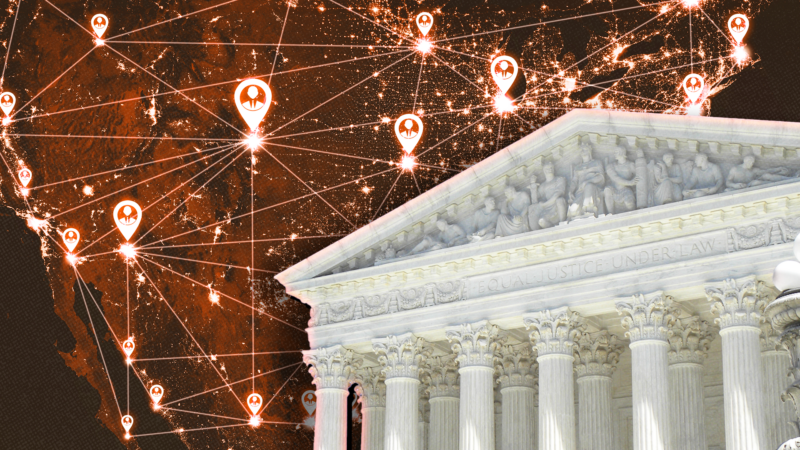
Scotus-Geo-4-8 | Mathieu Landretti/Dreamstime
(Mathieu Landretti/Dreamstime)

In Carpenter v. United States (2018), the U.S. Supreme Court held that warrantless government tracking of cellphone users via their cellphone location records violated the constitutional right to be free from unreasonable search and seizure. "A person does not surrender all Fourth Amendment protection by venturing into the public sphere," the Court said. "We decline to grant the state unrestricted access to a wireless carrier's database of physical location information."

Later this month, the justices will hear oral arguments in another case that sits at the intersection of cutting-edge technology and the Fourth Amendment. And just like in Carpenter, the privacy rights of millions will once again be at stake.

You’re reading Injustice System from Damon Root and Reason. Get more of Damon’s commentary on constitutional law and American history.

This field is for validation purposes and should be left unchanged.

At issue in the April 27 oral arguments in Chatrie v. United States is something known as a geofence warrant. It's a law enforcement tool in which a tech company is required to hand over user information for all devices, such as cellphones, within a particular geographic area and specific period of time. In this case, a geofence warrant was served on Google by the police. That warrant told Google to search the location history of every one of its users in order to determine which users were present in the vicinity of a bank robbery. Okello Chatrie was ultimately convicted based on the information obtained via this geofence warrant.

According to Chatrie and his lawyers, "the geofence warrant was an unconstitutional general warrant [that] compelled Google to conduct a fishing expedition through millions of Google accounts, without any basis for believing that any one of them would contain incriminating evidence." This "technology may be novel," they told the Court, "but the constitutional problem it presents is not. The Fourth Amendment was born of the Founders' revulsion for general warrants and writs of assistance—instruments that allowed the government to search first and develop suspicions later."

The Trump administration has countered by arguing that Chatrie "had no reasonable expectation of privacy in the short-term location information, which he voluntarily allowed Google to collect." That argument is based on something known as the third-party doctrine that, as the Supreme Court explained in Smith v. Maryland (1979), holds that "a person has no legitimate expectation of privacy in information he voluntarily turns over to third parties."

But the Supreme Court's recent Carpenter decision is now an additional factor that must be weighed whenever the third-party doctrine is invoked. In Carpenter, the Trump administration similarly invoked the third-party doctrine in support of warrantless cellphone data tracking. But the Supreme Court didn't buy it. "Whether the Government employs its own surveillance technology…or leverages the technology of a wireless carrier," the Court said in Carpenter, "we hold that an individual maintains a legitimate expectation of privacy in the record of his physical movements as captured through [cell site location information]."

As the above passage indicates, the logic of Carpenter would seem to pose a big problem for the Trump administration's position in Chatrie. On top of that, as the Cato Institute pointed out in the amicus brief it filed, "under state law and Google's user agreements, Chatrie may own his Location History records." The reason why that matters is because "property rights lie at the heart of the Fourth Amendment, and they do not dissolve merely because one's records are stored by a third party."

This case seems to have all the makings of a big win for Fourth Amendment advocates. Stay tuned.

Start your day with Reason. Get a daily brief of the most important stories and trends every weekday morning when you subscribe to Reason Roundup.

This field is for validation purposes and should be left unchanged.

NEXT: Trump v. Second Amendment: The Administration Is Trying To Selectively Apply Gun Rights

Damon Root is a senior editor at Reason and the author of A Glorious Liberty: Frederick Douglass and the Fight for an Antislavery Constitution (Potomac Books). His next book, Emancipation War: The Fall of Slavery and the Coming of the Thirteenth Amendment (Potomac Books), will be published in June 2026.

Supreme CourtPrivacyFourth AmendmentPoliceLaw & GovernmentConstitutionTrump AdministrationCriminal JusticeCivil Liberties
Share on FacebookShare on XShare on RedditShare by emailPrint friendly versionCopy page URL Add Reason to Google
Media Contact & Reprint Requests

Show Comments (0)

Latest

Lindsey Graham Says the President Can Start a War, but Only Congress Can End It

Joe Lancaster | 4.9.2026 8:00 AM

The Supreme Court's Next Big Fourth Amendment Case

Damon Root | 4.9.2026 7:00 AM

Trump v. Second Amendment: The Administration Is Trying To Selectively Apply Gun Rights

Jacob Sullum | From the May 2026 issue

Pete Buttigieg on Immigration, Policing, and His Pitch to Libertarians

Nick Gillespie | From the May 2026 issue

Brickbat: Hong Kong Crackdown

Charles Oliver | 4.9.2026 4:00 AM

Recommended

  • About
  • Browse Topics
  • Events
  • Staff
  • Jobs
  • Donate
  • Advertise
  • Subscribe
  • Contact
  • Media
  • Shop
  • Amazon
Reason Facebook@reason on XReason InstagramReason TikTokReason YoutubeApple PodcastsReason on FlipboardReason RSS Add Reason to Google

© 2026 Reason Foundation | Accessibility | Privacy Policy | Terms Of Use

This site is protected by reCAPTCHA and the Google Privacy Policy and Terms of Service apply.

r

I WANT FREE MINDS AND FREE MARKETS!

Help Reason push back with more of the fact-based reporting we do best. Your support means more reporters, more investigations, and more coverage.

Make a donation today! No thanks
r

I WANT TO FUND FREE MINDS AND FREE MARKETS

Every dollar I give helps to fund more journalists, more videos, and more amazing stories that celebrate liberty.

Yes! I want to put my money where your mouth is! Not interested
r

SUPPORT HONEST JOURNALISM

So much of the media tries telling you what to think. Support journalism that helps you to think for yourself.

I’ll donate to Reason right now! No thanks
r

PUSH BACK

Push back against misleading media lies and bad ideas. Support Reason’s journalism today.

My donation today will help Reason push back! Not today
r

HELP KEEP MEDIA FREE & FEARLESS

Back journalism committed to transparency, independence, and intellectual honesty.

Yes, I’ll donate to Reason today! No thanks
r

STAND FOR FREE MINDS

Support journalism that challenges central planning, big government overreach, and creeping socialism.

Yes, I’ll support Reason today! No thanks
r

PUSH BACK AGAINST SOCIALIST IDEAS

Support journalism that exposes bad economics, failed policies, and threats to open markets.

Yes, I’ll donate to Reason today! No thanks
r

FIGHT BAD IDEAS WITH FACTS

Back independent media that examines the real-world consequences of socialist policies.

Yes, I’ll donate to Reason today! No thanks
r

BAD ECONOMIC IDEAS ARE EVERYWHERE. LET’S FIGHT BACK.

Support journalism that challenges government overreach with rational analysis and clear reasoning.

Yes, I’ll donate to Reason today! No thanks
r

JOIN THE FIGHT FOR FREEDOM

Support journalism that challenges centralized power and defends individual liberty.

Yes, I’ll donate to Reason today! No thanks
r

BACK JOURNALISM THAT PUSHES BACK AGAINST SOCIALISM

Your support helps expose the real-world costs of socialist policy proposals—and highlight better alternatives.

Yes, I’ll donate to Reason today! No thanks
r

FIGHT BACK AGAINST BAD ECONOMICS.

Donate today to fuel reporting that exposes the real costs of heavy-handed government.

Yes, I’ll donate to Reason today! No thanks