

The Supreme Court's Next Big Fourth Amendment Case
How the digital privacy rights of millions are at stake in Chatrie v. United States.
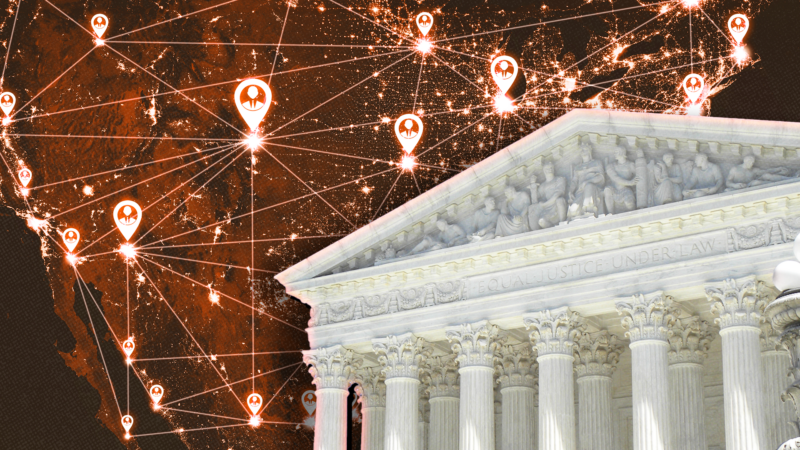
In Carpenter v. United States (2018), the U.S. Supreme Court held that warrantless government tracking of cellphone users via their cellphone location records violated the constitutional right to be free from unreasonable search and seizure. "A person does not surrender all Fourth Amendment protection by venturing into the public sphere," the Court said. "We decline to grant the state unrestricted access to a wireless carrier's database of physical location information."
Later this month, the justices will hear oral arguments in another case that sits at the intersection of cutting-edge technology and the Fourth Amendment. And just like in Carpenter, the privacy rights of millions will once again be at stake.
You’re reading Injustice System from Damon Root and Reason. Get more of Damon’s commentary on constitutional law and American history.
At issue in the April 27 oral arguments in Chatrie v. United States is something known as a geofence warrant. It's a law enforcement tool in which a tech company is required to hand over user information for all devices, such as cellphones, within a particular geographic area and specific period of time. In this case, a geofence warrant was served on Google by the police. That warrant told Google to search the location history of every one of its users in order to determine which users were present in the vicinity of a bank robbery. Okello Chatrie was ultimately convicted based on the information obtained via this geofence warrant.
According to Chatrie and his lawyers, "the geofence warrant was an unconstitutional general warrant [that] compelled Google to conduct a fishing expedition through millions of Google accounts, without any basis for believing that any one of them would contain incriminating evidence." This "technology may be novel," they told the Court, "but the constitutional problem it presents is not. The Fourth Amendment was born of the Founders' revulsion for general warrants and writs of assistance—instruments that allowed the government to search first and develop suspicions later."
The Trump administration has countered by arguing that Chatrie "had no reasonable expectation of privacy in the short-term location information, which he voluntarily allowed Google to collect." That argument is based on something known as the third-party doctrine that, as the Supreme Court explained in Smith v. Maryland (1979), holds that "a person has no legitimate expectation of privacy in information he voluntarily turns over to third parties."
But the Supreme Court's recent Carpenter decision is now an additional factor that must be weighed whenever the third-party doctrine is invoked. In Carpenter, the Trump administration similarly invoked the third-party doctrine in support of warrantless cellphone data tracking. But the Supreme Court didn't buy it. "Whether the Government employs its own surveillance technology…or leverages the technology of a wireless carrier," the Court said in Carpenter, "we hold that an individual maintains a legitimate expectation of privacy in the record of his physical movements as captured through [cell site location information]."
As the above passage indicates, the logic of Carpenter would seem to pose a big problem for the Trump administration's position in Chatrie. On top of that, as the Cato Institute pointed out in the amicus brief it filed, "under state law and Google's user agreements, Chatrie may own his Location History records." The reason why that matters is because "property rights lie at the heart of the Fourth Amendment, and they do not dissolve merely because one's records are stored by a third party."
This case seems to have all the makings of a big win for Fourth Amendment advocates. Stay tuned.




