
Trump Thinks Any Judge Who Rules Against Him Is in League With the 'Radical Left'
The president's wildly inaccurate ideological labels are no more meaningful than his other ad hominem attacks on people who disagree with him.
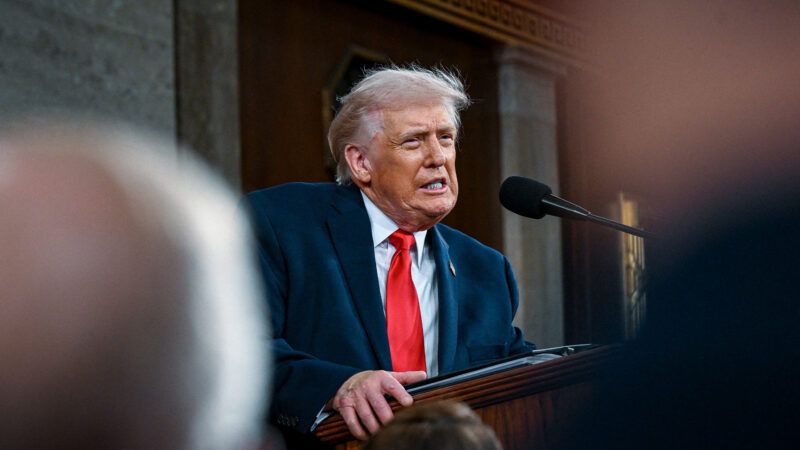
During his State of the Union address on Tuesday, President Donald Trump described the Supreme Court's rejection of his "emergency" tariffs as a "very unfortunate ruling." That was mild compared to what the president said immediately after the Court's decision in Learning Resources v. Trump.
On the day of that ruling, Trump condemned the Republican appointees who voted against him as "fools and lapdogs for the RINOs and the radical-left Democrats." He was especially angry at two of his own nominees, Justices Neil Gorsuch and Amy Coney Barrett, saying they were "very unpatriotic and disloyal to our Constitution," "an embarrassment to their families," and cowardly pawns of his political opponents, whom he describes as "Marxists and communists and fascists."
That episode illustrated Trump's habit of deploying wildly inaccurate ideological labels against people who disagree with him. The purpose of these epithets is not to describe the actual views of those people but to cast them as extremists whose opinions are not worth considering. Although Trump ostensibly is talking about the politics of his opponents, the terms he uses are so detached from reality that they communicate nothing beyond his personal revulsion.
In that respect, Trump's ideological labels are no different from his other ad hominem attacks. Trump diagnoses his foes as "sick," "crazy," and "deranged" (a tactic echoed by many of his critics). He calls them "sinister" and "evil" people who are "trying to destroy our country" because they "hate our country." He deems them a "disgrace to our nation" because "they're against anything that makes America strong, healthy, and great again." He says they "live like vermin within the confines of our country," constituting "the enemy from within." Although Trump's ideological characterizations might seem more substantive, they are no more informative than his allegations of mental illness, malign motives, disloyalty, or kinship with cockroaches.
"We cannot allow a handful of communist radical left judges to obstruct the enforcement of our laws and assume the duties that belong solely to the president of the United States," Trump declared at a rally in Michigan last April. "Judges are trying to take away the power given to the president to keep our country safe, and it's not a good thing."
Trump did not specify exactly which decisions he had in mind. But it hardly matters, because he reflexively portrays rulings against him as a reflection of leftist bias, even when that charge makes no sense.
Consider what Trump said after the U.S. Court of Appeals for the Federal Circuit ruled against his tariffs in September. He described the court as "Highly Partisan," implying that its reasoning was driven by political affiliation, and said the majority was "a Radical Left group of judges," implying that the result was dictated by ideology rather than a careful consideration of the facts and the law.
While it is true that six of the judges who thought Trump had exceeded his legal authority were appointed by Democratic presidents (Bill Clinton, Barack Obama, and Joe Biden), the majority also included Alan D. Lourie, who was nominated by George H.W. Bush in 1990. Notably, Lourie was one of four judges who went further than the majority, arguing that the International Emergency Economic Powers Act (IEEPA), the 1977 law on which Trump was relying, "does not authorize the President to impose any tariffs."
Meanwhile, the dissent was written by Judge Richard Taranto, an Obama appointee who was conspicuously sympathetic to the Trump administration during oral argument. Taranto's opinion was joined by another Obama appointee and two judges nominated by George W. Bush.
In Learning Resources, the Supreme Court upheld the Federal Circuit's decision, siding with the four judges who concluded that IEEPA does not authorize tariffs at all. True to form, Trump accused the three Republican appointees in the majority of catering to "radical-left Democrats," even though their conclusions were faithful to conservative principles.
Trump maintained that IEEPA empowers the president to impose any taxes he wants on any imports he chooses from any country he decides to target for any length of time he considers appropriate whenever he deems it necessary to "deal with" an "unusual and extraordinary threat" from abroad that constitutes a "national emergency." And according to Trump, the only way to restrain that power would be the veto-proof congressional majority required to terminate the supposed emergency.
That was a bold claim, to say the least, and there were plenty of reasons to question it, starting with the fact that IEEPA does not mention tariffs and had never before been used to impose them. Trump's power grab raised obvious concerns about the rule of law and the separation of powers.
Chief Justice John Roberts, who wrote the principal opinion in Learning Resources, thought Trump's reading of IEEPA ran afoul of the "major questions" doctrine, which says the executive branch can exercise delegated powers of "vast 'economic and political significance'" only with clear congressional approval. Gorsuch agreed, and so did Barrett, although she reframed that doctrine as "an ordinary application of textualism."
The other three justices—the ones Trump said were "an automatic no" because "they're against anything that makes America strong, healthy, and great again"—saw no need to rely on the major questions doctrine. But they agreed that IEEPA cannot reasonably be read as conferring the untrammeled authority that Trump perceived.
There was nothing remotely "radical left" about any of that reasoning. In particular, the major questions doctrine has been championed by the Supreme Court's conservative wing (including the three dissenters, who implausibly argued that it did not apply in this case). The Court's conservative majority had implicitly or explicitly relied on the doctrine to reject assertions of power by Democratic presidents, including the Biden administration's workplace vaccine mandate, nationwide eviction moratorium, and mass cancellation of student debt. If the justices were applying the doctrine consistently, there was no reason to think Republican presidents would be immune from its implications.
Trump's invocation of the Alien Enemies Act (AEA) against alleged members of the Venezuelan gang Tren de Aragua likewise presented a question of statutory interpretation. And as with his IEEPA tariffs, there was ample reason to question his reading of the law. Yet after James Boasberg, chief judge of the U.S. District Court for the District of Columbia, granted the temporary restraining order sought by detainees threatened with summary deportation under the AEA, Trump condemned him as a "Radical Left Lunatic of a Judge, a troublemaker and agitator" who "should be IMPEACHED!!!"
One issue in that case was whether it belonged in Boasberg's court to begin with. The Supreme Court ultimately decided it did not, saying AEA detainees had to seek relief by filing habeas corpus petitions in Texas, where they were held. But the justices also noted that the detainees were entitled to due process, including "judicial review" addressing "questions of interpretation and constitutionality."
A month after that ruling, Fernando Rodriguez Jr., a Trump-appointed federal judge in Texas, rejected the president's interpretation of the AEA, saying "the historical record renders clear that the President's invocation of the AEA…exceeds the scope of the statute and is contrary to the plain, ordinary meaning of the statute's terms." Did Trump accidentally nominate a "Radical Left Lunatic" to the U.S. District Court for the Southern District of Texas?
Four months later, the U.S. Court of Appeals for the 5th Circuit likewise rejected Trump's use of the AEA, saying he had asserted a nonexistent "invasion or predatory incursion." The 5th Circuit has a reputation as the country's most conservative federal appeals court, and the majority opinion in that case was written by Judge Leslie H. Southwick, a George W. Bush appointee who faced intense opposition from Democrats when he was nominated in 2007.
John C. Coughenour, whom Ronald Reagan appointed to the U.S. District Court for the Western District of Washington in 1981, likewise does not seem like a "Radical Left Lunatic." Yet he was the first judge to push back against Trump's attempt to unilaterally restrict birthright citizenship.
"I've been on the bench for over four decades," Coughenour remarked when he granted a temporary restraining order against Trump's decree three days after it was issued. "I can't remember another case where the question presented [was] as clear as this one is. This is a blatantly unconstitutional order." In a case that the Supreme Court will consider on April 1, Joseph Laplante, a federal judge in New Hampshire who was appointed by George W. Bush, likewise concluded that Trump's executive order "contradicts the text of the Fourteenth Amendment and the century-old untouched precedent that interprets it."
On Monday, Trump predicted that the Supreme Court, for which he said he has "a complete lack of respect," will rule against him in that case. Why? Not because he is wrong on the merits, Trump said, but because the justices are so determined to oppose him that they will "find a way to come to the wrong conclusion," presumably because they are in thrall to the "radical-left Democrats" whose influence he blamed for the tariff decision.
Trump's underlings take their cues from him. On Thursday, Patrick Schiltz, the chief judge of the U.S. District Court for the District of Minnesota, renewed his complaint about the Justice Department's failure to obey judicial orders in immigration cases, threatening to hold federal officials in criminal contempt. Tricia McLaughlin, the assistant secretary for public affairs at the Department of Homeland Security (DHS), described Schiltz's beef as a "diatribe from this activist judge," adding that "we will not be deterred by activists either in the streets or on the bench."
Schiltz is a George W. Bush appointee who clerked for conservative icon Antonin Scalia on the U.S. Court of Appeals for the D.C. Circuit, helped Scalia prepare for his Supreme Court confirmation hearings, and again served as Scalia's clerk after he was confirmed. But as McLaughlin tells it, Schiltz is in league with the "anti-ICE agitators" and "rioters" threatening DHS employees who are only trying to protect Americans from "the worst of the worst criminal aliens."
The Trump administration's reflexive tarring of its critics as crazy leftists may have reached its apogee when the Federal Trade Commission described the Chamber of Commerce, which is not known for its radicalism, as "a left-wing, open borders supporting activist group." The provocation, as Reason's Jack Nicastro notes, was the organization's criticism of a regulation regarding pre-merger notifications.
