

Iowa Officials Arrested This Guy for Criticizing Them—Twice. A Federal Judge Says They Are Liable.
A mayor and a police chief "mistook their authority to maintain order for a license to suppress criticism," says U.S. District Judge Stephanie Rose.
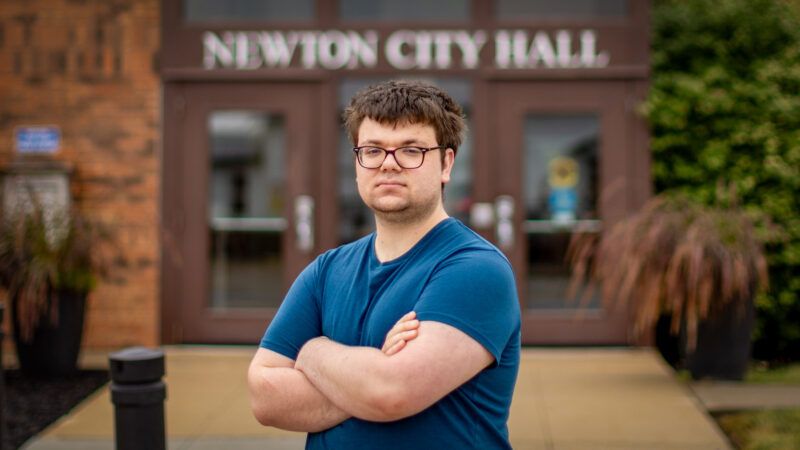
As Noah Petersen saw it, he was exercising his freedom of speech when he criticized the Newton, Iowa, police department during the public comment period at a city council meeting. But according to Mayor Michael Hansen and Police Chief Rob Burdess, who handcuffed Petersen and sent him to jail, his comments made him guilty of disorderly conduct.
Undeterred, Petersen spoke again at a city council meeting three weeks later, describing Hansen and Burdess as "fascists" based on his personal experience with their intolerance of dissent. Seemingly eager to confirm that critique, Hansen ordered Petersen to stop talking and leave the meeting. On his way out the door, Petersen was arrested again on the same bogus charge.
In both cases, Hansen deemed Petersen "out of order" because he made "derogatory statements." The resulting arrests, a federal judge ruled on Monday, plainly violated Petersen's rights under the First, Fourth, and 14th amendments. "Petersen's arrests were the deliberate product of officials who mistook their authority to maintain order for a license to suppress criticism—and of a city that ratified their conduct rather than correct it," U.S. District Judge Stephanie M. Rose writes in Petersen v. Newton. "The Constitution does not permit that outcome."
The defendants' conduct was so obviously unconstitutional, Rose concluded, that they cannot claim qualified immunity, which shields state and local officials from federal civil rights claims unless their alleged conduct violated "clearly established" law. Since "the constitutional principles governing this case have been settled for generations," Rose says, Hansen and Burdess "were not navigating uncertain terrain."
The decision is "a major win for government accountability," says James Knight, an attorney at the Institute for Justice, which represented Petersen. "From small towns to federal agents, government officials don't get to use the power of arrest to punish protected speech. The First Amendment doesn't allow public meetings to become praise-only zones—and it certainly doesn't allow officials to weaponize the police against dissent."
Petersen was born and raised in Newton, where he lives with his parents and has a job installing fiber-optic cable for Meta. According to the federal lawsuit that he filed against Hansen, Burdess, and the city in October 2023, his interest in local police practices was piqued by the arrest of an acquaintance, Tayvin Galanakis, who was pulled over by Officer Nathan Winters in August 2022, ostensibly because he had his high-beam headlights on.
Although Winters accused Galanakis of driving while intoxicated, a breath test detected no alcohol. Winters then suggested that Galanakis was under the influence of marijuana, which also was not true: After Winters arrested Galanakis and took him to jail, an officer trained in drug recognition found "no evidence" and "no information" indicating that Galanakis was "under the influence of drugs or alcohol."
Petersen looked into Winters' background and discovered that the officer was subject to a domestic violence restraining order. Although Winters was never charged or convicted, Rose notes, he "had not disputed his ex-girlfriend's affidavit detailing instances of physical abuse." After unsuccessfully seeking records that might cast light on the allegations against Winters and the decision to employ him as a police officer, Petersen decided to raise the issue at a city council meeting on October 3, 2022.
Petersen had three minutes to speak, but he did not get far. He recommended that the city "defund" the Newton Police Department, which he described as "a violent, civil and human rights violating organization [that does] not make your community safer." He added that "they are also pro–domestic abuse because they are currently employing a domestic abuser and choosing to not release the records about that domestic abuser."
At that point, Hansen, who was presiding over the city council meeting, interrupted Petersen, banging his gavel. Petersen was "out of order," Hansen said, demanding that he shut up. The mayor averred that Petersen had violated a city council policy barring "derogatory statements or comments" about "any individual." Under that policy, Hansen had complete discretion in deciding when someone had violated the rule. Burdess, who attended city council meetings, was charged with enforcing the mayor's edicts.
Petersen argued that Hansen was "violating the First Amendment." After "some back and forth between the mayor, Noah, and the police chief," the complaint says, Hansen told Burdess to eject Petersen from the meeting. When Burdess grabbed Petersen by the arm and threatened to arrest him, Petersen "reiterated his right to criticize the government" and said "he wanted to finish his three minutes of speaking." Burdess handcuffed Petersen, arrested him, and sent him to jail, where he was "booked, strip-searched, forced to wear an orange jumpsuit, and put in a cell." He remained there until his parents posted bail later that night.
According to the criminal complaint against Petersen, he committed disorderly conduct by disturbing a "lawful assembly or meeting" without "lawful authority or color of authority." Although Petersen "was instructed to leave the assembly," the complaint said, he "refused to leave." Under "victim information," the city filled in "SOCIETY" as the last name. No first name was given.
Since county prosecutors were understandably reluctant to pursue that charge, the city took over the case. On February 1, 2023, four months after Petersen's alleged crime, a Jasper County judge acquitted him.
Petersen "was not a spectator, but rather a participant in a limited public forum during the recognized citizen participation portion of the City Council's meeting," Magistrate Peter Lahn noted. "He used no profane language, nor did he identify any individual by name. He did not act in any objectively unreasonable manner. He read a prepared statement relating to the basic city service of policing. While some may not agree with the content of his comments, the Court finds the statements made were not 'derogatory' nor about an 'individual.' In the event the statements could be found 'derogatory' or a comment about an 'individual' as used in the City Council's rules, the Court finds these terms vague and overbroad. As applied in this particular instance, the Newton City Council rule is violative of the First Amendment."
Meanwhile, Petersen had been charged with a second count of disorderly conduct, based on his comments at a city council meeting on October 24, 2022. Petersen opened by alluding to Galanakis' arrest, questioning the use of "armed goons" to nab people for minor traffic offenses, criticizing the "racist, incredibly harmful drug war," and recommending harm reduction measures as an alternative to "locking people up in cages for what they either choose to put in their body or what they sell to others to put in their own body." He also had some thoughts about addressing the "housing crisis."
Hansen let all of that slide. But when Petersen noted his arrest at the previous meeting and remarked that "the top two fascists in this town, Mayor Michael Hansen and the chief of police, need to be removed from office," Hansen's gavel came down. Although Petersen had not used up his three minutes, Hansen told him his time was over and instructed him to sit down. After Petersen refused, Hansen suspended the meeting.
Petersen and Hansen rehashed their argument about whether the right to criticize government officials is protected by the First Amendment. But Petersen eventually started to leave, at which point Burdess and another officer handcuffed and arrested him.
"I make no apologies for that whatsoever," Hansen announced after the arrest. City council meetings, he declared, are not an appropriate forum to be "political" or "politically active on issues." If that is your intent, he said, you should "go do your activism somewhere where somebody cares."
The second criminal complaint against Petersen cited the same statute as the first but listed "City of Newton" rather than "SOCIETY" as the "victim." And while the first complaint described the essence of Petersen's crime as refusing to leave the city council meeting, the second complaint explicitly said he was arrested because he was "speaking negatively towards the Mayor of Newton and the Police Chief"—coincidentally, the same two officials who were charged with applying and enforcing the rule against "derogatory statements."
After Lahn acquitted Petersen of the first disorderly conduct charge, the city quietly dropped the second one. But in response to Petersen's lawsuit, Hansen and Burdess argued that Petersen's speech was not protected by the First Amendment because it was defamatory. They also claimed both arrests were based on probable cause to believe Petersen had committed a crime.
You've got to be kidding me, Rose essentially responds in Monday's ruling, although she goes into more detail. "Petersen's reference to an unnamed officer as a 'domestic abuser' was not defamatory because it was substantially true," she writes, noting that "Winters was subject to a civil no-contact order related to domestic abuse allegations" that he never rebutted. "Petersen's characterization of Mayor Hansen and Chief Burdess as 'fascists' represents classic political hyperbole that courts have consistently recognized as protected opinion rather than actionable defamation."
As for whether Hansen and Burdess had probable cause to arrest Petersen, Rose notes that "Petersen had lawful authority to speak," since "he was properly recognized and speaking within his allotted time." She adds that "Petersen did not engage in the type of disruptive conduct that the disorderly conduct statute was designed to address." He "spoke calmly, used no profanity, made no threats, and remained behind the podium throughout his remarks." Furthermore, "the circumstances surrounding both arrests demonstrate that they were motivated by the content of Petersen's criticism rather than any legitimate concern for meeting decorum."
At the first meeting, Petersen's remarks were preceded by comments from residents who severely criticized Newton's rental inspectors, using adjectives such as "ridiculous," "crazy," "frustrating," "hounding," and "unbelievable." They also suggested that inspectors were seeking to profit from their overzealous enforcement activity. Although Hansen objected to some of those comments, calling them "totally false," he did not assert that the speakers had violated the rule against "derogatory statements." He reserved that judgment for Petersen's criticism of the police department.
That contrast, Rose says, shows "the Rule operated to silence criticism of the police while permitting equally pointed criticism of others." In fact, "no one had ever been arrested at a Newton city council meeting before Petersen, despite years of contentious public meetings and the Rule's presence on the agenda since 2019." And the second criminal complaint against Petersen "explicitly identified his critical remarks about the Mayor and Police Chief as the basis for his arrest."
Hansen conceded that "praising the police department would, 'of course,' not violate the Rule," Rose notes. "Criticism was restricted; praise was welcomed. That is quintessential viewpoint discrimination."
The evidence, Rose concludes, "strongly supports" Petersen's claim that Hansen and Burdess violated the First Amendment by retaliating against him for constitutionally protected speech. "The Rule's inconsistent application, Hansen's admission that supportive comments would never trigger enforcement, and his post-arrest dismissal of the council chambers as no place for 'activism' all point in the same direction," she writes. "Enforcement decisions turned not on neutral concerns for decorum but on the viewpoint expressed. Petersen was targeted because he criticized the police department and city leadership. No reasonable jury could conclude otherwise on this record."
Should Hansen and Burdess have known they were violating the First Amendment? "By October 2022, the constitutional principles governing this case had long been settled," Rose writes. Those well-established principles include "the right to criticize government officials," "the prohibition against viewpoint discrimination," and "the prohibition against First Amendment retaliation." Given all of the case law recognizing those principles, Rose says, "any reasonable official would have recognized that silencing criticism of government officials under the guise of preventing 'derogatory comments' raises serious constitutional concerns."
Although "Hansen claims he reasonably believed Petersen's speech was defamatory," Rose writes, "this professed belief was objectively unreasonable as to both statements at issue….Nor can Hansen characterize his decisions as split-second judgments warranting deference. Unlike police officers confronting tense, rapidly evolving situations, Hansen had ample time to consider his actions."
Burdess "claims he was simply following Hansen's determination that Petersen violated the Rule," Rose notes. "But officers have an independent duty to assess the lawfulness of an arrest and cannot escape liability by claiming they were merely following orders that violate clearly established rights."
Petersen's arrests "violated not only the First Amendment but the Fourth Amendment as well," Rose writes. "An arrest unsupported by probable cause is an unreasonable seizure, and the constitutional infirmities that doomed Defendants' First Amendment defense are equally fatal here." She adds that Hansen and Burdess are also liable for these violations, since "the qualified immunity analysis for the Fourth Amendment claims follows directly from the First Amendment analysis."
Petersen also argued that his arrests violated the 14th Amendment's guarantee of equal protection. Rose agreed. "The Equal Protection Clause prohibits selective enforcement of laws based on impermissible considerations," she writes. "The evidence compels the conclusion that the Rule served as a mechanism for silencing unwelcome criticism while permitting favorable commentary. Enforcement decisions turned entirely on officials' approval of the speaker's viewpoint toward local government. This selective application motivated solely by protected criticism violates the Equal Protection Clause."
As with the First and Fourth amendment violations, Rose says, neither Hansen nor Burdess can claim qualified immunity. "The right to equal protection from selective enforcement was clearly established by October 2022," she writes. "Officials cannot enforce rules selectively based on hostility to a speaker's viewpoint. They cannot
punish the exercise of constitutional rights through pretextual enforcement. Any reasonable official would have recognized that arresting Petersen while permitting
others to violate the same rule based on the target of their criticism violates equal protection."
It is hard to imagine a more resounding defeat for petty local tyrants who try to treat speech that offends them as a crime. Rose "reaffirmed a basic American principle: public meetings are for the public, and you don't lose your First Amendment rights when you step up to the microphone," Petersen says. "Newton's leaders tried to treat public comment as a place where only praise is welcome—and when I wouldn't be quiet, they had me arrested. I'm grateful the judge held the city accountable, and I hope this ruling sends a clear message everywhere: government officials can't use the police to silence people who speak out."




