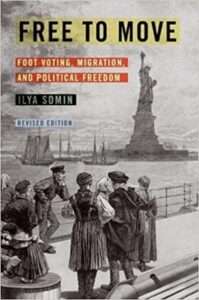
The American Enterprise Institute has posted a video of a recent event they hosted, at which I spoke about my book Free to Move: Foot Voting, Migration, and Political Freedom. The event included commentary by Emily Hamilton of the Mercatus Center (a leading expert on housing policy), and economist Filipe Campante of Johns Hopkins University. Economist Stan Veuger of AEI moderated.
Unlike many of the other events I have done about the book, in this one the commentary and discussion focused primarily on the implications of my argument for internal freedom of movement, rather than international migration. For example, there was extensive discussion of the extent to which zoning reform can increase opportunities for foot voting and increase US economic growth, and whether private planned communities, such as HOAs, expand foot voting options or potentially constrict them.
The revised edition of Free to Move is now available on Amazon for a mere $9.35. Vote with your feet for this deal, while it lasts! Makes a great graduation present for students interested in migration policy, federalism, democracy, self-determination, and other topics covered in the book. As always, 50% of all royalties generated by Free to Move go to help refugees. With Russia's brutal war of aggression against Ukraine, the need is now greater than it has been in many years.
I recently appeared on Prof. Eric Segall's "Supreme Myths" podcast. We talked about several subjects, including my book Free to Move: Foot Voting, Migration, and Political Freedom, whether George Mason University (where I teach) was justified in renaming its law school after the late Justice Antonin Scalia, and the state of originalism.
The Scalia renaming issue strikes me as far less significant than the others we talked about. But it has broader implications for both assessments of Scalia and the issue of which historical figures are worthy of being honored in this way, and why.
It was an honor to appear on a podcast whose previous guests include numerous prominent legal scholars and commentators, including Volokh Conspiracy co-bloggers Randy Barnett, Orin Kerr, Eugene Volokh, and Keith Whittington, among others. As is evident from the podcast, Eric Segall and I have many differences, including on the topics of originalism and the Scalia renaming. But I commend him for his openness to civil debate and discussion, with advocates of a wide range of views, including those he strong disagrees with.
I should note my memory failed me at one point in the podcast, when I said the European Union has a population of 600 million. The correct figure is actually about 447 million. I apologize for that mistake.
Judge Jackson has submitted her responses to written questions. I haven't read through the entire packet, but I did find one error. She wrote on p. 64 of the PDF:
Finally, I would note that I am pleased to be the sixth woman nominated to serve on the Supreme Court.
The Thomas Jefferson High School for Science and Technology. Fairfax, Virginia.
Yesterday, the US Court of Appeals for the Fourth Circuit stayed a trial court ruling against the new admissions policy at the Thomas Jefferson High School for Science and Technology, in Fairfax, Virginia (known as "TJ"). The new admissions policy was racially neutral on its face. But federal district Judge Claude Hilton ruled that it was unconstitutional because it was adopted for the purpose of promoting "racial balancing" and, in the process, discriminating against Asian Americans. I wrote about the district court decision (which I think was correct) in greater detail here.
Yesterday's 2-1 ruling by a divided Fourth Circuit panel stays the trial decision, with the result that the new admissions system will go into effect for at least one year. It also signals that the Fourth Circuit might well uphold the policy when they get around to deciding the case on the merits (probably sometime in the next few months, or sooner).
The majority did not issue an official opinion of the court (which is not unusual in rulings on procedural issues, like this one). But Judge Toby Heytens did put out a concurring opinion, which explains his reasoning. Here's a key excerpt:
I… am skeptical of the district court's conclusion that there is no genuine issue of material factimplicated by its conclusionthat the Board adopted the current admissions policy for a constitutionally impermissible purpose…. The centerpiece of the district court's analysis on this point is its statement that "the Board's policy was designed to increase Black and Hispanic enrollment, which would, by necessity, decrease the representation of Asian-Americans at TJ."…. (emphasis added).
That approach seems flatly inconsistent with the Supreme Court's decision in Personnel Administrator of Massachusetts v. Feeney, 442 U.S. 256, 279 (1979). Feeney involved a constitutional challenge to a Massachusetts statute mandating a categorical employment preference for qualified veterans over qualified non-veterans. 442 U.S. at 259. Even though "over 98% of the veterans in Massachusetts were male," id. at 270—and even though no one claimed that those who crafted and decided to maintain the law were unaware of that fact—the Supreme Court declined to apply heightened scrutiny. In language directly relevant to this case, the Court specifically held that "awareness of consequences" is not enough to show discriminatory intent and that a plaintiff challenging a facially neutral policy must show that a decisionmaker acted "at least in part 'because of,' not merely 'in spite of,' its adverse effects upon an identifiable group…."
Nor does the fact that the current policy may have been adopted, at least in part, with the expectation that it would "increase Black and Hispanic enrollment" change this analysis…. UnderFeeney, the question is whether the decisionmaker acted "at least in part because of [a race neutral policy's]adverseeffects upon an identifiable group," 442 U.S. at 279…, and the Coalition has never claimed that the challenged policy was motivated by or has any sort of adverse effect on Black or Hispanic applicants.
The most significant flaw in this argument is that Judge Heytens ignores extensive evidence that Fairfax school officials were in fact motivated by a desire to reduce the number of Asian-American students admitted. That reduction was not merely an incidental side effect of the new policy. I summarized some of that evidence here:
[E]vidence [shows] that some decision-makers were also motivated by bias against Asian-American students, such as claims that having too many of them would damage TJ's "culture," negative stereotypes about Asian-American parents and students, and state legislator Mark Keam's fulminations about the "unethical ways" Asian-American parents "push their kids into [TJ]," when those parents are "not even going to stay in America," but instead are "using [TJ] to get into Ivy League schools and then go back to their home country." Keam's sentiments are relevant because, as Judge Hilton found, Fairfax County school officials were influenced in part by pressure from the state government.
Longstanding Supreme Court precedent holds that such evidence of unconstitutional motivation for "facially neutral" policies shifts the burden of proof to the government to show that they would have enacted the same policy even in the absence of illicit motives.
In addition, there is a big difference between the Feeney case and the TJ litigation. In Feeney, the Court not only concluded that the state wasn't motivated by any desire to harm women, but also reasoned that the policy in question (job preferences for veterans) was not motivated by a desire to help men, as such. By contrast, extensive evidence shows that Fairfax County officials were motivated by a desire to promote racial balancing at TJ by increasing the percentage of students from some racial groups, particularly African-Americans and Hispanics.
Even if you set aside specific anti-Asian motives, it is inevitably the case that discriminating in favor of one racial group disadvantages other groups, and does so deliberately. If a public school adopted a facially neutral policy deliberately intended to increase the number of white students, thereby reducing the number of blacks, Judge Heytens would surely have to agree that it is presumptively unconstitutional - even if the evidence showed only that officials wanted to help whites and did not display any special hostility towards blacks.
I think Judge Allison Jones Rushing dealt with these issues much more persuasively in her dissent:
When motivated by discrimination, facially neutral policies like TJ's admissions plan "are just as abhorrent, and just as unconstitutional, as [policies] that expressly discriminate on the basis of race."N.C. State Conf. of NAACP v. McCrory, 831 F.3d 204, 220 (4th Cir. 2016);cf. Yick Wo v. Hopkins, 118 U.S. 356, 373– 374 (1886) (prohibiting discriminatory enforcement of facially neutral laws). A "[c]hallenger[] need not show that discriminatory purpose was the sole or even a primary motive" behind the policy, "just that it was a motivating factor."McCrory, 831 F.3d at 220….
Based on the undisputed evidence before it, the district court found that the Board pursued the policy change "at least in part 'because of,' and not merely 'in spite of,' its adverse effects" upon Asian Americans.Pers. Adm'r of Mass. v. Feeney, 442 U.S. 256, 279 (1979). Specifically, the court determined that the Board acted with an impermissible racial purpose when it sought to decrease enrollment of "overrepresented" Asian-American students at TJ to better "reflect the racial composition" of the surrounding area.As the court explained, Board member discussions were permeated with racial balancing, as were its stated aims and its use of racial data to model proposed outcomes.
The Supreme Court has repeatedly emphasized that racial balancing for its own sake is unconstitutional.See Fisher v. Univ. of Tex. at Austin, 570 U.S. 297, 311 (2013); Parents Involved in Cmty. Schs. v. Seattle Sch. Dist. No. 1, 551 U.S. 701, 729–730 (2007)…. Racial balancing is no less pernicious if, instead of using a facial quota, the government uses a facially neutral proxy motivated by discriminatory intent.And while the Supreme Court has endorsed certain race-based motivations—specificallytoremedypastintentionaldiscriminationor,inhigher education, to obtain the benefits of diversity—neither motivation is at issue here.
This ruling is not a definitive resolution of the case. It is just a procedural decision staying the trial court decision. We do not know for sure whether the third member of the panel - Judge Robert Bruce King - agrees with all of Judge Heytens' reasoning.
That said, it seems very possible that the two judges in the majority will ultimately rule n favor of the defendants on the merits. Likelihood of success on the merits is in fact one of the key criteria for an appellate court to stay a trial court judgment.
If the Fourth Circuit does ultimately reverse the trial court, the case could potentially end up in the Supreme Court, because it raises important issues about the use of facially neutral policies to achieve racial balancing that may be even more significant if - as expected - the Supreme Court issues a decision putting tighter constraints on explicit racial preferences in education, in the near future. That could well happen in the Harvard and University of North Carolina cases currently before the Supreme Court.
NOTE: My wife, Alison Somin, is one of the Pacific Legal Foundation public interest lawyers representing the plaintiffs in the TJ case. As links in one of my previous posts about this case demonstrate, I have been writing about these sorts of issues since long before Alison began working at PLF, and my views are much the same as they were before she did so.
Please enjoy the latest edition of Short Circuit, a weekly feature from the Institute for Justice.
New on the Short Circuit podcast: You win a judgment against the government on a constitutional claim, and then the government just doesn't pay up and says you can't make it. In America.
Under Brazil's Mais Médicos program, the country hires foreign doctors to bolster its medical services for poor Brazilians. Cuba, in turn, rounds up Cuban doctors and ships them out, allegedly without their consent and in violation of human trafficking laws. Four doctors escape to the U.S, where they sue the Pan American Health Organization (PAHO) for handling the money through its Washington, D.C. bank account. PAHO, for its part, claims immunity under the Constitution of the World Health Organization, which entitles it to the "privileges and immunities as may be necessary" to carry out WHO functions. D.C. Circuit: But those privileges and immunities were supposed to be spelled out in a separate agreement, which never happened. So the case goes forward.
Is the Speaker of New Hampshire's House of Representatives unlawfully discriminating against state reps who are especially vulnerable to COVID-19 by barring them from participating in proceedings remotely? First Circuit (sitting en banc): Can't say. The Speaker is entitled to absolute legislative immunity. Dissent: The point of legislative immunity is to protect legislators' ability to discharge their duties, which is not accomplished by forcing them to choose between those duties and a significant risk of death.
Friends, do please enjoy this week's vocab quiz: cergestrate, bisanguinous, three-step crazado, and pelltroon. Brought to you by Judge Selya of the First Circuit.
Shi'a man alleges he was abducted by the Taliban (who are Sunni) and forced to cook, clean, wash clothes and, on one occasion, fight. He escapes and is granted asylum in the U.S. in 2000. But in 2016, the feds decide he cannot become a permanent resident because, among other things, he used a weapon. Second Circuit: Okay, but there are some elements to the "weapons bar," and the feds didn't adequately explain in 2016 how those were met, and they can't just check those boxes now. Lots of other issues to sort out on remand.
U.S. residents with ties to Haiti sue the Haitian government and several multinational corporations, alleging that they conspired to fix the prices of remittances and telephone calls from the U.S. to Haiti. The district court dismisses the case under the "act of state doctrine." Second Circuit: Which was improper. The act of state doctrine prohibits courts from declaring foreign government acts invalid. It doesn't prohibit them from declaring foreign government acts wrongful under valid U.S. cause of action.
Third Circuit: A student expelled from Princeton after his ex accused him of sex abuse plausibly alleged that the university discriminated against him on the basis of his sex. Case undismissed.
Macon County, N.C. sheriff's deputy shoots into home from porch, killing man who had just racked a shotgun. Fourth Circuit (over a dissent): No qualified immunity. It's disputed where the man was pointing the shotgun and whether he knew the deputy was law enforcement. And some of the state-law claims should not have been dismissed either.
In the Zen tradition, indecipherable koans like "what is the sound of one hand clapping" are meant to lead us to greater truths about the universe. In that spirit, the Fourth Circuit confronts the question "can a prisoner's criminal history be held against him if he has no criminal history" and, having achieved true enlightenment, says no.
Williamson County, Tex. prosecutors lie to defendant during plea bargaining, tell him they have damning evidence that will put him away for life if he goes to trial. He pleads guilty. Yikes! There was no such evidence, and his conviction is vacated decades later. Can he sue the county over the district attorney's "closed-file policy," which allowed prosecutors to withhold evidence before trial? The Fifth Circuit says no. The policy may have enabled the prosecutors to lie, but he hasn't shown it caused them to lie.
After exhausting all state appeals, man convicted of murder seeks habeas review, alleging ineffective assistance of counsel. During closing argument, defense counsel sneezed 27 times during his 60-minute closing argument. Sixth Circuit: Indeed, counsel's failure to take a non-drowsy antihistamine—despite knowing he suffered seasonal allergies—materially prejudiced defendant's right to a fair trial. Retry him or let him go!
Allegation: After Nashville police officer is exonerated of child abuse (and the Cheatham County, Tenn. investigator who caused her indictment resigns in disgrace), she continues to face a baseless internal affairs investigation, during which she is pressured to accept a demotion. Sixth Circuit: Her state-law malicious prosecution claims survive state-law qualified immunity (which is pretty much the same as federal QI), and defendants' arguments to the contrary range from tenuous to more tenuous.
Allegation: Pretrial detainee tells Butler County, Ky. jail officials he's concerned for his safety because other detainees think he's a snitch, and sure enough he's knocked unconscious and suffers a broken jaw soon after. Can he sue a guard? District court: No. Sixth Circuit (over a dissent): Yes.
Allegation: After attempting to rob a gas station, man flees, crashes his vehicle. He exits and attempts to comply with Indianapolis officers' conflicting commands. They shoot him as he reaches for his ID. (He survives.) Seventh Circuit: To a jury this must go. No qualified immunity.
A Kansas inmate's claim that he was put in solitary in retaliation for filing a lawsuit should not have been dismissed, says the Tenth Circuit; but there is no constitutionally protected interest in jailhouse lawyering, so his claim that he was put in solitary for helping others with their suits can't go forward. Also dismissed (because of pro se pleading problems): His claims that his cell was teeming with roaches for over two months and that the cell was constantly lit, causing sleep deprivation.
Circuit split alert! If you force a person to withdraw money from their bank account, have you robbed the bank (a federal crime) or just the person (not a federal crime)? Seventh Circuit (2005): The bank. Fifth Circuit (2005): The person. Tenth Circuit (this week): Bank.
Denver officer orders homeless man to crawl out from behind some bushes, tases him seconds later as he walks out instead. District court: No qualified immunity. The officer didn't give him a chance to comply with his "bang-bang commands." Tenth Circuit: That finding is "blatantly contradicted" by the video. Reversed. (The man's claims against the city live to see another day, however.)
Transgender woman applies for asylum in the United States, alleging past persecution in Honduras from her uncle's abuse and fear of future persecution from pervasive discrimination and violence against transgender women in Honduras. An immigration judge denies asylum and the Board of Immigration Appeals dismisses an appeal. Tenth Circuit: No doubt her uncle is a monster, but he seems to be that way to everyone. So there's no asylum based on past persecution. But "any reasonable adjudicator" would find a pattern or practice of persecution against transgender women in Honduras. Partial dissent: What are you guys trying to say?
Christian evangelist sets up shop on a sidewalk on the University of Alabama campus, but is asked to leave because he doesn't have a permit. He sues, seeking a preliminary injunction, but the injunction is denied because the Eleventh Circuit holds that this particular sidewalk is a limited public forum. Following discovery and a loss on the merits, the evangelist argues the sidewalk is actually a traditional public forum because it is owned by the City of Tuscaloosa. Eleventh Circuit: Well, the government owns all the property subject to forum analysis, so that ain't it.
Serial ADA plaintiff alleges that she suffered "frustration and humiliation" while using a hotel website whose booking system did not list information about rooms' accessibility features. She also alleges that she plans to visit the website in the future, though admits she has no intention of actually staying at the hotel or even visiting the area in which it is located. The district court dismisses for lack of injury-in-fact. Eleventh Circuit (with separate concurrences by all three judges!): Which was a mistake. The plaintiff has properly alleged a stigmatic injury, though the district court can, of course, hold an evidentiary hearing to determine if that claim is credible and if the other standing requirements are met.
And in en banc news, the Fourth Circuit will not reconsider its decision rejecting a constitutional challenge to the NSA's purported spying on Wikimedia's internet communications.
And in further en banc news, the Ninth Circuit will not reconsider its decision upholding a $3.6 mil jury award (part of a total $13.2 mil award) to the family of a man killed by Anaheim, Calif. police for post-death "hedonic" damages—that is, the lost pleasure the man would have gotten out of life. Dissents: California state law (like 44 other states) prohibits such awards, which also weren't authorized at common law. They shouldn't be available in Section 1983 suits.
And in amicus appearance news, next week IJ will argue to the Michigan Supreme Court that it violates due process for the state's trial courts to depend on court costs generated from convictions to keep the lights on and their staffs paid. On average, a quarter of Michigan trial courts' funding comes directly from convictions. Some courts even turn a profit for their local city or county. As one judge put it, Michigan trial courts are seen as the "cash cow of local government." Click here to read the brief.
Friends, only a mere three weeks ago we told you about IJ's challenge to an Idaho law barring African-style hair braiders from earning a living doing their craft unless they first obtained an irrelevant and expensive beauty school credential. This week, Gov. Brad Little signed a bill that was unanimously passed by the legislature and that makes Idaho the 32nd state to free the braiders from cosmetology licensing laws—using language from IJ's model braiding bill. Huzzah! "Braiders deserve economic liberty in all fifty states and we'll keep standing up for natural braiders until braiding freedom is a reality nationwide," says IJ Senior Attorney Dan Alban. "No one should have to hire a lawyer or a lobbyist just to earn an honest living." Click here to learn more.
There have been conflicting accounts of the infamous March 10 protest of a Yale Federalist Society event. Some accounts contend that the protest was brief and not-all-that disruptive in the scheme of things; others claim that the protest disrupted not only the event, but was so noisy that it disrupted classes and meetings elsewhere in the building.
Among other participants in this debate, a Yale Law professor who claims to have been at a faculty meeting in the building at the time told me (and others) on Facebook that various accounts from "right wing media" have grossly exaggerated the protest's disruptiveness. This professor specifically asserted that the faculty meeting was not interfered with.
Professor Kate Stith, who was the moderator of the Fed Soc event, begs to differ. In a memorandum circulated to the law school's tenured faculty (and published, via an anonymous source, at journalist Vicky Ward's substack), she writes:
The hallway disruption was far more than excessively noisy. An audiotape released on March 29 by the group FIRE* reveals disruption and interference even while the protesters were in Room 127. The audiotape further reveals the shocking and extraordinary disruption of the event after the protesters moved (twice) to the School's main hallway—yelling, stomping, powerful chanting, and wall-banging. Students and faculty have also reported serious disruption of a faculty meeting and of two classes that were being conducted in other classrooms off the main hallway…
As it happens, events on March 10 were shut down by the remarkably loud and multisource hallway noise. For instance, whoever was running the faculty meeting decided to shut down its in-person portion and proceed solely on Zoom. Students in the class in Room 128 have said the instructor urged them to "yell" in order to be heard. The instructor in Room 121 stopped the class at one point explicitly because the noise so interfered with the teaching function. And we in Room 127 ceased even trying to talk or listen on multiple occasions.
Professor Stith concludes that the students' behavior was a blatant violation of university policy, though she stops short of calling for any penalties to be imposed:
As a former prosecutor, I know well that not every violation has to be an occasion for sanctions. In my judgment we should use this moment as an opportunity to educate our students about the core importance of free expression to our academic mission—and to make clear, as Dean Gerken has forcefully written, this can never happen again. That said, we cannot make the most of this opportunity unless we recognize that a blatant violation of Yale's Free Expression policy occurred on March 10.
Richmond, Virginia—The Intellectual Property Institute (IPI) at the University of Richmond School of Law announced that it has filed a lawsuit in the U.S. District Court for the Eastern District of Virginia against the Center for Law & Intellectual Property (CLIP) at Texas A&M University School of Law. The lawsuit seeks to prevent CLIP from continuing to violate the IPI's rights in its well-known "Evil Twin Debate" trademark.
Founded in 2004, the IPI is a dynamic and respected center for the study of contemporary intellectual property issues. The Evil Twin Debate is its marquee national event, which it has hosted every year since 2007. "The debate has been a prominent part of our public programming for more than a decade," stated IPI executive director Christa Pechora Poirot. "Its distinctive format brings together pairs of experts who disagree on an important topic but who can air their disagreements in a friendly exchange-serious in substance but lighthearted in tone. It's very important to our brand."
Late last year, the IPI became aware that CLIP was using the tagline "Shaping Debate" to promote its own intellectual property center. Despite a friendly request to choose a term other than "Debate," CLIP persisted in its use. "It's still right there in their marketing materials," noted Poirot. "It's right at the top."
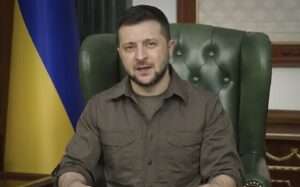
Ukrainian President Volodymyr Zelensky is leading his nation a just cause. But we should not allow him to impose censorship and emigration bans in the process. A nation fighting for freedom must not undermine it.
Ukrainian President Volodymyr Zelensky. March 21, 2022 (Ukrainian Presidential Press Office).
Ukraine is fighting a brutal and indefensible Russian invasion. Their cause is just, and the Ukrainian government is vastly preferable to the sort of puppet regime Vladimir Putin would install if he prevails. Indeed, from the standpoint of liberal democratic values, Ukraine is far better than Putin's increasingly repressive rule in Russia itself. Ukrainian President Volodymyr Zelensky deserves credit for his inspiring leadership under fire.
But these realities should not blind us to the injustice of two deeply illiberal policies enacted by Zelensky in the wake of the Russian invasion: decrees forbidding all men aged 18-60 from leaving the country, and imposing government control over all previously independent TV channels. Zelensky has appealed for increased Western aid on the ground that "we….are fighting for freedom and in defense of democracy together." The two decrees are blatantly inconsistent with those principles. The West should use its leverage to force him to end them. Doing so would simultaneously advance liberal values, and strengthen our position in the conflict against Putin's authoritarian regime.
Even most liberal political theorists who who believe governments are justified in restricting entry by immigrants generally agree that they are not justified in barring exit. That's one of the reasons why virtually all liberal democrats condemned the Berlin Wall and other emigration bans imposed by communist governments. Zelensky's policy is an obvious violation of that fundamental principle.
The rationale for the travel ban is the supposed need to keep the men in Ukraine, so that they can be drafted into the armed forces, if necessary. Military conscription is itself a grave injustice, incompatible with liberal principles. That's one of the reasons why most liberal democracies have ended it in recent decades. The fact that various liberal democracies practiced it in the past or even today does not by itself prove its compatibility with liberal values. States can fail to live up to their principles, and indeed often do. But even if conscription is defensible in extreme cases where there is no other way to ensure national defense, Zelensky's decree is still unjustified.
For obvious reasons, volunteers are likely to be better and more highly motivated fighters than conscripts who serve only because they have been compelled to do so. The poor performance of Russian conscripts in Ukraine is a case in point. In addition, many of the men covered by the travel ban are unlikely to prove to be effective soldiers, for any number of reasons related to temperament, skills, and physical ability. Zelensky's decree goes far beyond any possible conscription-based rationale, even if the latter were defensible to begin with (which it is isn't).
At this point, Ukraine needs weapons to arm its large numbers of volunteers, not forced laborers. The West should give them as many weapons as possible - but condition at least some of that assistance on Zelensky's ending his travel ban imposed on Ukrainian men. No government claiming to fight for freedom should impose such a cruel and pointless restriction on liberty.
The Ukrainian government's takeover of private TV channels probably causes less suffering. But it is just as illiberal and indefensible. It is a dangerous assault on freedom of speech and press. The government's rationale for this measure is the need to ensure a "unified information policy" in time of war. The justification actually highlights the illiberal and undemocratic nature of the policy. A "unified information policy" is deeply inimical to democracy, which requires an independent media willing and able to question the government line.
Government takeovers of private media for the purpose of forcing it to toe the official line are a classic tool in the incipient authoritarian's playbook. For a textbook example, we need look no further than Vladimir Putin, who started by seizing control of private TV networks, and most recently put an end to nearly all independent media.
Ukraine's media policies - so far - are not nearly as repressive as Putin's. State control is limited to TV channels, and does not extend to print, radio, and internet outlets. But things are obviously moving in the wrong direction. This, too, is a policy the West should force Zelensky to reverse.
The Ukrainian government's human rights violations might be rationalized on the grounds that they are just temporary emergency measures that will be repealed when the war is over. Perhaps so. But history shows that repression begun during emergencies often persists long afterwards. Moreover, the emergency might well continue for a long time to come. Even if large-scale fighting ends soon, Russia and Ukraine might remain in a tense military standoff on into the indefinite future. An emergency situation could easily persist for years on end. And it could be used to rationalize the continuation of these repressive policies - and perhaps others, as well.
Forcing Zelensky to end these injustices isn't just a matter of moral principle. There is a strategic advantage to it, as well. The conflict between liberal democracy and Putin's authoritarianism is a war of ideas, as well as a military and geopolitical confrontation. One of the reasons why Putin invaded Ukraine in the first place is the fear that a successful liberal democracy there might create a dangerous (from Putin's perspective!) example for the Russian people. To prevail in the war of ideas, we need a Ukrainian government that actually lives up to liberal values as much as possible, not one that practices a kid of Putinism-lite.
Foreign policy is an often-sordid business. Sometimes, we have little choice but to put up with illiberal allies, either because we lack the leverage to force them to change, or because the available alternatives to these regimes are even worse. Zelensky's human rights violations are modest, not only compared to Putin's, but also relative to those of such longtime US allies as Egypt and Saudi Arabia.
In this case, however, the US and other Western nations have a great deal of leverage by virtue of Ukraine's need for large-scale military and economic assistance, that it cannot get anywhere else. And the alternative to Zelensky with these two awful policies is Zelensky without them! The latter is both politically feasible and clearly superior to the former.
Ukraine's brave resistance to Russian aggression deserves our support. But its people also deserve a government that genuinely respects liberal democratic values. The West can and should use its leverage to help ensure they get it.
UPDATE: I have made a few minor additions to this post.
No, says the Appeals Court of Massachusetts: "We take this opportunity to reiterate that, where a c. 258E order is sought on the basis of speech alone, the plaintiff must prove that the speech rose to the level of true threats or fighting words and not merely that it was 'harassing, intimidating, or abusive in the colloquial sense.'"
From yesterday's pseudonymized decision in Kareem K. v. Ida I. (handed down by Justices Ariane Vuono, Sookyoung Shin, and Sabita Singh):
In the spring of 2021, the defendant and her husband sought legal advice from the plaintiff, an attorney. When the plaintiff later presented his findings, the defendant and her husband expressed displeasure with his work. The representation was then terminated.
On June 25, 2021, the plaintiff filed a complaint under G. L. c. 258E [the harassment restraining order statute] … against the defendant only. The affidavit, which we quote verbatim except where indicated, alleged the following acts of harassment: "[t]he defendants were unhappy with our findings and proceeded to go on Facebook and make a public post calling us thiefs and making up things that did not happen"; "[t]hey then proceeded to call us three times on June 25th, 2021"; "[t]hey proceeded to email our secr[e]tary …, as well as copying multiple people on the email"; and "[the defendant's husband] then proceeded to send [the secretary] a [Facebook] message trying to speak with us."
Plaintiffs are anonymously suing the City of Ludington for moving and re-connecting a siren in Copeyan Park in downtown Ludington, which allegedly exacerbated Plaintiff John Doe's post-traumatic stress syndrome (PTSD) from his two tours of duty in Afghanistan and one tour of duty in Iraq with the American Armed Forces. Plaintiffs claim that the City of Ludington has violated Plaintiff John Doe's rights under the Americans with Disabilities Act (ADA) and the Federal Fair Housing Act (FFHA) by refusing Plaintiffs' proposed reasonable accommodation of only using the siren for emergencies. Plaintiffs also allege pendant state claims for nuisance, city code violations, and a request for injunctive relief….
Courts begin with a presumption of open judicial proceedings. The Federal Rules of Civil Procedure generally require a complaint to state the names of all parties. Fed. R. Civ. P. 10(a). A plaintiff may proceed anonymously only in exceptional circumstances …. Plaintiffs have failed to demonstrate that their privacy interests substantially outweigh the presumption in favor of open judicial proceedings….
So holds the California Court of Appeal, in sending back to a different judge defendant's motion to retroactively downgrade her conviction (for non-slur resistance to the officers) to a misdemeanor.
From People v. Araujo, decided Tuesday by the California Court of Appeal (Justice Anthony Kline, joined by Justices James Richman and Therese Stewart):
Rosa Adriana Araujo was convicted in 2008 of three felony counts of attempting to deter or resisting an executive officer in the performance of duty by means of threats or violence. She now appeals from denials of her motions to reduce the convictions to misdemeanors and dismiss them….
Araujo's offenses occurred … when police officers went to her parents' house to conduct a probation search on her brother…. [A]ccording to the testimony of officers who were at the scene, Araujo arrived at the house shortly after the search had begun, irate, repeatedly yelling, "get the fuck out of my house, you fucking pigs," demanding to see a warrant, and saying her brother did not live there and was not on probation.
The policy caused immense suffering, in exchange for meager public health benefits, if any at all. Its history undercuts the case for granting broad powers and judicial deference to the CDC.
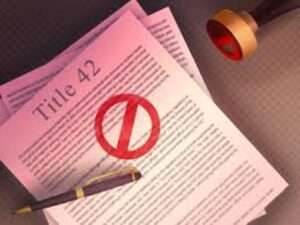
The Washington Postreports that the Biden administration may be planning to end Title 42 "public health" expulsions migrants at the southern border:
The Biden administration is planning to lift the Title 42 border controls that authorities have relied upon during the past two years of the pandemic, but the restrictions will not end immediately, according to two officials familiar with the preparations.
The administration is expanding border facilities and migrant processing capacity with the goal of fully lifting the pandemic restrictions in May, according to one of the officials, who spoke on the condition of anonymity because they were not authorized to discuss the plans publicly. Biden officials have insisted they will defer to the Centers for Disease Control and Prevention, which is completing a review of the Title 42 restrictions and said it will announce its determination this week.
The Trump administration implemented the Title 42 order in March 2020, characterizing the measure as an emergency safeguard to prevent the spread of infection inside detention cells, border stations and other crowded settings. The order has allowed border authorities to bypass normal immigration screening procedures and rapidly expel border crossers to their home countries or to Mexico without affording them a chance to seek humanitarian protection under U.S. law.
U.S. Customs and Border Protection has carried out more than 1.7 million of these "expulsions" over the past 24 months, the majority under President Biden.
The Title 42 expulsions have caused immense suffering, while doing little or nothing to stop the spread of Covid-19. As I explain in this article (pp. 439-40), the expulsions were begun by Trump and perpetuated by Biden for primarily political reasons, over the opposition of public health experts at the CDC and elsewhere.For many of those expelled, the Title 42 policy has resulted in terrible suffering, including "death, torture, and rape."
While it's a good thing that Biden may finally end the expulsions, it's reprehensible that the White House continues to hide behind the skirts of the CDC, perhaps hoping to convey the impression that they're just "following the science." In reality, this was a White House-driven and politics-driven policy from first to last.
More generally, the CDC's record during the pandemic undercuts the case for giving that agency vast discretionary authority and broad judicial deference when it exercises it, because it can be relied on to base policy purely on "objective" scientific considerations. Again and again, the agency has proven susceptible to political pressure from both left and right. That happened with the Title 42 expulsions, the eviction moratorium eventually invalidated by the Supreme Court, the transportation mask mandate, school mask mandates, and much else, besides.
Even if government agencies deserve special deference when they enact policy based on specialized scientific expertise, such disinterested expertise has been notable primarily by its absence, when it comes to CDC's role in Covid pandemic policy. Both Trump and Biden have used the agency's veneer of scientific expertise as a cover for dubious policies actually enacted for other reasons. Courts and others should take note.
Earlier this month, the US Court of Appeals for the DC Circuit partly invalidated the Title 42 policy, ruling that the CDC had the authority to expel migrants, but not to countries where they are likely to face persecution or torture. In my view, the Court should have invalidated the entire policy, as going beyond the authority delegated to the CDC by Congress, and raising "major question" and nondelegation problems. I cover these issues in detail in a forthcoming article about the case and its parallels with the earlier eviction moratorium litigation.
But, legal questions aside, Trump should never have instituted this terrible policy in the first place, and Biden should never have perpetuated it. Even if legal, it was pointless, cruel, and unjust.
UPDATE: The administration has now announced that the Title 42 expulsions will end on May 23.
One of the most discussed trends in American religion at the start of the 21st Century is the so-called "Rise of the Nones," the sharp increase, since the 1990s, in the percentage of Americans who tell pollsters they have no religious affiliation. Depending on the study, Nones now make up about a quarter to a third of Americans, up from something like six percent a generation ago. The category is quite broad, comprising militant secularists, atheists, agnostics, and the "spiritual but not religious"—persons who reject formal religious affiliation but nonetheless believe in some supernatural power or powers. Often, Nones mix and match elements of different traditions to come up with their own, DIY forms of religion—what one scholar has referred to as a kind of spiritual "bricolage."
A couple of fascinating new articles by law professors Gregory Sisk (St. Thomas) and Michael Heise (Cornell), available here and here, shed light on the ways Nones have started to influence religion cases in the federal courts. For years, Sisk and Heise have done empirical research on the effect of religious affiliations—the judges' and the parties'—in such cases. Their new articles contain some surprising, and some not so surprising, observations about the growing impact of the Nones.
First, the not-so-surprising: just as the percentage of Nones in the general population has increased over the past few decades, so has the percentage of Nones among federal judges. The percentage of Nones among judges in Sisk and Heise's current study, which covers the years 2006-2015, is 11.5%, double the percentage in their first study, which covered the years 1986-1995. Nones are more likely to have been appointed to the bench by Democratic presidents (though Sisk and Heise point out that Nones also number among GOP-appointed judges), which is to be expected, given the comparatively prominent role secular Americans have in the Democratic Party.
In addition, although Sisk and Heise didn't observe a large effect in their study, Nones on the bench appear comparatively hostile to religious accommodations under the Free Exercise Clause. Perhaps Nones, who reject traditional religion, object to such accommodations as a form of special pleading, especially because—and this a final, unsurprising observation—Nones are comparatively unsuccessful when they themselves seek such accommodations in the courts. Nones have a success rate of 25% in such cases, Sisk and Heise report, while claimants from traditional religions have a success rate of 39%.
Now for the surprising observation. One might expect judges who reject organized religion to favor Establishment Clause claims. For example, one might expect such judges to rule that public displays of religion violate the separation of church and state. But that is not what Sisk and Heise found. In fact, they report, Nones on the bench are significantly less likely than religiously affiliated judges to favor Establishment Clause claims. "Holding other variables constant," they write, "the predicted probability that a judge without a religious affiliation would approve an Establishment Clause challenge was 24.9 percent," while judges "with a religious affiliation approved such claims at a 40.0 percent rate."
What might judges who are Nones view Free Exercise and Establishment Clause claims differently? Sisk and Heise believe that Nones, who are detached generally from organized religion, may be more or less indifferent to public displays of religiosity. Recall that many Nones do not reject religion as such and even adopt elements of traditional faiths as their own. But Nones are very concerned about enforcing non-discrimination laws, which of course have been the focal point for many recent controversies regarding religious accommodations.
This is only one study, of course. But Sisk and Heise's observations are worth considering. A few years ago, I predicted that the rise of the Nones would portend sharp controversies in our culture and our law. I still think that's likely to be the case with respect to religious accommodations, and Sisk and Heise's data seem to bear that out. But, if Sisk and Heise are right, the effect of the Nones on Establishment Clause conflicts may be more irenic. We'll see.