The Volokh Conspiracy

Mostly law professors | Sometimes contrarian | Often libertarian | Always independent | Est. 2002

The Volokh Conspiracy

CNN: SCOTUS Investigation Demands Phone Records From Clerks, Who Must Sign Affidavits

Leaks about the leaks continue.

|

We are now one month removed from Politico's bombshell report. We still have no idea who leaked the opinion. No one has come forward to collect their plaudits from MSNBC. Whoever did the deed is keeping quiet--at least until the end of the term. And the investigation continues. For the longest time, the marshal of the Supreme Court was the subject of many Trump-related conspiracy-theories. But now, the marshal is exercising real authority. Joan Biskupic has an exclusive:

Supreme Court officials are escalating their search for the source of the leaked draft opinion that would overturn Roe v. Wade, taking steps to require law clerks to provide cell phone records and sign affidavits, three sources with knowledge of the efforts have told CNN.

Some clerks are apparently so alarmed over the moves, particularly the sudden requests for private cell data, that they have begun exploring whether to hire outside counsel. . . . Chief Justice John Roberts met with law clerks as a group after the breach, CNN has learned, but it is not known whether any systematic individual interviews have occurred.

….

"That's what similarly situated individuals would do in virtually any other government investigation," said one appellate lawyer with experience in investigations and knowledge of the new demands on law clerks. "It would be hypocritical for the Supreme Court to prevent its own employees from taking advantage of that fundamental legal protection."

Sources familiar with efforts underway say the exact language of the affidavits or the intended scope of that cell phone search -- content or time period covered -- is not yet clear.

Here are my tentative thoughts.

First, on sourcing, Joan cites "three sources with knowledge of the efforts." These are not sources "close to the Court," or some such language. Joan's sources could be clerks, or the Justices, but I think it more likely that the sources are the type of people she quotes from: "appellate lawyer with experience in investigations and knowledge of the new demands on law clerks."

Second, I am usually very critical of leaks, but I'll admit, this sort of leak does not trouble me as much as leaks about internal deliberations. Yes, even law clerks are entitled to competent representation of counsel--especially in the face of an investigation that could lead to severe sanctions. And I think an attorney, in the course of representation, could decide to speak to the press to promote his client's interests. But there is an open question: does the attorney-client privilege survive in light of a duty of confidentiality to the Court? That is, could a clerk tell her attorney about some internal information in order to prepare a legal strategy? Could the Chief fire a clerk who confides in this lawyer? The fact that the appellate lawyer quoted is even aware of this matter suggests, at a minimum, that clerks are seeking counsel and talking.

Third, the Supreme Court marshal office has, as far as I know, zero background in performing forensic analysis of phone records. Unless experts from DOJ are detailed, I am skeptical the Supreme Court has the competency to perform these tasks internally. Moreover, the idea of pulling "phone records" is so quaint. Anyone serious about leaking the document would use secure and encrypted channels like Signal, Telegram, or something more secure. Do we really think the law clerks are sliding into Josh Gerstein's Instagram DMs? More likely the leaker used sophisticated channels with Politico's national security reporter, Alexander Ward.

Fourth, the climate inside the Court must resemble a prison. There are massive security barriers around the building, and I understand Second Street--where the garage entrance to the Court is located--has been shut down. Now, every clerk must submit their private records to the marshal. Is there any expectation of privacy? Or protocol to prevent disclosure? And will the marshal start to contact the people that law clerks called? I imagine some Justices may resist this intrusion into their clerk's confidential information.

Fifth, law clerks are being asked to sign affidavits for an explicit purpose: if they lie, they face charges of making false statements to a government official. And, in theory, they can be criminally prosecuted. But what happens if a clerk is not at fault? Joan explains that as many as 75 people may have had access to the opinion:

If tradition was followed, copies were sent electronically and, separately, printed out and hand-delivered to chambers by aides to the marshal. Other employees connected to the nine chambers would have had some access to the opinion. CNN could not verify that number, but former law clerks say the document could have been sent through regular channels to nearly 75 people. It is not known if court officials are asking employees who are part of the permanent staff, beyond the one-year law clerks, for their phone records.

Ultimately, three-dozen law clerks--the cream of the crop--are being put through the wringer for an act that may not have been taken by a clerk. These are the sort of people who have never been sent to the principal's office, or faced anything but praise. This entire experience must be so jarring. To this day, I still do not think a clerk is at fault.

Sixth, Joan does not know if the five-member block survives:

But it is difficult for anyone outside the building to know whether the Alito draft still commands a majority on a court tightly divided on abortion rights and split over how quickly to reverse precedent.

There are no opinions this week. It ain't over till it's over.
Law & Government

Slippery Slope June

How should we think about slippery slope arguments, whether they come from liberals or conservatives or libertarians or anyone else?

|

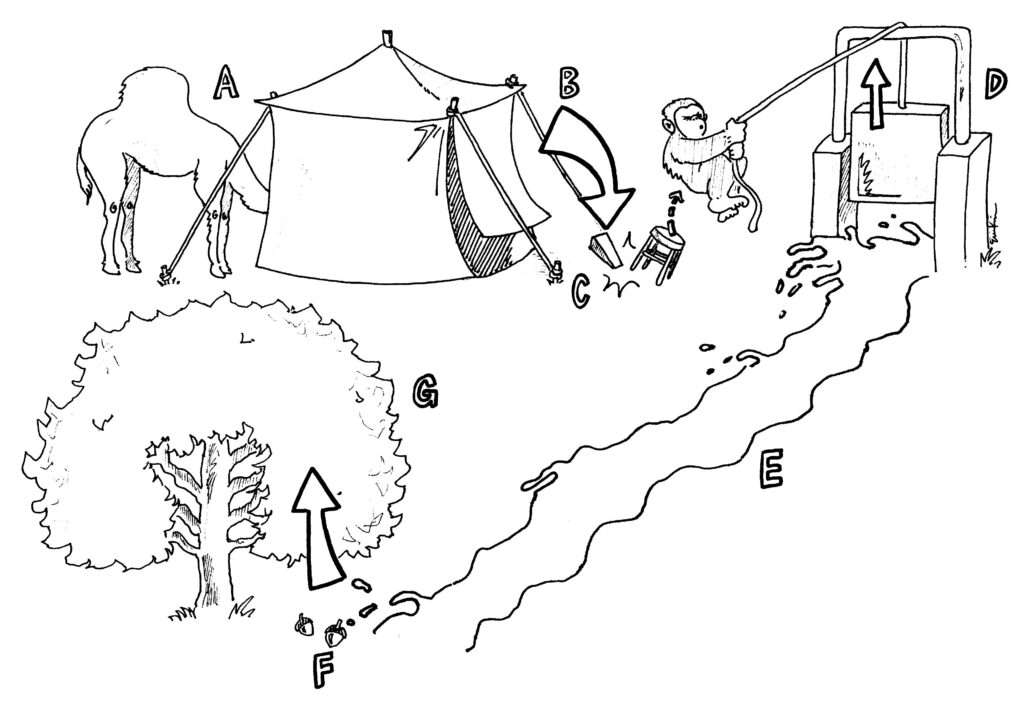
Camel (A) sticks his nose under the tent (B), which collapses, driving the thin end of the wedge (C) to cause monkey to open floodgates (D), letting water flow down the slippery slope (E) to irrigate acorn (F) which grows into oak (G). [Illustration by Eric Kim, from my idea.]

Some online discussions recently reminded me of The Mechanisms of the Slippery Slope, an article I published in 2003 in the Harvard Law Review. Slippery slope arguments are often made, quite categorically, as if saying "slippery slope" is enough to resolve an issue; but they are also often rejected, quite categorically, often with claims that they are outright fallacies. I think the matter is more complicated, in part because there are multiple mechanisms through which slippage can happen (and through which it can be resisted); and I thought I'd therefore serialize the article in some blog posts over the coming few weeks.

I think that might be particularly helpful now. The seemingly impending rejection of a constitutional right to abortion is likely to lead to many proposed restrictions in various states and in Congress. Many of the arguments about those restrictions will likely focus on the specific substance of the restrictions on their own terms—but many, especially ones that seem modest on their own, will lead to arguments that these are just the first steps down a slippery slope.

I expect we'll likewise see more such arguments with regard to proposed gun restrictions. And of course the arguments are commonly made with regard to new forms of surveillance, new forms of economic regulation, and indeed new forms of deregulation.

Slippery slope arguments aren't exclusive to liberals or conservatives, though different groups tend to deploy them as to different matters. Rather, they can be made with regard any sort of change, whether to the left, to the right, or elsewhere. My posts will use examples from a variety of areas, though chiefly as to abortion, free speech, guns, and privacy, which are areas I've focused on more; but my goal will be to analyze such arguments generally, and not call for any particular policy results.

Read More

Free Speech

Does Pulling Funding from CUNY Law School Because of School's Anti-Israel Resolution Violate First Amendment?

$50K in funding was withdrawn by a Brooklyn councilwoman, and transferred to a different organization.

|

So reports the New York Post (Carl Campanile):

A Brooklyn councilwoman is pulling $50,000 in funding earmarked to the CUNY Law School because its faculty council endorsed a resolution in support of the pro-Palestinian boycott, divestment and sanctions movement against Israel.

Inna Vernikov, a Ukranian-born Jew who represents a handful of heavily Jewish neighborhoods in southern Brooklyn, charges that CUNY Law professors are engaging in antisemitism by backing the BDS movement against the Jewish State.

"I have pulled funding from the program and redirected it to Legal Services NYC," Vernikov told The Post Friday.

A few thoughts:

[1.] If the government withdrew funding, or terminated a contract, or failed to renew a contract, based on a private entity's speech, that would be presumptively unconstitutional under Board of Comm'rs v. Umbehr (1996). The government might be able to do this if it shows that the disruptiveness of the speech to government operations outweighed its value (the so-called Pickering balance, first developed for speech by government employees). It would, however, indeed have to make such a showing.

[2.] But the government can indeed control the speech of its subordinate entities, without being constrained by the Free Speech Clause: A state government can control its political subdivisions, and a local government can control local agencies, see, e.g., Ysursa v. Pocatello Educ. Ass'n (2005). State and local governments are essentially viewed as one entity for federal constitutional purposes, at least as far as any struggles between them are concerned (though I oversimplify here slightly).

Read More

Has America Given Up on Free Speech?

A review of Mchangama's "Free Speech."

|

Most people have at least some family and friends with whom they disagree about religion, politics, and other neuralgic topics. We maintain relationships with these people because some commonality encourages us to look past our disagreements with them--because we have some basis for trusting them and their good will towards us, notwithstanding our differences. We may even engage now and then with these friends and family in a reasonably civil way (though, if surveys are correct, more and more Americans drop friends and family members because of politics, mostly liberals dropping conservatives, apparently, rather than the other way around).

It would be silly to expect the level of trust we have for friends and family to extend to society at large. Yet, social trust has a very important role in public discourse. It allows us to engage our fellow citizens without expecting the worst of them, without thinking they are out to get us--in short, without personalizing debate in a way that makes everyone defensive and angry.

In a review of Jacob Mchangama's new book, Free Speech, at the Law & Liberty site today, I argue that this social trust has frayed greatly, and that Americans' problems with free speech result more from social breakdown than from a failed commitment to abstract ideas about expression. Here's an excerpt:

It is a striking feature of American life in the first quarter of the 21st century that we have somehow created a culture in which everyone feels aggrieved. This is especially true when it comes to free speech. Both conservatives and progressives believe their opponents are out to silence them—not just beat them in debates and prevail against them in elections, but intimidate them, put them on mute permanently, eliminate any possibility of resistance. Many on each side see the other as not simply wrong, but ill-motivated and dangerous, an existential threat to be defeated before it is too late.

This state of affairs is more the norm in American history than we care to admit. Perhaps because we see ourselves in providential terms—"the last best hope of earth," as Lincoln said—Americans always have been sensitive to threats our democracy faces and often have worried about enemies within spreading "disinformation." Eras of Good Feeling occur relatively rarely. Even so, the level of recrimination just now seems quite high, and many Americans apparently believe we must silence our opponents before they succeed in silencing us.

In Free Speech: A History from Socrates to Social Media, Jacob Mchangama maintains that a renewed commitment to free expression can help us through these perfervid times. Mchangama, a lawyer and the founder of Justitia, a human-rights organization in Denmark, has written a programmatic history that "connect[s] past speech controversies with the most pressing contemporary ones." Today's debates about free expression recapitulate those of long ago, he believes, and just as our ancestors did, we must defend the right to speak against those who would take it away.

To write a comprehensive history like this one is an ambitious undertaking, and Free Speech is a mixed success. Mchangama writes engagingly and has done his research. The chapters on the Internet and social media are especially good. But even at 500 pages, a history that spans thousands of years and many civilizations is bound to be a bit superficial at times. Moreover, as he himself recognizes, tolerance for others' speech depends as much on culture as it does on law—and in today's polarized, distrustful America, we are less and less likely to give our opponents the benefit of the doubt and let them have their say even if the law permits it.

You can read the whole essay here.

Free Speech

Talking to A About Plans to Kill B Isn't a Punishable Threat

|

The case is Commonwealth v. Gadley, decided May 20 by Judge Mary Murray, joined by Judges Daniel McCaffery and James Gardner Colins of the Pennsylvania Superior Court; here's the trial court's summary of the facts:

At the [June 15, 2021, preliminary] hearing, the Defendant's mother, Melody Blair … testified that on the night of May 29, 2021, the Defendant and his minor daughter (hereafter [M]) were present at their shared residence, along with the Defendant's minor brother (hereinafter [T]). Ms. Blair stated that she reminded the Defendant's daughter to tell the Defendant that her preschool graduation was coming up on June 7. Ms. Blair testified that at this time the Defendant stated, "I'm not going to let that happen. [M.] and I will be out of here by Monday. I'm not letting that happen."

Ms. Blair further testified that after approximately fifteen (15) to twenty (20) minutes, "[M.] went back to my room and I finished what I needed to do for the night, and that's when [the Defendant] made the comment that he was going to kill Alicia … and at one point he said he was going to shoot her." Ms. Blair later clarified that Alicia Zabelsky … is [M]'s mother. She also said that the Defendant did not make any communications specifically to Ms. Zabelsky or any other individuals, except [Ms. Blair]. Ms. Blair also clarified that the Defendant did not state he was going to go to Ms. Zabelsky's [residence] that same night or provide any specific time he anticipated on carrying out his threat. Ms. Blair testified that after a period of time, she went to her bedroom where the [D]efendant followed her and wanted the keys to her vehicle to take [M] from the residence. Ms. Blair stated she then had [T] call her oldest son, Josh, to come to the residence and defuse the situation. Ms. Blair testified that once Josh was contacted by [T], he contacted the police.

Trooper Brian Tanner … of the Pennsylvania State Police responded to the residence[.] Trooper Tanner testified that when he initially questioned the Defendant outside of his residence, he denied stating he was going to kill Ms. Zabelsky. However, Trooper Tanner stated upon transferring the Defendant to the Clarion County Jail, the Defendant made comments regarding Ms. Zabelsky's boyfriend to him. Specifically, Trooper Tanner testified that "[the Defendant] made comments such as, 'This might cost me prison time, but it will cost him his life. They're going to kill me before they take my little girl from me.'" Trooper Tanner stated that the Defendant was asked, "'Were you talking about the boyfriend of [M.'s] mother?' and he [replied], 'Yes.'"

Gadley was charged with misdemeanor terroristic threats, but the trial court dismissed the case, and the appellate court affirmed:

Read More

Self-Defense

Habeas Grant in Defense-of-Others Case

A crack theft leads to alleged attempted rape and the shooting of the drug dealers / alleged attempted rapist.

|

[UPDATE: Whoops, sorry, double post from a few weeks ago; I'd have just deleted this, but it already accumulated some comments, which I don't want to delete in turn.]

From Mercer v. Stewart, decided April 25 by Judge Matthew Leitman (E.D. Mich.):

In 2011, Petitioner Barbara Jean Mercer, who was then in the throes of a crippling addiction to crack cocaine, made two grave mistakes that sent her and those around her down a dangerous path. Her first mistake was stealing a small amount of crack from two violent drug dealers, Anthony Hannah and Shemel Thomas. Thomas quickly discovered the theft, and he then threatened to "shoot [Mercer's] shit up" and "hurt" her. Mercer was frightened by Thomas' threats. She told her live-in boyfriend, Richard Janish, about them, and he was "terrified."

Mercer then made her second mistake. She developed a risky plan with Janish to end the threats from Thomas and Hannah. In Mercer's words, she agreed with Janish that they would (1) "call [Hannah and Thomas] over [to Mercer's house]" with a promise of payment for the stolen crack and then, (2) when Hannah and Thomas arrived, Janish would "scare them a little bit" in an effort to persuade them to stay away from Mercer. This ill-conceived scheme ended with Thomas and Hannah shot to death at Mercer's house.

During the police investigation into the shootings, Janish and Mercer explained to investigators how their plan to scare off Thomas and Hannah went awry. Janish told officers that shortly after Thomas and Hannah arrived at Mercer's residence, he (Janish) had a confrontation with Hannah in front of the house and ended up having to shoot Hannah in an effort to defend himself. Janish and Mercer both told investigators that Janish then entered the house and found Thomas attempting to sexually assault Mercer. They explained that Janish shot Thomas in order to defend Mercer against the assault.

The local prosecuting attorney did not believe Mercer's and Janish's account of the killings. He concluded that Mercer and Janish had conspired to kill Hannah and Thomas long before they arrived at Mercer's house to collect the drug debt. The prosecutor charged Mercer and Janish with, among other crimes, one count of conspiracy to commit first-degree murder, and two counts of pre-meditated first-degree murder. At trial, the jury was also permitted to consider charges of second-degree murder and manslaughter because those offenses were lesser-included offenses of the first-degree murder charges.

During the trial, the parties primarily clashed over whether Mercer and Janish planned the killings and whether they were guilty of conspiracy and first-degree murder. Mercer and Janish prevailed in that battle. The jury acquitted them of the conspiracy and first-degree murder charges.

Mercer and Janish also had a complete defense to the second-degree murder and manslaughter charges with respect to Thomas' death, but the state trial court prevented the jury from considering that defense. Under Michigan law, neither Mercer nor Janish could have been convicted of any homicide offense with respect to the killing of Thomas if the jury found, as they both told police, that Janish killed Thomas to prevent him from raping Mercer (the "Defense of Mercer Defense").

Read More

Free Speech

City Can Choose What Gets Painted on City Roadways

Painting "Black Lives Matter" doesn't require New York to allow other groups to paint other slogans.

|

From Women for America First v. Adams, decided Friday by the Second Circuit (Judges John M. Walker, Jr., Joseph F. Bianco, and Beth Robinson):

In July 2020, New York City employees and private citizens began painting "Black Lives Matter" in large, bright-yellow letters on Fifth Avenue in Manhattan, directly in front of Trump Tower. The mural was allegedly undertaken by the New York City Department of Transportation … at an initial cost of approximately $6,000. Moreover, the mural was part of former New York City Mayor Bill de Blasio's commitment to the "Black Lives Matter" movement, which included an announcement by Mayor de Blasio that each borough in New York City … would get its own "Black Lives Matter" mural. Thus, according to the amended complaint, the mural on Fifth Avenue was one of seven similar murals painted on streets throughout the City at Mayor de Blasio's direction.

Also in July 2020, WFAF submitted a request to Mayor de Blasio to paint its own mural on a City street. {Specifically, WFAF sought "to paint a mural of [their] motto—'Engaging, Inspiring and Empowering Women to Make a Difference!'—on Fifth Avenue, or another similar street within the city's jurisdiction."} After receiving no response, WFAF sent a second request that was later denied by the DOT because "the NYC DOT does not permit installations on City roadways that are open to traffic." …

WFAF sued, but the court held against them (quite correctly, I think):

[T]he City Defendants engaged in government—not private—speech, and thus, WFAF's First Amendment claim fails as a matter of law….

[I]f a government "engag[es] in [its] own expressive conduct, then the Free Speech Clause has no application" because, while the First Amendment "restricts government regulation of private speech," it does not restrict the government's speech. Pleasant Grove City v. Summum (2009). Thus, when the government speaks for itself, "it is not barred by the Free Speech Clause from determining the content of what it says," and "is entitled to favor certain views over others."

Read More

Parental Rights

Appellate Court Upholds Trial Court's Rejection of "[Independent] Custody Investigator" Opinion

Among other things, the investigator "appeared to accept Father’s explanation that his 2003 kidnapping conviction based on allegations of domestic violence in a previous relationship was a misunderstanding, not the result of criminal conduct," "[finding] 'credible' Father’s explanation that he 'was unfairly incarcerated based on the lies of the victim and because of the racist justice system.'"

|

From A.W. v. I.C., decided Friday by the California Court of Appeal (in an opinion by Presiding Justice Frances Rothschild, joined by Justices Victoria Gerrard Chaney and Helen Bendix):

Father appeals the family court's order granting Mother's request that M.W. [their now-six-year-old child] move with her to Washington, D.C. Father argues the court reversibly erred when, in granting this request, the court "ignored" the opinion testimony of a custody investigator that Mother was relocating to Washington, D.C. as a means of keeping M.W. away from Father. But the trial court was entitled to deem the investigator's testimony not credible, and substantial evidence supports the court's finding that Mother's move was not in bad faith….

There's a lot in the facts, as usual for child custody opinions, but the unusual feature was the trial court's rejection of the "independent evaluator's" opinion (which the Court of Appeal then upheld):

The court also heard testimony from Linda Hayes, a licensed marriage and family therapist and licensed clinical social worker, whom the parties had stipulated would "conduct a private, solutions-focused evaluation, akin to a two-day private Parenting Plan Assessment." Specifically, the parties agreed Hayes would evaluate "whether joint physical custody would be appropriate if the parties live in the same geographic area and if they do not, who should be awarded primary physical custody and what type of parenting plan would be in the best interest of the child." … Hayes recommended M.W. remain in Los Angeles with Father. Hayes opined Mother had put her own need to reside in Washington, D.C., over M.W.'s need "to love and experience both parents on a frequent and continuous basis." Hayes viewed Mother's decision to move to Washington, D.C., as narcissistic and not guided by M.W.'s best interests….

Hayes repeatedly testified that Mother's move to Washington, D.C., was "premeditated," and that her desire to take M.W. was an effort "for [Father] not to have access to the minor child." She based this conclusion in part on statements by Mother's friend, … who told Hayes that Mother had been planning for "multiple months, maybe six months" to leave California … [and] that Mother and Mother's family "had been planning for many months about how Mother would take [M.W.] away from the father."

Hayes was also skeptical of Mother's explanation that her move was motivated by difficulty finding work in Mother's field in the Los Angeles area. Hayes based this skepticism in part on a call with the executive director of the UCLA department of public policy, who Hayes testified had indicated that the vast majority of graduates with Mother's degree were employed. Hayes expressed concerns about Mother's veracity and forthrightness in other respects as well. She believed Mother had not been forthcoming with information that would allow Hayes to verify certain claims Mother had made about her new job. Hayes believed that Mother was trying to prevent Hayes from speaking to Mother's supervisor because the call would contradict Mother's previous statements.

Hayes expressed no such concerns about Father's veracity or forthrightness. To the contrary, she appeared to accept Father's explanation that his 2003 kidnapping conviction based on allegations of domestic violence in a previous relationship was a misunderstanding, not the result of criminal conduct. Specifically, Hayes found "credible" Father's explanation that he "was unfairly incarcerated based on the lies of the victim and because of the racist justice system," citing as the reason for this belief Father's explanation of the incident and Hayes's phone interview with "the sheriff who got to know [Father] during [his time in] the prison, and … said Father does not fit the profile at all of somebody who would … perpetrate domestic violence."

{By contrast, Hayes concluded that Mother's filing a request for a restraining order against Father was "strategic" because it was based on alleged conduct in Connecticut, and Mother did not file the request until Father brought M.W. back to California.}

The trial court rejected Hayes' views:

Read More

"Victorian-Era Orgasms and the Crisis of Peer Review"

Two phrases you probably didn't expect to see together.

|

But quite a compelling article in The Atlantic (Robinson Meyer & Ashley Fetters), with the subtitle "A favorite anecdote about the origins of the vibrator is probably a myth." An excerpt:

It's among the most delectably scandalous stories in the history of medicine: At the height of the Victorian era, doctors regularly treated their female patients by stimulating them to orgasm. This mass treatment—a cure for the now-defunct medical condition of "hysteria"—was made possible by a new technology: the vibrator. Vibrators allowed physicians to massage women's clitorises quickly and efficiently, without exhausting their hands and wrists.

It's a disturbing insight, implying that vibrators succeeded not because they advanced female pleasure, but because they saved labor for male physicians. And in the past few years, it has careened around popular culture. It's given rise to a Tony-nominated play, a rom-com starring Maggie Gyllenhaal, and even a line of branded vibrators. Samantha Bee did a skit about it in March. A seemingly endless march of quirky news stories has instructed readers in its surprising but true quality, including in Vice, Mother Jones, and Psychology Today.

In short, the tale has become a commonplace one in how people think about Victorian sex. And according to a contentious new paper, it may also be almost totally false.

There is absolutely no evidence that Victorian doctors used vibrators to stimulate orgasm in women as a medical technique, asserts the paper, written by two historians at Georgia Tech. "Manual massage of female genitals," they write, "was never a routine medical treatment for hysteria."

"There's no evidence for it," says Hallie Lieberman, an author of both the new paper and Buzz, a popular history of sex toys. "It's inaccurate."

A briefer reply to Orin Kerr

|

Replying to my recent post, Orin Kerr writes:

But I read Dave as also saying that criticizing the NRA for its positions and influence in gun control debates is somehow equal to the belief that it's okay to murder groups of people for their religious beliefs. If that's what Dave is saying, that claim strikes me as so completely preposterous and outrageous that there's some benefit in saying so publicly.

How Orin "read" my post, which he did not quote, strikes me as preposterous.

For the record, I debated a NRA representative at an event hosted by the Mountain States Legal Foundation. I advocated for Red Flag laws that have proper due process, whereas the NRA representative opposed them. I support of my view, I have testified before U.S.  the U.S. Senate Judiciary Committee on March 26, 2019, and before the Judiciary Committee's Subcommittee on the Constitution on April 28, 2022. So no, I don't think that disagreeing with the NRA is the same as murdering Jews.

In my view, as stated in the post, it is always and every evil to falsely accuse people of being murderers, and it is always and everywhere evil to libel people based on twisted theories of guilt by imagined association.

Outside the NRA Annual Meeting at the Houston Convention, while some of the protesters held up signs reasonably expressing their views on gun policy, some others screamed in hatred at people entering or leaving the convention building, calling people "murderer" or yelling that an elderly man in a wheelchair was a "piece of shit." I don't retract my strong criticism of the latter sort of conduct. Over the course of human history, there have been many different ways that people have wallowed in anti-rational group hatred. In my view, the details always change but the most basic source of such evil behavior remains the same.

Guns

Private Gun Carriers' Self-Defense Against Public Shooters

The Charleston (West Virginia) incident from a few days ago, the FBI 2021 statistics, and more.

|

Photo credit: Oleg Volk (naturally, this isn't the particular woman in the Charleston shooting).


Mass shooting incidents—or incidents that looked like they might have become mass shootings—often lead both to some calling to try to limit would-be killers' access to guns, and others calling to try to increase the number of law-abiding people who can have guns easily available for defensive purposes. Both kinds of calls in turn lead to practical skepticism:

  • Can we really effectively stop people who are willing to deliberately plan to violate laws against murder, just by adding more laws against gun possession or carrying?
  • And can we really expect ordinary citizens to stop would-be murderers?

Whatever your answer to these questions, it seems to me that they are good questions to ask. Optimally, they would be answered through careful data analysis, but good data on such matters is often hard to get. And sometimes, even some specific illustrations can be helpful (whether specific illustrations of shootings or of citizens stopping the shootings).

Because of that, I thought I'd offer a story from a couple of days ago; it's been long enough since the shooting that at least some of the initial factual uncertainty is likely to have been resolved. From WCHS-TV (see also the Associated Press); there's also a video of an interview with the chief (starting at about 1:10):

Police said a woman who was lawfully carrying a pistol shot and killed a man who began shooting at a crowd of people Wednesday night in Charleston.

Dennis Butler was killed after allegedly shooting at dozens of people attending a graduation party Wednesday …. No injuries were reported from those at the party.

Read More

A brief response to David Kopel

|

I realize the old days of extended debates among Volokh bloggers have long passed. Still, I can't help but chime in to say that David's recent post leaves me speechless.  Dave and I agree that the NRA has every right to meet, and that protesters have every right to protest. But I read Dave as also saying that criticizing the NRA for its positions and influence in gun control debates is somehow equal to the belief that it's okay to murder groups of people for their religious beliefs. If that's what Dave is saying, that claim strikes me as so completely preposterous and outrageous that there's some benefit in saying so publicly.

Religion and the Law

No Religious Freedom Problem with Court Approving One Parent's Choice of Religious School,

so long as the court makes the decision for secular reasons.

|

From today's decision in Karutz v. Karutz, decided by the Kentucky Court of Appeals (Judges Pamela Goodwine, Irv Maze, and J. Christopher McNeill):

Mother and Father share joint custody of their daughter, A.R.K. ("child"), who has been at the center of a protracted legal dispute since the parties' separation in 2016. Relevant to the appeal, the parties could not reach an agreement as to where the child should attend kindergarten and petitioned the court to resolve the issue. Father's preferred choice was Seton Catholic School in Lexington, Kentucky. Mother wanted child to attend Berea Independent Community School … in Berea, Kentucky….

Father testified that Seton was his preferred school because it was closer to the interstate and thus logistically better for pick-ups and drop-offs; had a later start time so child could sleep in; was more diverse than Berea Independent, was a newer school with better technology and academics; had a low student-to-teacher ratio; had an aftercare program; and the staff was communicative and friendly. Father further testified that child would know other children attending Seton, including his girlfriend's daughter, who is the same age, and children from his church.

Father, who is Catholic, liked that Seton was a Catholic school but noted that the curriculum also emphasized general Christian principles, as well as secular subjects such as Darwinism and evolution. Father said that he was willing to pay Seton tuition costs. Father expressed concern about child attending Berea Independent due to Mother's pending criminal charges in Berea for second-degree animal cruelty. Because Berea is a small community, Father worried child could be stigmatized, even if Mother was acquitted.

Mother testified that Berea Independent was her primary choice because it was less than a mile from her work, was in a small town, and was where she went to school as a child. She also liked that it provided a K-12 grade education in one place and liked the open classroom layout of the school. Mother, who is Baptist, was not comfortable with child attending a Catholic school and preferred that child attend a secular school.

Following the hearing, the trial court entered detailed findings of fact, concluding that it was in child's best interest to attend Seton. The trial court cited Young v. Holmes (Ky. App. 2009), for its authority to order child to attend a parochial school, and noted that the religious aspect of Seton was only one factor, among many, as to why Father preferred Seton. The court listed other, non-religious reasons supporting Father's school choice including Seton's later start time, the teacher-to-student ratio, its academic programs, and on-site childcare, just to name a few.

Read More

Law & Government

Filing False Accusation with Police Is Grounds for Attorney Discipline

Pretty obvious, I think, but helpful to see a specific case on the subject.

|

From the Iowa Supreme Court's opinion (written by Justice Dana Oxley) in Iowa Supreme Court Att'y Discip. Bd. v. Aeilts:

Honesty is the hallmark of the legal profession. It should go without saying that misrepresenting facts to a court and to law enforcement violates the rules of professional conduct Iowa attorneys take an oath to uphold. Attorney Andrew Aeilts appears before us after: receiving an OWI, falsely reporting a crime, and misrepresenting his professional experience during allocution to the court sentencing him on the resulting malicious prosecution charge in an effort to excuse his conduct…. [W]e suspend Aeilts's license for six months….

The conduct bringing Aeilts to the Board's attention began on August 21, 2018, when Randy Cornelison, the father of one of Aeilts's clients, called Aeilts to complain about the lack of progress on his son's custody case and to get his son's retainer back. During the phone call, Cornelison told Aeilts he was going to file an ethics complaint against him. Later that day, Aeilts told Pella Police Officer Tim Donelson that Cornelison threatened to physically assault him during the telephone call. Aeilts requested that harassment charges be brought against Cornelison and sought a no-contact order. Donelson asked Aeilts if he had a recording of the conversation. Aeilts replied he did not but that he was not afraid to testify and informed Donelson that Cornelison had a criminal history.

Donelson contacted Cornelison during his investigation. Cornelison denied making any threats against Aeilts and provided a recording of the conversation as proof. At no point during the three-minute-and-thirty-two-second audio recording did Cornelison make any threats that he was going to physically assault or harm Aeilts. On October 1, Aeilts was charged with Malicious Prosecution in violation of Iowa Code section 720.6 and with False Report of an Indictable Offense to a Public Entity in violation of Iowa Code section 718.6(1) for his conduct related to pressing harassment charges against Cornelison.

Read More

More