From Justice Gorsuch's dissent from denial of certiorari in Khorrami v. Arizona:
The State of Arizona convicted Ramin Khorrami of serious crimes before an 8-member jury. On appeal, Mr. Khorrami sought a new trial, arguing that the Sixth and Fourteenth Amendments of the U. S. Constitution guarantee individuals like him a trial before 12 members of the community. The Arizona Supreme Court rejected the appeal, explaining that it considered itself bound by Williams v. Florida, 399 U. S. 78 (1970). There, for the first time and in defiance of centuries of precedent, this Court held that a 12-member panel "is not a necessary ingredient" of the Sixth Amendment right to trial by jury. In his petition for certiorari, Mr. Khorrami asks us to reconsider Williams. Regrettably, the Court today declines to take up that task. Williams was wrong the day it was decided, it remains wrong today, and it impairs both the integrity of the American criminal justice system and the liberties of those who come before our Nation's courts….
For almost all of this Nation's history and centuries before that, the right to trial by jury for serious criminal offenses meant the right to a trial before 12 members of the community. In 1970, this Court abandoned that ancient promise and enshrined in its place bad social science parading as law. That mistake continues to undermine the integrity of the Nation's judicial proceedings and deny the American people a liberty their predecessors long and justly considered inviolable. Today's case presented us with an opportunity to correct the error and admit what we know the law is and has always been. Respectfully, we should have done just that.
For more historical details, see the opinion. Justice Kavanaugh would also have granted the petition, though he did not join Justice Gorsuch's opinion.
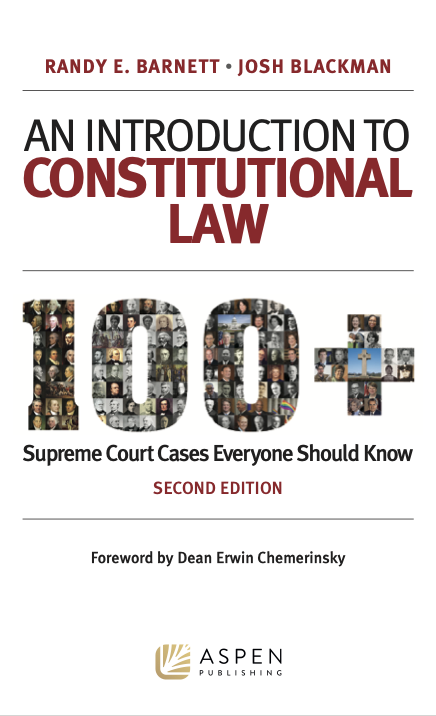
Randy and I titled the first edition of our book, 100 Supreme Court Cases Everyone Should Know. When we began the project, it was never our intent to include exactly 100 cases. Rather, after we finished compiling the list of the most important decisions, we realized we were right around one-hundred. We thought putting that round number in the title would be good for promotional purposes. But in fairness, we were actually over 100. We had 103 cases to be precise.
For the second edition, we had to modify the case count. We deleted five cases: McCreary County v. ACLU of Kentucky (2005), Van Orden v. Perry (2005).United States v. Windsor (2013), and Burwell v. Hobby Lobby Stores (2014), and Whole Woman's Health v. Hellerstedt (2016). That brought the total down to 98 cases. But we also added 12 new cases: Engel v. Vitale (1962), Baker v. Carr (1962), Gideon v. Wainwright (1963), Tinker v. Des Moines Independent Community School District (1969), New York Times v. United States (1971), Wisconsin v. Yoder (1972), Shaw v. Reno (1993), Town of Greece v. Galloway (2014), American Legion v. American Humanist Association (2019), Kennedy v. Bremerton School District (2022), New York State Rifle & Pistol Association, Inc. v. Bruen (2022), and Dobbs v. Jackson Women's Health Organization (2022).
We quickly decided against changing the title to 110 Cases Everyone Should Know. Indeed, the precise number would fluctuate over time for future decisions. Rather, we made a permanent fix: 100+ Cases Everyone Should Know. Indeed, the plus sign is in en vogue: Disney+, Paramount+, and so on.
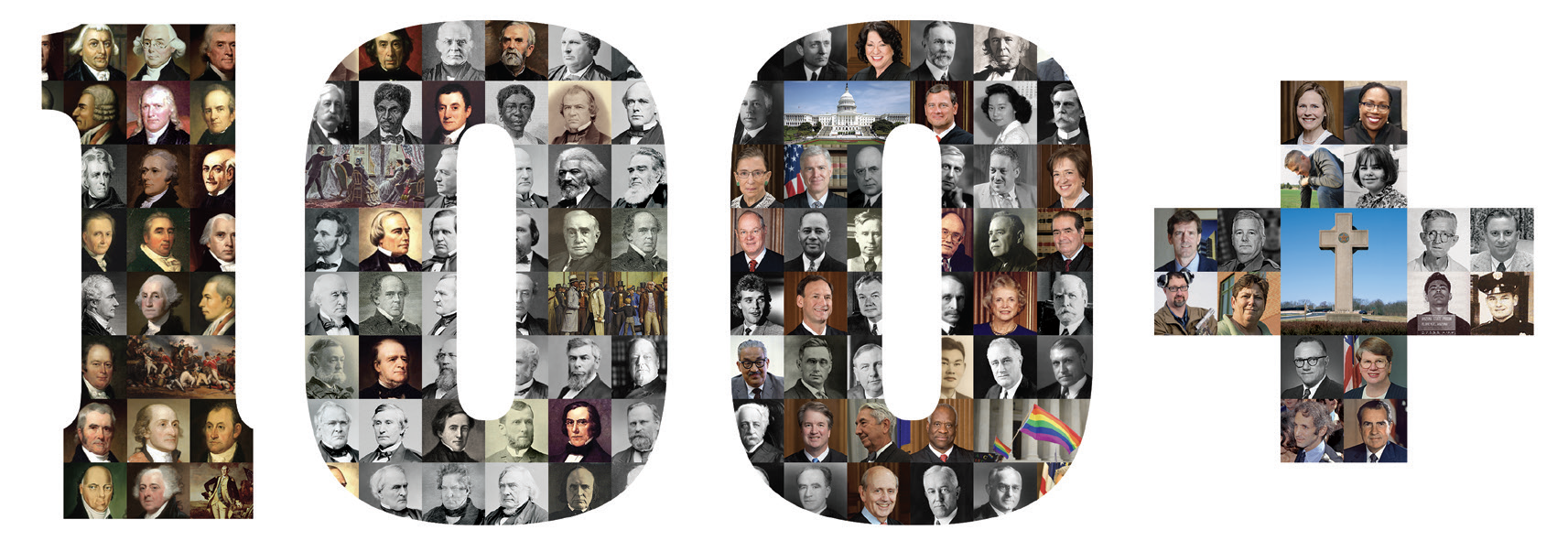
For the cover, we added a plus sign to the right of the "100."
The plus includes the newest additions to the book. In the center square, we added the Peace Cross from American Legion. In the top square, we included Justice Amy Coney Barrett, Coach Kennedy, Mary Beth Tinker, and Justice Ketanji Brown Jackson. The last addition came later, as we had to design the cover before Justice Jackson's official confirmation. In the left square, we included Thomas Dobbs of the Mississippi State Department of Health, Robert Nash of the New York State Rifle & Pistol Association, Susan Galloway of Town of Greece, and New York State Police Superintendent Kevin P. Bruen. In the bottom square, we included Tennessee Secretary of State Joe C. Carr, Daniel Ellsberg (leaker of the Pentagon Papers), President Richard Nixon, and Attorney General Janet Reno. In the right square, we included Clarence Earl Gideon, Ernesto Miranda, Officer Carroll Cooley (who arrested Miranda), and Florida Division of Corrections Director Louis L. Wainwright.
We will have more exciting news tomorrow about Supreme Court-related photographs.
There she was, low-tech Linda [Ellerbee], working on a word processor as a story writer for the Associated Press's broadcast wire in Dallas. One day she wrote a long, chatty letter to a friend in Alaska that was full of scandalously funny criticism of Texas newspapers, the Dallas City Council, the Vietnam war, and her boss. When it was accidentally sent out on the wires to the AP bureaus in four states, she lost that job but gained one at KHOU-TV "for writing funny."
A funny story, which reminds me of this Rudyard Kipling poem ("A Code of Morals"), though that involved the heliograph (a communication system that uses mirror-reflected flashes of sunlight) rather than a wire service. Always remember: "Howsoever Love be blind, the world at large hath eyes."
Now Jones had left his new-wed bride to keep his house in order,
And hied away to the Hurrum Hills above the Afghan border,
To sit on a rock with a heliograph; but ere he left he taught
His wife the working of the Code that sets the miles at naught.
And Love had made him very sage, as Nature made her fair;
So Cupid and Apollo linked, per heliograph, the pair.
At dawn, across the Hurrum Hills, he flashed her counsel wise —
At e'en, the dying sunset bore her husband's homilies.
He warned her 'gainst seductive youths in scarlet clad and gold,
As much as 'gainst the blandishments paternal of the old;
But kept his gravest warnings for (hereby the ditty hangs)
That snowy-haired Lothario, Lieutenant-General Bangs.
Under Rule 4.2 of the ABA Model Rules of Professional Conduct, in representing a client, a lawyer may not "communicate" about the subject of the representation with a represented person absent the consent of that person's lawyer, unless the law or court order authorizes the communication.
When a lawyer ("sending lawyer") copies the lawyer's client on an electronic communication to counsel representing another person in the matter ("receiving counsel"), the sending lawyer creates a group communication. This group communication raises questions under the "no contact" rule because of the possibility that the receiving counsel will reply all, which of course will be delivered to the sending lawyer's client. This opinion addresses the question of whether sending lawyers, by copying their clients on electronic communications to receiving counsel, impliedly consent to the receiving counsel's "reply all" response.
Several states have answered this question in the negative [see below -EV], concluding that sending lawyers have not impliedly consented to the reply all communication with their clients. {See,e.g., Wa. State Bar Ass'n Advisory Op. 202201 (2022); S.C. Bar Advisory Op. 18-04 (2018). For a list of the factors bearing on implied consent, see Cal. Standing Comm. on Prof'l Responsibility & Conduct Formal Op. 2011-181 ("Such facts and circumstances may include the following: whether the communication is within the presence of the other attorney; prior course of conduct; the nature of the matter; how the communication is initiated and by whom; the formality of the communication; the extent to which the communication might interfere with the attorney-client relationship; whether there exists a common interest or joint defense privilege between the parties; whether the other attorney will have a reasonable opportunity to counsel the represented party with regard to the communication contemporaneously or immediately following such communication; and the instructions of the represented party's attorney.").}
Although these states conclude that consent may not be implied solely because the sending lawyer copied the client on the email to receiving counsel, they also generally concede that consent may be implied from a variety of circumstances beyond simply having copied the client on a particular email. This variety of circumstances, however, muddies the interpretation of the Rule, making it difficult for receiving counsel to discern the proper course of action or leaving room for disputes….
Randy Barnett and I are proud to announce that the Second Edition of our best-selling book is now available for pre-order. An Introduction to Constitutional Law: 100+ Supreme Court Cases Everyone Should Know. The book is already the #1 new release in the Amazon category for Constitutional Law. When the book was launched in 2019, it sold out right away, and it took months for the stock to be refilled. Order the book today! And we will have more exciting announcements later this week.
Here I include the Author's Note, which describes what is new and different for the Second Edition--including essays on Dobbs, Bruen, and Kennedy v. Bremerton School District.
--
The first edition of An Introduction to Constitutional Law was published in September 2019. We innovated a product that did not exist on the market: incisive and balanced summaries of landmark decisions, written by leading constitutional law scholars, combined with an engaging video library, in an affordable paperback edition. By any metric, the past three years have been a resounding success.
The book has sold tens of thousands of copies, far surpassing all forecasts. Law school professors across the country have adopted 100 Cases. Indeed, many professors who started with 100 Cases as a supplement to another casebook have later adopted our casebook, which includes access to the video library. And thousands of students have found and used 100 Cases on their own to supplement the text their professor assigned. In addition to law schools, 100 Cases has been used at all levels of academia: in undergraduate constitutional law courses, high school political science classes, homeschools, and international programs for foreign students. In a short period of time, our book has consistently outsold well- established constitutional law treaties and horn books. Students and teachers alike routinely send us notes of praise, thanking us for our unique and accessible product.
Our book has also reached a broader general audience outside of academia and the law. As soon as the book was available for pre- order, the initial print run was completely sold out. For some time, the book was nearly impossible to find. In early 2020, after several prominent media interviews, the book skyrocketed to #4 on the Amazon best- seller list. The book was back- ordered for months. To date, 100 Cases has received more than 1,000 positive reviews on Amazon, dwarfing the feedback for similar titles.
We are deeply proud of our accomplishments to date. And this new edition will bring several improvements. First, we have modified the subtitle: 100+ Supreme Court Cases Everyone Should Know. Adding a "+ " is subtle but significant. We realized early on that it would be impossible to keep the count at exactly 100. Indeed, the first edition actually had 103 cases— but who's counting? This revised subtitle allows the constitutional corpus to wax and wane over time.
Second, we added and subtracted cases to reflect the current Supreme Court in flux. We removed United States v. Windsor (2013) and Burwell v. Hobby Lobby Stores (2014), as the vitality of those precedents has quickly faded. In the Establishment Clause section, we deleted McCreary County v. ACLU of Kentucky (2005) and Van Orden v. Perry (2005). Justice Breyer's retirement vitiated the relevance of those cases. In their place, we added two cases that follow the "history and tradition" approach to the Establishment Clause: Town of Greece v. Galloway (2014) and American Legion v. American Humanist Association (2019). And, on short notice, we added a brief discussion of Kennedy v. Bremerton School District (2022), which seems to have abandoned the Lemon test.
We included two other cases that were decided in June 2022. We replaced Whole Woman's Health v. Hellerstedt (2016) with Dobbs v. Jackson Women's Health Organization (2022). And we added New York State Rifle & Pistol Association, Inc. v. Bruen (2022). These cases relied on originalist methodologies to decide substantive due process and Second Amendment cases, respectively. Due to our exceedingly tight publication deadlines, the Dobbs and Bruen chapters had to be completed within a week after those lengthy cases were decided. We also preemptively removed the two affirmative action cases from the University of Texas. These two precedents by Justice Kennedy will likely be superseded by the Harvard and North Carolina cases, which should be decided by June 2023. We expect a lot more doctrine will shift when the third edition is (hopefully) published circa 2026. What will constitutional law and the Supreme Court look like at the semiquincentennial of the Declaration of Independence?
Third, to make our product more useful to high school classes, we included all fifteen required cases for the Advanced Placement U.S. Government and Politics course. We already covered eight of those cases, and have now added the other seven: Engel v. Vitale (1962), Baker v. Carr (1962), Gideon v. Wainwright (1963), Tinker v. Des Moines Independent Community School District (1969), New York Times v. United States (1971), Wisconsin v. Yoder (1972), and Shaw v. Reno (1993). We also included Miranda v. Arizona (1966) in a new section on the rights of the accused. We also have developed a wealth of resources for teachers to use in class, including slides, a teacher's manual, and a bank of study guide questions. Moreover, we worked diligently with Aspen Publishing to open up new distribution channels. Classes, schools, and even districts can obtain digital licenses and year- long subscriptions of our content. Now, students at all levels will be able to easily access our material on devices.
Fourth, Josh accomplished his long- standing goal: an illustrated "coffee table" version of Constitutional Places, Constitutional Faces. We have now published a hardcover, full- color, glossy version of 100+ Cases. In it, all of the same cases are supplemented by photographs, maps, portraits, and other enriching visuals to bring the law to life. The design is exquisite, and we include visuals you probably have never seen before. If you're reading this note, you have the black- and- white paperback edition. Treat yourself or a loved one and order the luminous illustrated edition; it will make a treasured keepsake gift for a lawyer, law student, or Supreme Court wonk.
Shortly after the first edition was launched, Randy and Josh had lunch near Capitol Hill. Josh told Randy that this product would sell a million copies over its lifetime. Randy responded with a healthy and well- deserved dose of skepticism. We are not there yet but, in time, we hope to achieve this goal, and educate people around the globe about constitutional law and the Supreme Court.
Just ran across this abbreviation for the first time in a court case; it's used in New York court citations, when the name of the county is included, and it means Bronx County, e.g., "See People v. Brown, 2022 NYLJ LEXIS 1051 (Sup Ct Bx Co.)." There are many references to it, and (less commonly) "Bx. Cty.," "Bx. Cnty.," and "Bx. County," so it's not just a one-off, though it's still much less common than the fully spelled out Bronx. A quick search reveals that Bx for Bronx is a common non-legalese reference, though seemingly pretty slangy; not all such abbreviations make their way into legal usage.
I have long advocated using May 1 for this purpose. But November 7 is a worthy alternative candidate, which I am happy to adopt if it can attract a broad consensus.
Since 2007, I have advocated designating May 1 as an international Victims of Communism Day. The May 1 date was not my original idea. But I have probably devoted more time and effort to it than any other commentator. In my view, May 1 is the best possible date for this purpose because it is the day that communists themselves used to celebrate their ideology, and because it is associated with communism as a global phenomenon, not with any particular communist regime, such as that of the USSR. However, I have also long recognized that it might make sense to adapt another date for Victims of Communism Day, if it turns out that some other date can attract a broader consensus behind it. The best should not be the enemy of the good.
As detailed in my May 1 post from 2019, November 7 is probably the best such alternative, and in recent years it has begun to attract considerable support. Unlike May 1, this choice is unlikely to be contested by trade unionists and other devotees of the pre-Communist May 1 holiday. While I remain unpersuaded by their objections on substantive grounds, pragmatic considerations suggest that an alternative date is worth considering, if it can sidestep objections and thereby attract broader support.
The November 7 option is not without its own downsides. From an American standpoint, one obvious one is that it will sometimes fall close to election day, as is the case this year. On such occasions, a November 7 Victims of Communism Day might not attract as much attention as it deserves, because many will - understandably - be focused on electoral politics instead. Nonetheless, November 7 remains the best alternative to May 1.
For that reason, I am - once again - doing a Victims of Communism Day post on November 7, in addition to the one I do on May 1. If November 7 continues to attract more support, I may eventually switch to that date exclusively. But, for the time being, I reserve the options of returning to an exclusive focus on May 1, doing annual posts on both days, or switching to some third option should there be another date that attracts a broader consensus than either May 1 or November 7.
In addition to its growing popularity, November 7 is a worthy alternative because it is the anniversary of the day that the very first communist regime was established in Russia. All subsequent communist regimes were at least in large part inspired by it, and based many of their institutions and policies on the Soviet model.
Having explained why November 7 is worthy of consideration as an alternative date, it only remains to remind readers of the more general case for having a Victims of Communism Day. The following is adopted from this year's May 1 Victims of Communism Day post, and some of its predecessors:
The Black Book of Communism estimates the total number of victims of communist regimes at 80 to 100 million dead, greater than that caused by all other twentieth century tyrannies combined. We appropriately have a Holocaust Memorial Day. It is equally appropriate to commemorate the victims of the twentieth century's other great totalitarian tyranny.
Our comparative neglect of communist crimes has serious costs. Victims of Communism Day can serve the dual purpose of appropriately commemorating the millions of victims, and diminishing the likelihood that such atrocities will recur. Just as Holocaust Memorial Day and other similar events promote awareness of the dangers of racism, anti-Semitism, and radical nationalism, so Victims of Communism Day can increase awareness of the dangers of left-wing forms of totalitarianism, and government domination of the economy and civil society.
While communism is most closely associated with Russia, where the first communist regime was established, it had equally horrendous effects in other nations around the world. The highest death toll for a communist regime was not in Russia, but in China. Mao Zedong's Great Leap Forward was likely the biggest episode of mass murder in the entire history of the world.
November 7, 2017 was the 100th anniversary of the Bolshevik seizure of power in Russia, which led to the establishment of the first-ever communist regime. On that day, I put up a post outlining some of the lessons to be learned from a century of experience with communism. The post explains why most of the horrors perpetrated by communist regimes were intrinsic elements of the system. For the most part, they cannot be ascribed to circumstantial factors, such as flawed individual leaders, peculiarities of Russian and Chinese culture, or the absence of democracy. The latter probably did make the situation worse than it might have been otherwise. But, for reasons I explained in the same post, some form of dictatorship or oligarchy is probably inevitable in a socialist economic system in which the government controls all or nearly all of the economy.
While the influence of communist ideology has declined greatly since its mid-twentieth century peak, it is far from dead. Largely unreformed communist regimes remain in power in Cuba and North Korea. In Venezuela, the Marxist government's socialist policies have resulted in political repression, the starvation of children, and a massive refugee crisis—the biggest in the history of the Western hemisphere.
In Russia, the authoritarian regime of former KGB Colonel Vladimir Putin has embarked on a wholesale whitewashing of communism's historical record. Putin's brutal war on Ukraine is primarily based on Russian nationalist ideology, rather than that of the Soviet Union. Nonetheless, the failure of post-Soviet Russia to fully reckon with its oppressive Soviet past is likely one of the reasons why Putin's regime came to power, and engaged in its own atrocities.
Here in the West, some socialists and others have attempted to whitewash the history of communism, and a few even attribute major accomplishments to the Soviet regime. Cathy Young has an excellent critique of such Soviet "nostalgia" in a recent Reason article.
In sum, we need Victims of Communism Day because we have never given sufficient recognition to the victims of the modern world's most murderous ideology or come close to fully appreciating the lessons of this awful era in world history. In addition, that ideology, and variants thereof, still have a substantial number of adherents in many parts of the world, and still retains considerable intellectual respectability even among many who do not actually endorse it. Just as Holocaust Memorial Day serves as a bulwark against the reemergence of fascism, so this day of observance can help guard against the return to favor of the only ideology with an even greater number of victims.
[For a brief explanation of this series of posts, see here]
Robert Oppenheimer's speech at a special meeting of the Manhattan Project staff at Los Alamos, NM on April 15, 1945, commemorating FDR's death:
When, three days ago, the world had word of the death of President Roosevelt, many wept who were unaccustomed to tears. Many men and women, little enough accustomed to prayer, prayed to God. Many of us looked with deep trouble to the future. Many of us felt less certain that our works would be to a good end. All of us were reminded of how precious a thing human greatness is. We have been living through years of great evil, and of great terror. Roosevelt has been our President, our Commander-in-Chief, and, in an old and unperverted sense, our leader. All over the world men and women have looked to him for guidance, and have seen symbolized in him the hope that the evil of these times will not be repeated, that the terrible sacrifices which have been made, and those that are still to be made, will lead to a world more fit for human habitation.
In the Hindu scripture, the Bhagavad Gita, it says 'Man is a creature whose substance is faith. What his faith is, he is.' The faith of Roosevelt is one that is shared by millions of men and women in every country of the world. For this reason it is possible to maintain the hope -- for this reason it is right that we should dedicate ourselves to the hope -- that his good works will not have ended with his death.
**********
For reasons I can't quite articulate, I find this quotation incredibly moving. It comes from Richard Rhodes' magnificent book The Making of the Atomic Bomb, which I enthusiastically recommend to anyone even remotely interested in the history of the 20th Century, the nature of matter in the universe, the way global science operates, or the intersection of science, politics, and warfare.
Rhodes tells two stories: One describes the work of a global community of physicists, an astonishing number of whom were Jewish refugees fleeing the fascism then sweeping over Europe, to understand the structure of the atom, beginning with Ernest Rutherford's discovery of the neutron in 1909 and culminating a mere 25 years later in Niels Bohr's proof that a self-sustaining nuclear reaction, emitting incomprehensibly large amounts of energy, was a theoretical possibility.
That's the physics; Part Two is about the engineering, and it is even more jaw-dropping. The effort required to convert Bohr's theoretical possibility into a usable and effective weapon was truly staggering, involving tens of thousands of individuals, many billions of dollars, the creation from scratch of not one but three separate small towns to house Manhattan Project workers (Oak Ridge TN, Hanford WA, and Los Alamos NM), construction of the world's first nuclear reactor and the world's first gaseous diffusion plant to produce the raw material for the bomb, and the design and construction of a bomb that was unlike, in every conceivable way, any weapon the world had ever seen before.
And all this was taking place while the U.S. was in the midst of a ferocious two-front global war, and when nobody was at all certain that any of it would actually work. And all in secret!
That they pulled it off in five years of work defies the imagination; if you have any doubts that governments can, sometimes, achieve tremendous things, this is the book for you. Bohr himself had written, back in '35, that the destructive potential of a fission-based weapon was just a theoretical possibility, unrealizable in the real world, because it would require substantial quantities of the isotope Uranium-235, which is only present in infinitesimally minute quantities in nature. To get enough for even a single bomb, he wrote, "you would have to turn the entire country into a factory." In 1944 he comes to the U.S. and is taken on a several-week tour of the Oak Ridge, Hanford, and Los Alamos facilities, at the end of which he turns to Oppenheimer and says: "You see, I was right! You've turned the entire country into a factory."
Do Colleges Set Asian Quotas? Newsweek, February 9, 1987.
With a mix of awe and animosity, students in the Boston area joke that MIT stands for Made in Taiwan. Like many of the nation's most competitive schools, the Massachusetts Institute of Technology has experienced huge increases in Asian-American enrollments.
Across the Ivy Legue, Asian-Americans, who make up only 2 percent of the nation's college-age population, account for 11 percent of this year's freshman class. Proud of their high grades and test scores, Asian-Americans say they should be doing even better -- and have accused top colleges of imposing ceilings to keep them out. "Asians are being discriminated against," charges Arthur Hu, an MIT alum who has studied Ivy League admissions patterns. "Unwritten quotas are making it more and more difficult to get into selective schools."
Recent admissions patterns do raise troubling questions. The nation's toughest institutions began admitting large numbers of Asian-Americans in the mid-1970s. But as their applications increased -- by as much as 1,000 percent -- the acceptance rate dropped; at Yale, the "admit" rate for Asian-Americans fell from 39 percent to 17 percent in the last decade. The timing was no coincidence, charges University of California, Berkeley, Prof. Ling-chi Wang. He claims that when worried schools realized what was happening, they began to curb the numbers.
Colleges deny setting ceilings, but they have taken the charges seriously. A Stanford University subcommittee concluded that "unconscious biases" might be responsible for the discrepancy in admission rates; subcommittee member Daniel Okimoto, a political-science professor, found that Asian-American applicants were often stereotyped as driven and narrowly focused….
Brown University, meanwhile, keeps a log of minority admits during admissions season, reportedly to achieve a total of 20 percent. "Asian-Americans should be concerned," says a Brown admissions officer. "We call them enrollment goals, but it works out about the same as a quota."….
"Stanford could become 40 percent Jewish, 40 percent Asian-American and 10 percent requisite black," says emeritus Harvard sociologist David Riesman. "You'd have a pure meritocracy, and that would create problems for diversity and alumni."
Around the same time this article appeared, I recall reading a story along the same lines, but with a specific focus on the UC schools. One thing that stood out to me was that the article related that several parents who happened to be attorneys sent demand letters to Berkeley and UCLA, threatening to sue them for discrimination against their Chinese-American children who had been rejected despite better credentials than non-Asian admittees from their high schools. The schools responded by quietly admitting the students.
The racial categories that the schools use are completely bonkers, an arbitrary mess mostly left over from the work of federal bureaucrats in the 1970s that can't withstand the slightest scrutiny.
The administrators who rely on these categories are beholden to senseless and unscientific distinctions — they aren't even competent or rational racialists.
The categories throw together a kaleidoscope of races and ethnicities in six neat categories: Asian, Native Hawaiian or Pacific Islander, Hispanic, White, African American, and Native American. Created for federal bookkeeping purposes 50 years ago, they long ago hardened into orthodoxy, with some adjustments here or there. ….
As legal scholar David Bernstein points out in "Classified: The Untold Story of Racial Classification in America," "Experience around the world shows that affirmative action categories almost always expand rather than contract, as more and more groups lobby to get affirmative action preferences and then lobby to protect those preferences." A system that drew its political support from our desire to eradicate Jim Crow ended up covering a number of protected classes, though along somewhat arbitrary lines that were driven as much by political maneuvering as by any rational criteria. This created various ad hoc absurdities — a Pakistani is "Asian," but an Afghan born a few miles across the border might be coded "White"; the daughter of a Spanish doctor is Hispanic, eligible for various private and government-sponsored affirmative action programs, while the child of an Italian janitor, who might be visually indistinguishable from the doctor's child, is presumably in no need of help.
The more immigrants who arrived, the more these complications multiplied, even among Black Americans. American descendants of enslaved people are our most disadvantaged citizens, with enduring gaps in education, income and wealth, but African immigrants are much better educated than average. The old system assumed a large White majority that was self-contained and thoroughly dominant; it was simply not built for a world where "biracial" was a meaningful category, or where some minority groups were more successful than the (rapidly shrinking) White majority….
Nametags at conferences have one main purpose, and one related subordinate purpose:
Make it easy for attendees to identify each other and each other's organizations.
Make it easy for attendees to pretend to remember people they've met, but whose names they've forgotten.
This yields five possible ways nametags can fail:
The type is too small, often because the nametag focuses on things like the conference name—even though everyone knows what conference they are attending—rather than the participant's name.
The type for the participant's name is large, but the name of the participant's organization or department (when the conference brings together people from various groups) is small, or even entirely omitted. That's bad, because knowing a stranger's organization can be a great icebreaker—"Oh, you're from the Judean People's Front; you must work with my old classmate Otto," or "You're the guys who work on sanitation, medicine, education, and wine; my colleagues and I just litigated a wine-related case in Anderson County, Texas …." (Related problem: Poor color contrast either for the participant's name or the participant's organization.)
The nametag is hanging down on a lanyard by the participant's bellybutton, so one has to look there in order to pretend to recognize someone.
The nametag is hanging down on a lanyard by the participant's bellybutton, so when people are talking over a meal, the nametag is below the tabletop and thus invisible.
The nametag is flipped around, which is especially common with those lanyard hanging-down-by-the-bellybutton nametags.
The solution to #3 and #4, of course, is to have the traditional clip-on nametags or things like them (some versions use magnets) and not the hanging nametags. If you want to offer both a clip and a hanging option, that's fine, and it might be helpful for the people whose clothes lack lapels, and who can't attach the nametag to the clothes' neckline. But absolutely have the clip or the magnet as at least one of the options.
(I've blogged about this before, but I was recently at a couple of conferences where I ran into some of these problems, so I thought it was worth mentioning again.)
The Federalist Society recently posted the video of an online panel entitled "What are the Limits of Executive Emergency Powers." Participants included Elizabeth Goitein (Brennan Center, NYU), Daniel Dew (Pacific Legal Foundation), and myself. The panel was moderated by Ilya Shapiro (Manhattan Institute), who is a different person from me.
As is to be expected with this ideologically diverse group (Goitein, for example, is well to the left of me, while the "other" Ilya is somewhat to my right), there was disagreement on several issues. Nonetheless, we did agree that emergency powers have been seriously abused by presidents of both parties in recent years, and that we need stronger constraints on their use - both legislative and judicial.
As part of my book publicity duties, I have appeared on a whole bunch of radio shows and podcasts, some of which can be fairly called "right-wing." One thing that I have noted is that when I give my typical shpiel about how American racial classifications are becoming almost entirely incoherent thanks to intergroup dating, marriage, and procreation, the host almost always starts talking about his own family, whether it be a Hispanic wife, half-black nephews, half-Asian cousins, or whatever. And of course, some of the hosts, even the "right-wing" ones, are themselves of full or partial black, Asian, or Hispanic descent. This, in short, is a very different America than fifty or even twenty years ago.
The book is being published by the Sentinel imprint of Bertelsmann SE's Penguin Random House. "We remain fully committed to publishing authors who, like Justice Barrett, substantively shape today's most important conversations," said Adrian Zackheim, publisher of Sentinel, a leading conservative house, in the publisher's first public comments on the situation….
Mr. Zackheim added that Sentinel "publishes books so that people can read them, and evaluate them on their own. In an intelligent free society we need to disseminate ideas in a robust form so that we can discuss them."
This was in response to an open letter from various authors, translators, agents, and Penguin Random House employees, which urged the publisher to cancel the book because of Justice Barrett's vote in Dobbs, which held that the Constitution doesn't protect abortion rights.
Sociologist Jennifer Lee writes in the New York Times:
In "The Asian American Achievement Paradox," which I wrote with Min Zhou and is based on 162 interviews of Asian, Hispanic, Black and white adults in Los Angeles, we found that Asian American precollege students benefit from "stereotype promise": Teachers assume they are smart, hard-working, high-achieving and morally deserving, which can boost the grades of academically mediocre Asian American students.
Let's stop right there. The coauthors attempt to explain the average educational success of "Asian Americans," a classification that includes dozens of ethnic/national subgroups that have varying average degrees of educational success (including some that are below average), who live all over the United States, based on *162 interviews* with adults of various "racial" groups in one city, Los Angeles.
The book won various awards. Go figure.
UPDATE: Perhaps the book is much more nuanced? But in any event, to give you some idea about the extent to which Asian American subgroups vary in educational success, let's take a look at undergraduate matriculants to UC Berkeley, which breaks the classification down by subgroup.
California is about 1.5% Indian American. 12.7% of Berkeley's class is "South Asian," primarily Indian.
California is about 3.5% Chinese American. 15.3% of Berkeley's class is Chinese.
California is about 2.5% Vietnamese American. 3.9% of Berkeley's class is Vietnamese.
California is about 3.2% Filipino American. 3.8% of Berkeley's class is Filipino.
California is about 1.2% Korean American. 4.6% of Berkeley's class is Korean.
California is about .7% Japanese American. 1.4% of Berkeley's class is Japanese.
California is about .8% Pacific Islander. Pacific Islanders are often lumped together into an AAPI category, and assumedly would benefit from at least some of the positive stereotypes that Asian Americans get. Berkeley's class is 1/10 of 1% Pacific Islander.
As you can see, while the larger Asian American subgroups in California almost all do better than average, the stereotype of remarkable Asian American educational success, at least in California, is driven primarily by Indians, Chinese, and Koreans who are "overrepresented" by approximately 8, 4.5, and 4 times their populations, respectively.
A reader reminded me of this blog post Jan. 24, 2022: Will the Supreme Court Ask Harvard How it Justifies Treating "Asian Americans" as a Homogenous Category? I wrote: "I'm not quite sure what Harvard's lawyer would or could say if asked why, say, Filipino, Nepalese, and Mongolian applicants are placed in the same 'diversity' category… We will never know unless one of the Justices asks."
Oral argument this past Monday, per Justice Alito (though questioning UNC's lawyer, not Harvard's):
JUSTICE ALITO: "But what is the justification for lumping together students whose families came from China with someone—with students whose families came from Afghanistan? What do they have in common?"
MR. PARK: So I agree that that would be a strange rule. And that is not the rule that this Court has established. It would require —
JUSTICE ALITO: Well, then why do you have them check a box that I'm Asian? What do you learn from the mere checking of the box?