
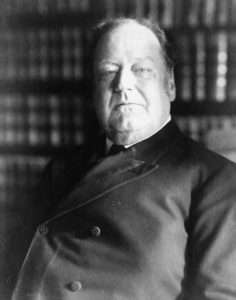
5/19/1921: Chief Justice Edward Douglass White dies.

Mostly law professors | Sometimes contrarian | Often libertarian | Always independent | Est. 2002

I happened to be at the Court when Chief Justice Roberts extended a welcome.
When the Supreme Court hosts foreign dignitaries, the Chief Justice will often recognize those guests and extend a welcome on behalf of the Court. (Dignitaries are usually seated in the first row of the public section, right behind the "bar."). I attended oral argument on April 24. At the outset of the session, Chief Justice Roberts announced that the Chief Justice of the Ukraine Supreme Court was in attendance, and welcomed him to the Court. At the time, I was honored by the jurist's presence. It is difficult to fathom how to manage a justice system while your country is at war. (Our country had mixed results with war on the homefront, see Merryman and McCardle). And despite all of the difficulties back home, he still found the time to come to the United States. I hoped his visit would provide some support for the rule of law back in Ukraine. Chief Justice Roberts then moved onto bar admissions, and I filed the Ukrainian Chief Justice's visit in my memory banks.
This evening, the NY Times reported that Chief Justice Vsevolod Knyazev was arrested on charges of accepting a bribe.
The chief of Ukraine's Supreme Court was formally arrested Thursday, as prosecutors indicated in a second day of hearings that a high-level corruption case was expanding to include a wider circle of judges.
Prosecutors also accused a lawyer of acting as an intermediary in paying a bribe to the chief justice, and said that at least three other judges of the court had been found holding thousands of dollars in currency marked by investigators.
The chief justice, Vsevolod Knyazev, was apprehended just after midnight Tuesday by officers of the National Anti-corruption Bureau of Ukraine, who searched his home and office in simultaneous raids and said they found large sums of cash in U.S. currency.
In videos of court hearings Wednesday and Thursday, posted on the High Anti-Corruption Court's YouTube channel, Mr. Knyazev appeared in the courtroom wearing a bright blue sweater and flanked by his lawyers. The High Council of Justice on Thursday lifted his immunity from prosecution, opening the way for his formal arrest.
Mr. Knyazev has been charged with graft in a public office, and accused of accepting a bribe of $1.8 million to influence a case in favor of a Ukrainian oligarch, Kostyantyn Zhevago. A prosecutor said Mr. Knyazev had sent a message to the lawyer in early May to split the money into at least 14 separate bags, and later sent a message saying he had passed the money to other judges.
The Anti-Corruption Court's prosecutor, Oleksandr Omelchenko, told the court that officers had tracked the payment of the first tranche of the bribe on May 3, and raided Mr. Knyazev's home half an hour after a second tranche was handed over on Monday evening.
The anti-corruption bureau had infiltrated the group making the bribe and marked the notes used in the payment. Officers discovered $1.8 million in cash at Mr. Knyazev's home and office, but the prosecutor said that not all the bribe money, totaling $2.7 million, had been recovered.
Barely a week after Knyazev was greeted so warmly by Chief Justice Roberts, he was soliciting a bribe, to be divided into 14 separate bags.
There is concern that this incident would tarnish the perception of the Ukrainian judiciary:
The case has shocked and dismayed members of Ukraine's judiciary. Two Supreme Court judges in interviews lamented the damage to the reputation of the court and the judiciary. They said they worked through the night and most of Tuesday to prepare a ballot in which 140 of the 142 Supreme Court judges voted to remove Mr. Knyazev from his post. The two judges spoke on condition of anonymity, because of their position as members of the court.
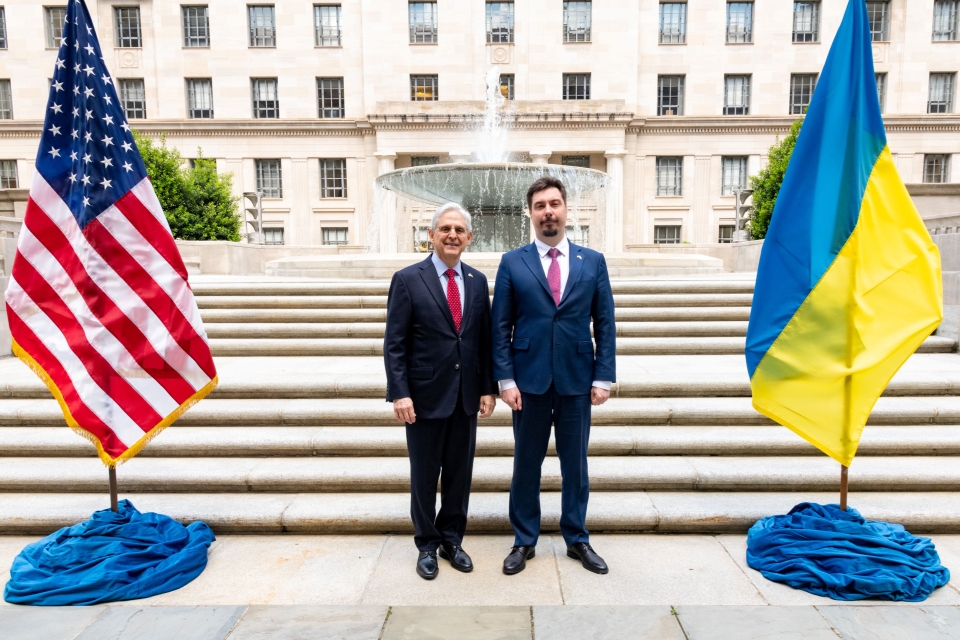
Knyazev also met with Attorney General Garland on his trip.
I'm sure readers will try to make some smarmy connection between Knyazev and the United States Supreme Court's legitimacy. I won't. I am grateful that our federal judges have integrity and honesty, and these sorts of allegations would be unthinkable.
What's on your mind?
Arizona v. Mayorkas is one of the cases dealing with "Title 42 orders" that "severely restricted immigration to this country for the ostensible purpose of preventing the spread of COVID–19"; today, the court issued a procedural order in the case, and Justice Gorsuch wrote a statement regarding that decision. It began with laying out the "tortured procedural history," and noting the problems posed by nationwide injunctions; but it then added:
Since March 2020, we may have experienced the greatest intrusions on civil liberties in the peacetime history of this country. Executive officials across the country issued emergency decrees on a breathtaking scale. Governors and local leaders imposed lockdown orders forcing people to remain in their homes. They shuttered businesses and schools, public and private. They closed churches even as they allowed casinos and other favored businesses to carry on. They threatened violators not just with civil penalties but with criminal sanctions too.
They surveilled church parking lots, recorded license plates, and issued notices warning that attendance at even outdoor services satisfying all state social-distancing and hygiene requirements could amount to criminal conduct. They divided cities and neighborhoods into color-coded zones, forced individuals to fight for their freedoms in court on emergency timetables, and then changed their color-coded schemes when defeat in court seemed imminent.
Federal executive officials entered the act too. Not just with emergency immigration decrees. They deployed a public-health agency to regulate landlord-tenant relations nationwide. They used a workplace-safety agency to issue a vaccination mandate for most working Americans. They threatened to fire noncompliant employees, and warned that service members who refused to vaccinate might face dishonorable discharge and confinement. Along the way, it seems federal officials may have pressured social-media companies to suppress information about pandemic policies with which they disagreed.
While executive officials issued new emergency decrees at a furious pace, state legislatures and Congress—the bodies normally responsible for adopting our laws—too often fell silent. Courts bound to protect our liberties addressed a few—but hardly all—of the intrusions upon them. In some cases, like this one, courts even allowed themselves to be used to perpetuate emergency public-health decrees for collateral purposes, itself a form of emergency-lawmaking-by-litigation.
Today's Twitter v. Taamneh, Inc. involved (to oversimplify slightly) a lawsuit against Twitter based on Twitter's alleged role in helping ISIS by providing it publishing services, and by algorithmically recommending some of ISIS's videos. The lawsuit was brought under the federal Antiterrorism Act, but the Act applied fairly traditional aiding-and-abetting principles, borrowed from the criminal law and tort law. (The tort law and criminal law principles aren't always identical, but they seemed to be treated similarly in this case.)
No liability, the Court held, chiefly because Twitter (and others) merely provided an off-the-shelf service, which treated ISIS no better than any other user. Here's an excerpt, with the references to this arms-length treatment emphasized:
To start, recall the basic ways that defendants as a group allegedly helped ISIS. First, ISIS was active on defendants' social-media platforms, which are generally available to the internet-using public with little to no front-end screening by defendants. In other words, ISIS was able to upload content to the platforms and connect with third parties, just like everyone else.
Second, defendants' recommendation algorithms matched ISIS-related content to users most likely to be interested in that content—again, just like any other content. And, third, defendants allegedly knew that ISIS was uploading this content to such effect, but took insufficient steps to ensure that ISIS supporters and ISIS-related content were removed from their platforms. Notably, plaintiffs never allege that ISIS used defendants' platforms to plan or coordinate the Reina attack; in fact, they do not allege that Masharipov himself ever used Facebook, YouTube, or Twitter.
None of those allegations suggest that defendants culpably "associate[d themselves] with" the Reina attack, "participate[d] in it as something that [they] wishe[d] to bring about," or sought "by [their] action to make it succeed." In part, that is because the only affirmative "conduct" defendants allegedly undertook was creating their platforms and setting up their algorithms to display content relevant to user inputs and user history. Plaintiffs never allege that, after defendants established their platforms, they gave ISIS any special treatment or words of encouragement.
That's today's dissent in Andy Warhol Foundation for the Visual Arts, Inc. v. Goldsmith, written by Justice Kagan and joined by Chief Justice Roberts (see pdf pp. 81-83). But I read the U.S. Reports only for the articles.
Note that at least one lower court decision, Cariou v. Prince [not the same Prince] (2d Cir. 2013), anticipated this. Law review articles had done the same, I'm sure (I did, for instance, in my Thinking Ahead About Freedom of Speech and Hostile Work Environment Harassment, 17 Berkeley J. Emp. & Lab. L. 305 (1996)), but I believe the Warhol dissent was the first Supreme Court decision to do this. Please let me know if there's some other precedent I've missed.
Historically, the Court issued opinions on Mondays after oral arguments concluded. But this Term, Thursday is the big day.
In the past, the Supreme Court followed a careful rhythm. You could predict, with a degree of certainty, when orders would drop and when opinions would be released. When oral arguments were scheduled, the Court would release orders on Monday, and opinions on Tuesday. As March turned to April, the Court would begin releasing opinions on Tuesday as well as Wednesday. However, in May, when oral arguments concluded, the Court would issue both opinions and orders on Mondays. That practice would continue until mid-June, when the Court would start issuing opinions on Mondays, Wednesdays, Thursdays, and on rare occasions, Fridays. You could set your watch to that timeline. Indeed, I would try to avoid air travel in June on Monday, Wednesday, and Thursday mornings.
The pandemic changed many things around, but the Monday handdown tradition continued, at least through May 2022. But this term, the Court seems to be experimenting. Oral argument concluded on April 26, 2023. And over the past two weeks, the Court has not reverted to the Monday/Tuesday/Wednesday hand-down. Rather, the Court is cramming all of the opinions on Thursdays. Indeed, the Court handed down four opinions on Thursday, May 11, and six opinions on Thursday, May 18. This seems to be the new practice.
Jacob Berlove, who was the champion of the inaugural season of FantasySCOTUS, flagged this issue on the SCOTUSBlog live-blog:
Why is the Court announcing decisions on Thursdays instead of Mondays? Pre-Covid, Monday was the day once arguments ended until they moved to multiple decision days.
I much prefer trickling out a few opinions on Monday, Tuesday, and Wednesday. That timeline gives me more time to read and digest the decisions. But now I have to read six opinions totaling about 170 pages, in a single day. If nothing else, the press will have a harder time covering this much content at once. We are used to this torrent the last week in June, but not throughout May. On balance, the Court should go back to its old tradition. Unless making it harder for the press to cover cases is a feature, rather than a bug.
A critique of claims that the federal government and the states can use military force to prevent immigration, based on constitutional powers to prevent "invasion."

It has become commonplace for right-wing activists and GOP politicians to describe illegal migration across the southern border as an "invasion." While much of this is just political rhetoric, some have argued that the Guarantee Clause of the Constitution, gives state and federal governments the authority to use military force to block such migration. The Clause states that "The United States shall guarantee to every State in this Union a Republican Form of Government, and shall protect each of them against Invasion; and on Application of the Legislature, or of the Executive (when the Legislature cannot be convened) against domestic Violence." Then-Arizona Attorney General Mark Brnovich advanced this theory as a justification for military action in a February 2022 opinion. Andrew Hyman recently made a similar argument at the Originalism Blog.
As a matter of logic and common sense, the equation of illegal migration and invasion makes little sense. Invasion involves large-scale use of force (or at least threat of force) to seize territory. Russia's attack on Ukraine is an invasion. Migrants crossing a border in search of freedom and opportunity are not. We do, of course, have metaphorical uses of the word "invasion," as with "invasion of privacy" or even the 1960s "British Invasion" of UK rock music. But such metaphorical uses should not be conflated with literal ones. Claims that immigration is a kind of "invasion" are about the latter.
The text of the Guarantee Clause suggests that it refers to violent attack. "Invasion" is paired with "domestic Violence" (which here obviously means uprisings against the state government, not the modern use of the term to denote violence in family and intimate relationships). Hyman also cites the provision of the Constitution indicating that "No State shall, without the Consent of Congress … engage in War, unless actually invaded, or in such imminent Danger as will not admit of delay." But the "invasion" referred to here is pretty obviously an armed attack. Otherwise, it would not make sense to "engage in War" as a response to it. I think it obvious that the "war" referred to here is a literal war against a foreign power, not a metaphorical war, such as the War on Drugs or the War on Poverty. This Clause is an exception to the constitutional requirement that only Congress has the power to declare war.
Brnovich and Hyman both cite James Madison in support of their position. But they overlook the one time he discussed the Guarantee Clause's reference to "invasion" specifically in the context of immigration. He did so in his Report of 1800, which rebutted claims that the Alien Friends Act of 1798 (which gave the president broad power to expel non-citizens) was authorized by the clause:
It is said, that Congress, are, by the constitution, to protect each state against invasion; and that the means of preventing invasion, are included in the power of protection against it….
Invasion is an operation of war. To protect against invasion is an exercise of the power of war. A power therefore not incident to war, cannot be incident to a particular modification of war. And as the removal of alien friends [citizens of countries with which the US is not at war] has appeared to be no incident to a general state of war, it cannot be incident to a partial state, or a particular modification of war.
Nor can it ever be granted, that a power to act on a case when it actually occurs, includes a power over all the means that may tend to prevent the occurrence of the case. Such a latitude of construction would render unavailing, every practicable definition of particular and limited powers. Under the idea of preventing war in general, as well as invasion in particular, not only an indiscriminate removal of all aliens, might be enforced; but a thousand other things still more remote from the operations and precautions appurtenant to war, might take place. A bigoted or tyrannical nation might threaten us with war, unless certain religious or political regulations were adopted by us; yet it never could be inferred, if the regulations which would prevent war, were such as Congress had otherwise no power to make, that the power to make them would grow out of the purpose they were to answer. Congress have power to suppress insurrections, yet it would not be allowed to follow, that they might employ all the means tending to prevent them…
As Madison put it, "invasion is an operation of war." Immigration, by contrast, is not. And, as he explained, if this power is interpreted broadly to include anything that might reduce the risk of war or increase national security at the margin, it would undermine virtually all structural limits on federal power. It would also render many of the federal government's other enumerated powers superfluous. For example, there would be no need for the power to "raise and support," armies, the power to impose taxes (which could help repel invasions!), and many other powers listed in Articles I and II of the Constitution.
While overlooking the Report of 1800, Brnovich and Hyman both cite Madison's statement about the invasion provision of the Guarantee Clause in Federalist 43:
A protection against invasion is due from every society to the parts composing it. The latitude of the expression here used seems to secure each State, not only against foreign hostility, but against ambitious or vindictive enterprises of its more powerful neighbors. The history, both of ancient and modern confederacies, proves that the weaker members of the union ought not to be insensible to the policy of this article.
Brnovich and Hyman claim that the reference to "ambitious or vindictive enterprises of its more powerful neighbors" suggests that "invasion" includes nonviolent actions. But the point of this phrase is pretty obviously not to imply a broad definition of "invasion" but to emphasize that the Guarantee Clause protects states against invasions by other states (the "more powerful neighbors") as well as foreign powers ("foreign hostility"). The reference to the history of "confederacies" and the needs of the "weaker members of the union" reinforces this interpretation.
The possibility of warfare between states was more than just a hypothetical possibility in the Founding era. Conflicts between them had occurred during the colonial era, most notably the long-running, occasionally violent, dispute between New Hampshire and New York over possession of the territory that eventually became the state of Vermont.
Brnovich also cites Madison's comments, in the Virginia debate over ratification of the Constitution, to the effect that "[t]he militia ought to be called forth to suppress smugglers." But this passage has nothing to do with the power to protect against invasions. Rather, it was a response to Patrick Henry's attack on Congress' power of "calling forth the Militia to execute the Laws of the Union." Madison does not claim here that smuggling qualifies as an invasion. And using the militia to enforce laws isn't the same thing as taking the kind of large-scale military action that might be justified in the event of a genuine invasion.
If you want to know what Madison thought about the claim that immigration counts as "invasion," look to the Report of 1800, where he actually discusses that issue.
Hyman also tries to buttress his case with a clever, but unpersuasive hypothetical: "It would certainly be odd if the forces of a foreign government could simply leave their weapons at home, and thereby deprive a U.S. state of power to resist their incursion." If these foreign troops left their weapons at home, their "invasion" wouldn't be much of a threat! I think it may not even be worthy of the name. But if an attack by unarmed troops did qualify as an invasion, it would be because they are still part of an organized military force trying (even if not very effectively) to use violence to seize territory. The difference between that and illegal immigration is pretty obvious. The same reasoning applies to an attack by non-state armed forces, such as terrorists.
It might be argued that any illegal movement from one place to another qualifies as an "invasion." By that standard, however, an invasion occurs anytime someone smuggles in contraband, violates tariff regulations, and so on. In the pre-Civil War era, some states, such as Indiana, enacted laws banning the in-migration of free blacks from other states. But it would be absurd to claim that black migrants who violated these laws were thereby "invading."
Similarly, one can argue that an "invasion" occurs anytime at least some migrants engage in violence (as in the case of drug cartels operating in the border area, for example). But by that standard, one state has "invaded" another any time criminals cross a state border to engage in any violent action. A real "invasion" requires a large-scale attack on the territorial or political authority of the state. Small-scale, nonpolitical private violence doesn't qualify. The latter can, of course, still be dealt with by normal law enforcement actions. But it doesn't justify large-scale use of military force of the kind that can be used to respond to an invasion.
Finally, it's worth noting that even if the Guarantee Clause gives the federal government power over immigration, it does not give states any authority of any kind (except to call for federal assistance in suppression "domestic Violence"). The power to protect against "invasion" is given only to "the United States," which is the way the Constitution refers to the federal government.
At least for the moment, the practical legal significance of the "invasion" issue is very limited. In the Chinese Exclusion Case (1889), the Supreme Court held (very wrongly, in my view) that the federal government has a nearly unlimited "inherent" power to restrict immigration, without relying on the Guarantee Clause to reach that conclusion. For their part, state governments have fairly broad authority to use the National Guard or other military forces in a law enforcement role, if they so choose. The main limit on that, if any, lies in their state constitutions. For these and other reasons, we are unlikely to see any significant litigation over the meaning of "invasion" as it relates to immigration, anytime soon.
But the rhetoric of "invasion" and citations to constitutional provisions on that subject do serve the purpose drawing a false moral and legal equivalency between migrants and invaders. They thereby potentially justify harsher and more militaristic responses to migration than might otherwise be contemplated. Moreover, the Guarantee Clause argument could potentially become legally significant when and if there is broader recognition of the many weaknesses of other constitutional rationales for federal-government migration restrictions. For these reasons, I thought it worthwhile to critique the invasion theory, even though it's unlikely to have much immediate legal effect.
Hyman also cites the Migration or Importation Clause and the Define and Punish Clause as possible constitutional justifications for federal power over immigration (though not necessarily for the use of military force). I addressed the former theory here, and the latter here.
Seth Barrett Tillman and I discuss whether the President is an "Officer of the United States" for purposes of the federal officer removal statute.
Two weeks ago, President Trump removed his criminal case to federal court. (I wrote about Trump's motion here.) 28 U.S.C. 1442 provides, in part:
(a) A civil action or criminal prosecution that is commenced in a State court and that is against or directed to any of the following may be removed by them to the district court of the United States for the district and division embracing the place wherein it is pending: (1)The United States or any agency thereof or any officer (or any person acting under that officer) of the United States or of any agency thereof, in an official or individual capacity, for or relating to any act under color of such office or on account of any right, title or authority claimed under any Act of Congress for the apprehension or punishment of criminals or the collection of the revenue.
Yes, you read that right. Trump could only invoke this statute if, as President, he was an "Officer of the United States." Sometimes I feel like I am living in the movie Groundhog Day, but with the Constitution's officer-language.
Seth Barrett Tillman and I wrote a new article for Lawfare, titled Why the Manhattan DA's Trump Case Cannot Be Removed to Federal Court. Here is the introduction
Last month, a Manhattan grand jury indicted Donald J. Trump for violating state law based on alleged "hush money" payments to Stormy Daniels. To be precise, Michael Cohen, who was then-candidate Trump's lawyer, paid the adult film star before the 2016 election. And after the inauguration, President Trump reimbursed Cohen for those payments. Indeed, Trump allegedly signed the checks to Cohen in the Oval Office. That timing may matter.
Trump now alleges that he made those payments as part of his federal duties, and as a result, the criminal case against him belongs in federal court. Trump's lawyers have invoked the obscure federal officer removal statute. This statute allows an "officer of the United States" to remove a prosecution from state court to federal court. But the former president can only remove the case to federal court if he was an "officer of the United States." Fortunately for District Attorney Alvin Bragg, there are good reasons to conclude that the elected president was not an "officer of the United States," so the case should stay in Manhattan criminal court.
Tillman and I walk through the history of the federal officer removal statute from the War of 1812 to the present. We also discuss DOJ policy with regard to the phrase "Officers of the United States":
The Department of Justice has long reasoned that the phrase "officers of the United States" in the Constitution and federal statutes should not extend to the elected president. For example, in 1969, future-Chief Justice William H. Rehnquist, then an Executive Branch attorney, stated that statutes that refer to "officers of the United States" generally "are construed not to include the President unless there is a specific indication that Congress intended to cover the Chief Executive." Five years later, future-Justice Antonin Scalia, then also an Executive Branch attorney, reached a similar conclusion. He wrote, that "when the word 'officer' is used in the Constitution, it invariably refers to someone other than the President or Vice President." These Executive Branch precedents would counsel against deeming the president an "officer of the United States" for purposes of the federal removal statute.
The Department of Justice is not a party to this prosecution, but the federal court should consider calling for the views of the United States here.
For those who want to learn more about the phrase "Officers of the United States," see Part III of my ten-part series with Tillman.
OK, not really, but the judge partly denied the motion for summary judgment, which would allow it to go to trial.
From Williams v. Bd. of Ed., decided Tuesday by Judge Matthew Kennelly (N.D. Ill.):
Williams attended Bogan Computer Technical High School (Bogan) in Chicago from fall 2017 until he graduated on June 18, 2019. While Williams was a student, Bogan implemented the Quiet Time program during the 2017–18 and 2018–19 school years….
According to Williams, his first experience with Transcendental Meditation as a part of the Quiet Time program occurred during the 2018–19 school year, when he was eighteen years old. He stated that he did not receive any letters about the program to give to his parents, but in October 2018 he and other students were given a document titled "Quiet Time Program Student Application for Transcendental Meditation Instruction Bogan High School." He also stated that he had been informed that Transcendental Meditation was "a really effective way to meditate and find yourself" and that he signed the form when it was first presented to him because he "was interested learning [meditation] properly."
Although the document included language stating that "learning the TM technique is an optional activity," Williams maintained it was "not optional" and "mandated" for students to sign the document. He explained that this was because students who initially chose not to learn Transcendental Meditation "eventually had to sign up," though "off the top of [his] head at the [moment]" he was unable to name any student who did not sign the document at first and later "was forced to do [Transcendental Meditation]." As for meditating during the fifteen-minute Quiet Time periods, Williams did not dispute that "if [he] didn't want to do [Transcendental Meditation], [he] didn't have to."
In contrast, Principal Aziz-Sims testified during her deposition that students could choose not to learn Transcendental Meditation. She stated that although students who were disrupting others during Quiet Time may have been reprimanded by a teacher, an administrator, or the principal herself, she was not aware of any Bogan student being disciplined for choosing not to learn Transcendental Meditation. She also testified that she approved giving students at least two letters explaining Quiet Time to their parents and allowing their parents to opt out of the program, in accordance with the school's policy regarding student involvement in other school activities.
Baby Ninths assume a Lockean social contract—not a Hobbesian one. They protect Lockean rights but not positive or procedural rights.
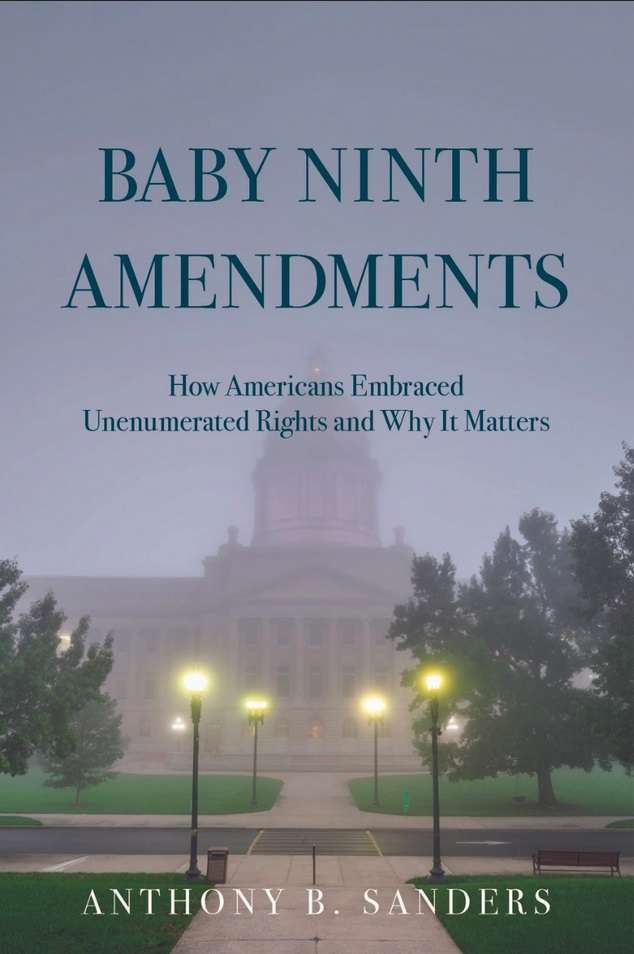
You might call this post "The Big Mac." I'm getting to the meat of the issue: What rights do Baby Ninths protect, and how do these state constitutional provisions protect those rights?
You can see the previous three in this series here, here, and here, all of which summarize my new book from the University of Michigan Press, Baby Ninth Amendments: How Americans Embraced Unenumerated Rights and Why It Matters (available for free here).
First let's take a 30,000 foot view of what we're talking about: a specific type of provision with specific words with variants in thirty-three state constitutions. We are not talking about "rights" generally or what we would put in a constitution ourselves. You could imagine a state constitution that says something like everyone has a right to "a minimum annual income." Or "adequate housing." Or even something wide-open like "what one needs to live a fulfilling life." For various reasons I think those provisions would be bad. But if they were in a constitution, you would have to admit they were "constitutional rights." Indeed, some fellow libertarians may not like this, but many state constitutions already make a state provided primary education a right. What the text says matters.
With that level-setting, let's look at what Baby Ninths protect. For guidance, we're first going to see what various scholars have said about the Ninth Amendment itself. Since the text is always very similar between the Ninth and Baby Ninths, this will hopefully give us a good start.
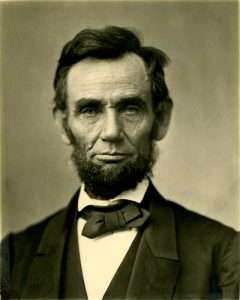
5/18/1860: Abraham Lincoln wins the Republican Party presidential nomination.
5/18/1896: Plessy v. Ferguson decided.
Professor Prakash dispatches the arguments for unilateral Presidential authority to disregard the debt ceiling.
As negotiations between Congress and the White House over the debt ceiling proceed, some continue to argue that the President should invoke the 14th Amendment as authority to circumvent the debt ceiling. As I noted before, this is not a new debate, but the claims continue.
In Thursday's WSJ, University of Virginia law professor Saikrishna Prakash explains why "neither the Constitution nor the law nor common sense" supports the argument that the debt ceiling can be disregarded. Professor Prakash starts with the text:
The 14th Amendment is often cited but rarely quoted. Section 4 both repudiates Confederate debt and promises to honor U.S. debt. The provision at issue provides that the "validity of the public debt of the United States, authorized by law . . . shall not be questioned." Section 4 doesn't address default or other failures to honor terms of a debt contract. It bars repudiation. A debtor who is late on a payment isn't questioning the debt's validity; he is merely tardy. To my knowledge, no one on either side of the debate is suggesting that the U.S. repudiate its debt.
Further, even if one assumes the 14th Amendment bars debt defaults, it nowhere authorizes the president to take whatever measures he deems necessary to prevent default. It no more empowers him to take such measures than it does you or me. As per the Constitution, Congress, not the president, has the power to "borrow money on the credit of the United States." If the Constitution bars default and more money is needed to prevent default, Congress must act. The president can't issue debt on his own say-so.
Prakash further notes that insofar as the 14th Amendment obligates the President to act to ensure that debts are paid, this would require the President to prioritize paying such obligations over making other appropriations.
If Congress fails to raise the debt ceiling, the only reason there would be a default is if the executive fails to pay the interest on the debt as it comes due. But if the executive branch believes there is a constitutional requirement to pay the interest, why would it even consider refusing to do so? To my knowledge there is no law that prevents the executive from prioritizing interest payments above all other spending.
In fact, there is an argument that having by statute pledged the "faith of the United States Government," Congress implicitly prioritized the payment of the interest and principal. If the debt ceiling isn't raised, the Treasury should pay the interest as it is due and spend less than Congress appropriated. That would be the best solution in the wake of a mismatch between total inflows (taxes plus new borrowing) and Congress's desired spending.
Not only does the President lack the authority to disregard the debt ceiling, he also lacks the constitutional authority to borrow funds without congressional authorization.
The majority leader, and everyone else, should listen to the voice of Godbey on single-judge divisions.
A few weeks ago, Senate Majority Leader Chuck Schumer sent a letter to Chief Judge Godbey of the Northern District of Texas. Schumer wrote, in so many words, That's a really nice court you have there, it would be a shame if something happened to it.
On Tuesday, Judge Godbey wrote a two-page response to Schumer. He made several important points
First, the proposals to outright eliminate single-judge divisions disregard how litigation works in remote places like Amarillo or Wichita Falls.
The allocation of cases among our judges is a complex matter. In addition to the fair administration of justice, we must also consider: the number and type of civil and criminal cases filed in a division, which varies significantly from division to division; the convenience of the jurors, witnesses, parties, and attorneys; the desire of communities to have local judges; the burden of travel on court personnel; and the need to provide judicial support for divisions without a resident district judge. Our system of case allocation among available judicial officers is one that has evolved over the years to meet the particular needs of our District, and we constantly reevaluate it.
Second, Judge Godbey opined on the sheer size of the Northern District of Texas, which is not comparable to the Northern District of New York:
The Northern District of Texas has some unusual characteristics that also require consideration. First, the District is geographically large. It encompasses more than 96,000 square miles. That is approximately 75% larger than the entire State of New York. It stretches more than 400 miles across, both North to South and East to West. It is also diverse, including the dense, urban Dallas/Fort Worth Metroplex, as well as sparsely populated rural counties in our North, West, and South reaches.
The distance from the southernmost portion of New York (Staten Island, my hometown) to the Northernmost portion (near the Canadian border) is only 350 miles. And a similar dynamic applies to the Southern District of Texas. The distance from Houston (the northernmost portion of the Southern District) to Brownsville (near the Mexican border) is about 350 miles. Then again, the Southern District of New York stretches all the way from Manhattan to Poughkeepsie (about 85 miles). I realize Senator Schumer may think the world ends beyond the Hudson, but there is lots of America that needs access to justice. And I say this as a former New Yorker who got to Texas as fast as I could. Rules that apply to dense states like New York would not make sense for sparse states like Texas.
Third, Judge Godbey explains why "random" assignments would not work.
So the random assignment of all civil cases across this District would present logistical challenges far beyond those of the smaller districts you mention, or the random assignment of a small slice of civil cases such as patent cases.
Judges who are stationed in Dallas with their staff cannot be expected to travel hundreds of miles away for random cases. And no, justice cannot always be dispensed on Zoom.
Godbey's last point is the most significant. The Chief Judge does not have the unilateral power to make this change.
I also bring to your attention a provision of our Local Rules which requires that the district judges as a whole determine the method by which cases are assigned to individual judges. See L. Civ. R. 83.3. It is common for the Chief Judge to tweak the percentage assignment to particular judges after consultation with the affected judges, which I did in the Orders you cite. But, I am not authorized to impose unilaterally a new method of case allocation for our District.
I am well aware that in 2016, Judge Godbey's predecessor reassigned 15% of cases from the Wichita Falls division to herself. That was a controversial decision at the time, and one that was never fully justified. And Judge Godbey reversed that decision in 2022. And I think Judge Godbey accurately states the rules.
My earlier writing on single-judge divisions can be found here and here.
Florida Law + New York Law + Jewish Law = ....
From today's decision of the New York appellate court in Bernstein v. Benchemoun (Judges Valerie Brathwaite Nelson, Joseph A. Zayas, William G. Ford & Helen Voutsinas):
On February 7, 2013, the parties were married in a Jewish religious ceremony in Florida. At the ceremony the parties executed a religious marriage contract, known as a ketubah, but they did not obtain a marriage license from the State of Florida. The parties then came to New York, where they executed a second ketubah in the presence of a rabbi.
In 2018, the wife sought a divorce, and the husband responded that the parties were never married. Husband wins, says the court:
From today's Wisconsin Court of Appeals summary disposition in Lafferty v. Amundson (decided by Justices Gundrum, Neubauer & Grogan):
Brian and Katie Lafferty appeal from a circuit court order rejecting the Laffertys' constitutional challenges to [a] Department of Children and Families Rule, which imposes certain firearm storage requirements for foster parents, as well as the Department's prohibition on foster parents from carrying weapons while in the presence of foster children.
The relevant prohibition requires, among other things, that guns generally be stored unloaded and locked; the prohibition on carrying ready-to-use firearms on one's person would presumably flow from that.
Our new Journal of Free Speech Law is faculty-edited, but we'd love to have help from students with cite-checking. Our American law professor authors generally have their own research assistants do that, but some of our authors are from outside the U.S., and some are practitioners or professors in other fields; for them, we do offer cite-checking. We publish both electronically and in print, and we've already published many articles, with many more in the pipeline.
If you'd like to join our team of Production Editors (this is the title we give, on our site and in our print issues), please e-mail me at volokh@law.ucla.edu. In particular, we'll need several people who can work on several articles over the next few weeks.
As you might gather from the job description, one thing we need is attention to detail. If your mind just absorbs information from written text, and doesn't bother you by alerting you to typos in citations and quotes, then this will be a frustrating task for you. On the other hand, if errors just jump off the page at you as you read, you'd be perfect.
Allegations include violations of the First and Fourteenth Amendments
I just received word that the PEN American Center as well as several book authors, publishers, and parents of children attending public school in Escambia County (Florida) have filed a lawsuit related to public school library book bans. The complaint can be found on Protect Democracy's website here.
The lawsuit alleges that the Escambia County School District and School Board removed and restricted books from public school libraries "based on their disagreement with the ideas expressed in those books." It further alleges that the School District has sided with "a challenger expressing openly discriminatory bases for challenge, overruling the recommendations of review committees at the school and district levels" and that "[t]hese restrictions and removals have disproportionately targeted books by or about people of color and/or LGBTQ people, and have prescribed an orthodoxy of opinion that violates the First and Fourteenth Amendments."
One of the banned books is the award-winning And Tango Makes Three, a picture book depicting the true story of two male penguins at the Central Park Zoo who raised a baby penguin named Tango for whom the mother couldn't care. The book's challenger successfully asserted when arguing for removal that the book served an "LGBTQ agenda using penguins."
The complaint at bar alleges that the book bans constitute viewpoint discrimination under the First Amendment. It also argues that the First Amendment right to receive information and ideas "is violated when a school district or school board removes or restricts access to library books in a narrowly partisan or political manner, and for the purpose of denying students access to ideas with which the school district or school board disagrees" (internal quotation marks and emphasis removed). Last, the complaint states that the "removal efforts at issue are based on discriminatory animus in violation of the Equal Protection Clause of the Fourteenth Amendment."
The plaintiffs are represented by Protect Democracy and Ballard Spahr. Let's see if Florida can keep children safe from co-parenting male penguins!
Celebrate your independence with a subscription to Reason magazine, your most trusted source of honest, insightful news and analysis.




