The Volokh Conspiracy

Mostly law professors | Sometimes contrarian | Often libertarian | Always independent | Est. 2002

The Volokh Conspiracy

If You Grant a Mouse's Motion for a Cookie, It Might Take a Mile's Worth of Bites at the Apple

Also geese and ganders.

|

From Basulto v. Netflix, Inc., decided Saturday by Magistrate Judge Jonathan Goodman (S.D. Fla.):

"Give him an inch and he'll take a mile"

— Well-known proverb

The hugely-popular children's book If You Give a Mouse a Cookie involves a boy who gives a mouse a cookie. The mouse then asks for milk, and a series of requests begins. The mouse makes request after request, and the boy grants all the mouse's wishes: a glass of milk, a straw (to drink the milk), a mirror (to avoid a milk moustache), nail scissors (to trim his hair in the mirror), a broom (to sweep up the hair trimmings), a nap, a story (to be read to him), a picture (to be drawn), a refrigerator (to hang the picture on)—and then a glass of milk (because looking at the refrigerator made the mouse thirsty).

One theme of the story is that every event has consequences. There is always a cause and an effect. Every action causes a reaction. Decisions about litigation tactics are no exception to this fundamental rule. Another theme is that the recipient of a favor or benefit may well seek additional rewards. The lessons children learn from If You Give a Mouse a Cookie apply equally to tactics used in lawsuits.

All of which brings us to Defendant Netflix's Expedited Motion to Strike Plaintiffs' Amended Opposition to Netflix's Motion for Summary Judgment…. Essentially, Netflix contends that Plaintiffs have taken advantage of a recent discovery ruling (which permitted an additional two hours of deposition testimony on limited topics from a Netflix corporate representative) to unfairly submit materially revised materials: the amended opposition brief, statement of undisputed facts, new declarations from Dreyfuss and Basulto and related exhibits. According to Netflix, Plaintiffs abused their ability to submit a revised memorandum to the limited extent it concerned the new and additional deposition testimony by fundamentally re-conceiving their arguments.

Read More

What Does U.S. v. Texas Tell Us About The DACA Litigation?

Is this a ticket good for one ride?

|

Justice Kavanaugh's decision in United States v. Texas does not cohere on many levels. Worse, the decision can only be understood as some sort of middling compromise to avoid revisiting Massachusetts v. EPA and national vacaturs under Section 706. (Jon Adler and Mike Dorf have more on these issues). Is U.S. v. Texas a ticket good for one ride, and one ride only? Part II-C of the majority opinion identifies five areas where the courts may "entertain cases involving the Executive Branch's alleged failure to make more arrests or bring more prosecutions." The third point may have some relevance for the never-ending DACA litigation.

Third, the standing calculus might change if the Executive Branch wholly abandoned its statutory responsibilities to make arrests or bring prosecutions. Under the Administrative Procedure Act, a plaintiff arguably could obtain review of agency non-enforcement if an agency "has consciously and expressly adopted a general policy that is so extreme as to amount to an abdication of its statutory responsibilities." Heckler, 470 U. S., at 833, n. 4 (internal quotation marks omitted); see id., at 839 (Brennan, J., concurring); cf. 5 U. S. C. §706(1). So too, an extreme case of non-enforcement arguably could exceed the bounds of enforcement discretion and support Article III standing. But the States have not advanced a Heckler-style"abdication" argument in this case or argued that the Executive has entirely ceased enforcing the relevant statutes. Therefore, we do not analyze the standing ramifications of such a hypothetical scenario.

This argument brings me back. For more than a decade, advocates have contended that DACA amounts to a wholesale abandonment of the immigration laws with respect to the Dreamers. Does DACA "exceed the bounds of enforcement discretion"? Usually, Heckler is understood as a merits question, rather than a standing question. But now, Justice Kavanaugh has seemed to merge, or at least conflate the inquiries. Justice Barrett pointed out this problem in her concurrence:

Whatever Heckler's relevance to cases like this one, it does not establish a principle of Article III standing. And elevating it to the status of a constitutional rule would transform it from a case about statutory provisions (that Congress is free to amend) to one about a constitutional principle (that lies beyond Congress's domain). Although the Court notes that Heckler involved the APA, its conflation of Heckler with standing doctrine is likely to cause confusion.

Yes, Justice Kavanaugh's opinion will cause confusion. I think that's a feature, rather than a bug. Moreover, the Court provides no explanation of what "abandonment" even means. Justice Alito points out the obvious:

Under what circumstances might the Court say that the Federal Government has "wholly abandoned" its enforcement duties? Suppose the Federal Government announced that it would obey 80% of the immigration laws or 70% of the environmental laws. Would the Court say that it had"

Still, Justice Kavanaugh expressly left open the question of whether there is standing to challenge the executive "disregarding" statutory obligations. Justice Kavanaugh repeated himself, so you know he really means it!

To be clear, our Article III decision today should in no way be read to suggest or imply that the Executive possesses some freestanding or general constitutional authority to disregard statutes requiring or prohibiting executive action.

And is it even true that the states failed to raise this issue? Justice Gorsuch says no.

But the Court declines to say more than that because "the States have not advanced" such an argument. Ibid. Is that true, though? The States have pleaded a claim under the Take Care Clause. App. 106. Is that not an abdication argument? Did they fail to plead it properly? Or is the Court simply ignoring it?

Regrettably, the lower courts will toil to make sense of Justice Kavanaugh's "abandonment" argument--and to what end?

Justice Kavanaugh's majority opinion raised a fourth point that may be relevant for the DACA case.

The fourth point may also have some relevance to the DACA litigation:

Fourth, a challenge to an Executive Branch policy that involves both the Executive Branch's arrest or prosecution priorities and the Executive Branch's provision of legal benefits or legal status could lead to a different standing analysis. That is because the challenged policy might implicate more than simply the Executive's traditional enforcement discretion. Cf. Department of Homeland Security v. Regents of Univ. of Cal. (2020) (benefits such as work authorization and Medicare eligibility accompanied by non-enforcement meant that the policy was "more than simply a non-enforcement policy"); Texas v. United States (Linda R. S. "concerned only nonprosecution," which is distinct from "both nonprosecution and the conferral of benefits"), aff'd by an equally divided Court (2016). Again, we need not resolve the Article III consequences of such a policy.

Here, Justice Kavanaugh is obviously referring to DACA. But what is perplexing is the conjunction "and." DACA does not involve an "arrest or prosecution priorities." Yesterday, I pointed out that immigration law is civil. To be precise, there is no arrest and prosecution; there is detention and removal. Sure, some aliens are charged with the crime of illegal re-entry. But for the most part, immigration enforcement is civil. DACA does provide legal benefits. Indeed, the existence of those benefits provided the basis for the Chief's "reliance interest" analysis in DHS v. Regents. (Isn't it something that New York and California won their big cases against Trump while but Texas keeps losing against Biden?)

What exactly does this fourth point mean? Justice Alito writes in dissent:

Exactly what this means is not easy to ascertain. One possibility is that the majority is talking about a complaint that asserts separate claims based on the grant or denial of benefits, the grant or denial of legal status, and harms resulting from non-enforcement of a statutory mandate. In that event, standing with respect to each claim would have to be analyzed separately.

This is how I read the Kavanaugh opinion, which would leave open the question of whether there is standing to challenge DACA. But Alito flags another possible reading:

Another possibility is that the majority is referring to a claim asserting that non-enforcement of a statutory requirement requiring the arrest or prosecution of third parties resulted in the plaintiff's loss of benefits or legal status. Such a situation is not easy to imagine, and the majority cites no case that falls within this category. But if such a case were to arise, there is no reason why it should not be analyzed under our standard three-pronged test.

I find this reading unlikely--the Court described a non-existent program. But I suppose Justice Kavanaugh can duck-and-cover when the DACA cases arrives.

Finally, Footnote 3 of the majority opinion tries to draw a distinction between "direct" and "indirect" effects on state spending.

But in our system of dual federal and state sovereignty, federal policies frequently generate indirect effects on state revenues or state spending. And when a State asserts, for example, that a federal law has produced only those kinds of indirect effects, the State's claim for standing can become more attenuated.

The theory for standing in the DACA case, and much strategic litigation, has always concerned state spending: the failure to enforce immigration law foists more costs on state coffers. The Court doesn't explain the line between direct and indirect effects. Indeed, this line harkens back to the Pre-New-Deal era of Commerce Clause jurisprudence, where the Court would approve of direct regulations of commerce, but not indirect regulations.

What makes this argument particularly infuriating is that the census case expressly relied on an indirect effect. Justice Gorsuch makes this point in his concurrence:

Indeed, this Court has allowed other States to challenge other Executive Branch policies that indirectly caused them monetary harms. See, e.g., Department of Commerce v. New York (2019). So why are these States now forbidden from doing the same?

As does Justice Alito in dissent:

Instead, it observes only that a "State's claim for standing can become more attenuated" when based on the "indirect effects" of federal policies "on state revenues or state spending." Ante, at 9, n. 3. But while it is certainly true that indirect injuries may be harder to prove, an indirect financial injury that is proved at trial supports standing. And that is what happened here.

Ultimately, I think the effect of this decision is quite limited. It will probably be a ticket good for one ride.

Supreme Court

Supreme Court to Consider Scope of Congress's Taxing Power under the 16th Amendment

The question presented is whether the 16th Amendment authorizes Congress to tax unrealized sums without apportionment among the states.

|

Today the Supreme Court granted certiorari in Moore v United States, which considers the estent to which the 16th Amendment constrains Congress's ability to impose different sorts of taxes and, in particular, whether Congress may tax unrealized income without apportionment.

Here is the question presented from the petition for certiorari:

The Sixteenth Amendment authorizes Congress to lay "taxes on incomes…without apportionment among the several States." Beginning with Eisner v. Macomber, 252 U.S. 189 (1920), this Court's decisions have uniformly held "income," for Sixteenth Amendment purposes, to require realization by the taxpayer. In the decision below, however, the Ninth Circuit approved taxation of a married couple on earnings that they undisputedly did not realize but were instead retained and reinvested by a corporation in which they are minority shareholders. It held that "realization of income is not a constitutional requirement" for Congress to lay an "income" tax exempt from apportionment. App.12. In so holding, the Ninth Circuit became "the first court in the country to state that an 'income tax' doesn't require that a 'taxpayer has realized income.'" App.38 (Bumatay, J., dissenting from denial of rehearing en banc).

The question presented is:

Whether the Sixteenth Amendment authorizes Congress to tax unrealized sums without apportionment among the states.

As noted in the brief, the U.S. Court of Appeals for the Ninth Circuit denied rehearing en banc over a dissent from Judge Bumatay. I suspect that was a flag to the Court that this case could be cert-worthy. Either that or it was the amicus brief filed by my colleague Erik Jensen (along with James Ely and the Manhattan Institute). Either way, this will be an interesting case to watch next term.

Briefs and lower court opinions can be found here.

Russia

Michael McFaul Makes the Case for Reaching out to the "Russian Diaspora"

A leading US expert on Russia advocates outreach to Putin's Russian opponents and encouraging emigration from Russia. The best way to encourage Russians to leave is to allow more of them to come to the West.

|

The Russian-language sign in this image says "exit."


In a recent Washington Post article, former US Ambassador to Russia Michael McFaul advocates a US "diplomatic surge" that includes outreach to the Russian diaspora and encouraging emigration from that country:

Biden or Secretary of State Antony Blinken should appoint a de facto ambassador to the Russian diaspora. Our current efforts in assisting Russians who emigrated to avoid supporting Putin's war are inadequate. We have a national security interest in giving these refugees reasons not to return home. Young men who leave Russia today are soldiers who will not be on the battlefield in Ukraine tomorrow. To that end, we should also be working to encourage more emigration.

These ideas makes excellent sense. Russians who emigrate are no longer helping Putin's war machine. And they can instead boost Western economies, including through their disproportionate contributions to scientific and technical innovation. Russian emigration to the West can also bolster our position in the war of ideas against Putin. Russian opponents of Putin and his war, such as Ilya Yashin [who is no relation of mine], have made similar pleas for Western outreach.

But McFaul omits the most effective way to encourage emigration: Letting more Russians come to the West! Currently, Western nations are largely closed to Russian immigration, to the point where even political dissidents sometimes face cruel immigration detention if they try to enter the US.

If we want to improve outreach to the Russian diaspora, opening our doors to Russian migrants is likely to be far more effective than any special ambassador. Actions speak louder than words. Since February 2022, some 1 million Russians have fled the country despite the fact that most have been able to go only to such unappealing destinations as Turkey and Kazakhstan. Many more might leave if they had the opportunity to move to Western nations that can offer far greater freedom and opportunity.

The resolution of Yevgeny Prigozhin's coup against Putin ensures the latter will stay in power for some time to come. Even if Prigozhin had overthrown Putin, it's far from clear that Russia would have ended the war and ceased to be a menace to the West. So long as Russia remains a hostile, illiberal power, the kind of outreach McFaul advocates makes excellent strategic, as well as moral, sense.

I have made the case for dropping barriers to Russian migration in greater detail in previous writings, compiled here. In those pieces, I also addressed various counterarguments, such as claims that Russians should be kept out because they bear collective responsibility for Putin's war.

Law & Government

"The Neglected Value of Effective Government," by Prof. Rick Pildes (NYU)

"How law and policy have undermined the ability of government to deliver both large-scale policies and a range of public goods."

|

I saw Prof. Pildes's forthcoming article, and asked him if he might guest-blog about it; he kindly agreed, and passed along the following:

I thank Eugene for inviting me to write about a new essay of mine entitled "The Neglected Value of Effective Government."

A central challenge, and threat, to democracies throughout the West in recent years is the perceived failure of democratic governments to deliver effectively on the issues their members care most about. When democratic governments cannot do so, that failure can lead to distrust, alienation, withdrawal, anger, and resentment. Even worse, it can fuel desires for a strongman figure who will supposedly cut through the dysfunction and deliver when democratic governments have failed to do so. Many of these manifestations of dissatisfaction are already visible in the United States.

Despite the critical importance of delivering effective government, democratic and legal theory have given too little attention and weight to this value. Much of democratic theory and legal scholarship on democracy focuses on values such as political equality, fair representation, democratic deliberation, political participation, and individual rights, among other values. This focus is largely on the input side to democracy. But less weight is given to the output side: the capacity of government to deliver effectively on the issues citizens care about most urgently.

I have been writing about the decline of effective government, focused initially on the United States, since 2014. In this essay, I aim to bring greater affirmative attention to the imperative of effective government in our thinking about the design of democratic institutions and processes. My approach is to identify and highlight tensions that arise between effective government and other important democratic values. These tensions or tradeoffs arise at both the macro-level of democratic institutional design and the more routine level of matters such as the administration of public policy.

Read More

Free Speech

Frequent Pro Se Plaintiff Suing Court Document Archive PlainSite Over Publication of Court Records

|

Paul Alan Levy (Public Citizen) and Oliver Edwards are defending against the claims (in Joe Johnson v. Think Computer Corp.) on behalf of PlainSite's operator (Think Computer Corp.); an excerpt (and I'll also excerpt Johnson's counterarguments when they're filed):

The plaintiff is a prolific pro se litigant who has been criticized for frivolous litigation by several judges among the many who have presided over the many pro se lawsuits that he has filed in the past three decades. In this case, he sues to challenge a website that hosts judicial records from thousands of lawsuits across the county, because the website includes information about his civil and criminal litigation history, including information that the plaintiff himself placed in public records when he filed papers in his lawsuits, including the name, address, telephone number and email address of his representative in court: himself.

The plaintiff first wrote to the defendant Think Computer Corporation in 2016, threatening to file suit if it did not take down the records of one lawsuit, and warning that if this request were not honored, "[Y]ou will be subject to a civil lawsuit, and will be tied up in litigation for the next year or so litigating this issue." The plaintiff also threatened to sue defendant's owner personally, even to embroil the owner's parents into the matter.

However, the First Amendment and Article 40 of the Maryland Declaration of Rights protect the public's right of access to judicial records, and protect Think Computer's right to assist the public with access to those records. All the legal claims are subject to dismissal. Moreover, their utter lack of merit, coupled with the plaintiff's repeated threats to impose the cost and trouble of litigation on Think Computer, its owner and even the owner's parents, show bad faith that warrants invocation of Maryland's anti-SLAPP law to support immediate dismissal of this action with prejudice….

[B]ecause judges addressing his litigation have discussed Johnson's name and contact information in the course of resolving motions in his cases, that information appears in online judicial dockets for his cases, and on privately-operated sites that host the same information for the convenience of members of the public. Inspection of the PlainSite website reveals that, with one exception, the only identifying information about plaintiff is his name, address, telephone number and email address.

The decision cited above from a federal judge in Pennsylvania specifies Johnson's birth date, a key part of the reasoning of that decision because the date was needed to disambiguate Johnson from others with the same name, which was an issue in his criminal prosecution there. The federal court docket in that case, which is available on PlainSite as well as the federal courts' PACER system and CourtListener does not reveal any filing by Johnson seeking to have his birth date redacted from the opinion. Johnson did file a motion to seal all the records in that criminal case, which was denied.

Read More

Standing

What's Left Standing of Special Solicitude for States After U.S. v. Texas?

The Supreme Court did not overturn the standing holding of MAssachusetts v. EPA, but it may have left it on life support.

|

On Friday, in United States v. Texas, the Supreme Court held that Texas and Louisiana lack Article III standing to challenge Department of Homeland Security's immigration enforcement guidelines which, the states allege, violate applicable federal statutes which require the arrest of certain non-citizens, pending their removal from the country. Justice Kavanaugh wrote for the Court, joined by the Chief Justice and Justices Sotomayor, Kagan, and Jackson. Justices Gorsuch, Barrett and Thomas concurred in the judgment. Justice Alito dissented. 

In rejecting the states' claims to have Article III standing, Justice Kavanaugh purported to distinguish Massachusetts v. EPA, in which the Court had held that states are entitled to a "special solicitude" when asserting standing to sue the federal government. According to Justice Kavanaugh, nothing in his opinion implicates the Massachusetts holding. Justice Gorsuch, joined by Justices Thomas and Barrett, expressed some skepticism on this point, as did Justice Alito in dissent. I share their skepticism. As I read Justice Kavanaugh's opinion, it undercuts the premises upon which Massachusetts rests (and I am okay with that, having been critical of the Massachusetts standing holding since the beginning).

From the outset of his opinion for the Court, Justice Kavanaugh evaluates the states' standing arguments as if they were no more entitled to invoke Article III jurisdiction than anyone else. So, in his introduction, Justice Kavanaugh writes:

The States essentially want the Federal Judiciary to order the Executive Branch to alter its arrest policy so as to make more arrests. But this Court has long held "that a citizen lacks standing to contest the policies of the prosecuting authority when he himself is neither prosecuted nor threatened with prosecution." Linda R. S. v. Richard D., 410 U. S. 614, 619 (1973). Consistent with that fundamental Article III principle, we conclude that the States lack Article III standing to bring this suit. 

In Justice Kavanaugh's formulation, it is a "fundamental principle" or Article III standing jurisprudence that "citizens" cannot contest the federal government's prosecution policies, so states cannot either. This point is repeated in his conclusion:

In sum, the States have brought an extraordinarily unusual lawsuit. They want a federal court to order the Executive Branch to alter its arrest policies so as to make more arrests. 

Justice Kavanaugh does not claim that federal immigration enforcement policies will not impact the plaintiff states. He simply argues that is insufficient to establish standing, particularly insofar as those harms are "Indirect," and the sort that would not usually justify Article III standing for anyone else (an argument the concurring justices can avoid, as they believe the standing problem here is redressability). Write Kavanaugh in a footnote:

To be sure, States sometimes have standing to sue the United States or an executive agency or officer. See, e.g., New York v. United States, 505 U. S. 144 (1992). But in our system of dual federal and state sovereignty, federal policies frequently generate indirect effects on state revenues or state spending. And when a State asserts, for example, that a federal law has produced only those kinds of indirect effects, the State's claim for standing can become more attenuated. See Massachusetts v. Laird, 400 U. S. 886 (1970); Florida v. Mellon, 273 U. S. 12, 16–18 (1927); cf. Lujan, 504 U. S., at 561–562. In short, none of the various theories of standing asserted by the States in this case overcomes the fundamental Article III problem with this lawsuit. 

Justice Kavanaugh goes on to note that " the standing analysis might differ when Congress elevates de facto injuries to the status of legally cognizable injuries redressable by a federal court," while refusing to countenance the claim that the standing analysis should differ because the plaintiffs are states.  Read More

Will Massachusetts v. EPA get the Lemon v. Kurtzman quiet interment?

The landmark environmental decision may have already been abandoned.

|

Flash back to the October 2006 Term. It was the first full term for Chief Justice Roberts and Justice Alito. That term, Chief Justice Roberts wrote "The way to stop discrimination on the basis of race is to stop discriminating on the basis of race." And at that point, I think he actually meant it! (Stay tuned for this week). One of Roberts's most vigorous dissents that term came in Massachusetts v. EPA. That 5-4 decision held that Massachusetts had standing to challenge the Bush administration's failures to regulate greenhouse gas emissions. The decision was heralded by environmental scholars, but it always stuck out like a sore thumb among standing nerds. What exactly was the basis for the "special solicitude" of state standing? (Is that anything like the "equal sovereignty" in Shelby County?)

Jump forward sixteen years. Now, states routinely take the federal government to court over virtually every policy. Red states sued the Obama and now Biden administrations. Blue states sued the Trump administration. And along the way, Massachusetts v. EPA was a helpful precedent for red and blue states alike. But is it still good law? After United States v. Texas, the answer may not be so clear.

Let's start with Justice Kavanaugh's majority opinion. He cited Massachusetts v. EPA only once in a footnote. And Justice Kavanaugh presented the case in very negative terms:

As part of their argument for standing, the States also point to Massachusetts v. EPA, 549 U. S. 497 (2007). Putting aside any disagreements that some may have with Massachusetts v. EPA, that decision does not control this case. The issue there involved a challenge to the denial of a statutorily authorized petition for rulemaking, not a challenge to an exercise of the Executive's enforcement discretion.

Other than Chief Justice Roberts, has any member of the majority expressed any "disagreement" with Massachusetts v. EPA? Put that precedent on life support. Or is it already dead? Justice Gorsuch suggests that the lower courts should cast the case aside:

Next, the Court contends that, "when the Executive Branch elects not to arrest or prosecute, it does not exercise coercive power over an individual's liberty or property." Ante, at 6. Here again, in principle, I agree. But if an exercise of coercive power matters so much to the Article III standing inquiry, how to explain decisions like Massachusetts v. EPA? There the Court held that Massachusetts had standing to challenge the federal government's decision not to regulate greenhouse gas emissions from new motor vehicles. And what could be less coercive than a decision not to regulate? In Massachusetts v. EPA, the Court chose to overlook this difficulty in part because it thought the State's claim of standing deserved "special solicitude." I have doubts about that move. Before Massachusetts v. EPA, the notion that States enjoy relaxed standing rules "ha[d] no basis in our jurisprudence." Id., at 536 (ROBERTS, C. J., dissenting). Nor has "special solicitude" played a meaningful role in this Court's decisions in the years since. Even so, it's hard not to wonder why the Court says nothing about "special solicitude" in this case. And it's hard not to think, too, that lower courts should just leave that idea on the shelf in future ones.

I've seen this move before. In American Legion, Justice Gorsuch suggested that the Court had already abandoned the Lemon test. Then in Kennedy v. Bremerton, Justice Gorsuch instructed the lower courts to no longer follow the Lemon test.

Justice Alito, in dissent, evokes Justice Scalia's imagery of the Lemon test emerging from the grave like "some ghoul in a late night horror movie."

So rather than answering questions about this case, the majority's footnote on Massachusetts raises more questions about Massachusetts itself—most importantly, has this monumental decision been quietly interred? Cf. ante, at 3 (GORSUCH, J., concurring in judgment).

Then again, Justice Alito seems peeved that blue states can rely on "special solicitude" but not read states:

Our law on standing should not deprive the State of even that modest protection. We should not treat Texas less favorably than Massachusetts. And even if we do not view Texas's standing argument with any "special solicitude," we should at least refrain from treating it with special hostility by failing to apply our standard test for Article III standing.

Maybe "special solicitude" is already dead. I suppose Texas is a warning that lower courts cite Massachusetts v. EPA at their own peril, as some future case may deem the precedent "abandoned."

Justice Kavanaugh's Arrested Development

U.S. v. Texas, Linda v. Richard, and Brett v. Amy.

|

Last week, Justice Kavanaugh wrote four opinions of exceedingly short length. Arizona v. Navajo Nations was thirteen pages, Pugin v. Garland was ten pages,  Coinbase, Inc. v. Bielski was ten pages, and United States v. Texas was fourteen pages. I am generally a fan of short opinions. Brevity is the soul of wit, after all. But Justice Kavanaugh's opinions are not short and witty. Rather, he consistently presents a very narrow conception of the facts, and then quietly modifies precedent to fit those sterilized facts. I've already written about Kavanaugh's anemic opinion in Navajo Nations. I don't have time to write about Pugin and Coinbase, but you should skim the dissents, which I found more persuasive than I expected. (Just CTRL-F the word "majority"). Here, I will discuss Justice Kavanaugh's majority opinion in United States v. Texas--in particular, what he included and what he excluded.

The majority opinion turns almost entirely on Linda R.S. v. Richard D. (1973). The facts of that case are unusual. At the time, Texas law apparently obligated prosecutors to bring charges against married fathers who did not pay child support. But the law did not require prosecutors to bring charges against unmarried fathers who failed to pay child support. The mother of an illegitimate child filed a suit that would have compelled prosecutors to charge these deadbeat dads. You'll be forgiven if you missed Linda R.S. The Solicitor General's brief devoted about two paragraphs to the case, and Texas's brief devoted about two sentences to the Marshall decision. But that decision included a very useful sentence: "A citizen lacks standing to contest the policies of the prosecuting authority when he himself is neither prosecuted nor threatened with prosecution." And, as Justice Kavanaugh sees it, that is exactly the relief Texas sought: "The States essentially want the Federal Judiciary to order the Executive Branch to alter its arrest policy so as to make more arrests." Therefore, the Court held, the plaintiffs do not assert a judicially cognizable injury-in-fact.

Justice Barrett's concurrence demonstrates that Justice Kavanaugh misread Linda R.S. That case concerned what Lujan described as the redressability prong. The Court indeed found that the plaintiff had suffered an injury, but concluded that the Court could not issue a remedy that would redress the injury. Specifically, ordering the prosecutor to bring charges against the deadbeat dad would not necessarily compel him to pay child support. (Indeed, an incarcerated father seems less likely to pay child support.) The relationship between injury and redressability often blurs together--the ability for the court to order some remedy that redresses an injury often turns on what the asserted injury is. But it is possible to have an injury, even if the court cannot issue an order that would redress that injury. I noted earlier that Justices Gorsuch, Thomas, and Barrett concluded that a statute prohibited the issuance of an injunction in this case--thus the states suffered an injury that the courts could not redress.

In her Texas concurrence, Justice Barrett wrote:

We agreed [in Linda R.S.] that the plaintiff "suffered an injury stemming from the failure of her child's father to contribute support payments." But if the plaintiff "were granted the requested relief, it would result only in the jailing of the child's father." Needless to say, the prospect that prosecution would lead to child-support payments could, "at best, be termed only speculative." For this reason, we held that the plaintiff lacked standing. Only then, after resolving the standing question on redressability grounds, did we add that "a private citizen lacks a judicially cognizable interest in the prosecution or nonprosecution of another." In short, we denied standing in Linda R. S. because it was speculative that the plaintiff's requested relief would redress her asserted injury, not because she failed to allege one.

There are further problems with Justice Kavanaugh's reliance on Linda. R.S. Does Linda R.S. even apply to the immigration context? Justice Kavanaugh cites one case in a string cite, which the Solicitor General also cited:

cf. Sure-Tan, Inc. v. NLRB, 467 U. S. 883, 897 (1984) (citing Linda R. S. principle in immigration context and stating that the petitioners there had "no judicially cognizable interest in procuring enforcement of the immigration laws" by the Executive Branch).

Justice Alito's dissent explains why Sure-Tan burns:

The Court notes in a quick parenthetical that the "Linda R. S. principle" was once "cit[ed] . . . in [the] immigration context" in Sure-Tan, Inc. v. NLRB, 467 U. S. 883, 897 (1984), ante, at 5. But Sure-Tan's single "[c]f." cite to Linda R. S. provides the Court no help. 467 U. S., at 897. Sure-Tan only rejected (quite reasonably) any standalone "cognizable interest in procuring enforcement of the immigration laws" by a party who lacked any "personal interest." Ibid. (emphasis added). And it did so, not as part of a standing analysis, but as part of its explanation for rejecting two employers' attempt to assert that seeking to have employees deported as retaliation for union activity was "an aspect of their First Amendment right 'to petition the Government for a redress of grievances.'"

That's some thin gruel to extend Linda R.S. to the immigration context. There is another reason to question the relevance of  Linda R.S. Immigration enforcement is a civil, rather than a criminal matter. (United States v. Hansen addressed this distinction.) The word "arrest" is not wrong in this context. Indeed, Section 1226(a) provides that "On a warrant issued by the Attorney General, an alien may be arrested." But Texas's suit concerned Section 1226(c), which references detention: "The Attorney General shall take into custody . . . ." There is a difference between the prosecutorial discretion of a criminal district attorney, and prosecutorial discretion for federal immigration enforcement. Congress has imposed fairly stringent standards for the latter--even if it has failed to provide sufficient funding to enforce the laws. The majority sought to avoid infringing on Article II, but in the process, disregarded how the executive abused Article I. I think the analogy between criminal prosecutions and immigration detainers does not hold. This precedent fails on so many levels.

What about the sentence from Linda R.S. that Justice Kavanaugh quoted over and over again? Barrett described it as a "bonus discussion--that is, dicta.

I see little reason to seize on the case's bonus discussion of whether "a private citizen" has a"judicially cognizable interest in the prosecution or non-prosecution of another" to establish a broad rule of Article III standing.

Let's assume that Linda R.S. applies to an immigration case. Is that precedent even analogous to the relief Texas sought? Remember, that Texas case concerned a request to criminally prosecute deadbeat dads. For starters, Justice Kavanaugh was incorrect in stating, over and over again, that "The States essentially want the Federal Judiciary to order the Executive Branch to alter its arrest policy so as to make more arrests." Justice Barrett explains why:

Second, even granting the broad principle the Court takes from Linda R. S., I doubt that it applies with full force in this case. Unlike the plaintiff in Linda R. S., the States do not seek the prosecution of any particular individual—or even any particular class of individuals. See ASARCO Inc. v. Kadish(1989) ("[F]ederal standing 'often turns on the nature and source of the claim asserted'"). In fact, they disclaim any interest in the prosecution or nonprosecution of noncitizens. See Brief for Respondents 15; Tr. of Oral Arg. 124–125. They acknowledge that 8 U. S. C. §1226(c)(1)'s detention obligation "only applies until" the Government makes "a decision whether or not to prosecute." Tr. of Oral Arg. 100. And they readily concede that if the Government decides not to prosecute, any detention obligation imposed by §1226(c)(1) "immediately ends."

Linda R.S. provides no basis for the majority opinion. Yet, Justice Kavanaugh's breezy 14-pager relies almost exclusively on this precedent. Did Justice Kavanaugh have a response to Justice Barrett? No. As he is wont to do, Justice Kavanaugh simply ignored the former procedure professor who runs circles around him. Indeed, the other Justices are starting to call Kavanaugh out for playing fast-and-loose with facts and law. Justice Alito wrote that Justice Kavanaugh "omits much that is necessary to understand the significance of its decision." And Justice Gorsuch asked if Justice Kavanaugh "ignored" Texas's arguments concerning the Take Care Clause. These ultra-short opinions aren't fooling anyone.

Even worse, Justice Kavanaugh quietly modified Linda to establish a new rule. It's not enough to assert an injury in fact, as that term is understood by Lujan. Rather, under the Kavanaugh test, there must be some sort of "tradition" of courts recognizing that type of injury. In other words, for an injury to be "judicially cognizable," the asserted injury must "'traditionally [be] thought to be capable of resolution through the judicial process'—in other words, that the asserted injury is traditionally redressable in federal court." To be clear, Justice Kavanaugh mentions redressability, but the focus is on whether the injury is "judicially cognizable." (The loose language here will no doubt create confusion.)

Under this standard, the Court should now apply some sort of "history and tradition" test when assessing whether the plaintiff has asserted an injury in fact. And really, as Justice Alito notes, "no history is discussed apart from those cases," so the test is just tradition. It's like Bruen for standing! And Texas flunks this test: "The States have not cited any precedent, history, or tradition of courts ordering the Executive Branch to change its arrest or prosecution policies so that the Executive Branch makes more arrests or initiates more prosecutions." This framework is not clearly stated in past precedent. As Justice Barrett demonstrates, Linda R.S. accepted that the plaintiff had an injury. Rather, the Court adds a new gloss on the Lujan framework. Ultimately, the Court quietly misread a five-decade-old precedent to develop a new restriction on Article III standing--a restriction gerrymandered to the facts of this case. The lower courts will have a blast with this decision!

After five years on the Court, Justice Kavanaugh continues to confound me. I know he is more capable than the work-product he produces. Just this past week, he wrote four super-short opinions, which cut corners on law and fact, and failed to respond to pointed concurrences/dissents. Justice Kavanaugh was a well-regarded circuit justice for more than a decade. He routinely prepared intricate and careful decisions about the most arcane topics. But on the Supreme Court, his breezy approach to judging leaves so much to be desired. What happened? To use a theme from the case, his development was arrested. I'm about to write a sentence I never thought I would write: Justice Jackson's opinions this term have displayed more analytical rigor than Justice Kavanaugh's. Seriously, read her dissent in Coinbase v. Bielski,  and tell me you were not persuaded--at least Justice Thomas was. At this point, Justice Kavanaugh is probably done with majority opinions for this term, so at most we'll get a few frustrating concurring opinions. I hope next term brings an improvement.


FDA

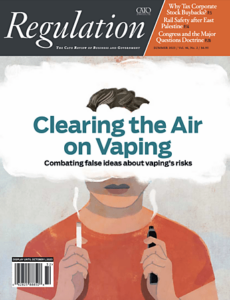
Uneducating Americans on Vaping

Since the FDA began regulating vaping products as "tobacco" products, American ignorance about vaping's realtive risks has gotten worse.

|

Food and Drug Administration regulation of tobacco products is supposed to help protect public health. Yet since the FDA endeavored to regulate electronic cigarette and other vaping products through its tobacco regulation program, Americans' understanding of the relative risks posed by various types of tobacco products has gotten worse. Today fewer Americans understand that vaping poses less risk than smoking, and this ignorance could have significant consequences for public health.

In the new issue of Regulation, Jacob James Rich and I discuss this problem in our article "Uneducating Americans on Vaping." Here is how the article begins:

Cigarette smoking continues to be a leading cause of avoidable death in the United States. Nearly half a million Americans die each year from smoking‐​related diseases according to the Centers for Disease Control and Prevention. Understandably, this makes reducing smoking and discouraging youth smoking significant public health priorities.

Fortunately, there are less dangerous ways for smokers to satisfy their nicotine habits than smoking cigarettes. Electronic cigarettes and other vaping products (so‐​called "electronic nicotine delivery devices" or ENDS) appear to be a substantially safer substitute for combustible cigarettes. Such products can even help some smokers quit altogether. Yet too few people know this, and the ignorance appears to be getting worse.

Since the Food and Drug Administration began regulating ENDS as "tobacco products," public understanding of the relative risks of various tobacco products has declined. The FDA and many other expert authorities accept that there is a "continuum of risk" and that vaping is less dangerous than smoking. Yet, a majority of Americans do not understand this to be true. Smokers in particular do not realize there are less dangerous alternatives to combustible cigarettes—alternatives that could save their lives.

What explains widespread and worsening understanding of the relative risks of vaping? And what can be done about it? Improved messaging and public statements from public health authorities could help, but we are unconvinced such efforts would be enough. The ability of government messaging to inform consumers is inherently limited, particularly when public trust in institutions is flagging. As we explain below, educating Americans about the relative risks of tobacco products may require rethinking the way we classify and regulate such products and in particular allowing those with an economic interest in educating Americans about the relative risks of nicotine products to do so.

And our conclusion:

Public health experts are rightly concerned about the long‐​term consequences of ENDS use, but leading medical journals continue to highlight the urgent need to accurately communicate to the public that these products are substantially safer to consume than conventional cigarettes. Relying upon government public health authorities to convey timely, accurate, and accessible information to consumers about the relative risks of nicotine products has failed. Americans are less informed about the relative risks of ENDS as compared to combustible cigarettes than ever before, and this lack of understanding has public health consequences.

Were ENDS manufacturers allowed to make truthful and substantiated health claims about their products, they would be free to engage in market‐​driven competitive discovery of how to inform smokers of the potential health benefits of switching to their products. These incentives would also motivate the manufacturers to make their information more salient and digestible to potential customers. The existing regulatory framework and the FDA's interpretation of its own regulatory authority make such market‐​driven consumer education unlawful, however. As a consequence, public health advocates are deprived of a potentially powerful tool in the campaign to reduce the health consequences of smoking.

Counting to Five in Texas v. United States

Justice Kavanaugh penned a narrow decision that cobbled together a majority.

|

In December 2022, the Supreme Court heard the latest iteration of a case styled as United States v. Texas. This dispute concerned the Biden Administration's 2021 memorandum that "prioritized" immigration enforcement. (I'll get into the details later). The trial court found that Texas had standing, and vacated the policy. The Fifth Circuit declined to stay an injunction. The Supreme Court granted certiorari before judgment.

After oral argument, my prediction was that the final vote would be very fragmented. A majority of the Court seemed inclined to rule against Texas, but there was no obvious consensus on why the states lacked standing. Moreover, several Justices seemed uncomfortable with the argument pressed by the Solicitor General that Section 706 of the APA did not support so-called "national vacaturs."

The Court decided this case on Friday. The bottom line is that eight justices ruled against Texas, and only Justice Alito would have affirmed the lower court. But the majority really fractured 5-3. Justices Gorsuch, Thomas, and Barrett found that the plaintiffs lack standing on redressability grounds. They contended that 8 U. S. C. § 1252(f)(1) prohibits injunctions against certain immigration laws, including those at issue in this case. Because the Court couldn't remedy the alleged injuries, the concurring justices found, the Court lacked jurisdiction. But Justice Kavanaugh, writing for the Court, did not rely on redressability. Instead, he found that the plaintiff states did not have a "judicially cognizable" injury--the sort of injury that the federal courts "traditionally" have recognized.

I'll admit, when I first digested this case, I couldn't quite figure out why the majority chose this path. My first inclination was that the Court was trying to close the door on strategic litigation brought by red states against blue administrations. There is certainly some language to that effect, but there is some other language that limits the Kavanaugh opinion to the specific facts presented in this case. (More on the specifics later). Now, my working hypothesis is that the Court simply couldn't come to an agreement on one key issue: could a national vacatur redress a cognizable injury? Justices Thomas, Gorsuch, and Barrett, who cast doubt on the entire notion of a national vacatur, suggest the answer to this question is no. Therefore, Texas has to lose. But the majority does not even touch the redressability prong because they resolve the case on the injury prong. And in doing so, they leave open the question of whether federal courts can issue national vacaturs--and more importantly, whether the availability of a national vacatur can satisfy the redressability prong.

Rather, the majority seized upon a super-specific rationale that will not apply in any other circumstances. That's the only way I can count to five. The Court's progressives do not want to block off progressives using national vacatur to challenge a future Republican administration, and the Chief and Kavanaugh are still partial to D.C. Circuit, which vacates five rules before breakfast. Thus, the majority needed to find a rationale--any rationale really--that would deny Texas standing without trickling into other future disputes. So Justice Kavanaugh latched onto Linda S. v. Richard D. (1973), which he raised during oral arguments.

As promised, more details will come later.

Judiciary

D.C. Circuit Affirms Dismissal of Bivens Claims Over Clearing of Lafayette Park

Applying settled precedent, the court bars a Bivens action, but Judge Walker suggests a possilble alternative.

|

On Friday, the U.S. Court of Appeals for the D.C. Circuit affirmed the dismissal of Bivens actions filed against former Attorney General WIlliam Barr and various federal law enforcement officers over their conduct in clearing protestors from Lafayette Park in June 2020.

The opinion for the panel in Buchanan v. Barr was written by Senior Judge David Sentelle (in what was likely his last opinion for the D.C. Circuit). The opinion was joined by Judges Wilkins and Walker, each of whom also wrote a separate concurring opinion.

The case was rather straightforward. Judge Sentelle summarized it as follows:

Appellants, individual protestors and Black Lives Matter D.C., brought these consolidated actions against federal law enforcement officers, alleging that officers' actions in clearing protestors from Lafayette Park in June 2020 violated their First, Fourth, and Fifth Amendment rights and seeking damages under Bivens v. Six Unknown Named Agents of the Federal Bureau of Narcotics, 403 U.S. 388 (1971). Appellees, former Attorney General Barr and various named U.S. Park Police officers, moved to dismiss the claims, arguing that a Bivens remedy is unavailable in this context. The district court granted the motions, and this appeal followed. Applying Supreme Court precedent, we hold that Appellants' claims arise in a new context and that special factors counsel hesitation against extending the availability of Bivens claims to that context. Accordingly, we affirm.

As Judge Sentelle explains, the Supreme Court has never overturned Bivens, but it has made clear that allowing such claims is "a disfavored judicial activity." Claims that are squarely on all fours with Bivens or one of a handful of other cases may proceed, but lower courts should rarely allow such suits when they arise in a "new context." This is a high hurdle to clear, and one that the plaintiffs could not surmount in this case.

Judge Wilkins wrote separately to stress some of the separation-of-powers concerns that arose in this particular case. Judge Walker concurred separately to suggest that the lack of a federal Bivens remedy might not preclude all relief.

Judge Walker's concurring opinion begins:

Protesters say federal officers violated their constitutional rights by forcibly dispersing a demonstration outside the White House. So they sued for damages, claiming that the Constitution gives them permission to bring their suit. See Bivens v. Six Unknown Federal Narcotics Agents, 403 U.S. 388 (1971).

But as the Court's opinion explains, the protesters' claims do not fit any recognized cause of action under the Constitution. And gone are the days when federal courts  could invent new remedies to redress the protesters' injuries. See Egbert v. Boule, 142 S. Ct. 1793, 1803 (2022).

Yet that does not mean the protesters have no way to recover. For most of our history, those injured by federal officers' unconstitutional conduct could sue for damages in state court. The Framers saw state common-law suits as an important check on federal misconduct.

Some have assumed that those suits are now precluded by the Westfall Act. It bars many "civil action[s] . . . for money damages" filed to redress "injury or loss . . . resulting from" federal officers' conduct. 28 U.S.C. § 2679(b)(1). But it also has an exception. It does not bar "a civil action . . . brought for a violation of the Constitution of the United States." Id. § 2679(b)(2)(A).

That exception might preserve state tort suits "brought" to remedy constitutional injuries. Reading the Act that way accords with Founding-era principles of officer accountability and closes the remedial gap left by today's narrow approach to remedies under the Constitution — ensuring relief for those unconstitutionally injured by federal officers.

Judge Walker makes clear that he is "not certain" this alternative avenue is actually available, but he has effectively invited potential plaintiffs to give it a try.

Judiciary

Judge Dave Retires from the Bench

The Honorable David B. Sentelle has heard his last case.

|

This year, the Honorable David B. Sentelle is retiring from the U.S. Court of Appeals for the D.C. Circuit. He heard his last oral argument in April, and Judge Sentelle's opinion from that sitting was issued on Friday. Earlier this month the court held a retirement celebration and the judge hosted one last clerk reunion.

Judge Sentelle was appointed to the D.C. Circuit in 1987 by President Ronald Reagan, and he took senior status in 2013. While on the D.C. Circuit he served as the presiding judge of the Special Division appointing and overseeing independent counsels. The D.C. CIrcuit Historical Society interviewed Judge Sentelle as a part of its oral history project.

Prior to his move to Washington, Judge Sentelle had served as a federal district court judge, a state district court judge, and an assistant U.S. attorney, and he had also worked a decade in private practice. Service on the federal bench may have required Judge Sentelle to leave North Carolina, but North Carolina never left him.

Some know Judge Sentelle as "Judge Dave," in part for his serialized account of his encounter with the "Rainbow People," who sought to host an annual festival on federal lands. The tale was initially published in The Green Bag and published in a book. It also features in this engaging remembrance by one of Judge Sentelle's clerks, Judge Andrew S. Oldham of the U.S. Court of Appeals for the Fifth Circuit. (In addition to Judge Oldham, Judge Sentelle alumni on the federal appellate bench include Judge Beth Robinson on the Second Circuit Judge Joan Larsen on the Sixth Circuit, and Justice Neil Gorsuch.)

Longtime Reason readers may also remember this 2001 Reason story about an oral argument in front of Judge Sentelle. A taste:

Presiding at the hearing were David Sentelle, Larry Silberman, and Karen Henderson—and an official portrait of Robert Bork, who worked here before his nomination to the Supreme Court. You may recall that Sentelle presides over the panel that oversees Independent Counsels, and hence appointed and supervised the work of one Kenneth Starr. Here's a little tourist advice: If you find yourself in D.C., check the court's Web site at www.cadc.uscourts.gov. If Sentelle is slated to hear a case, pop into his courtroom for an hour; he's far more entertaining than the IMAX nature film at the National Museum of Natural History.

Mark Ross, an attorney for Adtranz, went first. The imperious Judge Sentelle, seated in the center of the dais, his gray hair coifed in a formidable pompadour, his black robe broadening his shoulders, interrupted Ross as he went through his argument.

"Can you imagine a counsel for a large employer today not advising his client to put in" a rule like this one banning abusive language?

"Not unless he has a lot of good insurance," replied Ross, as chuckles came from the bench.

"Malpractice insurance," added Sentelle.

Judge Sentelle wrote the opinion for the panel in this case (and the opinion cites one Eugene Volokh).

I had the good fortune to clerk for Judge Sentelle during the 2000-2001 term. It was, and remains, one of the most significant, formative, and enjoyable years of my professional life. I am far from the only person to feel this way. Judge Sentelle's influence on the law and the legal profession will long remain. His presence on the bench will be missed.

The First Amendment and Refusals to Deal

Here's a draft of my article, on the constitutionality of anti-BDS laws and other related matters, forthcoming in a symposium at The University of the Pacific Law Review.

|

It's based on amicus briefs that Michael Dorf (Cornell), Andrew Koppelman (Northwestern), and I filed in past cases (and that I blogged about before), but it elaborates somewhat further on that argument. There's still time to make changes, so I'd love to hear people's responses; you can also read it in PDF.

[* * *]

Anti-BDS laws, which bar government contractors from boycotting Israel, are generally constitutional—for the same reason that anti-discrimination laws are generally constitutional: Refusals to deal are, outside some narrow situations, generally unprotected by the First Amendment.

Introduction

Decisions not to buy or sell goods or services are generally not protected by the First Amendment. That is the necessary implication of Rumsfeld v. Forum for Academic & Institutional Rights,[1] and it is the foundation of the wide range of antidiscrimination laws, public accommodation laws, and common carrier laws throughout the nation.

Thus, for instance:

  • A limousine driver has no First Amendment right to refuse to serve a same-sex wedding party, even if he describes this as a boycott of same-sex weddings (or part of a nationwide boycott of such weddings by like-minded citizens).
  • A store has no First Amendment right to refuse to sell to Catholics, even if it describes this as a boycott of people who provide support for the Catholic Church.
  • An employer in a jurisdiction that bans political affiliation discrimination[2] has no First Amendment right to refuse to hire Democrats, even if it describes such discrimination as a boycott.
  • An employer that is required to hire employees regardless of union membership has no First Amendment right to refuse to hire union members on the grounds that it is boycotting the union.
  • A cab driver who is required to serve all passengers has no First Amendment right to refuse to take people who are visibly carrying Israeli merchandise.

Of course, all these people would have every right to speak out against same-sex weddings, Catholicism, the Democratic Party, unions, and Israel. That would be speech, which is indeed protected by the First Amendment. For this reason, when phrases such as "otherwise taking any action that is intended to penalize, inflict economic harm on, or limit commercial relations" appear in various anti-BDS statutes,[3] courts should read them as covering only commercial conduct such as that listed in the preceding phrases ("refusing to deal with" and "terminating business activities with"), and not extending to advocacy.

But as a general matter, a decision not to do business with someone, even when it is politically motivated (and even when it is part of a broader political movement), is not protected by the First Amendment.[4] And though people might have the First Amendment right to discriminate (or boycott) in some unusual circumstances—for instance when they refuse to participate in distributing or creating speech they disapprove of—that is a basis for a narrow as-applied challenge, not a facial one.

Read More

Supreme Court

Predicting Case Authors and Outcomes as the Supreme Court Hits the Home Stretch

Some worth-what-you-paid-for-them predictions for the final(?) week of SCOTUS opinions.

|

This term the Supreme Court was extraordinarily slow to issue opinions, but they have been catching up. As of today, there are only ten argued cases yet to be decided, so it seems likely the Court will finish its October Term 2022 business this week.

As Yogi Berra warned, it's tough to make predictions, expecially about the future. Nonetheless, here I offer a few likely-worthless predictions about which justices will write the remaining opinions, and how those cases might come out.

To set the table, consider the following. The term heard fewer cases than normal, and has resulved fewer than fifty cases thus far. Justice Kavanaugh leads the pack with seven majority opinions to date. I think that's it for him. Ditto Justices Barrett, Jackson and Thomas, who have each authored six. Justice Gorsuch, Kagan, and Sotomayor have each authored five opinions, so it is reasonable to assume they were each assigned at least one more. Justice Alito and Chief Justice Roberts have each authored only three opinions, so we would expect each of them to have multiple additional opinions.

Now the cases, in the order in which they were argued.

  • Harvard/UNC Affirmative Action Cases - Chief Justice Roberts writes, holding both schools' use of race unlawful. The conservative justices splinter on how far to go limiting the use of race in college admissions, as not all are willing to eliminate the consideration of race or pursuit of racial diversity all together. If these cases produce two separate opinions, Justice Thomas may have one of them.
  • Mallory v. Norfolk Southern - Justice Alito writes, limiting the ability of states to require consent to jurisdiction as a condition for doing business in the state.
  • 303 Creative v. Elenis - Justice Gorsuch writes, concluding the state cannot compel a web designer to make websites contrary to their deeply held beliefs.
  • Moore v. Harper - Chief Justice Roberts writes (perhaps as "per curiam") concluding that the case is moot and that grant of certiorari divested state courts of jurisdiction.
  • Student Loan Cases - Chief Justice Roberts writes, finding Missouri has standing and the program is unlawful. (Unlike some, I see very little in the Texas immigration case that undermines the case for standing in this case.)
  • Abitron Austria GmbH v. Hetronic International - Justice Sotomayor writes. I have no idea what the outcome might be as I know very little about the applicability of the Lanham Act. Heck, I barely understand the issues in this case (let alone why it's taken so long for a decision here to issue).
  • Groff v. DeJoy - Justice Alito writes, siding with the employee who sought religious accommodation.
  • Counterman v. Colorado - Justice Kagan writes, rejecting the objective "reasonable person" standard for determining what is a "true threat" and remanding back to the Colorado courts.

If my predictions are correct, I will tweet and blog repeatedly about how this demonstrates my keen insight about the Court. In the (more likely) event that many of these predictions are gobsmacklingly wrong, I will delete this post and hope that people do not use the Wayback Machine to find it.

Start the Death Watch for the Overbreadth Doctrine

United States v. Hansen signals the Court is not willing to "strike down" laws that may, hypothetically, burden someone else's speech rights.

|

On Friday, the Supreme Court decided United States v. Hansen. In this case, the defendant promised aliens that they could obtain citizenship through "adult adoption." In the process, the defendant induced the aliens to stay in the country illegally. Hansen was convicted of violating a federal statute that forbids "encourag[ing] or induc[ing] an alien to come to, enter, or reside in the United States, knowing or in reckless disregard of the fact that such [activity] is or will be in violation of law." On appeal, Hansen argued that this statute violated the Free Speech Clause of the First Amendment. To be sure, Hansen's own conduct was not protected speech. Rather, Hansen asserted that the entire statute was "invalid" under the so-called overbreadth doctrine.

Generally, a person only has "standing" to challenge a law when it violates that person's rights. However, an overbreadth challenge allows a person to assert that the government has violated the free speech rights of third parties who are not before the court. In other words, the overbreadth doctrine allows someone whose speech can be prohibited to assert that a statute is unconstitutional. This approach allows courts to vigorously scrutinize laws that may violate the freedom of speech — even for those people who might never be prosecuted for violating these laws.

This doctrine, which was developed by (you guessed it) the Warren Court, never quite fit into constitutional law. All the usual rules of standing are thrown out the window, and a defendant can be acquitted even if his own conduct is unprotected by the First Amendment. Civil rights litigants often rely on the overbreadth doctrine, which allows them to challenge statutes on their face, even if they are not subject to a present-day injury. The 3D-printed gun litigation, which I've been involved with for some time, has invoked the overbreadth doctrine.

But I've long suspected that the overbreadth doctrine was on borrowed time. In 2020, the Supreme Court decided United State v. Sineneng-Smith. This case concerned the same statute at issue in Hansen. But the Court ducked the overbreadth question because of the bizarre way that the Ninth Circuit decided a question that none of the parties presented. In a concurrence, Justice Thomas expressed his doubts on the overbreadth doctrine.

Although I have previously joined the Court in applying this doctrine, I have since developed doubts about its origins and application. It appears that the overbreadth doctrine lacks any basis in the Constitution's text, violates the usual standard for facial challenges, and contravenes traditional standing principles. I would therefore consider revisiting this doctrine in an appropriate case.

Well, Hansen wouldn't be that "appropriate case," but a majority of the Court seems to share Justice Thomas's doubts. Justice Barrett refers to the doctrine with some skepticism.

First, she described the doctrine as "unusual" and explains that generally criminal defendants cannot assert someone else's constitutional rights.

Read More

More