The October 2022 Term of FantasySCOTUS has come to a close. This term was one a bit of a letdown after last term, but still packed some punch. And FantasySCOTUS did quite well. In the aggregate, our crowd predicted 75% of the cases accurately, down from 81% last term.
This year, the Chief Justice of the league was Brady Kelly. Players receive ten points for each correct prediction of a Justice's vote. We recorded 56 merits cases (DIGs do not count). A perfect score would have been 5,600 points. Brady scored 4,650 points. Bill Corteal, who was the champion last year, was the runner-up with 4,250 points.
Brady lives in the District of Columbia and works in analytics consulting, but not in politics, government, or law. In fact he has no legal training or background whatsoever. Brady tells me that he enjoys problem-solving, whatever the context.
Brady's first exposure to Supreme Court cases was reading ones with a direct impact on his life - especially United States v. Windsor (2013). From there he developed an interest in appellate law and the Supreme Court. Brady first begin to predict case outcomes after hearing about FantasySCOTUS in 2015. But, he explains, after predicting a few cases, life got in the way, and he took a pause. The October 2022 term was his first time reading more than a handful of the cases in a given year, and he really enjoyed the process and the competition.
I asked Brady how he goes about predicting cases. He said the first thing he always does is read the decision below. And if he still doesn't fully understand the issues, he reads the petitioner and respondent briefs too. From there, he really tries to focus on what he personally thinks the right interpretation of the law is, focusing squarely on the text and on precedent. Brady admitted that he is certainly not qualified to have an opinion on these questions, but finds it most helpful to start there rather than as an outside observer just predicting what other people will think. Brady acknowledged that he does not always expect his interpretation to be the majority opinion, just that he finds it a helpful framework to start with. Only then does he try to predict which justices he'll end up agreeing vs. disagreeing with. Once he has formed a tentative opinion, he'll listen to the oral arguments and change predicted votes around as needed.
I asked Brady what case gave him the most difficulty. He responded, Health and Hospital Corporation of Marion County v. Talevski. He felt pretty confident in predicting a 7-2 majority that FNHRA could theoretically be enforced through section 1983, but there were still multiple layers of questions after that point. Brady missed this case, when other top players got it right. Brady explained that he missed the implicit-preclusion path question. Brady told me that having so many separate questions, each of which could change the case's outcome, was stressful.
Another challenging case for Brady was Jones v Hendrix. On that one, his predictions were right. But Brady said it was very difficult - as a certified non-lawyer - to try to understand federal Habeas Corpus law. He is still not sure he understands it. (Join the club).
Brady really enjoys listening to the oral arguments on Oyez, especially when someone just hits it out of the park. He told me he personally thought the best two examples this term were Solicitor General Prelogar in Groff v. DeJoy and Colleen Roh Sinzdak in Amgen v. Sanofi.
Brady also has a favorite writer: Justice Kagan, with Justice Barrett in second place, even though he might not agree with Barrett as often as he agrees with Kagan. If the two of them are on the same side (e.g. the dissent in Mallory, the dissent in Bittner, or the concurrence-in-judgment in Abitron Austria), he is guaranteed to end up agreeing with them.
Congratulations Brady, and to all the participants in the competition. We will launch next term's competition on the first Monday in October.
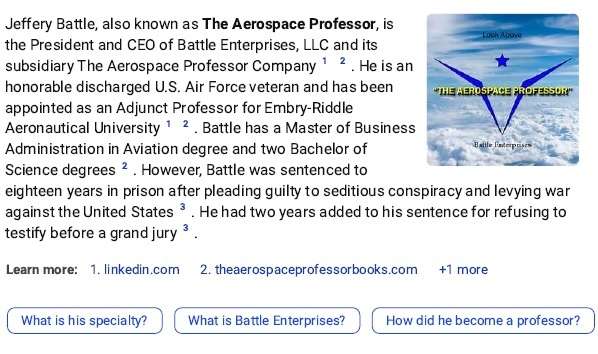
When people search for Jeffery Battle in Bing, they get the following (at least sometimes; this is the output of a search that I ran Tuesday):
But it turns out that this combines facts about two separate people with similar names: (1) Jeffery Battle, who is indeed apparently a veteran, businessman, and adjunct professor, and (2) Jeffrey Leon Battle, who was convicted of trying to join the Taliban shortly after 9/11. The two have nothing in common other than their similar names. The Aerospace Professor did not plead guilty to seditious conspiracy.
And this Bing output doesn't just list the facts about each of the Battles separately, the way that search engine results have long listed separate pages separately. Rather, it expressly connects the two, with the "However, Battle was sentenced …" transition, which conveys the message that all the facts are about one person. And to my knowledge, this connection was entirely made up out of whole cloth by Bing's summarization feature (which is apparently based on ChatGPT); I know of no other site that actually makes any such connection (which I stress again is an entirely factually unfounded connection).
Battle is now suing Microsoft for libel over this, in Battle v. Microsoft (D. Md.) (filed Friday). He's representing himself, and the Complaint is flawed in various ways. But, if the case is properly framed, he may well have a serious argument. That is especially so if he can substantiate his allegations that he had informed Microsoft of the problem and it didn't promptly fix it.
In law schools, generations of students have been taught the IRAC model to answer legal questions. First, students must spot the issue--what legal doctrine do the facts implicate? Second, students must state the rule--what particular legal precedent, statute, or principle governs this conflict? Third, students must then apply the rule to these facts--under a particular legal standard, how should the court rule? Fourth, students must state the conclusion--who wins, the plaintiff or the defendant?
Of course, there are many variations of IRAC, and invariably, many students stop using it rigidly at some point during the second year. But the basic process--applying a rule to particular facts is a cornerstone of legal education.
That background brings me to the NextGen bar exam. I have written about this new formulation of the multistate bar exam, which will launch in some states in 2026. Justice Jay Mitchell of the Alabama Supreme Court already expressed a concern that the National Conference of Bar Examiners (NCBE) is placing DEI concerns over competence. (Critics contend that the bar exam is racist, and should be eliminated). I have another concern, which may be related--the NCBE seems to be making the exam substantially easier.
The NCBE released a batch of questions to demonstrate how the NextGen exam will function. The multiple choice questions reflect a new approach. Rather than forcing students to memorize particular rules, and then apply them, the new questions only ask students to spot the issue. The thinking is that practicing attorneys do not actually have to memorize particular rules, or even know how to apply them. So long as they can recognize what doctrine is implicated, a quick query on WestLaw, Lexis, and (lord help us) ChatGPT can locate the particular rule, and then the lawyer can figure out how to apply that rule to the facts (or just ask ChatGPT to do it). In short, bar examinees will not have to know the rule, apply the rule, or conclude the case. They only have to spot the issue. Only I, not RAC.
Consider this Criminal Procedure question:
You are a criminal defense lawyer representing a client who has been charged with fentanyl possession. The police found the fentanyl in the guest bedroom of the client's uncle's house when responding to a noise complaint at the house. Before entering the house, the officers knocked on the door. When the uncle answered the door, the officers asked if they could look inside the house, and the uncle agreed. The client did not live in the house and was not there at the time of the search. The client had stayed in the guest bedroom of the house two nights prior to the search. The uncle told the officers that the client was the last person to have slept in that room.
You are considering filing a motion to suppress the fentanyl under the Fourth Amendment.
Which of the following legal topics are the most important for you to research to determine the likelihood of success on a motion to suppress? Select two.
A. Consent search.
B. Exigent circumstances.
C. Hot pursuit.
D. Probable cause.
E.Reasonable suspicion.
F. Standing.
The correct answer here is A (Consent Search) and F (Standing). Those are the legal topics that are "most important" to research. First, would the Uncle have authority to consent to the search? Second, would the criminal defendant have standing to challenge the Uncle's consent? Now the examinee does not actually have to answer whether the motion to suppress would be granted. Who cares if the Uncle could consent to the search? It doesn't matter if the defendant has standing. The test taker doesn't even have to know the relevant rules for consent searches and standing. All she has to do is spot the issue. I suppose the NCBE thinks that a first-year lawyer can simply enter "consent search" and "standing" into ChatGPT, knowing nothing more, and download the answer. I am not confident anyone can figure out these doctrines on the fly.
Let's try a Property question.
You are representing a client in a dispute with a neighbor. The client owns a single-family home with several acres of surrounding land. Recently, the client noticed that his neighbor had built a fence that extends onto the client's land. The client is unsure when the fence was built because that part of the client's land is obscured by large trees. When the client contacted the neighbor about the fence, the neighbor claimed that she did not know the location of the property line. The client has shown you a recent survey of the property that confirms the encroachment and has asked you whether he has a claim against the neighbor.
Which of the following legal topics are the most important for you to research before advising the client? Select two.
A. Adverse possession.
B. Conversion.
C. Implied easement.
D. License.
E. Negligence.
F. Trespass.
The answers here are, once again, A (Adverse Possession) and F (Trespass). The question presented is whether the neighbor's fence encroaches (trespasses) on the client's property, and if there is an encroachment, has the neighbor acquired the right to do so through adverse possession. This question is complicated, because trees obscure the boundary (affecting the open and notorious prong), and the neighbor may not have even known if he was obtaining land through adverse possession (in the lingo, did he have the right claim of right?). I could see a student struggling with applying the rules to this question. But on the bar, an applicant only needs to spot the relevant doctrine, and pray they can figure stuff out when in practice.
I worry that these questions are far too simple. If the states end up adopting the NextGen exam, they should increase the cut score (the relevant percentage needed to pass the exam). Finally, I worry how this exam will trickle down to law school pedagogy. Will professors shift their coverage to no longer require memorizing and applying the rules--only spotting issues? It's true that all lawyers have sophisticated tools at their disposal to research different topics. This new format seems to be a surrender to this technology--don't require students to do what they don't have to. I, for one, do not plan to change how I teach for this exam. And state supreme court justices should take a very long pause before adopting this new exam.
Some scholars and commentators argue that legacy preferences at public universities are unconstitutional because they are a form of hereditary privilege. If so, the same is likely true of the far more consequential hereditary privilege of citizenship that severely restricts the right to live and work in the United States.
In my last post about legacy preferences in higher education, I argued for their abolition, but expressed skepticism about claims that they are illegal under current civil rights laws. I still think they are likely legal under current precedent. But it's worth noting that scholars and legal commentators such as Indiana University law professor Gerard Magliocca and my Cato Institute colleague Thomas Berry have put forward strong arguments that legacy preferences at public institutions are banned by the Fourteenth Amendment. The key idea is that state-created hereditary privileges are at least presumptively forbidden.
I am not fully convinced these arguments are right. But if they are, the principle has potentially radical implications for other policies, particularly the hereditary aristocracy of citizenship, under which the rights to live and work in the United States are largely reserved for children of US citizens and those who had the good fortune to be born on US soil.
Here's Berry:
Legacy preferences at public universities violate the 14th Amendment for a simple reason: They discriminate between applicants on the basis of an "accident of birth," namely the identity and alumni status of the applicant's parents. The history of the 14th Amendment shows that it was understood to put an end to this type of state discrimination based on parentage at the time of its adoption….
Representative John Bingham was the primary drafter of Section 1 of the amendment, which guarantees both "the equal protection of the laws" and respect for the "privileges or immunities" of citizens. Bingham had previously praised the Constitution's ban on any "Title of Nobility" as signaling that "all are equal under the Constitution" and that "no distinctions should be tolerated, except those which merit originates." Bingham also noted that the Fifth Amendment furthered this republican value by guaranteeing "Due Process" of the law to all persons, with "no distinction either on account of complexion or birth." One of Bingham's core motivations for drafting the 14th Amendment was to extend these principles to state governments and ensure that state laws would "be no respecter of persons."
Senator Charles Sumner, another key proponent of the 14th Amendment, had cited the Constitution's guarantee of a "Republican Form of Government" as support for a Senate resolution banning any "Oligarchy, Aristocracy, Caste, or Monopoly." Sumner had also condemned discrimination against foreigners, because it was based on "the accident of birth."
Berry cites additional original-meaning evidence, as well. And there is much more in this 2009 law journal article by Steve Shadowen, Sozi Tulante, and Shara Alpern, on which Berry in part relies.
Magliocca's Prawfsblawg post focuses on the Supreme Court's 1947 decision in Kotch v. Board of River Port Pilot Commissioners, which narrowly upheld a Louisiana law that had the effect of restricting some types of pilot licenses to relatives of current pilots. But the Court suggested other state-granted hereditary privileges might well be unconstitutional:
Louisiana required that ships entering New Orleans port and the Mississippi have a local licensed pilot to avoid shallow water and underwater obstacles. (This is a longstanding rule for maritime commerce.) State law provided neutral criteria for getting a pilot license that included an apprenticeship, but in practice pilots would almost always take only their relatives as pilot apprentices. Some wannabe pilots who could not get a license challenged this practice on equal protection grounds.
The Supreme Court (in 1947) rejected this claim by a 5-4 vote. Justice Black wrote for the Court and leaned heavily on the idea that pilot regulation was a traditional state function and that pilotage was "a unique institution and must be judged as such." Basically, he said that a pilot needed local knowledge and that this need for personalized knowledge was (or could be) rationally related to picking mainly relatives of existing pilots. The Court went out of its way, though, to say that this deference might not apply to other professions or business that used family ties to make selections.
Justice Rutledge dissented and said: "The result of the decision therefore is to approve as constitutional state regulation which makes admission to the ranks of pilots turn finally on consanguinity. Blood is, in effect, made the crux of selection. That, in my opinion, is forbidden by the Fourteenth Amendment's guaranty against denial of the equal protection of the laws. The door is thereby closed to all not having blood relationship to presently licensed pilots." He added: "The discrimination here is not shown to be consciously racial in character. But I am unable to differentiate in effects one founded on blood relationship."
If any of these arguments is valid, it obviously can't be limited to legacy preferences, but must also apply to other state-created hereditary privileges. By far the most significant of these is what I have called the hereditary aristocracy of citizenship. Under this longstanding legal regime - which most of us take for granted - only those lucky enough to have a US-citizen parent or be born on American soil have a presumptive right to live and work in the United States. For almost everyone else, that right is only available if the federal government chooses to grant it. And, for the vast majority of would-be immigrants, there is little or no chance of ever getting it (especially those who lack close family ties to current US citizens).
Of course a small percentage of would-be immigrants attain citizenship or permanent resident status through pathways made available at the discretion of the federal government. But that no more eliminates the hereditary privilege of citizenship than traditional hereditary aristocracy was eliminated by virtue of the fact that kings would occasionally elevate a commoner to the nobility. The same point applies to arguments that immigration restrictions aren't really based on heredity, because people can sometimes overcome them by meeting occupational requirements and the like. So long as similar requirements aren't imposed on the native-born, hereditary privilege is still very much present. Moreover, such work visas are extremely difficult or impossible to get, even for most who meet the relevant qualifications.
The aristocracy of citizenship is a form of hereditary privilege with far more dire consequences than being disadvantaged in admissions to selective universities. Many of those excluded by the hereditary privilege of citizenship are thereby consigned to a lifetime of oppression and poverty in their countries of origin. And they end up in this situation largely because of "accident of birth," as Charles Sumner put it in a speech quoted in Berry's article. There are also severe consequences for current US citizens, who are denied the economic and social benefits of interacting with migrants.
If the Constitution categorically - or even presumptively - bans state-imposed hereditary privileges, than the privileges associated with citizenship cannot be excluded. Indeed, they are a vastly more egregious case than legacy preferences at state universities.
One possible response to this argument is that birthright citizenship is itself required by the Constitution, in Section 1 of the Fourteenth Amendment, which grants citizenship to all persons "born … in the United States and subject to the jurisdiction thereof." This provision was, of course, enacted in response to the notorious passages in the 1857 Dred Scott ruling, which held that blacks could not be citizens of the United States.
But, while the Citizenship Clause requires the government to grant citizenship to people born in the United States, it does not require denying it to would-be immigrants. Still less does it require denying the latter the right to live and work in the United States. These rights could potentially be decoupled from citizenship and presumptively granted to anyone willing to come and exercise them, subject to nondiscriminatory constraints (e.g. - restrictions on espionage, terrorism, and the like). Access to citizenship could also be liberalized in a variety of ways.
Moreover, current law goes beyond birthright citizenship (granting citizenship to all born on US soil) by also granting citizenship to all children of US citizens, regardless of place of birth. But even if the grant was limited to those born on US soil, it still makes vital rights dependent on an arbitrary "accident of birth," one in most cases only attainable by being born to a US citizen.
Another possible justification for treating citizenship rules differently from other hereditary privileges is that the relevant text of the Fourteenth Amendment applies only to state governments, while citizenship and immigration law is largely federal. However, the Supreme Court has long held that the Equal Protection Clause's nondiscrimination requirements apply to the federal government, as well - a principle established in the Court's famous 1954 ruling in Bolling v. Sharpe, which struck down racial segregation in public schools in the District of Columbia, despite the fact that DC is a federal territory, not a state. While Bolling has been criticized by some originalists, few are willing to advocate its reversal and thereby give the federal government a blank check to engage in racial and ethnic discrimination.
If, as Carlton Larson argues, the constitutional case against legacy preferences rests on the Titles of Nobility Clause rather than the 14th Amendment, then it indisputably applies to the federal government - and thus to immigration and citizenship law. Larson suggests, in his article, that there are special justifications for granting citizenship to children of US citizens born abroad because it "would be absurd to suggest that the United States could not grant citizenship to this narrow category without also granting it to every other inhabitant of the globe." But it's far from absurd to suggest that people not lucky enough to be born in the US or children of US citizens, should not be presumptively barred from living and working here, if they wish. Similarly, it's not absurd to suggest that they be allowed a path to citizenship that isn't virtually unattainable for the vast majority of those who might want it. There is a major difference between automatically granting citizenship to vast numbers of foreign-born people who, in most cases, don't even want it (which would indeed be absurd), and eliminating heredity-based bans on living and working in the United States for those who very much do want it.
It could also be argued that the ban on hereditary privilege only applies to people who are already members of the society, which immigrants (by assumption) are not. But nothing in the text of the Titles of Nobility Clause or the relevant provisions of the Fourteenth Amendment (most obviously, the Equal Protection Clause, which protects all "persons") is limited to current members of society or to current US citizens. It's also not clear why "membership" can justly be restricted based on heredity, while other legal rights cannot.
If the ban on hereditary privilege is merely presumptive (subject to something like the "strict scrutiny" applied to racial and ethnic discrimination), rather than absolute, then perhaps some immigration restrictions could be preserved in situations where they are the only way to prevent great harm. I discuss possible scenarios of this type (and various strategies for addressing them) in Chapter 6 of my book Free to Move: Foot Voting, Migration, and Political Freedom.
But even if some heredity-based migration restrictions could pass strict scrutiny in extreme situations, the vast majority likely cannot. At the very least, the federal government would have to meet a heavy burden of proof to justify them.
The hereditary aristocracy of citizenship isn't going to be eliminated anytime soon. But if we truly believe state-mandated hereditary privilege is unconstitutional and unjust, we cannot give a pass to what is by far the most significant example of such privilege in modern America. I summarized some of what can be done to mitigate its impact here. Broadly speaking, we should pursue a combination of expanding access to citizenship and reducing the the extent to which citizen status determines where people are allowed live and work.
If nothing else, when we consider the issue of state-created hereditary privilege in our society, we should stop turning a blind eye to what is by far the biggest example of it.
UPDATE: For those interested, elsewhere I have addressed the related, but distinct issue of whether governments may restrict immigration because nations are analogous to private houses or clubs. I cover this in greater detail in Chapter 5 of my book Free to Move.
I had the pleasure of appearing on CBC Radio's Alberta at Noon with Judy Alduous yesterday to speak about romance scams. The recording is available here and you can hear my intermittent commentary from around 14:30 to 26:50.
For a quick list of safety measures to take to protect yourself against romance scams, check out the FBI's list here. This recent NBC piece also discusses the mental health toll that such scams can take on their victims in addition to the financial cost - another good reminder to treat those kindly who have suffered enough in this context.
For a generation, Justice Kennedy was the Court's swing vote. Erwin Chemerinsky used to joke that if he could, he would have put Anthony Kennedy's face on the cover of the brief. Now we are seeing similar appeals to the Court's new median voter, Justice Kavanaugh.
Today's New York Times includes a guest essay by Kathy Hochul. The Governor of New York wrote about Rahimi. But in practice, the essay functions as an amicus brief aimed at Justice Kavanaugh. She extolled his Bruen concurrence, and said there was a "split" with the majority:
Before oral arguments are heard, there's no way to tell which way the Supreme Court will rule. The precedent set by Bruen is extraordinarily troubling. Yet even within the court's majority in Bruen, there was a split. Justice Thomas kept his focus on historical arguments. But a concurrence by Justice Brett Kavanaugh, in which Chief Justice John Roberts joined, left room for certain basic protections, noting that "properly interpreted, the Second Amendment allows a 'variety' of gun regulations."
Huh? Justice Kavanaugh joined the majority opinion in full. There was no "split." But, Justice Kavanaugh did what he always did--reach out to decide issues that were not in front of the Court in order to signal moderation. He did so in Bruen, Dobbs, and other cases. Regrettably, Justice Kavanaugh has taken the mantle from Justice Kennedy as the chief mediator of the United States.
Indeed, Governor Hochul claimed that the concurrence "helped inform" New York's response to Bruen.
This concurrence helped inform New York's response to Bruen. After New York State's century-old gun law was overturned, I took immediate steps to restore protections from gun violence, including signing new laws to strengthen training and gun licensing requirements.
To paraphrase Chief Justice Roberts in Students for Fair Admissions, it is poor practice to read a concurrence to figure out what the majority opinions means. Moreover, much of New York's legislation amounts to "massive resistance" of Bruen, that finds no grounding even in the Kavanaugh concurrence.
Hochul ends with a naked emotional appeal to Justice Kavanaugh, laced with the obvious gender-motivated violence charge:
An extreme, out-of-control Supreme Court put gun safety laws at risk in Bruen. Across America, survivors of domestic abuse will now wait in fear to see whether Justice Kavanaugh and his colleagues deem laws that protect survivors to "properly" interpret the Constitution.
Over the next year, we will see a similar litany of appeals to Justice Kavanaugh. The subtext is clear: rule against Rahimi and atone for the allegations made during the confirmation hearing. Preview: it won't work. Nothing will ever make these people not want to destroy Justice Kavanaugh.
It's surely fitting that a decision released on the 4th of July would set off fireworks on the Cyberlaw Podcast. The source of the drama was U.S. District Court Judge Terry Doughty's injunction prohibiting multiple federal agencies from leaning on social media platforms to suppress speech the agencies don't like. Megan Stifel,Paul Rosenzweig, and I could not disagree more about the decision, which seems quite justified to me, given the threatening and incessant White House message telling the platforms exactly whose speech they should suppress. Paul and Megan argue that it's not censorship, that the judge got standing law wrong, and that I ought to invite a few content moderation aficionados on for a full hour episode on the topic.
Sultan walks us through the wreckage of the American cryptocurrency industry, pausing to note the executive exodus from Binance and the end of the view that cryptocurrency could be squared with U.S. regulatory authorities. That won't happen in this administration, and maybe not in any, an outcome that will delay financial modernization here for years. I renew my promise to get Gus Coldebella on the podcast to see if he can turn the tide of negativism.
In quick hits and updates:
There's an effort afoot to amend the National Defense Authorization Act to prevent American government agencies, and only American government agencies, from buying data available to everyone else. We are skeptical that it will pass.
Canada, which already looks ineffectual for passing a link tax that led Facebook and Google to simply drop their links to Canadian media, now looks ineffectual and petty, announcing it has pulled its paltry advertising budget from Facebook.
Oh, and last year's social media villain is this year's social media hero, at least on the left, as Meta launches Threads and threatens Twitter's hopes for recovery from a year of turmoil.
You can subscribe to The Cyberlaw Podcast using iTunes, Google Play, Spotify, Pocket Casts, or our RSS feed. As always, The Cyberlaw Podcast is open to feedback. Be sure to engage with @stewartbaker on Twitter. Send your questions, comments, and suggestions for topics or interviewees to CyberlawPodcast@gmail.com. Remember: If your suggested guest appears on the show, we will send you a highly coveted Cyberlaw Podcast mug! The views expressed in this podcast are those of the speakers and do not reflect the opinions of their institutions, clients, friends, families, or pets.
[UPDATE: For a loosely similar decision from the Minnesota Court of Appeals in 2012, see this post.]
From DeHart v. Tofte, decided Thursday by the Oregon Court of Appeals (Judges Douglas Tookey, Jacqueline Kamins, and Erika Hadlock):
In this case involving claims brought under Oregon's recently enacted "anti-doxing" statute, ORS 30.835, three defendants appeal a limited judgment denying their special motions to strike under Oregon's anti-SLAPP statute, ORS 31.150.
Each of the three plaintiffs in this case [Brown, DeHart, and Shannon] is an elected public official—namely, an elected director on the Newberg School Board (the School Board). Each plaintiff voted on a motion directing the superintendent of Newberg schools to, among other things, "remove all Black Lives Matter (aka BLM) signs, flags, and placards, apparel, buttons, and all other modes of display, and all instances of the symbol known as the Pride Flag from District facilities immediately" (the Ban).
Following the Ban, defendants [Schwanz, Tofte, and Brookfield]—each of whom has a child or children attending Newberg public schools, and each of whom disagreed with the Ban—posted information about plaintiffs' employers in a private Facebook group called "Newberg Equity in Education" (NEEd).
Plaintiffs sued under the anti-doxing statute, which allows people to sue "for improper disclosure of private information" based on a showing that:
[a] The defendant, with the intent to stalk, harass or injure the plaintiff, knowingly caused personal information to be disclosed;
[b] The defendant knew or reasonably should have known that the plaintiff did not consent to the disclosure;
[c] The plaintiff is stalked [as defined in Oregon criminal and civil stalking statutes], harassed or [bodily] injured by the disclosure; and
[d] A reasonable person would be stalked, harassed or injured by the disclosure….
As Washington Post columnist Catherine Rampell explains, doing so will simultaneously strengthen the US and weaken a major geopolitical rival. It can also rescue many Chinese from terrible oppression.
If there's one thing Republicans and Democrats tend to agree on, it's that China has become America's most dangerous geopolitical adversary. But, as Washington Post columnist Catherine Rampell explains in a recent article, we are shooting ourselves in the foot in this competition by severely restricting Chinese immigration to the US. Opening our doors is an easy way to strengthen the US at Xi Jinping's expense:
My fellow Americans, it's time to set aside our xenophobia. For the good of our country, let's help drain China's brains.
As China has lifted its pandemic lockdowns, many residents have grown more footloose. Maybe high youth unemployment has left younger workers restless…. Or maybe people are just tired of living in an authoritarian country with arbitrary restrictions on freedom of ideas, capital and movement.
Whatever the specificmotivations, the number of people leaving China and seeking to make (or invest) their fortunes abroad is rising again, according to data from the U.N. Population Division….
China's loss presents a huge opportunity for the United States…..
Immigrants have long been the lifeblood of the U.S. economy and innovation. For more than a century, we have benefited from waves of peopleleaving difficult conditions in their home countries. In fact, the U.S. government has often worked hard to poach the top talent of our geopolitical adversaries. During the mid-20th century, for instance, we took in scientists from Germany (both those who worked for the Nazis and those persecuted by them); and part of our Cold War policy included siphoning off Sovietsuperstars.
These and other immigrants turned out to be productive workers, who in turn made our own homegrown workers more productive. This served our interests economically, militarily and geopolitically. It's great marketing for Western democratic values, after all, to be a desirable destination for your rivals' top talent….
Plus, bringing this coveted talent here means that same talent is not available there.
For all these reasons, I've previously argued for exploiting Russia's brain drain. The same arguments apply to China, too. Perhaps especially to China, given that U.S. political leaders openly fear being surpassed by Chinese innovation or getting locked out of global supply chains that intersect with China….
But however much money we throw at semiconductor or battery manufacturing, we will struggle to achieve our own ambitions if we lack the talent to build and operate those high-tech facilities, as we now clearly do. As Cato Institute scholar Scott Lincicome put it: You can be a China hawk or you can be an immigration hawk, but you can't really be both.
I have made similar arguments with respect to Chinese migration here and here. As Rampell notes, most of the same points apply to Russian migration, as well. In both cases, we can simultaneously bolster our economy, weaken an adversary, and score valuable points in the international war of ideas against dictators like Vladimir Putin and Xi Jinping. The latter can't credibly claim their authoritarian regimes are the wave of the future if millions of their people "vote with their feet" for our system over theirs.
Sadly, as Rampell points out, the political winds are actually blowing in the wrong direction on this:
Right now, nervous Chinese professionals and entrepreneurs are streaming to Singapore and other countries. The United States should be encouraging them to bring their talents here instead. Unfortunately, we've mostly done the opposite.
Some U.S. senators, for instance, have pushed to deny visas to Chinese citizens who want to come to the United States to study science, citing supposedly unmanageable national security risks (even though no one is suggesting visiting foreign nationals, from any country, go unvetted). Scholars of Chinese descent already here are reportedly choosing to leave tenured jobs at U.S. institutions, citing a hostile political and cultural environment…
Even some state governments are getting in on the red-baiting. Florida recently passed a law banning Chinese nationals from buying property, with several other states following suit.
In addition to the economic and national security advantages of opening doors to Chinese immigration, there is also a great moral benefit: freeing large numbers of people from horrific authoritarian oppression. Chinese seeking freedom should not be forcibly confined in an increasingly repressive dictatorship merely because they were born in the wrong place or to the wrong parents.
During the Cold War, US policymakers - including many conservative Republicans - understood the economic, security, and moral benefits of openness to migration from hostile communist nations. Sadly, that common-sense wisdom has faded, especially - though certainly not exclusively - on the political right. It's long past time we rediscover it.
[UPDATE: I hadn't realized that Jonathan Adler had posted about this before me; see his post and its comments here.]
From L.W. v. Skrmetti, decided today by the Sixth Circuit, in an opinion by Judge Jeffrey Sutton joined by Judge Amul Thapar:
Tennessee enacted a law that prohibits healthcare providers from performing gender-affirming surgeries and administering hormones or puberty blockers to transgender minors. After determining that the law likely violated the Equal Protection and Due Process Clauses, the district court facially enjoined the law's enforcement as to hormones and puberty blockers and applied the injunction to all people in the State. Tennessee appealed and moved for an emergency stay of the district court's order. Because Tennessee is likely to succeed on its appeal of the preliminary injunction, we grant the stay….
In March 2023, Tennessee enacted the Prohibition on Medical Procedures Performed on Minors Related to Sexual Identity…. Seeking to "protect[] minors from physical and emotional harm," the legislature identified several concerns about recent treatments being offered by the medical profession for children with gender dysphoria. It was concerned that some treatments for gender dysphoria "can lead to the minor becoming irreversibly sterile, having increased risk of disease and illness, or suffering adverse and sometimes fatal psychological consequences." It was concerned that the long-term costs of these treatments remain unknown and outweigh any near-term benefits because they are "experimental in nature and not supported by high-quality, long-term medical studies." And it noted that other helpful, less risky, and non-irreversible treatments remain available.
These findings convinced the legislature to ban certain medical treatments for minors with gender dysphoria. A healthcare provider may not "administer or offer to administer" "a medical procedure" to a minor "for the purpose of" either "[e]nabling a minor to identify with, or live as, a purported identity inconsistent with the minor's sex," or "[t]reating purported discomfort or distress from a discordance between the minor's sex and asserted identity." Prohibited medical procedures include "[s]urgically removing, modifying, altering, or entering into tissues, cavities, or organs" and "[p]rescribing, administering, or dispensing any puberty blocker or hormone."
The Act contains two relevant exceptions. It permits the use of these medical procedures to treat congenital defects, precocious puberty, disease, or physical injury. And it has a "continuing care" exception until March 31, 2024, which permits healthcare providers to continue administering a long-term treatment, say hormone therapy, that began before the Act's effective date.
The district court blocked enforcement of the law, but the Court of Appeals stayed the decision pending appeal, concluding that the challengers were unlikely to prevail on their parental rights (substantive due process) and equal protection claims:
The Supreme Court's misguided decision to grant Lorie Smith standing to pursue her entirely hypothetical claim against the State of Colorado in the web designer case.
"The judicial Power shall extend to … Cases … [and] to Controversies …"
US Constitution, Article III Sec. 2
We all know roughly what that means, right? No advisory opinions from the federal courts; no decisions about hypothetical cases. I admit that I'm no expert in the doctrine in this area, though I do watch it out of the corner of my eye, and I can't recall reading a more ridiculous standing decision in the last 10 years or so than the one the Court endorsed in the 303 Creative v. Elenis case (holding, on the merits, that the designer of a wedding website has a First Amendment right to deny her creative and expressive services to same-sex couples). If you know of one, I'd love to know what it is.
Lorie Smith, through her business (303 Creative), offers "website design services." At some point in 2016, she "decided [to]expand her offerings to include services for couples seeking websites for their weddings." Smith has a "sincerely held religious conviction" that "marriage is a union between one man and one woman," and she "will not produce content that contradicts biblical truth."
The Colorado Anti-Discrimination Act prohibits all "public accommodations" - defined "broadly to include almost every public-facing business in the State" - from "denying the full and equal enjoyment of its goods and services to any customer based on his race, creed, disability, sexual orientation, or other statutorily enumerated trait."
Although Smith "laid the groundwork for her new venture, she has yet to carry out her plans." [I.e., there is no wedding website] She "worries that, if she does so, Colorado will force her to express views with which she disagrees." To "clarify her rights," Ms. Smith "filed a lawsuit in federal district court . . . seeking an injunction to prevent the State from forcing her to create wedding websites celebrating marriages that defy (sic) her beliefs."
Now I don't know about you, but I look at these (undisputed) facts and I have a very, very hard time discerning the "case or controversy" here. There's no website. Indeed, there may never be a 303 Creative wedding website.** Because there is no website, there are no customers, same-sex couples or anyone else, for the services the website might provide (if it existed). Because she is offering no services (yet) to anyone, she has not "denied her services" (yet) to anyone based on their race, creed, or sexual orientation. And because she has not denied her services to anyone based on their race, creed, sexual orientation, etc., she has not done anything that could be deemed a violation of the CADA. And because she has not done anything that could be deemed a violation of the CADA, CO has not taken any action against her.
** Note: Smith filed her initial complaint in 2016, asserting her plans to open up a wedding website. As far as I can tell from the 303 Creative website, she has not yet carried through with those plans, as of yesterday.
In short, the case is entirelyhypothetical. "IF I do this, and IF they do that, my constitutional rights will have been violated." Exactly the sort of case, one would think, that federal courts must, as a constitutional matter, decline to hear, for the simple reason that it does not yet exist (and may never exist - see below). Read More



 Brady lives in the District of Columbia and works in analytics consulting, but not in politics, government, or law. In fact he has no legal training or background whatsoever. Brady tells me that he enjoys problem-solving, whatever the context.